Mixing vs mastering: what each process does and why both matter
Mixing vs mastering at a glance
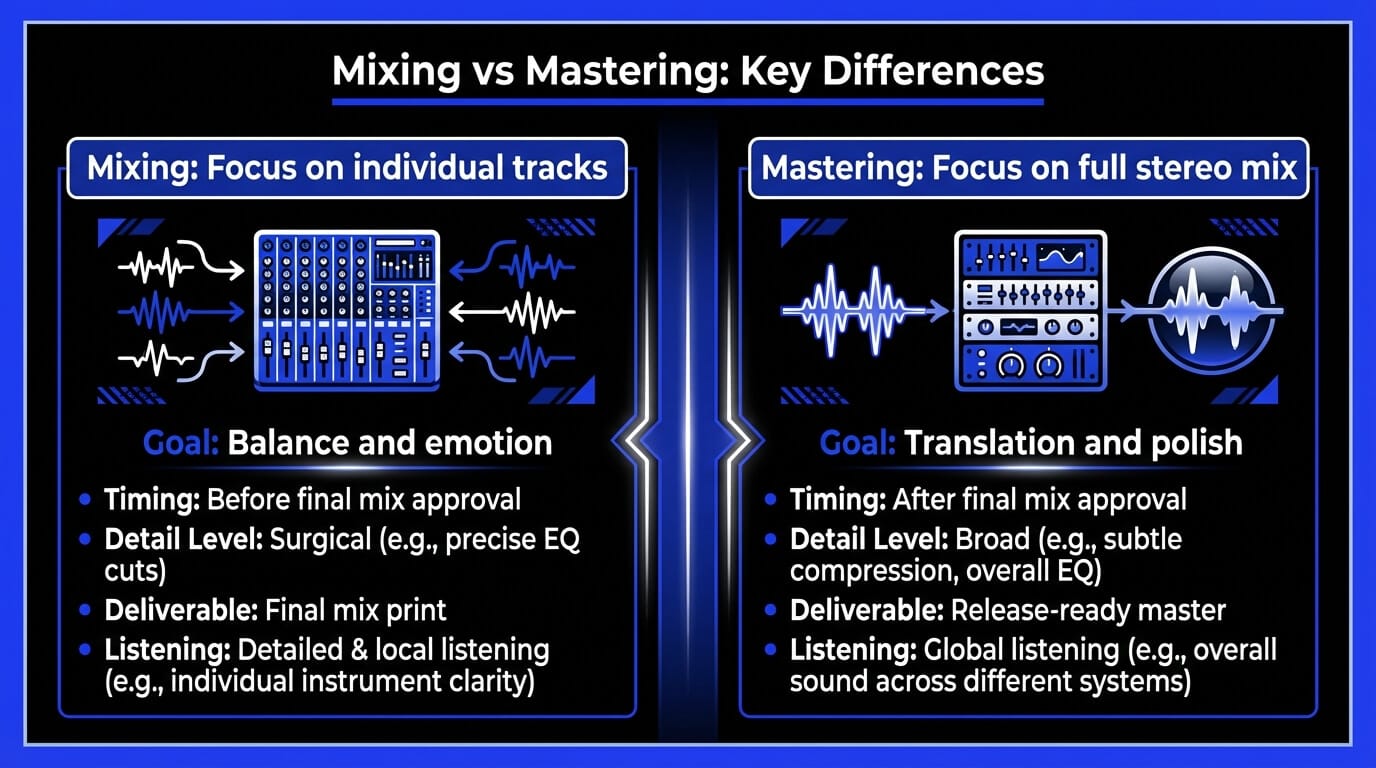
If you have ever finished a song and felt unsure whether it needs mixing, mastering, or both, you are not alone. These two stages often get grouped together, but they solve different problems. Mixing is where you shape the relationship between the individual parts of a track. Mastering is where you evaluate the finished stereo file and prepare it for release. One is about internal balance. The other is about final translation, polish, and delivery.
A simple way to think about mixing vs mastering is this: mixing happens inside the song, while mastering happens to the song as a whole. During mixing, you are adjusting vocal level, panning instruments, cleaning up low-end buildup, controlling dynamics, and creating space with EQ, compression, delay, and reverb. During mastering, you are listening to the full track as a single piece and making subtle moves so it feels cohesive, competitive, and reliable across speakers, headphones, phones, and streaming platforms.
This difference matters because mastering cannot rescue a weak mix. If the vocal is too loud, the kick masks the bass, or the chorus gets harsh when it opens up, those are mix problems. A mastering chain may soften the issue, but it will not truly solve it. The foundation has to be right first.
That is also where ACE Studio can fit naturally into the workflow. Before you even reach the mixing stage, a lot of production decisions are already shaping your outcome. In ACE Studio 2.0, you can build vocals from MIDI and lyrics, work with AI instruments rather than only vocal parts, sketch ideas with Generative Kits, convert audio with Vocal to MIDI, split stems, and arrange everything on the redesigned Canvas.
You can also balance tracks in the Mixer and use built-in effects such as EQ, vocal EQ, compression, de-essing, and reverb before sending your production onward through ACE Bridge into a DAW for final mix and master work.
What is mixing?
Mixing is the stage where a song stops being a collection of separate tracks and starts feeling like one performance. You are not writing the song anymore. You are shaping how the song speaks. That means balancing levels, panning elements across the stereo field, controlling dynamics, carving out frequency space, and deciding what should feel close, wide, dry, warm, tense, or open.
In practical terms, mixing is where you answer questions like these: Is the vocal sitting in front of the snare or getting buried by it? Does the bass support the groove or smear the low end? Does the reverb create depth or just blur the arrangement? Are the guitars and keys fighting for the same midrange? Good mixing is rarely about making everything louder or shinier. It is about making the emotional point of the song clear.
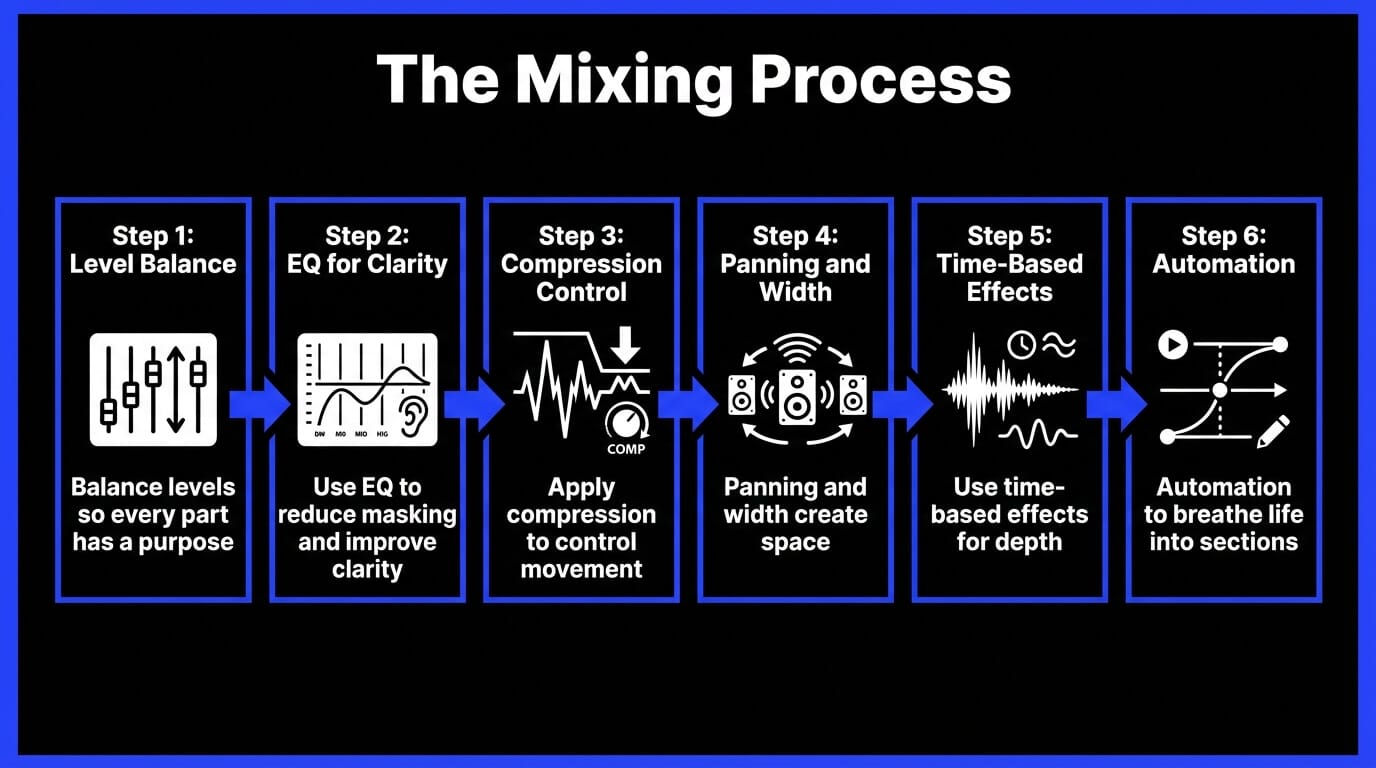
A strong mix usually includes a few core moves:
- Level balance so every part has a purpose
- EQ to reduce masking and improve clarity
- Compression to control movement and shape impact
- Panning and width to create space
- Time-based effects like delay and reverb for depth
- Automation so the arrangement breathes from section to section
This is also the point where arrangement quality matters. A mix gets easier when the source material already makes sense. That is one reason ACE Studio can help long before mastering enters the picture.
That matters because mixing is only as good as the decisions feeding it. If your vocal phrasing is stiff, your harmonies are cluttered, or your instrumental layering is muddy, the mix stage becomes repair work. If the arrangement is intentional and the performances are already shaped, mixing becomes what it should be: refinement.
What is mastering?
Mastering is the final stage of audio preparation before release. Instead of adjusting the individual parts inside the song, you are now listening to the finished mix as a single stereo file. The goal is not to reinvent it. The goal is to make sure it translates well, feels cohesive, and is technically ready for the platform or format where people will hear it.
A mastering engineer usually works with broad, subtle moves. That might include gentle EQ to smooth tonal imbalance, compression to tighten overall movement, limiting to control peak level, and careful loudness decisions so the track feels solid without collapsing its dynamics. Mastering is also where you think about consistency across an EP or album, spacing between songs, export format, and the listening experience outside your studio.
The key point in mixing vs mastering is that mastering works on the whole picture. If the hi-hat is too sharp only in the chorus, or the vocal rides too high in verse two, mastering is not the best place to solve that. Those are mix decisions. Mastering can polish the result, but it is not a substitute for a clear and balanced mix.
This distinction matters even more in modern home production. Many artists reach mastering too early because the track sounds exciting in headphones and they want that final loudness right away. But loudness can hide unresolved problems. Once a limiter is working hard, harshness, imbalance, and low-end clutter often become more obvious, not less.
What are the key differences between mixing and mastering?
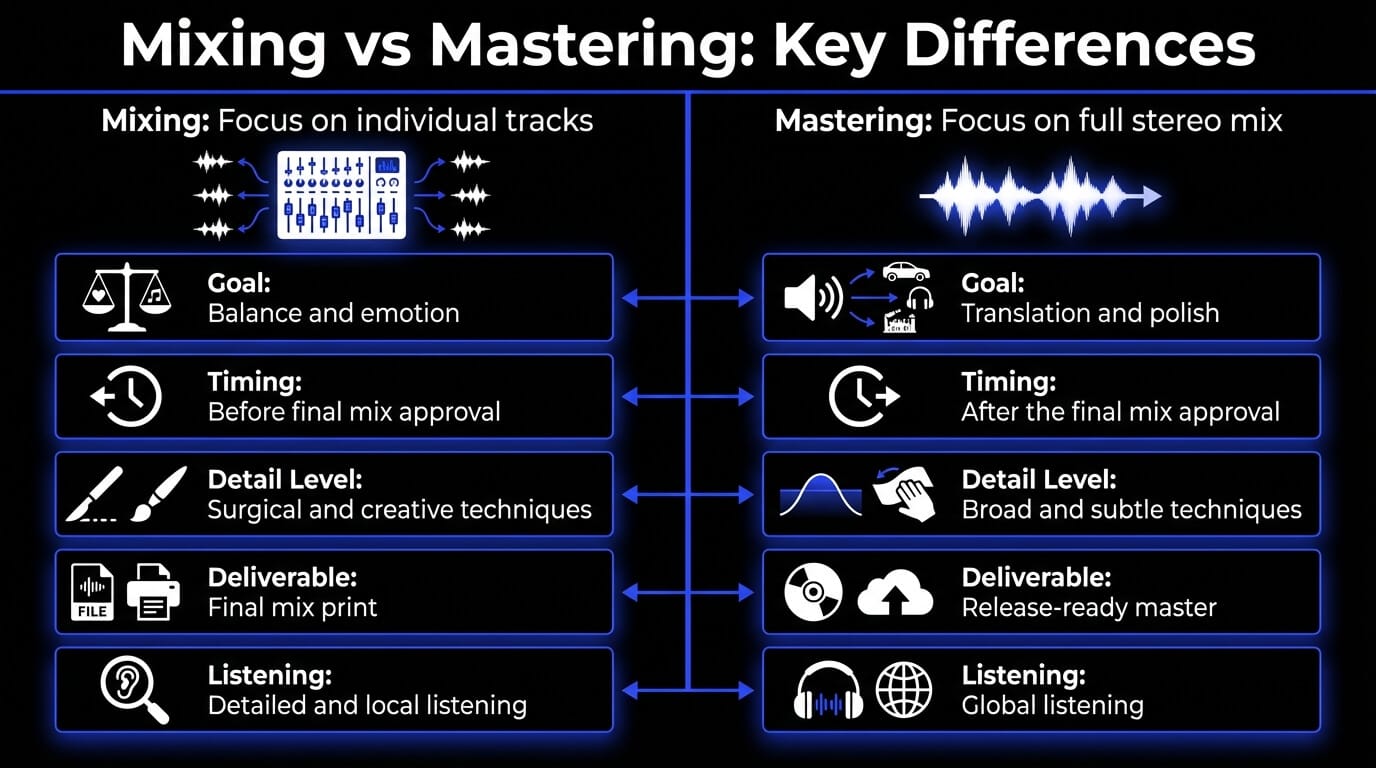
Scope of work
Mixing deals with the internal parts of a production. You are working on vocals, drums, bass, synths, guitars, strings, effects returns, buses, and automation.
Mastering deals with the finished stereo mix, or occasionally a set of approved stems. That alone changes the whole mindset. In mixing, you can solve problems at the source. In mastering, you are shaping the song from the outside.
Main goal
The main goal of mixing is clarity, balance, depth, and emotional focus. You want every important element to land the way the song needs it to.
The main goal of mastering is translation and final presentation. You want the finished song to hold together across earbuds, car speakers, club systems, laptops, and streaming platforms.
Stage in the production process
Mixing comes after songwriting, recording, production, editing, and arrangement. Mastering comes after the mix is approved. That sequence matters because each stage depends on the decisions made before it. If you skip ahead too early, you often end up mastering problems that should have been mixed.
Tools and techniques
Mix engineers use channel EQ, compression, transient shaping, reverb, delay, saturation, automation, panning, stereo imaging, bus processing, and editing tools.
Mastering engineers use broader tonal shaping, loudness control, subtle compression, limiting, sequencing tools, meters, and reference-based quality control. The overlap in plugins can be real, but the purpose behind them is different.
Listening approach
Mixing is detailed and local. You zoom in on a vocal consonant, a kick transient, a reverb tail, a bass note, or a stereo clash in the pre-chorus.
Mastering is global. You listen for overall tone, energy, consistency, headroom, and whether the song feels finished as a complete object.
Final deliverable
A mix usually ends as a final stereo print plus instrumental, TV, clean, or stem versions if needed.
A master is the approved release file prepared for distribution. It is the version that should feel complete, consistent, and dependable outside your studio.
|
Aspect |
Mixing |
Mastering |
|
Focus |
Individual tracks |
Full stereo mix |
|
Goal |
Balance and emotion |
Translation and polish |
|
Timing |
Before final approval |
After final mix approval |
|
Detail Level |
Surgical and creative |
Broad and subtle |
|
Deliverable |
Final mix print |
Release-ready master |
What does a mixed song vs a mastered song sound like?
A well-mixed song usually sounds balanced, intentional, and emotionally readable. You can hear what matters. The lead vocal feels placed, not floating. The kick and bass work together instead of wrestling for the same space. The chorus opens up because arrangement, automation, and width are doing their job. Even before mastering, a good mix should already feel like a song you want to keep listening to.
A mastered song sounds more settled. The tonal balance feels a little more unified. The track may feel denser, more stable, and more confident across playback systems. Quiet details can come forward in a more controlled way, and the overall presentation often feels closer to commercial release standards. Not dramatically different, just more finished.
That subtlety is important. Many beginners expect mastering to create a shocking before-and-after moment. Sometimes it can, especially if the mix was close but not quite there. More often, the difference is about reliability. The mastered version holds together better in different listening environments. It feels less fragile. Less dependent on your own speakers.
One useful test is this: if a song only feels impressive after a heavy limiter, the mix probably is not ready. A strong mix should already communicate groove, clarity, tension, warmth, and energy. Mastering should reinforce that feeling, not invent it.
When do you need mixing vs mastering?
You need mixing whenever you are working with multiple elements that must coexist inside one song. That includes almost every modern production, whether it is a dense pop arrangement, a stripped indie track, a cinematic cue, or a choir-based composition. If there are individual tracks competing for attention, you need mixing.
You need mastering when the mix is finished and you want the track prepared for release, pitching, syncing, client delivery, or consistent playback across systems. Even a simple acoustic song can benefit from mastering if it is going out into the world. The simpler the arrangement, the more exposed the final presentation often is.
A practical way to think about it:
- If you are still adjusting the relationship between parts, you are mixing.
- If you are happy with the mix and want to improve final translation and delivery, you are mastering.
There are also real-world situations where one stage matters more urgently than the other. If your track sounds muddy, cluttered, or unbalanced, spend time on mixing first. If your mix already feels strong but a little uneven from system to system, mastering is the next step. If you are sending music to a label, sync library, or distribution platform, mastering usually becomes more important because consistency and readiness matter.
Can you master a song without mixing it first?
Technically, yes. Practically, only in limited cases. If you have a very simple production, such as a stereo live recording, a finished instrumental bounce, or a two-track demo that already sounds balanced, you can apply light mastering moves without going through a formal multitrack mix stage. In that case, the “mix” decisions were either made during recording or baked into the stereo file already.
But for most songs, mastering without mixing first is a shortcut that causes more trouble than it saves. Once everything is printed into one stereo file, your options become far narrower. You cannot easily lower just the hi-hat, widen only the backing vocals, clean mud from a specific synth layer, or automate one line of the lead vocal. You are working around the issue rather than solving it.
This is why people often confuse loudness with completion. A limiter can make a song feel more finished for a moment, but if the internal balance is weak, that feeling does not last. The problems usually get louder too.
So the honest answer is this: you can master without mixing first, but you should not expect mastering to do the job of mixing. Those are different stages for a reason.
Common mixing and mastering mistakes
Common mixing mistakes
A lot of mixing mistakes come from chasing excitement too early. Producers reach for loudness, width, or brightness before the balance is right. The result can feel impressive for thirty seconds, then tiring, messy, or strangely flat.
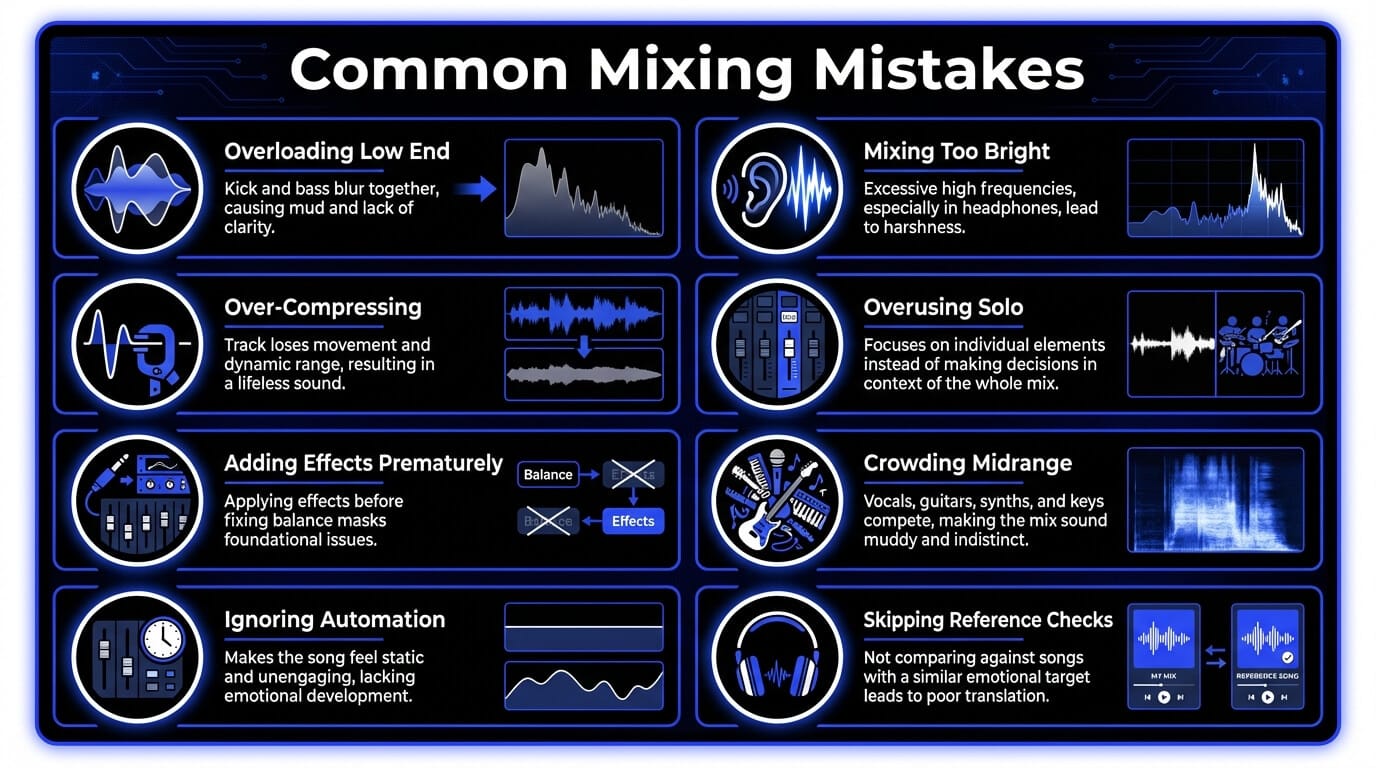
Some of the most common mixing mistakes include:
- Overloading the low end so kick and bass blur together
- Over-compressing until the track loses movement
- Adding effects before fixing balance
- Ignoring automation, which makes the song feel static
- Mixing too bright, especially in headphones
- Using solo too much instead of making decisions in context
- Crowding the midrange with vocals, guitars, synths, and keys fighting each other
- Not checking references against songs with a similar emotional target
Another common issue is trying to mix weak source material into greatness. That rarely works. If the vocal timing is awkward or the supporting parts are fighting the lead, the best move is often to go back and edit the source.
Common Mastering Mistakes
The biggest mastering mistake is trying to fix the mix from the mastering chain. If the vocal is wrong, the snare is harsh, or the chorus collapses under its own density, broad stereo processing is the wrong tool. Another common mistake is pushing loudness too hard. A song that is technically louder but emotionally smaller is not a better master.
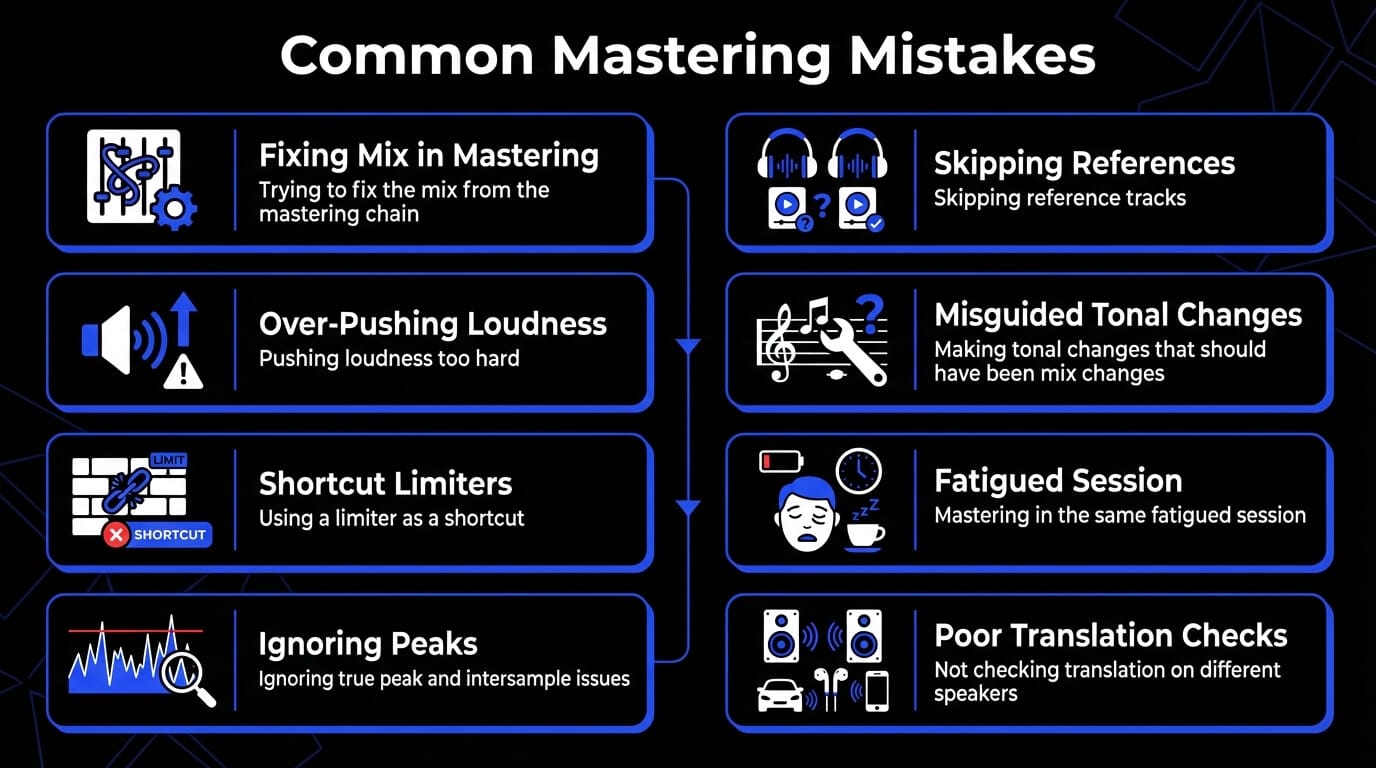
Other common mastering mistakes include:
- Using a limiter as a shortcut
- Ignoring true peak and intersample issues
- Skipping reference tracks
- Making tonal changes that should have been mix changes
- Mastering in the same fatigued session where you produced the song
- Not checking translation on different speakers
- Judging the master only by volume
The best mastering decisions are restrained. They support the mix instead of stepping on it. If you feel tempted to do major surgery in mastering, that usually means the mix needs one more pass.
Mixing vs mastering tools and software
Mixing and mastering often use some of the same plugin categories, but the workflow behind them is different.
For mixing, the most useful tools usually include channel EQ, compressors, de-essers, saturators, delays, reverbs, transient shapers, automation, routing, stereo placement tools, and metering. These are tools for shaping relationships inside the track. You are deciding how parts interact.
For mastering, the core set is usually narrower: broad EQ, gentle compression, limiting, stereo evaluation, loudness metering, true peak monitoring, reference matching, and sometimes subtle saturation. These are tools for shaping the final presentation without damaging the mix.
A lot of producers work across both stages in one DAW, and that can be fine if you are disciplined about perspective. What matters is not whether the plugin appears in both chains. What matters is why you are using it.
Where ACE Studio fits in the workflow
ACE Studio is best understood as part of the production, arrangement, editing, and pre-mix workflow rather than a dedicated mastering platform. That is a strength, not a limitation.
ACE Studio 2.0 combines AI vocals, AI instruments, voice cloning, choir building, voice blending, generative tools, stem splitting, Vocal to MIDI, a redesigned Canvas, and DAW connectivity through ACE Bridge. It also includes a Mixer and an effects panel with EQ3, EQV, Compressor, De-esser, Reverb, and room effects.
That means ACE Studio can help you:
- create stronger source performances before mixing
- organize harmonies and layered arrangements more clearly
- clean or rebuild material from stems and vocal conversions
- shape vocal tone and articulation before export
- move parts into your DAW with ACE Bridge and ARA tempo sync
- reduce friction between idea, arrangement, and final mix prep
For many musicians, that is exactly where the biggest improvement happens. A better master starts with a better mix, and a better mix starts with better decisions upstream.
Should you mix and master your own music?
Sometimes yes. Sometimes no. The better question is whether you can stay objective enough to do both well.
Mixing your own music makes sense when you know the arrangement deeply, understand the emotional target, and have enough technical control to shape the track without second-guessing every move. Many artists mix their own work because they want that level of authorship. There is nothing wrong with that. In fact, it can be the most honest route if you are careful and experienced.
Mastering your own music is harder. Not because the tools are more mysterious, but because perspective is more fragile. By the time you finish producing and mixing a track, you are usually too close to it. Your ears adapt. Your biases settle in. You stop hearing certain problems and start overvaluing details that do not matter to the listener.
That does not mean you must outsource everything. A realistic middle path works well for many musicians:
- Produce and arrange the song yourself.
- Mix it yourself or with a collaborator.
- Take a break.
- Try a conservative self-master.
- Compare it against references and other playback systems.
- Decide whether it is ready or whether fresh ears are worth paying for.
ACE Studio supports that kind of musician-led workflow well. It gives you detailed control over vocal shaping, editable AI instruments, built-in mixing tools, DAW integration, and generative support without reducing the process to one-click output. Its design philosophy is clearly centered on expressive control, real performers, licensed data, royalty-sharing with artists, and human decision-making throughout the process. That makes it a practical tool for creators who want help with execution while still owning the musical judgment.
FAQ
Which comes first, mixing or mastering?
Mixing comes first. Mastering happens after the mix is finished and approved. If you are still changing vocal levels, fixing EQ conflicts, or adjusting arrangement space, you are still in the mixing stage.
Is mastering necessary for every song?
Not every song needs formal commercial mastering, but almost every song benefits from some kind of final listening and preparation stage. Even a simple release deserves checks for translation, loudness balance, and overall cohesion.
How long does mixing and mastering take?
That depends on arrangement density, revision rounds, and how finished the production already is. A simple track might take a few hours to mix and a short session to master. A dense arrangement with layered vocals, automation, and revisions can take much longer. Better source preparation usually shortens both stages.
How much does mixing vs mastering cost?
Costs vary widely by experience level, genre, scope, and deliverables. Mixing is usually more expensive because it is more labor-intensive and track-specific. Mastering is generally more focused and shorter, though high-level mastering still carries real value because of perspective and consistency.
Can one engineer handle both mixing and mastering?
Yes, one engineer can handle both, especially on smaller independent projects. But many professionals still prefer separate mastering because fresh ears catch things the mix engineer may miss. If the same person does both, it helps to leave time between stages.
How do you know when a mix is ready for mastering?
A mix is ready for mastering when the internal balance feels solved. The vocal sits right. The low end behaves. Section energy works. Nothing is relying on a mastering limiter to feel exciting. The song already communicates clearly on several playback systems, and any remaining changes are broad, final, and subtle.