


We value your privacy

By clicking "Allow", you agree to the storing of cookies on your device to enhance site navigation, analyze site usage, and assist in our marketing efforts.

Consent Selection
Details
  • Necessary cookies help make a website usable by enabling basic functions like page navigation and access to secure areas of the website. The website cannot function properly without these cookies.
    • Learn more about this provideropens in a new window

      Some of the data collected by this provider is for the purposes of personalization and measuring advertising effectiveness. The provider may use the IP Addresses for ads measurement and ads personalization.

      test_cookieUsed to check if the user's browser supports cookies.
      Maximum Storage Duration: 1 dayType: HTTP Cookie
    • Learn more about this provideropens in a new window
      bcookieUsed in order to detect spam and improve the website's security.
      Maximum Storage Duration: 1 yearType: HTTP Cookie
      li_gcStores the user's cookie consent state for the current domain
      Maximum Storage Duration: 180 daysType: HTTP Cookie
    • Learn more about this provideropens in a new window
      datadomeUsed in context with the website's BotManager. The BotManager detects, categorizes and compiles reports on potential bots trying to access the website.
      Maximum Storage Duration: SessionType: HTTP Cookie
    • studio-web-language-keyPending
      Maximum Storage Duration: SessionType: HTML Local Storage
    • _cfuvid [x2]This cookie is a part of the services provided by Cloudflare - Including load-balancing, deliverance of website content and serving DNS connection for website operators.
      Maximum Storage Duration: SessionType: HTTP Cookie
    • __cf_bm [x5]This cookie is used to distinguish between humans and bots. This is beneficial for the website, in order to make valid reports on the use of their website.
      Maximum Storage Duration: 1 dayType: HTTP Cookie
    • CookieConsent [x2]Stores the user's cookie consent state for the current domain
      Maximum Storage Duration: 1 yearType: HTTP Cookie
    • guidPreserves users states across page requests.
      Maximum Storage Duration: 1 yearType: HTTP Cookie
    • ttRegisters the website's speed and performance. This function can be used in context with statistics and load-balancing.
      Maximum Storage Duration: 1 yearType: HTTP Cookie
    • sc_anonymous_idUsed in context with the 3D-view-function on the website.
      Maximum Storage Duration: 10 yearsType: HTTP Cookie
  • Preference cookies enable a website to remember information that changes the way the website behaves or looks, like your preferred language or the region that you are in.
    • Learn more about this provideropens in a new window
      lidcRegisters which server-cluster is serving the visitor. This is used in context with load balancing, in order to optimize user experience.
      Maximum Storage Duration: 1 dayType: HTTP Cookie
  • Statistic cookies help website owners to understand how visitors interact with websites by collecting and reporting information anonymously.
    • Learn more about this provideropens in a new window
      geoSaves the user's current geographical location based on the user's IP address.
      Maximum Storage Duration: SessionType: HTTP Cookie
    • Learn more about this provideropens in a new window
      ajs_anonymous_idThis cookie is used to identify a specific visitor - this information is used to identify the number of specific visitors on a website.
      Maximum Storage Duration: 1 yearType: HTTP Cookie
      ajs_anonymous_idThis cookie is used to count how many times a website has been visited by different visitors - this is done by assigning the visitor an ID, so the visitor does not get registered twice.
      Maximum Storage Duration: PersistentType: HTML Local Storage
    • Learn more about this provideropens in a new window
      _tt_enable_cookieUsed by the social networking service, TikTok, for tracking the use of embedded services.
      Maximum Storage Duration: 1 yearType: HTTP Cookie
    • Learn more about this provideropens in a new window
      personalization_idThis cookie is set by Twitter - The cookie allows the visitor to share content from the website onto their Twitter profile.
      Maximum Storage Duration: 400 daysType: HTTP Cookie
    • FPGSIDRegisters statistical data on users' behaviour on the website. Used for internal analytics by the website operator.
      Maximum Storage Duration: 1 dayType: HTTP Cookie
      FPIDRegisters statistical data on users' behaviour on the website. Used for internal analytics by the website operator.
      Maximum Storage Duration: 400 daysType: HTTP Cookie
      FPLCRegisters a unique ID that is used to generate statistical data on how the visitor uses the website.
      Maximum Storage Duration: 1 dayType: HTTP Cookie
      sajssdk_2015_cookie_access_testPending
      Maximum Storage Duration: 73000 daysType: HTTP Cookie
      sajssdk_2015_cross_new_userCollects statistics on the user's visits to the website, such as the number of visits, average time spent on the website and what pages have been read.
      Maximum Storage Duration: 1 dayType: HTTP Cookie
      sensorsdata_domain_testPending
      Maximum Storage Duration: SessionType: HTTP Cookie
      sensorsdata2015jssdkcrossCollects statistics on the user's visits to the website, such as the number of visits, average time spent on the website and what pages have been read.
      Maximum Storage Duration: 2 yearsType: HTTP Cookie
    • sentryReplaySessionRegisters data on visitors' website-behaviour. This is used for internal analysis and website optimization.
      Maximum Storage Duration: SessionType: HTML Local Storage
    • u_scsidRegisters data on visitors' website-behaviour. This is used for internal analysis and website optimization.
      Maximum Storage Duration: SessionType: HTML Local Storage
      X-ABThis cookie is used by the website’s operator in context with multi-variate testing. This is a tool used to combine or change content on the website. This allows the website to find the best variation/edition of the site.
      Maximum Storage Duration: 1 dayType: HTTP Cookie
    • SERVERCORSIDPending
      Maximum Storage Duration: SessionType: HTTP Cookie
      SERVERIDThis cookie is used to assign the visitor to a specific server - this function is necessary for the functionality of the website.
      Maximum Storage Duration: SessionType: HTTP Cookie
    • number(#)Used to track user’s interaction with embedded content.
      Maximum Storage Duration: SessionType: HTML Local Storage
  • Marketing cookies are used to track visitors across websites. The intention is to display ads that are relevant and engaging for the individual user and thereby more valuable for publishers and third party advertisers.
    • Learn more about this provideropens in a new window
      _fbpUsed by Facebook to deliver a series of advertisement products such as real time bidding from third party advertisers.
      Maximum Storage Duration: 3 monthsType: HTTP Cookie
      lastExternalReferrerDetects how the user reached the website by registering their last URL-address.
      Maximum Storage Duration: PersistentType: HTML Local Storage
      lastExternalReferrerTimeDetects how the user reached the website by registering their last URL-address.
      Maximum Storage Duration: PersistentType: HTML Local Storage
    • Learn more about this provideropens in a new window
      mtClientConfig_cachedSource_xp_amp_music_webplayerUsed to implement iTunes content and presentation of covers.
      Maximum Storage Duration: PersistentType: HTML Local Storage
    • Learn more about this provideropens in a new window
      __tld__Used to track visitors on multiple websites, in order to present relevant advertisement based on the visitor's preferences.
      Maximum Storage Duration: SessionType: HTTP Cookie
      ajs_user_idThis cookie is used to collect data on the visitor's behavior on the website - this information can be used to assign the visitor to a visitor segment, based on common preferences.
      Maximum Storage Duration: SessionType: HTTP Cookie
      ajs_user_idCollects data on visitors' preferences and behaviour on the website - This information is used make content and advertisement more relevant to the specific visitor.
      Maximum Storage Duration: PersistentType: HTML Local Storage
    • Learn more about this provideropens in a new window

      Some of the data collected by this provider is for the purposes of personalization and measuring advertising effectiveness. The provider may use the IP Addresses for ads measurement and ads personalization.

      IDEUsed by Google DoubleClick to register and report the website user's actions after viewing or clicking one of the advertiser's ads with the purpose of measuring the efficacy of an ad and to present targeted ads to the user.
      Maximum Storage Duration: 400 daysType: HTTP Cookie
      ads/ga-audiencesUsed by Google AdWords to re-engage visitors that are likely to convert to customers based on the visitor's online behaviour across websites.
      Maximum Storage Duration: SessionType: Pixel Tracker
      pagead/1p-user-list/#Tracks if the user has shown interest in specific products or events across multiple websites and detects how the user navigates between sites. This is used for measurement of advertisement efforts and facilitates payment of referral-fees between websites.
      Maximum Storage Duration: SessionType: Pixel Tracker
    • Learn more about this provideropens in a new window
      _uetsidCollects data on visitor behaviour from multiple websites, in order to present more relevant advertisement - This also allows the website to limit the number of times that they are shown the same advertisement.
      Maximum Storage Duration: 1 dayType: HTTP Cookie
      _uetvidUsed to track visitors on multiple websites, in order to present relevant advertisement based on the visitor's preferences.
      Maximum Storage Duration: 1 yearType: HTTP Cookie
      _uetsidUsed to track visitors on multiple websites, in order to present relevant advertisement based on the visitor's preferences.
      Maximum Storage Duration: PersistentType: HTML Local Storage
      _uetsid_expContains the expiry-date for the cookie with corresponding name.
      Maximum Storage Duration: PersistentType: HTML Local Storage
      _uetvidUsed to track visitors on multiple websites, in order to present relevant advertisement based on the visitor's preferences.
      Maximum Storage Duration: PersistentType: HTML Local Storage
      _uetvid_expContains the expiry-date for the cookie with corresponding name.
      Maximum Storage Duration: PersistentType: HTML Local Storage
      MUIDUsed widely by Microsoft as a unique user ID. The cookie enables user tracking by synchronising the ID across many Microsoft domains.
      Maximum Storage Duration: 1 yearType: HTTP Cookie
    • Learn more about this provideropens in a new window
      _rdt_uuidUsed to track visitors on multiple websites, in order to present relevant advertisement based on the visitor's preferences.
      Maximum Storage Duration: 3 monthsType: HTTP Cookie
      rp.gifNecessary for the implementation of the Reddit.com's share-button function.
      Maximum Storage Duration: SessionType: Pixel Tracker
    • Learn more about this provideropens in a new window
      sc_atUsed by Snapchat to implement advertisement content on the website - The cookie detects the efficiency of the ads and collects visitor data for further visitor segmentation.
      Maximum Storage Duration: 1 yearType: HTTP Cookie
      pUsed to track visitors on multiple websites, in order to present relevant advertisement based on the visitor's preferences.
      Maximum Storage Duration: SessionType: Pixel Tracker
    • Learn more about this provideropens in a new window
      dd_testcookiePending
      Maximum Storage Duration: SessionType: HTTP Cookie
      ddSession_datadomePending
      Maximum Storage Duration: PersistentType: HTML Local Storage
    • Learn more about this provideropens in a new window
      sp_landingUsed to implement audio-content from Spotify on the website. Can also be used to register user interaction and preferences in context with audio-content - This can serve statistics and marketing purposes.
      Maximum Storage Duration: 1 dayType: HTTP Cookie
      sp_tUsed to implement audio-content from Spotify on the website. Can also be used to register user interaction and preferences in context with audio-content - This can serve statistics and marketing purposes.
      Maximum Storage Duration: 1 yearType: HTTP Cookie
    • Learn more about this provideropens in a new window
      _ttp [x2]Used by the social networking service, TikTok, for tracking the use of embedded services.
      Maximum Storage Duration: 1 yearType: HTTP Cookie
      ttcsidUsed to track visitors on multiple websites, in order to present relevant advertisement based on the visitor's preferences.
      Maximum Storage Duration: 1 yearType: HTTP Cookie
      ttcsid_#Tracks the conversion rate between the user and the advertisement banners on the website - This serves to optimise the relevance of the advertisements on the website.
      Maximum Storage Duration: 1 yearType: HTTP Cookie
      tt_appInfoUsed by the social networking service, TikTok, for tracking the use of embedded services.
      Maximum Storage Duration: SessionType: HTML Local Storage
      tt_pixel_session_indexUsed by the social networking service, TikTok, for tracking the use of embedded services.
      Maximum Storage Duration: SessionType: HTML Local Storage
      tt_sessionIdUsed by the social networking service, TikTok, for tracking the use of embedded services.
      Maximum Storage Duration: SessionType: HTML Local Storage
    • Learn more about this provideropens in a new window
      1/i/adsct [x2]Collects data on user behaviour and interaction in order to optimize the website and make advertisement on the website more relevant.
      Maximum Storage Duration: SessionType: Pixel Tracker
      muc_adsCollects data on user behaviour and interaction in order to optimize the website and make advertisement on the website more relevant.
      Maximum Storage Duration: 400 daysType: HTTP Cookie
      guest_idCollects data related to the user's visits to the website, such as the number of visits, average time spent on the website and which pages have been loaded, with the purpose of personalising and improving the Twitter service.
      Maximum Storage Duration: 400 daysType: HTTP Cookie
      guest_id_adsCollects information on user behaviour on multiple websites. This information is used in order to optimize the relevance of advertisement on the website.
      Maximum Storage Duration: 400 daysType: HTTP Cookie
      guest_id_marketingCollects information on user behaviour on multiple websites. This information is used in order to optimize the relevance of advertisement on the website.
      Maximum Storage Duration: 400 daysType: HTTP Cookie
    • Learn more about this provideropens in a new window
      __Secure-ROLLOUT_TOKENUsed to track user’s interaction with embedded content.
      Maximum Storage Duration: 180 daysType: HTTP Cookie
      __Secure-YECStores the user's video player preferences using embedded YouTube video
      Maximum Storage Duration: SessionType: HTTP Cookie
      __Secure-YNIDUsed to track user’s interaction with embedded content.
      Maximum Storage Duration: 180 daysType: HTTP Cookie
      LAST_RESULT_ENTRY_KEYUsed to track user’s interaction with embedded content.
      Maximum Storage Duration: SessionType: HTTP Cookie
      LogsDatabaseV2:V#||LogsRequestsStoreUsed to track user’s interaction with embedded content.
      Maximum Storage Duration: PersistentType: IndexedDB
      ServiceWorkerLogsDatabase#SWHealthLogNecessary for the implementation and functionality of YouTube video-content on the website.
      Maximum Storage Duration: PersistentType: IndexedDB
      TESTCOOKIESENABLEDUsed to track user’s interaction with embedded content.
      Maximum Storage Duration: 1 dayType: HTTP Cookie
      VISITOR_INFO1_LIVETries to estimate the users' bandwidth on pages with integrated YouTube videos.
      Maximum Storage Duration: 180 daysType: HTTP Cookie
      YSCRegisters a unique ID to keep statistics of what videos from YouTube the user has seen.
      Maximum Storage Duration: SessionType: HTTP Cookie
      yt-icons-last-purgedNecessary for the implementation and functionality of YouTube video-content on the website.
      Maximum Storage Duration: PersistentType: HTML Local Storage
      ytidb::LAST_RESULT_ENTRY_KEYUsed to track user’s interaction with embedded content.
      Maximum Storage Duration: PersistentType: HTML Local Storage
      YtIdbMeta#databasesUsed to track user’s interaction with embedded content.
      Maximum Storage Duration: PersistentType: IndexedDB
    • _gaUsed to send data to Google Analytics about the visitor's device and behavior. Tracks the visitor across devices and marketing channels.
      Maximum Storage Duration: 2 yearsType: HTTP Cookie
      _ga_#Used to send data to Google Analytics about the visitor's device and behavior. Tracks the visitor across devices and marketing channels.
      Maximum Storage Duration: 2 yearsType: HTTP Cookie
      _gcl_auUsed by Google AdSense for experimenting with advertisement efficiency across websites using their services.
      Maximum Storage Duration: 3 monthsType: HTTP Cookie
      _/set_cookieUsed by server-side Google Tag Manager to set or update cookies required for analytics or marketing tags.
      Maximum Storage Duration: SessionType: Pixel Tracker
      _gcl_lsTracks the conversion rate between the user and the advertisement banners on the website - This serves to optimise the relevance of the advertisements on the website.
      Maximum Storage Duration: PersistentType: HTML Local Storage
    • _schn1Sets a unique ID for the visitor, that allows third party advertisers to target the visitor with relevant advertisement. This pairing service is provided by third party advertisement hubs, which facilitates real-time bidding for advertisers.
      Maximum Storage Duration: 1 dayType: HTTP Cookie
      _scidSets a unique ID for the visitor, that allows third party advertisers to target the visitor with relevant advertisement. This pairing service is provided by third party advertisement hubs, which facilitates real-time bidding for advertisers.
      Maximum Storage Duration: 13 monthsType: HTTP Cookie
      _scid_rSets a unique ID for the visitor, that allows third party advertisers to target the visitor with relevant advertisement. This pairing service is provided by third party advertisement hubs, which facilitates real-time bidding for advertisers.
      Maximum Storage Duration: 13 monthsType: HTTP Cookie
      _screloadUsed by Snapchat to implement advertisement content on the website - The cookie detects the efficiency of the ads and collects visitor data for further visitor segmentation.
      Maximum Storage Duration: SessionType: HTTP Cookie
      u_sclidSets a unique ID for the visitor, that allows third party advertisers to target the visitor with relevant advertisement. This pairing service is provided by third party advertisement hubs, which facilitates real-time bidding for advertisers.
      Maximum Storage Duration: PersistentType: HTML Local Storage
      u_sclid_rSets a unique ID for the visitor, that allows third party advertisers to target the visitor with relevant advertisement. This pairing service is provided by third party advertisement hubs, which facilitates real-time bidding for advertisers.
      Maximum Storage Duration: PersistentType: HTML Local Storage
      u_scsid_rSets a unique ID for the visitor, that allows third party advertisers to target the visitor with relevant advertisement. This pairing service is provided by third party advertisement hubs, which facilitates real-time bidding for advertisers.
      Maximum Storage Duration: SessionType: HTML Local Storage
  • Unclassified cookies are cookies that we are in the process of classifying, together with the providers of individual cookies.
    • Learn more about this provideropens in a new window
      _rdt_pnPending
      Maximum Storage Duration: 3 monthsType: HTTP Cookie
    • Learn more about this provideropens in a new window
      tt_pixel_is_enrich_ipv6_triggered_by_enrich_amPending
      Maximum Storage Duration: SessionType: HTML Local Storage
    • adjust-sdk#asPending
      Maximum Storage Duration: PersistentType: IndexedDB
      adjust-sdk#edPending
      Maximum Storage Duration: PersistentType: IndexedDB
      adjust-sdk#gpPending
      Maximum Storage Duration: PersistentType: IndexedDB
      adjust-sdk#qPending
      Maximum Storage Duration: PersistentType: IndexedDB
      adjust-sdk.pPending
      Maximum Storage Duration: PersistentType: HTML Local Storage
      redirectPathPending
      Maximum Storage Duration: SessionType: HTML Local Storage
      studio-web-web-uuidPending
      Maximum Storage Duration: PersistentType: HTML Local Storage
    • __oaiq_domain_probePending
      Maximum Storage Duration: SessionType: HTTP Cookie
      __obrefPending
      Maximum Storage Duration: SessionType: HTTP Cookie
      oaiq_cs:TMBW9u3qWVchcyxjFU4gVQPending
      Maximum Storage Duration: SessionType: HTML Local Storage
    • _vbPending
      Maximum Storage Duration: SessionType: HTTP Cookie
    • _twpidPending
      Maximum Storage Duration: SessionType: HTTP Cookie
    • pixel/sPending
      Maximum Storage Duration: SessionType: Pixel Tracker
Cookie declaration last updated on 8/17/26 by Cookiebot
[#IABV2_TITLE#]
[#IABV2_BODY_INTRO#]
[#IABV2_BODY_LEGITIMATE_INTEREST_INTRO#]
[#IABV2_BODY_PREFERENCE_INTRO#]
[#IABV2_BODY_PURPOSES_INTRO#]
[#IABV2_BODY_PURPOSES#]
[#IABV2_BODY_FEATURES_INTRO#]
[#IABV2_BODY_FEATURES#]
[#IABV2_BODY_PARTNERS_INTRO#]
[#IABV2_BODY_PARTNERS#]
About
Cookies are small text files that can be used by websites to make a user's experience more efficient.

The law states that we can store cookies on your device if they are strictly necessary for the operation of this site. For all other types of cookies we need your permission.

This site uses different types of cookies. Some cookies are placed by third party services that appear on our pages.

You can at any time change or withdraw your consent from the Cookie Declaration on our website.

Learn more about who we are, how you can contact us and how we process personal data in our Privacy Policy.

Please state your consent ID and date when you contact us regarding your consent.
Get Started

What is a Synthesizer? Definition, types, and how it works

A synthesizer turns control into sound: an oscillator makes tone, filters shape it, envelopes define motion, and LFOs add life. Learn the flow, then build your first patch with confidence.

What is a Synthesizer? Definition, types, and how it works

Key takeaways

  • A synthesizer is an instrument that creates sound and lets you shape it through tools like filters, envelopes, and modulation, which makes it far more flexible than fixed-character acoustic instruments.
  • The easiest way to understand how a synth works is through signal flow: oscillator creates the raw tone, filter shapes brightness, amp controls loudness, and envelopes and LFOs add timing and movement.
  • There is no single “best” type of synth. Analog, digital, hardware, software, monophonic, polyphonic, modular, and non-modular options all serve different sounds, workflows, and skill levels.
  • For beginners, subtractive synthesis is the best place to start because it teaches the core building blocks quickly and helps you make usable basses, pads, and leads without getting lost.
  • Modern synthesis now includes performance-based tools like ACE Studio, where MIDI can drive editable vocals, choir, and instrument parts, expanding the synth concept beyond classic oscillator-based sound design.

Understanding synthesizers without the technical overload

If you’ve ever wondered what a synthesizer really is, you’re usually looking for one thing: a clear, musical explanation – not a physics lecture, not a gear flex. A music synthesizer is simply an instrument (hardware or software) that creates sound by generating and shaping electrical or digital signals. The important part is this: you decide what the sound does. You shape pitch, tone, movement, and expression, often in ways acoustic instruments can’t.

That’s why synthesizers show up everywhere – from basslines and pads to cinematic textures, leads, and even modern “instrument-like” vocal timbres. And in 2026 workflows, the idea of synthesis has also expanded: tools like performance synthesis can turn MIDI into expressive vocals and instruments, while still keeping you in control of phrasing and emotion.

Let’s break down synthesizer meaning, how synths work, the main types, and how to start using one without getting lost in knobs.

What is a synthesizer?

Synthesizer definition

A synthesizer is an instrument that generates sound and then lets you shape that sound using controls like filters, envelopes, and modulation. Unlike a piano (which has a fixed acoustic character), a synth starts with a basic sound source and gives you tools to sculpt it into something personal.

You can think of a synthesizer as a “sound engine + control panel.” The engine creates a raw tone (often a waveform), and the panel lets you carve it into a bass, a pad, a pluck, a string-like swell, or something totally new.

What a synthesizer does in music

In real production terms, a synthesizer can act like:

  • A bass player (tight low-end, controlled attack)
  • A chord instrument (pads, keys, organs, evolving textures)
  • A lead voice (melodies that cut through a mix)
  • A rhythmic element (plucks, arps, gated patterns)
  • A sound design tool (risers, impacts, movement, atmosphere)

It also teaches you “mix thinking.” When you change a filter cutoff, you’re not just changing tone – you’re deciding where the sound sits against vocals, drums, and guitars.
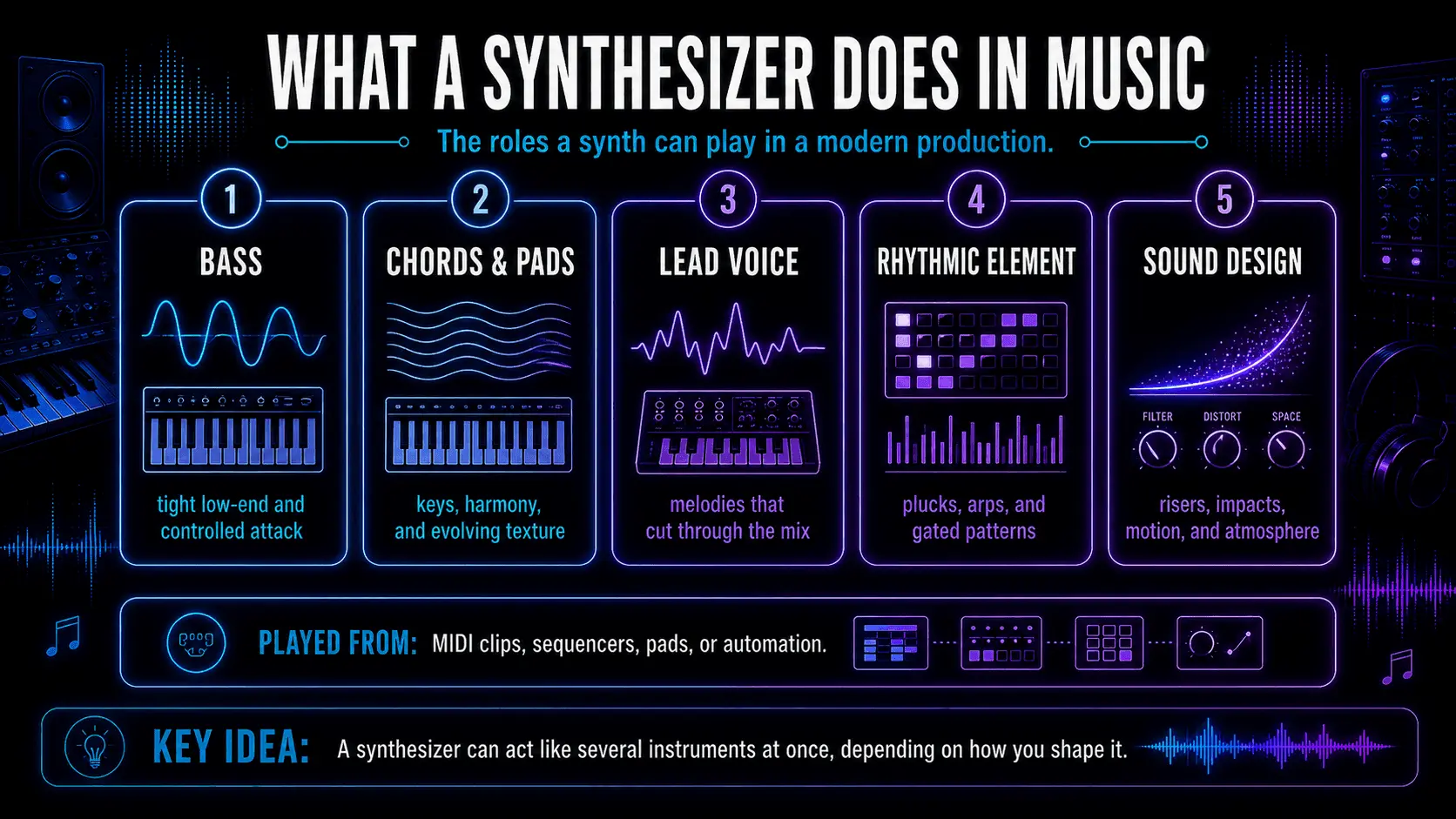
Infographic showing a synthesizer used for bass, chords and pads, lead melodies, rhythmic patterns, and sound design.
Five essential roles a synthesizer can play in modern music production.

One more important idea: a synthesizer doesn’t need a piano-style keyboard. Many synths are played via MIDI clips, sequencers, pads, MPE controllers, or even automation lanes. What matters is the relationship between control data (notes, velocity, modulation) and sound output.

How do synthesizers work?

If you’ve been asking how a synthesizer works, the clean answer is: signal flow. A sound starts as a raw tone, then passes through shaping stages that affect brightness, loudness, time, and motion. Here’s the classic building-block view:

ModuleWhat It DoesCommon Controls
OscillatorGenerates the Raw ToneWaveform, Pitch, Detune
FilterRemoves or Emphasizes FrequenciesCutoff, Resonance, Drive
Amplifier (Amp)Controls VolumeLevel, Velocity Amount
Envelope (ADSR)Controls How Something Changes Over TimeAttack, Decay, Sustain, Release
LFO / ModulationAdds Repeating MovementRate, Depth, Routing

Oscillators

Oscillators are your starting point. A single oscillator might output a sine (pure), triangle (soft), saw (bright), or square (hollow). Stack two oscillators, detune them slightly, and suddenly you get width and tension.

Filters

Filters shape tone by removing frequencies. A low-pass filter is the classic “synth sweep” sound because it reduces brightness as you turn the cutoff down. Resonance adds a focused peak – useful for character, but easy to overdo.

Amplifier

The amplifier stage is where loudness lives. Many synth patches feel “played” or “static” based on how the amp responds to velocity and envelopes.
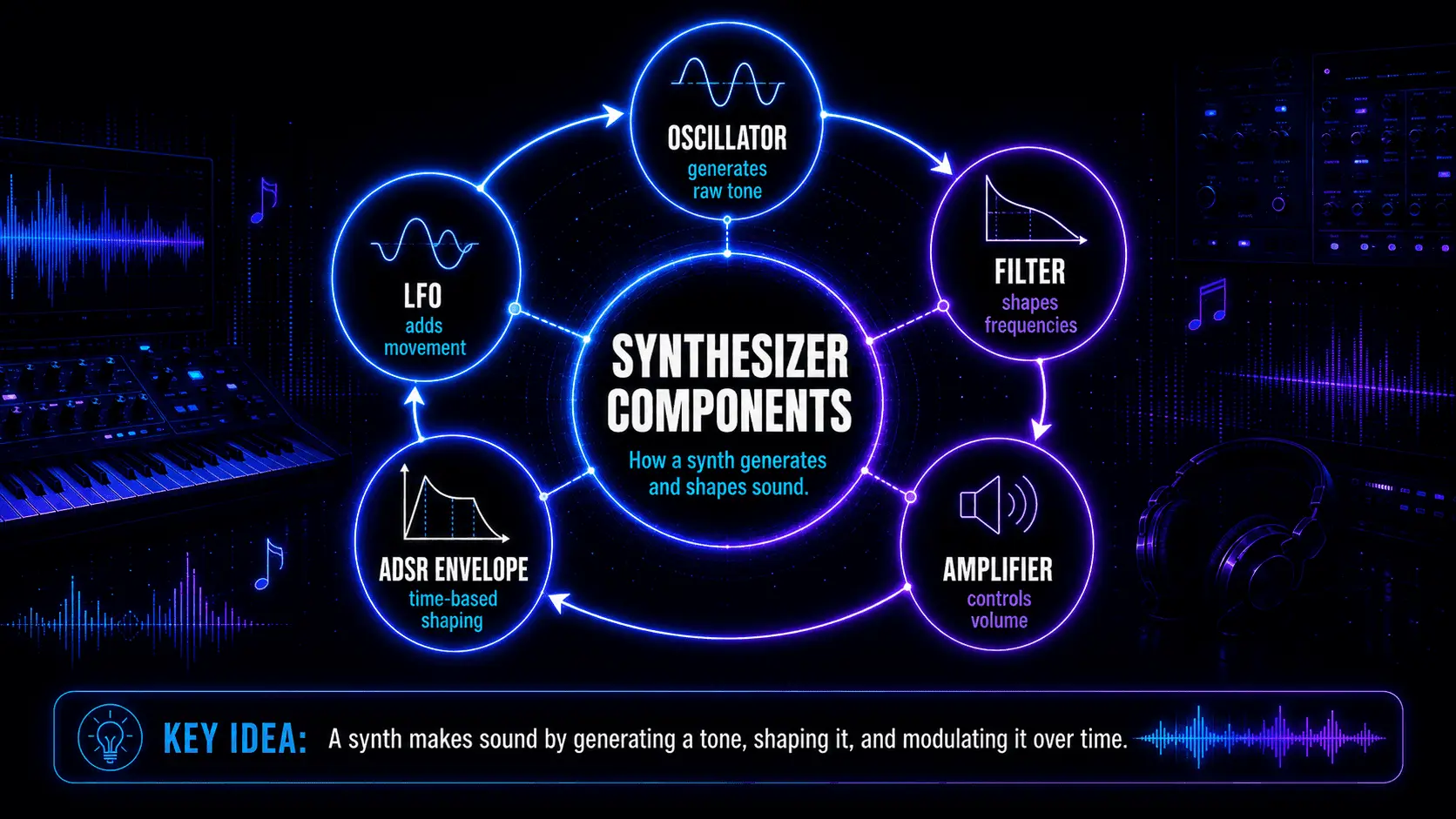
Infographic showing key synthesizer components, including oscillator, filter, amplifier, ADSR envelope, and LFO movement.
Synthesizer components explained, from oscillators and filters to amplifiers, envelopes, and LFO movement.

ADSR envelope

ADSR is how you turn a tone into an instrument-like gesture:

  • Attack: how fast it starts
  • Decay: how fast it falls after the hit
  • Sustain: the held level
  • Release: how it fades when you lift the note

A pluck has short attack/decay. A pad has slow attack and longer release.

LFOs and modulation

LFOs (low-frequency oscillators) create motion: vibrato (pitch), tremolo (volume), wobble (filter), panning movement, and more. The real fun is routing – one modulation source controlling multiple destinations.

Synth signal flow
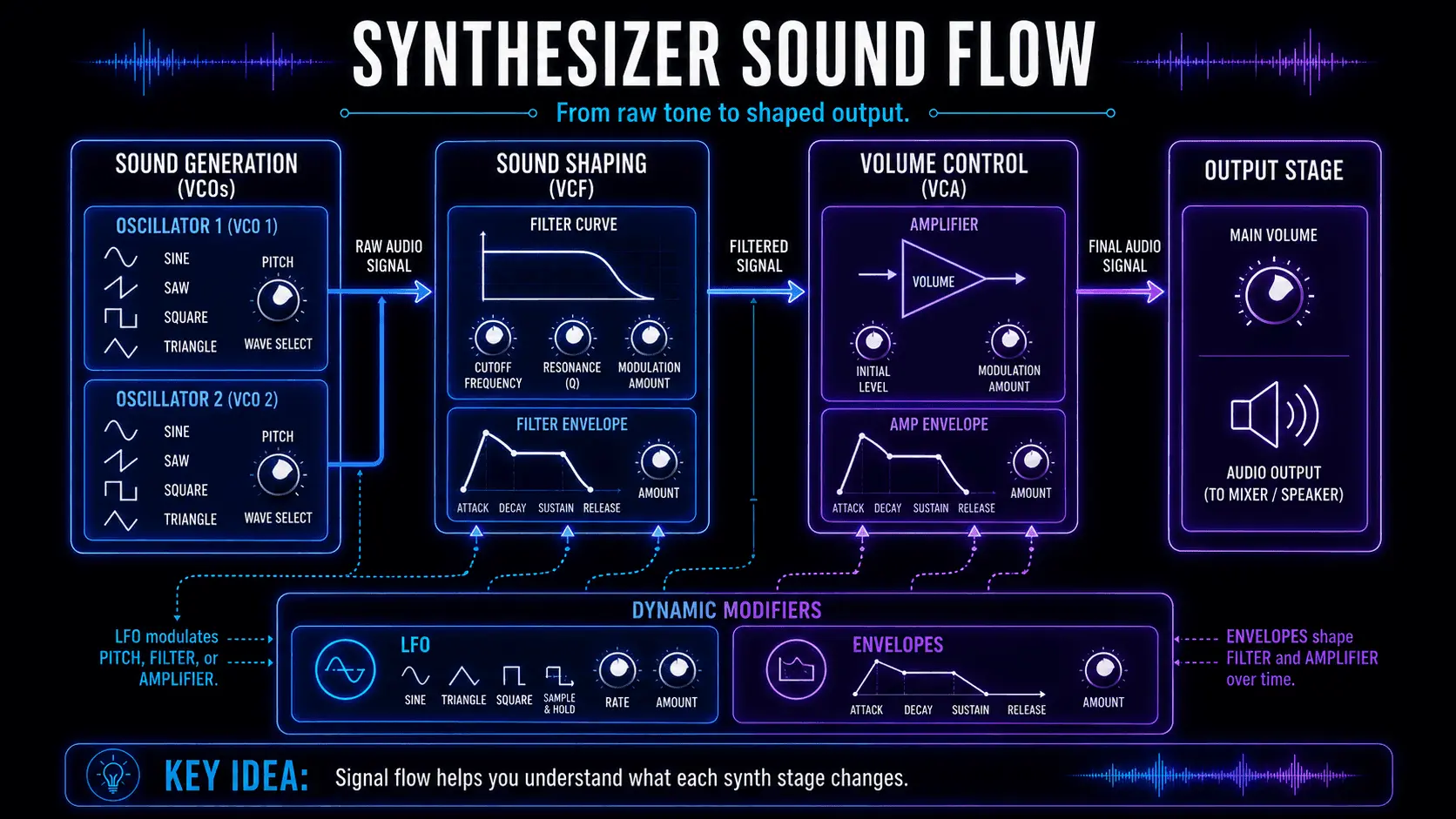
Synthesizer signal flow diagram showing oscillators, filter, amplifier, envelopes, LFO modulation, and final audio output.
How a raw oscillator signal becomes a shaped and playable sound.

A practical beginner mental model is:

Oscillator → Filter → Amp …and then envelopes and LFOs are “hands” moving those knobs over time.

Once you understand signal flow, most synthesizers (even wildly different ones) start feeling familiar.

Types of synthesizers

Synths get categorized in a few useful ways. None of these categories are “better” – they’re about workflow, sound, and how much control you want at the front end.
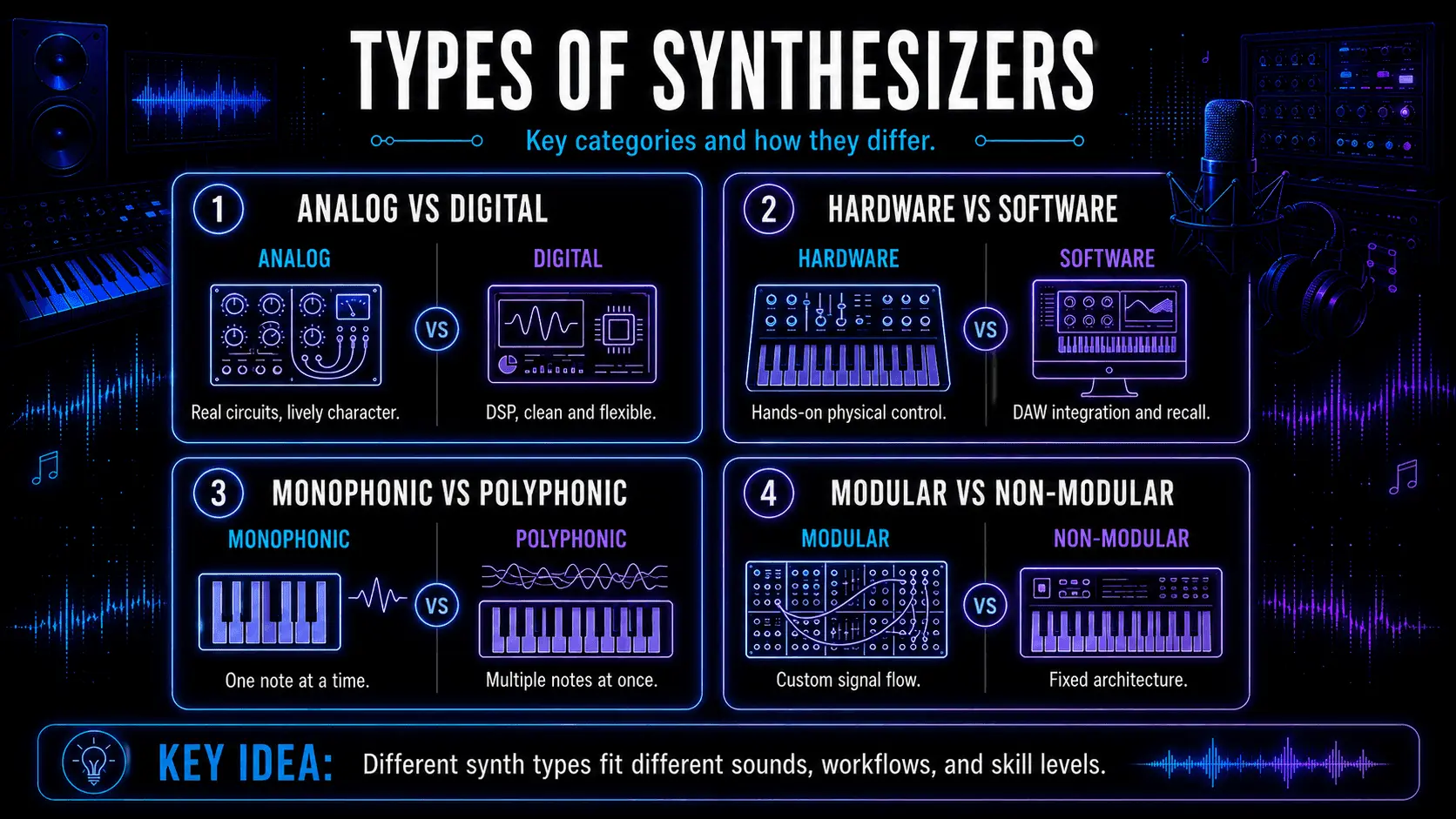
Infographic comparing analog and digital, hardware and software, monophonic and polyphonic, and modular and non-modular synthesizers.
The main synthesizer categories and how they differ in sound, control, and workflow.

Analog vs digital synthesizers

  • Analog synths generate and shape sound using real electrical circuits. They’re often praised for subtle instability and “alive” behavior.
  • Digital synths generate sound using DSP and can be cleaner, more complex, and more consistent – especially for modern wavetable, FM, and granular styles.

In practice: you can make warm music with digital synths and sharp music with analog. The difference is often more about the instrument’s design than the buzzwords.

Hardware vs software synthesizers

  • Hardware can be immediate and performance-friendly, with knobs you can grab without thinking.
  • Software synths are flexible, recallable, and easy to automate inside a DAW. You can run multiple instances, save presets with a project, and integrate deeper with editing.

If you’re learning, software synths are often the fastest path because you can see what’s happening and revisit your patches.

Monophonic vs polyphonic synths

  • Monophonic: one note at a time – great for bass and leads.
  • Polyphonic: multiple notes – pads, chords, rich harmony.

Monophonic synths often feel “expressive” because they focus on one line, one movement, one story.

Modular vs non-modular synths

  • Non-modular synths have fixed signal flow (even if you can modulate a lot).
  • Modular synths let you build the flow from scratch – powerful, but easy to disappear down the rabbit hole.

A good rule: learn synthesis concepts on a normal synth first, then go modular if you crave custom routing.

Software synths inside a DAW – where ACE Bridge fits

This is where modern production gets interesting. When your synth lives inside a DAW, you’re not only “playing notes” – you’re sequencing, automating, aligning to tempo maps, and syncing with arrangement changes.

ACE Studio can fit into that same ecosystem via ACE Bridge 2, a plugin connection that links Ace Studio to your DAW for audio streaming, MIDI recording, and synchronization. 

It also supports syncing tempo maps and time signatures using an ARA workflow, so Ace Studio can behave like a tightly-linked companion window to your DAW’s timeline.

That matters because “synth workflow” is really “timeline workflow” – your sound design has to land exactly where the music breathes.

Types of synthesis explained

“Synthesis” just means different methods of creating and shaping sound. Most producers end up using several types without even thinking about it.
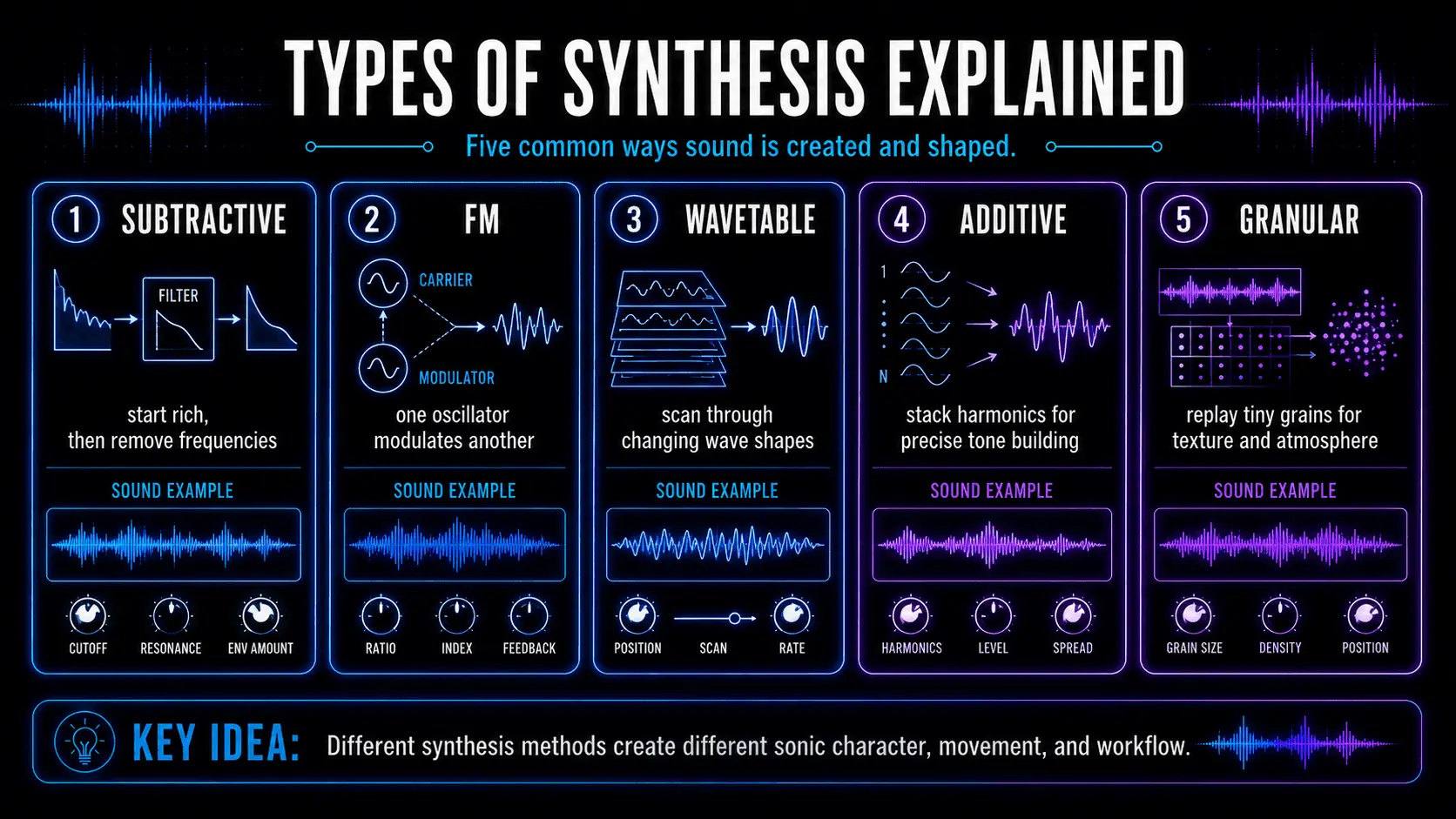
Infographic comparing subtractive, FM, wavetable, additive, and granular synthesis methods with waveforms and key controls.
Five synthesis methods and the different ways they create sound.

Subtractive Synthesis

Start with a harmonically rich waveform (like a saw), then subtract frequencies using a filter. It’s the classic path to basses, pads, and leads. If you want fast wins, start here.

FM Synthesis

FM uses one oscillator to modulate another at audio rate. It creates bright, complex tones – bells, metallic plucks, glassy keys, futuristic bass. It can feel mathy, but it’s incredible once you learn a few “go-to” ratios.

Wavetable Synthesis

Wavetable synths scan through a table of wave shapes over time. That scanning motion is a built-in source of movement – great for evolving pads, vocal-like leads, and modern electronic textures.

Additive Synthesis

Additive builds sound by stacking sine waves (harmonics). It can be very precise and very clean, and it’s powerful for resynthesis-style sounds.

Granular Synthesis

Granular takes audio and breaks it into tiny grains, then replays them with new timing, pitch, and density. This is where shimmering ambiences and “frozen” textures often come from.

Singing voice synthesis (SVS) – treating voice like an instrument

SVS is worth mentioning because it extends the synth concept: you’re still shaping a performance from control data, but the output is a voice-like instrument. 

In Ace Studio, AI Vocal Synth and AI Choir can generate vocals and chorals from MIDI and lyrics – meaning you can sequence harmony like a synth pad, but keep it editable as a performance layer.

The key is the same principle as any good synth: human in the loop. You’re not pressing “make song.” You’re writing the notes, deciding the timing, and refining the delivery.

ACE Studio as an AI performance synth (vocals and instruments)

One helpful way to understand ACE Studio in a synth context is: Ace Studio is performance synthesis – it turns MIDI into expressive audio (vocals and instruments) while keeping your editing control intact.
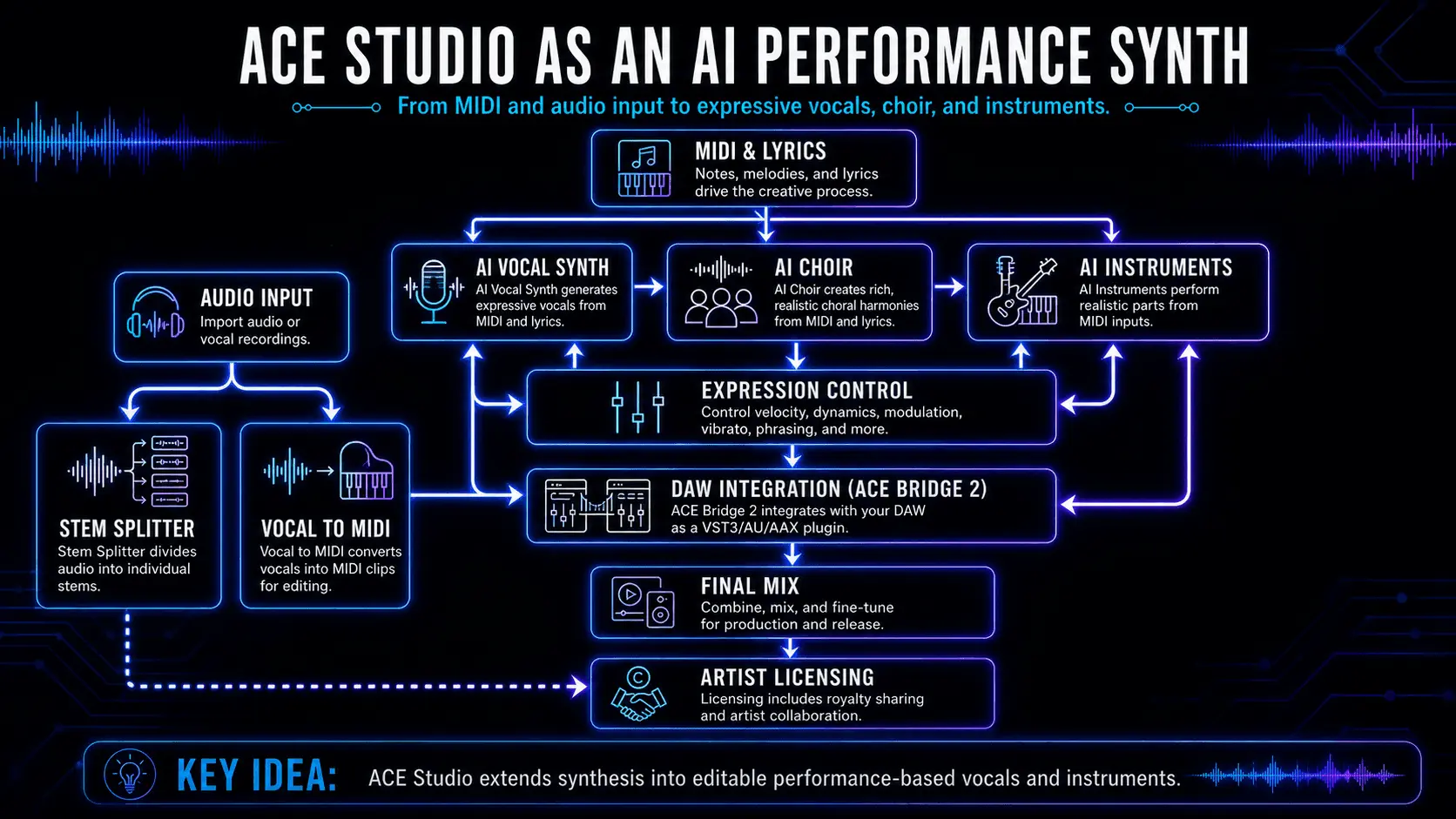
Infographic showing Ace Studio’s singing voice synthesis workflow, including audio input, stem splitter, vocal to MIDI, AI vocal synth, AI choir, AI instruments, DAW integration, final mix, and artist licensing.
Ace Studio connects vocal synthesis, MIDI tools, stem splitting, DAW integration, and licensing into one AI music workflow.

MIDI → performance – vocals, choir, and AI instruments

Ace Studio includes:

This is similar to how you’d use a software synth: write MIDI, then shape the sound. The difference is the target: instead of a raw oscillator, you’re shaping a performance model.

Expression control that feels musical

A good synth patch lives or dies by expression – velocity, modulation, articulation, phrasing. Ace Studio leans into that idea for instruments too. Its AI violin example explicitly focuses on performance details like phrasing and tonal color, driven by your MIDI input and refined by your choices.

Audio → MIDI – resynthesizing ideas you already recorded

Classic synth workflow: record something messy, then “resynthesize” it into something controllable. Ace Studio includes tools like:

  • Stem Splitter (split a mix into stems like vocals, drums, bass, etc.)
  • Vocal to MIDI (convert a vocal track into a MIDI clip with lyrics on each note)

That’s not replacing musicianship – it’s giving you a way to keep your original feel while gaining editability.

DAW integration – keep everything on the timeline

ACE Bridge 2 integrates as a VST3/AU/AAX plugin and supports real-time connection and sync with your DAW workflow. With ARA syncing, it can follow tempo map and time signature changes and keep transport aligned (play/stop/seek).

How to use a synthesizer as a beginner

If you’re searching how to use a synthesizer, here’s the fastest path: build one simple patch repeatedly until your hands understand the cause-and-effect.

  1. Choose a waveform

Start with a saw wave for a bright base or a square wave for a hollow tone. If your synth has two oscillators, detune the second slightly (a few cents) for width.

Beginner exercise: make a bass with one oscillator first. Add complexity only when you can predict what it will change.

  1. Shape tone with a filter

Turn the filter cutoff down until it’s darker, then bring it up until it sits in the mix. Add just a touch of resonance for character.

Mix tip: if your synth fights vocals, you often don’t need more EQ – you need less brightness at the source.

  1. Set an ADSR envelope

Try these starter shapes:

  • Pluck: Attack 0–10ms, Decay short, Sustain low, Release short
  • Pad: Attack slower (200–800ms), Decay medium, Sustain medium-high, Release longer
  1. Add modulation for movement

Assign an LFO to:

  • Pitch (tiny amount) for vibrato
  • Filter cutoff (slow) for gentle breathing
  • Amp (subtle) for tremolo

Movement is what turns “a tone” into “a part.”
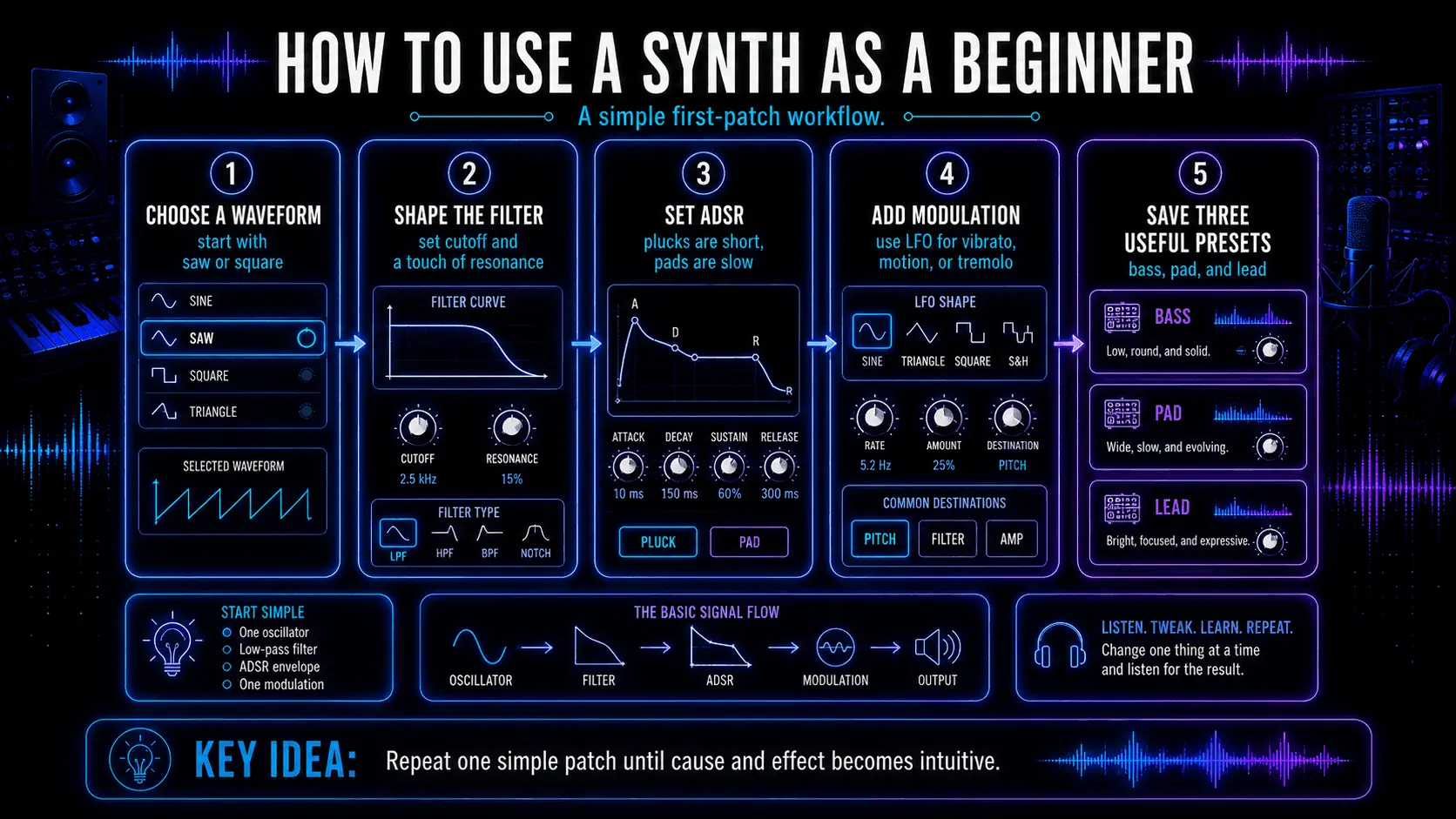
Beginner synthesizer workflow covering waveform selection, filter shaping, ADSR settings, LFO modulation, and preset creation.
A simple five-step workflow for building your first synth patch.

Save presets and build your first patch

Make three presets you actually use:

  1. A bass that leaves room for kick
  2. A pad that supports chords without masking vocals
  3. A lead that stays focused in the midrange

Practical workflow: build the patch while the track is playing. Synthesis is an arrangement. You’re deciding what emotional role the sound plays.

Common performance features

Performance features are what make a synthesizer feel like an instrument instead of a sound generator.
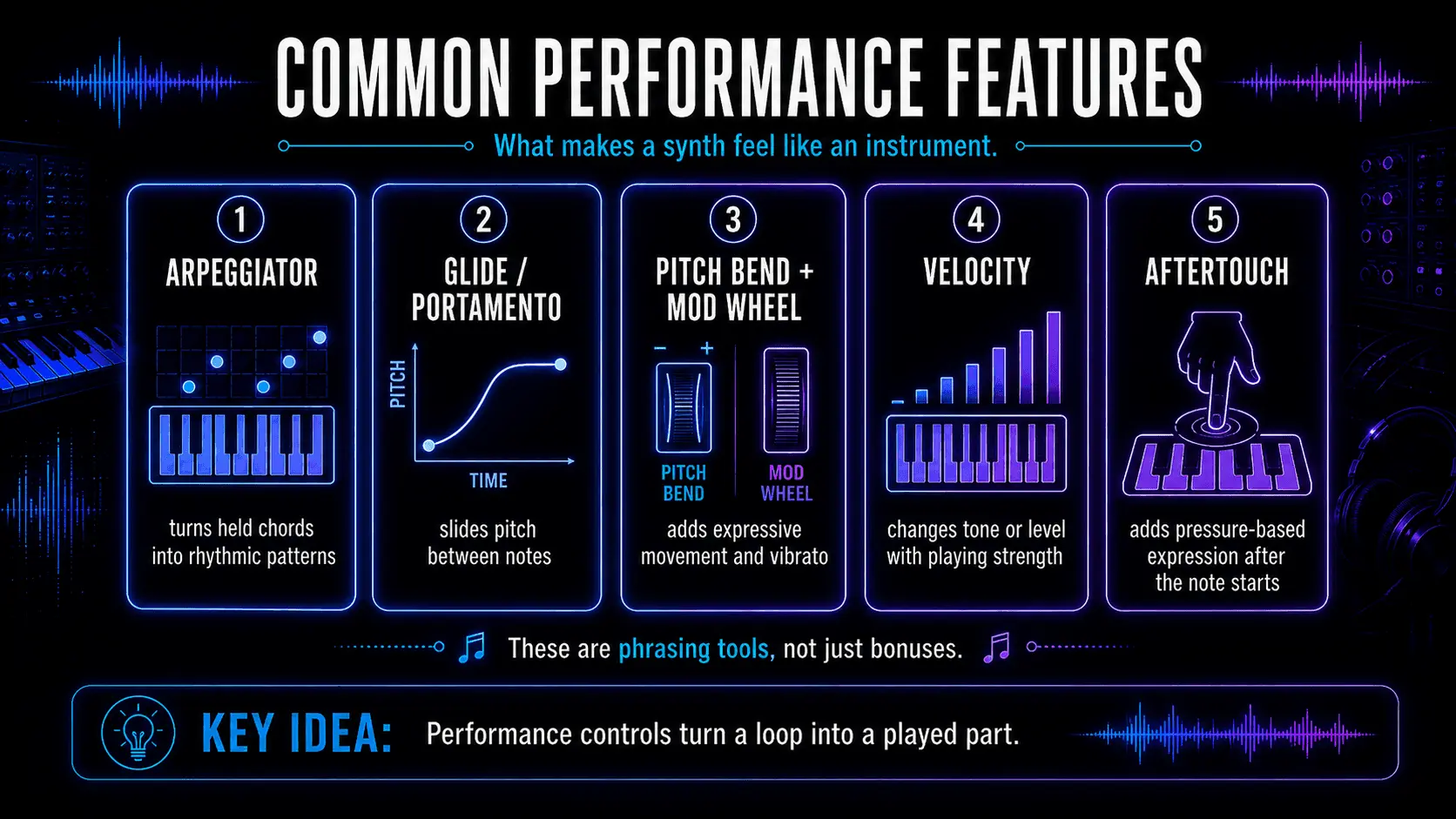
Infographic explaining arpeggiator, glide, pitch bend, mod wheel, velocity, and aftertouch on a synthesizer.
Performance controls that add movement, dynamics, and expression to synth parts.

Arpeggiator

An arpeggiator turns held chords into rhythmic note patterns. It’s great for building momentum without manually drawing every note. The best tip is to treat it like a drummer – choose a rate and gate length that complements the groove.

Glide and portamento

Glide creates pitch slides between notes. A small amount adds vocal-like legato; a lot becomes an effect. It’s especially useful on monophonic synth leads and bass.

Pitch bend and mod wheel

Pitch bend gives you “human” imperfection – scoops, falls, expressive hits. The mod wheel is often mapped to vibrato, filter brightness, or FX depth. If you’re recording synth lines, riding mod wheel is one of the quickest ways to make a part feel performed.

Velocity and aftertouch

Velocity controls how hard you “hit” a note. Map it to filter cutoff or amp level for dynamics. Aftertouch (pressure after the key is down) is perfect for expressive movement – opening a filter on long notes, adding vibrato, or introducing distortion.

Producer mindset: these features aren’t bonuses – they’re your phrasing tools. They’re the difference between a loop and a performance.

Why use a synthesizer?

Sound design and creativity

A synthesizer is a direct pipeline from imagination to sound. When you learn basic synthesis, you stop hunting for the “perfect preset” and start building parts that match the emotion of the track.

Synthesizers also let you:

  • Create sounds that don’t exist acoustically
  • Tune the tone to the mix from the start
  • Automate movement over time (filters, modulation, texture)

This is why synths are so common in modern production: they’re adaptable. They can be soft or aggressive, intimate or huge, clean or gritty.
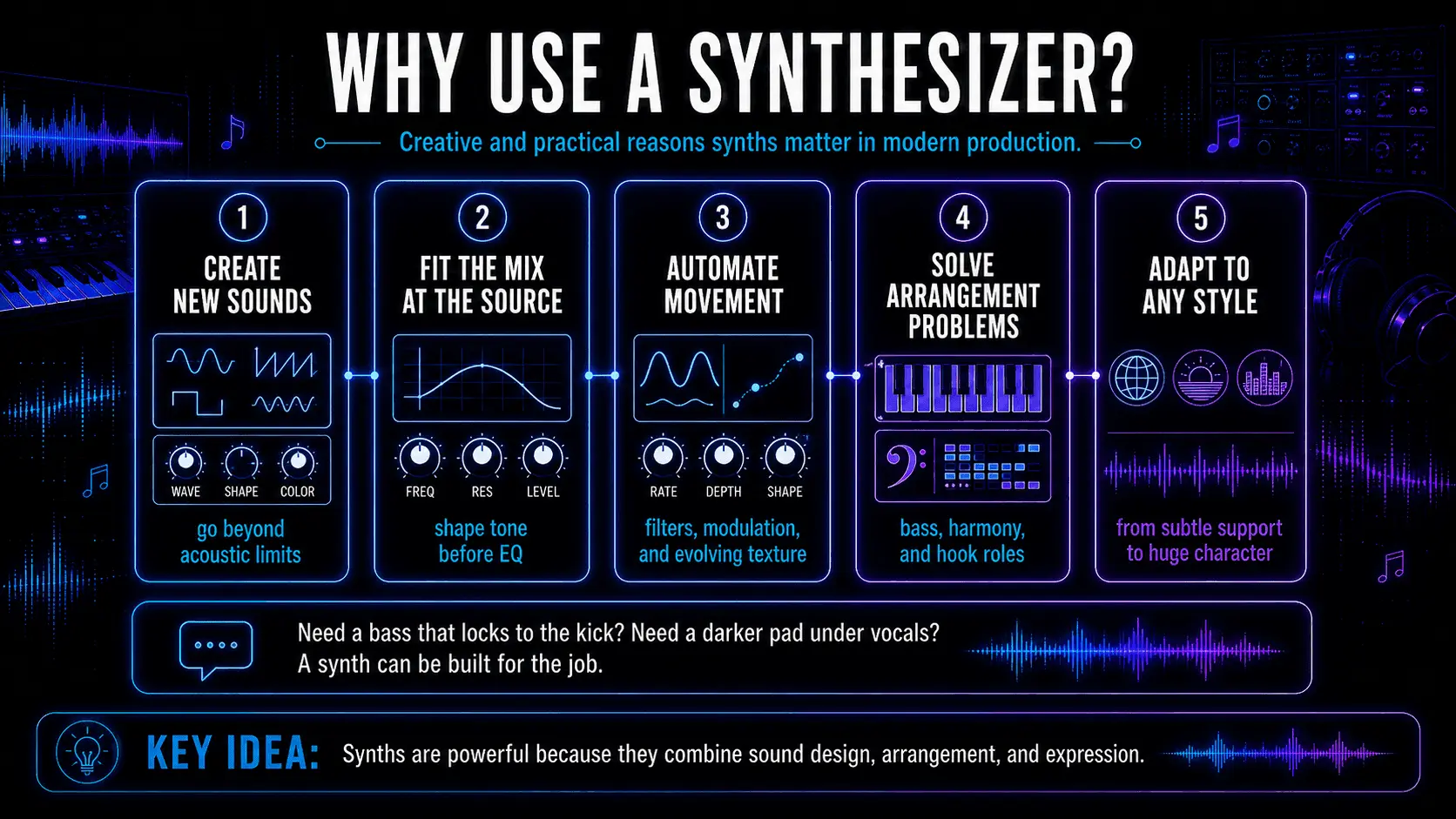
Infographic showing how synthesizers create new sounds, fit the mix, automate movement, solve arrangement problems, and adapt to different styles.
How synthesizers support sound design, arrangement, movement, and musical versatility.

Synthesizers in modern music

Synths are everywhere because they solve real arrangement problems:

  • Need a bass that locks to the kick? Use a tight envelope and controlled low end.
  • Need harmony that doesn’t fight vocals? Use a darker pad with slower attack.
  • Need a hook sound? Use movement (wavetable scan, filter automation, modulation).

And now the “synth” idea includes performance-based tools too. If you can drive something from MIDI and shape expression, it’s part of the same creative family – whether it’s a classic subtractive plugin or a performance engine like Ace Studio that turns MIDI into vocals, choir, or instruments while you refine the musical details.

Synthesizer FAQ

What’s the difference between a keyboard and a synthesizer?

A keyboard is a controller format (keys). A synthesizer is a sound engine. Some keyboards contain synth engines, some are just MIDI controllers, and some synths don’t have keys at all.

Are synthesizers hard to learn?

They can feel confusing until you learn signal flow. After that, it’s mostly repetition: oscillator → filter → envelope → modulation. Learn one synth well, and the rest start making sense faster.

What synthesizer should a beginner start with?

Pick a simple subtractive synth with a clear layout. You want to see and hear what every control does. Avoid ultra-deep synths at first, not because they’re bad – because you’ll learn faster with fewer options.

Do I need a MIDI controller for a software synth?

Not strictly. You can draw MIDI notes in your DAW piano roll. A MIDI controller helps with feel, but editing and automation matter just as much.

What type of synthesis is best for beginners?

Subtractive synthesis. It teaches the fundamentals that apply everywhere: waveform choice, filtering, envelopes, and modulation.

Is ACE Studio a synthesizer?

Not in the traditional “oscillator + filter” sense. But it does sit inside the larger synthesis world as performance synthesis: it turns MIDI into editable vocals, choir, and instrument performances, with DAW sync via ACE Bridge 2 and tempo mapping via ARA workflows.

Maxine Zhang
Written by
Maxine Zhang
Maxine Zhang is Head of Operations at ACE Studio, where she bridges AI technology and creative music applications. With deep expertise in user experience and product development, she champions the needs of musicians in the age of AI.
View full profile →
Jeff "Soulspeak" Liang
Edited by
Jeff "Soulspeak" Liang
Jeff "Soulspeak" Liang is an LA-based producer, composer, and music technologist. Rooted in Beijing's underground hip-hop scene, he bridges experimental music, generative systems, and AI creative tools.
View full profile →