

Key Takeaways
- The music industry has shifted from label-controlled physical distribution to a digital ecosystem shaped by streaming platforms, algorithms, and direct-to-fan promotion.
- Music moves through an interconnected value chain that includes creators, labels, publishers, distributors, streaming services, live events, licensing companies, and consumers.
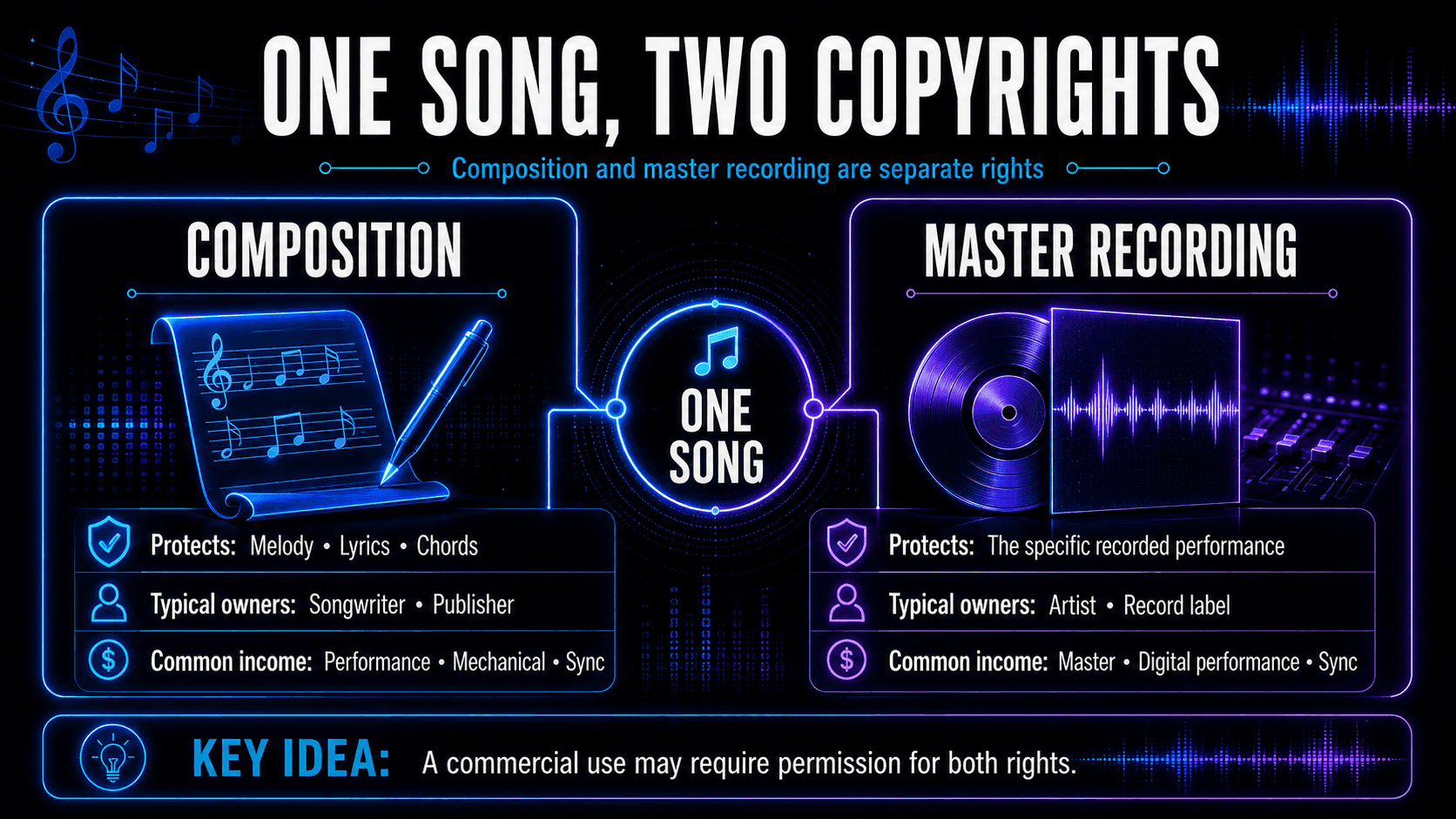
- Every song contains two separate copyrights—the composition and the master recording—each generating different royalties for its respective rights holders.
- Artists can earn through streaming, publishing, touring, merchandise, synchronization licensing, radio, sponsorships, and direct fan support, but contracts determine how that income is divided.
- Modern tools such as ACE Studio give independent creators more control over production by helping them develop vocals, instruments, and full arrangements before distribution and promotion.
The Evolution of Artist Career Development and Promotion
The historical trajectory of the music sector organization reveals a repeating cycle of technological disruption, structural adaptation, and shifting leverage between independent creators and centralized gatekeepers. Understanding the modern landscape requires a rigorous analysis of how music was funded, manufactured, and promoted across distinct historical epochs.
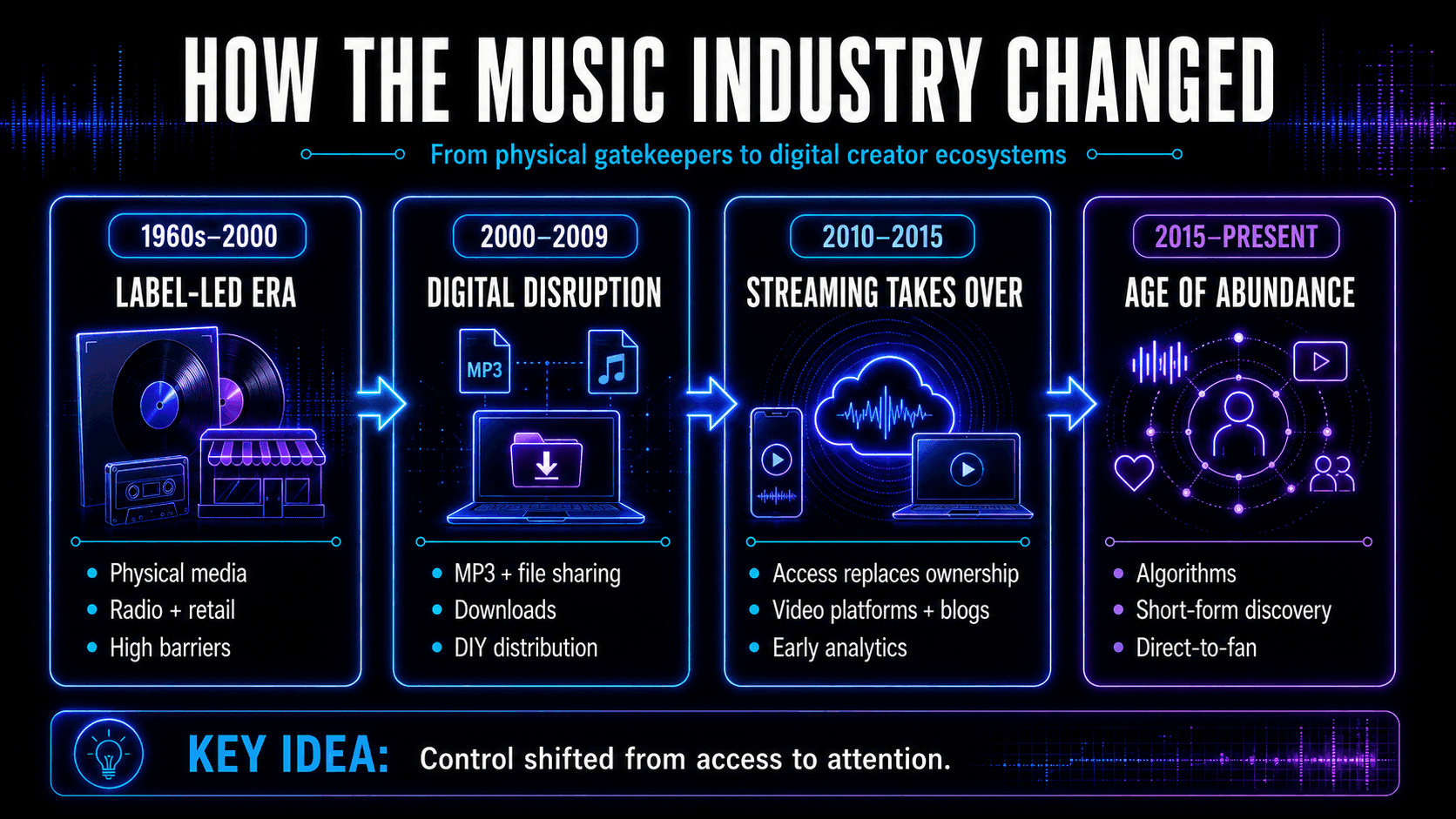
The 1960s to 2000: Centralized Promotion by Legacy Record Labels
During the late twentieth century, the music industry structure functioned as a strict oligopoly dominated by major record labels. These institutions held an absolute monopoly over capital-intensive manufacturing facilities, physical logistics networks, and mass-media promotional channels.
In this system, record label operations were focused on risk mitigation. Because manufacturing vinyl records, cassettes, and compact discs required significant upfront capital expenditure, labels acted as venture capitalists. They discovered talent through specialized Artist and Repertoire agents, financed professional studio recordings, and controlled access to terrestrial radio and retail shelf space.
Promotion was entirely top-down. Labels deployed substantial street teams, financed nationwide radio promotion campaigns, and secured high-visibility product placement within major retail chains. The introduction of data-tracking tools like SoundScan in 1991 shifted how inventory was monitored, but it did not change the underlying power dynamic. Independent musicians could rarely break through to a national or international audience without signing a traditional recording contract, which routinely required surrendering ownership of their master recordings in exchange for recoupable financial advances.
2000 to 2009: The Digital Disruption and Emerging DIY Distribution
The commercialization of the MP3 file format and the rapid adoption of peer-to-peer file-sharing networks dismantled the physical monetization model. This decade marked a severe economic contraction for the recorded music sector, characterized by widespread digital piracy and a sharp decline in physical retail revenue.
As major label profit pools collapsed, the industry initially resisted digitalization through aggressive litigation against platforms and individual consumers. However, this defensive posture created an absolute vacuum that enabled the first wave of decentralized consumer alternatives. The launch of the Apple iTunes Store in 2003 established a legitimate digital download market by unbundling the traditional album format into individual track sales priced at a standard rate.
Simultaneously, early digital platforms like MySpace, alongside pioneering independent digital distributors, allowed musicians to bypass traditional gatekeepers. This period marked the birth of independent distribution networks, giving rise to an early framework where creators could upload digital audio files directly to internet storefronts without surrendering their intellectual property rights.
2010 to 2015: The Access Model and New Digital Promotion Spaces
The global music market stabilized and began its recovery with the widespread adoption of cloud-based music streaming services. This era marked a fundamental transition from an ownership-based economic model to an access-based model, completely altering consumer behavior.
Promotion migrated from traditional media channels to digital ecosystems. Platforms like YouTube became essential visual hubs for global track discovery, while specialized music blogs and early digital tastemakers replaced terrestrial radio directors as the primary architects of cultural influence. Musicians began analyzing consumer data directly through early dashboard analytics, allowing for targeted digital marketing campaigns.
The industry adjusted to a system where success was measured not by physical units shipped to retail stores, but by digital streams accumulated over time, creating a continuous, long-tail monetization model that rewarded sustained listener engagement rather than upfront transaction volume.
2015 to Present: Content Proliferation and Promotion in the Age of Abundance
Today, the music industry ecosystem operates in a state of absolute hyper-saturation. Digital distribution channels have democratized access to global markets to such an extent that tens of thousands of new audio tracks are uploaded to digital streaming platforms every single day.
The contemporary promotional landscape is defined by algorithmic recommendation engines and short-form video ecosystems. Traditional music discovery mechanisms have been superseded by user-generated content, viral challenges, and collaborative digital audio trends.
In this environment, consumer attention is the primary scarce commodity. Record labels have transformed into data-analytics operations that monitor digital platforms to identify independent tracks that are already demonstrating organic momentum. For creators, the challenge has shifted from accessing distribution networks to standing out within a highly competitive digital marketplace, requiring a sophisticated grasp of digital branding and content creation.
The Music Industry Value Chain: From Creation to Consumption
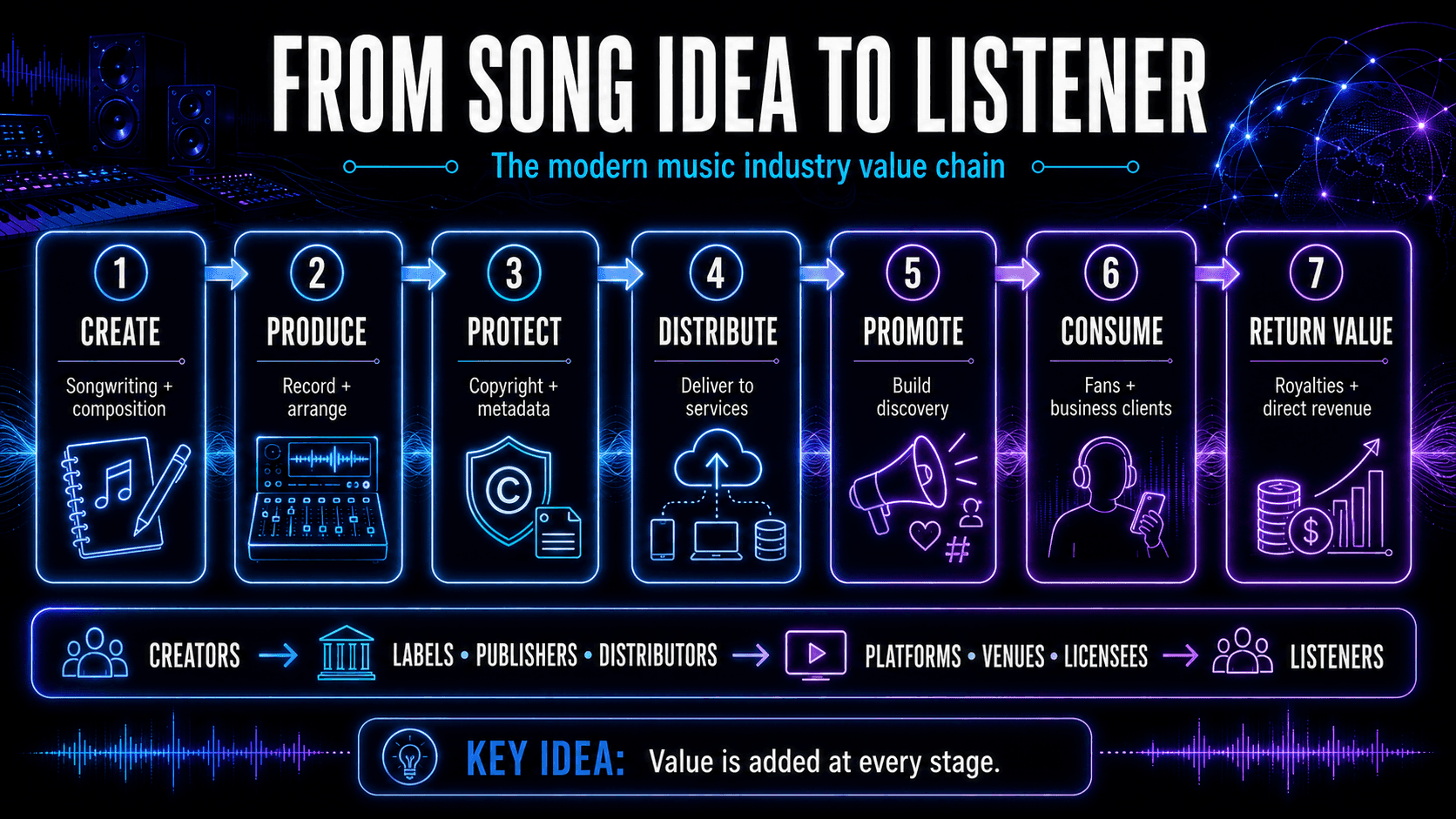
The modern music business framework functions as an interconnected lifecycle that transforms a creative concept into a monetizable commercial asset. This multi-tiered system relies on specialized inputs at every phase to capture value from global consumer audiences.
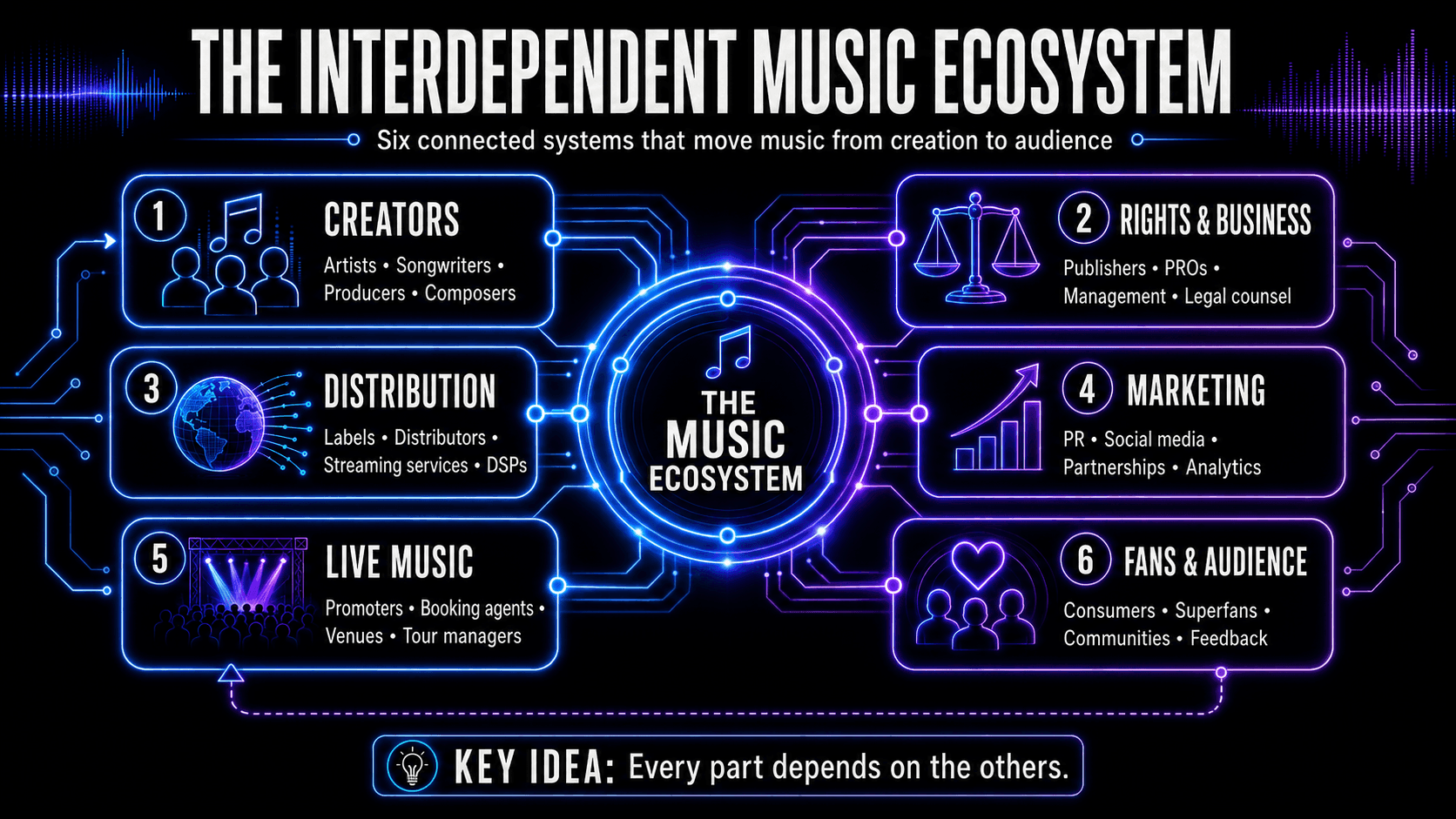
Mapping the Music Industry Ecosystem
The value chain begins with the initial intellectual property generation and terminates at the point of consumer end-user consumption or business-to-business licensing. Value is added at each stage through financial investment, technical refinement, legal administration, and targeted audience acquisition.
| Value Chain Phase | Primary Activities | Key Objectives |
| Creation & Ideation | Songwriting, Composition, Arrangement, Lyric Generation. | Establishing the Underlying Musical Composition Copyright. |
| Production & Capture | Tracking, Sound Design, Vocal Engineering, Mixing, Mastering. | Finalizing the Commercial Master Sound Recording Asset. |
| Rights Management | Copyright Registration, Metadata Auditing, Publishing Administration. | Ensuring Global Tracking of Royalty Collection Vectors. |
| Distribution & Supply | Delivery to Digital Service Providers, Physical Manufacturing. | Ensuring Universal Availability Across Consumer Touchpoints. |
| Marketing & Amplification | Algorithmic Optimization, Pitch Campaigns, Short-Form Asset Generation. | Generating Consumer Demand and Platform Engagement. |
| Consumption & Monetization | Streaming, Live Performance Ticketing, Merchandise Acquisition, Sync Exploitation. | Capturing Financial Value from End-Users and Commercial Clients. |
Key Supplier Segments in the Music Industry
The primary layer of the music sector organization consists of the creators and technical professionals who build the sonic foundation of the industry.
- Songwriters and Lyricists: Creators who author the foundational elements of a song, including the melodic architecture, chord structures, and lyrical content. They generate the raw intellectual property that feeds the publishing sector.
- Composers and Arrangers: Musicians who write instrumental arrangements, orchestral scores, or background tracks for commercial projects, films, and live ensembles. They balance creative expression with structural constraints required by visual media.
- Session Musicians and Vocalists: Instrumental and vocal specialists hired to perform on studio recordings or supplement live performance lineups. They typically operate as independent contractors, providing technical skill without retaining long-term copyright ownership.
- Audio Engineers and Software Developers: Technical specialists responsible for physical signal paths, microphone placement, acoustic treatment, and the creation of digital audio workstations, virtual instruments, and audio processing plug-ins.
Industry Company Segments and Key Market Players
The intermediary layer of the music industry structure converts creative outputs into scalable commercial products through capital injection, administrative oversight, and marketing scale.
- Major Entertainment Conglomerates: Large corporate entities that control vast networks of subsidiary record labels, publishing catalogs, and localized distribution networks across multiple continents. They maintain a dominant share of the global music market hierarchy.
- Independent Record Labels: Agile organizations that provide financing, marketing, and strategic support to artists while offering more flexible contractual terms than major labels. They frequently specialize in niche genres or regional markets.
- Publishing Administrators: Companies that protect, administer, and license musical compositions globally. They ensure that songwriters receive proper compensation whenever their melodies or lyrics are used anywhere in the world.
- Digital Distributors: Specialized enterprise platforms that act as technical bridges, delivering digital audio files and verified metadata to global digital service providers while tracking backend financial returns.
Customer Segments: Music Consumers and Enterprise Clients
Monetization travels through two primary vectors: business-to-consumer and business-to-business.
- Retail Consumers: Individuals who subscribe to premium digital streaming services, purchase physical media, buy event tickets, and acquire physical artist merchandise. They drive the volume metrics that power the modern streaming economy.
- Enterprise Clients: Film production companies, television networks, advertising agencies, and video game developers seeking to license musical compositions and master sound recordings to enhance their visual media properties. They represent high-value, lump-sum monetization opportunities.
- Commercial Establishments: Retail venues, fitness centers, hospitality groups, and night clubs that require blanket performance licenses to broadcast background music within physical commercial spaces, ensuring legal compliance with regional copyright acts.
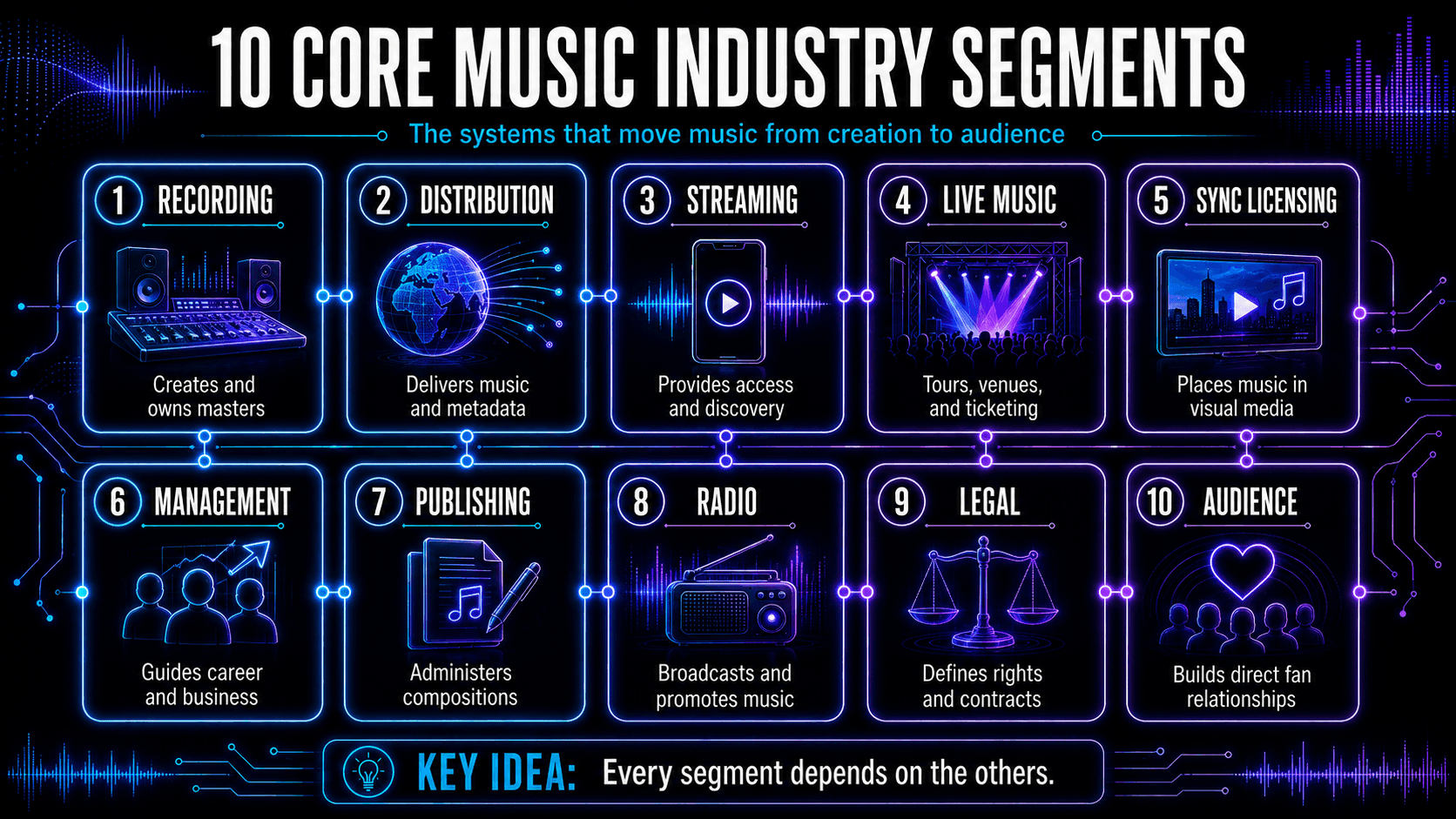
The Mechanics of the Music Market Hierarchy: 10 Core Segments Explained
The contemporary music market hierarchy is an interlocking system of ten distinct operational segments. Each segment functions as an independent profit center while remaining deeply reliant on the other nine components to maintain structural stability.
1. The Recording Industry and Record Label Operations
The recording industry focuses on the creation, acquisition, and monetization of master sound recordings. Modern record label operations require a complex balancing act between risk management and venture capital investments. Labels look for independent artists who have already built a preliminary digital footprint, reducing the risks involved in traditional talent scouting.
Once an artist is signed, the label funds recording costs, video production, international marketing campaigns, and playlist placement strategies. In exchange, traditional contracts require the artist to assign their master copyrights to the label either permanently or for a long-term duration. The label distributes these master recordings across global networks and collects the resulting revenues. It then deducts its upfront investments and pays out a contractually agreed royalty percentage to the artist.
2. Digital Music Distribution Channels
Digital distributors act as the critical technical pipeline connecting creators to digital service providers. These platforms manage the ingestion of high-fidelity audio files, verify compliance with strict formatting rules, and deliver asset packages containing verified metadata across global servers.
Independent distribution networks follow two primary business models. The first is a flat-fee subscription model, where platforms charge a recurring annual fee, allowing artists to upload unlimited tracks while retaining one hundred percent of their earned digital streaming royalties. The second is a commission-based model used by enterprise distributors, who operate on a curated model, taking a commission split—typically ranging from fifteen to thirty percent—of the artist's streaming revenue. In exchange, they provide advanced marketing support, playlist pitching, and financial advances.
3. The Mechanics of Streaming Services
Digital service providers operate as subscription and ad-supported access platforms. These companies do not pay creators a fixed fee per stream; instead, they distribute revenue through a complex pro-rata model.
All subscription fees and advertising revenues collected within a specific market are pooled together. The streaming platform deducts its corporate share, which is typically around thirty percent. The remaining seventy percent forms the royalty pool, which is distributed proportionally to rights holders based on their share of total platform streams.
Discoverability within these applications relies on a mix of editorial playlists managed by human curators and algorithmic recommendation systems, which analyze user listening habits, acoustic profiles, and skip-rate data to build personalized user feeds.
4. The Live Performance and Touring Industry
The live music sector is an essential source of direct income for performing artists, operating completely independently of digital streaming algorithms. This segment relies on local concert promotion networks, national venue booking groups, and ticket processing platforms.
Touring requires careful cash flow management. Talent agents negotiate performance fees with regional promoters, secure dates, and structure payment terms using models such as flat guarantees, where a fixed performance fee is paid to the artist regardless of ticket outcomes, or backend splits, which grant a percentage-based share of net box office revenues after the promoter breaks even on their documented production expenses. The financial performance of live events depends heavily on secondary revenue streams, particularly high-margin venue merchandise sales, VIP upgrade packages, and corporate brand sponsorships.

5. Music Licensing and Synchronization (Sync)
Synchronization licensing involves placing musical compositions and master sound recordings into visual media platforms like films, television shows, commercial ads, and video games. A sync placement acts as a powerful dual monetization vector.
To use a track in a visual project, a music supervisor must clear two separate licenses: a master use license sourced from the record label or independent artist to clear the specific sound recording, and a synchronization license sourced from the music publisher or songwriter to clear the underlying musical composition. These licenses are typically negotiated on a most favored nations basis, which ensures both the master rights holder and the publishing rights holder receive identical upfront licensing fees. Beyond the initial fee, television and film sync placements generate ongoing performance royalties whenever the media project is broadcast on global networks.
6. Professional Artist Management in Music
Artist managers function as the chief executive officers of an artist's professional business entity. They coordinate all components of the music business framework, ensuring the artist's creative choices align with long-term financial stability.
Managers coordinate communication between record labels, publishing administrators, booking agents, legal counsel, and public relations teams. Standard management contracts use a commission structure where the manager receives fifteen to twenty percent of the artist's gross or net earnings across all revenue streams. This setup ensures the manager's financial incentives are directly tied to the artist's overall commercial growth.
7. The Music Publishing Industry Explained
Music publishing focuses exclusively on protecting and capitalizing on the intellectual property of the musical composition—the melody, lyrics, and chord arrangements—rather than the recorded audio file.
Publishers look for talent in songwriters and lyricists, manage catalog registration with global rights organizations, and pitch songs to major recording artists, film supervisors, and advertising networks. Publishing administrators collect mechanical royalties from physical and digital sales, performance royalties from public broadcasts, and print royalties from sheet music distribution, paying out the remaining funds to songwriters based on contractually agreed splits.
8. Terrestrial and Digital Radio Ecosystems
While streaming dominates consumer music discovery, traditional terrestrial radio and satellite networks remain vital for reaching broad demographic groups. Radio airplay is highly regulated and relies on charts compiled by automated tracking systems.
Radio distribution acts as a key promotional tool that helps drive regional tour ticket sales and digital streaming metrics. The royalty structures for radio vary significantly by territory. For example, in the United States, terrestrial radio stations only pay performance royalties to songwriters and publishers, completely exempting record labels and performing artists from broadcast performance payments, a structural quirk that contrasts sharply with European models.
9. The Legal Framework and Contractual Foundations
The entire music market hierarchy is held together by intellectual property statutes and contract law. Legal professionals specializing in entertainment law are essential for drafting and reviewing agreements across every industry division.
Key legal agreements include recording contracts, such as traditional exclusive artist agreements or 360-degree deals where labels participate in an artist's touring, merchandise, and endorsement revenues. They also encompass publishing deals, which define copyright ownership splits and specify royalty collection fees, as well as performance contracts governing live events, detailing performance guarantees, venue cancellation clauses, insurance requirements, and radius clauses that prevent artists from performing in nearby areas around the event date.
10. Audience Acquisition and Fan Attention Dynamics
The final stage of the value chain focuses on building, maintaining, and monetizing audience attention. In an environment where consumers have nearly unlimited entertainment options, sustainable business models require moving casual platform listeners into dedicated community spaces.
This process involves utilizing direct-to-fan channels like mailing lists, SMS text networks, and community platform apps alongside exclusive subscriber programs. By nurturing direct relationships with core listeners, artists can bypass the unpredictable algorithm changes of major social media networks, turning audience attention into a reliable, predictable source of creative funding.
How Technology is Changing Music Creation
The music industry does not begin with labels, distributors, or streaming platforms. It begins with creating the music itself, and technology has given independent artists and producers much more control over this stage of the process. Songwriters can now develop arrangements, produce demos, experiment with vocals and instruments, and refine ideas before involving other parts of the industry.
ACE Studio brings these new production capabilities into one creative environment, giving independent artists and producers greater control over how their music is developed. Its AI Singing Voice Generator turns MIDI and lyrics into editable vocal performances, while AI Instruments let producers create instrument parts from MIDI and shape elements such as notes, articulations, and expression. ACE Studio can also connect with existing DAW workflows, so these tools can be used as part of a broader production setup.
ACE Studio also offers prompt-based tools for creators who want to develop ideas without starting from a finished composition. Inspire Me can generate music from text descriptions or lyrics, allowing users to define elements such as mood, style, and instrumentation. Add a Layer works more selectively, generating new musical layers from a description when an existing arrangement needs another instrument, vocal element, texture, or supporting part. Music Enhancer can take existing audio and reimagine it in a new musical direction based on the creator’s instructions. Together, these tools give independent artists another way to move from an initial idea or rough demo toward a fuller arrangement while keeping the creative decisions in their hands.
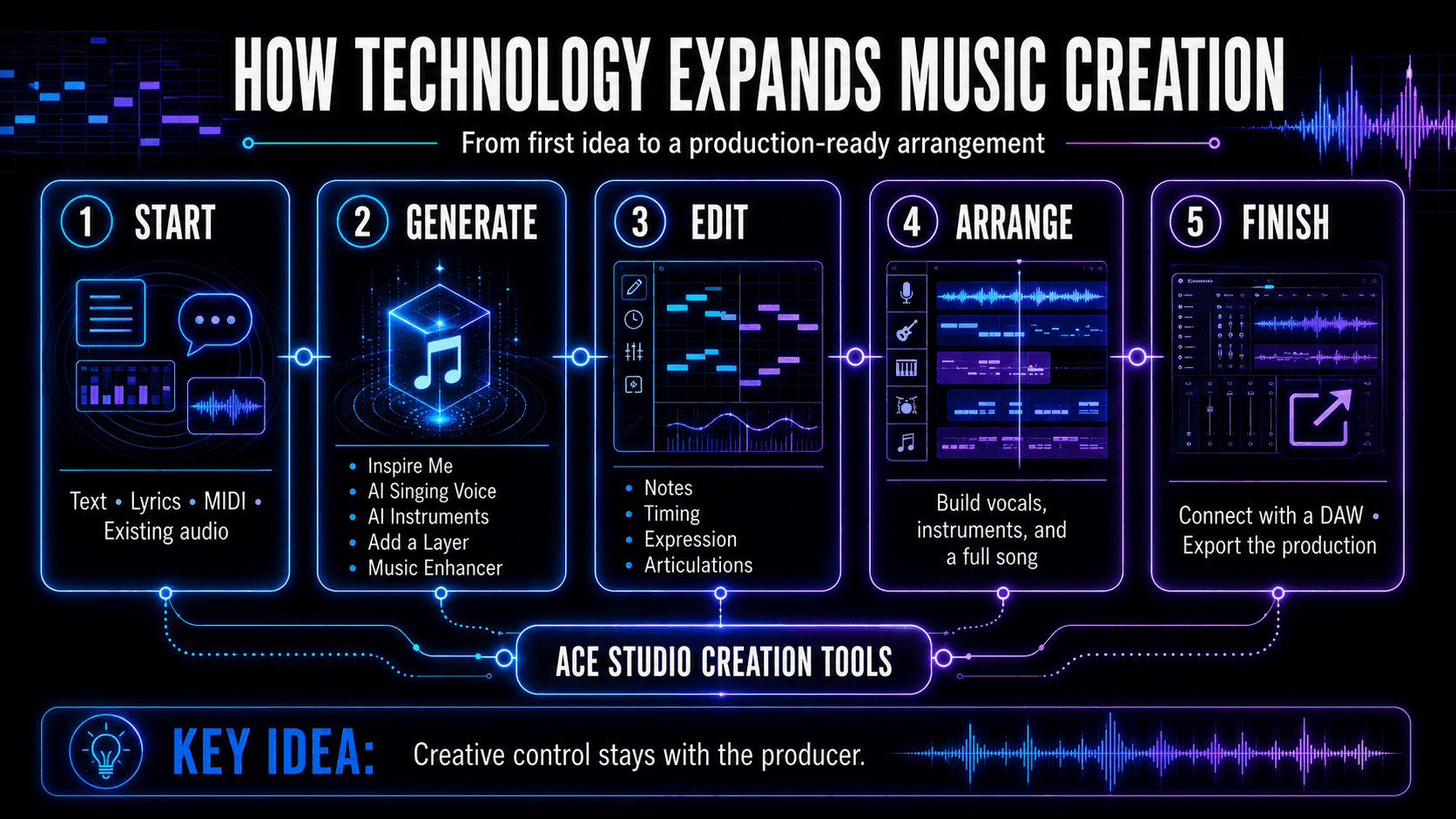
For independent creators, tools like these can make it easier to move from an initial composition to a more developed production before the music reaches the next stages of the industry. The finished work can then move into rights management, distribution, promotion, licensing, and the other systems discussed throughout this guide.
Music Copyright Laws, Licensing, and Royalty Frameworks
Intellectual property rights serve as the foundational legal currency of the global music business framework. Without a clear understanding of copyright separation and global licensing paths, creators cannot properly capture the revenue generated by their music.
Understanding Copyrights: Composition vs. Sound Recording
Every commercial track consists of two distinct, legally independent pieces of intellectual property that are frequently owned by different entities:
- The Musical Work (Composition): This copyright covers the underlying musical structure, including the specific sequence of notes, harmonic progressions, rhythm, and written lyrics. It is generated the moment a musical idea is fixed in a tangible medium, such as a notation sheet or an initial audio demo. This asset is traditionally managed by music publishers and credited to the original songwriters and composers.
- The Sound Recording (Master): This copyright protects the specific physical or digital audio recording of a performance. It captures the unique acoustic attributes, vocal performances, studio engineering choices, and sonic production elements of a specific session. This asset is traditionally owned by a record label or independent recording artist.
This structural separation means that if a performing artist records a cover version of a classic song, the new master copyright belongs to the performing artist or their label, while the composition copyright continues to belong to the original songwriter's publishing company.
Modern Royalty Breakdown: Mechanicals, Performance, and Master Royalties
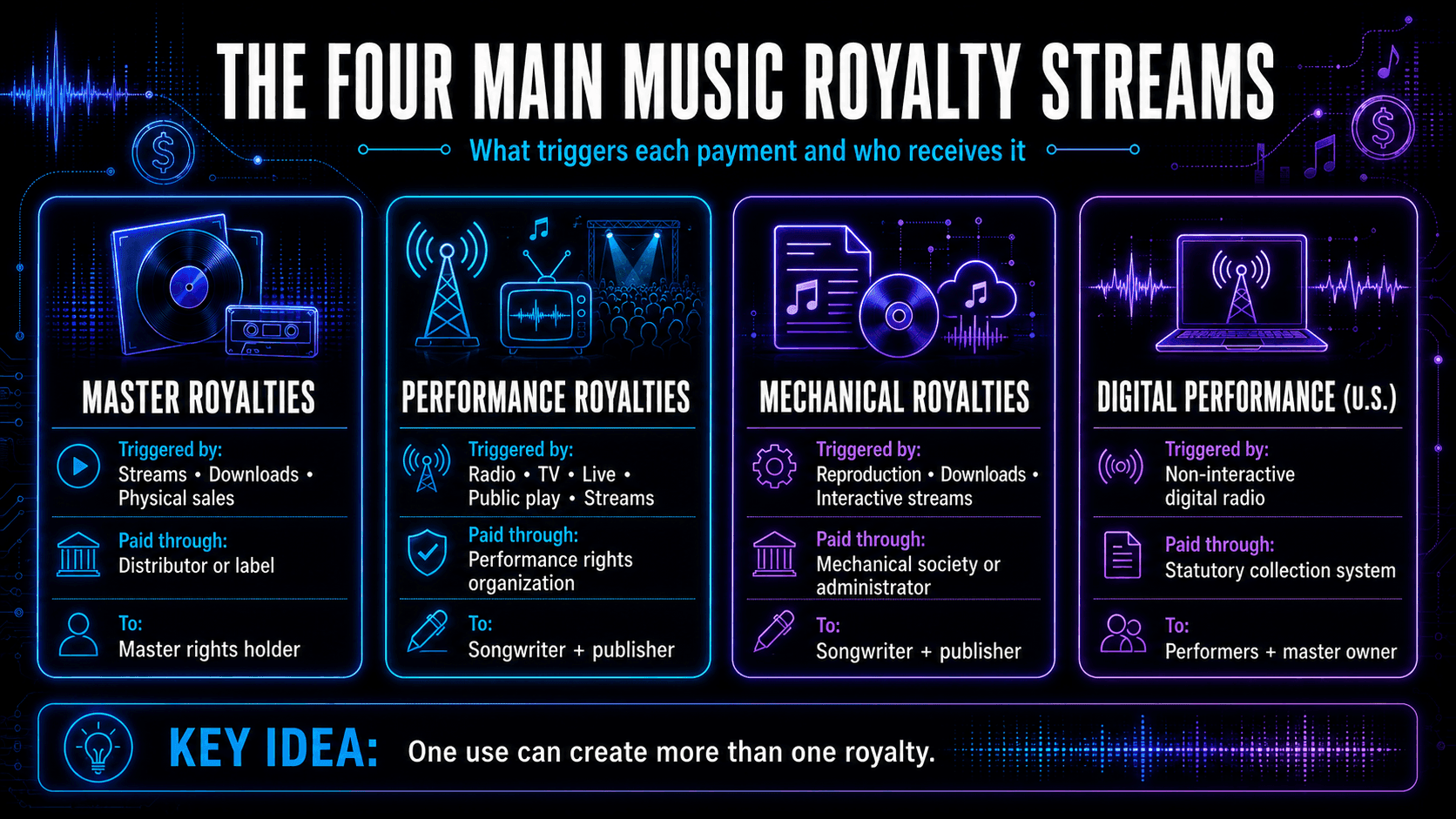
When music is consumed commercially, it triggers multiple distinct royalty streams managed by specialized collection agencies.
Master Royalties
Generated by physical sales, digital downloads, and digital streaming interactions. For independent acts, these royalties are collected by digital distributors; for signed artists, they flow straight to the record label. The master rights holder then pays out contractually agreed cuts to the main artist, featured guests, and the studio producers involved in the project.
Performance Royalties
Triggered whenever a musical composition is broadcast or performed publicly. This includes terrestrial radio plays, television broadcasts, live concert venues, retail store background music, and digital music streaming. These fees are gathered by specialized Performance Rights Organizations. These organizations divide the incoming revenue into two equal pools: the writer share, paid directly to the individual songwriter, and the publisher share, distributed to the managing publishing company.
Mechanical Royalties
Earned whenever a composition is reproduced and distributed in a physical or digital format. Historically tied to physical vinyl pressing and CD manufacturing, mechanical royalties now apply directly to interactive digital streaming formats and digital downloads. In the United States, digital mechanical royalties are centrally processed by a unified licensing collective, which issues blanket mechanical licenses to streaming services and routes the resulting revenues directly to publishers and self-published songwriters.
Digital Performance Royalties
A unique statutory royalty stream generated within the United States by non-interactive digital radio broadcasts, such as satellite networks and webcasts. Because US copyright law excludes terrestrial radio from paying master performance fees, statutory licenses govern digital platforms. These specialized royalties are collected and distributed by organizations like SoundExchange, which route a significant portion of the funds directly to the featured performing artist and session musicians, bypassing traditional record label accounting pipelines entirely.
The Economics of the Industry: Cost Structures, Pricing, and Profit Pools
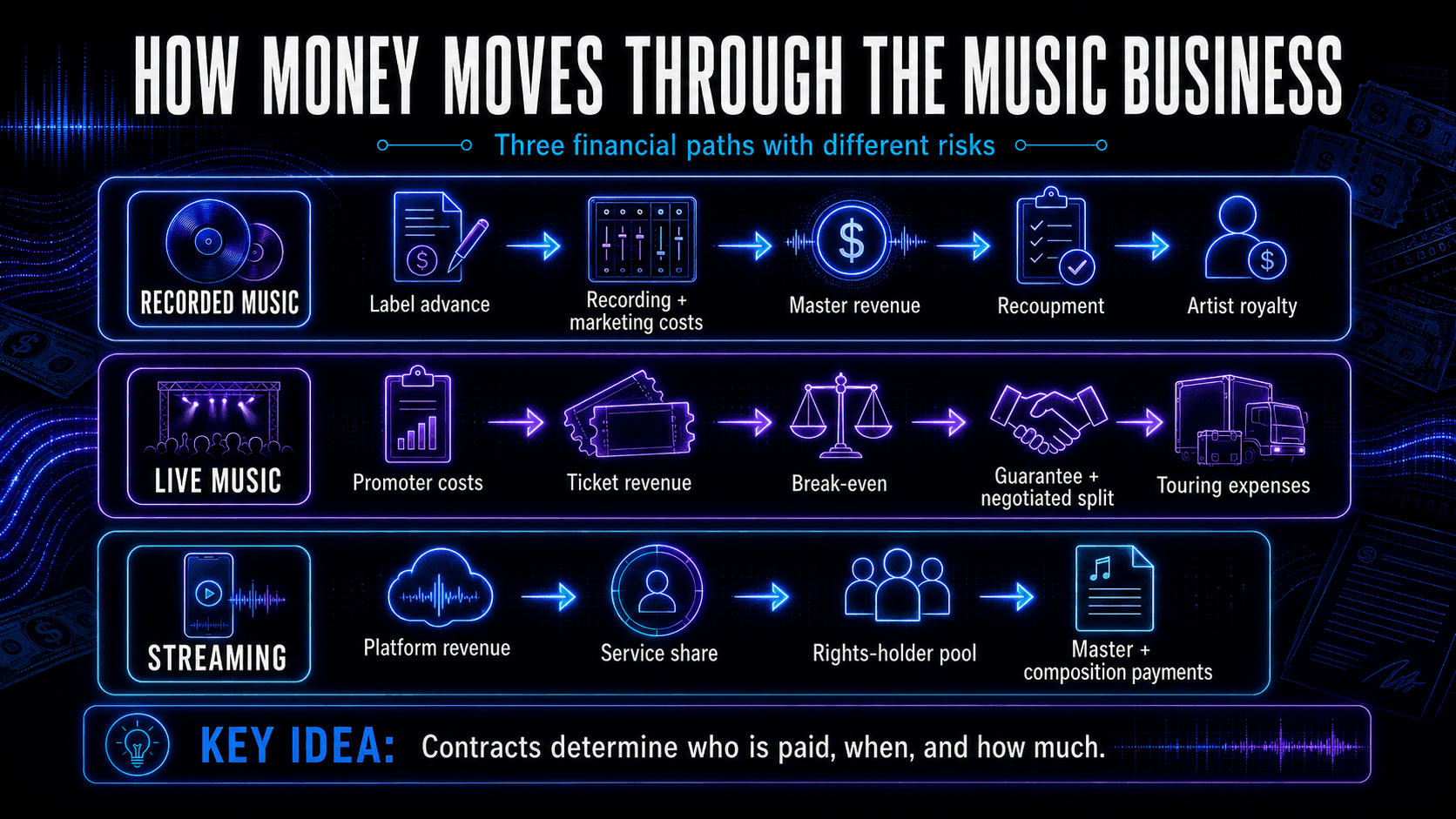
The financial architecture of the music sector organization requires balancing high upfront development costs against highly variable revenue streams across the commercial lifecycle.
Recorded Music Economics and Capital Expenditure
Operating a modern record label requires managing significant upfront capital investments across a portfolio of signed talent. The financial model functions similarly to venture capital: the revenue from a small percentage of highly successful projects must cover the development losses of the rest of the roster.
When a label signs an artist to a standard recording agreement, it provides a recoupable financial advance. This capital covers personal living expenses and finances the technical studio production process, video production, and initial marketing campaigns. All design costs, marketing expenditures, and radio promotions are charged against the artist's royalty account.
Under standard contract terms, the artist will not receive any additional royalty payouts until the entire recoupable balance is fully recovered through their contractually defined royalty share—typically fifteen to twenty-five percent of gross master revenues. Consequently, a track must generate several times its initial budget in total streaming revenue before the artist's account achieves a positive balance.
Live Music Economics and Promoter Risk Profiles
The financial model of the live performance sector is based on a high-risk operational structure centered around localized live event promoters. When planning a concert or regional tour, the local promoter takes on the vast majority of the financial risk.
The promoter pays for venue rentals, event staff, insurance, local security teams, and marketing campaigns upfront. They then negotiate a contract with the artist's booking agent, typically offering an advance guarantee coupled with a split of net box office revenues—frequently an eighty-five to fifteen split in favor of the artist after breaking even on production expenses.
If ticket sales underperform, the promoter must still pay the artist's guarantee, taking a direct financial loss. Conversely, artists face significant expenses during touring cycles, including commission fees for managers and booking agents, travel and lodging logistics, equipment shipping, and payroll for backing musicians and road crew technicians.
Publishing and Songwriting Economics
The economics of music publishing feature low operational overhead and highly stable, long-tail revenue streams. Unlike the recorded music sector, which faces intense competition and brief consumer attention cycles, publishing catalogs retain reliable value over decades.
Publishing companies build financial value by acquiring evergreen catalogs from established classic songwriters, using advanced valuation models based on historical royalty collection metrics. These investments are protected by statutory regulations, such as government-mandated mechanical royalty rates, which provide predictable returns that are generally insulated from the volatile trends of the mainstream recorded music market.
Profit Pools Across the Value Chain
The distribution of profits across the music industry value chain reveals an unequal landscape where entities controlling intellectual property rights and large consumer distribution channels capture the largest margins.
Digital streaming services retain roughly thirty percent of gross platform revenues to cover cloud infrastructure costs, app development, and corporate overhead. The remaining seventy percent enters the rights holder pool, with major record label conglomerates capturing fifty to fifty-five percent of that total due to their ownership of high-value master recording catalogs.
Music publishers and songwriters share twelve to fifteen percent of the total revenue pool through composition royalties. In the live performance sector, dominant venue management companies and ticket processing platforms secure high profit margins by charging integrated service fees directly to consumers, leaving independent touring acts and local venue owners with tight operational margins.
Regulation and Intellectual Property Laws in Key Global Markets
Because music is inherently borderless and distributed globally across digital networks, rights tracking must navigate a complex landscape of international intellectual property laws, regional regulatory updates, and national trade agreements.
United States Regulatory Architecture
The United States represents the largest commercial music market in the world, with a legal framework built on federal copyright statutes and oversight from the US Copyright Office.
The most significant regulatory update in recent years was the passage of the Music Modernization Act. This legislation modernized the mechanical licensing pipeline by establishing a centralized licensing collective. This entity created a public database matching musical compositions to sound recordings, ensuring streaming platforms pay mechanical royalties using a transparent blanket license structure.
Additionally, the United States relies on a consent decree system to govern its largest performance rights organizations. Managed by the Department of Justice, these consent decrees prevent the organizations from engaging in anti-competitive behavior, requiring them to issue blanket performance licenses to any commercial broadcaster that requests them, with rate disputes resolved by a specialized federal rate court.
Europe and the United Kingdom
The European Union and the United Kingdom use a highly protective regulatory framework that prioritizes creator compensation and structural copyright enforcement.
The cornerstone of modern European digital copyright law is the European Union Directive on Copyright in the Digital Single Market. This regulation shifted the legal responsibility for copyright infringement from individual users onto large online platforms. Under these guidelines, platforms must make best efforts to secure proactive licensing agreements with rights holders, or deploy automated filtering technologies to block unauthorized copyrighted content from being uploaded to their servers.
In the United Kingdom, rights collection is centralized through long-standing collective management organizations, which operate outside the US consent decree framework. This setup allows for greater flexibility when negotiating licensing rates with major digital services and commercial broadcasters.
Japan and Traditional Physical Retention Markets
Japan is the second-largest music market globally and features a unique industry landscape characterized by a strong consumer preference for physical formats, particularly compact discs and specialized vinyl releases.
This physical market longevity is supported by a government-sanctioned legal framework known as the Resale Price Maintenance system. This law allows copyright holders to set fixed, mandatory retail prices for physical music products, preventing retailers from discounting new releases. This price stability keeps physical profit margins high, helping local record stores survive and slowing the transition to low-margin digital streaming platforms.
Rights management in Japan is highly centralized under the Japanese Society for Rights of Authors, Composers and Publishers. This organization maintains a near-monopoly over composition licensing across the entire territory, enforcing strict copyright compliance across broadcast networks, digital platforms, and live entertainment venues.
Notable Emerging Markets and Global Treaties
The long-term growth of the global music business framework relies on expansion into emerging markets, led by Latin America, Sub-Saharan Africa, and the Asia-Pacific region.
Cross-border rights tracking depends on international intellectual property treaties, including the Berne Convention for the Protection of Literary and Artistic Works and the Rome Convention. These agreements establish the principle of national treatment, ensuring that foreign creators receive the exact same copyright protections as local citizens within any participating nation.
As digital networks expand into developing regions, local governments are updating their intellectual property frameworks to curb digital piracy, formalize regional collection agencies, and build secure royalty pipelines to integrate local creators into the global music economy.
How Independent Artists Participate in the Industry
Independent artists can now manage more of the music industry value chain themselves. They can develop vocals and arrangements with production tools such as ACE Studio, release their music through digital distributors, register their rights, promote tracks through social platforms, pursue licensing opportunities, perform live, and build direct relationships with listeners.
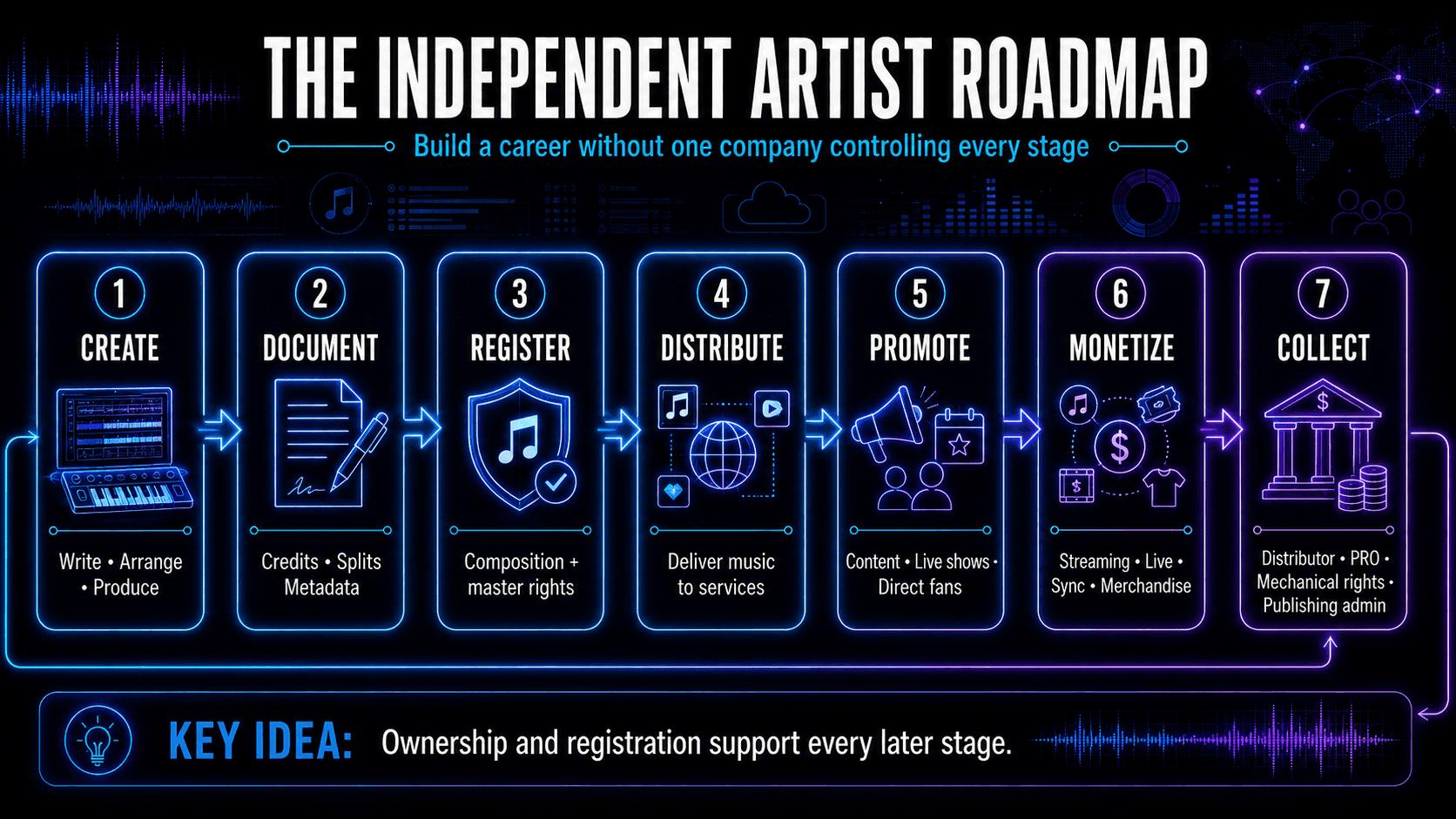
This independence does not mean artists must work alone. They may still collaborate with labels, managers, publishers, session musicians, and booking agents when those relationships provide useful expertise or scale. The difference is that creators can develop stronger recordings, test ideas, and establish an audience before giving another company control over their careers.
Frequently Asked Questions
How do independent creators collect all of their music royalties?
A digital distributor usually collects only certain royalties from streams and downloads. To collect other revenue, independent creators may also need to register with a performance rights organization such as ASCAP, BMI, or PRS for Music, use a publishing administrator, join the relevant mechanical rights organization, and register with services such as SoundExchange where applicable.
What is the difference between a traditional record deal, a 360 deal, and a distribution deal?
In a traditional record deal, the label usually finances recording and promotion in exchange for rights to the master and a share of revenue. A 360 deal may also give the label a percentage of income from touring, merchandise, endorsements, and other activities. A distribution deal is typically more limited, allowing artists to retain ownership while paying the distributor a fee or percentage to deliver and manage their music on digital platforms.
Why do streaming payouts vary between platforms?
Streaming services do not usually pay one fixed amount per stream. Payouts depend on factors such as subscription and advertising revenue, listener location, subscription prices in each market, and the artist’s share of total streams on the platform.
How does generative AI affect copyright in the music industry?
Generative AI raises questions about how copyrighted music is used to train AI systems, whether AI-generated works qualify for copyright protection, and how voice or likeness rights should be protected. Laws in these areas are still developing, so creators using AI tools should pay attention to licensing terms and the level of human creative input involved.