
Key Takeaways
- AI-generated music is not always copyrightable, especially when a full song is created by a tool with little or no human input. Human authorship still plays a major role in copyright protection.
- AI-assisted music has stronger copyright potential when the creator writes, edits, arranges, mixes, or transforms the output into a clearly human-led work.
- Training data, voice cloning, and soundalike vocals are major legal concerns, especially when AI tools use copyrighted material or imitate real artists without permission.
- Producers should keep project versions, check platform terms, avoid fully automated “one-click” songs, and use tools with clear commercial rights policies.
- ACE Studio offers a more creator-friendly AI workflow by giving musicians royalty-free AI voices and instruments for commercial projects, while still encouraging human control over melodies, lyrics, arrangements, and production choices.
The human authorship requirement
To answer whether AI-generated music can be protected, one must first understand the bedrock of global copyright law: the requirement of human authorship.
Historically, copyright offices—specifically the United States Copyright Office (USCO)—have maintained that copyright protection only extends to works created by a human being. This "Human Authorship Requirement" was famously tested in non-AI contexts, such as the "monkey selfie" case, where it was ruled that animals and machines cannot hold copyrights.
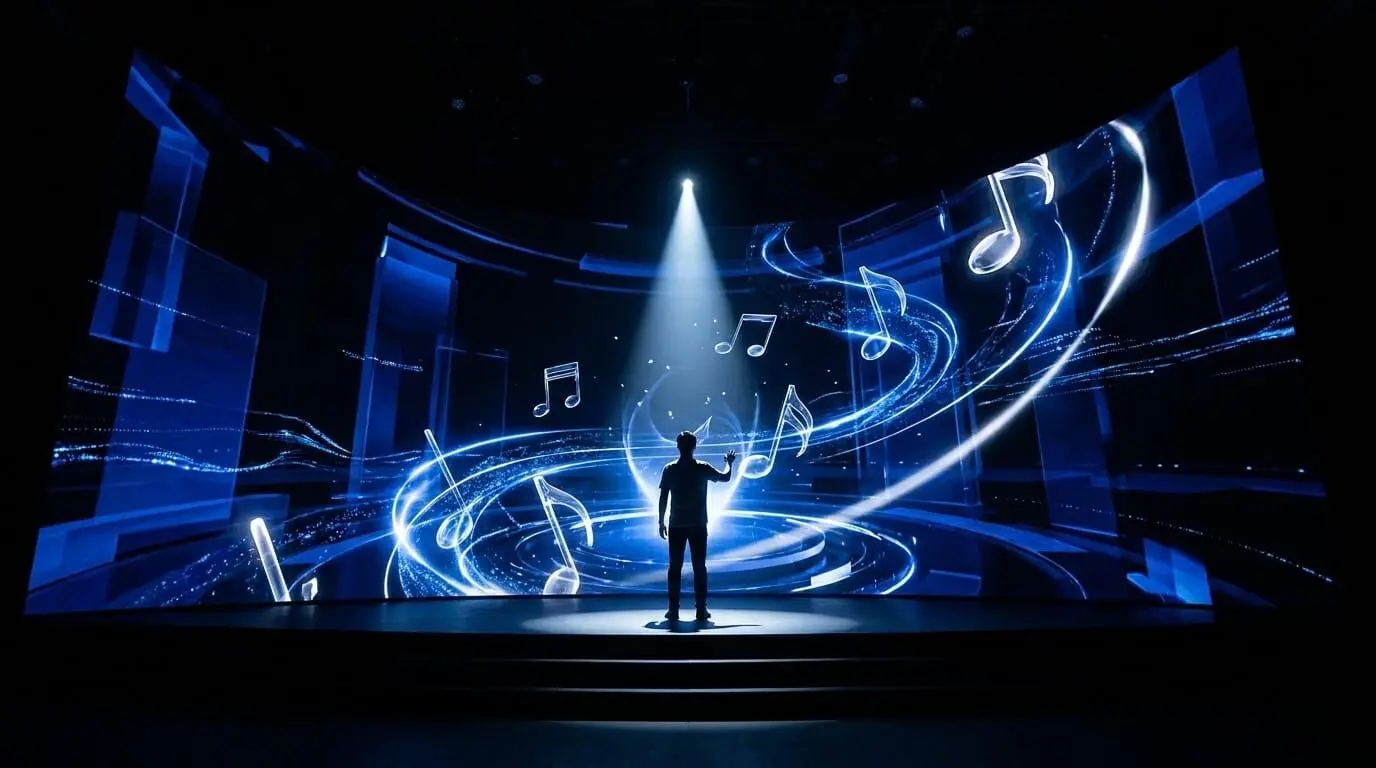
In the context of AI music copyright laws, this means that a file generated purely by an algorithm via a single text prompt (e.g., "Create a 120 BPM lo-fi hip hop beat") is generally ineligible for copyright protection. The output is considered to be in the public domain because it lacks the "creative spark" originating from a human mind.
Defining AI-generated vs. AI-assisted works
The distinction between AI-generated and AI-assisted works is the most critical factor in determining the legal status of AI music.
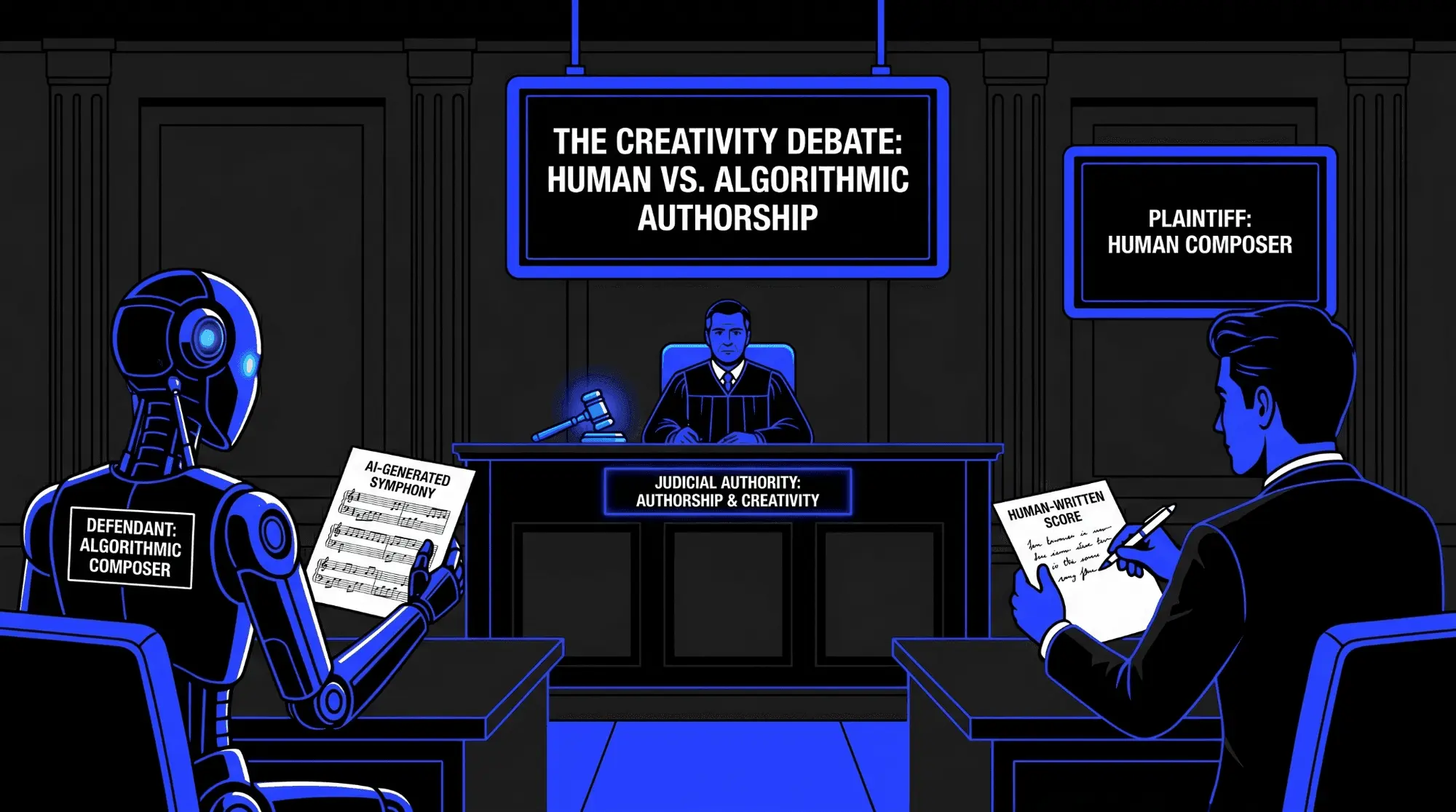
- AI-generated works: These are compositions where the AI provides the "traditional elements of authorship"—melody, rhythm, and harmony—without significant human intervention. Under current 2026 standards, these works are typically non-copyrightable.
- AI-assisted works: These involve a human creator using AI as a tool, much like a Digital Audio Workstation (DAW) or tools like ACE Studio. If a producer selects specific stems, rearranges AI-suggested chords, and mixes the final track, the human’s "creative contribution" may be sufficient to secure a copyright.
How AI generates music: Technical mechanisms and training data
To understand copyright issues in AI-generated music, one must understand how these models are built. Modern AI music platforms utilize Deep Learning, specifically Generative Adversarial Networks (GANs) and Transformers, to synthesize audio.
Machine learning and neural networks
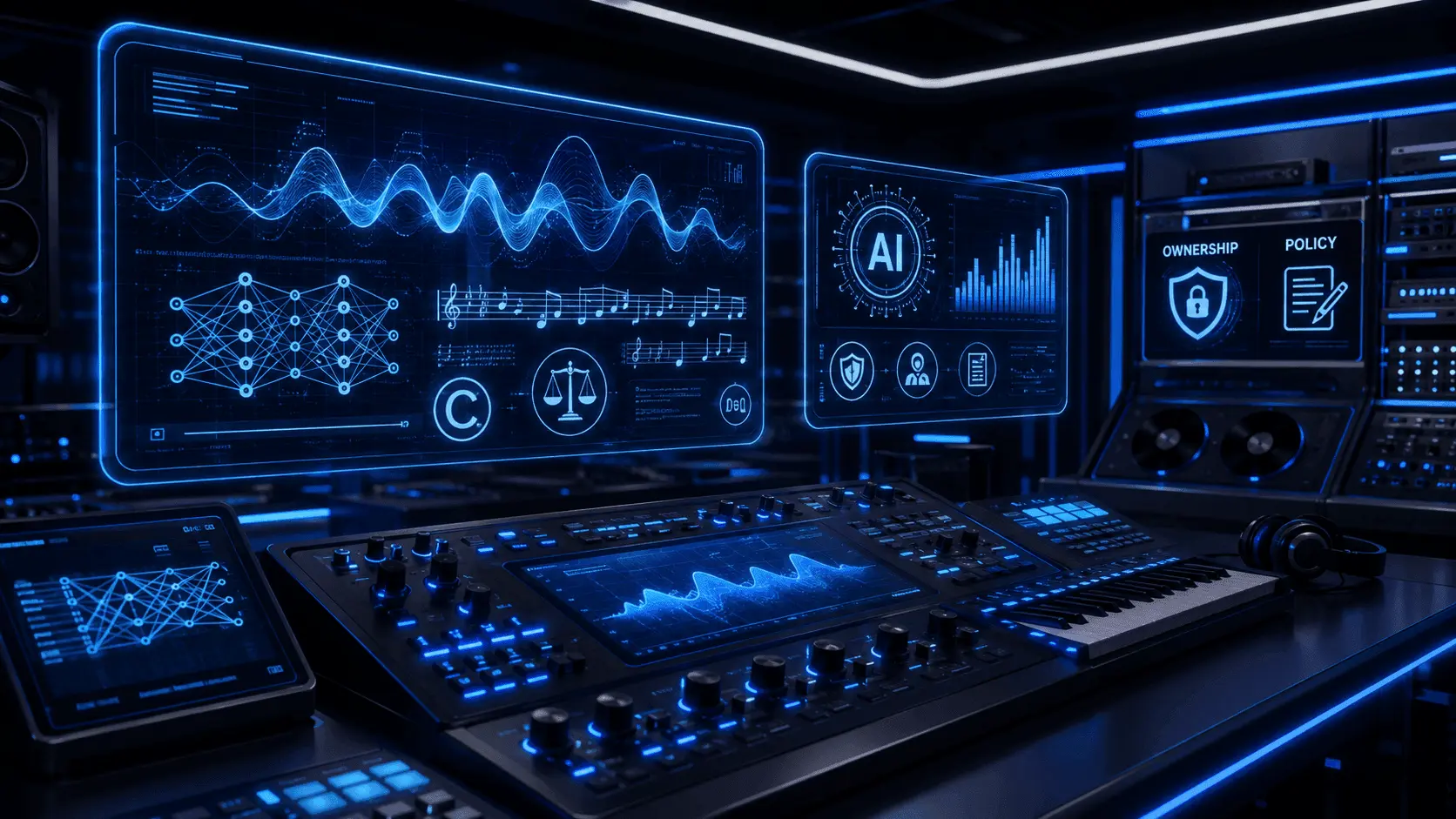
AI models do not "copy-paste" existing music. Instead, they analyze millions of tracks to identify statistical patterns in latent space. By understanding the mathematical relationship between a C-major chord and a G-major chord in a specific genre, the AI predicts the next most likely sequence of audio samples or MIDI notes.
The role of large-scale datasets
The controversy arises from AI music training data. Most high-performance models are trained on copyrighted catalogs. Rights holders argue that this "ingestion" constitutes copyright infringement, as the model is essentially deriving its capability from protected human works without compensation.
The global legal landscape: Current policies and emerging frameworks
As of 2026, the global approach to music rights for AI compositions remains fragmented but is rapidly coalescing around transparency.
United States Copyright Office (USCO) rulings
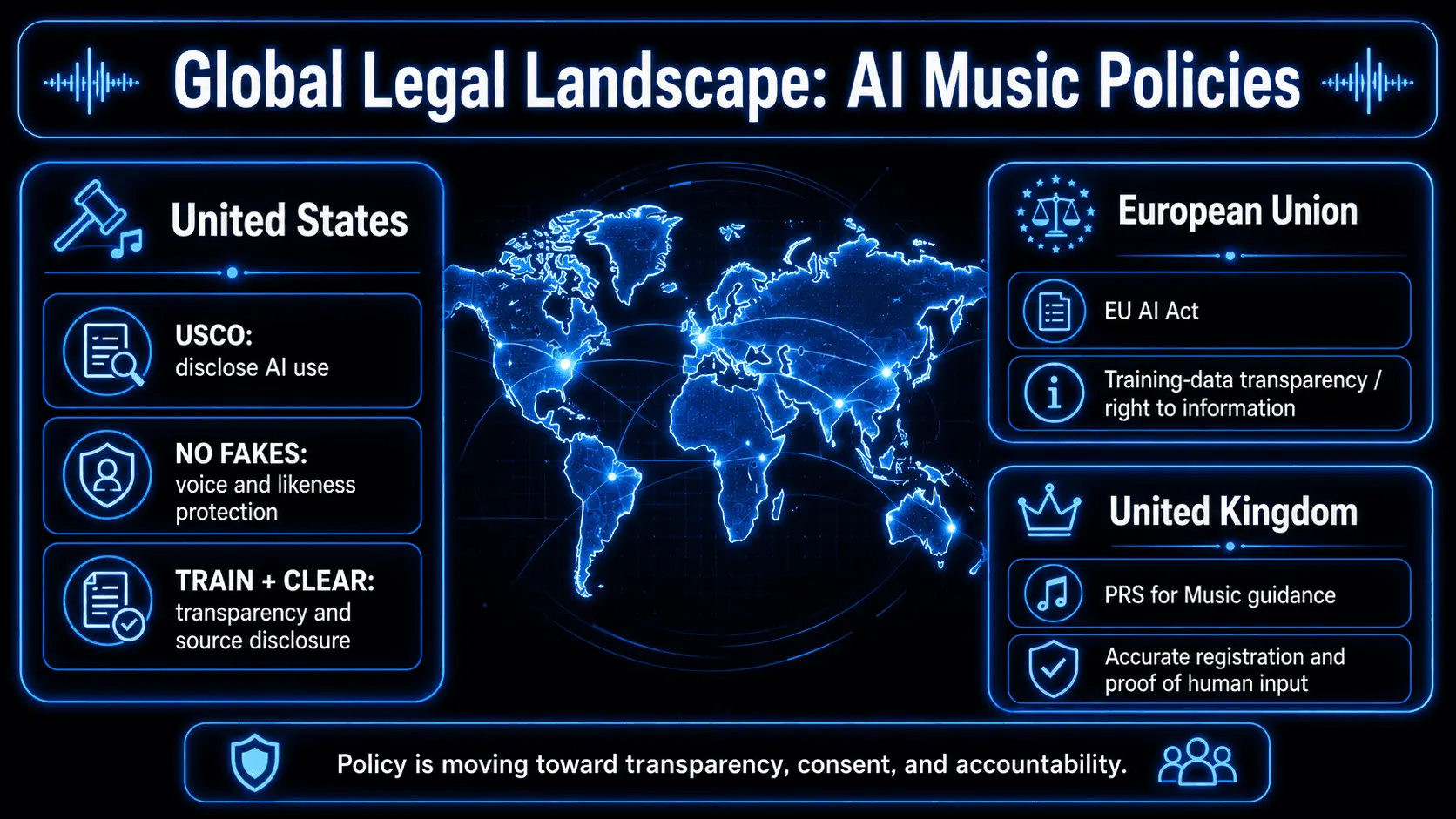
The USCO has issued several key guidance documents stating that applicants must disclose the use of AI in their registrations. If the AI contribution is more than "de minimis" (minimal), it must be disclaimed. Only the human-authored portions of the work will receive protection.
PRS for Music (UK) AI Policy Summary
The UK’s PRS for Music has been a leader in establishing clear guidelines for its members. Their 2026 policy focuses on:
- Registration Accuracy: Members must specify if a work is "AI-assisted."
- Transparency: Creators must be able to prove the extent of their human input if a registration is challenged.
- Detection: PRS utilizes advanced "audio fingerprinting" to identify tracks that are 100% machine-generated to prevent fraudulent royalty claims.
The European Union (EU AI Act)
The EU has taken a "Right to Information" approach. Under the EU AI Act, companies must provide a detailed summary of the copyrighted data used to train their music models, allowing artists to opt-out or negotiate licensing fees.
Key Legislation: The NO FAKES, TRAIN, and CLEAR Acts
The year 2026 has been a landmark for music advocacy, driven by three pivotal pieces of legislation aimed at protecting human creativity. Together, these acts reflect a broader legal shift toward transparency, consent, and accountability in the way AI music tools are trained, used, and released.
The NO FAKES Act (Nurture Originals, Foster Art, and Keep Entertainment Safe)
This act focuses on digital replicas. It provides a federal right to control one’s voice and likeness. In the age of "AI Drake" and "AI Weeknd," this law ensures that AI cannot be used to impersonate a human artist’s unique vocal identity without explicit consent.
The TRAIN Act (Transparency in Reporting of AI Numbers)
The TRAIN Act requires AI developers to maintain "training logs". If an AI music SaaS company uses a specific artist’s catalog to fine-tune its model, that artist has the right to know. This promotes visibility into AI systems and prevents "black box" development.
The CLEAR Act (Copyright Liability and Enforcement for AI Resources)
The CLEAR Act addresses copyright infringement and AI music by requiring AI companies to be upfront about their sourcing. It mandates that AI-generated content be watermarked with metadata, ensuring that users and platforms can distinguish between human and machine creations.
Music Royalties in the Age of Artificial Intelligence
Royalties have always depended on a clear chain of rights: someone writes the song, someone records it, and different parties collect income when that music is streamed, licensed, performed, or reused. AI makes that chain harder to follow because one track can now include human-written lyrics, AI-assisted melodies, synthetic vocals, generated instrument parts, edited stems, and a final mix shaped inside a DAW.
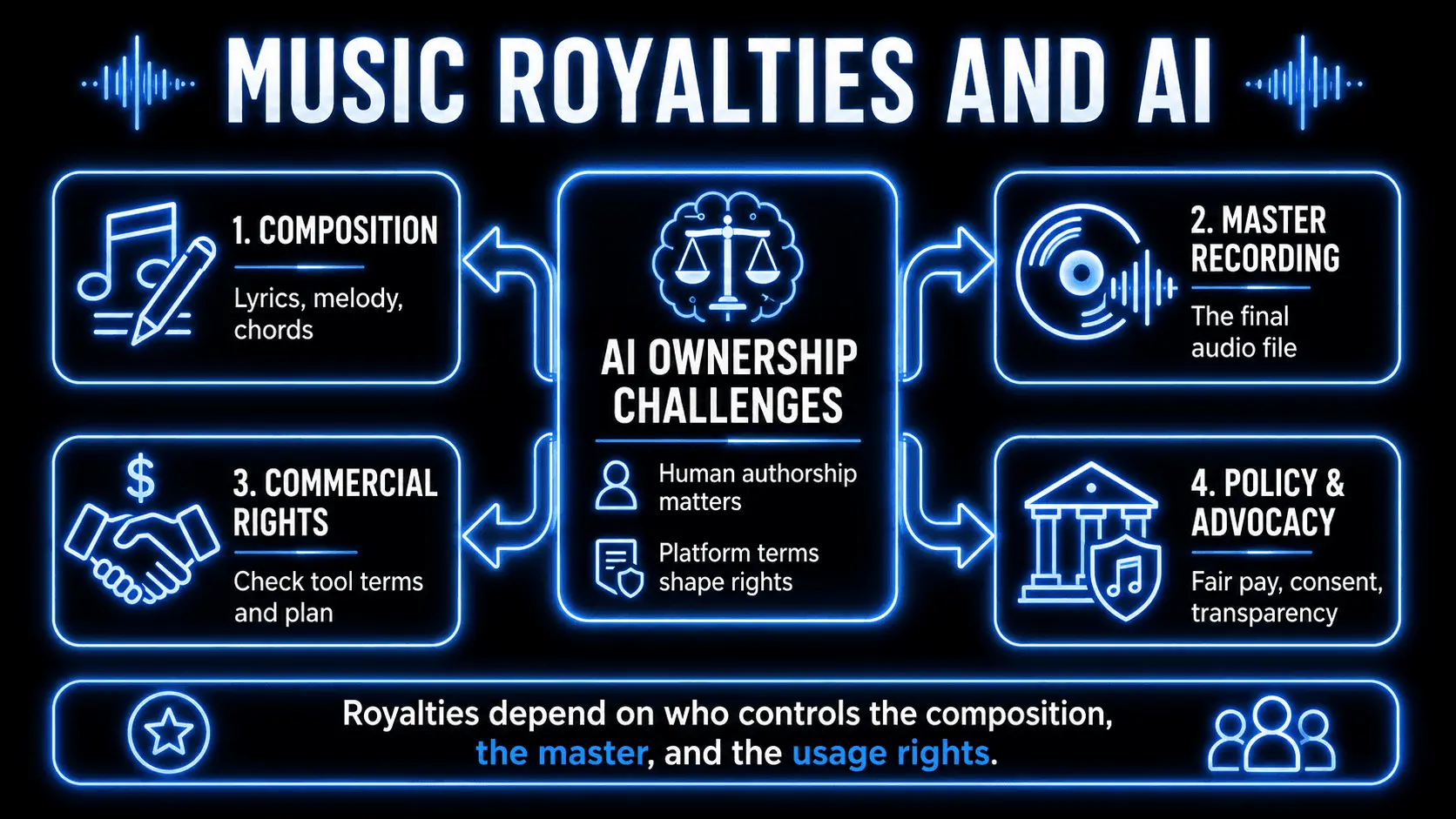
That does not mean royalties disappear. It means creators need to understand which part of the song they are talking about. In most cases, AI music royalty questions still come back to two core rights: the composition and the master recording. Each one is affected differently by AI, and each one needs to be handled with care before a track is released commercially.
Composition and Songwriting: The Underlying Work
The composition is the song itself: the melody, lyrics, chord structure, and musical ideas that could be performed in many different versions. This is the side of music that songwriters, lyricists, composers, and publishers usually register with Performance Rights Organizations such as ASCAP, BMI, SESAC, PRS for Music, or similar societies in other countries.
AI creates uncertainty here because copyright protection still depends heavily on human authorship. If a producer writes the lyrics, shapes the melody, arranges the chords, and uses AI only to test or refine ideas, the human contribution is easier to identify. But if the AI creates the main melody and lyrics with little meaningful editing, there may be no clear copyrightable composition to register. For producers, the safest approach is to keep their creative role visible through drafts, lyric notes, MIDI files, arrangement changes, and clear human edits.
Master and Sound Recording: The Master
The master is the specific recorded version of the song: the final audio file that listeners hear on streaming platforms, YouTube, social media, ads, games, or sync placements. While the composition covers the underlying song, the master covers the actual recording, including the vocal sound, instrumental layers, production choices, mix, and exported audio.
AI affects master rights because different platforms handle output ownership in different ways. Some tools may restrict commercial use, claim certain rights, or apply different terms depending on the plan, model, voice, or feature used.
The Recording Academy’s leadership: GRAMMYS On The Hill 2026
The Recording Academy has taken a more active role in shaping AI music policy, using GRAMMYS 2026 advocacy efforts to push for stronger protections around authorship, consent, and compensation. Rather than treating AI as only a technical issue, the organization frames it as a creator-rights issue that affects artists, producers, songwriters, and performers across the industry.
Key issues at GRAMMYS 2026:
- Protecting human-centric awards: The Recording Academy continues to emphasize that GRAMMY recognition should reward human creativity, even when AI tools are part of the production process.
- Federal Right of Publicity: Advocates are pushing for clearer national protections against unauthorized AI voice cloning, digital replicas, and soundalike performances.
- Fair compensation: Music leaders are calling for licensing systems or compensation models when artists’ recordings, voices, or catalogs are used to train AI music models.
Legal implications: Copyright infringement risks
Using AI music tools without a clear understanding of the legal status of AI music can lead to significant liability. This is especially important for producers who release AI-assisted tracks commercially, because infringement risks can arise from melodies, samples, vocal likenesses, training data, or outputs that resemble existing copyrighted works too closely.
Derivative works and substantial similarity
If an AI generates a melody that is "substantially similar" to a copyrighted song, the user—not necessarily the AI company—may be liable for infringement. Because AI models are probabilistic, they occasionally "hallucinate" or regurgitate specific sequences from their training data.
The "generative soundalike" dispute
In early 2026, a major label sued an independent producer for using an AI-generated vocal that mimicked a legendary soul singer. Even though the lyrics were original, the court ruled that the "vocal timbre and stylistic affectations" were protected under the NO FAKES Act, resulting in a significant settlement.
Practical guidance for producers and saas users
Navigating AI music copyright laws effectively means treating every AI-assisted project as both a creative work and a rights-management process. Producers should be able to show where their own human input begins, understand what their chosen platform allows, and avoid workflows that leave ownership or originality unclear.
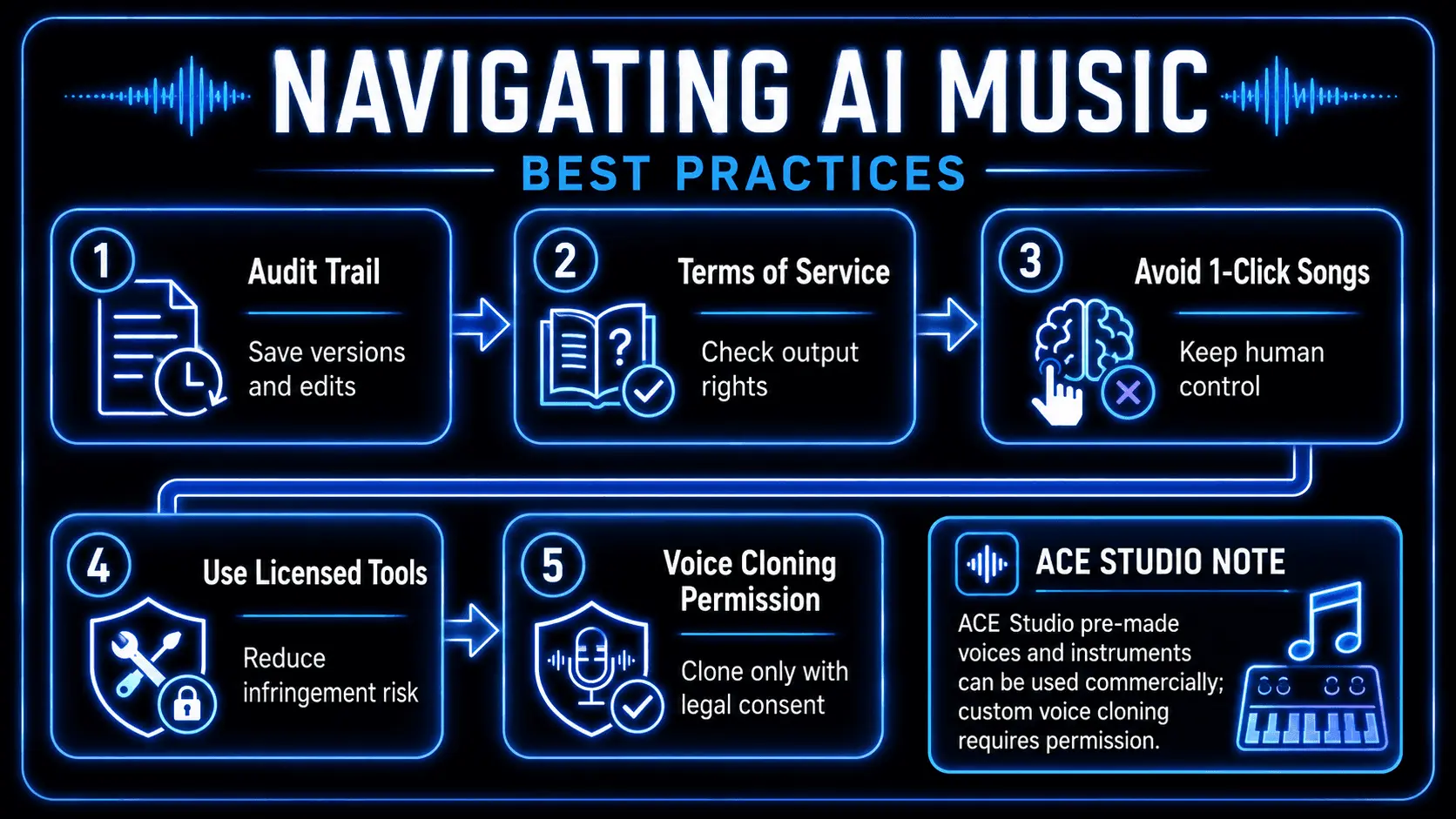
The following practices can help reduce legal uncertainty and make your AI-assisted music easier to document, register, release, and monetize:
- Maintain an "audit trail": Save versions of your project. Show the progression from a raw AI stem to a polished, human-mixed track. This serves as evidence of "human authorship."
- Check Terms of Service (ToS): Not all AI music platforms are created equal. Ensure your SaaS provider explicitly grants you the rights to the output.
- Avoid "1-Click" hits: Use AI for inspiration (chord suggestions, drum patterns) rather than generating a complete 3-minute song with no edits.
- Use licensed tools: Opt for AI models trained on licensed, royalty-free, or "ethical" datasets to minimize the risk of "training data infringement."
A more creator-friendly way to make AI music with ACE Studio
One reason AI music copyright feels confusing is that not every AI music tool gives creators the same level of clarity. Some platforms generate a complete track in seconds, but leave users wondering who owns the master, whether the sound was trained on protected material, and whether the result can safely be released.
ACE Studio supports both song generation and detailed music production, giving creators options to shape their work beyond the initial output. With Inspire Me, creators can generate songs from text descriptions or lyrics, then choose whether to develop the results further. A producer can write a melody, add lyrics, choose an AI voice, build harmonies, create choir parts, or use AI instruments from MIDI. In ACE Studio 2.0, the platform also includes tools like Voice Cloning, Stem Splitter, Audio to MIDI, AI instruments, Generative Kits, and ACE Bridge for connecting with classic DAWs.
That matters in a copyright discussion because the creative process is more visible. In MIDI-driven vocal and instrument workflows, the producer works with musical parts that can be edited, arranged, and refined. Vocals can be shaped through pitch, timing, phrasing, vibrato, breath, and expression. Instrumental parts can be built from MIDI and adjusted to fit the song. Choirs, layers, and generated ideas can become part of a broader production rather than the entire creative decision.
ACE Studio also helps reduce one of the biggest concerns around AI music releases: unclear commercial rights. Its pre-made AI voices and AI instruments are royalty-free for commercial projects, so producers can publish, distribute, and monetize music made with those royalty-free models without paying additional royalties. That includes uses like streaming, YouTube, advertising, games, and client work. This does not mean every possible use is automatically “copyright-free,” but it does give musicians a cleaner starting point than tools with vague output policies.
There are still limits producers should understand. If you train a custom voice, the rights depend on the recordings and permissions behind that voice. ACE Studio allows users to clone their own voice or a voice they have explicit legal permission to use, but unauthorized cloning of another person’s voice is not allowed. The same common-sense rule applies to stems and samples: if the source audio belongs to someone else, splitting or transforming it does not erase the original copyright.
For musicians trying to answer is AI music copyrighted, ACE Studio is useful because it sits closer to a creative production tool than a replacement for authorship. It gives producers access to royalty-free voices and instruments, while still leaving room for their own melodies, lyrics, arrangements, performances, and final production choices. In a space where copyright depends heavily on human contribution and clear usage rights, that balance is exactly what many creators are looking for.
Frequently Asked Questions
Can I register a song with the Copyright Office if I used AI to help write the lyrics?
Yes, but you must disclose it. You will only own the copyright to the lyrics if you can prove you "exercised sufficient creative control" over the final version (e.g., rewriting 50% of the AI's output).
What happens if I register works generated only by an AI tool?
If the Copyright Office determines the work was generated solely by AI without human intervention, the registration may be cancelled, and the work will enter the public domain. False or misleading registrations can lead to penalties and loss of credibility with PROs like PRS or ASCAP.
Will I own the rights if I use a stem splitter?
Stem splitting is considered a "technical process" rather than a "creative composition." You own the rights to the original recording you are splitting, but the act of splitting doesn't create a new copyrightable work.
How does the TRAIN Act affect me as a producer?
It gives you the right to see if your uploaded music was used by AI companies to train their models, potentially allowing you to claim a share of the "training royalties."