
What is a beat in music? An essential guide

Key Takeaways
- A beat in music is the steady pulse that keeps a song moving, much like a heartbeat or footsteps that listeners can tap along to.
- Beat, rhythm, and tempo are related, but not the same: the beat is the pulse, rhythm is the pattern built around it, and tempo is the speed of that pulse.
- Different genres use beats in different ways, from steady pop and EDM grooves to more complex jazz, hip-hop, Afrobeat, and progressive rhythms.
- Time signatures shape how beats are grouped, which is why 4/4 feels familiar and danceable, 3/4 feels flowing, and unusual patterns like 5/4 or 7/8 feel more unexpected.
- ACE Studio can help producers build around the beat by turning MIDI ideas into expressive vocals, AI instruments, rhythmic layers, and prompt-based musical starting points that can be edited and refined.
The steady pulse behind every song
At its simplest, a beat in music is like a steady heartbeat that keeps everything moving in time. Imagine tapping your foot while listening to a song—each tap matches the beat, giving the music a consistent pulse.
You can think of it like walking: every step you take follows a regular pattern, just like beats in a song. The speed of those steps, whether slow like a relaxed stroll or fast like a run, represents the tempo, which tells you how quickly the beat moves. Beats are also grouped in patterns, often counted as “1-2-3-4,” which helps organize the music and is known as the time signature.
A metronome, which clicks at a steady rate, is a perfect example of how a beat works, acting like a guide to keep musicians on track. Whether it’s a slow, emotional ballad or a fast, energetic dance track, the beat is always there in the background, quietly guiding the rhythm and helping everything stay in sync.
Importance of beat in music
Beyond just keeping time, the beat plays a major role in shaping different types of music. For example, many pop songs use a steady “1-2-3-4” pattern that feels familiar and easy to follow, while jazz often uses more complex, off-beat rhythms that feel looser and more creative.
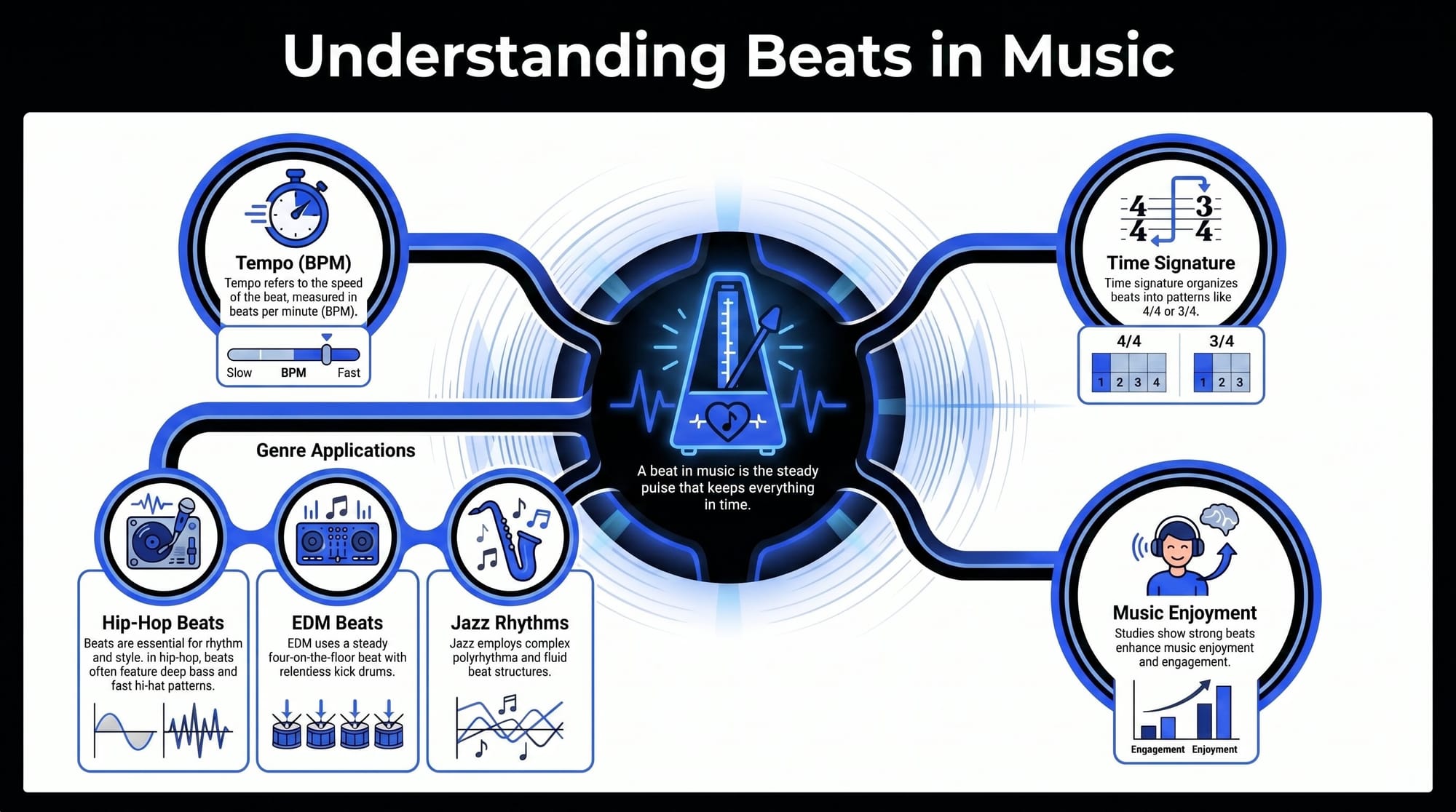
Research, such as studies from Spotify, shows that songs with strong, clear beats are often more enjoyable to listen to repeatedly, which shows how powerful rhythm can be. By changing how beats are grouped or how fast they move, producers can create different moods and experiences, making a song feel exciting, relaxed, or even unpredictable.
In this way, the beat doesn’t just keep music in time—it helps define its style and guides the listener through the entire musical journey.
What is a steady beat?
A steady beat in music provides a consistent pulse that guides the tempo and rhythm of a composition. Think of it as the clock that keeps everyone in sync, whether it's the drummer in a band or the metronome in your DAW. This pulse is crucial in defining what is a beat in music, as it sets the foundation for the groove and feel of the piece.
In genres like EDM or hip-hop, the steady beat often manifests through the kick drum, delivering a reliable thump that anchors the track. Without this regular pulse, maintaining a cohesive structure becomes challenging, similar to trying to dance without a clear rhythm to follow. In essence, a steady beat ensures that all musical elements move harmoniously, creating engagement and flow in the music.
Examples of beats in different music genres
Understanding what is a beat in music requires exploring its diverse manifestations across genres.
In hip-hop, the beat is the foundation of the entire track, often built with deep 808 bass and fast, detailed hi-hat patterns that drive the rhythm forward—something you can clearly hear in songs by Kendrick Lamar, where the beat supports and enhances the flow of the lyrics.
In contrast, EDM relies on a steady four-on-the-floor beat, propelling the energy of the dance floor with relentless kick drums. The pulsating rhythm drives festival-goers into a frenzy during the drop.
Meanwhile, in Jazz, beats take on a more fluid form, often challenging traditional time signatures and embracing complex polyrhythms, offering a playground for improvisation. Each genre's unique approach to beats not only shapes its musical identity but also exemplifies the diverse answers to what is a beat in music.
Beat structure and musical pulse
To better understand beat structure and musical pulse, it helps to look at real songs you may recognize. In a 4/4 time signature, which is the most common in modern music, the beat is counted as “1-2-3-4” repeatedly, creating a steady and predictable groove. For example, songs like “Shape of You” by Ed Sheeran or “Uptown Funk” by Mark Ronson featuring Bruno Mars follow this structure, making them easy to clap or dance along to.
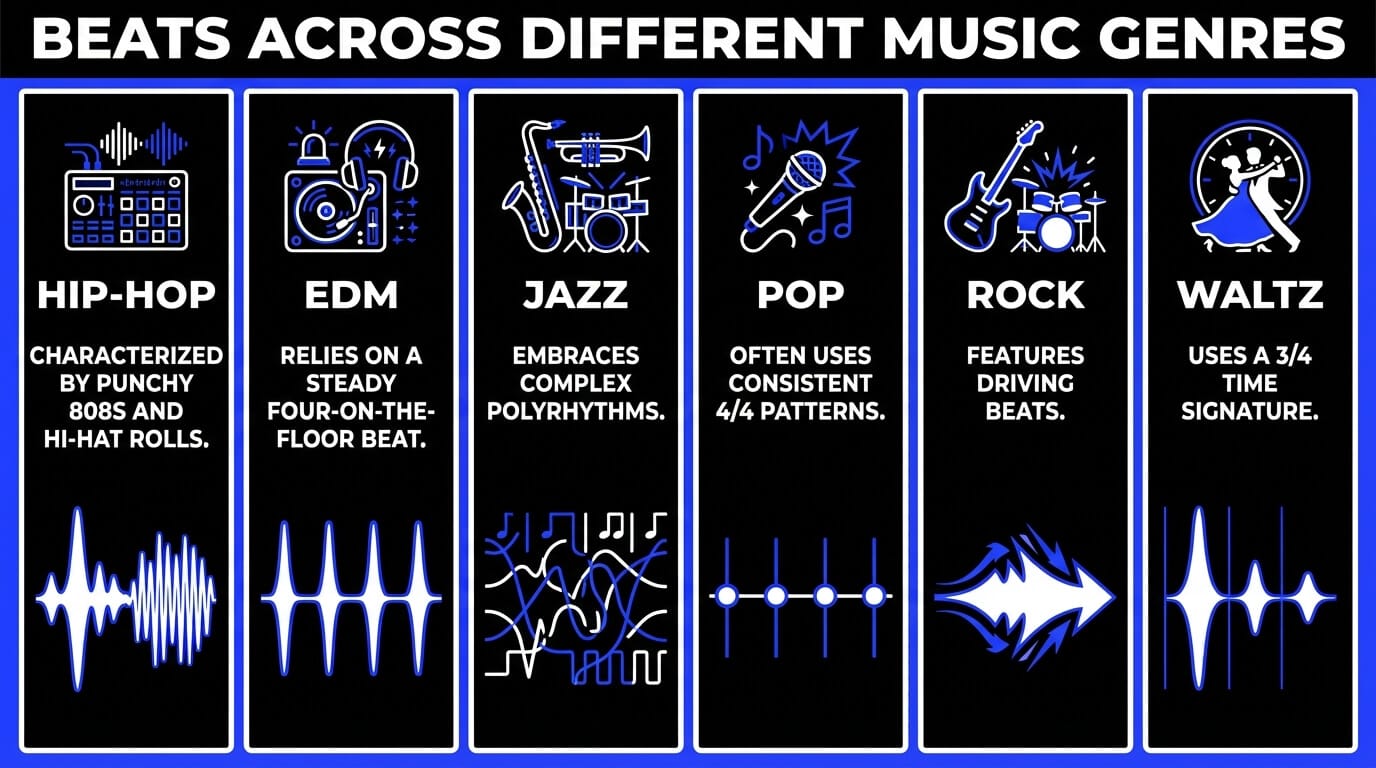
In contrast, a 3/4 time signature has a “1-2-3” pattern that creates a swaying, waltz-like feel. A classic example is “The Blue Danube” by Johann Strauss II, where you can feel the music gently flowing in three beats per measure. Another modern example is “Perfect” by Ed Sheeran, which also uses this softer, rolling rhythm.
There are also songs that experiment with unusual beat structures. For instance, “Take Five” by Dave Brubeck uses a 5/4 time signature, counted as “1-2-3-4-5,” giving it a distinctive and slightly off-balance feel compared to typical pop songs. These examples show how changing the number of beats in each measure can completely transform the groove and emotional feel of a piece of music.
Why teaching rhythm and beat matters
Understanding what is a beat in music is crucial for any aspiring producer or musician. Rhythm and beat form the backbone of every track, providing a structured framework upon which melodies and harmonies are built. Much like a heartbeat keeps our bodies in sync, a solid beat keeps a composition coherent and lively.
According to a study by the National Association for Music Education, students who grasp the concept of musical rhythm and different types of beats in music demonstrate improved cognitive abilities, showcasing better pattern recognition and problem-solving skills. Moreover, learning how to manipulate rhythm and beat can transform a basic loop into a dynamic piece of art, bridging the gap between amateur and professional production.
By mastering elements like time signature in music and understanding the nuances of tempo definition, producers can create tracks that not only capture attention but also evoke emotion and movement.
Is rhythm the same as beat?
While often used interchangeably, rhythm and beat are distinct elements in music. The beat serves as the foundation—a steady pulse you tap your foot to, anchoring the track's tempo. But rhythm refers to the pattern of sounds and silences woven over that beat.
Consider a drum pattern in a hip-hop track: the beat is the consistent boom-bap feel, while the rhythm can introduce complex hi-hat rolls and syncopated snare hits.
Understanding what is a beat in music helps in distinguishing between these elements, allowing for greater precision in production and arrangement. A classic example is the iconic "Billie Jean," where the beat remains steady, but Michael Jackson's vocal rhythms dance around it, creating a dynamic interplay.
Is tempo the same as beat?
While tempo and beat might seem interchangeable, they serve distinct roles in music production. The tempo is essentially the heartbeat of a track, determining how fast or slow the musical rhythm flows. It's typically measured in beats per minute (BPM).
For instance, a tempo of 120 BPM suggests that the track has 120 beats within a minute, often associated with dance genres. On the other hand, a beat is the fundamental unit of time in a composition, akin to the ticks of a clock.
Understanding the difference between these elements is crucial when crafting a track, as they influence both the energy and mood. For example, a track with a slower tempo and a steady beat might evoke a more relaxed vibe, while a faster tempo with a driving beat can create an energetic dance floor anthem.
Evolution of beats in music
When exploring the evolution of beats in music, it helps to see them not just as timing tools, but as reflections of culture and history. In early human societies, rhythm began with simple percussion—like the tribal drumming traditions found across Africa—where beats were used to communicate, celebrate, and tell stories. These complex rhythmic patterns laid the groundwork for many modern musical styles, showing that the beat has always been deeply tied to human expression.
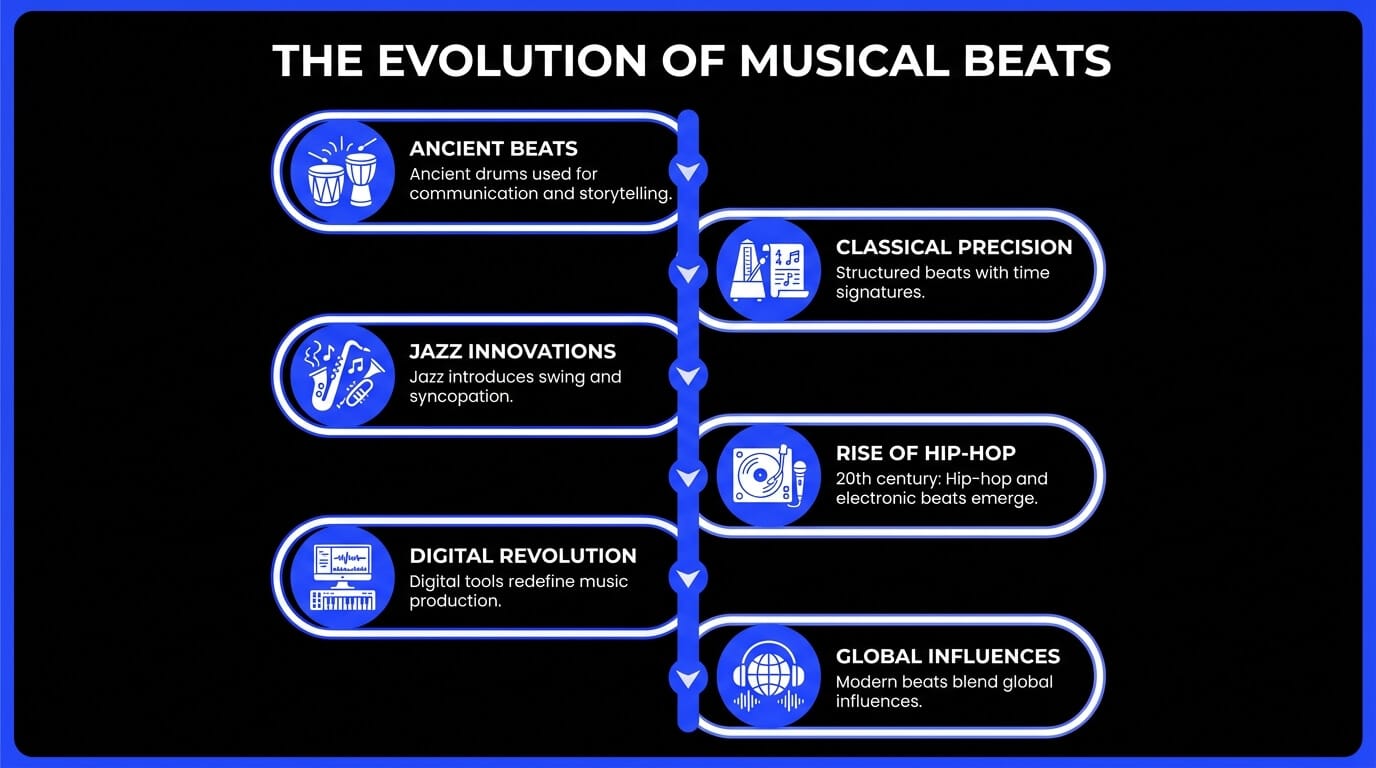
As music developed in the Western world, especially during the era of classical composers like Ludwig van Beethoven, beats became more structured and precise. Time signatures such as 4/4 and 3/4 were formalized, allowing composers to carefully control rhythm and emotion within their compositions. This shift helped shape how we understand musical pulse today, turning rhythm into something both mathematical and expressive.
Moving into the 20th century, genres like jazz began to reshape the role of the beat. Artists such as Duke Ellington introduced swing and syncopation, where beats were intentionally shifted or accented in unexpected ways. This gave music a more relaxed and dynamic feel, opening the door for improvisation and creativity.
In modern music, the beat has become even more central and versatile. Hip-hop and electronic music, driven by producers and artists like Kanye West, rely heavily on programmed rhythms, layered sounds, and digital tools to create entirely new sonic experiences. Today, beats cross cultural boundaries, blending influences from around the world and continuing to evolve. From ancient drums to digital production, the beat remains the driving force behind music’s ability to connect, move, and inspire people across generations.
How ACE Studio helps you build around the beat
Once you understand what a beat is in music, the next step is learning how to build around it. ACE Studio can help with that by giving producers and songwriters a practical way to create musical parts that follow the beat while still feeling expressive and human-shaped.
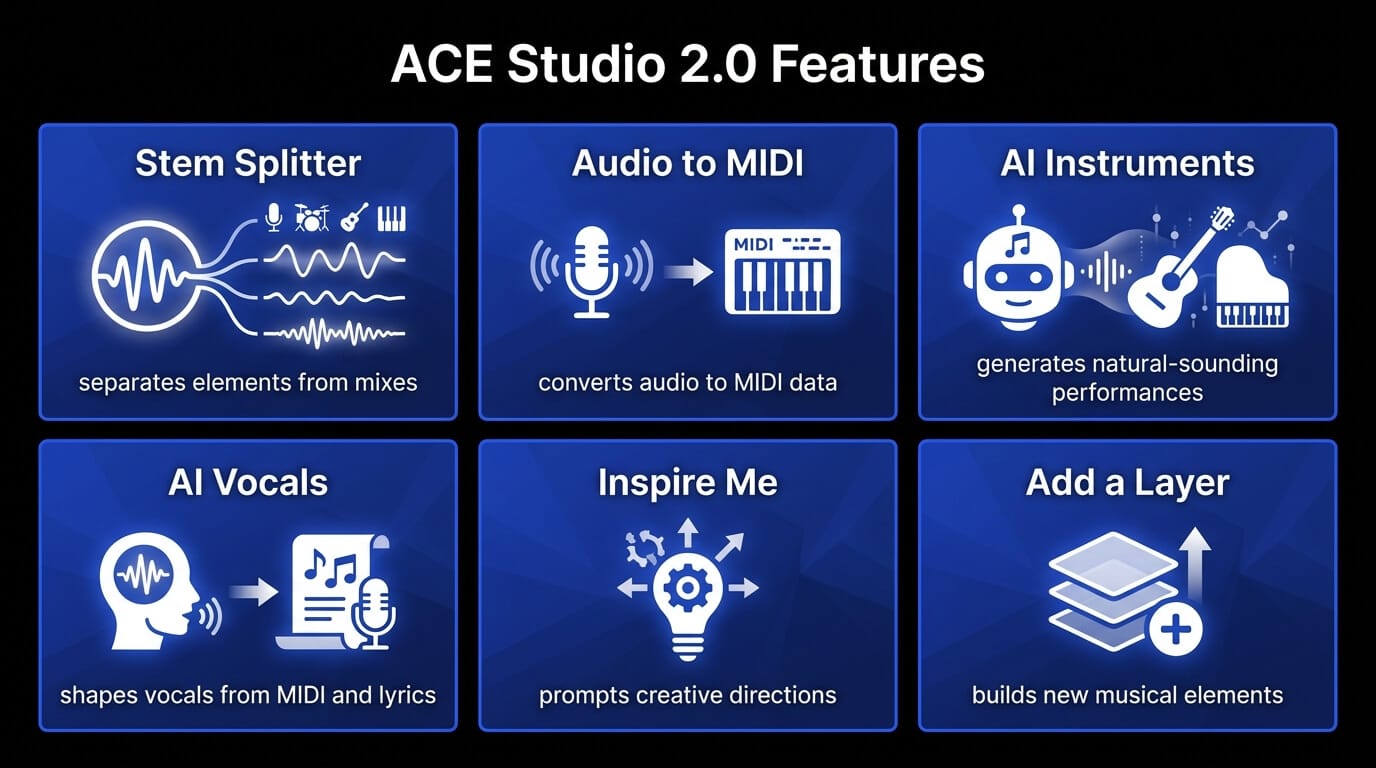
For example, you can start with a simple MIDI melody that matches your song’s tempo, add lyrics, and use ACE Studio to turn it into an AI vocal performance. From there, you can adjust the timing, pitch, breath, and emotion so the vocal sits naturally with the beat. This is useful because vocals do not always land exactly on the pulse. Sometimes they feel better slightly ahead of the beat, slightly behind it, or stretched across it for more tension.
ACE Studio also works beyond vocals. Its AI instruments let you create instrument parts from MIDI, so you can shape strings, brass, or other sounds around the rhythm of your track. If the beat is slow and spacious, you might write longer notes that glide over it. If the beat is fast and energetic, you might use shorter phrases that support the groove.
ACE Studio also includes prompt-based tools that can help when you need a starting point for a beat-driven idea. Instead of building every layer from scratch, you can describe the kind of musical support you want, such as a soft background texture, a stronger rhythmic layer, or a more energetic section. It can then generate ideas that you can keep, edit, or replace. The creative decision still stays with you: the prompt starts the idea, but you shape the final sound.
The main idea is simple: ACE Studio does not create the song for you. You choose the beat, tempo, melody, lyrics, and arrangement. The software gives you tools to hear your ideas faster, refine how each part fits the pulse, and shape performances that support the feeling of the track.
Conclusion: the beat goes on
In the end, understanding what a beat is in music is like discovering the heartbeat that keeps a song alive. It’s the driving force behind musical rhythm, guiding both musicians and listeners through the flow of a track, no matter the genre. Whether it’s the steady pulse of a rock anthem or the complex, shifting rhythms found in jazz, the beat provides the structure that holds everything together. You can think of it as the foundation or “skeleton” of a song—without it, melody, harmony, and lyrics would feel disconnected and hard to follow.
The wide variety of beats in music also reflects the richness of different cultures and styles. For example, a standard 4/4 beat, commonly heard in songs by bands like Imagine Dragons, creates a familiar and accessible groove, while more complex patterns like 7/8, often explored by progressive bands such as Tool, offer a more unusual and dynamic listening experience. Each variation brings its own character, but all rely on the beat to guide the listener through the music.
Ultimately, the beat is what allows music to connect across time, cultures, and emotions. By understanding and experimenting with it, musicians and producers can create songs that feel engaging, expressive, and memorable—ensuring that no matter how music evolves, the beat truly goes on.
Frequently Asked Questions about beats in music
How can I find the beat in a song if I cannot hear it right away?
A simple way to find the beat is to listen for the most consistent part of the song, usually the kick drum, snare, or bass. Try tapping your foot naturally while the music plays. Try to start counting “1-2-3-4” along with the song helps train the ear to identify the pulse more clearly over time.
Can a song have more than one beat?
A song normally has one main beat that acts as the foundation, but some music can feel like it has multiple beats because of layered rhythms. Genres such as jazz, Afrobeat, and progressive music often use polyrhythms, where different instruments play contrasting rhythmic patterns over the same steady pulse.
Why do some songs feel harder to follow than others?
Songs can feel harder to follow when they use syncopation, unusual time signatures, or off-beat accents. Instead of placing emphasis on the expected counts, some producers intentionally shift the rhythm to create tension or movement. This can make the beat feel less obvious, especially for new listeners.
Is the beat always played by the drums?
Not always. While drums often make the beat easier to hear, the beat can also be carried by bass, piano, guitar, or even vocals. In acoustic or classical music, the beat may be implied rather than clearly played by percussion, which is why some songs require more careful listening.
Can the beat change in the middle of a song?
Yes, some songs change the beat during different sections. A producer might slow down the groove, speed it up, or switch the time signature to create contrast between verses, choruses, or bridges. This is less common in mainstream pop but often used in progressive, cinematic, or experimental music.
What is the difference between beat and groove?
The beat is the steady pulse of the music, while groove is how that beat feels. Groove comes from the subtle timing, accents, and interaction between instruments. Two songs can have the same tempo but feel completely different because of the groove created by the musicians or producer.
Why is learning the beat important for beginners?
Understanding the beat helps beginners stay in time, play with other musicians, and build stronger rhythm skills. Whether someone wants to sing, produce, or play an instrument, recognizing the beat makes it easier to understand how music is organized and how each part fits together.
Can practicing with a metronome improve beat recognition?
Yes. A metronome trains your ear to hear a consistent pulse and helps develop better timing. Many professional musicians recommend practicing with a metronome because it strengthens internal rhythm and makes it easier to lock into the beat naturally when listening or performing.