
Key takeaways
- Tempo is the speed of a piece of music, usually measured in BPM, but it also shapes the emotion, energy, and overall feel of a track.
- Faster tempos often create movement, urgency, and excitement, while slower tempos leave more space for emotion, atmosphere, and expressive performances.
- Tempo and rhythm are not the same: tempo controls how fast the music moves, while rhythm controls how sounds are arranged within that timing.
- Small tempo changes can make a big difference, so producers should experiment with BPM instead of treating the first tempo choice as final.
- Tools like DAWs and ACE Studio make it easier to shape tempo in real production workflows, from syncing MIDI and vocals to refining timing, phrasing, layers, and performance feel.
What tempo really means in music
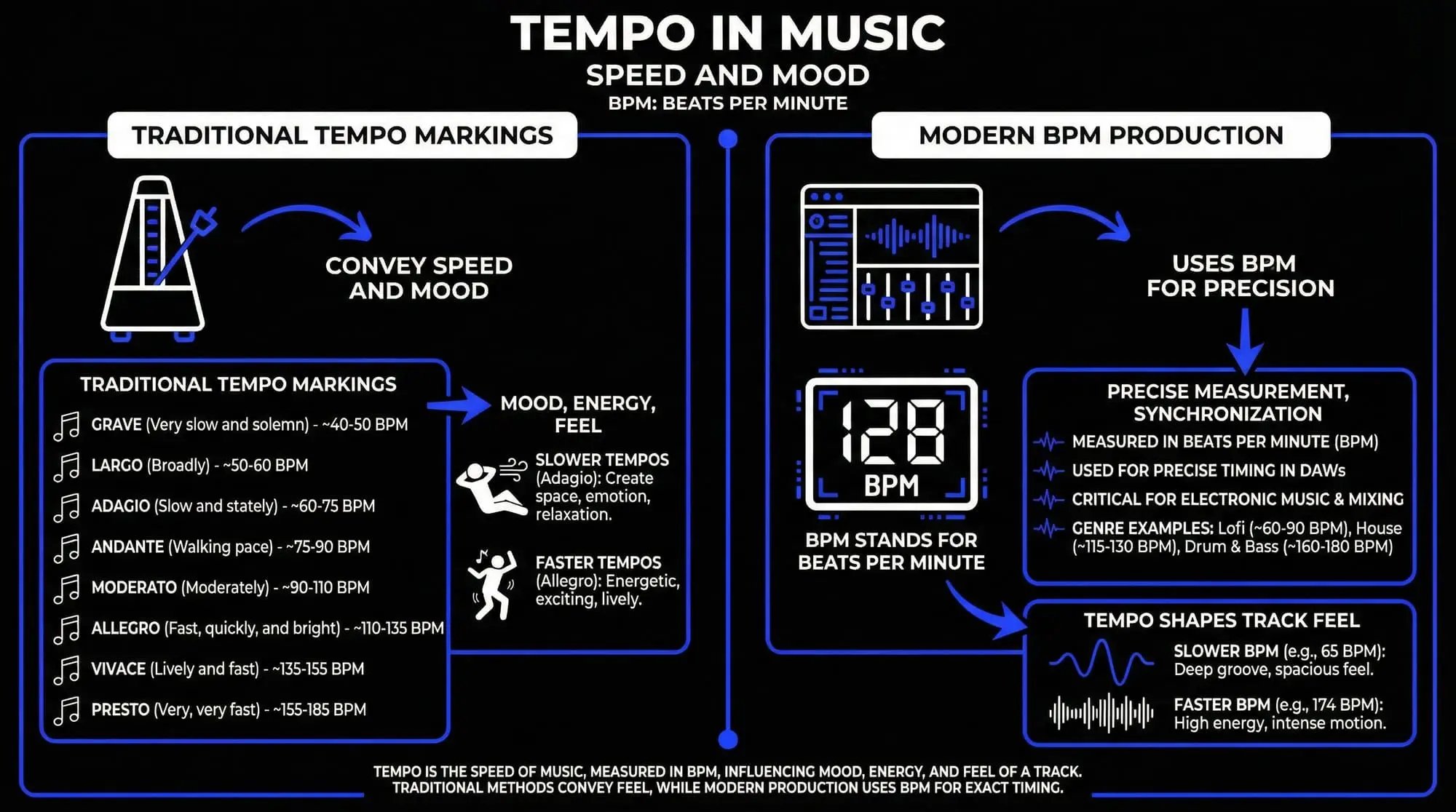
Tempo is the speed at which music moves. It determines how fast or slow a track feels and is typically measured in beats per minute (BPM), which simply counts how many beats occur in one minute.
At first glance, tempo might seem like a basic setting—a number you choose before starting a track. In reality, it’s one of the most powerful elements in music. Tempo shapes how a listener experiences a song, influencing not only its energy but also its emotional impact. A slow tempo can feel introspective and spacious, while a faster tempo creates urgency and movement. Even if every note stays the same, changing the tempo can completely transform how a piece of music feels.
When producers talk about “feel,” tempo is almost always part of that conversation. It’s the underlying pulse that everything else locks into, from drums and basslines to melodies and vocals.
Definition of tempo in music
In its simplest form, tempo is the rate at which beats occur in a piece of music. It provides the timing framework that keeps everything aligned, ensuring that each element of a track works together cohesively.
Historically, tempo wasn’t measured in BPM. Instead, composers used descriptive Italian terms to indicate speed and mood. These markings didn’t just tell musicians how fast to play—they also conveyed character. Over time, BPM became the standard in modern production, especially with the rise of digital audio workstations, but those traditional terms still carry meaning today.
Understanding tempo means understanding both its technical and expressive roles. It’s not just about speed—it’s about intention.
Every tempo marking explained
To fully understand tempo, it helps to look at the full spectrum of tempo markings used in music. These range from extremely slow to extremely fast, each carrying a distinct emotional quality.
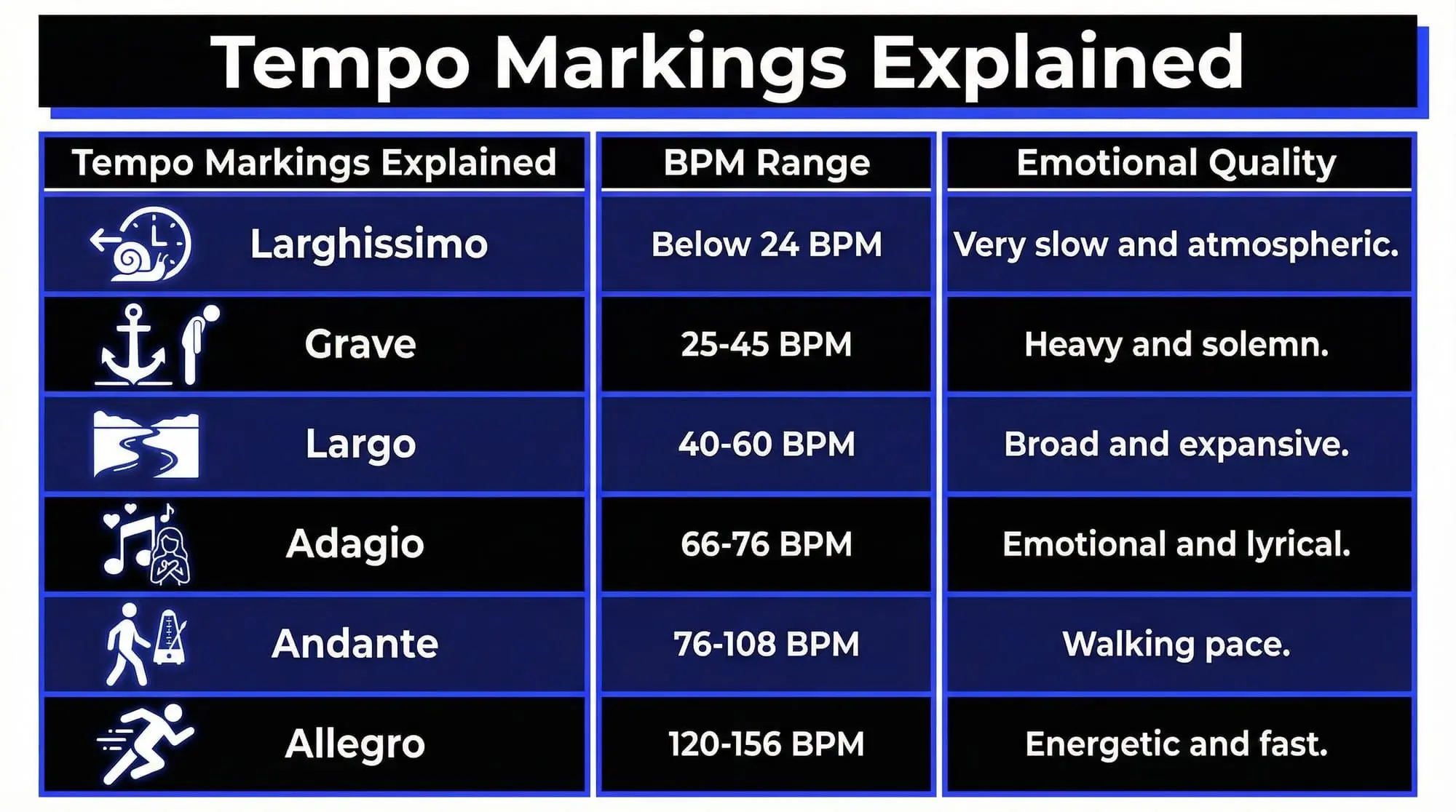
At the slowest end, you’ll find markings like Larghissimo, which is rarely used but represents an extremely slow pace, often below 24 BPM. At this speed, rhythm almost dissolves into the atmosphere. Music feels suspended in time, closer to ambient sound design than traditional composition.
Slightly faster is Grave, which typically falls between 25 and 45 BPM. This tempo carries a heavy, solemn character, often associated with dramatic or serious works. It creates a sense of weight, making every note feel significant.
Moving into more commonly used slow tempos, Largo sits around 40 to 60 BPM and is often described as broad and expansive. It allows for space between notes, giving music a sense of grandeur. Larghetto and Lento follow closely, maintaining a slow pace but with slightly more motion and flow.
One of the most expressive tempo markings is Adagio, usually ranging from 66 to 76 BPM. This tempo is widely used in emotional and lyrical pieces because it allows melodies to breathe. It’s slow enough to feel intimate, but not so slow that it loses direction. A slightly faster variation, Adagietto, retains that emotional quality while adding a bit more movement.
As tempo increases, we enter the moderate range. Andante, often described as a “walking pace,” sits between roughly 76 and 108 BPM. It feels natural and balanced, closely aligning with human movement. Andantino is a related term, though historically its exact meaning has been debated—it can be slightly faster or slower depending on context.
Moderato, typically between 108 and 120 BPM, represents a comfortable middle ground. It’s neither too slow nor too fast, making it one of the most versatile tempo ranges across genres.
From there, music begins to pick up energy. Allegretto introduces a light, upbeat feel, while Allegro pushes into a faster, more energetic range, often between 120 and 156 BPM. This is one of the most common tempo markings in both classical and modern music because it strikes a balance between excitement and control.
Beyond that, tempos like Vivace and Vivacissimo bring even more intensity, often exceeding 160 BPM. These tempos feel lively and driving, creating a strong sense of forward motion.
At the extreme end, Presto and Prestissimo represent very fast and extremely fast tempos. These are often used to create urgency, excitement, or technical brilliance. In some modern genres, tempos in this range can exceed 200 BPM, pushing the limits of both performance and perception.
What’s important to understand is that these markings are not strict rules. They act more like guidelines, giving performers and producers a sense of how the music should feel rather than dictating an exact speed.
Why tempo matters in music
Tempo plays a central role in shaping how music is experienced. It directly affects energy, emotion, and even physical response.
A faster tempo tends to create excitement and momentum. This is why genres like electronic dance music often sit around 120 to 130 BPM, a range that naturally encourages movement. Slower tempos, on the other hand, create space and allow for deeper emotional expression, which is why they’re often used in ballads or ambient music.
There’s also a physiological aspect to tempo. Studies have shown that listeners often synchronize their internal rhythms—such as heart rate or movement—to the tempo of music. This is one reason certain tempo ranges feel universally appealing.
For producers, this makes tempo a powerful tool. Adjusting it even slightly can change how a track feels without altering any of its musical content.
Tempo vs. rhythm
Tempo is often confused with rhythm, but the two are fundamentally different. Tempo defines how fast the music moves, while rhythm defines how sounds are arranged within that time. Two tracks can share the same tempo but feel completely different because of their rhythmic patterns.
For example, a hip-hop track and a jazz composition might both sit at 90 BPM, yet their grooves and accents create entirely different listening experiences. Understanding this distinction is essential for developing control over both timing and feel.
How to measure tempo
Tempo is measured in beats per minute, but understanding BPM goes beyond numbers.
At 60 BPM, one beat occurs every second. At 120 BPM, there are two beats per second. As tempo increases, the spacing between beats decreases, which changes how the music feels.
Modern producers rely on digital tools to measure and adjust tempo. Most DAWs include metronomes, tap tempo features, and automatic BPM detection. These tools make it easy to experiment with different tempos and find what works best for a track.
However, experienced producers often develop an internal sense of tempo, allowing them to feel whether something is too fast or too slow without relying solely on numbers.
Tempo and emotion
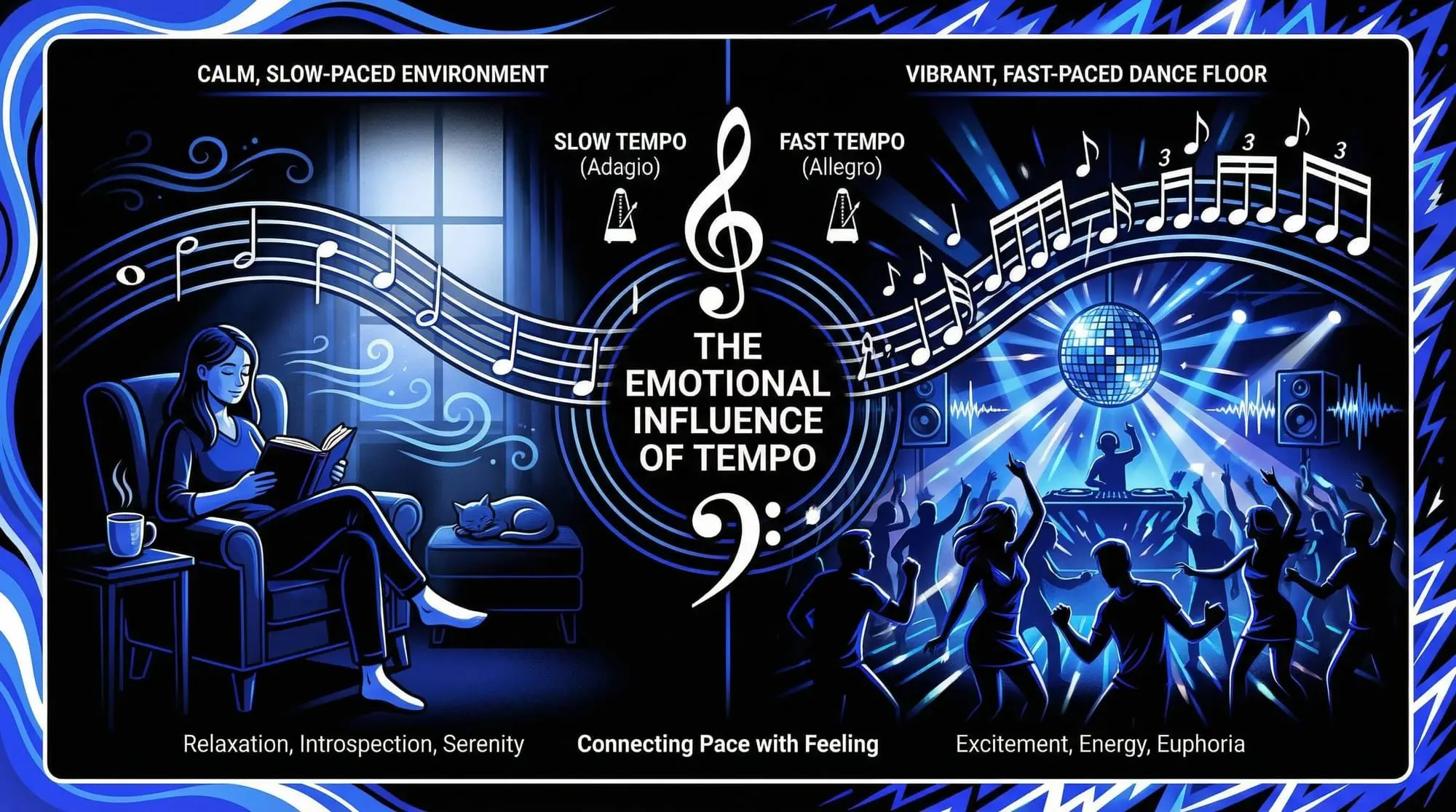
Tempo doesn’t just control speed—it shapes how music feels on a deeper, almost physical level. Producers don’t choose BPM randomly. They often pick a tempo based on the emotional response they want to create. In practice, even small tempo changes can shift the entire mood of a track.
Many well-known producers have spoken about this directly. Rick Rubin has emphasized that music is about feeling above all else, and that decisions like tempo should support the emotional intention of a song rather than follow rules. Similarly, Deadmau5 has pointed out that certain BPM ranges naturally lend themselves to specific genres because they create a predictable emotional and physical response—especially in dance music.
A clear example of tempo shaping emotion can be heard in Someone Like You by Adele. The slow tempo gives space between phrases, allowing the emotion in the vocals to stand out. If the same song were sped up significantly, it would lose much of its emotional weight.
On the opposite end, tracks like Animals by Martin Garrix use a faster tempo to build energy and tension. The consistent drive of the beat creates anticipation, especially leading into drops.
Producers often talk about tempo in terms of movement and body response. In dance music, tempos around 120–130 BPM are widely used because they feel natural for dancing. This isn’t accidental—it’s something DJs and producers have refined over decades through trial and observation.
There are also interesting “in-between” cases where tempo creates a unique emotional space. A track like Sicko Mode by Travis Scott shifts tempo throughout the song, creating contrast and unpredictability. These changes keep the listener engaged and constantly reset the emotional tone.
Another practical example comes from lo-fi and hip-hop producers, who often choose tempos between 60 and 80 BPM. This range creates a relaxed, head-nodding feel that encourages focus and introspection. That’s a big reason why lo-fi music is commonly used for studying or relaxing.
Ultimately, tempo acts as an emotional foundation. Before melody, before sound design, before mixing—tempo is already shaping how the listener will experience the track.
Once you start paying attention to it, you’ll notice that tempo isn’t just a technical setting. It’s one of the first creative decisions that defines the entire mood of your music.
Tempo changes and expression
Tempo doesn’t always stay fixed. In many styles of music—especially classical, film scoring, and even modern production—it can shift over time to add expression, tension, or release. These changes aren’t random. They’re intentional tools that shape how a listener experiences a moment. Instead of thinking of tempo as a static number, it helps to see it as something flexible—something that can breathe with the music.
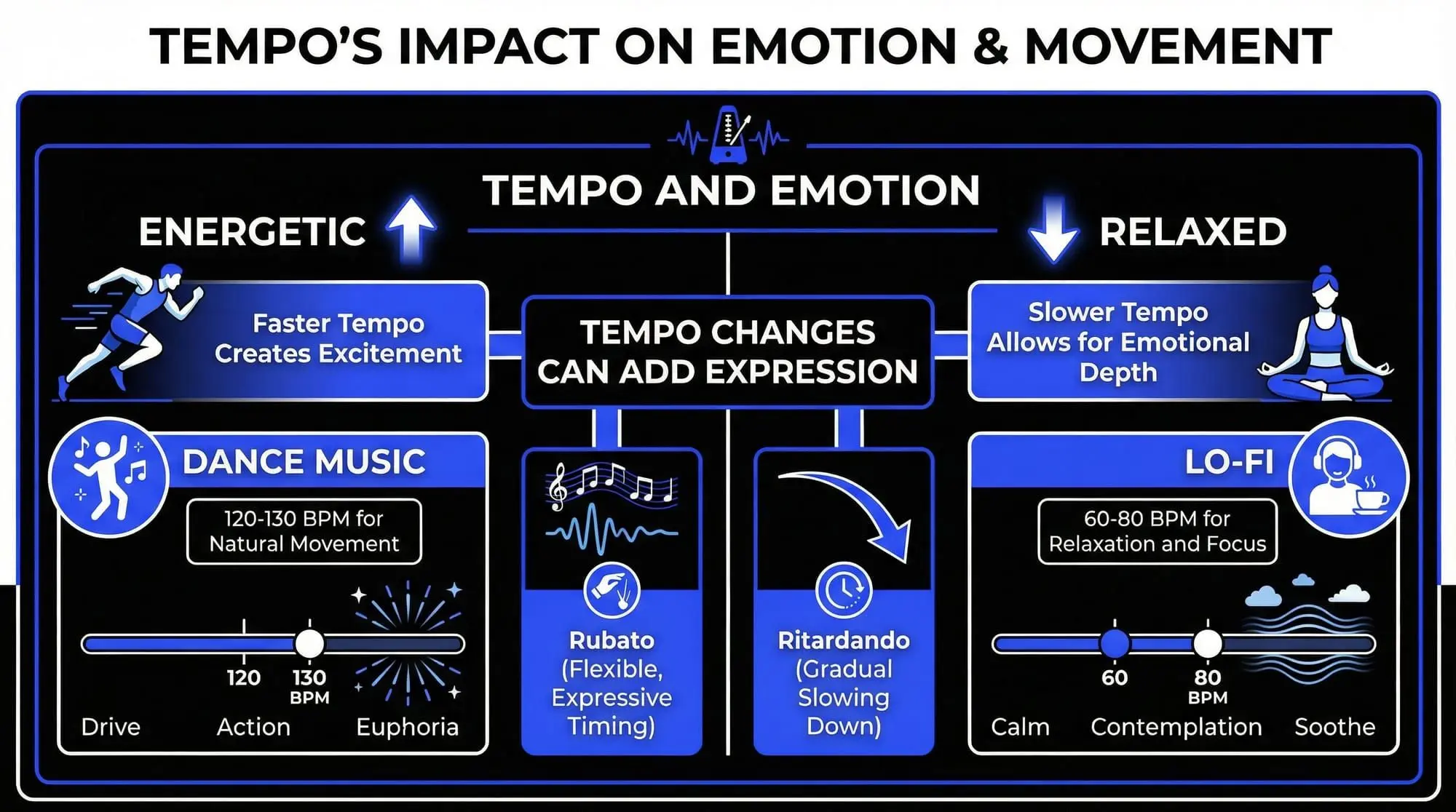
One of the most expressive techniques is rubato, which literally means “stolen time.” Instead of strictly following the tempo, the performer slightly stretches or compresses certain moments. A phrase might slow down for emotional emphasis, then speed up again to catch up. You can hear this clearly in piano performances of composers like Frédéric Chopin, where timing feels fluid and deeply expressive rather than mechanical. In modern terms, rubato is similar to subtly nudging notes off the grid in a DAW to create a more human feel.
Another common tempo change is ritardando, often shortened to “rit.” This means gradually slowing down. It’s typically used at the end of a phrase or section to create a sense of closure or resolution. A closely related term is rallentando, which also means slowing down, but usually with a slightly more dramatic or drawn-out effect. While the difference between the two isn’t always strict, rallentando often feels more expressive and deliberate, as if the music is gently coming to a stop.
In contrast, accelerando means gradually speeding up. This is often used to build excitement or momentum. You’ll hear it in orchestral music leading into a climax, or in modern production during a buildup before a drop. As the tempo increases, tension rises, making the release feel more impactful.
After a tempo change, you’ll often see the term a tempo, which simply means “return to the original tempo.” It acts like a reset, bringing the music back to its initial pace after a slowdown or speed-up. Without this, the listener could lose a sense of structure, so a tempo helps re-establish the groove.
Another important marking is the fermata. Unlike the others, it doesn’t describe a gradual change. Instead, it tells the performer to hold a note or pause longer than its written value. The exact duration isn’t fixed—it’s up to the performer or conductor. This creates a moment of suspension, where time feels temporarily paused. You’ll often hear this right before a dramatic shift or the end of a piece, adding emphasis and anticipation.
In modern production, these concepts still apply, even if the terminology isn’t always used. Tempo automation in a DAW allows you to recreate accelerando or ritardando digitally. Rubato can be achieved by moving notes slightly off-grid, and a fermata-like effect can be created by pausing or stretching a sound before a transition.
What all these techniques have in common is that they break away from rigid timing. They add movement, emotion, and unpredictability—turning a track from something mechanical into something that feels alive.
Common mistakes when working with tempo
Working with tempo sounds simple at first: choose a BPM and start building the track. But in practice, tempo is one of the easiest areas to get wrong. A track can have great sounds, strong melodies, and a clean mix, yet still feel slightly off if the tempo does not support the idea.
The most common tempo mistakes happen when producers treat BPM as a fixed technical setting instead of a creative decision. Tempo affects groove, emotion, rhythm, phrasing, and energy, so it should be tested and adjusted throughout the production process.
Choosing a tempo too early
One of the biggest mistakes is choosing a tempo at the beginning of a project and never questioning it again. Many producers start with a default value like 120 or 128 BPM, build the whole track around it, and assume the tempo is correct because they have heard it that way for hours.
The problem is that your ears adapt quickly. A track may feel slightly rushed, slow, stiff, or low-energy, but the cause is not always obvious. Sometimes the fix is not a new drum sound, a better mix, or more layers. It may be as simple as moving the tempo up or down by a few BPM.
Starting too fast
Another common mistake is starting at a tempo that is too fast for the idea. This often makes melodies, drums, vocals, or instrumental parts feel forced. Instead of letting the music breathe naturally, the producer ends up squeezing the arrangement into a speed that does not suit it.
This is especially important when developing a new idea. If the track feels rushed from the beginning, timing problems can build up quickly. It is often better to start slightly slower, let the groove settle, and then increase the tempo if the track needs more energy.
Treating tempo as just a number
Tempo is measured in BPM, but it should not be understood only as a number. Two tracks can be very close in tempo, such as 92 BPM and 95 BPM, yet feel completely different depending on the rhythm, groove, arrangement, and performance style.
This is why producers should think about tempo as a feeling. The right BPM is not always the one that looks correct on paper. It is the one that makes the track move in the right way, supports the emotional tone, and helps every part sit naturally in the arrangement.
Relying too much on automatic tempo detection
Modern DAWs can detect BPM automatically, but they do not always get it right. This is especially true when working with samples that do not have clear drums, steady transients, or a simple rhythmic structure.
If the DAW misreads the tempo, the sample may stretch incorrectly, the groove may feel unstable, and timing issues can appear across the whole session. Producers should always double-check tempo by ear, especially when importing loops, vocals, live recordings, or melodic samples.
Ignoring the relationship between tempo and rhythm
Tempo does not work in isolation. A rhythm that feels great at one BPM may feel messy, empty, or overwhelming at another. A complex drum pattern played too fast can sound chaotic, while a very simple beat at a slow tempo can feel too bare.
This is why rhythm and tempo should be tested together. If a section feels weak, the issue may not be the pattern itself. The tempo may simply not match the rhythmic density of the track.
Making everything too perfect on the grid
A strict metronome can be useful, but making every note perfectly aligned can make music feel robotic. Real performances usually include small timing variations. Vocals may sit slightly behind the beat, basslines may push forward, and melodic instruments may stretch certain phrases for expression.
The goal is balance. If everything is too loose, the track can feel messy. If everything is perfectly quantized, it can feel sterile. Good tempo work is not only about staying in time, but also about knowing when small timing differences make the music feel more human.
Never experimenting with tempo changes
Many beginners assume that a song must stay at one tempo from start to finish. While that works for many genres, tempo changes can add movement, tension, and emotional contrast.
Even a small tempo change of 2 or 3 BPM can make a section feel more energetic without the listener consciously noticing. Slowing down before a final chorus, adding subtle movement in a build-up, or slightly increasing energy toward a drop can make the track feel more dynamic and alive.
Tempo variations across instruments and roles
Tempo doesn’t exist in isolation—it’s interpreted differently depending on the instrument or role within a track.
At the core, drums are usually the most tightly locked to tempo. The kick and snare define the pulse, acting as the foundation that everything else follows. In electronic music, these elements are often perfectly quantized, creating a consistent and stable groove.
Bass sits somewhere between rhythm and melody. It typically follows the tempo closely but can introduce subtle timing variations that affect the groove. A bassline played slightly behind the beat can feel relaxed, while one pushed slightly ahead can feel more aggressive.
Melodic instruments, like piano or guitar, tend to have more freedom. They still follow the tempo, but they often stretch or compress timing slightly for expression. This is especially noticeable in genres like jazz or classical, where strict timing is less important than feel.
Vocals are perhaps the most flexible of all. Singers often use natural timing variations—slightly delaying or anticipating phrases—to add emotion. This creates a push-and-pull effect against the tempo that makes performances feel human and expressive.
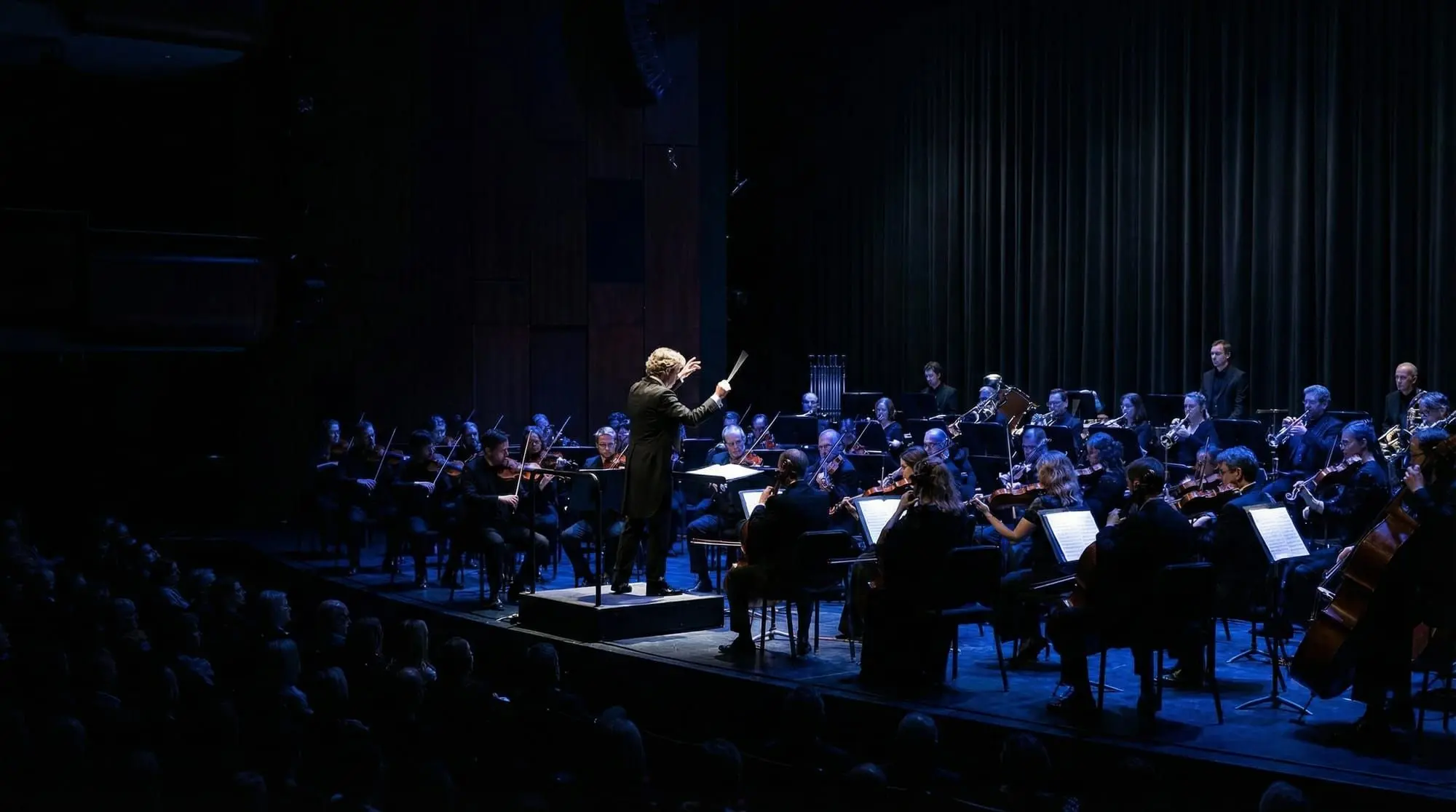
In orchestral settings, tempo is often guided by a conductor, who can subtly adjust speed in real time. This allows the entire ensemble to move together, creating a cohesive but flexible interpretation of tempo.
In modern production, these roles still exist, even in a digital environment. While drums might stay locked to the grid, other elements are often intentionally moved off-grid to create groove and variation.
This interplay is what gives music its character. If everything is perfectly aligned, it can feel rigid. If everything is too loose, it can feel chaotic. The balance between precision and variation is what makes a track feel alive.
Tools for working with tempo
Modern production tools have made tempo more flexible than ever. DAWs allow for real-time tempo changes, precise BPM adjustments, and advanced time-stretching.
These tools give producers the ability to experiment freely, making tempo not just a setting, but a creative parameter.
How ACE Studio helps you shape tempo, timing, and performance
Understanding tempo becomes much more practical when you move from theory into production. A BPM value tells you how fast the music moves, but the real work happens in how each part responds to that tempo: the vocal phrasing, the instrumental articulation, the groove, the build-ups, and the small timing choices that make a track feel alive.
That is where ACE Studio 2.0 fits naturally into a modern music workflow. It is not only an AI vocal tool. It has grown into a broader AI music workstation with AI vocals, AI instruments, generative tools, stem separation, Audio to MIDI, and DAW integration through ACE Bridge. Its role is not to replace your tempo decisions, but to help you hear, test, and refine them with more control.
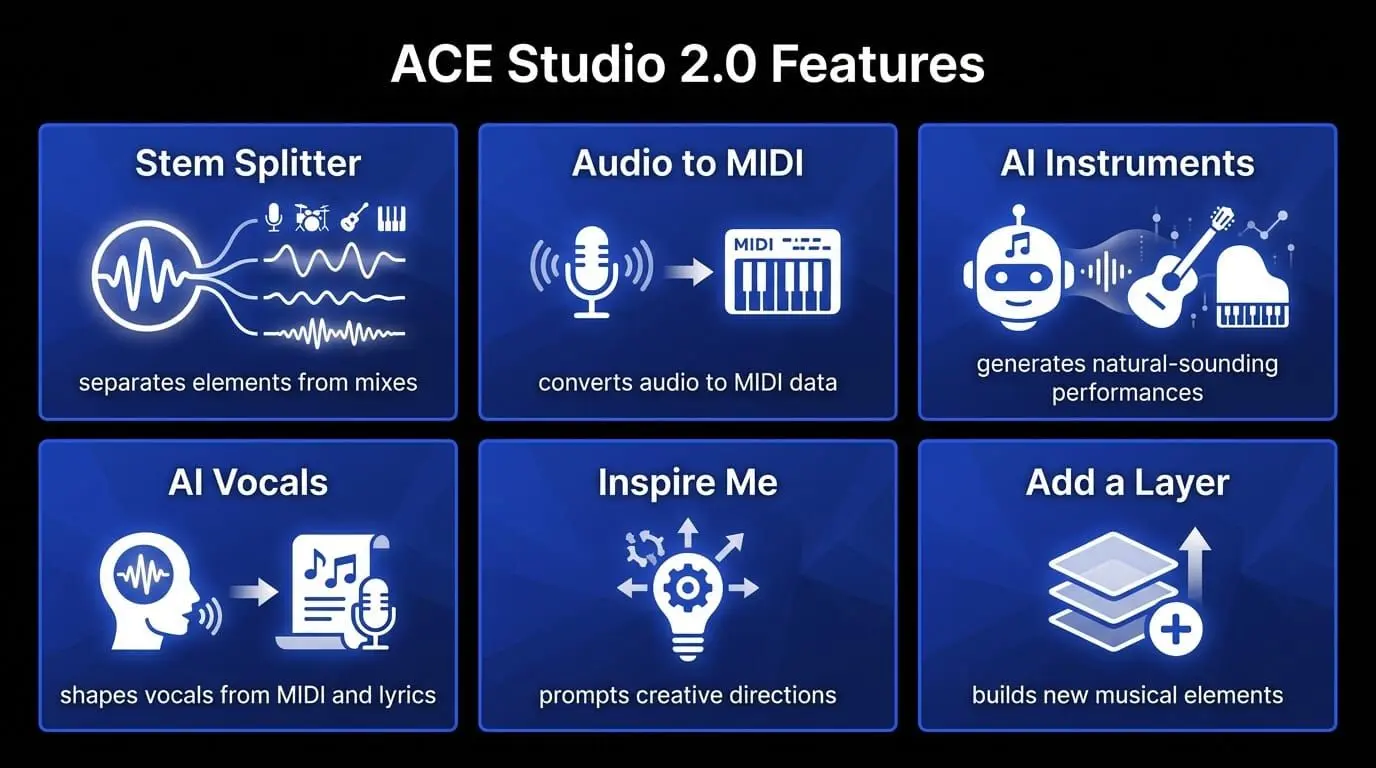
For example, if you write a melody at 90 BPM, you can use ACE Studio to generate an AI vocal from MIDI and lyrics, then shape the phrasing so the line sits behind the beat, pushes slightly forward, or breathes more naturally between notes. This matters because vocals are one of the most flexible parts of tempo perception. A vocal can technically be “in time” and still feel rushed if the phrasing does not support the emotional pace of the song.
The same idea applies to instruments. ACE Studio includes AI Instruments including strings, saxophones, trumpets, and duduk, with articulation control for more nuanced performances. Instead of treating MIDI as stiff note data, you can shape how the performance responds to the tempo: smoother legato for slower passages, tighter articulation for faster sections, or layered ensemble parts that add movement without crowding the groove.
ACE Bridge is especially relevant when working with tempo. ACE Bridge is useful when you want ACE Studio to work smoothly with your DAW. It helps keep ACE Studio connected to your project, so your MIDI, playback, tempo, and time signature changes stay in sync.
This is useful when a track includes tempo changes. If your song slows down before a final chorus, builds through an accelerando-style section, or moves between different time signatures, tempo sync helps keep the creative parts aligned. You can continue shaping the musical feel without constantly exporting files and manually lining things up again.
ACE Studio’s prompt-based Generative Kits also connect well with tempo exploration. If a groove feels too empty at a slower BPM, Add a Layer functionality can help you prompt and build supporting parts around the existing idea. If a rough sketch needs more motion, Music Enhancer can help develop it into something more expressive. The important part is that you still decide what belongs in the track. You choose the tempo, judge the feel, edit the arrangement, and keep the parts that serve the song.
For vocals, ACE Studio gives detailed control over pitch, timing, breath, vibrato, and emotional delivery. For choirs, you can build layered vocal arrangements from multiple AI voices. For instruments, you can turn MIDI into more natural performances while keeping the part editable. For existing audio, tools like Stem Splitter and Audio to MIDI help recover musical ideas and make them easier to reshape.
In other words, ACE Studio helps with the space between a tempo number and a finished performance. BPM gives you the grid. ACE Studio helps you shape what happens inside that grid: the breath before a vocal line, the tension in a string phrase, the timing of a harmony stack, the movement of a generated layer, or the way an instrument part locks into the song’s pulse.
That distinction matters. Tempo is not just about making everything perfectly aligned. It is about choosing how the music should move. ACE Studio gives producers, songwriters, and composers more ways to refine that movement while keeping the human decision-making at the center.
Future trends in tempo
Tempo is no longer just a fixed number you set at the beginning of a track. As music technology evolves, tempo is becoming more flexible, adaptive, and even intelligent.
One of the biggest shifts comes from AI-driven tools. Modern music software can already analyze a track and detect its tempo automatically, but newer systems are going further—suggesting ideal BPM ranges based on genre, mood, or even reference tracks. This means producers are starting to treat tempo less as a guess and more as a guided decision.
There’s also a growing trend toward adaptive tempo, especially in interactive media like video games and immersive experiences. Instead of staying constant, tempo can now respond in real time. For example, music can speed up during intense gameplay or slow down during calmer moments, creating a more dynamic connection between sound and experience.
Another interesting development is how tempo is being used creatively in modern genres. Instead of sticking to one BPM, producers are experimenting with tempo shifts within a single track. This isn’t entirely new, but it’s becoming more common in genres like hip-hop and experimental electronic music, where multiple sections can feel like completely different songs stitched together.
Streaming platforms are also influencing how tempo is used. Since listeners often decide within seconds whether to keep listening, many producers choose tempos that quickly establish energy or mood. This has subtly shaped trends across genres, pushing certain BPM ranges to become more dominant.
Looking ahead, tempo will likely become even more fluid. With tools that can analyze listener behavior and adapt music in real time, we may reach a point where tempo isn’t just chosen by the producer—it evolves based on how the music is being experienced.
Frequently Asked Questions about tempo in music
Is tempo the same as BPM?
Tempo and BPM are closely related, but they are not exactly the same. Tempo describes the speed or feel of the music, while BPM (beats per minute) is the numerical way of measuring that speed. For example, a song at 120 BPM means there are 120 beats in one minute.
Can changing the tempo change the mood of a song?
Yes, even a small tempo change can completely alter how a song feels. Slower tempos often sound emotional or reflective, while faster tempos can feel energetic or urgent. Many producers on music forums mention that changing the tempo by just a few BPM can make a track feel more natural.
How do producers choose the right tempo?
Most producers start by thinking about the emotion they want the song to create. Dance music usually uses faster tempos for movement, while ballads often use slower tempos for expression. Some producers also experiment by raising or lowering the BPM until the track feels right.
Does every genre have a common tempo range?
Many genres tend to fall into certain tempo ranges. Hip-hop often sits around 70–100 BPM, house music usually around 120–130 BPM, and drum and bass often around 160–180 BPM. These are not strict rules, but they are common starting points.
Can tempo change during a song?
Yes, some songs intentionally change tempo. A track may speed up to create excitement or slow down for emotional effect. While pop songs often stay consistent, film scores, progressive music, and experimental productions frequently use tempo changes.
Why does the same BPM feel different in two songs?
Two songs can share the same BPM but feel very different because rhythm, groove, and arrangement also affect perception. For example, a relaxed hip-hop beat at 90 BPM can feel slower than a driving rock song at the same tempo because of how the instruments are played.
What is tap tempo?
Tap tempo is a feature in many DAWs and apps that lets you tap a button in time with the music. The software calculates the tempo based on your taps. It is useful when you want to quickly find the BPM of a song by ear.