
We value your privacy

By clicking "Allow", you agree to the storing of cookies on your device to enhance site navigation, analyze site usage, and assist in our marketing efforts.

Consent Selection
Details
  • Necessary cookies help make a website usable by enabling basic functions like page navigation and access to secure areas of the website. The website cannot function properly without these cookies.
    • Learn more about this provideropens in a new window

      Some of the data collected by this provider is for the purposes of personalization and measuring advertising effectiveness. The provider may use the IP Addresses for ads measurement and ads personalization.

      test_cookieUsed to check if the user's browser supports cookies.
      Maximum Storage Duration: 1 dayType: HTTP Cookie
    • Learn more about this provideropens in a new window
      bcookieUsed in order to detect spam and improve the website's security.
      Maximum Storage Duration: 1 yearType: HTTP Cookie
      li_gcStores the user's cookie consent state for the current domain
      Maximum Storage Duration: 180 daysType: HTTP Cookie
    • Learn more about this provideropens in a new window
      _cfuvid [x2]This cookie is a part of the services provided by Cloudflare - Including load-balancing, deliverance of website content and serving DNS connection for website operators.
      Maximum Storage Duration: SessionType: HTTP Cookie
    • Learn more about this provideropens in a new window
      datadomeUsed in context with the website's BotManager. The BotManager detects, categorizes and compiles reports on potential bots trying to access the website.
      Maximum Storage Duration: SessionType: HTTP Cookie
    • studio-web-language-keyPending
      Maximum Storage Duration: SessionType: HTML Local Storage
    • __cf_bm [x5]This cookie is used to distinguish between humans and bots. This is beneficial for the website, in order to make valid reports on the use of their website.
      Maximum Storage Duration: 1 dayType: HTTP Cookie
    • CookieConsent [x2]Stores the user's cookie consent state for the current domain
      Maximum Storage Duration: 1 yearType: HTTP Cookie
    • guidPreserves users states across page requests.
      Maximum Storage Duration: 1 yearType: HTTP Cookie
      rtThis cookie is used to identify the visitor through an application. This allows the visitor to login to a website through their LinkedIn application for example.
      Maximum Storage Duration: 1 yearType: HTTP Cookie
    • ttRegisters the website's speed and performance. This function can be used in context with statistics and load-balancing.
      Maximum Storage Duration: 1 yearType: HTTP Cookie
    • sc_anonymous_idUsed in context with the 3D-view-function on the website.
      Maximum Storage Duration: 10 yearsType: HTTP Cookie
  • Preference cookies enable a website to remember information that changes the way the website behaves or looks, like your preferred language or the region that you are in.
    • Learn more about this provideropens in a new window
      lidcRegisters which server-cluster is serving the visitor. This is used in context with load balancing, in order to optimize user experience.
      Maximum Storage Duration: 1 dayType: HTTP Cookie
  • Statistic cookies help website owners to understand how visitors interact with websites by collecting and reporting information anonymously.
    • Learn more about this provideropens in a new window
      geoSaves the user's current geographical location based on the user's IP address.
      Maximum Storage Duration: SessionType: HTTP Cookie
    • Learn more about this provideropens in a new window
      ajs_anonymous_idThis cookie is used to identify a specific visitor - this information is used to identify the number of specific visitors on a website.
      Maximum Storage Duration: 1 yearType: HTTP Cookie
      ajs_anonymous_idThis cookie is used to count how many times a website has been visited by different visitors - this is done by assigning the visitor an ID, so the visitor does not get registered twice.
      Maximum Storage Duration: PersistentType: HTML Local Storage
    • Learn more about this provideropens in a new window
      _tt_enable_cookieUsed by the social networking service, TikTok, for tracking the use of embedded services.
      Maximum Storage Duration: 1 yearType: HTTP Cookie
    • Learn more about this provideropens in a new window
      personalization_idThis cookie is set by Twitter - The cookie allows the visitor to share content from the website onto their Twitter profile.
      Maximum Storage Duration: 400 daysType: HTTP Cookie
    • FPGSIDRegisters statistical data on users' behaviour on the website. Used for internal analytics by the website operator.
      Maximum Storage Duration: 1 dayType: HTTP Cookie
      FPIDRegisters statistical data on users' behaviour on the website. Used for internal analytics by the website operator.
      Maximum Storage Duration: 400 daysType: HTTP Cookie
      FPLCRegisters a unique ID that is used to generate statistical data on how the visitor uses the website.
      Maximum Storage Duration: 1 dayType: HTTP Cookie
      sajssdk_2015_cookie_access_testPending
      Maximum Storage Duration: 73000 daysType: HTTP Cookie
      sajssdk_2015_cross_new_userCollects statistics on the user's visits to the website, such as the number of visits, average time spent on the website and what pages have been read.
      Maximum Storage Duration: 1 dayType: HTTP Cookie
      sensorsdata_domain_testPending
      Maximum Storage Duration: SessionType: HTTP Cookie
      sensorsdata2015jssdkcrossCollects statistics on the user's visits to the website, such as the number of visits, average time spent on the website and what pages have been read.
      Maximum Storage Duration: 2 yearsType: HTTP Cookie
    • sentryReplaySessionRegisters data on visitors' website-behaviour. This is used for internal analysis and website optimization.
      Maximum Storage Duration: SessionType: HTML Local Storage
    • u_scsidRegisters data on visitors' website-behaviour. This is used for internal analysis and website optimization.
      Maximum Storage Duration: SessionType: HTML Local Storage
      X-ABThis cookie is used by the website’s operator in context with multi-variate testing. This is a tool used to combine or change content on the website. This allows the website to find the best variation/edition of the site.
      Maximum Storage Duration: 1 dayType: HTTP Cookie
    • SERVERCORSIDPending
      Maximum Storage Duration: SessionType: HTTP Cookie
      SERVERIDThis cookie is used to assign the visitor to a specific server - this function is necessary for the functionality of the website.
      Maximum Storage Duration: SessionType: HTTP Cookie
    • number(#)Used to track user’s interaction with embedded content.
      Maximum Storage Duration: SessionType: HTML Local Storage
  • Marketing cookies are used to track visitors across websites. The intention is to display ads that are relevant and engaging for the individual user and thereby more valuable for publishers and third party advertisers.
    • Learn more about this provideropens in a new window
      _fbpUsed by Facebook to deliver a series of advertisement products such as real time bidding from third party advertisers.
      Maximum Storage Duration: 3 monthsType: HTTP Cookie
      lastExternalReferrerDetects how the user reached the website by registering their last URL-address.
      Maximum Storage Duration: PersistentType: HTML Local Storage
      lastExternalReferrerTimeDetects how the user reached the website by registering their last URL-address.
      Maximum Storage Duration: PersistentType: HTML Local Storage
    • Learn more about this provideropens in a new window
      mtClientConfig_cachedSource_xp_amp_music_webplayerUsed to implement iTunes content and presentation of covers.
      Maximum Storage Duration: PersistentType: HTML Local Storage
    • Learn more about this provideropens in a new window
      __tld__Used to track visitors on multiple websites, in order to present relevant advertisement based on the visitor's preferences.
      Maximum Storage Duration: SessionType: HTTP Cookie
      ajs_user_idThis cookie is used to collect data on the visitor's behavior on the website - this information can be used to assign the visitor to a visitor segment, based on common preferences.
      Maximum Storage Duration: SessionType: HTTP Cookie
      ajs_user_idCollects data on visitors' preferences and behaviour on the website - This information is used make content and advertisement more relevant to the specific visitor.
      Maximum Storage Duration: PersistentType: HTML Local Storage
    • Learn more about this provideropens in a new window

      Some of the data collected by this provider is for the purposes of personalization and measuring advertising effectiveness. The provider may use the IP Addresses for ads measurement and ads personalization.

      IDEUsed by Google DoubleClick to register and report the website user's actions after viewing or clicking one of the advertiser's ads with the purpose of measuring the efficacy of an ad and to present targeted ads to the user.
      Maximum Storage Duration: 400 daysType: HTTP Cookie
      ads/ga-audiencesUsed by Google AdWords to re-engage visitors that are likely to convert to customers based on the visitor's online behaviour across websites.
      Maximum Storage Duration: SessionType: Pixel Tracker
      pagead/1p-user-list/#Tracks if the user has shown interest in specific products or events across multiple websites and detects how the user navigates between sites. This is used for measurement of advertisement efforts and facilitates payment of referral-fees between websites.
      Maximum Storage Duration: SessionType: Pixel Tracker
    • Learn more about this provideropens in a new window
      _uetsidCollects data on visitor behaviour from multiple websites, in order to present more relevant advertisement - This also allows the website to limit the number of times that they are shown the same advertisement.
      Maximum Storage Duration: 1 dayType: HTTP Cookie
      _uetvidUsed to track visitors on multiple websites, in order to present relevant advertisement based on the visitor's preferences.
      Maximum Storage Duration: 1 yearType: HTTP Cookie
      _uetsidUsed to track visitors on multiple websites, in order to present relevant advertisement based on the visitor's preferences.
      Maximum Storage Duration: PersistentType: HTML Local Storage
      _uetsid_expContains the expiry-date for the cookie with corresponding name.
      Maximum Storage Duration: PersistentType: HTML Local Storage
      _uetvidUsed to track visitors on multiple websites, in order to present relevant advertisement based on the visitor's preferences.
      Maximum Storage Duration: PersistentType: HTML Local Storage
      _uetvid_expContains the expiry-date for the cookie with corresponding name.
      Maximum Storage Duration: PersistentType: HTML Local Storage
      MUIDUsed widely by Microsoft as a unique user ID. The cookie enables user tracking by synchronising the ID across many Microsoft domains.
      Maximum Storage Duration: 1 yearType: HTTP Cookie
    • Learn more about this provideropens in a new window
      __oaiq_domain_probeTracks the conversion rate between the user and the advertisement banners on the website - This serves to optimise the relevance of the advertisements on the website.
      Maximum Storage Duration: SessionType: HTTP Cookie
      __obrefTracks the conversion rate between the user and the advertisement banners on the website - This serves to optimise the relevance of the advertisements on the website.
      Maximum Storage Duration: SessionType: HTTP Cookie
      oaiq_cs:#Tracks the conversion rate between the user and the advertisement banners on the website - This serves to optimise the relevance of the advertisements on the website.
      Maximum Storage Duration: SessionType: HTML Local Storage
    • Learn more about this provideropens in a new window
      _rdt_uuidUsed to track visitors on multiple websites, in order to present relevant advertisement based on the visitor's preferences.
      Maximum Storage Duration: 3 monthsType: HTTP Cookie
    • Learn more about this provideropens in a new window
      sc_atUsed by Snapchat to implement advertisement content on the website - The cookie detects the efficiency of the ads and collects visitor data for further visitor segmentation.
      Maximum Storage Duration: 1 yearType: HTTP Cookie
      pUsed to track visitors on multiple websites, in order to present relevant advertisement based on the visitor's preferences.
      Maximum Storage Duration: SessionType: Pixel Tracker
    • Learn more about this provideropens in a new window
      dd_testcookiePending
      Maximum Storage Duration: SessionType: HTTP Cookie
      ddSession_datadomePending
      Maximum Storage Duration: PersistentType: HTML Local Storage
    • Learn more about this provideropens in a new window
      sp_landingUsed to implement audio-content from Spotify on the website. Can also be used to register user interaction and preferences in context with audio-content - This can serve statistics and marketing purposes.
      Maximum Storage Duration: 1 dayType: HTTP Cookie
      sp_tUsed to implement audio-content from Spotify on the website. Can also be used to register user interaction and preferences in context with audio-content - This can serve statistics and marketing purposes.
      Maximum Storage Duration: 1 yearType: HTTP Cookie
    • Learn more about this provideropens in a new window
      _ttp [x2]Used by the social networking service, TikTok, for tracking the use of embedded services.
      Maximum Storage Duration: 1 yearType: HTTP Cookie
      ttcsidUsed to track visitors on multiple websites, in order to present relevant advertisement based on the visitor's preferences.
      Maximum Storage Duration: 1 yearType: HTTP Cookie
      ttcsid_#Tracks the conversion rate between the user and the advertisement banners on the website - This serves to optimise the relevance of the advertisements on the website.
      Maximum Storage Duration: 1 yearType: HTTP Cookie
      tt_appInfoUsed by the social networking service, TikTok, for tracking the use of embedded services.
      Maximum Storage Duration: SessionType: HTML Local Storage
      tt_pixel_session_indexUsed by the social networking service, TikTok, for tracking the use of embedded services.
      Maximum Storage Duration: SessionType: HTML Local Storage
      tt_sessionIdUsed by the social networking service, TikTok, for tracking the use of embedded services.
      Maximum Storage Duration: SessionType: HTML Local Storage
    • Learn more about this provideropens in a new window
      1/i/adsct [x2]Collects data on user behaviour and interaction in order to optimize the website and make advertisement on the website more relevant.
      Maximum Storage Duration: SessionType: Pixel Tracker
      muc_adsCollects data on user behaviour and interaction in order to optimize the website and make advertisement on the website more relevant.
      Maximum Storage Duration: 400 daysType: HTTP Cookie
      guest_idCollects data related to the user's visits to the website, such as the number of visits, average time spent on the website and which pages have been loaded, with the purpose of personalising and improving the Twitter service.
      Maximum Storage Duration: 400 daysType: HTTP Cookie
      guest_id_adsCollects information on user behaviour on multiple websites. This information is used in order to optimize the relevance of advertisement on the website.
      Maximum Storage Duration: 400 daysType: HTTP Cookie
      guest_id_marketingCollects information on user behaviour on multiple websites. This information is used in order to optimize the relevance of advertisement on the website.
      Maximum Storage Duration: 400 daysType: HTTP Cookie
    • Learn more about this provideropens in a new window
      __Secure-BUCKETPending
      Maximum Storage Duration: 180 daysType: HTTP Cookie
      __Secure-ROLLOUT_TOKENUsed to track user’s interaction with embedded content.
      Maximum Storage Duration: 180 daysType: HTTP Cookie
      __Secure-YECStores the user's video player preferences using embedded YouTube video
      Maximum Storage Duration: SessionType: HTTP Cookie
      __Secure-YNIDUsed to track user’s interaction with embedded content.
      Maximum Storage Duration: 180 daysType: HTTP Cookie
      LAST_RESULT_ENTRY_KEYUsed to track user’s interaction with embedded content.
      Maximum Storage Duration: SessionType: HTTP Cookie
      LogsDatabaseV2:V#||LogsRequestsStoreUsed to track user’s interaction with embedded content.
      Maximum Storage Duration: PersistentType: IndexedDB
      ServiceWorkerLogsDatabase#SWHealthLogNecessary for the implementation and functionality of YouTube video-content on the website.
      Maximum Storage Duration: PersistentType: IndexedDB
      TESTCOOKIESENABLEDUsed to track user’s interaction with embedded content.
      Maximum Storage Duration: 1 dayType: HTTP Cookie
      VISITOR_INFO1_LIVETries to estimate the users' bandwidth on pages with integrated YouTube videos.
      Maximum Storage Duration: 180 daysType: HTTP Cookie
      YSCRegisters a unique ID to keep statistics of what videos from YouTube the user has seen.
      Maximum Storage Duration: SessionType: HTTP Cookie
      yt-icons-last-purgedNecessary for the implementation and functionality of YouTube video-content on the website.
      Maximum Storage Duration: PersistentType: HTML Local Storage
      ytidb::LAST_RESULT_ENTRY_KEYUsed to track user’s interaction with embedded content.
      Maximum Storage Duration: PersistentType: HTML Local Storage
      YtIdbMeta#databasesUsed to track user’s interaction with embedded content.
      Maximum Storage Duration: PersistentType: IndexedDB
    • _gaUsed to send data to Google Analytics about the visitor's device and behavior. Tracks the visitor across devices and marketing channels.
      Maximum Storage Duration: 2 yearsType: HTTP Cookie
      _ga_#Used to send data to Google Analytics about the visitor's device and behavior. Tracks the visitor across devices and marketing channels.
      Maximum Storage Duration: 2 yearsType: HTTP Cookie
      _gcl_auUsed by Google AdSense for experimenting with advertisement efficiency across websites using their services.
      Maximum Storage Duration: 3 monthsType: HTTP Cookie
      _/set_cookieUsed by server-side Google Tag Manager to set or update cookies required for analytics or marketing tags.
      Maximum Storage Duration: SessionType: Pixel Tracker
      _gcl_lsTracks the conversion rate between the user and the advertisement banners on the website - This serves to optimise the relevance of the advertisements on the website.
      Maximum Storage Duration: PersistentType: HTML Local Storage
    • _schn1Sets a unique ID for the visitor, that allows third party advertisers to target the visitor with relevant advertisement. This pairing service is provided by third party advertisement hubs, which facilitates real-time bidding for advertisers.
      Maximum Storage Duration: 1 dayType: HTTP Cookie
      _scidSets a unique ID for the visitor, that allows third party advertisers to target the visitor with relevant advertisement. This pairing service is provided by third party advertisement hubs, which facilitates real-time bidding for advertisers.
      Maximum Storage Duration: 13 monthsType: HTTP Cookie
      _scid_rSets a unique ID for the visitor, that allows third party advertisers to target the visitor with relevant advertisement. This pairing service is provided by third party advertisement hubs, which facilitates real-time bidding for advertisers.
      Maximum Storage Duration: 13 monthsType: HTTP Cookie
      _screloadUsed by Snapchat to implement advertisement content on the website - The cookie detects the efficiency of the ads and collects visitor data for further visitor segmentation.
      Maximum Storage Duration: SessionType: HTTP Cookie
      u_sclidSets a unique ID for the visitor, that allows third party advertisers to target the visitor with relevant advertisement. This pairing service is provided by third party advertisement hubs, which facilitates real-time bidding for advertisers.
      Maximum Storage Duration: PersistentType: HTML Local Storage
      u_sclid_rSets a unique ID for the visitor, that allows third party advertisers to target the visitor with relevant advertisement. This pairing service is provided by third party advertisement hubs, which facilitates real-time bidding for advertisers.
      Maximum Storage Duration: PersistentType: HTML Local Storage
      u_scsid_rSets a unique ID for the visitor, that allows third party advertisers to target the visitor with relevant advertisement. This pairing service is provided by third party advertisement hubs, which facilitates real-time bidding for advertisers.
      Maximum Storage Duration: SessionType: HTML Local Storage
  • Unclassified cookies are cookies that we are in the process of classifying, together with the providers of individual cookies.
    • Learn more about this provideropens in a new window
      _rdt_pnPending
      Maximum Storage Duration: 3 monthsType: HTTP Cookie
      _rdt_cfgPending
      Maximum Storage Duration: SessionType: HTML Local Storage
    • Learn more about this provideropens in a new window
      tt_pixel_is_enrich_ipv6_triggered_by_enrich_amPending
      Maximum Storage Duration: SessionType: HTML Local Storage
    • _mpxl_guidPending
      Maximum Storage Duration: SessionType: HTTP Cookie
      adjust-sdk#asPending
      Maximum Storage Duration: PersistentType: IndexedDB
      adjust-sdk#edPending
      Maximum Storage Duration: PersistentType: IndexedDB
      adjust-sdk#gpPending
      Maximum Storage Duration: PersistentType: IndexedDB
      adjust-sdk#qPending
      Maximum Storage Duration: PersistentType: IndexedDB
      adjust-sdk.pPending
      Maximum Storage Duration: PersistentType: HTML Local Storage
      redirectPathPending
      Maximum Storage Duration: SessionType: HTML Local Storage
      studio-web-web-uuidPending
      Maximum Storage Duration: PersistentType: HTML Local Storage
    • _vbPending
      Maximum Storage Duration: SessionType: HTTP Cookie
    • _twpidPending
      Maximum Storage Duration: SessionType: HTTP Cookie
      _twsidPending
      Maximum Storage Duration: SessionType: HTTP Cookie
    • pixel/sPending
      Maximum Storage Duration: SessionType: Pixel Tracker
Cookie declaration last updated on 10/16/26 by Cookiebot
[#IABV2_TITLE#]
[#IABV2_BODY_INTRO#]
[#IABV2_BODY_LEGITIMATE_INTEREST_INTRO#]
[#IABV2_BODY_PREFERENCE_INTRO#]
[#IABV2_BODY_PURPOSES_INTRO#]
[#IABV2_BODY_PURPOSES#]
[#IABV2_BODY_FEATURES_INTRO#]
[#IABV2_BODY_FEATURES#]
[#IABV2_BODY_PARTNERS_INTRO#]
[#IABV2_BODY_PARTNERS#]
About
Cookies are small text files that can be used by websites to make a user's experience more efficient.

The law states that we can store cookies on your device if they are strictly necessary for the operation of this site. For all other types of cookies we need your permission.

This site uses different types of cookies. Some cookies are placed by third party services that appear on our pages.

You can at any time change or withdraw your consent from the Cookie Declaration on our website.

Learn more about who we are, how you can contact us and how we process personal data in our Privacy Policy.

Please state your consent ID and date when you contact us regarding your consent.
Would you like to switch to English?
Confirm
close
Comenzar

¿Qué es un sintetizador? Definición, tipos y cómo funciona

Un sintetizador convierte el control en sonido: un oscilador crea el tono, los filtros lo moldean, las envolventes definen el movimiento y los LFOs añaden vida. Aprende el flujo y construye tu primer patch con confianza.

¿Qué es un sintetizador? Definición, tipos y cómo funciona

Puntos clave

  • Un sintetizador es un instrumento que crea sonido y te permite darle forma a través de herramientas como filtros, envolventes y modulación, lo que lo hace mucho más flexible que los instrumentos acústicos de carácter fijo.
  • La manera más fácil de entender cómo funciona un sintetizador es a través del flujo de señal: el oscilador crea el tono crudo, el filtro da forma al brillo, el amplificador controla el volumen, y las envolventes y LFOs añaden temporización y movimiento.
  • No existe un tipo "mejor" de sintetizador. Las opciones analógicas, digitales, de hardware, software, monofónicas, polifónicas, modulares y no modulares sirven para diferentes sonidos, flujos de trabajo y niveles de habilidad.
  • Para principiantes, la síntesis sustractiva es el mejor lugar para empezar porque enseña los bloques básicos rápidamente y te ayuda a crear bajos, pads y melodías principales útiles sin perderte.
  • La síntesis moderna ahora incluye herramientas basadas en interpretación como ACE Studio, donde MIDI puede controlar voces, coros y partes instrumentales editables, expandiendo el concepto de sintetizador más allá del diseño de sonido clásico basado en osciladores.

Entendiendo los sintetizadores sin la sobrecarga técnica

Si alguna vez te has preguntado qué es realmente un sintetizador, normalmente buscas una cosa: una explicación clara y musical, no una conferencia de física ni una demostración de equipo. Un sintetizador de música es simplemente un instrumento (hardware o software) que crea sonido generando y dando forma a señales eléctricas o digitales. La parte importante es esta: tú decides qué hace el sonido. Das forma al tono, color, movimiento y expresión, a menudo de maneras que los instrumentos acústicos no pueden.

Por eso los sintetizadores aparecen en todas partes: desde líneas de bajo y pads hasta texturas cinemáticas, melodías principales e incluso timbres vocales modernos "similares a instrumentos". Y en los flujos de trabajo de 2026, la idea de síntesis también se ha expandido: herramientas como la síntesis de interpretación pueden convertir MIDI en voces e instrumentos expresivos, mientras te mantienen en control del fraseo y la emoción.

Desglosemos el significado de sintetizador, cómo funcionan los sintetizadores, los tipos principales y cómo empezar a usar uno sin perderte en las perillas.

¿Qué es un sintetizador?

Definición de sintetizador

Un sintetizador es un instrumento que genera sonido y luego te permite dar forma a ese sonido usando controles como filtros, envolventes y modulación. A diferencia de un piano (que tiene un carácter acústico fijo), un sintetizador comienza con una fuente de sonido básica y te da herramientas para esculpirlo en algo personal.

Puedes pensar en un sintetizador como un "motor de sonido + panel de control". El motor crea un tono crudo (a menudo una forma de onda), y el panel te permite tallarlo en un bajo, un pad, un punteo, una hinchazón similar a cuerdas, o algo totalmente nuevo.

Qué hace un sintetizador en la música

En términos de producción real, un sintetizador puede actuar como:

  • Un bajista (graves ajustados, ataque controlado)
  • Un instrumento de acordes (pads, teclas, órganos, texturas evolutivas)
  • Una voz principal (melodías que sobresalen en una mezcla)
  • Un elemento rítmico (punteos, arreglos, patrones con gate)
  • Una herramienta de diseño de sonido (elevadores, impactos, movimiento, atmósfera)

También te enseña "pensamiento de mezcla". Cuando cambias un corte de filtro, no solo estás cambiando el tono: estás decidiendo dónde se sitúa el sonido contra voces, batería y guitarras.
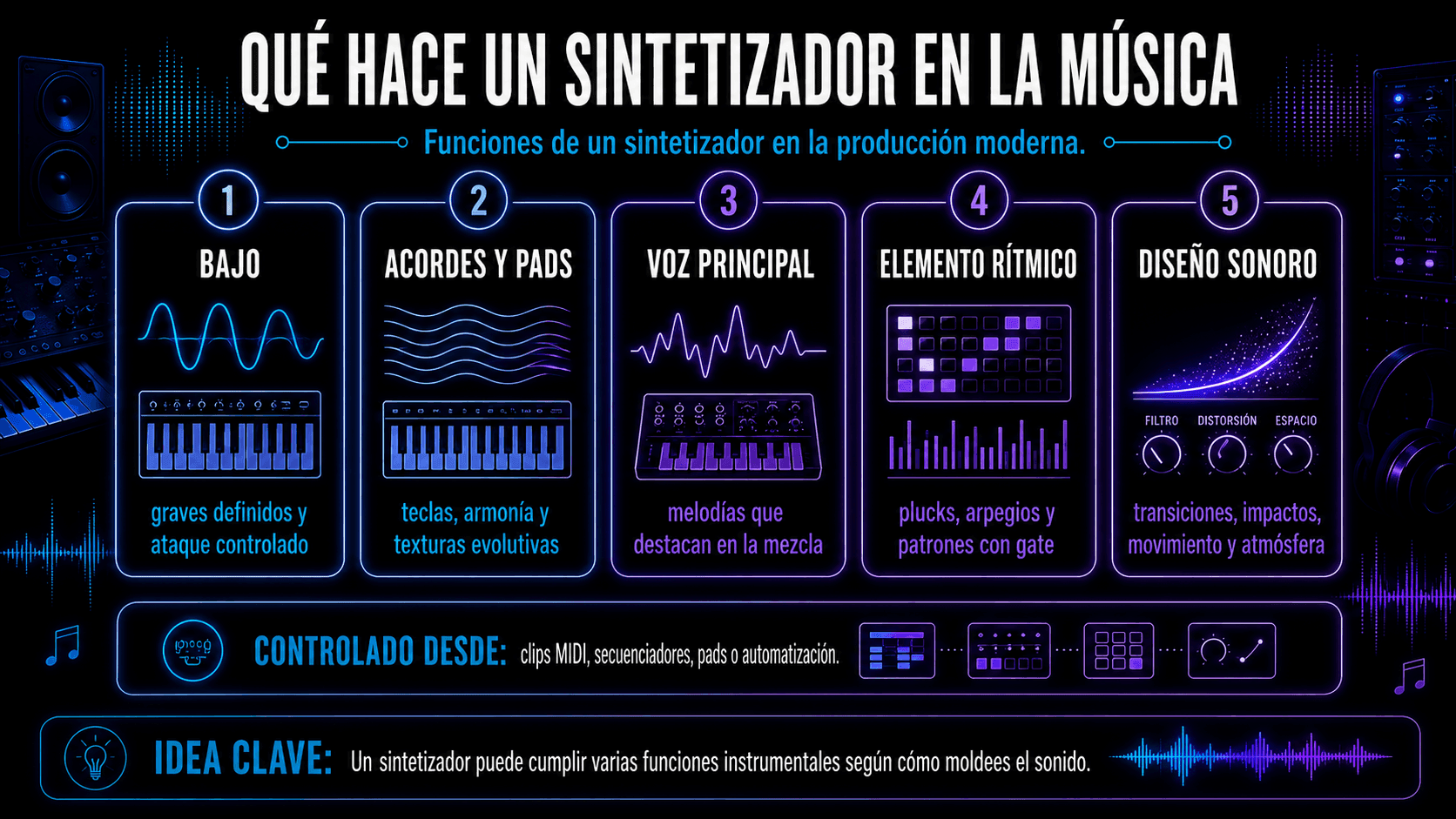
Infografía mostrando un sintetizador usado para bajo, acordes y pads, melodías principales, patrones rítmicos y diseño de sonido.
Cinco roles esenciales que puede desempeñar un sintetizador en la producción musical moderna.

Una idea más importante: un sintetizador no necesita un teclado estilo piano. Muchos sintetizadores se tocan a través de clips MIDI, secuenciadores, pads, controladores MPE, o incluso carriles de automatización. Lo que importa es la relación entre los datos de control (notas, velocidad, modulación) y la salida de sonido.

¿Cómo funcionan los sintetizadores?

Si te has estado preguntando cómo funciona un sintetizador, la respuesta clara es: flujo de señal. Un sonido comienza como un tono crudo, luego pasa por etapas de modelado que afectan el brillo, volumen, tiempo y movimiento. Aquí está la vista clásica de bloques de construcción:

MóduloQué HaceControles Comunes
OsciladorGenera el Tono CrudoForma de Onda, Tono, Desafinación
FiltroElimina o Enfatiza FrecuenciasCorte, Resonancia, Saturación
Amplificador (Amp)Controla el VolumenNivel, Cantidad de Velocidad
Envolvente (ADSR)Controla Cómo Algo Cambia con el TiempoAtaque, Decaimiento, Sostenimiento, Liberación
LFO / ModulaciónAñade Movimiento RepetitivoVelocidad, Profundidad, Enrutamiento

Osciladores

Los osciladores son tu punto de partida. Un solo oscilador podría producir una senoidal (pura), triangular (suave), diente de sierra (brillante), o cuadrada (hueca). Apila dos osciladores, desafínalos ligeramente, y de repente obtienes amplitud y tensión.

Filtros

Los filtros dan forma al tono eliminando frecuencias. Un filtro pasa-bajos es el clásico sonido de "barrido de sintetizador" porque reduce el brillo mientras bajas el corte. La resonancia añade un pico enfocado: útil para el carácter, pero fácil de exagerar.

Amplificador

La etapa del amplificador es donde vive el volumen. Muchos patches de sintetizador se sienten "tocados" o "estáticos" basándose en cómo responde el amplificador a la velocidad y las envolventes.
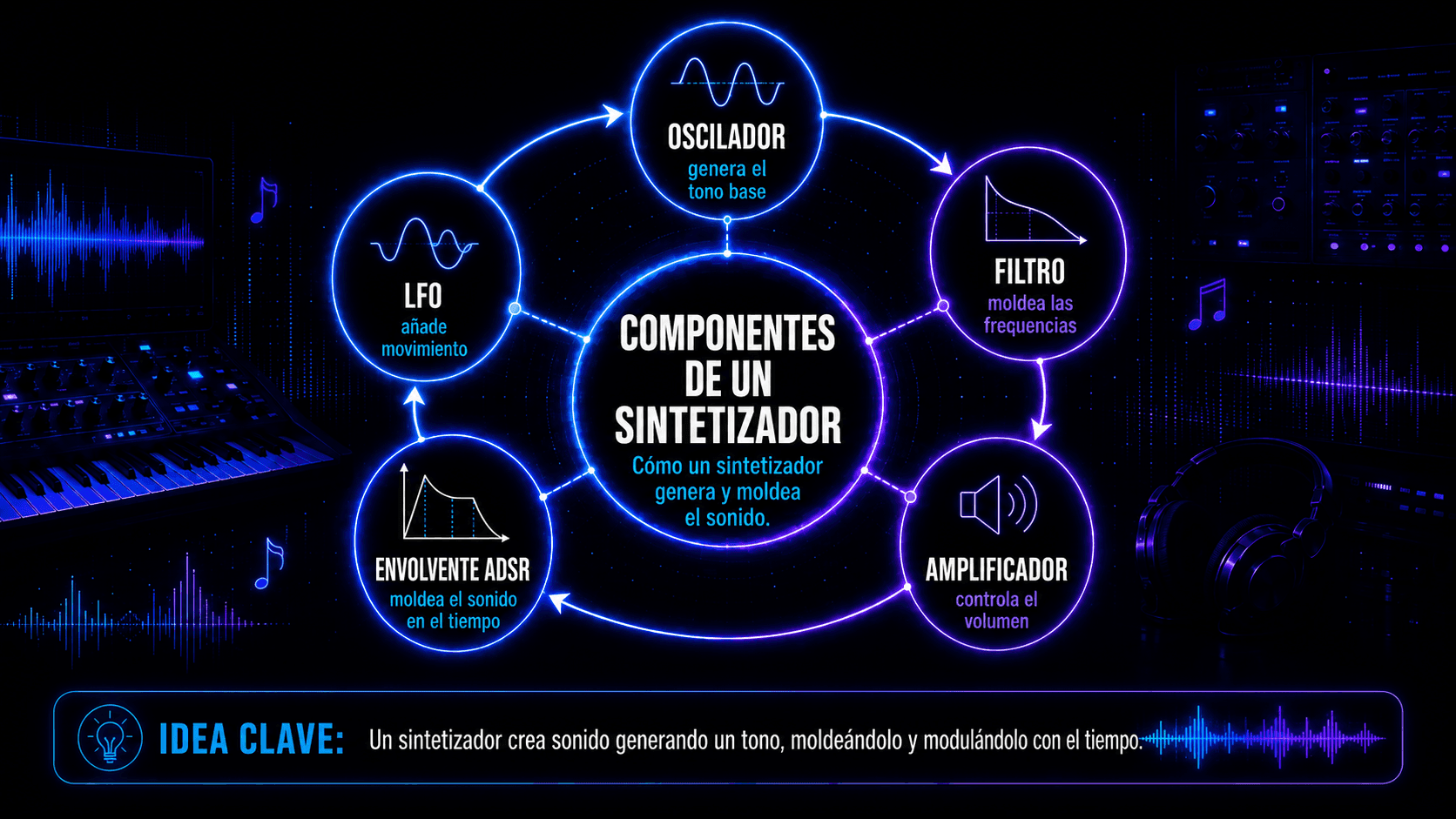
Infografía mostrando componentes clave del sintetizador, incluyendo oscilador, filtro, amplificador, envolvente ADSR y movimiento LFO.
Componentes del sintetizador explicados, desde osciladores y filtros hasta amplificadores, envolventes y movimiento LFO.

Envolvente ADSR

ADSR es cómo conviertes un tono en un gesto similar a un instrumento:

  • Ataque: qué tan rápido comienza
  • Decaimiento: qué tan rápido cae después del golpe
  • Sostenimiento: el nivel mantenido
  • Liberación: cómo se desvanece cuando levantas la nota

Un punteo tiene ataque/decaimiento cortos. Un pad tiene ataque lento y liberación más larga.

LFOs y modulación

Los LFOs (osciladores de baja frecuencia) crean movimiento: vibrato (tono), tremolo (volumen), oscilación (filtro), movimiento panorámico y más. La verdadera diversión está en el enrutamiento: una fuente de modulación controlando múltiples destinos.

Flujo de señal del sintetizador
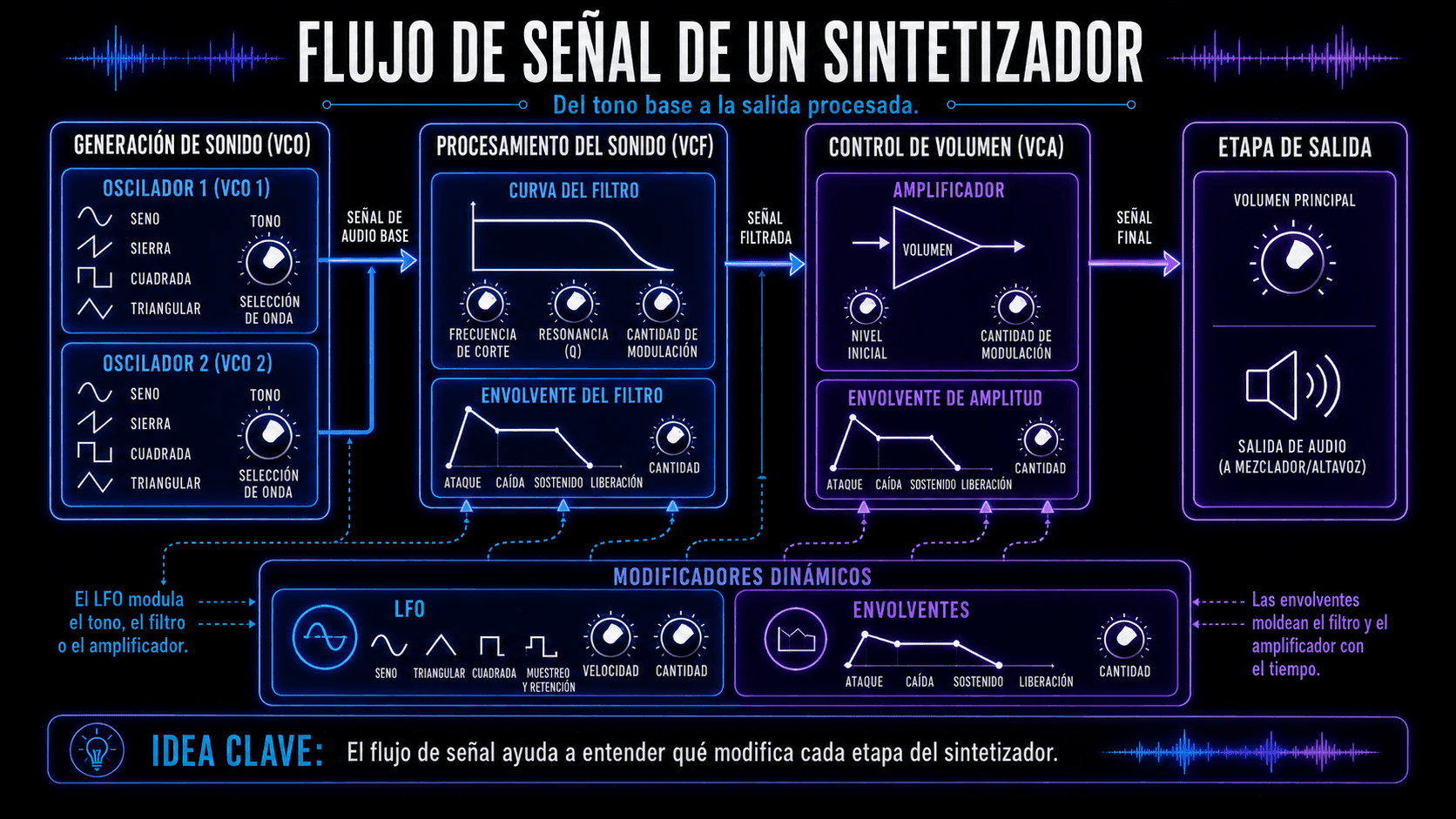
Diagrama de flujo de señal del sintetizador mostrando osciladores, filtro, amplificador, envolventes, modulación LFO y salida de audio final.
Cómo una señal cruda de oscilador se convierte en un sonido formado y reproducible.

Un modelo mental práctico para principiantes es:

Oscilador → Filtro → Amplificador… y luego las envolventes y LFOs son "manos" moviendo esas perillas a lo largo del tiempo.

Una vez que entiendes el flujo de señal, la mayoría de los sintetizadores (incluso los muy diferentes) empiezan a sentirse familiares.

Tipos de sintetizadores

Los sintetizadores se categorizan de algunas maneras útiles. Ninguna de estas categorías es "mejor": se trata del flujo de trabajo, sonido y cuánto control quieres desde el principio.
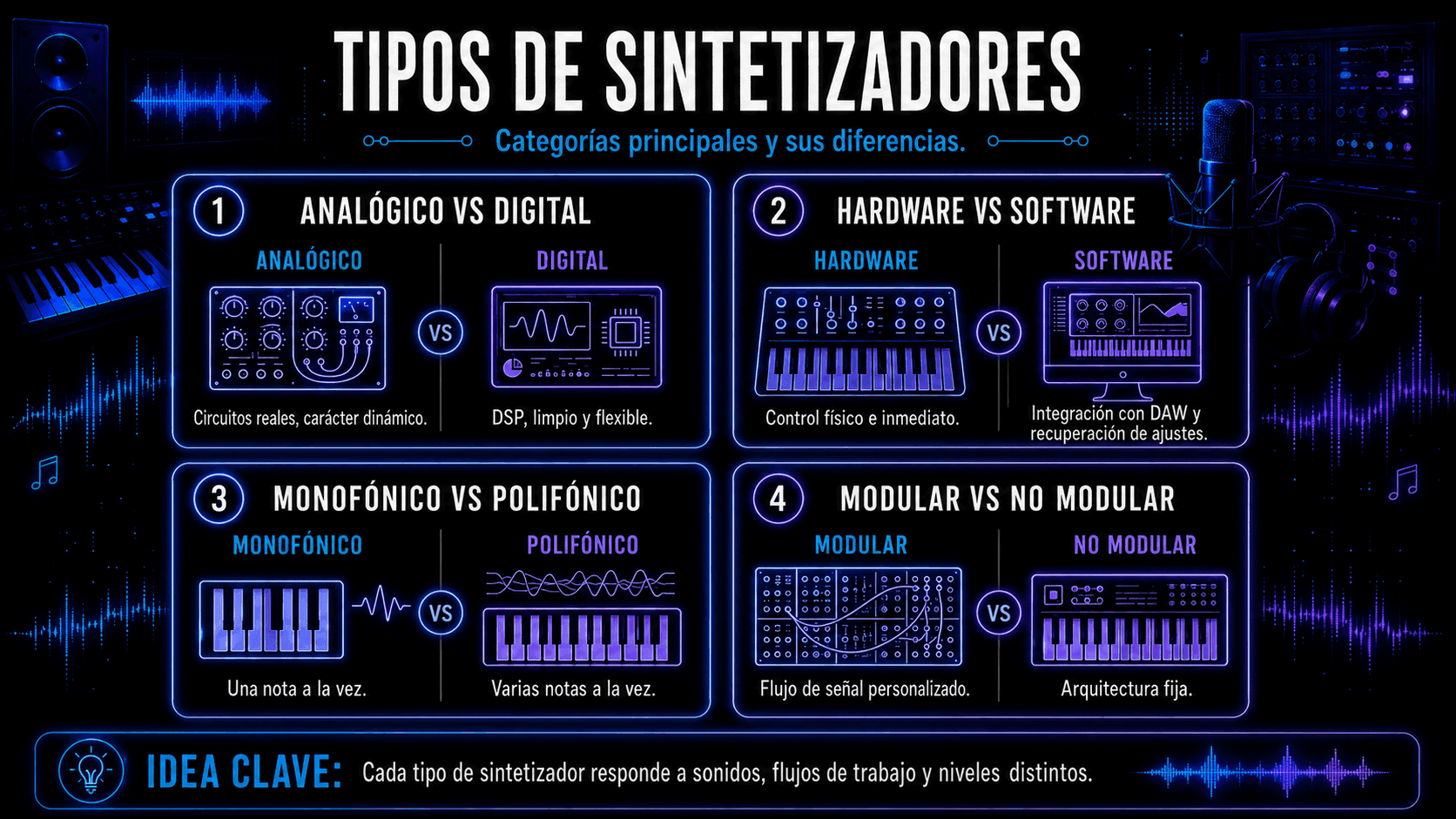
Infografía comparando sintetizadores analógicos y digitales, hardware y software, monofónicos y polifónicos, y modulares y no modulares.
Las principales categorías de sintetizadores y cómo difieren en sonido, control y flujo de trabajo.

Sintetizadores analógicos vs digitales

  • Los sintetizadores analógicos generan y dan forma al sonido usando circuitos eléctricos reales. A menudo se elogian por su sutil inestabilidad y comportamiento "vivo".
  • Los sintetizadores digitales generan sonido usando DSP y pueden ser más limpios, más complejos y más consistentes, especialmente para estilos modernos de wavetable, FM y granulares.

En la práctica: puedes hacer música cálida con sintetizadores digitales y música afilada con analógicos. La diferencia a menudo es más sobre el diseño del instrumento que sobre las palabras de moda.

Sintetizadores de hardware vs software

  • El hardware puede ser inmediato y amigable para la interpretación, con perillas que puedes agarrar sin pensar.
  • Los sintetizadores de software son flexibles, recordables y fáciles de automatizar dentro de un DAW. Puedes ejecutar múltiples instancias, guardar presets con un proyecto e integrar más profundamente con la edición.

Si estás aprendiendo, los sintetizadores de software a menudo son el camino más rápido porque puedes ver qué está pasando y revisar tus patches.

Sintetizadores monofónicos vs polifónicos

  • Monofónicos: una nota a la vez, excelentes para bajos y melodías principales.
  • Polifónicos: múltiples notas, pads, acordes, armonía rica.

Los sintetizadores monofónicos a menudo se sienten "expresivos" porque se enfocan en una línea, un movimiento, una historia.

Sintetizadores modulares vs no modulares

  • Los sintetizadores no modulares tienen flujo de señal fijo (incluso si puedes modular mucho).
  • Los sintetizadores modulares te permiten construir el flujo desde cero: poderosos, pero fácil de desaparecer en el agujero del conejo.

Una buena regla: aprende los conceptos de síntesis en un sintetizador normal primero, luego ve modular si anhelas enrutamiento personalizado.

Sintetizadores de software dentro de un DAW – donde encaja ACE Bridge

Aquí es donde la producción moderna se vuelve interesante. Cuando tu sintetizador vive dentro de un DAW, no solo estás "tocando notas": estás secuenciando, automatizando, alineando con mapas de tempo y sincronizando con cambios de arreglo.

ACE Studio puede encajar en ese mismo ecosistema a través de ACE Bridge 2, una conexión de plugin que enlaza Ace Studio a tu DAW para transmisión de audio, grabación MIDI y sincronización.

También soporta sincronización de mapas de tempo y compases de tiempo usando un flujo de trabajo ARA, para que Ace Studio pueda comportarse como una ventana compañera estrechamente enlazada a la línea de tiempo de tu DAW.

Eso importa porque el "flujo de trabajo de sintetizador" es realmente "flujo de trabajo de línea de tiempo": tu diseño de sonido tiene que aterrizar exactamente donde la música respira.

Tipos de síntesis explicados

"Síntesis" simplemente significa diferentes métodos de crear y moldear sonido. La mayoría de los productores terminan usando varios tipos sin siquiera pensarlo.
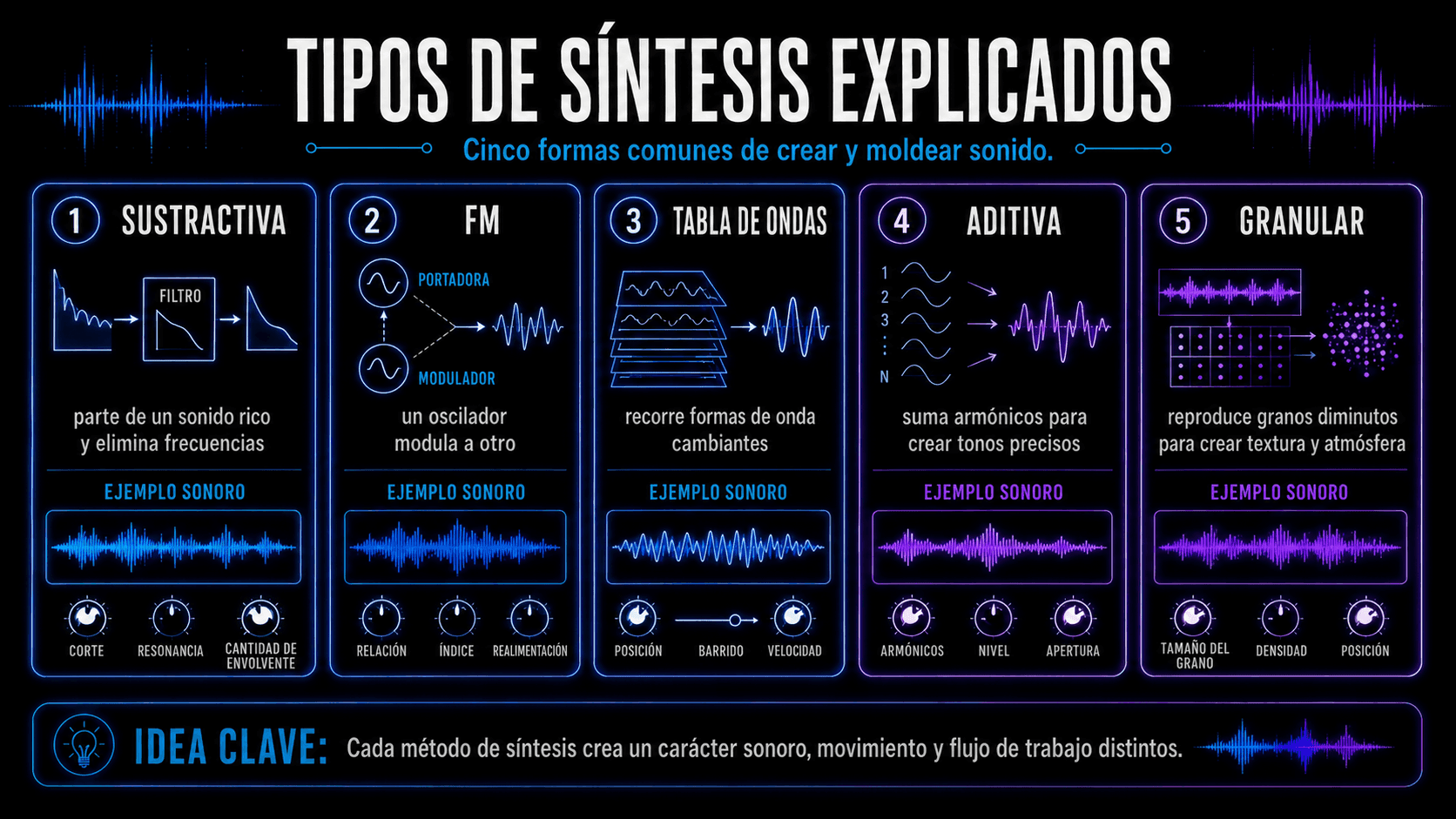
Infografía que compara los métodos de síntesis sustractiva, FM, wavetable, aditiva y granular con formas de onda y controles clave.
Cinco métodos de síntesis y las diferentes formas en que crean sonido.

Síntesis Sustractiva

Comienza con una forma de onda armónicamente rica (como una diente de sierra), luego resta frecuencias usando un filtro. Es el camino clásico para bajos, pads y melodías principales. Si quieres resultados rápidos, comienza aquí.

Síntesis FM

FM usa un oscilador para modular otro a velocidad de audio. Crea tonos brillantes y complejos: campanas, punteos metálicos, teclas cristalinas, bajos futuristas. Puede parecer matemático, pero es increíble una vez que aprendes algunas proporciones "de referencia".

Síntesis Wavetable

Los sintetizadores wavetable escanean a través de una tabla de formas de onda a lo largo del tiempo. Ese movimiento de escaneo es una fuente incorporada de movimiento: genial para pads evolutivos, melodías similares a vocales y texturas electrónicas modernas.

Síntesis Aditiva

La síntesis aditiva construye sonido apilando ondas senoidales (armónicos). Puede ser muy precisa y muy limpia, y es poderosa para sonidos de estilo de resíntesis.

Síntesis Granular

La síntesis granular toma audio y lo descompone en granos diminutos, luego los reproduce con nueva sincronización, tono y densidad. De aquí es donde a menudo provienen los ambientes brillantes y las texturas "congeladas".

Síntesis de voz cantada (SVS) – tratando la voz como un instrumento

SVS vale la pena mencionar porque extiende el concepto de sintetizador: todavía estás moldeando una interpretación desde datos de control, pero la salida es un instrumento similar a la voz. 

En ACE Studio, Generador de vocales y Coros con IA pueden generar vocales y coros desde MIDI y letras, lo que significa que puedes secuenciar armonía como un pad de sintetizador, pero mantenerlo editable como una capa de interpretación.

La clave es el mismo principio que cualquier buen sintetizador: humano en el bucle. No estás presionando "hacer canción". Estás escribiendo las notas, decidiendo la sincronización y refinando la entrega.

ACE Studio como un sintetizador de interpretación IA (vocales e instrumentos)

Una forma útil de entender ACE Studio en un contexto de sintetizador es: ACE Studio es síntesis de interpretación: convierte MIDI en audio expresivo (vocales e instrumentos) mientras mantiene intacto tu control de edición.
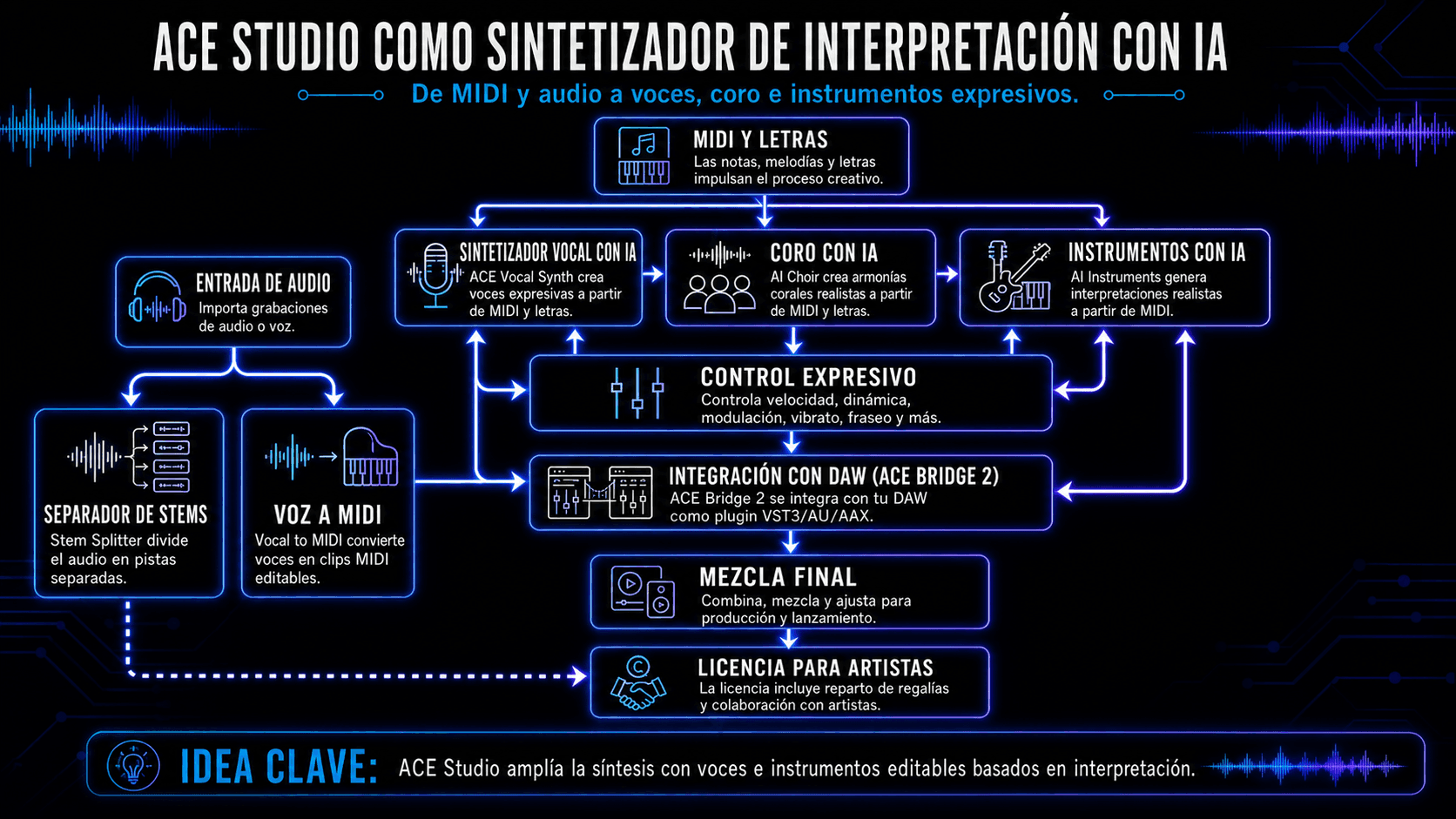
Infografía que muestra el flujo de trabajo de síntesis de voz cantada de ACE Studio, incluyendo entrada de audio, separador de stems, vocal a MIDI, sintetizador vocal AI, coro AI, instrumentos AI, integración DAW, mezcla final y licenciamiento de artistas.
ACE Studio conecta síntesis vocal, herramientas MIDI, separación de stems, integración DAW y licenciamiento en un flujo de trabajo de música IA.

MIDI → interpretación – vocales, coro e instrumentos IA

ACE Studio incluye:

Esto es similar a cómo usarías un sintetizador de software: escribir MIDI, luego moldear el sonido. La diferencia está en el objetivo: en lugar de un oscilador crudo, estás moldeando un modelo de interpretación.

Control de expresión que se siente musical

Un buen parche de sintetizador vive o muere por la expresión: velocidad, modulación, articulación, fraseo. ACE Studio se apoya en esa idea para instrumentos también. Su ejemplo de violín IA se enfoca explícitamente en detalles de interpretación como fraseo y color tonal, impulsado por tu entrada MIDI y refinado por tus elecciones.

Audio → MIDI – resintetizando ideas que ya grabaste

Flujo de trabajo clásico de sintetizador: grabar algo desordenado, luego "resintetizarlo" en algo controlable. ACE Studio incluye herramientas como:

  • Separador de Stems (dividir una mezcla en stems como vocales, batería, bajo, etc.)
  • Vocales a MIDI (convertir una pista vocal en un clip MIDI con letras en cada nota)

Eso no está reemplazando la musicalidad: te está dando una forma de mantener tu sensación original mientras obtienes editabilidad.

Integración DAW – mantener todo en la línea de tiempo

ACE Bridge 2 se integra como un plugin VST3/AU/AAX y soporta conexión en tiempo real y sincronización con tu flujo de trabajo DAW. Con sincronización ARA, puede seguir el mapa de tempo y cambios de compás y mantener el transporte alineado (reproducir/parar/buscar).

Cómo usar un sintetizador como principiante

Si estás buscando cómo usar un sintetizador, aquí está el camino más rápido: construye un parche simple repetidamente hasta que tus manos entiendan la causa y efecto.

  1. Elige una forma de onda

Comienza con una onda diente de sierra para una base brillante o una onda cuadrada para un tono hueco. Si tu sintetizador tiene dos osciladores, desafina el segundo ligeramente (unos pocos centavos) para anchura.

Ejercicio para principiantes: haz un bajo con un oscilador primero. Agrega complejidad solo cuando puedas predecir lo que cambiará.

  1. Moldea el tono con un filtro

Baja el corte del filtro hasta que esté más oscuro, luego súbelo hasta que se asiente en la mezcla. Agrega solo un toque de resonancia para carácter.

Consejo de mezcla: si tu sintetizador pelea con las vocales, a menudo no necesitas más EQ, necesitas menos brillo en la fuente.

  1. Configura una envolvente ADSR

Prueba estas formas iniciales:

  • Punteo: Ataque 0–10ms, Decay corto, Sustain bajo, Release corto
  • Pad: Ataque más lento (200–800ms), Decay medio, Sustain medio-alto, Release más largo
  1. Agrega modulación para movimiento

Asigna un LFO a:

  • Tono (cantidad diminuta) para vibrato
  • Corte de filtro (lento) para respiración suave
  • Amp (sutil) para tremolo

El movimiento es lo que convierte "un tono" en "una parte".
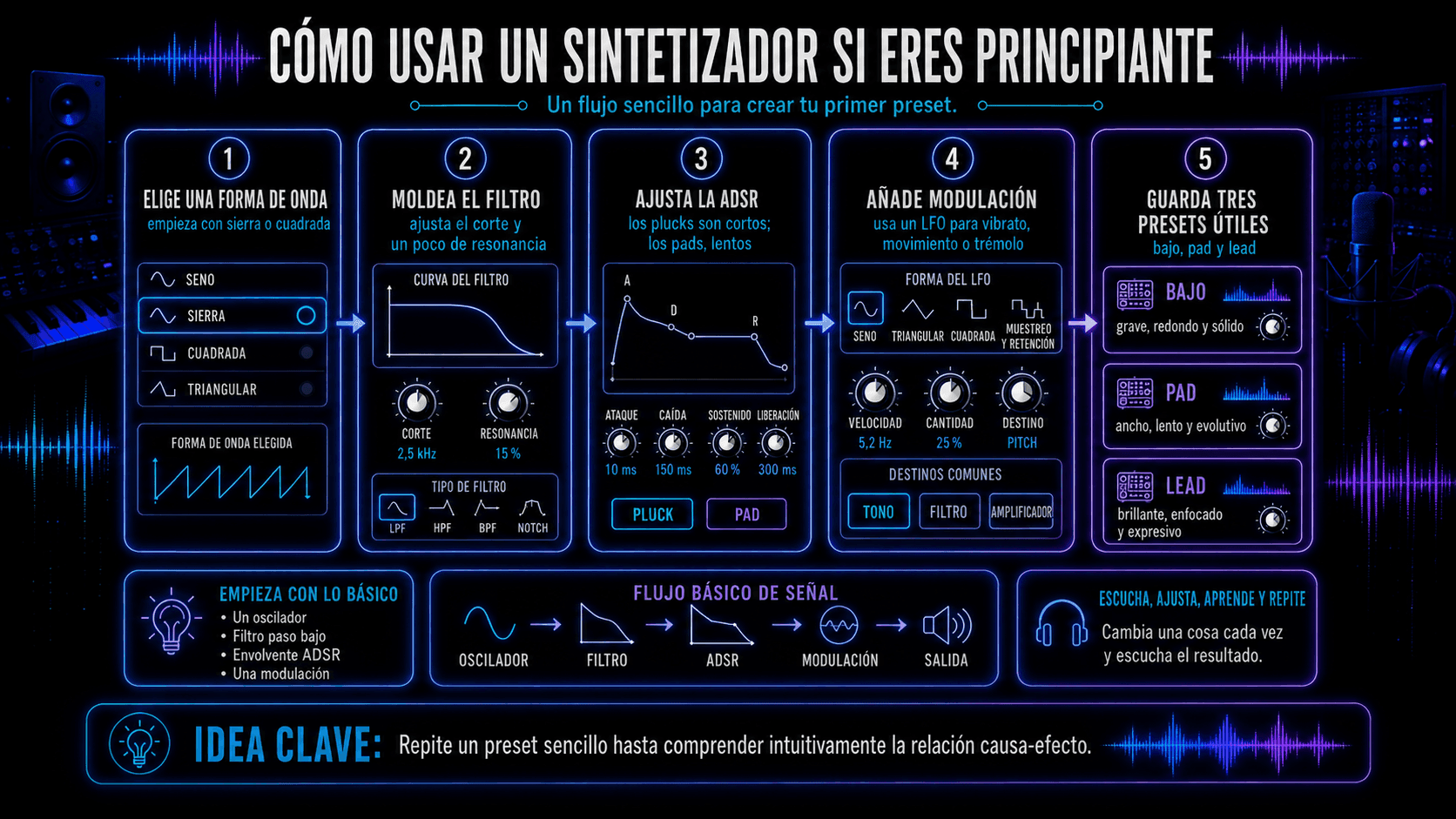
Flujo de trabajo de sintetizador para principiantes que cubre selección de forma de onda, moldeado de filtro, configuraciones ADSR, modulación LFO y creación de presets.
Un flujo de trabajo simple de cinco pasos para construir tu primer parche de sintetizador.

Guarda presets y construye tu primer parche

Haz tres presets que realmente uses:

  1. Un bajo que deje espacio para el kick
  2. Un pad que soporte acordes sin enmascarar vocales
  3. Una melodía principal que se mantenga enfocada en el rango medio

Flujo de trabajo práctico: construye el parche mientras la pista está sonando. La síntesis es un arreglo. Estás decidiendo qué papel emocional juega el sonido.

Características comunes de interpretación

Las características de interpretación son lo que hace que un sintetizador se sienta como un instrumento en lugar de un generador de sonido.
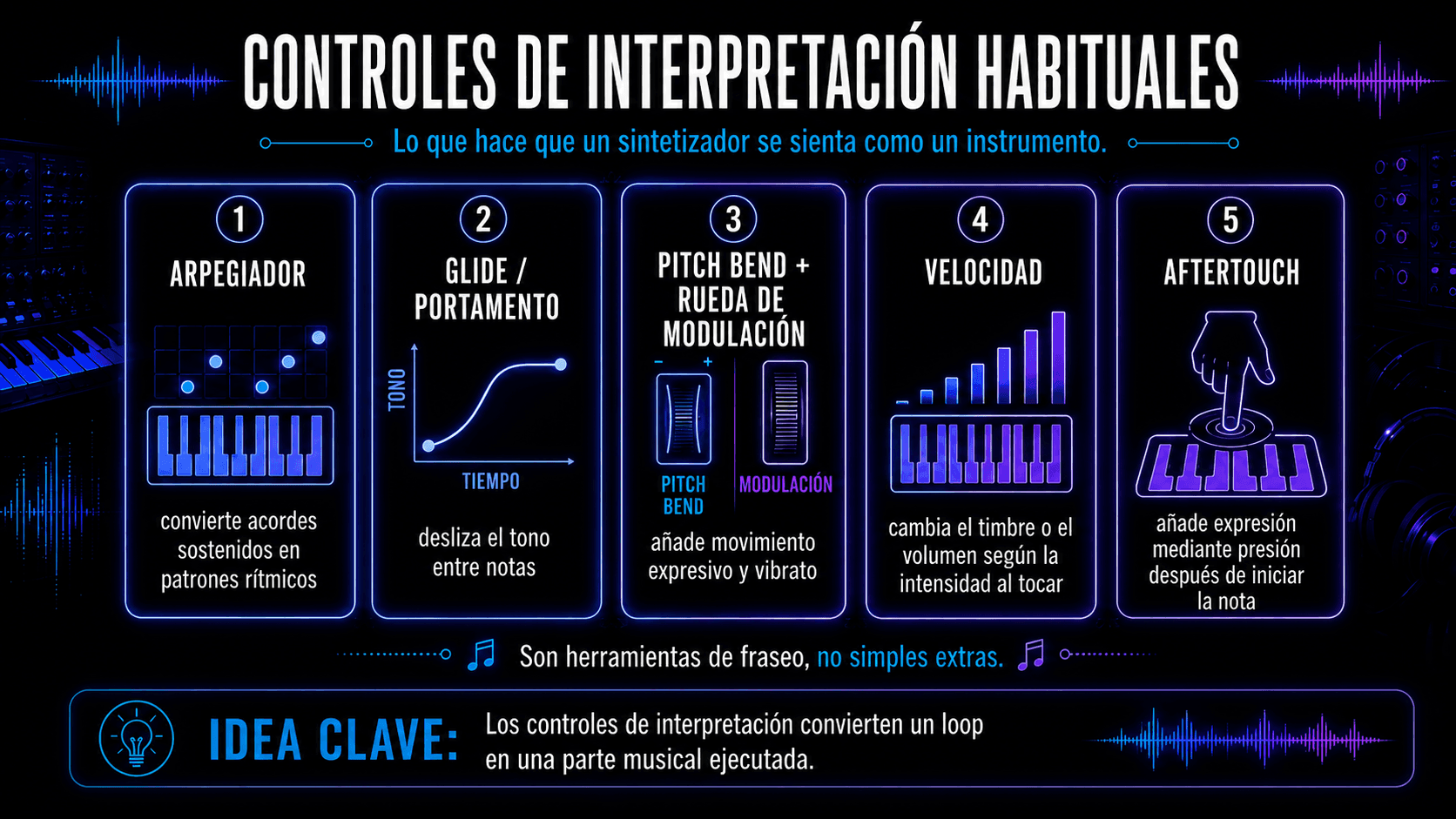
Infografía que explica arpegiador, glide, pitch bend, rueda mod, velocidad y aftertouch en un sintetizador.
Controles de interpretación que agregan movimiento, dinámica y expresión a las partes de sintetizador.

Arpegiador

Un arpegiador convierte acordes sostenidos en patrones de notas rítmicas. Es genial para construir impulso sin dibujar manualmente cada nota. El mejor consejo es tratarlo como un baterista: elige una velocidad y longitud de gate que complemente el groove.

Glide y portamento

Glide crea deslizamientos de tono entre notas. Una pequeña cantidad agrega legato similar a vocal; mucho se convierte en un efecto. Es especialmente útil en melodías principales de sintetizador monofónico y bajo.

Pitch bend y rueda mod

Pitch bend te da imperfección "humana": curvas, caídas, golpes expresivos. La rueda mod a menudo se mapea a vibrato, brillo de filtro o profundidad de FX. Si estás grabando líneas de sintetizador, manejar la rueda mod es una de las formas más rápidas de hacer que una parte se sienta interpretada.

Velocidad y aftertouch

La velocidad controla qué tan fuerte "golpeas" una nota. Mapéala al corte de filtro o nivel de amplificador para dinámicas. Aftertouch (presión después de que la tecla esté presionada) es perfecta para movimiento expresivo: abrir un filtro en notas largas, agregar vibrato o introducir distorsión.

Mentalidad de productor: estas características no son bonificaciones, son tus herramientas de fraseo. Son la diferencia entre un loop y una interpretación.

Por qué usar un sintetizador

Diseño de sonido y creatividad

Un sintetizador es una tubería directa de la imaginación al sonido. Cuando aprendes síntesis básica, dejas de buscar el "preset perfecto" y comienzas a construir partes que coincidan con la emoción de la pista.

Los sintetizadores también te permiten:

  • Crear sonidos que no existen acústicamente
  • Afinar el tono a la mezcla desde el inicio
  • Automatizar movimiento a lo largo del tiempo (filtros, modulación, textura)

Por esto los sintetizadores son tan comunes en la producción moderna: son adaptables. Pueden ser suaves o agresivos, íntimos o enormes, limpios o ásperos.
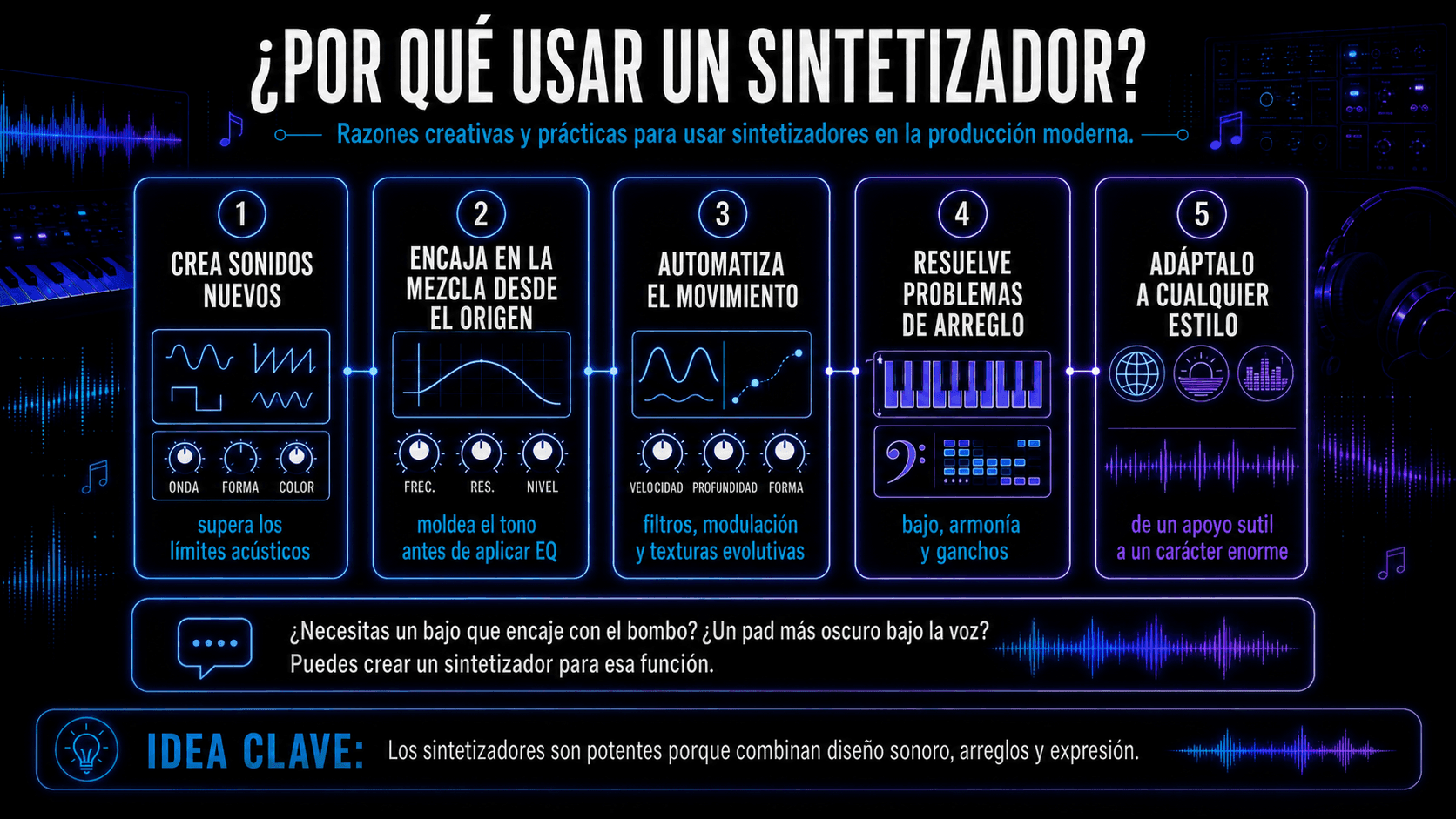
Infografía que muestra cómo los sintetizadores crean nuevos sonidos, se ajustan a la mezcla, automatizan movimiento, resuelven problemas de arreglo y se adaptan a diferentes estilos.
Cómo los sintetizadores apoyan el diseño de sonido, arreglo, movimiento y versatilidad musical.

Sintetizadores en la música moderna

Los sintetizadores están en todas partes porque resuelven problemas reales de arreglo:

  • ¿Necesitas un bajo que se sincronice con el kick? Usa una envolvente ajustada y graves controlados.
  • ¿Necesitas armonía que no pelee con vocales? Usa un pad más oscuro con ataque más lento.
  • ¿Necesitas un sonido gancho? Usa movimiento (escaneo wavetable, automatización de filtro, modulación).

Y ahora la idea de "sintetizador" incluye herramientas basadas en interpretación también. Si puedes manejar algo desde MIDI y moldear expresión, es parte de la misma familia creativa, ya sea un plugin sustractivo clásico o un motor de interpretación como ACE Studio que convierte MIDI en vocales, coro o instrumentos mientras refinas los detalles musicales.

Preguntas frecuentes

¿Cuál es la diferencia entre un teclado y un sintetizador?

Un teclado es un formato de controlador (teclas). Un sintetizador es un motor de sonido. Algunos teclados contienen motores de sintetizador, algunos son solo controladores MIDI, y algunos sintetizadores no tienen teclas en absoluto.

¿Son difíciles de aprender los sintetizadores?

Pueden parecer confusos hasta que aprendas el flujo de señal. Después de eso, es principalmente repetición: oscilador → filtro → envolvente → modulación. Aprende bien un sintetizador, y el resto comienza a tener sentido más rápido.

¿Con qué sintetizador debería comenzar un principiante?

Elige un sintetizador sustractivo simple con un diseño claro. Quieres ver y escuchar lo que hace cada control. Evita sintetizadores ultra profundos al principio, no porque sean malos, sino porque aprenderás más rápido con menos opciones.

¿Necesito un controlador MIDI para un sintetizador de software?

No estrictamente. Puedes dibujar notas MIDI en el piano roll de tu DAW. Un controlador MIDI ayuda con la sensación, pero la edición y automatización importan igual de mucho.

¿Qué tipo de síntesis es mejor para principiantes?

Síntesis sustractiva. Enseña los fundamentos que se aplican en todas partes: elección de forma de onda, filtrado, envolventes y modulación.

¿Es ACE Studio un sintetizador?

No en el sentido tradicional de "oscilador + filtro". Pero sí se sitúa dentro del mundo más amplio de la síntesis como síntesis de interpretación: convierte MIDI en vocales, coro e interpretaciones de instrumentos editables, con sincronización DAW vía ACE Bridge 2 y mapeo de tempo vía flujos de trabajo ARA.

Maxine Zhang
Escrito por
Maxine Zhang
Maxine Zhang es Directora de Operaciones en ACE Studio, conectando la tecnología de IA con aplicaciones musicales creativas. Experta en experiencia de usuario y desarrollo de productos, defiende las necesidades de los músicos en la era de la IA.
Ver perfil completo →
Copyright © 2026 Timedomain Inc.
Términos de Uso
Política de Privacidad