

Key Takeaways
- A scale in music is a sequence of notes that gives melodies, chords, basslines, and harmonies a clear structure instead of making them feel random.
- Major and minor scales create different emotional effects: major scales usually sound brighter and more stable, while minor scales feel darker, deeper, or more atmospheric.
- Scales are built from interval patterns, and understanding whole steps, half steps, and scale degrees helps you know why certain notes create tension or resolution.
- Pentatonic and blues scales are simple but powerful tools for writing catchy melodies, riffs, hooks, and improvisations with fewer “wrong” notes.
- Modes, world scales, and exotic scales give producers more creative color, helping them move beyond standard major and minor sounds while still keeping melodies intentional.
Why scales are the foundation of musical ideas
Understanding scales in music is similar to learning the alphabet of a language. They form the basic structure behind melodies, chords, and harmonies. A scale is simply a sequence of notes arranged by pitch, but that simplicity is what makes it so powerful. Every melody you recognize, whether in pop, film, or electronic music, is built from some form of scale.
What gives scales their identity is not just the notes themselves, but the relationships between them. A major scale tends to feel open and stable, often associated with brighter or more uplifting music. A minor scale, on the other hand, introduces tension and depth, which is why it’s commonly used in more emotional or atmospheric contexts. These differences are not accidental—they come directly from how the notes are spaced.
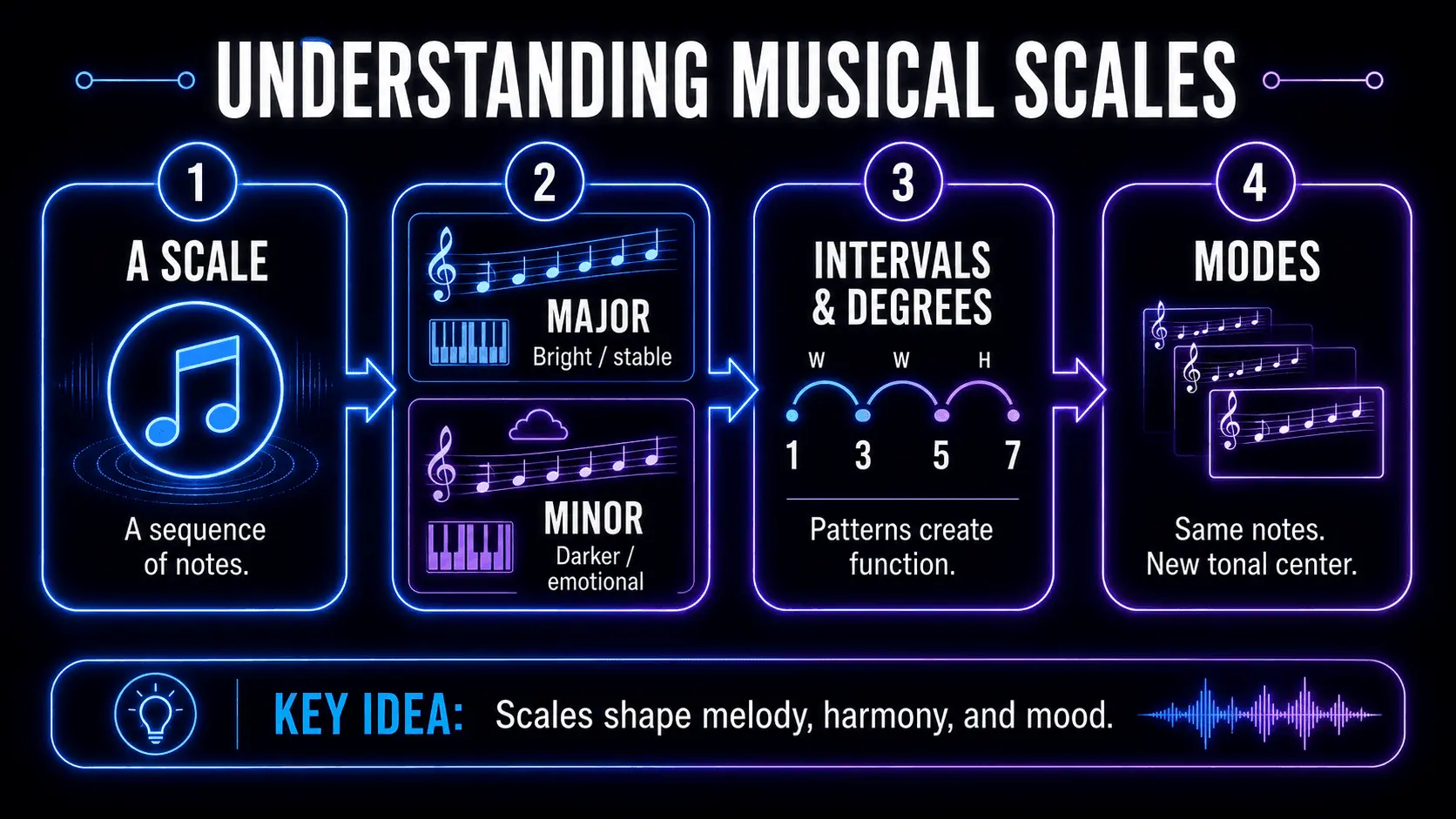
For producers and musicians, scales are not just theory. They are practical tools. Knowing how a scale works allows you to build melodies that feel intentional instead of random, and helps different elements in a track work together instead of clashing.
Understanding Scale Construction and Intervals
To fully understand how scales work, you need to look at how they are built. A scale is not just a random sequence of notes—it follows a precise pattern of intervals that gives it its identity.
Whole Steps and Half Steps
In music theory, intervals are measured in half steps and whole steps. A half step is the smallest distance between two notes, while a whole step equals two half steps.
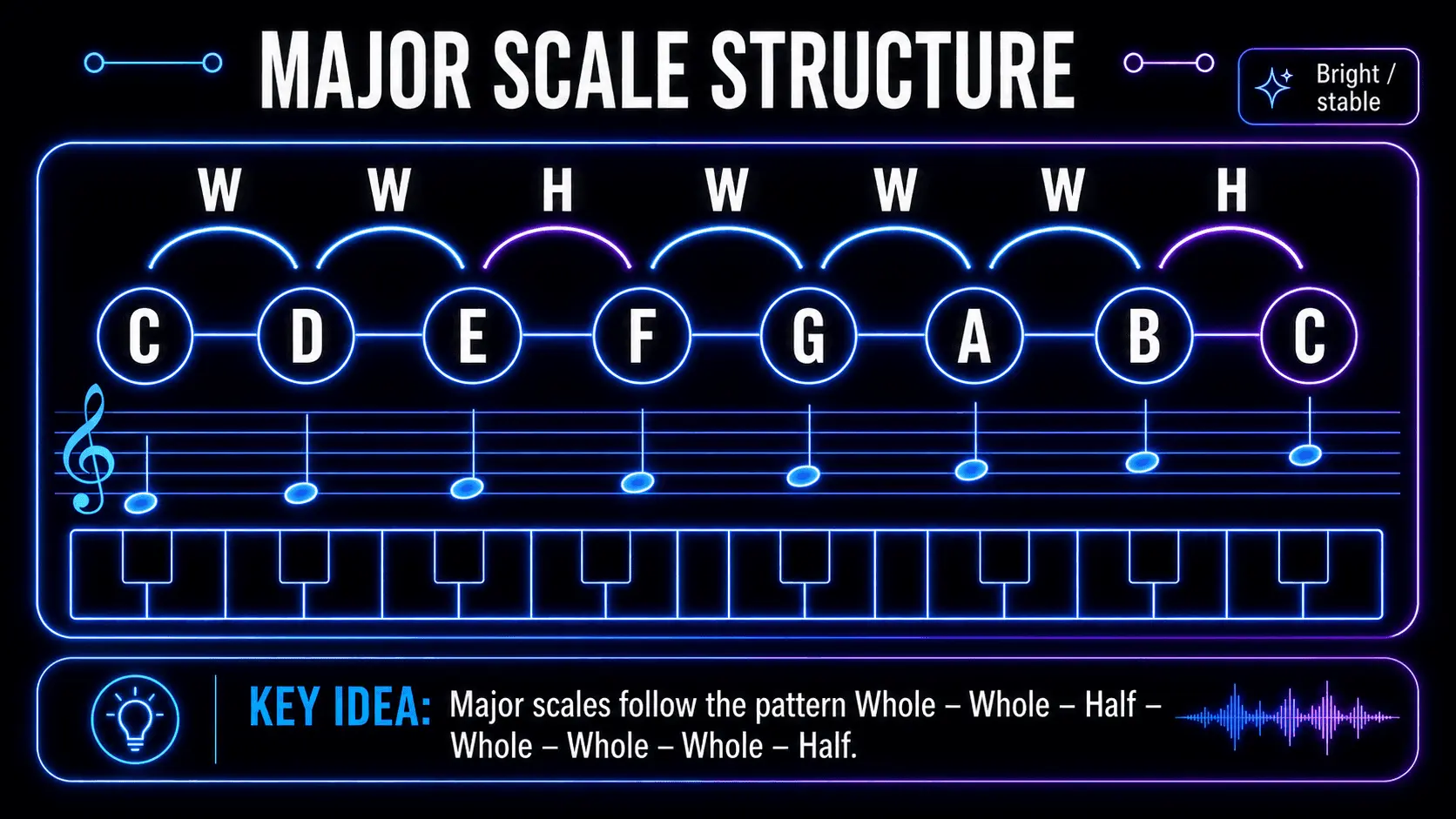
The major scale follows this pattern:
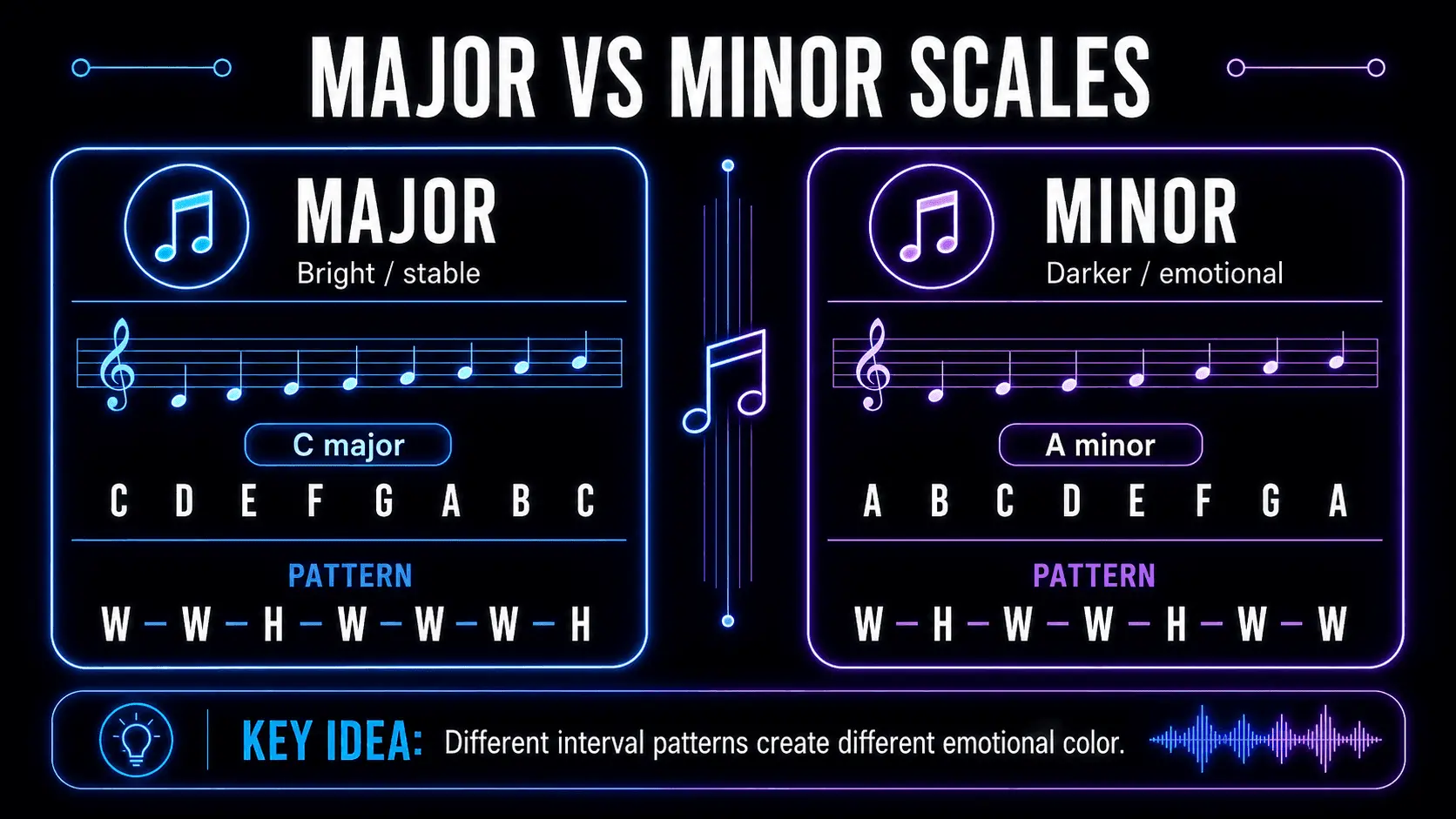
Whole – Whole – Half – Whole – Whole – Whole – Half
This pattern creates the stable sound associated with major keys. Applying this pattern from any starting note produces a major scale.
Minor scales use different spacing, creating a darker emotional effect. This shows how even small changes in interval structure can completely change musical mood.
Distances Between Scale Notes
The distances between notes create the framework for:
- melodies
- harmonies
- chord construction
- tension and resolution
When notes are close together, movement feels tighter. Wider intervals often sound more open or dramatic.
For producers, understanding interval spacing helps sounds layer naturally instead of fighting each other.
For example, a major scale follows this interval pattern:
W – W – H – W – W – W – H
or numerically:
2 – 2 – 1 – 2 – 2 – 2 – 1
Scale Degrees Explained
Each note in a scale has a specific role, known as its scale degree. These degrees act like reference points, helping you understand how each note behaves within the scale and why certain notes feel more stable than others.
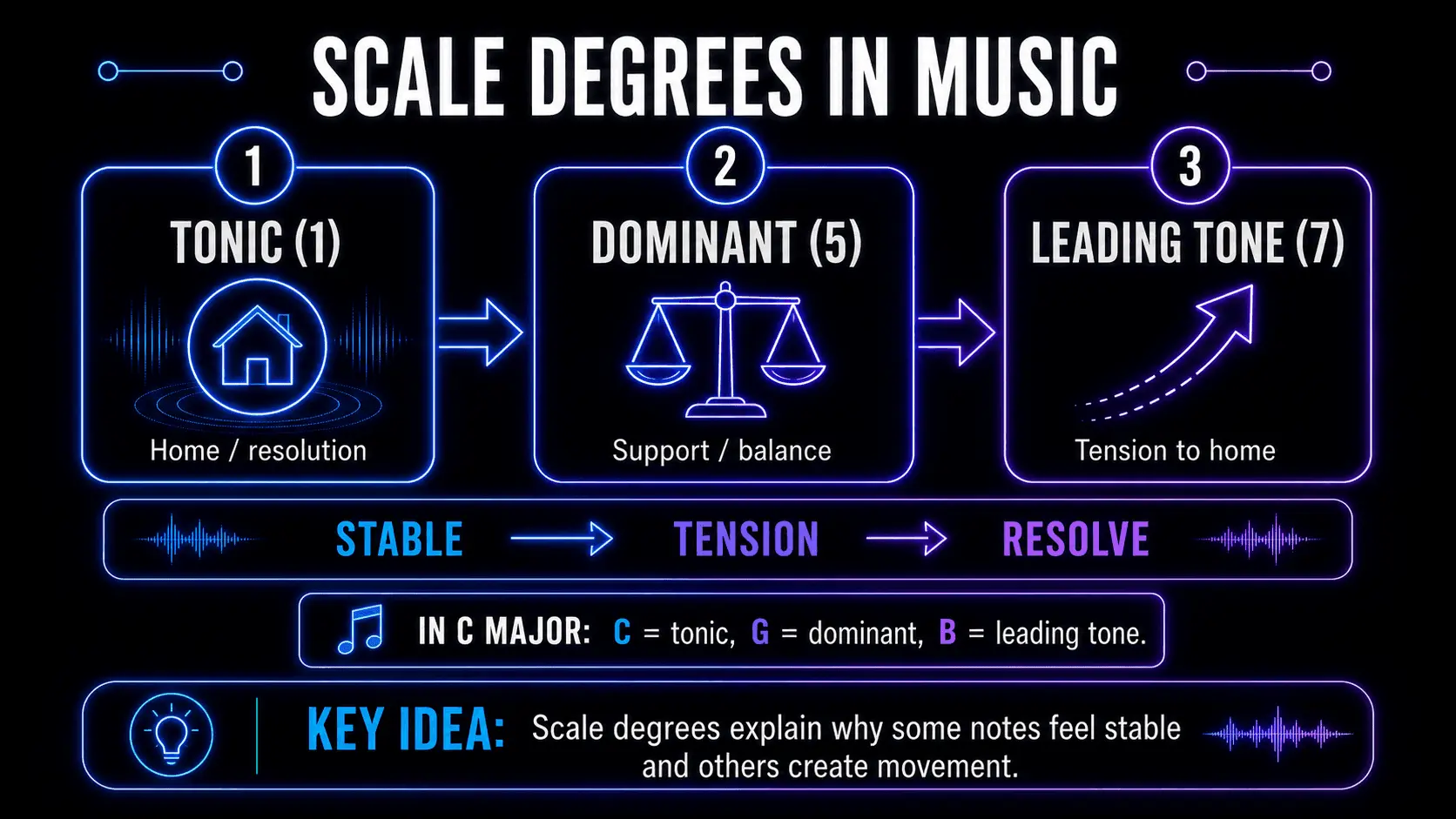
- The first degree, called the tonic, serves as the foundation of the scale. It is the note where everything feels resolved and stable. Most melodies naturally return to this note because it creates a sense of completion.
- The fifth degree often feels strong and supportive. It reinforces the tonal center and gives a melody a sense of balance without sounding fully resolved.
- The seventh degree usually creates tension. It naturally pulls back toward the tonic, creating a sense of expectation that makes the resolution feel satisfying.
- The interaction between stable and unstable degrees is what gives music its sense of movement. Some notes feel like resting points, while others create the tension that pushes a melody forward.
- Understanding scale degrees makes writing more intentional. Instead of placing notes randomly, you begin choosing them based on the emotional effect you want to create. This is where scales stop being purely theoretical and become practical tools for composition.
Major Scales: The Basics
A major scale is one of the most fundamental structures in Western music. It consists of seven notes arranged in a specific interval pattern, which defines its sound and emotional character.
How the Major Scale Is Built
The major scale follows this structure:
2 – 2 – 1 – 2 – 2 – 2 – 1 (where 1 = half step, 2 = whole step)
This pattern is what gives the major scale its recognizable bright, stable, and balanced sound. No matter which note you start from, applying this exact sequence will always produce a major scale.
The C Major Scale as a Starting Point
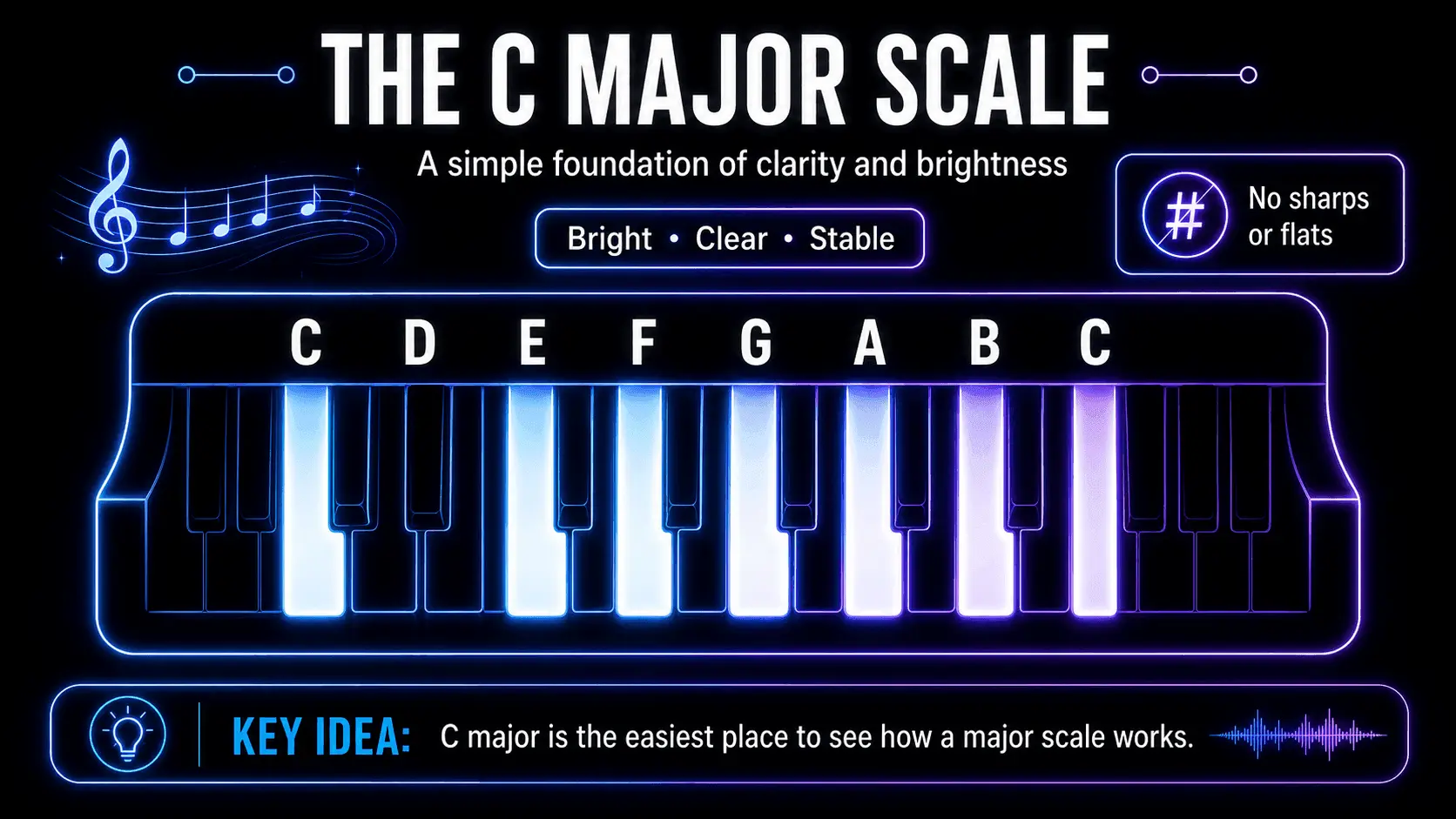
C major is often the easiest starting point because it contains only natural notes:
C – D – E – F – G – A – B
Because of its simplicity, it clearly shows how scale degrees function in practice:
- C is the tonic (rest point)
- G is the dominant (stability and support)
- B is the leading tone (tension toward resolution)
There are no sharps or flats, making the relationships easier to see.
Why Major Scales Matter in Real Music
The major scale is one of the most widely used scales in music across genres because of its clarity and emotional accessibility. It forms the foundation for countless melodies, chord progressions, and harmonic structures.
You can hear major scales in a wide range of music, for example:
- The Beatles – “Let It Be” (C major) A classic example of a simple, emotionally direct major key progression built around stability and resolution.
- Coldplay – “Viva La Vida” (A♭ major) A modern orchestral pop example where the major key supports a dramatic but still uplifting atmosphere.
- ABBA – “Dancing Queen” (A major) A clear, bright major-key structure that emphasizes energy and accessibility in pop music.
- Pharrell Williams – “Happy” (F major) A modern pop example where the major scale directly reinforces an upbeat, celebratory mood.
- Beethoven – “Ode to Joy” (D major) One of the most iconic classical uses of the major scale, emphasizing universality and resolution.
Exercises and Practice Tips for Major Scales
Understanding scales is one thing, but being able to use them confidently requires consistent practice. The goal is not just technical accuracy, but familiarity—so that scales become second nature rather than something you have to think about.
1. The "Song-Back" Method
Instead of just playing a scale, play the vocal melody of the songs you mentioned using the scale you're practicing.
- Action: Practice the C Major scale, then try to pick out the opening melody of "Let It Be" (G-G-G-G-A-E...) using only those scale notes.
- Why: This proves the scale isn't just a drill—it's the "alphabet" the song is written in.
2. Chord-Tone Targeting (The "Happy" Drill)
Your skip-note exercise (1 - 3 - 5) is great, but you can make it more practical by matching it to a beat.
- Action: Loop a simple drum beat in your DAW. In F Major, play only 1, 3 and 5 (F, A, C) in a funky, rhythmic way (like the "Happy" bassline).
- Why: Most pop hits rely on these "strong" notes. This trains your ears to find the "hook" notes immediately.
3. The "Key Jump" Challenge
Moving from C to G and F is a classic start, but for producers, the "Circle of Fifths" jump is more useful.
- Action: Practice C Major, then move to G Major (add 1 sharp), then D Major (add 2 sharps).
- Why: This mimics how music naturally flows and helps you understand why some keys feel "brighter" than others.
4. MIDI "Ghost" Notes (DAW Hack)
In Ableton or FL Studio, don't just use a "scale lock" (which can be a crutch).
- Action: Draw the full A Major scale in your MIDI clips, move the notes to the left of the playhead (so they don't sound), and use them as "ghost notes."
- Why: You see the "map" of Dancing Queen right on your screen, forcing you to manually pick the right notes rather than having the DAW fix your mistakes.
Exploring Minor Scales
If major scales provide clarity and stability, minor scales introduce contrast, depth, and emotional complexity. They are essential for creating mood-driven music, whether that’s introspective, dramatic, or atmospheric. Instead of sounding resolved and predictable, minor scales naturally create tension, which is why they are so widely used across genres like hip-hop, film scoring, and electronic music.
What makes minor scales particularly powerful is their flexibility. Rather than a single structure, they exist in multiple forms, each offering a slightly different emotional color depending on how the notes are arranged.
1. Natural Minor: The "Vibe" Scale
- The Vibe: Gritty, dark, and melancholic. This is your "foundation" minor.
- The Pattern: W - H - W - W - H - W - W
- Why use it: Perfect for looped beats (Trap, Lo-fi) where you want a steady, moody atmosphere.
- Song Example: "Lose Yourself" by Eminem (D Minor). It feels serious and unyielding.
- Practice: Play A Natural Minor (A-B-C-D-E-F-G-A). It’s all white keys, sounding "heavy" and unresolved.
2. Harmonic Minor: The "Drama" Scale
- The Vibe: Spooky, exotic, and high-tension.
- The Pattern: W - H - W - W - H - (W+H) - H
- Why use it: By raising the 7th note (creating that big 1.5-step jump), you get a "leading tone" that pulls aggressively back to the start. Great for cinematic tension or "dark" pop.
- Song Example: "Smooth" by Santana. That sharp, "Latin" flair comes from the raised 7th.
- Practice: Play A Harmonic Minor (A-B-C-D-E-F-G#-A). That G# is the "drama" note.
3. Melodic Minor: The "Classy" Scale
- The Vibe: Sophisticated, mysterious, and smooth.
- The Pattern (Ascending): W - H - W - W - W - W - H
- Why use it: It smooths out the "spooky" gap of the harmonic minor. It sounds like a "jazzy" version of a major scale, making it feel elegant rather than just sad.
- Song Example: "Yesterday" by The Beatles. The melody uses these smoother jumps to feel nostalgic and polished.
- Practice: Play A Melodic Minor going up (A-B-C-D-E-F#-G#-A). It sounds almost like a Major scale at the very top.
Pro Practice Drills for Your DAW
- The "Ghost Note" Swap: Draw an A Natural Minor scale in your MIDI editor. Select all the G notes and move them up to G#. You’ve instantly turned a "sad" loop into a "dramatic" (Harmonic Minor) loop.
- The "Turnaround" Signal: Write a 4-bar melody. Use Natural Minor for the first 3 bars. In the 4th bar, use notes from the Harmonic Minor (raise the 7th). This "tells" the listener the loop is about to restart.
- The Bassline Contrast: Hold an A Minor chord (A-C-E). Play the Natural Minor scale over it; it feels "grounded." Then play the Melodic Minor scale over it; notice how it suddenly feels "lighter" and more "expensive."
Pentatonic and Blues Scales
While major and minor scales provide a full framework of seven notes, pentatonic and blues scales take a more minimal approach. By reducing the number of notes, they remove much of the tension found in traditional scales, making them easier to use while still remaining highly expressive.
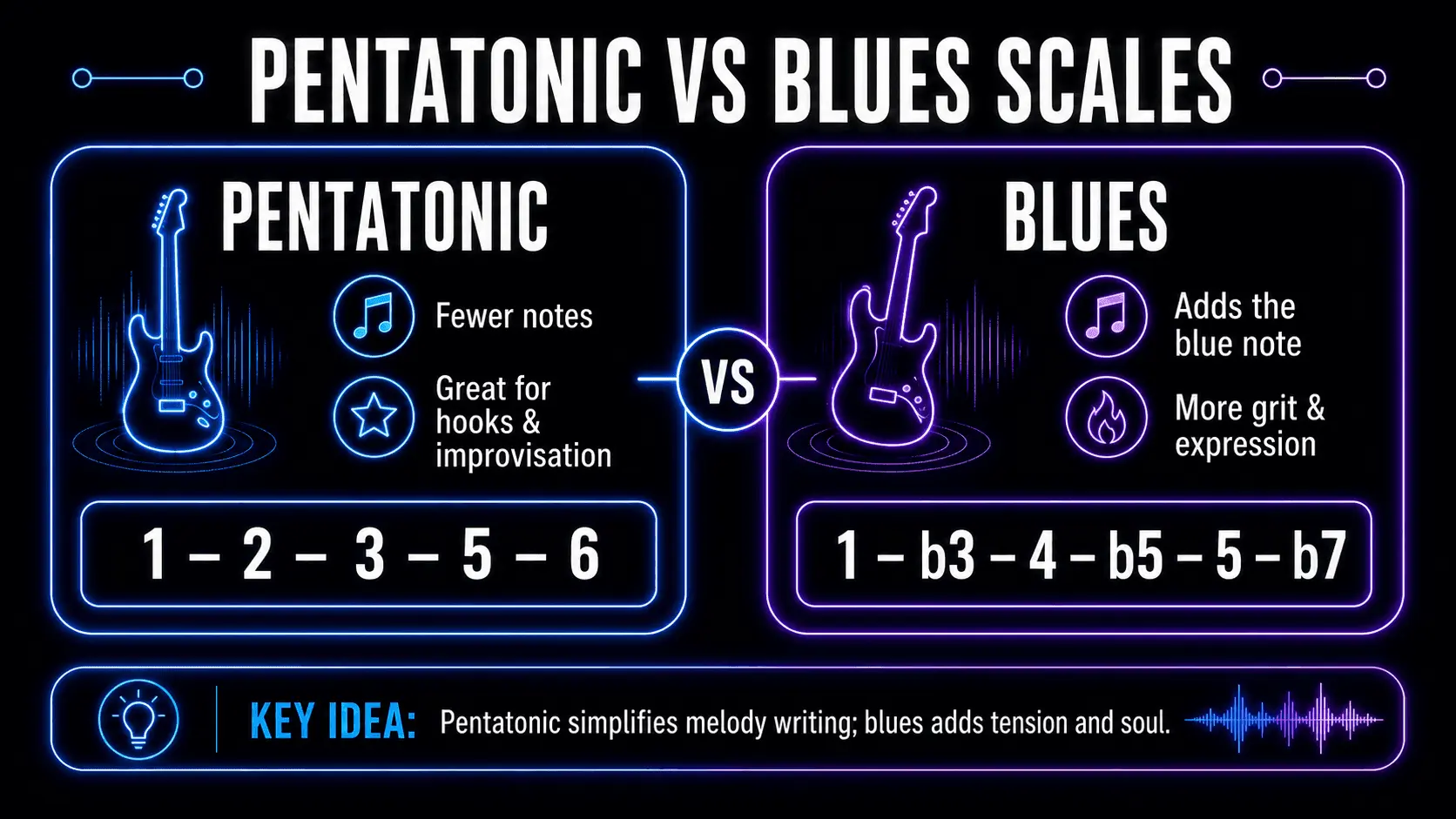
This simplicity is exactly what makes them so powerful. With fewer notes to work with, it becomes much harder to hit something that sounds out of place. As a result, these scales are widely used for melody writing, improvisation, and riff creation across multiple genres.
1. Major Pentatonic (The "Feel-Good" Scale)
- The Vibe: Pure, bright, and impossible to mess up. It sounds like sunshine.
- The Pattern: 1 - 2 - 3 - 5 - 6 (Skip the 4th and 7th).
- Real-World Example: The Temptations – "My Girl." That opening guitar riff is just a Major Pentatonic scale walking up.
- Why it works: By removing the 4th and 7th notes, you remove all the "clashing" notes. Everything you play will sound "correct."
2. Minor Pentatonic (The "Cool" Scale)
- The Vibe: Grounded, soulful, and tough. The "bread and butter" of modern music.
- The Pattern: 1 - b3 - 4 - 5 - b7 (Skip the 2nd and 6th).
- Real-World Example: Led Zeppelin – "Black Dog" or almost any Drake melody. It’s the "default" for hip-hop and rock because it leaves lots of room for the bass and vocals.
- Practice: Play A Minor Pentatonic (A, C, D, E, G, A). Notice how it sounds instantly "bluesy" or "rock" without trying.
3. The Blues Scale (The "Soul" Scale)
- The Vibe: Raw, gritty, and human.
- The Pattern: 1 - b3 - 4 - b5 - 5 - b7 (The "Blue Note" is the b5).
- Real-World Example: Muddy Waters – "Hoochie Coochie Man" or the vocal runs in Beyoncé songs.
- The "Secret Sauce": The b5 (the "Blue Note") is the "ugly-beautiful" note. It sounds "wrong" in a way that feels "right" and soulful.

Better Practice Exercises for Producers
1. The "Topline" Test (The 5-Note Rule)
- Action: Take a 4-bar loop you’ve made. Try to write a melody using only 5 notes (the Pentatonic).
- Why: It forces you to focus on rhythm and catchiness rather than complicated note choices. This is how "hooks" are born.
2. The "Blue Note" Spice (MIDI)
- Action: Write a simple melody in A Minor Pentatonic (A, C, D, E, G).
- The Hack: Find one "long" note in your melody and add a quick "grace note" (a very short MIDI note) on the Eb (the Blue Note) just before it.
- Why: This mimics a singer "sliding" into a note, giving your digital synth a "human" feel.
3. The "Black Key" Cheat Code
- Action: Go to your keyboard and play only the black keys.
- Why: The black keys naturally form a Gb Major Pentatonic (or Eb Minor Pentatonic). This is why beginners can "jam" on the black keys and it always sounds like a movie score or a pop hit.
World and Exotic Scales
Most Western music is built around major and minor scales, which follow consistent interval patterns. World scales, however, often include intervals that feel less familiar, such as augmented seconds or unusual step patterns. These differences create a distinct sense of movement that immediately stands out.
1. The Phrygian Dominant (The "Desert / Middle Eastern" Scale)
- The Vibe: Intense, dark, and royal. It sounds like a desert chase scene or ancient mystery.
- The Pattern (Semitones): 1 - 3 - 1 - 2 - 1 - 2 - 2 (The "3" jump is the secret).
- Real-World Example: Dick Dale – "Misirlou" (The Pulp Fiction theme) or Offspring – "Come Out and Play."
- Practice: Play E Phrygian Dominant (E, F, G#, A, B, C, D). The "F" to "G#" Jump is what creates that instant Middle Eastern flavor.
2. The Hirajoshi Scale (The "Japanese / Zen" Scale)
- The Vibe: Introspective, beautiful, and "empty." It feels like a rainy night in Tokyo.
- The Pattern (Semitones): 2 - 1 - 4 - 1 - 4 (This is a 5-note pentatonic scale).
- Real-World Example: Used heavily in Marty Friedman’s guitar solos or the soundtrack to Ghost in the Shell.
- Practice: Play A Hirajoshi (A, B, C, E, F). Because of the big "4" jumps, it feels very spacious.
3. The Double Harmonic Major (The "Byzantine / Flamenco" Scale)
- The Vibe: Extreme tension and exotic beauty. It sounds "expensive" and dramatic.
- The Pattern (Semitones): 1 - 3 - 1 - 2 - 1 - 3 - 1
- Why it works: It has two "3-step" jumps, which makes it sound very different from standard pop music.
- Practice: Play C Double Harmonic (C, Db, E, F, G, Ab, B, C). It is incredibly expressive for melodies.
Producer Practice Drills
1. The "Single Note Drone" Test
- Action: In your DAW, lay down a long, continuous bass note (like a low C).
- The Drill: Play the Phrygian Dominant melody over that single note.
- Why: These scales are "Modal," meaning they sound best when they are compared to a single root note rather than a complex chord progression.
2. The "Synth Lead" Hack
- Action: Take a simple lead synth and turn up the Portamento (Glide).
- The Drill: Play the Hirajoshi scale.
- Why: The big gaps (the "4"s) in this scale sound amazing when the synth "slides" between the notes. It creates a very organic, flute-like feel.
3. The "Cinematic Layer" (DAW)
- Action: If your track feels "boring" or "too Western," take your melody and flatten the 2nd note by one semitone.
- Why: This often shifts you into Phrygian territory, instantly adding "edge" and "mystery" to a standard minor melody.
Music Modes and Their Importance
Once you move beyond basic major and minor scales, modes open up a much wider creative space. They aren’t new sets of notes, but different ways of organizing the same scale. By shifting the tonal center—the note that feels like “home”—you completely change the emotional character of a melody without introducing new pitches.
This is what makes modes so powerful. Instead of learning entirely new systems, you’re learning how perspective changes sound.
In practical terms, modes allow producers to break out of predictable patterns. While standard major and minor scales dominate most modern music, they can start to feel limited over time. Modes introduce subtle variations that keep melodies interesting without making them overly complex.
The 7 Modes: From Brightest to Darkest
Each mode carries its own identity, defined by how its intervals relate to the tonal center. The difference can be subtle on paper, but in practice it has a strong impact on how a listener experiences the music.
| Mode | The Vibe | Pattern | Example |
|---|---|---|---|
| Lydian | Dreamy | 2-2-2-1-2-2-1 | The Simpsons Theme |
| Ionian | Happy | 2-2-1-2-2-2-1 | Let It Be |
| Mixolydian | Festive | 2-2-1-2-2-1-2 | Sweet Home Alabama |
| Dorian | Cool | 2-1-2-2-2-1-2 | Get Lucky - Daft Punk |
| Aeolian | Sad | 2-1-2-2-1-2-2 | Hello - Adele |
| Phrygian | Dark | 1-2-2-2-1-2-2 | Humble - Kendrick Lamar |
| Locrian | Chaotic | 1-2-2-1-2-2-2 | YYZ - Rush |
Why Modes Matter for Producers
- Expanded Creative Range: Understanding modes allows you to break free from the sonic limits of standard major and minor scales, offering a wider variety of "flavors" and captivating textures for your compositions.
- Intentional Mood Setting: Each mode carries a distinct emotional character—such as Dorian being "bluesy" or Lydian sounding "mystical"—giving you precise control over the atmosphere and vibe of your tracks.
- Natural Skill Progression: For beginners, learning modes is a logical next step after mastering foundations. It provides a roadmap for understanding how shifting a tonal center can change the entire feeling of a piece without needing new notes.
- Refinement for Pros: For experienced producers, modes act as a specialized toolkit. They allow you to make deliberate tonal choices that refine a track’s emotional impact, moving beyond the "ordinary" sounds often found in popular music.
- Mastery of Nuance: By adjusting the intervals within a mode, you can shape subtle emotional differences—like turning a bright pop melody into something more nostalgic or soulful—that make your music more distinctive and memorable.
How ACE Studio Helps You Hear Scales as You Create Real Music
Turning scale patterns into sound: Scales are easier to understand when you hear them as performed parts, not just note patterns. In ACE Studio, you can write a simple MIDI melody in C major, A minor, Dorian, blues, or any other scale, then hear that idea sung by an AI voice or played by an AI instrument. This makes the emotional difference between scales much clearer. A major scale can feel open and direct, while harmonic minor immediately creates stronger pull and tension. Instead of only studying the pattern, you hear what the scale actually does inside a musical phrase.
Testing vocal melodies and toplines: For songwriters, scales become especially useful when they carry lyrics. ACE Studio lets you create AI Vocals from MIDI notes and lyrics, then refine pitch, phrasing, vibrato, breath, phonemes, and emotional delivery. That means you can test whether a pentatonic melody feels strong enough for a hook, whether a minor scale gives the lyric enough weight, or whether a raised seventh adds the right amount of drama before the phrase resolves. You still choose the notes and shape the performance, the tool lets you hear the topline with real vocal character.
Exploring scales through instruments, not just piano: A scale can feel completely different depending on the instrument playing it. A Lydian melody on piano might sound bright, but on strings it can feel cinematic and suspended. A Phrygian phrase on a solo instrument can feel darker and more pointed. ACE Studio supports AI Instruments, so you can test scale-based ideas as strings, brass, saxophone, duduk, or layered ensemble parts. This helps producers decide whether a scale works best as a lead melody, counter-melody, bass movement, or background texture.
Understanding modes through tonal center: Modes often confuse beginners because they use familiar notes but create a different sense of “home.” ACE Studio gives you a practical way to hear that shift. Hold one root note, then write a short modal phrase above it. D Dorian, D Aeolian, and D Phrygian may look similar on paper, but once you hear them performed, the difference becomes obvious. Dorian feels cooler and more open, Aeolian feels heavier, and Phrygian creates darker tension. That kind of listening turns modes from theory into a creative choice.
Learning from existing melodies: ACE Studio can also help when you already have an audio idea. If you sing, hum, or import a melody, tools like Vocal to MIDI and Audio to MIDI can turn the phrase into editable notes. From there, you can study which scale the melody suggests, where the tension notes land, and which scale degrees create the strongest moments. This is one of the most practical ways to learn scales: start with sound, reveal the notes, then refine the idea with intention. Scales give you the structure – ACE Studio helps you hear, adjust, and shape that structure into music.
Frequently Asked Questions
What is a scale in music?
A scale in music is a sequence of notes arranged in ascending or descending order, usually within one octave. Each note in the scale has a specific role, known as a scale degree, which helps define how melodies and harmonies are built. In simple terms, a scale is the framework that tells you which notes will sound good together.
Why are scales important in music?
Scales are important because they provide structure. Most melodies, chords, and harmonies are built from them. A common insight shared by experienced musicians is that once you understand scales, you stop guessing and start making intentional musical decisions. Instead of randomly placing notes, you know what will work and why.
What’s the difference between major and minor scales?
The difference comes down to interval structure, which changes the emotional feel. Major scales sound bright, stable, and uplifting. Minor scales sound darker, more emotional, or introspective. This difference is why major scales are often used in pop and upbeat music, while minor scales are common in genres that aim for mood and depth.
Do I need to memorize all scales?
No—but you do need to understand how they work. A widely shared piece of advice among producers is to focus on patterns instead of memorizing every scale individually. Once you understand how intervals are built, you can construct any scale on the fly. This approach is faster and far more practical than pure memorization.
Why do my melodies sound random or “off”?
This is one of the most common beginner problems. In most cases, it happens because notes are being chosen outside of a consistent scale. Without a clear tonal center, melodies lose direction and feel disconnected. The solution is simple: pick a scale first, then build your melody inside it.
What are scale degrees and why do they matter?
Scale degrees are the positions of notes within a scale. Each degree has a function. For example, the first degree (tonic) feels like “home,” while other degrees create movement, tension, or resolution. Understanding this is what allows you to create melodies that feel intentional instead of random.
How do I choose the right scale for my track?
There’s no single correct answer—it depends on the emotion you want. Producers often choose scales based on feeling rather than theory. A major scale might fit something energetic and uplifting, while a minor scale works better for something atmospheric or emotional. A common approach is to experiment quickly: try a few scales and stick with the one that feels right.
Are scales only for melodies?
No. Scales are used for melodies, chords, basslines, and even sound design. One insight often shared by more advanced producers is that scales influence the entire track, not just the lead. When everything follows the same scale, the mix feels more cohesive.
What’s the easiest scale to start with?
The major scale is usually the best starting point because of its simple and consistent structure. From there, most beginners move to the natural minor scale, which introduces a different emotional tone while still being easy to understand. These two scales cover a large percentage of modern music.
Why do professionals still practice scales?
Because scales are not just theory—they’re muscle memory and sound recognition. Even experienced musicians revisit scales regularly to improve speed, precision, and creativity. It helps them move faster when writing melodies and makes improvisation more natural.
Can I make music without knowing scales?
Yes—but it’s much harder to stay consistent. Many beginners start by using their ear, which can work in simple cases. However, without understanding scales, it becomes difficult to fix mistakes, build complex ideas, or collaborate effectively. Learning scales doesn’t limit creativity—it actually makes the process easier and faster.