
Key Takeaways
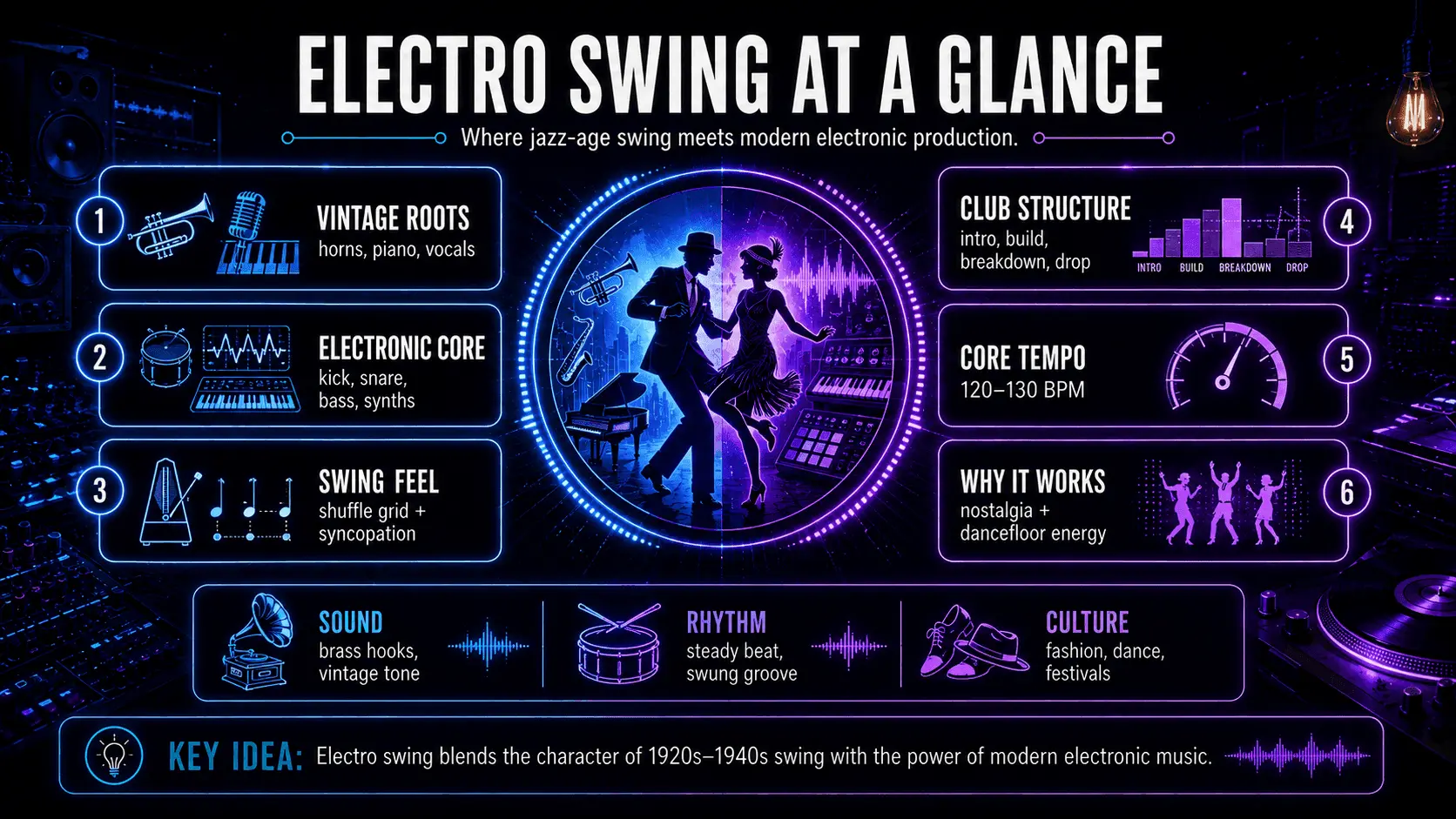
- Electro swing combines the brass, piano, vocal, and rhythmic character of 1920s–1940s swing with electronic drums, synthesizers, sampling, and modern bass production.
- Most electro swing tracks use a steady 120–130 BPM club structure, while variations such as swing hop, glitch swing, and swing n’ bass explore slower or significantly faster tempos.
- The genre’s signature sound comes from swing quantization, vintage-inspired melodic elements, four-on-the-floor or breakbeat rhythms, and careful processing that creates space for modern low-end frequencies.
- Electro swing extends beyond music production into live performance, retro-inspired fashion, festival culture, and energetic dance styles that combine Charleston movements with contemporary electronic dance steps.
- Producers can use cleared samples, royalty-free libraries, or original MIDI-based performances created with tools such as ACE Studio to build expressive horn, bass, string, and ensemble parts without relying entirely on historical recordings.
Where Jazz-Age Swing Meets Modern Electronic Production
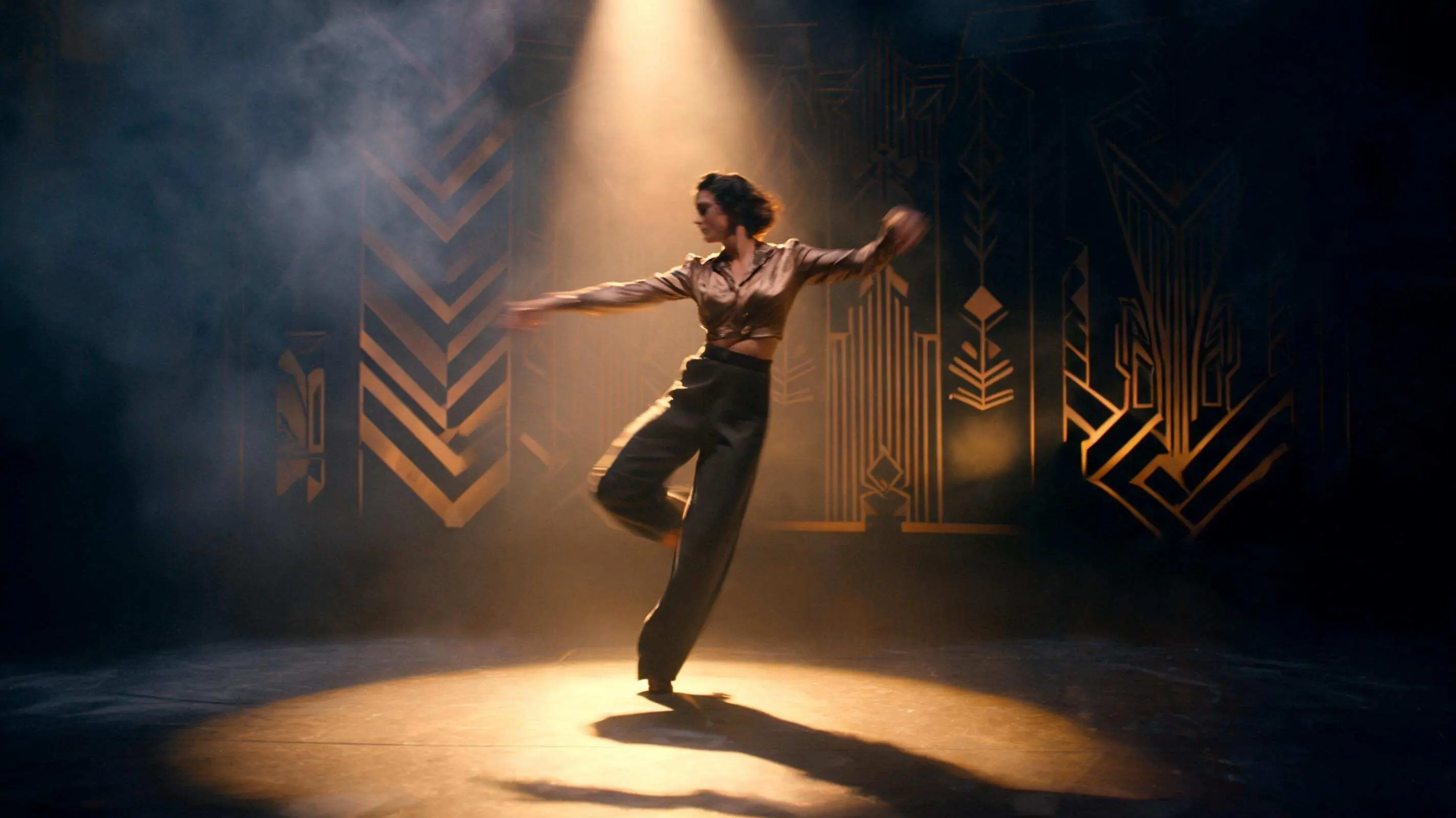
The landscape of contemporary electronic music is defined by its capacity to absorb, recontextualize, and revitalize historical audio aesthetics. Among the most resilient and stylistically distinct movements born from this ethos is the electro swing genre. By fusing the syncopated, brass-heavy energy of vintage music from the 1920s and 1930s with the foundational weight of modern electronic beats, electro swing bridges a century-long sonic gap. This movement translates the rebellious, high-energy ballroom culture of the Prohibition era into a driving, electronic dance music fusion designed for modern club environments and festival main stages.
What is Electro Swing? Inside the Genre That Made Jazz Dance Again
At its core, electro swing is an electronic music genre that superimposes the harmonic structures, melodic motifs, and rhythmic cadences of early twentieth-century jazz and swing onto contemporary electronic music foundations. It represents a deliberate juxtaposition: the warm, crackling, mid-range-focused analog texture of vintage music meets the pristine, full-frequency, sub-heavy dynamics of modern digital production.
The sonic signature of the genre relies heavily on jazz influences. Typical arrangements utilize horn sections, including trumpets, trombones, and saxophones, alongside traditional ragtime or swing piano progressions, acoustic guitars, and vocals reminiscent of the big band era. However, rather than relying on a live acoustic rhythm section to drive the groove, electro swing anchors these elements using modern swing techniques implemented via digital sequencing. This includes the deployment of synthesized basslines, crisp electronic snares, and a driving percussion matrix that adheres to contemporary electronic dance music structures.
This dance music fusion serves a dual purpose. For the electronic music enthusiast, it introduces an organic, narrative-driven melodic complexity often absent from minimalist digital genres. For lovers of traditional jazz, it provides a high-energy modernization that reintroduces historical arrangements into contemporary social spaces, driving a global 1920s music revival.
Origins of Electro Swing
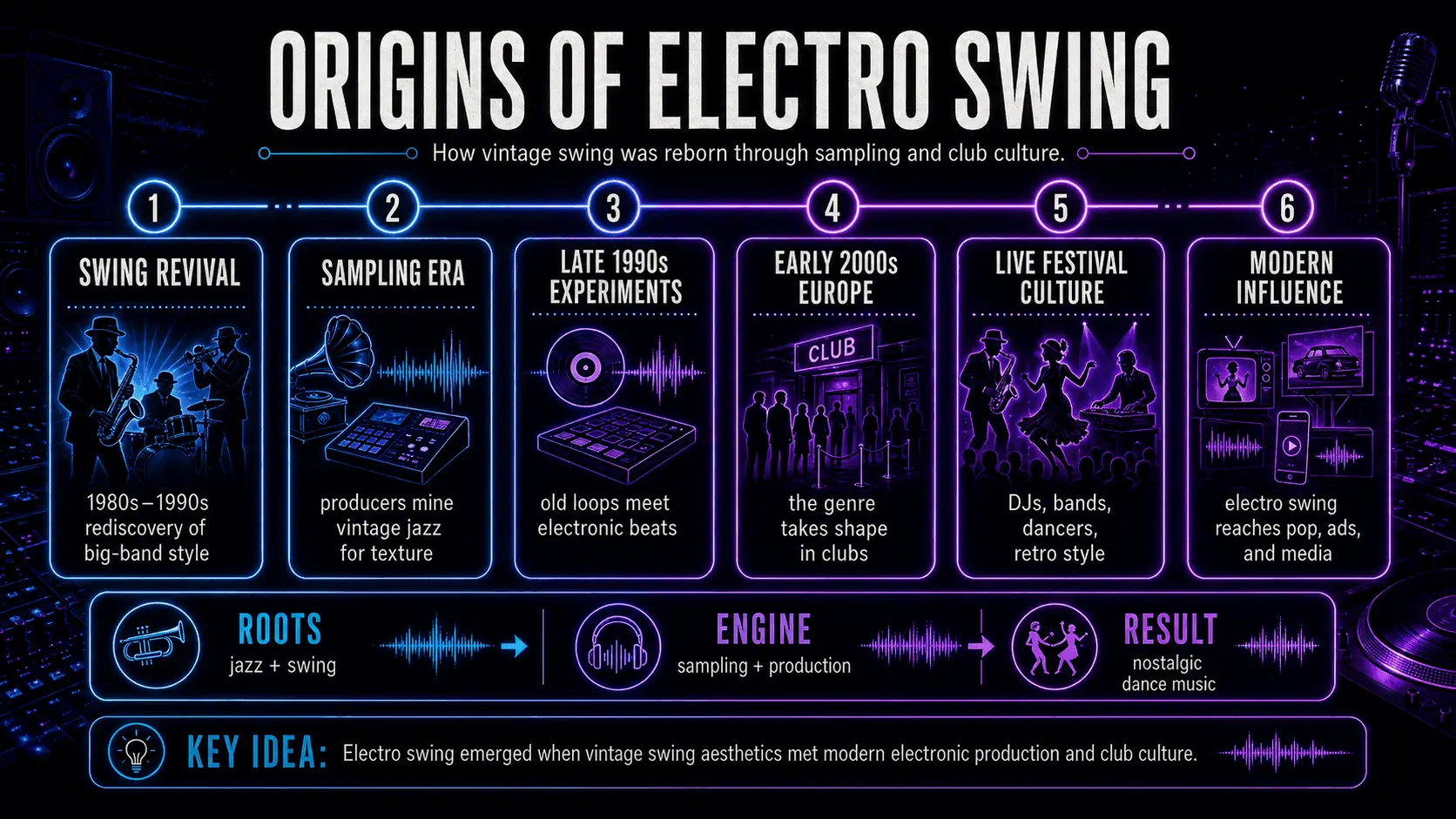
The genesis of electro swing cannot be credited to a single isolated creative flash; rather, it evolved through a series of experiments in sampling and cross-genre hybridization during the late 1990s and early 2000s. To understand how the history of electro swing began, one must examine the broader musical landscape of the late twentieth century.
The groundwork was laid in part by the swing revival movement of the late 1980s and 1990s, where bands across North America and Europe sought to replicate the high-octane performance style of original swing bands. While this movement relied strictly on acoustic instrumentation and traditional rockabilly or punk-infused energy, it re-acquainted the public with the visual aesthetics and dance styles of the big band era.
Concurrently, the electronic music production landscape was undergoing a sampling revolution. Hip-hop, trip-hop, and downtempo producers were actively mining vintage jazz records for distinct textures. In the late 1990s, avant-garde electronic musicians began to push these samples past traditional downtempo arrangements, speeding up the loops and pairing them with club-ready house and techno percussion.
The true crystallization of the genre occurred in Europe. Producers realized that the infectious, syncopated momentum of vintage swing lines possessed an inherent compatibility with the four-on-the-floor rhythmic grid of electronic dance music. By slicing historical horn hooks and vocal lines, treating them with modern audio processors, and layering them over powerful electronic sub-bass, these early innovators developed a sound that felt simultaneously nostalgic and futuristic. This marked the official birth of the genre, transforming it from an underground club experiment into a recognizable global phenomenon.
Electro Swing vs Swing Music: Core Structural Differences
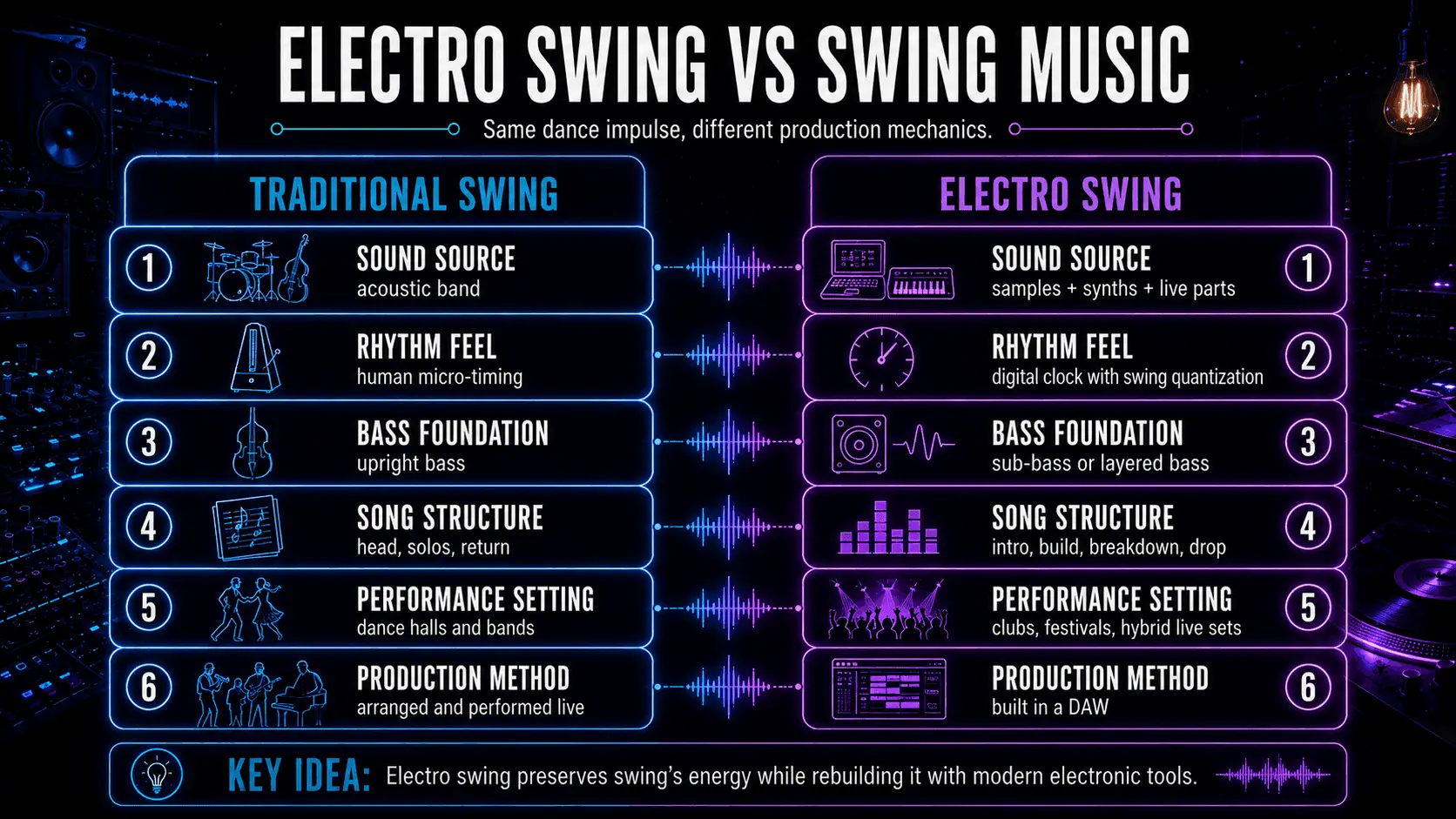
Evaluating electro swing vs swing music requires an analysis of structural, technical, and musicological contrasts. While both genres aim to induce kinetic movement and dance, their mechanical execution varies wildly across several vectors.
- Traditional swing music relies entirely on acoustic and electro-mechanical sound generation. The sonic power of a 1930s big band came from the physical displacement of air by large brass sections, reed sections, and a rhythm section consisting of an upright double bass, piano, and a drum kit.
In traditional swing, the tempo and groove are fluid. The rhythm section exhibits human micro-timing variations, often playing slightly ahead of or behind the beat to create a relaxed, human feel.
Classic swing charts generally follow standard jazz songwriting structures, utilizing head arrangements, alternating solo sections for individual instrumentalists, and a return to the main theme.
- Electro swing replaces or supplements the rhythm section with digital synthesis. The upright bass is frequently replaced by, or layered underneath, a synthesized sub-bass or a heavily compressed bass patch. While live electro swing musicians frequently perform alongside digital tracks, the foundational arrangement is dictated by a Digital Audio Workstation.
In electro swing, the groove is locked to a digital clock. Even when heavy swing quantization is applied to the MIDI grid, the absolute tempo remains perfectly consistent from the first measure to the last, satisfying the structural requirements of contemporary DJ sets and club sound systems.
Electro swing adapts these jazz elements into the arrangement architecture of electronic dance music. Tracks are built around structural concepts such as the intro, the build-up, the breakdown, and the drop, where the full intensity of the electronic beats and basslines are unleashed simultaneously with the main vintage sample hook.
3 Characteristics of Electro Swing Music
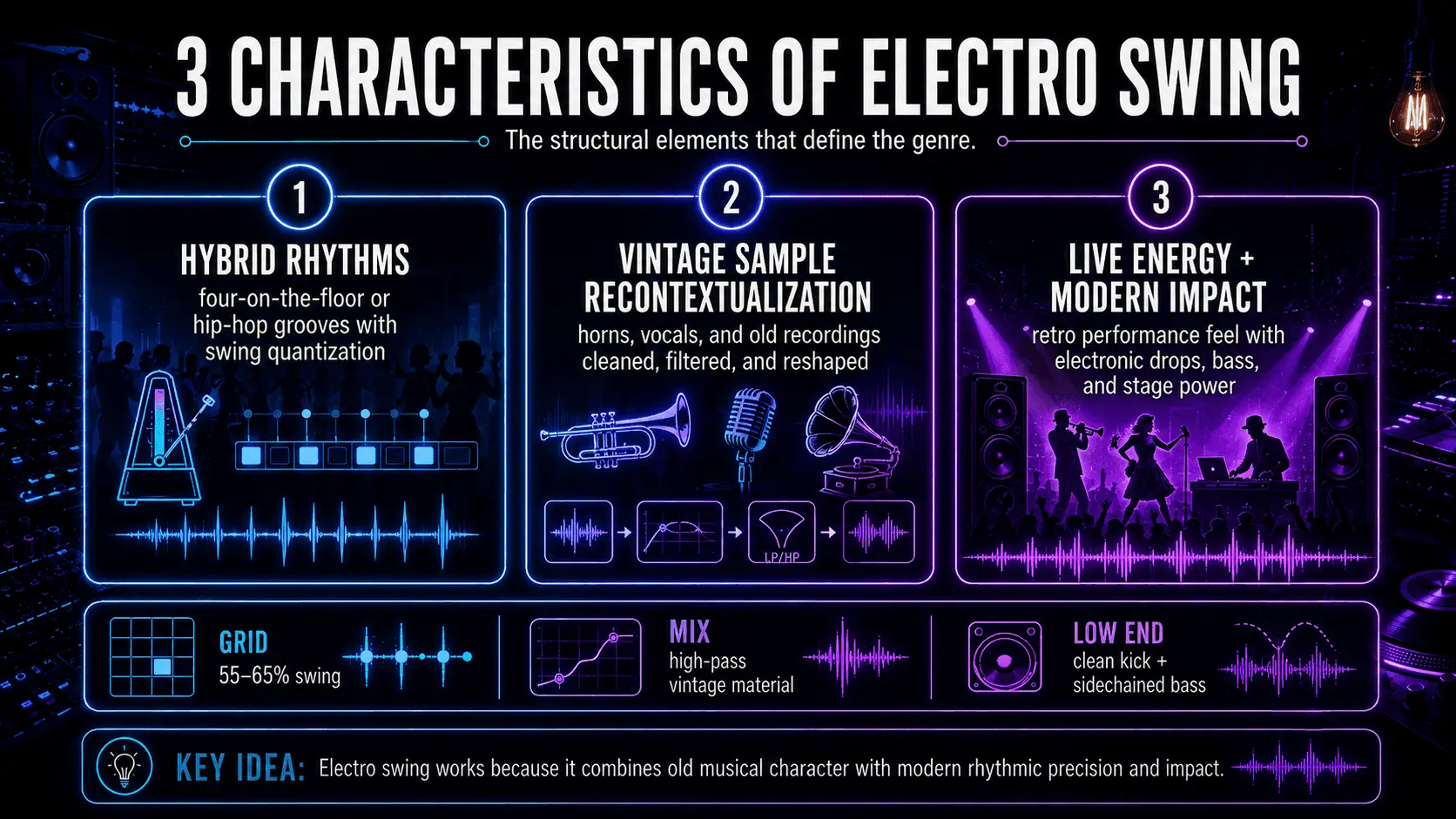
To master the composition, analysis, or performance of this genre, one must understand the three core structural characteristics that differentiate electro swing from all other contemporary electronic subgenres. By merging vintage acoustic compositions with modern digital execution, these elements define the boundaries of the sound.
1. Hybrid Rhythmic Foundations and Swing Grid Quantization
Electro swing relies on a dual rhythmic identity, alternating between or layering driving house beats and syncopated hip-hop grooves. While core club tracks utilize a steady four-on-the-floor kick drum pattern to maintain energy, subgenres frequently integrate down-tempo hip-hop samples and performance techniques such as rhythmic DJ scratches to diversify the sonic texture.
The defining mechanical characteristic across all these variations is the deliberate deviation from the straight, unyielding sixteenth-note grids common in techno or trance. Instead, producers employ an adjusted shuffle or swing grid.
In a standard electronic dance track, notes are perfectly straight and even, meaning every beat is divided into mathematically identical segments. Electro swing rejects this rigid timing by delaying the second note in a pair. This delay shifts the rhythm away from a mechanical grid and toward a humanized feel, often adjusted via the swing or shuffle percentage settings in a digital audio workstation. This intentional rhythmic drag creates a rolling pocket that satisfies modern dance floor expectations while preserving the authentic, physical syncopation of early jazz.
2. Vintage Sample Recontextualization and Signal Processing
The harmonic and melodic identity of the genre is dictated by the integration of authentic swing samples, typically sourced from Depression-era jazz recordings. Producers mine historical shellac and vinyl pressings to isolate distinctive loops featuring reeds, brass sections, shuffled percussion, and vintage vocal elements. Rather than deploying full, continuous arrangements, creators frequently isolate a single buoyant phrase or melodic hook to serve as the structural backbone of the entire track.
Integrating these low-fidelity acoustic elements within a high-fidelity digital mix requires advanced signal processing:
- Spectral Cleaning: Because original recordings from the 1920s and 1930s lack low-frequency information below 100 Hz and are dense with surface noise and shellac hiss, producers employ drastic equalization.
- High-Pass Filtering: High-pass filters are used to completely carve out the muddy low-middle frequencies of the vintage sample, leaving clean spectral real estate for modern digital sub-bass elements.
- Transient Shaping: Transient shapers are applied to the sample to restore the natural punch of the acoustic brass and reeds, ensuring the historical hook cuts cleanly through a dense electronic mix.
3. Live Integration and Cultural Axis
Unlike many purely digital electronic subgenres, electro swing maintains a deep dependency on live elements. While the music originates in the studio, it is best appreciated in a hybrid live format. Depending on the venue and production scale, this setup features a live band—including saxophonists, clarinetists, trumpet players, and vocalists—improvising directly over the DJ remixes and sequenced electronic backing tracks.
This live element extends directly into the audience culture, creating a highly participatory global community:
The Electro Swing Cultural Identity
- Visual Aesthetic: Enthusiasts frequently adopt a distinct retro look and vintage fashion style, blending prohibition-era formal wear with modern festival accents.
- Kinetic Expression: Audiences routinely utilize classic dance moves, modifying traditional swing styles to match the accelerated tempo of electronic beats.
- Regional Hubs: This cultural axis is particularly pronounced in major nightlife hubs across London and throughout the United Kingdom, where live event brands merge vintage cabaret aesthetics with modern sound systems to transform club spaces into interactive performance environments.
Popular Electro Swing Artists and Songs
The global rise of the electro swing genre has been propelled by a dedicated cohort of electro swing musicians, producers, and electro swing bands who defined its sonic boundaries. The following tracks and creators represent the foundational canon of the movement.
Yolanda Be Cool & DCUP - We No Speak Americano
Released in 2010, this track stands as one of the most commercially successful crossover successes in the history of the genre. Built upon a substantial sample of Renato Carosone’s 1956 track Tu Vuò Fà L'Americano, the Australian production duo Yolanda Be Cool paired the bouncy, minimalist Italian vocal and horn line with a clean, high-energy tech-house drum loop. The track achieved multi-platinum status across numerous territories, demonstrating the immense global pop appeal of pairing vintage swing motifs with modern club music production.
Mr. Scruff - Get A Move On!
Released in 1999, Mr. Scruff’s “Get a Move On!” is built around a prominent sample from Moondog’s “Bird’s Lament,” combined with a vocal fragment from T-Bone Walker’s “Hypin’ Woman Blues.” The track became an important early example of vintage jazz material being reconstructed within an electronic arrangement.
Carthy layered the distinct, rolling acoustic bassline and soulful vocal samples over a mid-tempo, jazz-influenced breakbeat. It served as a proof of concept for the electronic music production community, showing that vintage swing and blues elements could form the backbone of an infectious electronic dance record.
Parov Stelar
Widely acknowledged as one of the most influential pioneers of the electro swing genre, Austrian DJ and producer Marcus Füreder, performing under the moniker Parov Stelar, systematically laid the structural blueprints of the sound. Tracks like Booty Swing and All Night showcase his signature methodology: sampling iconic horn arrangements from the 1920s and 1930s, slicing them into precise rhythmic loops, and anchoring them with driving house tempos and crisp, syncopated electronic percussion. His work transitioned electro swing from a studio production style into a formidable live performance format, utilizing a full backing band to complement his electronic trigger setups.
Caravan Palace
Representing one of the genre’s most prominent live bands, Paris-based Caravan Palace brought a profound level of live musicianship to the electronic music fusion space. Comprising highly accomplished jazz musicians who were deeply influenced by gypsy jazz pioneer Django Reinhardt, the group fused live violin, clarinet, double bass, and scat vocals with heavy electronic synths and beats. Tracks such as Dramophone and Clap Your Hands illustrate their ability to deliver complex, frantic acoustic performances that interact dynamically with modern electronic glitch and house structures.
Gramatik
A highly versatile Slovenian producer who approaches the vintage-electronic intersection from a hip-hop and funk perspective. While not exclusively constrained to electro swing, Gramatik’s early catalog significantly contributed to the evolution of the genre's mid-tempo variations. His meticulous approach to chopping swing jazz piano chords and brass stabs and laying them over heavy, synthesized rhythms expanded the genre's appeal beyond standard house music tempos.
Electro Swing Variations & Spin-offs
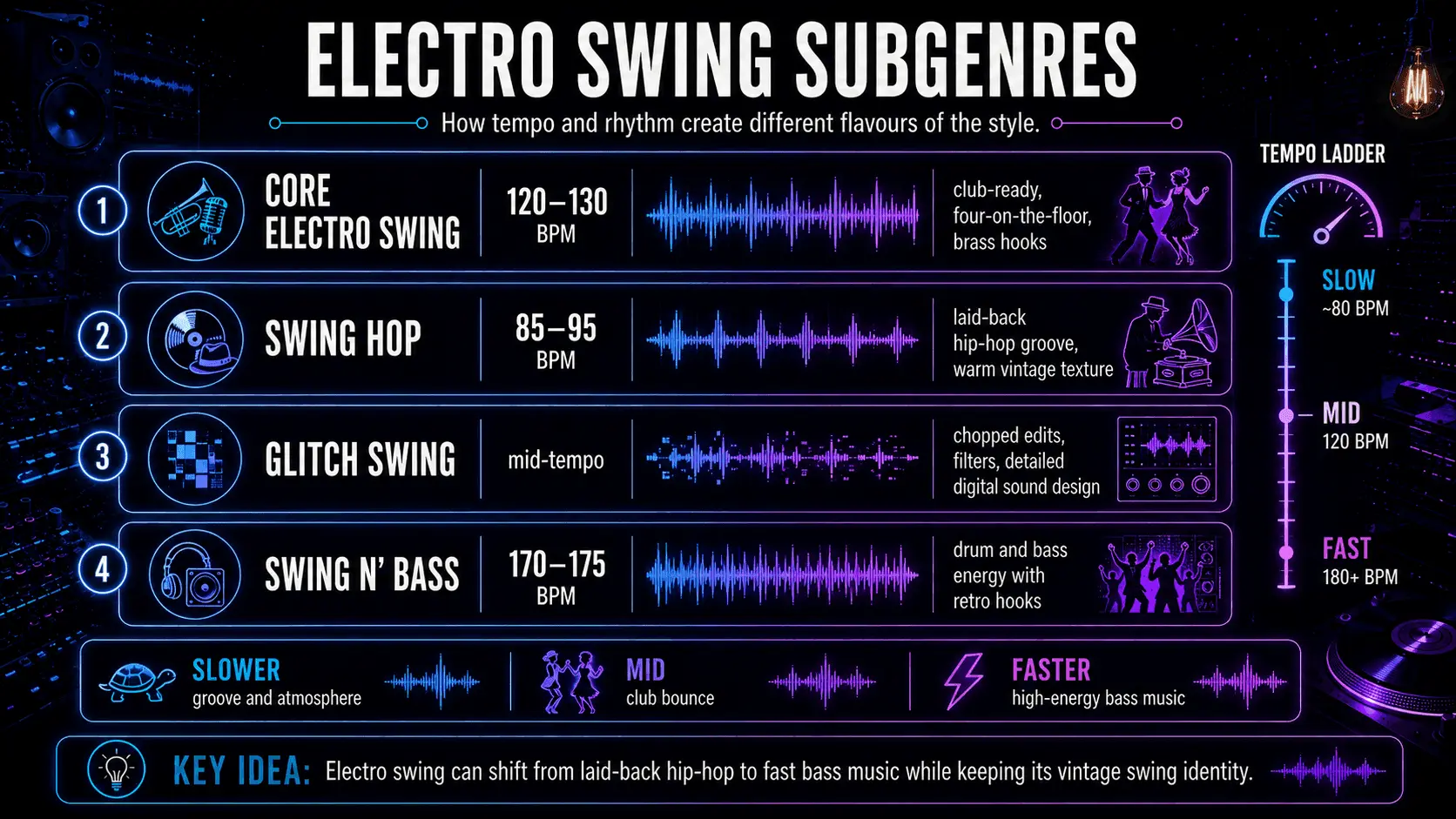
As the primary electro swing genre matured, producers sought to break away from standard four-on-the-floor house tempos, leading to the creation of distinct sub-genres and spin-offs. These variations blended swing melodies with other established electronic paradigms like drum and bass, glitch hop, and instrumental hip-hop.
Swing n' Bass: Swing, Breaks, and Drum n' Bass
Swing n' Bass accelerates the tempo of traditional electro swing, moving away from the 120-130 BPM range up into the 170-175 BPM territory characteristic of drum and bass. The rhythmic foundation shifts from a steady four-on-the-floor pulse to complex, syncopated breakbeats and rolling basslines, creating a frantic, high-energy environment.
K+Lab - Do Right
New Zealand producer K+Lab explores the intersection of vintage aesthetic and heavy bass design. Do Right introduces vintage vocal textures and brass arrangements into an aggressive electronic music framework. The track features complex electronic breaks and heavily modulated bass synths, using the vintage elements as a melodic counterpoint to contemporary sound design.
Mista Trick & Fizzy Gillespie - Don't Leave (Harlem Swing Riddim) feat. Brazier
This collaboration represents a premier example of UK-style swing n' bass. The track takes a distinctly retro vocal and horn hook and overlays it with a traditional drum and bass rhythmic matrix. The juxtaposition of the fast-paced, snapping two-step drum pattern against the swinging brass arrangement creates a unique kinetic energy that performs exceptionally well in modern bass music festival settings.
Glitch Swing: Swing and Glitch Hop
Glitch Swing operates primarily in the mid-tempo realm, usually ranging from 100 to 110 BPM. This style merges the syncopation of swing with the stuttering, bit-crushed, heavily modulated synthesis of glitch hop. The focus here is on digital manipulation: cutting swing samples into microscopic pieces and re-sequencing them alongside laser-like synths and heavy, distorted electronic drums.
Defunk - Jive Is Good For You
Canadian producer Defunk is a master of blending blues, funk, and swing with heavy bass music. Jive Is Good For You demonstrates how a swinging horn line can be manipulated via digital audio tools to sync with a gritty glitch hop beat. The track shifts between clean, organic swing loops and heavily distorted electronic drops, creating a compelling sonic contrast.
The McMash Clan feat. Kate Mullins - Swing Break (Opiuo feat. Russ Liquid Remix)
This remix represents a notable example in the glitch swing subgenre. Opiuo and Russ Liquid dismantle the original acoustic components, transforming the track into a detailed example of mid-tempo glitch hop production. The live horn layers are augmented by real-time analog synthesis, and the rhythm is processed through advanced digital filters, showing the creative possibilities of modern electronic music fusion.
Swing Hop: Swing and Instrumental Hip Hop
Swing Hop lowers the tempo significantly, grounding the genre in the 85-95 BPM range. It marries the laid-back, grooving nature of traditional hip-hop beats with the sophisticated harmonic structures of vintage jazz and swing. Rather than aiming for high-energy dancefloor drops, swing hop prioritizes atmosphere, loop texture, and smooth acoustic instrumentation.
ProleteR - It Don't Mean a Thing
French producer ProleteR has carved out a massive niche within the swing hop landscape. His track It Don't Mean a Thing re-envisions the classic Duke Ellington motif over a boom-bap hip-hop drum configuration. The production honors the vintage music source material by preserving its warmth and crackle, while providing a modern, heavy low-end groove that appeals to hip-hop purists and electronic music fans alike.
Gramatik - Just Jammin'
A widely recognized track within the instrumental hip-hop and electronic jazz fusion world. Just Jammin' showcases Gramatik's exceptional ability to take a smooth, swinging jazz guitar loop, warm horn stabs, and a laid-back acoustic bassline, and lock them into a crisp hip-hop drum sequence. The track emphasizes vibe and instrumental texture over aggressive electronic manipulation, serving as an entry point for listeners exploring the relaxed side of the modern swing movement.
Electro Swing Culture and Communities
Beyond the sound, electro swing has generated a distinct subculture that spans the globe. This community is defined by its retro-futuristic aesthetic, blending the visual styles of the 1920s and 1930s with contemporary rave and steampunk influences.
At a typical electro swing club event or festival stage, the dress code is a core element of the experience. Attendees frequently wear tailored waistcoats, suspenders, fedoras, bow ties, and flapper-style dresses adorned with sequins. However, these vintage garments are often modified with neon elements, LED accents, and festival eyewear, visually mirroring the past-meets-present nature of the music itself.
This culture thrives on inclusivity and historical escapism. The hedonistic, free-spirited vibe of the roaring twenties is viewed by the community as an ideal antidote to modern societal anxieties. The electro swing culture connects generations, attracting older jazz enthusiasts who appreciate the reclamation of classic melodies, as well as young club-goers drawn to the high-energy basslines and theatrical performances of live electro swing musicians.
Live Performances and Electro Swing Music Festivals
The true energy of electro swing is best experienced live. While the genre began in the digital domain, its leading acts quickly realized that audiences wanted to see the physical performance of the instruments being sampled. This realization transformed how electro swing is staged.
A premier live electro swing show features a hybrid setup: a producer or DJ managing the electronic backing tracks, digital synthesizers, and live effect parameters, while fronted by a live horn section, dynamic vocalists, and sometimes synchronized swing dancers. The tension between the rigid digital clock of the electronic setup and the expressive delivery of live brass players creates an engaging concert experience.
This performance model led to the creation of dedicated electro swing music festivals and specialized stages within larger electronic events. Electro swing also appears through dedicated club nights and themed festival stages, including the Swingamajig area at the United Kingdom’s Shambala festival.
Electro Swing Dance: How to Dance to Electro Swing
The rapid acceleration of electro swing music naturally necessitated a parallel evolution in dance styles. Traditional swing dance, such as the Lindy Hop or East Coast Swing, was originally choreographed to acoustic tempos that allowed for complex partner footwork and aerial maneuvers. When paired with a heavy 124 BPM electronic house kick drum, these classic steps require modification.
The contemporary electro swing dance style is a high-energy hybrid. It takes core elements of the 1920s Charleston—specifically the inward and outward twisting of the feet and knees—and merges them with modern electronic dance steps, most notably the Melbourne Shuffle and cutting shapes. The result is a fast, footwork-heavy dance style that can be performed individually or with a partner.
Core Elements of Electro Swing Dance
- The Electro Charleston Step: Dancers perform the traditional kick-back and step-forward motion of the 1920s Charleston, but accelerate their leg movements to match the sharp synchronization of electronic beats.
- The Swing Shuffle: Borrowing from street dance cultures, dancers use a gliding step to move across the floor, maintaining a traditional swing bounce in their upper body while their feet execute rapid, rhythmically precise shuffles.
- Jazz Hands and Upper-Body Flares: To honor the theatrical roots of cabaret and big band performances, dancers incorporate dramatic arm extensions, syncopated claps, and traditional jazz hand movements to accent major horn stabs and musical drops.
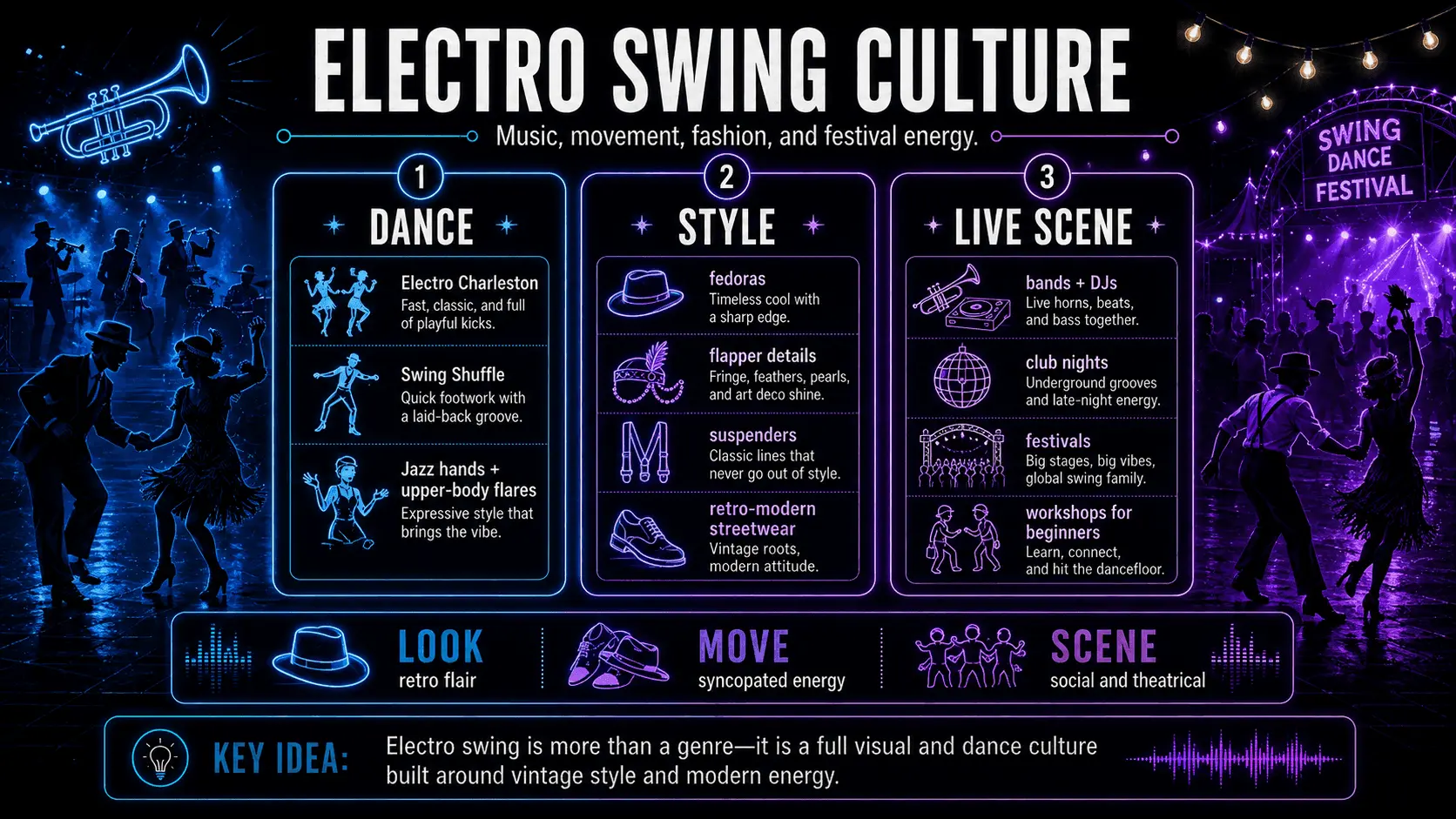
For beginners looking to learn how to dance to electro swing, many dedicated festivals and club nights offer introductory workshops before the main musical acts take the stage. These educational sessions focus on translating traditional swing dance foundations into solo, rhythmically driven movements that help dancers feel comfortable navigating any modern electro swing dancefloor.
Influence of Electro Swing on Modern Music
While electro swing is often categorized as a niche or alternative genre, its stylistic fingerprints can be found across the broader modern music landscape. The genre's core innovation—layering bright, historical brass hooks over heavy digital percussion—has been adopted by mainstream pop, hip-hop, and commercial electronic music producers.
In contemporary pop production, the use of brass hooks that mimic the syncopated phrasing of electro swing has become a reliable method for creating infectious radio singles. Elements associated with electro swing, particularly syncopated brass hooks and vintage-inspired arrangements, have also appeared in contemporary pop and commercial dance production.
Furthermore, the advertising and film scoring industries have thoroughly embraced the electro swing aesthetic. The genre's inherent energy makes it a frequent choice for television commercials, video game soundtracks, and motion picture sequences that require a sense of momentum, whimsy, and style. By proving that antique musical ideas can be successfully adapted for modern, high-fidelity audio systems, electro swing has expanded how mainstream producers approach sampling and genre hybridization.
How to Get Started with Electro Swing: A Producer's Guide
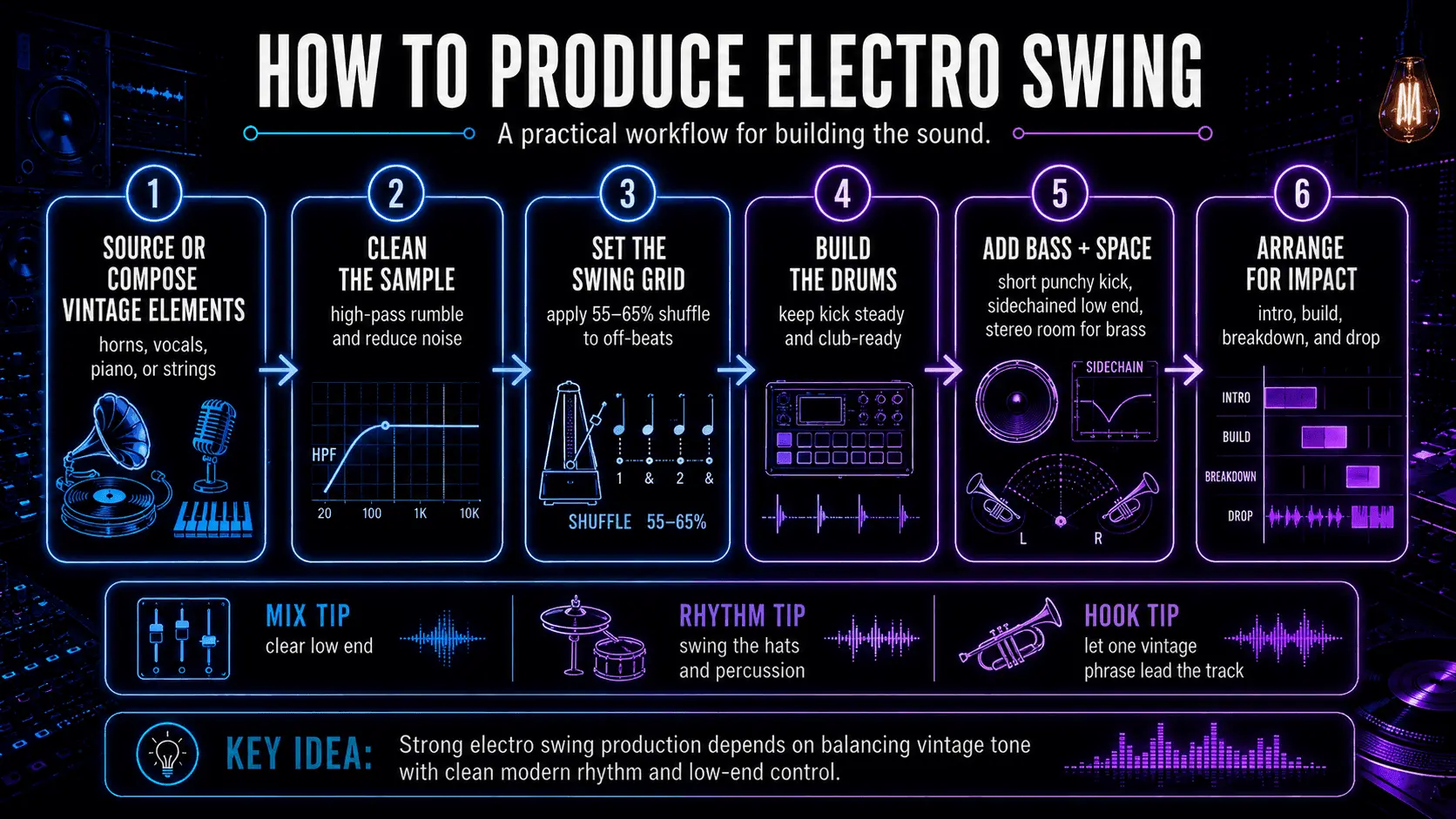
For electronic music producers, content creators, and audio engineers, entering the world of electro swing production requires a specialized technical workflow. The challenge lies in balancing the sonic qualities of two entirely different eras.
Sourcing and Preparing Vintage Elements
Your track will live or die based on its melodic foundation. When sourcing vintage music loops, look for public domain jazz recordings from the 1920s through the 1940s, or utilize specialized high-quality royalty-free sample libraries that replicate the playing style of original electro swing musicians. Once you have isolated a horn stab or a vocal phrase, apply a steep high-pass filter around 120 Hz to completely clear out historical low-end rumble and surface noise.
Setting Up the Production Grid
Do not sequence your drums on a straight grid. In your Digital Audio Workstation (DAW), locate the global swing or shuffle settings. Apply a swing quantization value between 55% and 65% to your hi-hats, percussion, and secondary synths. This introduces the necessary micro-delay to the off-beats, creating that signature rolling swing pocket. Keep your primary kick drum locked straight on the quarter notes to ensure the track retains its club-ready drive.
Managing Low-End Frequency Clashes
Because electro swing tracks feature dense mid-range information from brass and woodwinds, your low-end must be clean and precise. Use a short, punchy kick drum sample that finishes its transient cycle quickly. Pair this with a sub-bass or walking bassline that is strictly sidechained to the kick. Route your vintage sample loops to a dedicated stereo bus and apply a subtle mid-side EQ cut in the center image around 300 Hz; this clears space for the lead vocals and kick transients while keeping the vintage brass wide and immersive in the stereo field.
Create Original Electro Swing Elements with ACE Studio
Vintage samples can give electro swing its recognizable character, but they are not the only way to build convincing source material. ACE Studio allows producers to compose original trumpet, saxophone, double bass, and string performances from MIDI, making it possible to capture the energy of a swing arrangement without relying entirely on fragments taken from historical recordings.
A producer can begin with a simple MIDI phrase and turn it into a more expressive instrumental performance. Short trumpet stabs can reinforce the main hook, while a saxophone can answer the melody between vocal phrases. Notes can be drawn directly into the piano roll or imported from an existing MIDI file, then refined through articulation and expression controls.
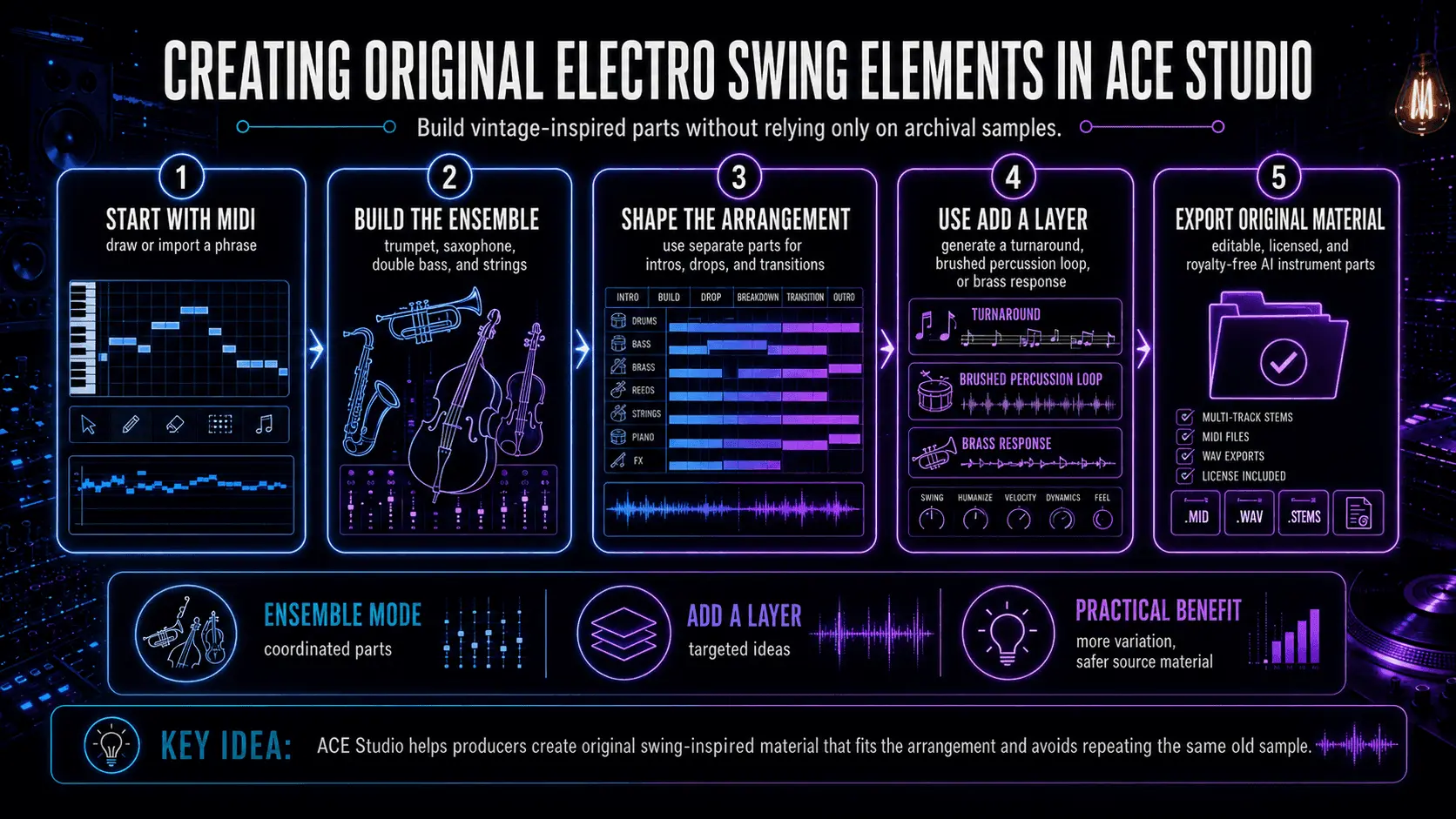
ACE Studio’s Ensemble Mode also makes it possible to layer several AI instruments into a single coordinated arrangement. Instead of treating the vintage section as one repeated sample, producers can build separate trumpet, saxophone, bass, and string parts that develop across the track. The introduction might contain only bass and a restrained horn phrase, while the drop can open into a denser ensemble with sharper accents and a more animated countermelody.
Add a Layer provides another practical option when a section needs a specific musical element rather than a complete replacement. After selecting a portion of the timeline, the producer can describe the required instrumental, phrase, or sample loop with a text prompt. A prompt might request a brief vintage piano turnaround before the drop, a brushed percussion loop for the breakdown, or a playful brass response that follows the main hook. The generated result can then be trimmed, rearranged, processed, or combined with the existing swing elements.
This approach is especially useful when an archival sample has the right mood but does not follow the track’s chord changes, extend for the required number of bars, or provide enough variation for a complete arrangement. Rather than repeating the same fragment throughout the song, the producer can create complementary original parts for transitions, breakdowns, second drops, and instrumental solos.
There is also a practical rights advantage. Commercially released historical recordings may still require sample clearance even when the underlying composition is in the public domain. ACE Studio states that its AI instruments are licensed and royalty-free, while audio created with its Generative Kits can be used for commercial or non-commercial purposes without ACE Studio claiming copyright over the generated material. This does not clear any third-party recording imported into the project, but it gives producers a safer source of original material for building the vintage side of an electro swing production.
Contextual Music Landscapes and Related Genres
To fully appreciate the architecture of electro swing, it helps to understand how it relates to other historical and contemporary musical movements. The instinct to fuse traditional acoustic styles with modern electronic production is an ongoing theme throughout music history.
- Big Beat: Emerging in the 1990s through artists like Fatboy Slim, big beat shares electro swing's reliance on heavy sampling and high-energy drops. Both genres prioritize taking raw, distorted loops from older records and re-contextualizing them over driving electronic grooves designed for massive crowd responses.
- Britpop: While texturally distinct, the mid-1990s Britpop movement shared electro swing’s obsession with nostalgia and historical reclamation. Just as Britpop looked back to the guitar arrangements of the 1960s to revitalize rock music, electro swing looks back to the 1920s to inject organic soul and musicianship into electronic dance music.
- Highlife and Traditional Fusions: The globalization of music production has led to similar fusions worldwide, such as modern Highlife music West African guitar loops meeting afrobeat drum programming, or electronic classical projects updating the Baroque Concerto Grosso form with synthesizers. These movements share a common goal with electro swing: preserving the emotional weight of traditional instrumentation while maximizing its impact using modern audio technology.
Frequently Asked Questions
What is the typical tempo of an electro swing track?
The standard tempo for core electro swing is between 120 and 130 BPM, aligning directly with contemporary house music. However, spin-offs like swing hop run slower (85-95 BPM), while swing n' bass accelerates up to 170-175 BPM.
Is electro swing played with live instruments or completely sequenced?
It can be both. Studio-focused producers often sequence the entire track using vintage samples and virtual instruments. However, prominent electro swing bands like Caravan Palace or Parov Stelar feature full live horn sections, vocalists, and acoustic string players performing alongside digital playback systems during their live shows.
Is electro swing music royalty-free?
Not by default. If a producer samples a commercial recording from the 1920s or 1930s, that specific master recording may still be protected by copyright law, even if the underlying composition is in the public domain. Modern producers must clear their samples or utilize dedicated royalty-free sample libraries to avoid legal issues.
How do you dance to electro swing if you only know traditional swing?
Traditional swing dancers can easily adapt by focusing on solo Charleston steps and adjusting their timing to fit the steady electronic kick drum. The key is to match the fast, synchronized rhythm of the feet while maintaining the classic upper-body posture and bounce of traditional swing dance styles.