

Key Takeaways
- A condenser microphone converts sound into an electrical signal through changes in capacitance between a thin diaphragm and a fixed backplate.
- Most condenser microphones require power for the capsule and internal electronics, usually supplied through 48V phantom power, USB, batteries, or a dedicated tube power supply.
- Condenser microphones are highly sensitive and capture fine details, fast transients, and high frequencies, making them especially useful for vocals, acoustic instruments, drum overheads, and room recordings.
- Large-diaphragm condensers generally provide a fuller, more flattering sound, while small-diaphragm models offer greater transient accuracy and a more consistent off-axis response.
- Compared with dynamic microphones, condensers provide more detail but require greater care, better room control, and appropriate gain, placement, and sound-pressure-level management.
What is Condenser Microphone
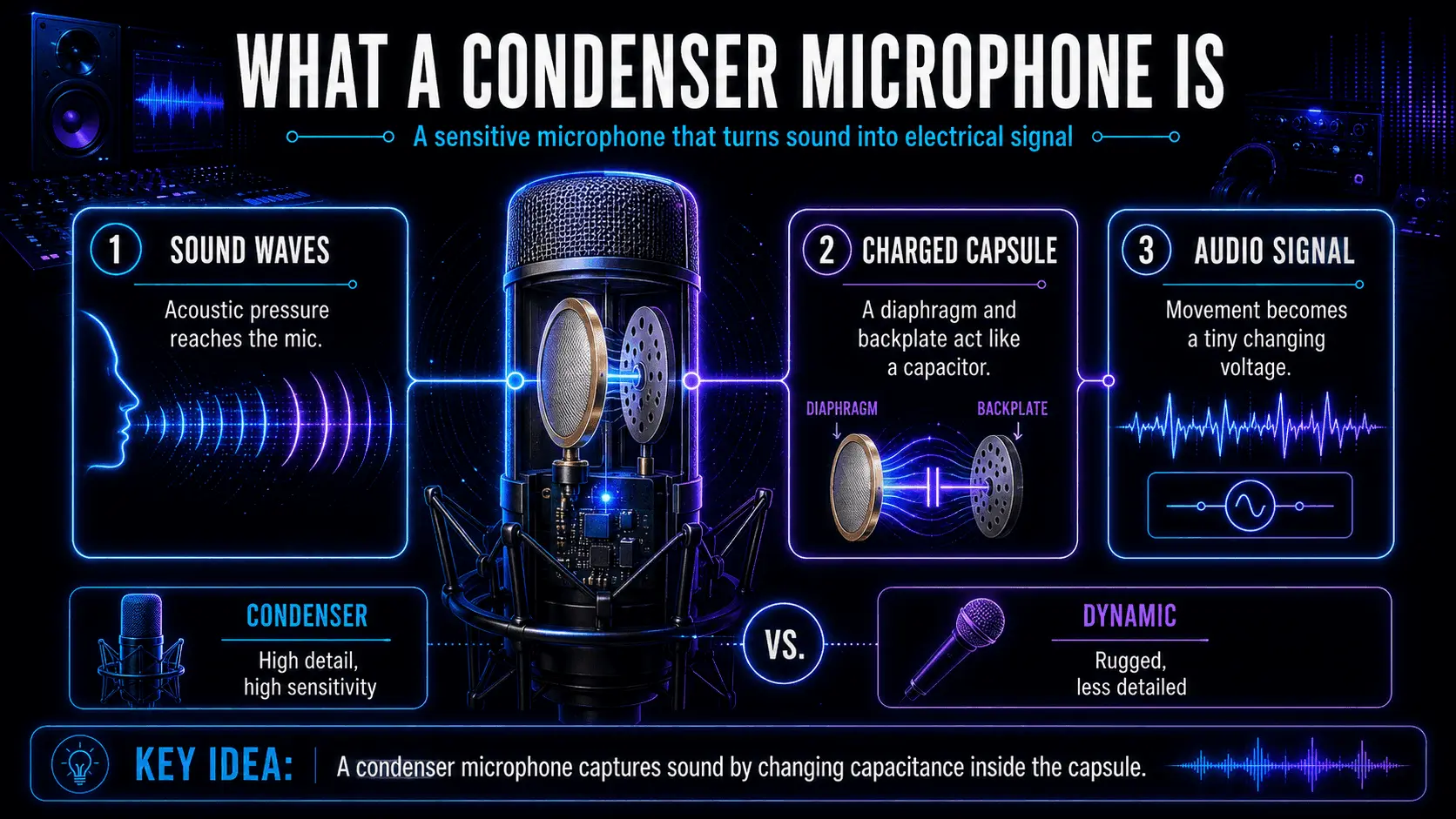
A condenser microphone is a transducer that converts acoustic energy (sound waves) into electrical energy (audio signals) using the principle of capacitance. The term condenser is actually an archaic British term for a capacitor, which is an electronic component designed to store an electrical charge.
Unlike dynamic microphones, which utilize electromagnetic induction via a moving coil and magnet, condenser microphones rely on an electrostatically charged diaphragm and backplate. This design allows for a much lighter moving mass, resulting in superior microphone sensitivity characteristics and a significantly faster transient response.
How a Condenser Microphone Works
To understand how a condenser microphone works, one must understand the basic physics of a capacitor. A capacitor consists of two conductive plates separated by an insulating material (the dielectric). In a microphone capsule, the air between the diaphragm and the backplate acts as the dielectric.
The Capacitance Formula
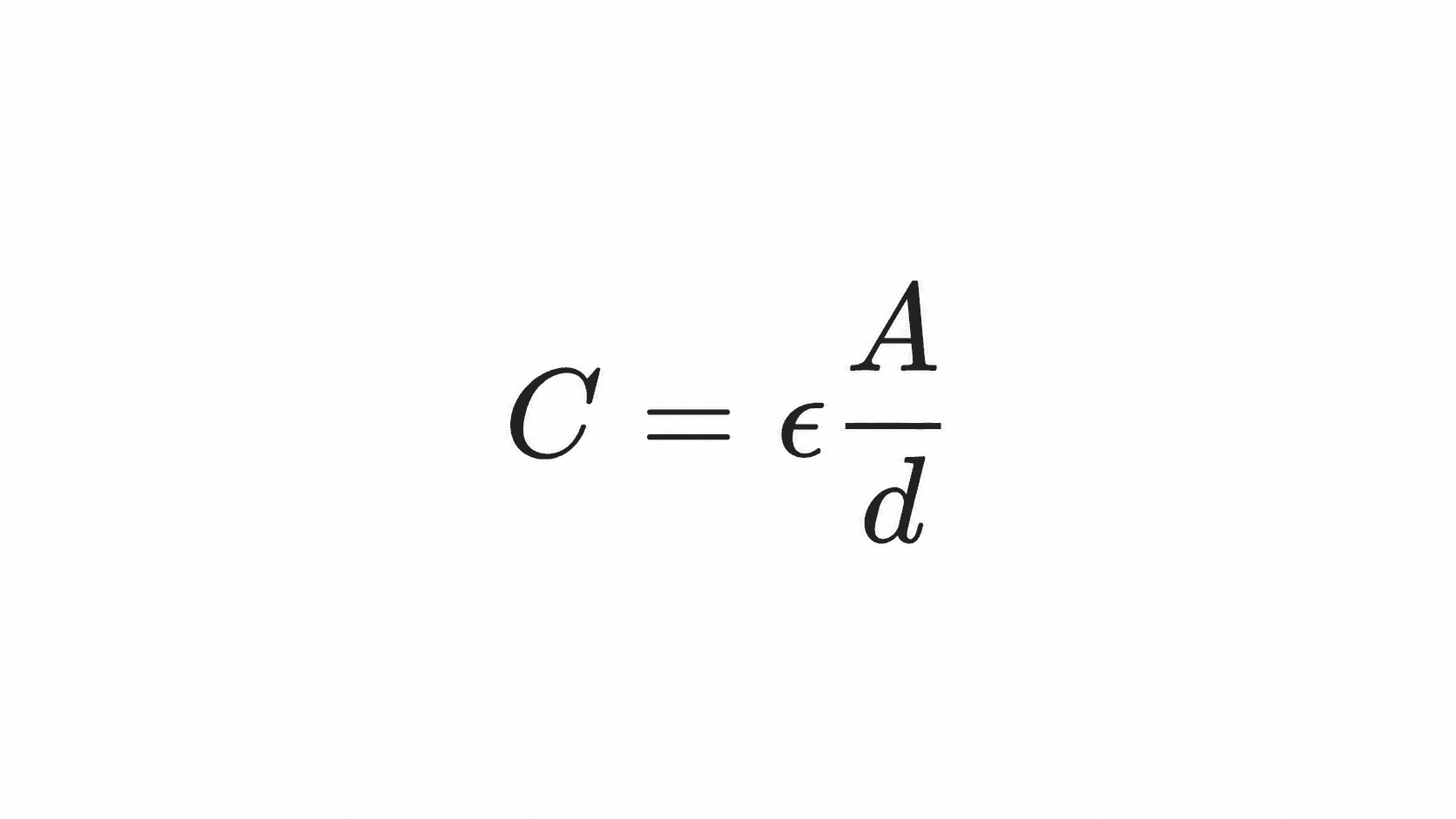
The capacitance (C) of the system is determined by the area of the plates (A), the distance between them (d), and the permittivity of the material between them ():
Sound Transduction and Electrical Signal Conversion
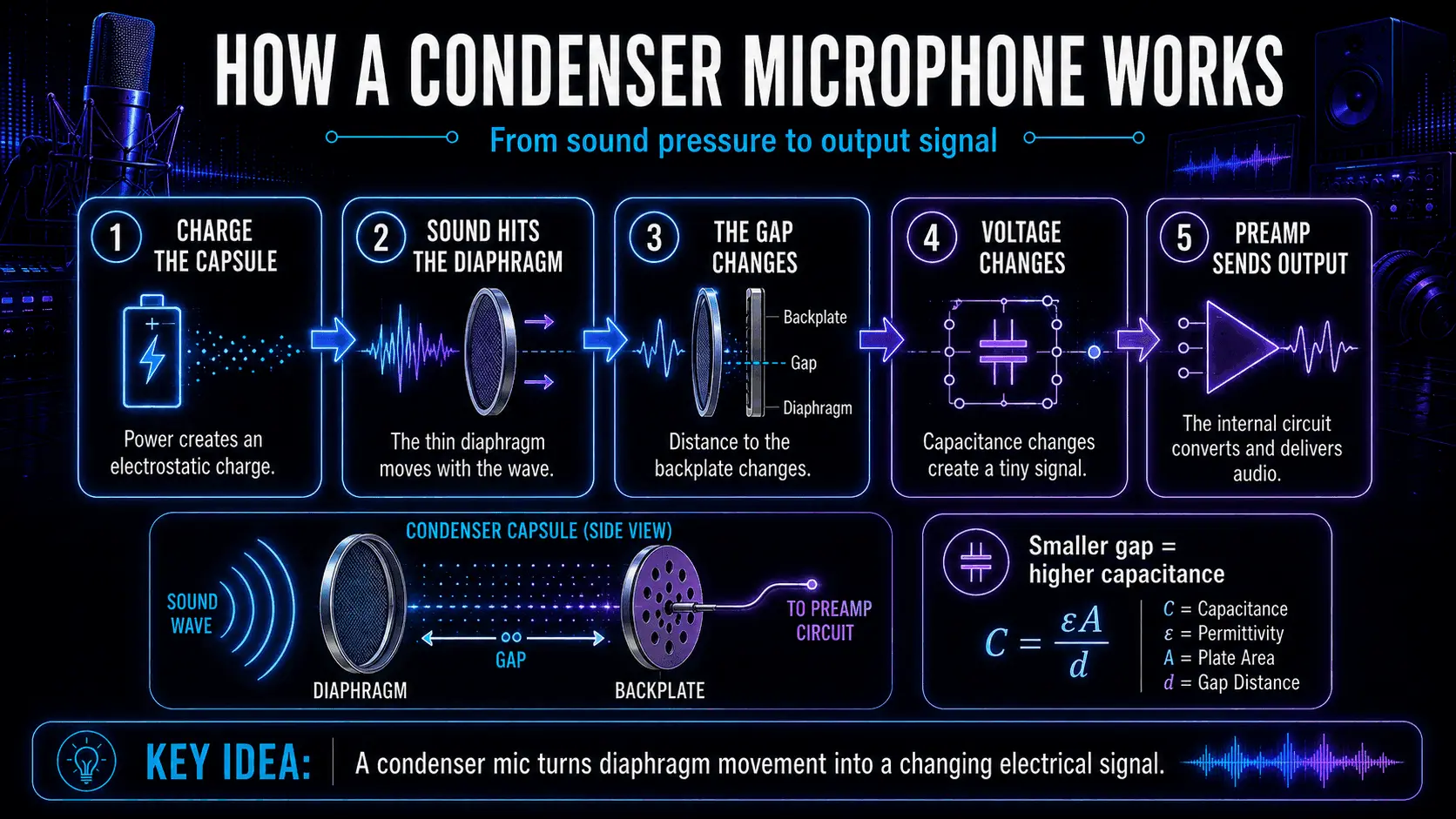
- Charging the Capacitor: An external voltage (Phantom Power) is applied to the diaphragm and backplate, creating an electrostatic charge.
- Diaphragm Movement: When acoustic pressure (a sound wave) hits the diaphragm, it moves back and forth relative to the fixed backplate.
- Changing Distance (d): As the diaphragm moves, the distance (d) between the plates changes.
- Voltage Fluctuations: According to the formula V = Q / C (where V is voltage and Q is charge), if the charge remains constant and the capacitance changes due to the moving diaphragm, the voltage must also change.
- Signal Output: These tiny voltage fluctuations represent the electrical audio signal, which is then sent to an internal preamplifier (either a tube or a FET) for impedance conversion and gain.
Essential Condenser Microphone Components
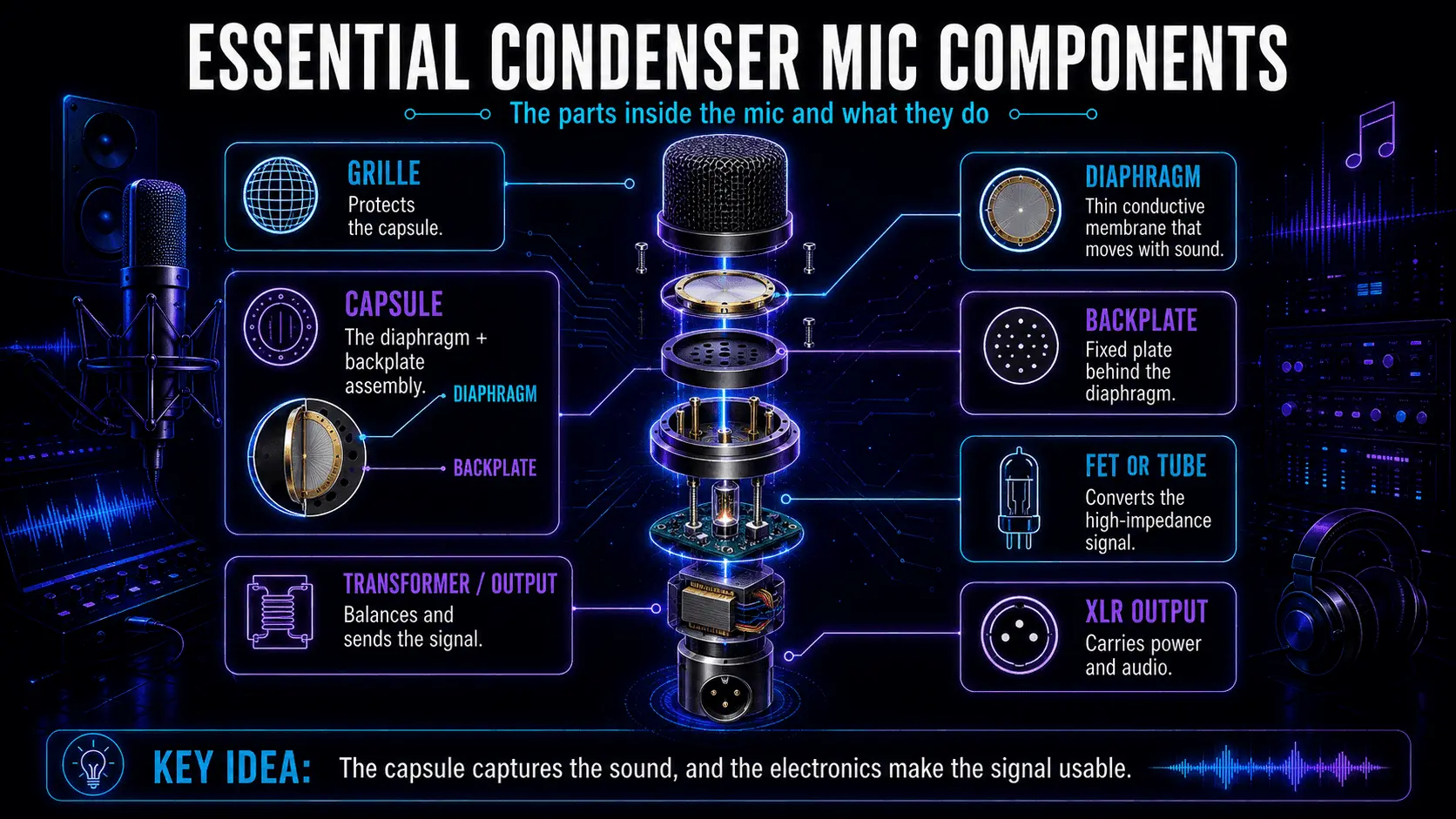
The performance of a condenser mic is the sum of its parts. Each component must be engineered to microscopic tolerances to ensure sound quality and reliability.
The Diaphragm
The diaphragm is the most critical element of the microphone parts. Most modern condensers use a thin film of polyester that has been sputtered with a microscopic layer of gold to make it conductive.
- Thickness: Usually between 3 and 6 microns.
- Sensitivity: Because the diaphragm is so light, it can react to the highest frequencies and the softest sounds that a heavy dynamic coil would ignore.
The Backplate
The backplate is a solid piece of brass or other conductive metal. It often contains precision-drilled holes or pits that control the movement of air behind the diaphragm. This air-damping is crucial for shaping the microphone's frequency response and polar patterns of microphones.
The Impedance Conversion Circuit
The signal produced by the capsule has a very high electrical impedance, meaning it has very little driving force and is highly susceptible to noise and signal loss over long cables.
- FET or Tube: Acts as an impedance converter, transforming the high-impedance signal into a low-impedance signal.
- Output Transformer: Some microphones use a transformer to further balance the signal and add specific harmonic character, while others are transformerless for maximum transparency.
Powering Condenser Microphones
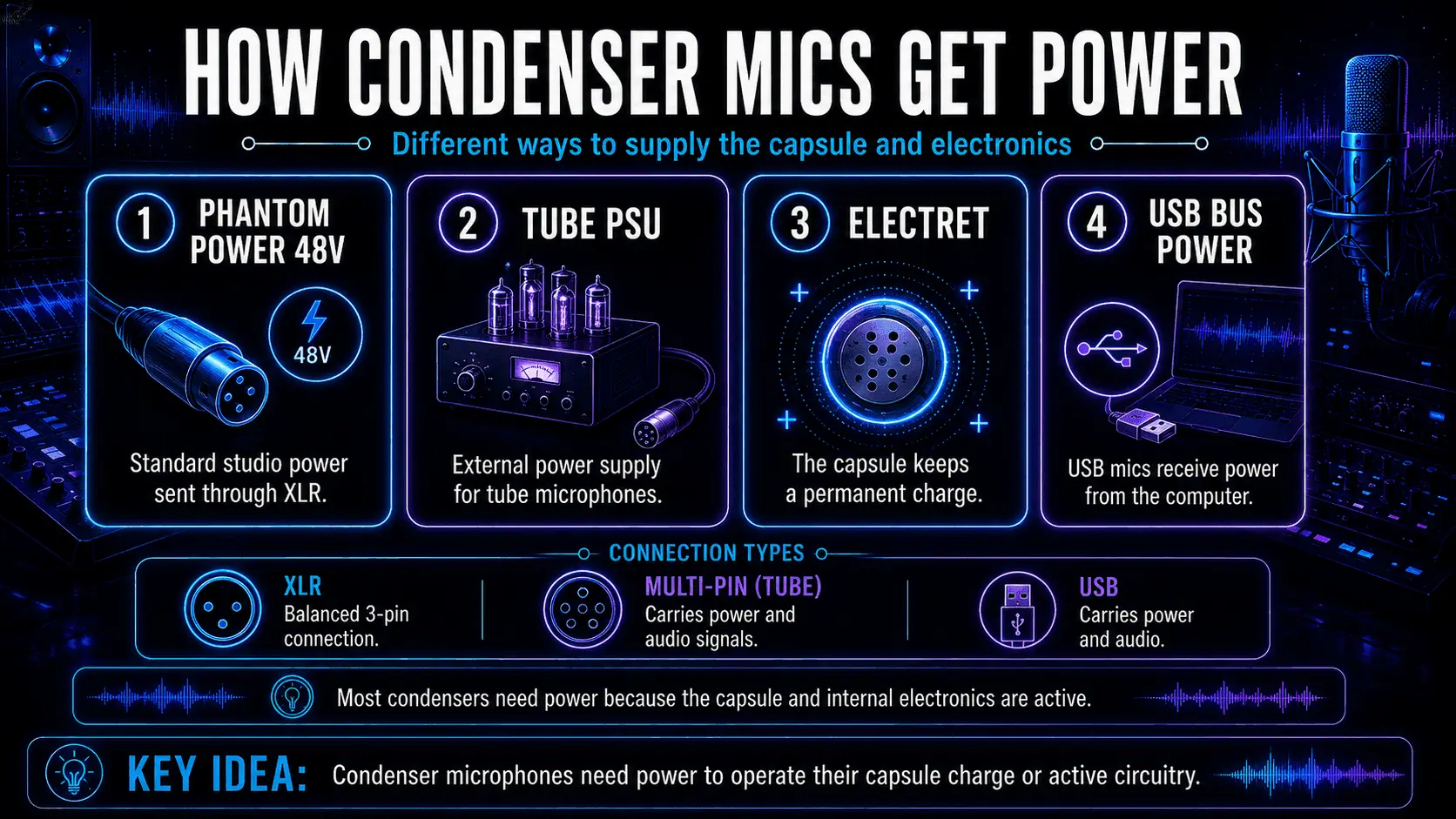
Because the capacitor and the internal preamplifier require electricity to function, condenser microphones cannot operate passively.
Phantom Power (48V)
Phantom power is the industry standard for powering solid-state condenser microphones. It is a DC voltage sent from the audio interface or mixing console back up the XLR cable.
- Pin Configuration: The voltage is delivered equally on Pin 2 and Pin 3 of the XLR cable relative to Pin 1.
- Convenience: It allows the microphone to receive power and send audio over the same three-wire cable without the need for batteries.
Tube Power Supplies
Vacuum tube condenser microphones require much higher voltages than phantom power can provide. These microphones come with dedicated external power supply units and multi-pin proprietary cables.
Electret Technology
In some applications, such as lavalier or USB condenser microphones, the capsule is permanently charged during the manufacturing process using a specialized material called an electret. While they still require power for their internal FET preamps, they do not need the high-voltage charge for the capsule itself.
What are the Different Types of Condenser Microphones?
The categorization of condenser microphones is determined by the physical dimensions of the capsule, the method of impedance conversion, and the intended directional focus. Each design choice affects microphone sensitivity characteristics, transient accuracy, and the overall frequency response. To master recording with condenser microphones, an engineer must understand how these physical properties translate into acoustic results.
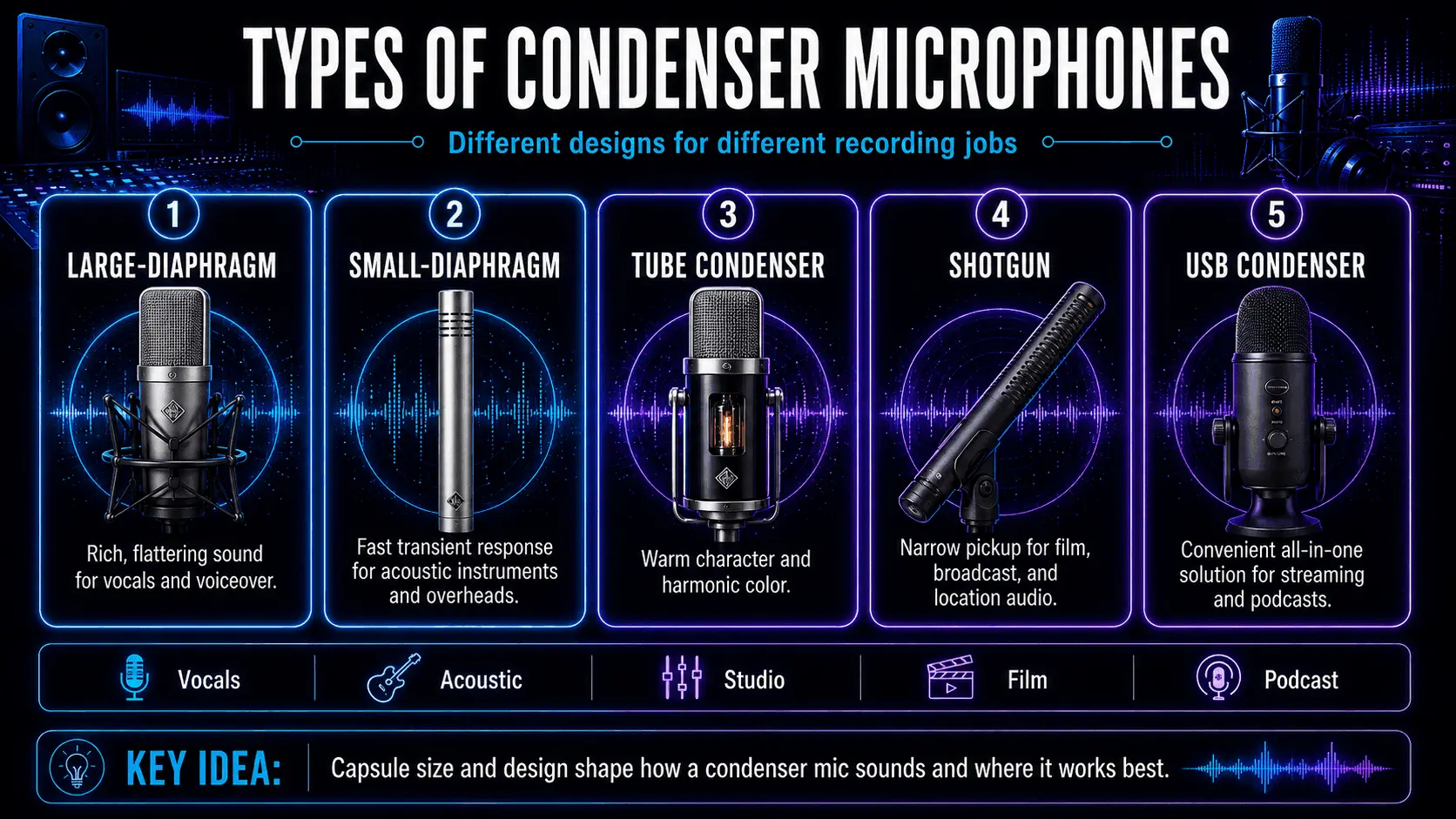
Large-Diaphragm Condenser Microphones (LDC)
An LDC is defined by a diaphragm diameter of 1 inch (25.4 mm) or greater. These are the most common studio microphones found in professional environments, prized for their ability to capture a rich, full-bodied sound.
Design and Surface Area
The larger surface area of an LDC diaphragm means it can capture more acoustic pressure than smaller designs. Because a larger diaphragm is easier to move with lower levels of sound energy, LDCs typically boast the lowest self-noise ratings in the industry. This high sensitivity makes them ideal for capturing the subtle nuances of a vocal performance or the delicate decay of a piano in a quiet room.
The Proximity Effect and Low-End Resonance
LDCs are known for a specific acoustic phenomenon where low-frequency response increases as the sound source moves closer to the capsule. This is a result of the pressure-gradient nature of the cardioid capsule. Engineers often use this to add authority and weight to a voice, though it requires careful placement to avoid making the audio sound muddy or indistinct.
Lead Vocals and Narrative Voiceover
In vocal recording, the LDC is the primary choice. The larger diaphragm has more mass and inertia than an SDC, which creates a slight smoothing effect on high-frequency transients. This often results in a sound that is perceived as more flattering or musical, rather than strictly clinical.
Small-Diaphragm Condenser Microphones (SDC)
Often referred to as pencil microphones due to their slim, cylindrical shape, SDCs typically feature a diaphragm diameter of 1/2 inch (12.7 mm) or less.
Mass, Inertia, and Transient Response
The primary advantage of the SDC is its extremely low mass. A smaller diaphragm has less inertia, allowing it to start and stop moving almost instantaneously in response to sound waves. This leads to an incredibly accurate transient response, capturing the sharp attack of a drum kit or the pluck of an acoustic guitar string with absolute precision.
Phase Coherence and Off-Axis Consistency
SDCs are superior when it comes to consistent polar patterns of microphones. Because the capsule housing is small, it creates fewer acoustic shadows and reflections around the diaphragm. This results in a very linear off-axis response. If a sound source moves to the side of the microphone, the volume will drop, but the tonal balance (the frequency response) remains remarkably consistent. This makes SDCs the gold standard for orchestral recording and stereo miking arrays.
Tube Condenser Microphones (Thermionic Valve)
Before the invention of the Field Effect Transistor (FET), all condenser microphones used vacuum tubes to handle impedance conversion. Modern tube microphones are highly sought after for their specific electrical characteristics.
The Role of the Vacuum Tube
In a tube condenser, the tiny electrical charge from the capsule is sent to a vacuum tube (thermionic valve) located inside the microphone body. The tube acts as a pre-amplifier and impedance converter. Because tubes operate at high temperatures and require high voltages, these microphones always require a dedicated external power supply unit (PSU) rather than standard phantom power.
Harmonic Saturation and Nonlinear Distortion
Tubes are prized for their nonlinear response. When a tube is pushed by a loud signal, it creates subtle even-order harmonic distortion. This adds a sense of warmth and thickness to the sound that is difficult to replicate with solid-state electronics. Furthermore, tubes exhibit a natural, gentle compression that helps smooth out the dynamic range of a performance, making it sit more comfortably in a mix.
Other Condenser Formats
Shotgun microphones often use condenser capsules combined with an interference tube to achieve a narrow directional response. They are mainly used for film, broadcast, and location recording.
USB condenser microphones combine a condenser capsule with an internal preamplifier and analog-to-digital converter. They connect directly to a computer and are commonly used for podcasting, streaming, voiceovers, and home recording.
Comparative Breakdown of Condenser Types
| Type | Diaphragm Size | Primary Advantage | Best For | Power Source |
|---|---|---|---|---|
| Large Diaphragm (LDC) | > 1 Inch | Low Noise, Flattering Tone | Lead Vocals, Voiceover | 48V Phantom |
| Small Diaphragm (SDC) | < 0.5 Inch | Transient Accuracy, Neutral | Acoustic Guitar, Overheads | 48V Phantom |
| Tube Condenser | Usually Large | Harmonic Warmth, Character | Vintage-Style Recordings | External PSU |
| Shotgun | Variable | Extreme Side Rejection | Film Dialogue, Field Recording | 48V or Battery |
| USB Condenser | Variable | Convenience, Portability | Podcasting, Work-from-Home | USB Bus Power |
Technical Performance Metrics
To truly master recording with condenser microphones, one must understand how to read a specification sheet.
Microphone Sensitivity Characteristics
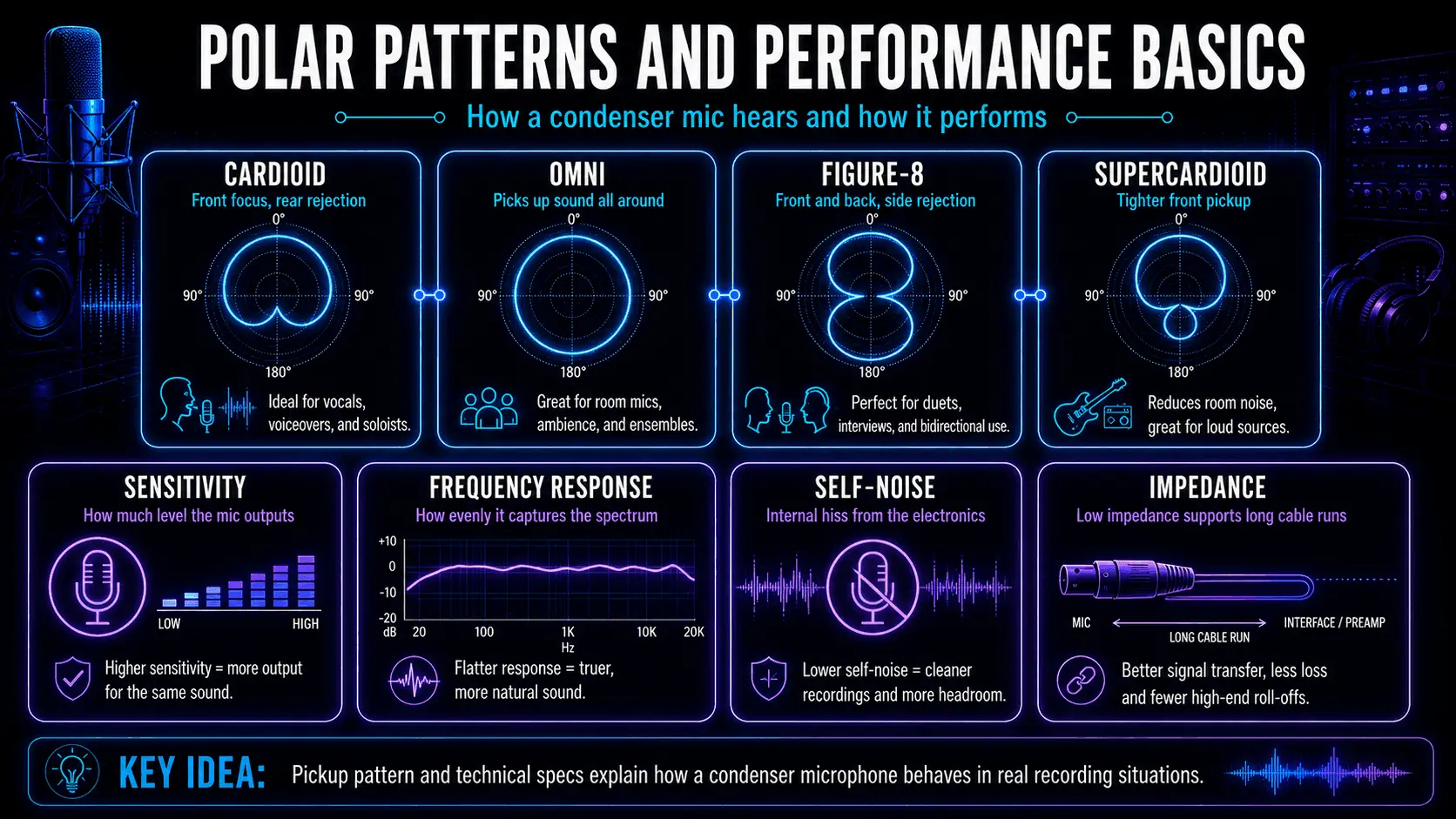
Sensitivity refers to how much electrical output a microphone produces for a given sound pressure level. Condensers typically have high sensitivity, meaning they can capture whispers with very little gain from an external preamp.
Microphone Impedance Explained
Microphone impedance is measured in Ohms. Professional condenser microphones are low impedance, usually 50 to 200 Ohms. Low impedance allows the signal to travel through long cables without losing high-frequency detail or picking up electromagnetic interference.
Frequency Response
Condenser microphones often boast a flat frequency response from 20 Hz to 20 kHz. However, many LDCs feature a presence peak, which is a slight boost between 3 kHz and 10 kHz that helps vocals cut through a mix.
Self-Noise
Since condenser microphones have active electronics, they generate a small amount of internal hiss. High-end studio microphones strive for a self-noise rating below 10 dBA, which is virtually inaudible in a quiet room.
Polar Patterns: Directional Characteristics
The polar pattern determines how much sound the microphone picks up from different directions. Many condenser microphones offer switchable patterns.
- Cardioid: Picks up sound from the front and rejects sound from the rear. Ideal for isolating a singer from the rest of the room.
- Omnidirectional: Picks up sound equally from all directions. Best for capturing the natural ambiance of a high-quality acoustic space.
- Figure-8: Picks up sound from the front and back, with total rejection at the sides. Useful for face-to-face interviews.
- Supercardioid: Narrower than cardioid with more rear rejection, found often in shotgun microphones.
What Are the Advantages of a Condenser Microphone vs a Dynamic?
Choosing the right tool for the job requires an understanding of how these two technologies differ.
Transient Response
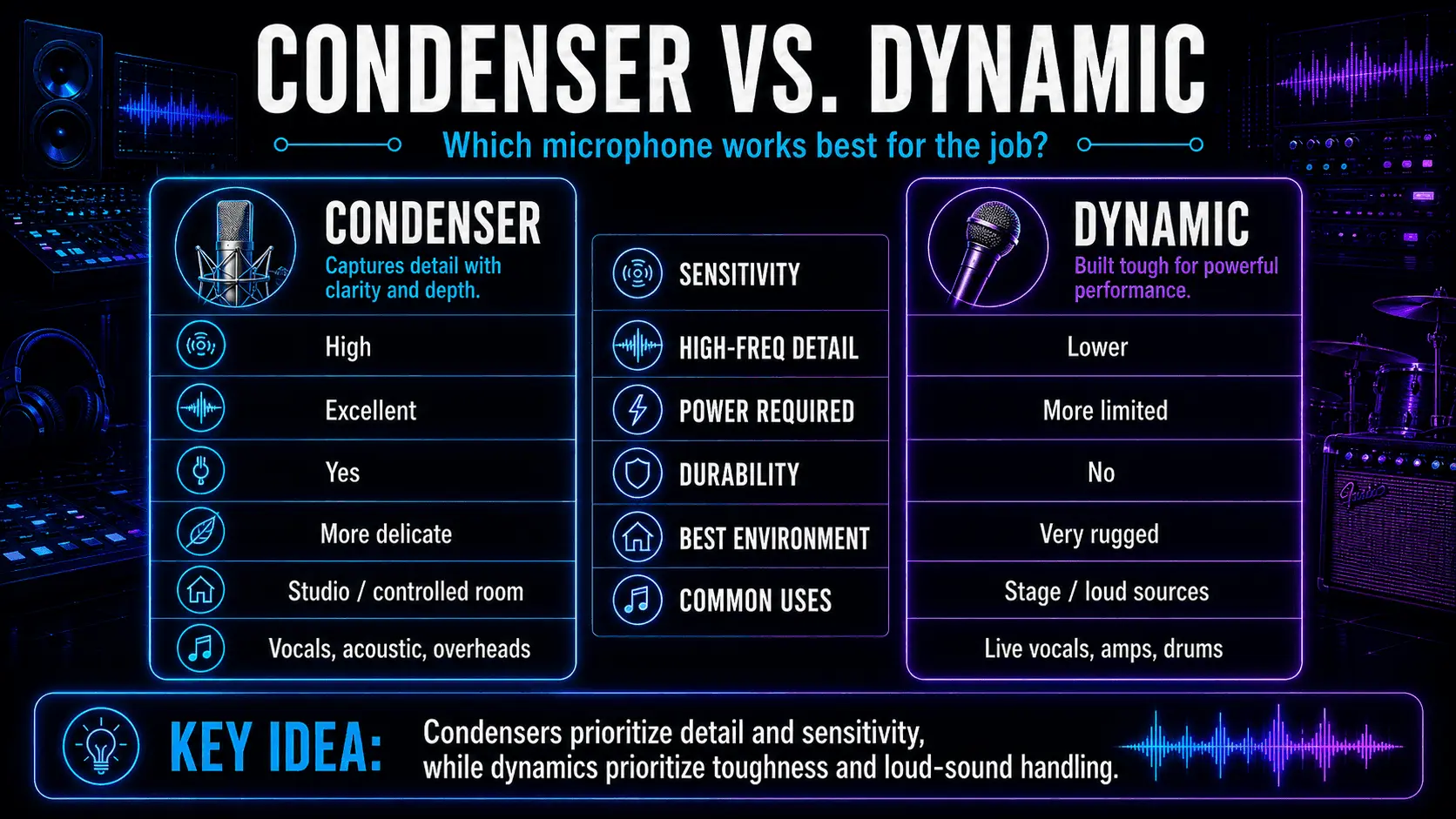
A transient is the initial, high-energy burst of a sound, such as the hit of a snare drum. Because a condenser diaphragm is significantly lighter than a dynamic mic's copper coil, it can move much faster. This results in a crisper and more detailed sound.
Sound Pressure Level (SPL) Handling
Dynamic microphones are passive and rugged, allowing them to handle extremely loud sources without distorting. While modern condensers can handle high SPL, their internal circuitry can clip if the sound is too intense.
Condenser vs. Dynamic
Typical Use Cases of Condenser Microphones
The versatility of the condenser microphone makes it a staple across various applications of condenser microphones.
Studio Vocal Recording
For lead vocals, the LDC is the industry standard. It captures the breathiness, the subtle sibilance, and the emotional nuances of a performance that a dynamic mic might smooth over.
Acoustic Instruments
For acoustic guitars, violins, and cellos, SDCs are preferred for their ability to capture the fast attack of the strings and the complex harmonic overtones of the wood.
Drum Overheads
To capture the shimmer of cymbals and the overall air of a drum kit, a pair of condenser microphones is almost always used.
Room and Ambient Miking
When recording an orchestra or a choir, engineers place condenser microphones several feet away from the source to capture the interaction between the sound and the room's acoustics.
When to Choose Dynamic Over Condenser Microphones
While condensers are superior in detail, dynamic microphones are preferred in certain scenarios:
- High-Volume Stages: When monitor wedge feedback is a concern.
- Extremely Loud Sources: Close-miking a kick drum or a high-gain guitar amplifier.
- Harsh Environments: Outdoor reporting in wind or rain where a sensitive condenser might be damaged.
- Handheld Use: Dynamic microphones are less sensitive to the noise made by a hand moving on the microphone body.
Condenser Microphone Care and Troubleshooting
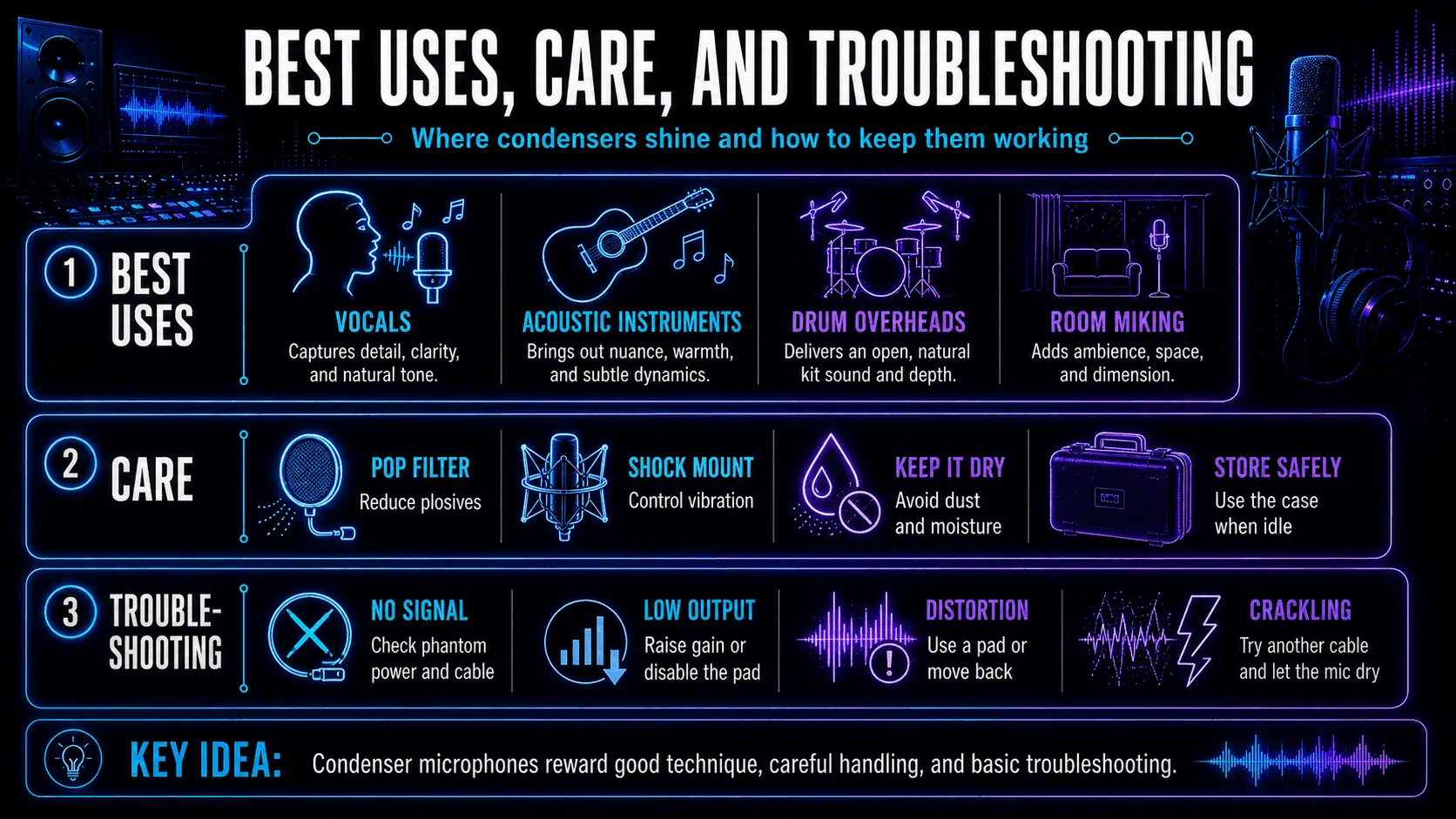
Condenser microphones contain sensitive capsules and electronics, so basic care helps prevent noise, damage, and reduced performance.
- Use a pop filter when recording vocals.
- Use a shock mount to reduce vibrations and handling noise.
- Protect the microphone from dust, moisture, and extreme temperatures.
- Store it in its case when it is not in use.
- Wipe the body with a soft cloth, but never spray cleaner into the grille.
Common Condenser Microphone Problems
| Problem | Possible Cause | What to Check |
|---|---|---|
| No signal | The microphone is not receiving power | Enable phantom power and check the XLR or USB connection |
| Low output | A pad is engaged or the input gain is too low | Disable the pad if unnecessary and adjust the preamp gain |
| Distortion | The source is too loud for the capsule or internal circuit | Move the microphone farther away or activate the pad |
| Crackling | Moisture, dust, or a faulty cable may be affecting the signal | Try another cable and allow the microphone to dry naturally in a safe environment |
Comparison with Other Microphone Types
Ribbon Microphones
Ribbon mics are a type of dynamic mic that uses a thin strip of aluminum. They are even more fragile than condensers and have a very dark, vintage sound. They are prized for their natural high-frequency roll-off.
MEMS Microphones
Found in smartphones, MEMS microphones are essentially microscopic condenser microphones etched onto a silicon chip. While they lack the fidelity of a studio capsule, they represent the cutting edge of microphone technology for consumer electronics.
The Future of Condenser Technology and AI
As we move further into the decade, studio microphones are becoming increasingly smart.
We are seeing a rise in modeling microphones. These are transparent condenser microphones paired with software that uses digital signal processing to emulate the frequency response and harmonic character of classic vintage mics. Artificial Intelligence is now being used to assist in real-time noise reduction and polar pattern steering.
From Detailed Recording to Creative Production with ACE Studio
As microphone technology becomes more intelligent, AI is beginning to influence not only how sound is captured, but also what producers can do with it afterward. A condenser microphone provides a detailed recording of a singer’s tone, dynamics, articulation, and subtle performance changes. Once that material enters the production environment, those captured details can become the foundation for further creative work.
ACE Studio extends this process beyond conventional recording and editing. Producers can use Voice Changer to reinterpret an existing vocal performance with a different authorized voice, generate new sung passages with AI singing voices, or develop the surrounding arrangement with AI Instruments and Add a Layer. The microphone captures the original expression, while ACE Studio provides tools to reshape, expand, and place that performance within a complete song.
This does not replace the importance of microphone selection, placement, room acoustics, or recording technique. A clean condenser recording still provides better source material and greater flexibility during production. AI simply adds another creative stage, connecting traditional sound capture with new ways to develop vocals and arrangements after the recording session.
Frequently Asked Questions
Does a condenser microphone always need phantom power?
No. Most studio condensers use 48V phantom power, but tube microphones require external power supplies, while USB and electret models may use other power sources.
What is the difference between condenser and dynamic microphones?
Condenser microphones are more sensitive and capture greater detail. Dynamic microphones are usually more durable and better suited to loud sources and live environments.
Can a condenser microphone record loud sounds?
Yes. Many modern condensers can handle high sound pressure levels, especially when a built-in pad is used or the microphone is placed farther from the source.