
Key Takeaways
- Dynamic EQ adjusts specific frequency bands only when they become a problem, making it more flexible than static EQ for changing vocals, instruments, and dense mixes.
- Dynamic EQ and multiband compression are not the same: dynamic EQ is better for surgical frequency control, while multiband compression is better for broader tonal and dynamic shaping.
- One of the biggest uses of dynamic EQ is cleaning up vocals, including harsh sibilance, low-mid buildup, and sudden resonances without making the whole performance sound dull.
- Dynamic EQ is especially useful for solving masking problems, such as kick and bass clashes or guitars covering the vocal range, because it creates space only when needed.
- Tools like ACE Studio can help shape cleaner vocals, instruments, stems, and MIDI parts before mixing, so dynamic EQ becomes a precision tool rather than a rescue tool.
Introduction to Advanced Audio Processing
As tracking environments diversify and dense digital arrangements become the norm, traditional mixing tools often encounter severe operational limitations. Static processing, while fundamental to sound engineering, frequently fails when confronted with the highly fluid nature of musical performances.
In any given arrangement, instrument tones evolve continuously. A vocalist may deliver an intimate, soft verse before transitioning into an aggressive, belted chorus. A bass guitar might sound perfectly balanced when playing higher melodic lines but introduce overwhelming low-end resonance when moving down to the open strings. A static equalizer cannot adapt to these shifts; it applies an unyielding frequency response adjustment across the entire timeline, solving a problem in one section while inadvertently damaging another.
To overcome these limitations, sound engineering has embraced spectral shaping tools that react dynamically to incoming material. Dynamic equalization represents the pinnacle of this technological evolution. By marrying the precision of a parametric EQ with the ballistic control of a dynamics processor, dynamic equalization offers an elegant solution to the most stubborn acoustic challenges in mixing and mastering.
Beginner's Guide to Dynamic EQ
For those entering the world of advanced music production, understanding the fundamental nature of audio processing tools is critical. A dynamic equalizer is a signal processing tool that alters the frequency response of an audio signal in real time based on the volume level of specific frequency bands.
To understand this concept, consider a standard static equalizer. If you apply a 3 decibel cut at 2 kilohertz on a vocal track, that cut is permanent. It attenuates 2 kilohertz by 3 decibels whether the singer is whispering, shouting, or completely silent. If the vocal only sounds harsh when the singer shouts, a static cut makes the quiet passages sound dull and lacking in presence.
An adaptive equalization system solves this dilemma. It acts as a real-time equalizer that monitors the energy at 2 kilohertz. When the vocal is quiet, the equalizer remains completely flat, preserving the natural warmth and detail of the performance. The moment the singer hits an intense note and the energy at 2 kilohertz crosses a user-defined threshold, the dynamic equalizer applies the 3 decibel cut instantly. As soon as the harsh note ends, the filter response smoothly returns to zero. This localized sound enhancement guarantees that corrective actions only occur when problems are actively present.
Technical Mechanics of Dynamic Equalization
At its architectural core, a dynamic equalizer combines a traditional parametric filter network with an independent dynamics detection circuit. To comprehend how this functions inside a digital audio workstation, we must examine the signal modulation path.
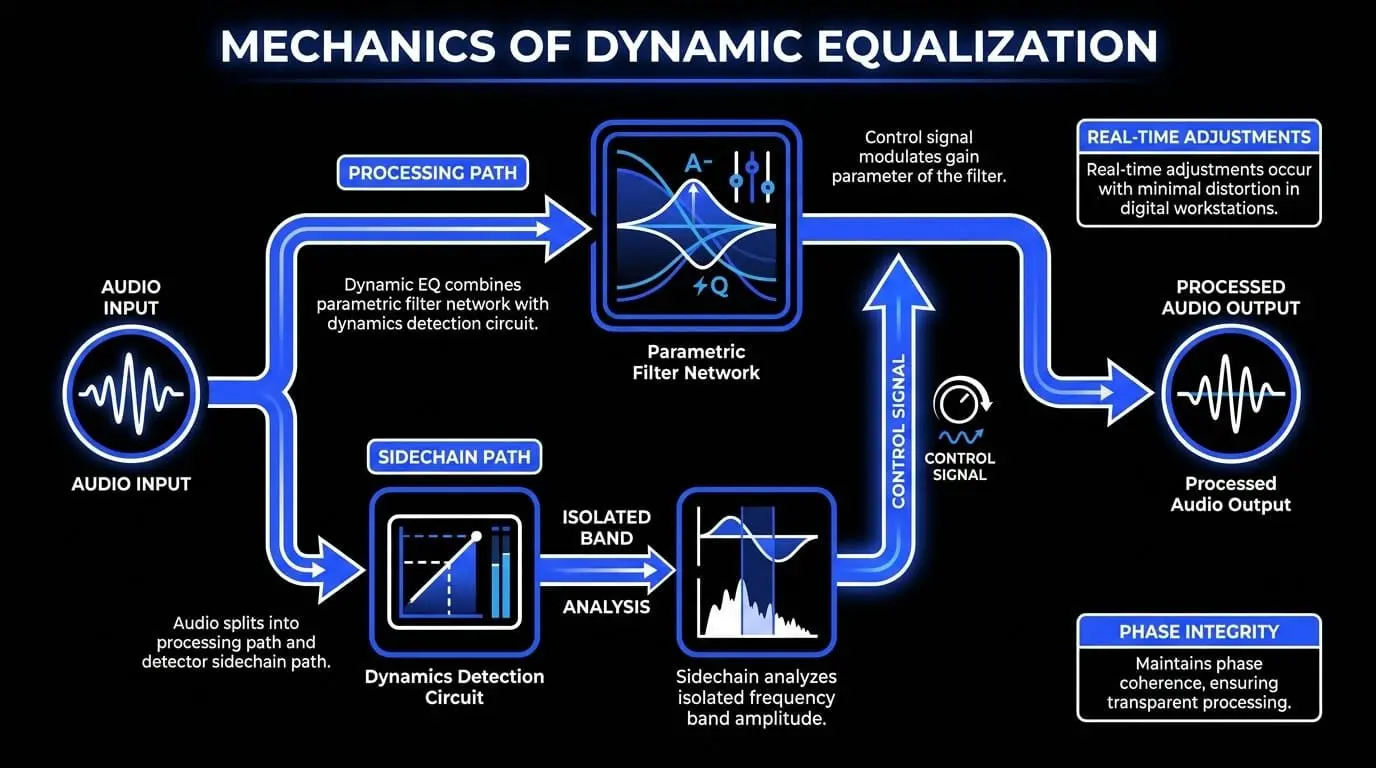
When audio enters a dynamic EQ band, the signal splits into two distinct pathways: the audio processing path and the detector sidechain path. The sidechain path routes the audio through a band-pass filter centered around the chosen target frequency. This isolated frequency band is then analyzed by a level detector, which calculates the amplitude using either peak or root-mean-square measurement models.
If the energy within this narrow band exceeds the threshold, the detector generates a control signal. This control signal directly modulates the gain parameter of the primary parametric filter. Unlike a compressor, which attenuates the overall volume of a split signal block, the control signal in a dynamic EQ scales the actual boost or cut of the EQ band itself.
Because modern digital audio workstations handle audio with floating-point precision, these real-time adjustments occur with minimal distortion and artifact introduction. The filter curve expands or contracts dynamically, altering the spectral geometry of the sound without introducing the phase anomalies commonly associated with heavy multiband filtering.
Structural Differences: Dynamic EQ vs. Multiband Compression
One of the most persistent points of confusion in sound engineering is the precise distinction between dynamic equalization and multiband compression. While both tools perform audio dynamics control across targeted frequency ranges, their underlying digital architectures and sonic behaviors are vastly different.
Crossover Networks vs. Parametric Filters
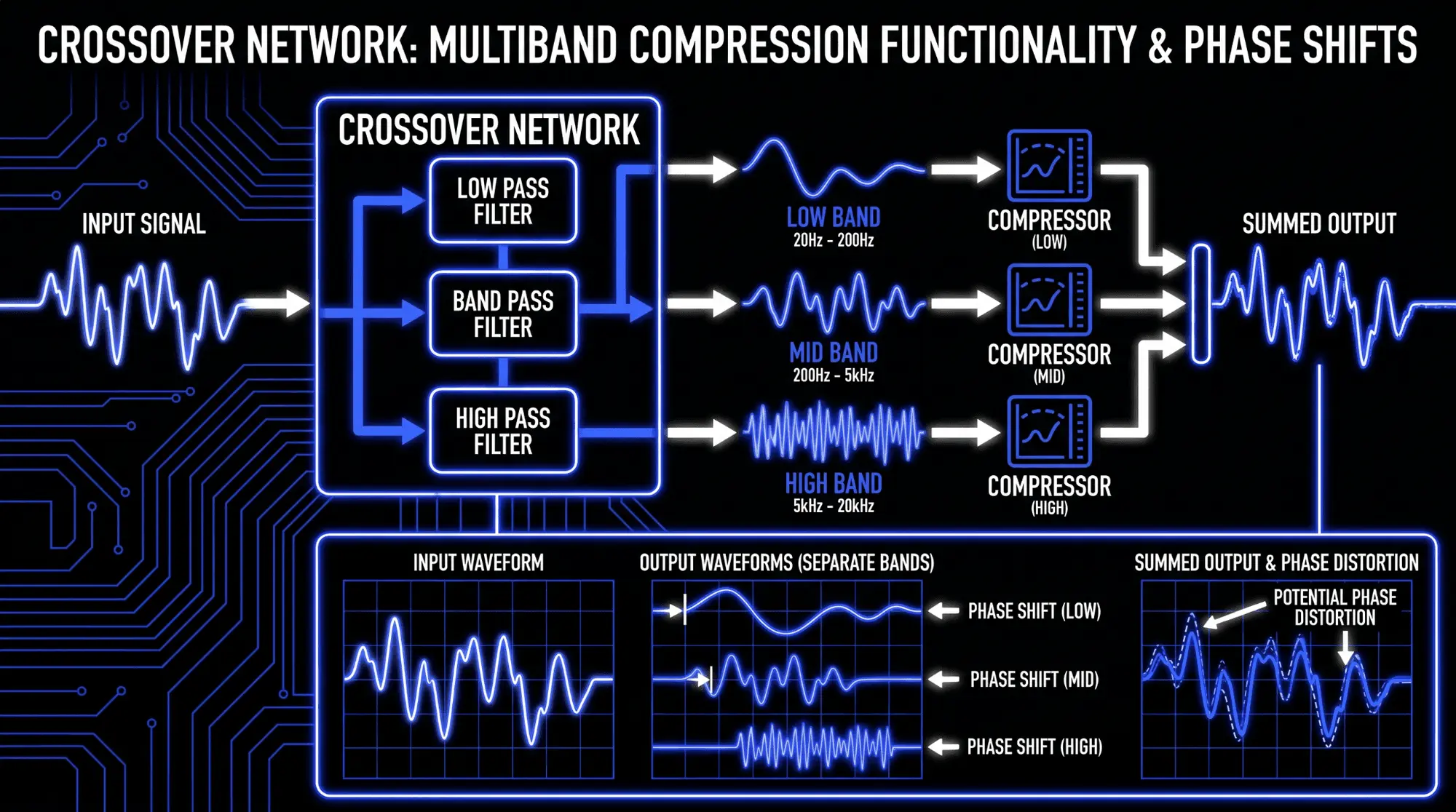
A multiband compressor utilizes a collection of steep crossover filters to split the incoming audio signal into broad, contiguous frequency regions, such as low, low-mid, mid, and high bands. These bands are completely isolated from one another, processed by individual compression circuits, and then summed back together at the output stage. Even when a multiband compressor is performing zero gain reduction, the audio signal must pass through these crossover networks, which can introduce phase shifts, subtle harmonic coloration, and pre-ringing artifacts at the crossover points.
In contrast, a dynamic equalizer employs a standard parametric filter topology. The audio remains intact as a single, full-range signal. The filters only introduce phase adjustments and coloration when they are actively triggered by the sidechain circuit. When the signal sits below the threshold, the plugin behaves as a completely transparent bit-for-bit bypass for that specific frequency area.
Operational Bandwidth and Geometry
Multiband compressors generally utilize fixed slope shapes, such as Linkwitz-Riley or Butterworth filters, which affect large blocks of the audio spectrum. This makes them highly effective for macro-level leveling and structural control of complex mix buses.
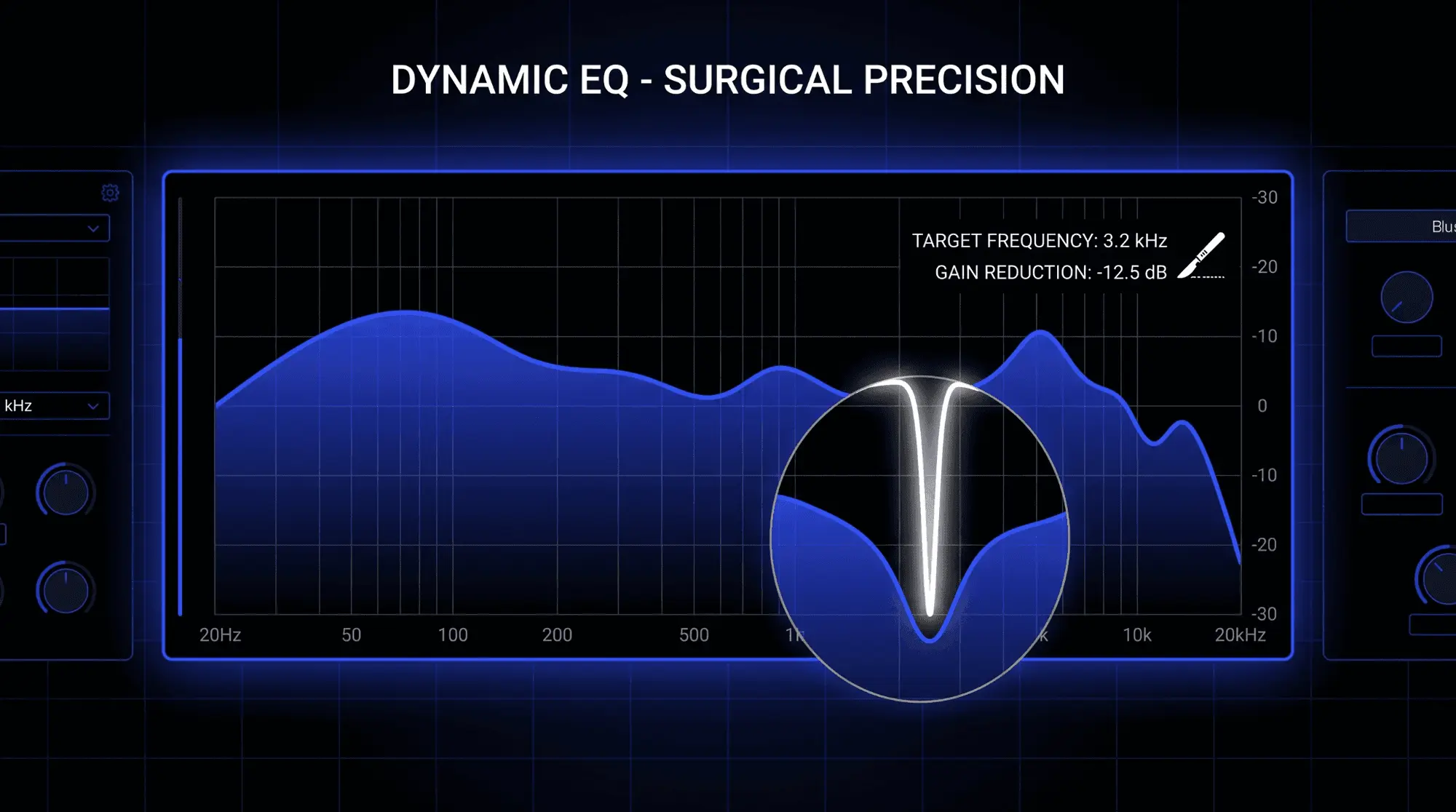
Dynamic EQs utilize variable quality factors, or Q values. This allows for incredibly narrow, surgical bell curves or precise shelving options. A dynamic EQ can target a resonance as narrow as a few hertz without disturbing any neighboring frequencies, a feat that is fundamentally impossible for a traditional multiband compressor.
Comparison Table: Structural Architecture
Essential Dynamic EQ Parameters
To exploit the full potential of an adaptive equalization system, an engineer must command its primary control parameters. Each parameter dictates a specific aspect of how the real-time equalizer alters the incoming sound wave.
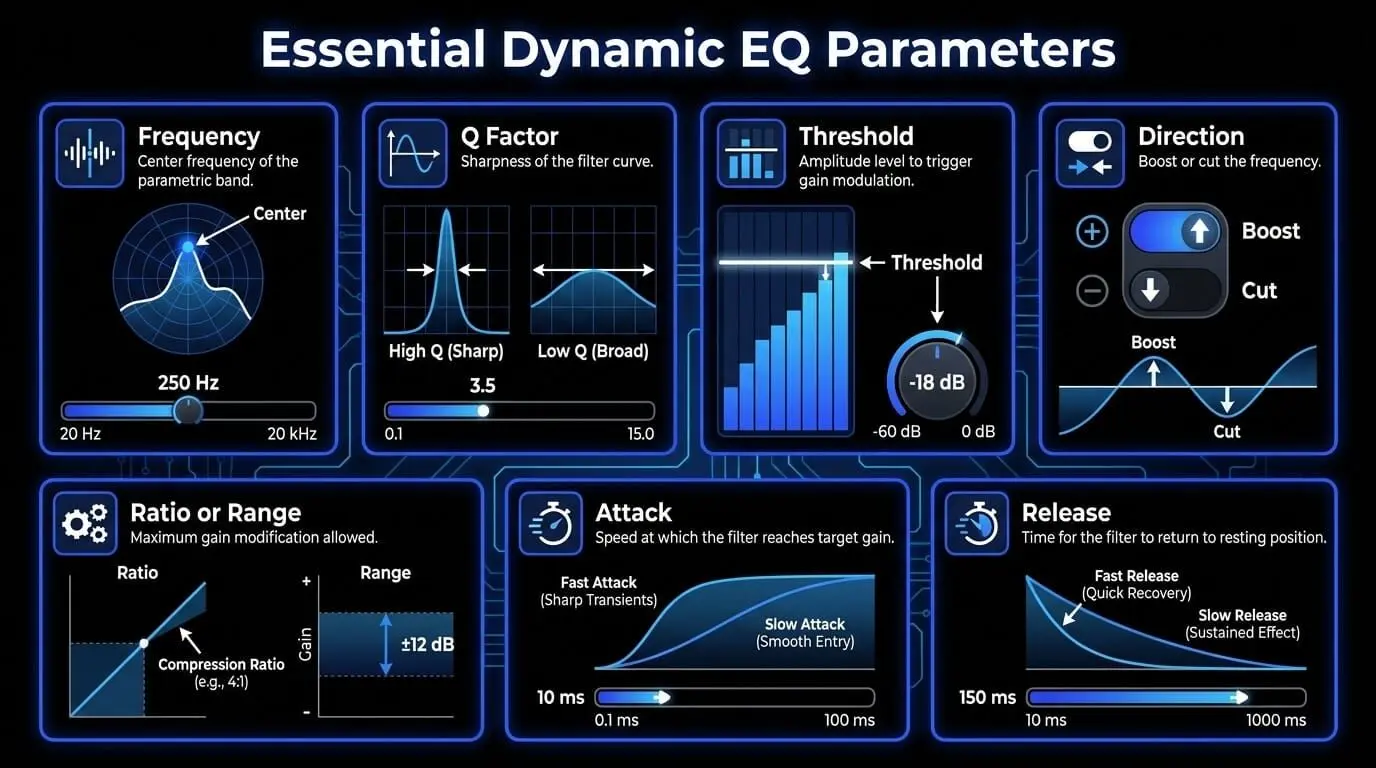
- Frequency: Selects the center frequency of the parametric band that will be subject to modification.
- Q Factor (Bandwidth): Sets the sharpness of the filter curve. A low Q value creates a wide, smooth arc that affects a broad musical region, while a high Q value generates a razor-sharp spike designed for surgical correction of specific resonances.
- Threshold: Establishes the amplitude level, measured in decibels, that the sidechain detector must cross before gain modulation begins.
- Direction (Boost or Cut): Determines whether the filter will expand outward to enhance a frequency or contract downward to attenuate it when triggered.
- Ratio or Range: Dictates the maximum amount of gain modification allowed or scales the intensity of the correction relative to the signal level.
- Attack: Defines the speed, usually measured in milliseconds, at which the filter reaches its target gain modulation once the signal crosses the threshold. Fast attack times catch brief transients, while slower times let the initial impact pass before applying processing.
- Release: Controls the duration of time the filter takes to return to its resting position after the audio signal falls back below the threshold. Proper adjustment prevents a pulsing or pumping sensation in the audio material.
Advanced Applications in Music Mixing
Integrating dynamic EQ into a mixing workflow unlocks sophisticated techniques for establishing clarity, separation, and impact across a digital audio workstation session.
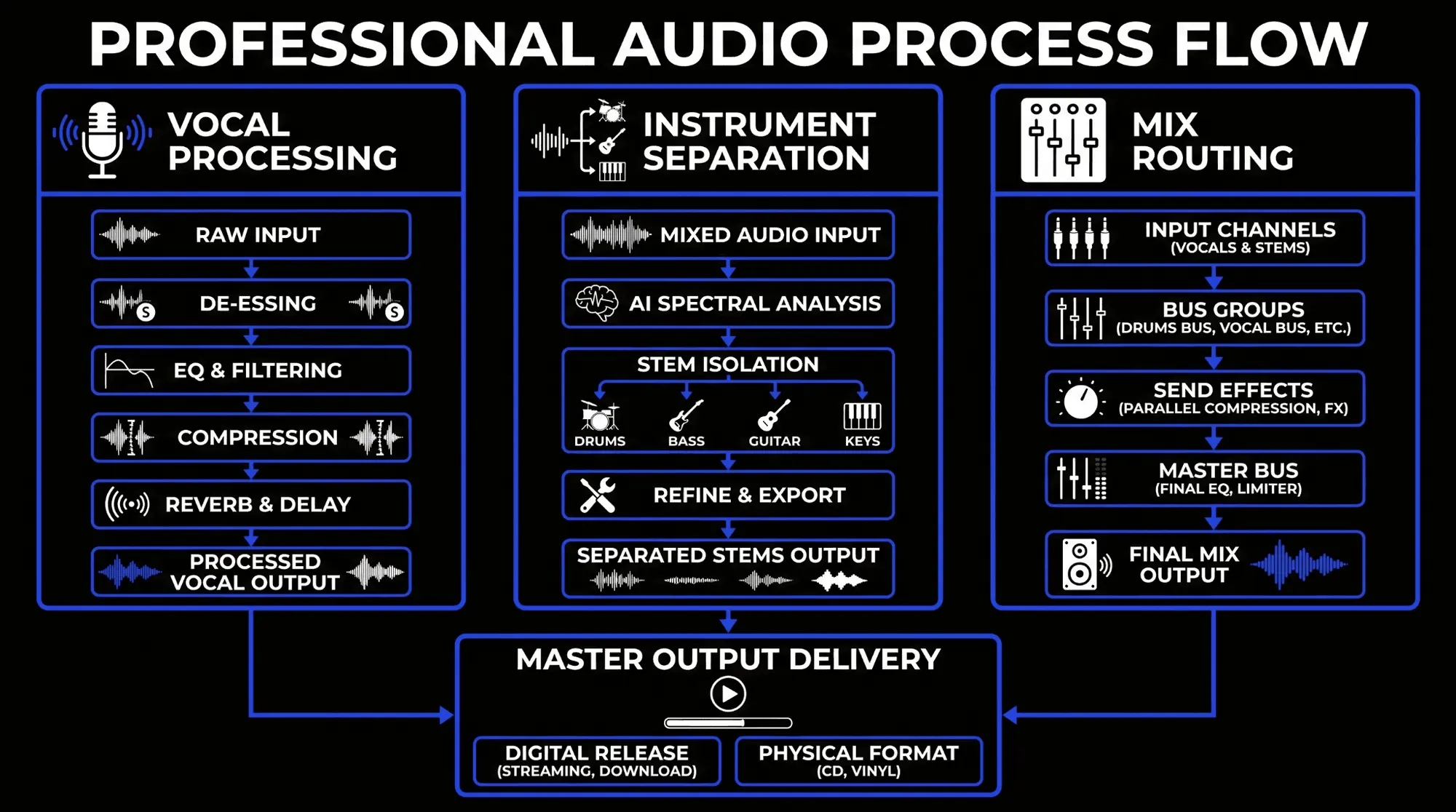
Vocal Processing Workflows
The human voice is an exceptionally challenging instrument to mix due to its wide dynamic range and constantly shifting spectral character. A vocalist moving closer to a directional microphone triggers the proximity effect, generating an erratic buildup of low-mid frequencies between 150 hertz and 350 hertz.
Clarity and Balance
By placing a dynamic EQ band in the 200 hertz region with a moderate Q factor, you can dial in a threshold that only activates when the singer leans into the microphone or sings notes in their lower register. This keeps the performance from sounding muddy or boomy during dense arrangements while ensuring the voice remains full-bodied during sparse sections.
Natural De-Essing
Traditional de-essers operate by compressing the entire high-frequency region whenever sibilance is detected, which can lead to a lisping effect. A dynamic EQ configured as a high-precision de-esser can target the exact frequency of the sibilance, typically between 4 kilohertz and 8 kilohertz. By using a sharp Q factor and an instantaneous attack time, the dynamic EQ cleanly clamps down on harsh sibilant bursts while leaving the breathy, airy qualities of the vocal completely untouched during non-sibilant passages.
Instrument Separation and Spectral Slotting
When multiple instruments jockey for dominance within the same frequency territory, a mix quickly loses its definition. Traditional static cuts can emasculate an instrument, making it sound thin when soloed. Dynamic equalization provides an elegant solution through advanced frequency slotting.
Kick Drum and Sub-Bass Interaction
The relationship between the kick drum and the bass guitar is the foundation of modern low-end control. Frequently, the fundamental impact of the kick drum (around 60 hertz) clashes directly with the sustained low notes of the bass.
By instantiating a dynamic EQ on the bass guitar track and routing the kick drum into its external sidechain input, you can configure a band at 60 hertz to attenuate the bass guitar only during the millisecond duration that the kick drum strikes. The instant the kick decays, the bass guitar regains its full low-end power. This precise orchestration yields a massive, hard-hitting low end without causing any mud or masking.
Guitars and Lead Vocals
Electric guitars and keyboards frequently mask the critical mid-range intelligibility of a lead vocal between 1 kilohertz and 3 kilohertz. By sidechaining the vocal to a dynamic EQ band on the guitar bus, the guitars can gently yield a decibel or two of mid-range presence exclusively when the vocalist is actively singing. When the vocal pauses, the guitars instantly reclaim their bite and mid-range energy.
Advanced Mix Routing and Processing
Beyond individual tracks, adaptive equalization provides exceptional control when applied to complex mix buses, groups, and effect returns.
Bus and Group Processing
Placing a dynamic EQ across a drum bus allows for the targeted control of unpredictable elements. For example, an overly enthusiastic drummer might strike the cymbals with varying intensity. A wide dynamic shelving band set at 10 kilohertz can act as a safety valve, gently suppressing excessive high-frequency buildup during intense drum fills while maintaining a bright, open sound during standard grooves.
Parallel Processing
In parallel compression chains, processing can often amplify unwanted low-frequency build-ups or harsh transients. Placing a dynamic EQ after a heavy parallel compressor allows engineers to reshape the compressed signal dynamically before summing it back with the dry track. This ensures that the parallel chain adds density and sustain without injecting low-end rumble or upper-midrange harshness.
Managing Time-Based Effects
Reverb and delay returns can easily clutter a mix if their frequency content is left unmanaged. A static high-pass filter can make a reverb sound thin and synthetic. Instead, using a dynamic EQ on the reverb return—triggered by the dry lead vocal track via an external sidechain—allows the reverb's mid-range frequencies to duck down while the vocal is active. As phrases trail off, the reverb blooms into the empty spaces, creating a lush sense of depth that never interferes with lyrical clarity.
Where ACE Studio Fits Before Dynamic Equalization
Dynamic equalization is most powerful when the source material already gives you something worth shaping. It can tame harshness, control low-end buildup, and clear space between competing elements, but it should not be forced to rescue every problem in a production. The cleaner and more intentional your vocal, instrument, or stem is before the mix, the more musical your dynamic EQ decisions become.
ACE Studio gives producers a more direct way to shape the performance before the mix ever reaches the corrective stage. ACE Studio 2.0 has developed into a broader AI Music Generator with AI voices, AI instruments, prompt-based generative kits, stem tools, audio-to-MIDI features, and a redesigned Canvas for arranging musical ideas with more control.
For vocal production, this matters immediately. Instead of relying on a rough placeholder take that carries uneven tone, unclear phrasing, or inconsistent pitch movement, you can create a more controlled vocal part from MIDI and lyrics. AI Singing Voice Generator lets you shape pitch, timing, phonemes, breaths, vibrato, and vocal expression before the signal ever reaches your EQ chain.
That gives dynamic EQ a better job to do. Rather than cutting aggressively to hide a weak performance, you can use it for what it does best: catching occasional sibilance, smoothing brief low-mid buildup, or controlling harsh notes only when they appear.
The same idea applies to instruments. ACE Studio includes AI instruments: strings, saxophones, trumpets, and duduk, with articulation control for more nuanced performances. If you are building a string layer, cinematic line, or melodic instrument part, you can shape the MIDI performance first, then use dynamic EQ later to control resonances that appear only during louder notes or denser sections.
A practical example is a layered chorus. You might create a lead vocal, harmony stack, and supporting string line in ACE Studio. Once those parts are exported or connected to your production session, dynamic EQ can help each element stay clear:
- A narrow band can soften sibilance in the lead vocal only when it spikes.
- A low-mid band can control warmth buildup in backing vocals during full harmonies.
- A dynamic cut on the string layer can clear space for the vocal between 1 kilohertz and 3 kilohertz.
- A subtle high-frequency band can keep bright AI instruments present without turning sharp.
ACE Studio also includes Stem Splitter and Audio to MIDI tools, which are useful when you are working from existing material. You can separate parts from a track, convert musical ideas into editable MIDI, and rebuild or refine elements with more control. This is especially helpful when a mix problem starts at the arrangement level rather than the EQ stage. If a vocal, bass, or instrumental layer is fighting the rest of the track, sometimes the better move is to adjust the part itself before reaching for another processor.
This is the real advantage: ACE Studio gives you more control over the performance before you begin corrective mixing. Dynamic EQ then becomes a precision tool instead of a repair tool. You still decide the phrasing, tone, timing, emotion, and arrangement. It gives you editable musical material, and dynamic equalization helps that material sit cleanly inside the final mix.
Used this way, the two tools support the same goal: clearer productions with less over-processing and more musical intent.
Common Mixing Mistakes and How to Avoid Them
While dynamic equalization is an incredibly powerful asset, its flexibility can lead inexperienced engineers into devastating pitfalls that compromise the integrity of a mix.
Over-Processing and Spectral Erasure
The visual feedback provided by modern real-time equalizer plugins can be highly addictive. It is easy to fall into the trap of mixing with your eyes rather than your ears. When an engineer attempts to iron out every single movement in the frequency spectrum analyzer, they commit spectral erasure.
Music requires organic variance to feel alive. If every frequency spike is ironed out flat by endless dynamic cuts, the instrument loses its native character, resulting in a sterile, boring, and artificial sound. Use dynamic EQ only when an acoustic problem actively distracts from the cohesion of the mix.
Aggressive Threshold Settings
Always set thresholds so that the filter relaxes completely back to its zero position during quieter moments of the performance. Setting a threshold too low causes the dynamic filter to remain clamped down constantly.
Misconfigured Time Constants
Improper attack and release settings can introduce severe acoustic artifacts. If the attack time is set too slow on a sibilant vocal band, the harsh transient pass will escape entirely before the filter engages, followed by an awkward dip during the vowel sound that follows. Conversely, an excessively fast release time on low-frequency material can cause the filter to open and close mid-waveform, creating audible harmonic distortion known as chatter.
As a general rule, use faster attack and release times for high-frequency transients, and slower, more deliberate time constants for low-frequency management.
Dynamic Equalization in Mastering
In the mastering stage, adjustments must be executed with extreme subtlety. Because a mastering engineer works with a mixed stereo file, any modification applied to a specific frequency band will affect every single instrument occupying that space. Dynamic equalization is highly revered in this discipline due to its transparent sound enhancement capabilities.
Preparing a Mix for Mastering
Before pushing a track into brickwall limiters, the spectral balance must be completely stabilized. Uncontrolled low-frequency bursts or sudden mid-range spikes will cause a mastering limiter to pump aggressively, distorting the final master. Dynamic EQ serves as the ultimate diagnostic and corrective tool during this preparatory phase.
Broadband Problematic Frequency Mitigation
A stereo mix may exhibit an occasional buildup of harshness around 4 kilohertz due to overlapping frequencies from overhead microphones, aggressive synthesizers, and vocal tracks. A static cut across the master file would dull the entire record. A mastering engineer can deploy a wide dynamic EQ band with a soft threshold to gently shave off 0.5 to 1 decibel of energy only during the loudest, most intense choruses. This tames the harshness while preserving the necessary brilliance of the verses.
Gentle Tonal Shaping
Dynamic EQ can be used to add global polish to a mix. If a track lacks low-end weight during the verses but becomes crowded during the choruses, an engineer can apply a subtle dynamic low-shelf boost below 100 hertz. By setting the threshold carefully, the dynamic EQ can gently lift the low end during the sparse verses, providing warmth and foundation, and then back off automatically when the full arrangement arrives to prevent the low end from overloading the master bus.
Project and Album Consistency
When mastering a full-length album or EP, maintaining sonic continuity across disparate tracks is paramount. Tracks recorded at different times or by different producers will inevitably exhibit varying spectral balances. Dynamic equalization allows the mastering engineer to impose a unifying tonal profile across the project.
If one track features an abnormally aggressive acoustic guitar resonance that does not appear anywhere else on the album, a targeted dynamic EQ band can isolate and control that specific anomaly, instantly bringing the track into alignment with the surrounding material without requiring a complete remix.
Frequency Balancing for Global Cohesion
Achieving global cohesion requires balancing the relationship between the extreme low end and the high-mid air of a recording. A master must translate flawlessly across a wide variety of playback systems, from consumer earbuds to massive club sound systems.
Dynamic EQ allows for mid-side frequency balancing, enabling engineers to compress low frequencies exclusively in the center channel (mid) to ensure mono compatibility, while using an expanding high shelf on the sides to gently enhance the stereo width and spatial depth of the track as it gets louder.
Genre-Specific Adaptation Strategies
An exceptional audio engineer understands that every musical genre demands a completely unique approach to audio dynamics control and frequency response adjustment.
Hip-Hop and Trap Production
In modern urban music, the low end is the definitive center of gravity. Engineers face the constant challenge of mixing massive 808 sub-bass glides with punchy kick drums. Because 808s change pitch rapidly, a static EQ cut will ruin the tone of certain notes while failing to control others.
A dynamic EQ with a fast attack and release can track the moving fundamental pitch of an 808, dipping the specific frequency where it collides with the kick transient on a note-by-note basis. This preserves maximum sub-bass impact while maintaining absolute clarity in the low end.
EDM and Electronic Music
Electronic productions are characterized by massive walls of synthesized sound and heavy spectral density. During intense arrangements and build-ups, the mid-range frequencies can accumulate an immense amount of energy, leading to a harsh listening experience.
Using dynamic equalization to target the 3 kilohertz area on synth buses allows the pads and leads to sound incredibly bright and wide during sparse moments, while automatically softening and ducking when the main drop hits to clear an open path for the primary lead lines and transient impacts.
Rock and Metal Arrangements
Heavy rock music is dominated by dense walls of distorted electric guitars that fight continuously with cymbals and vocals. Distorted guitars tend to build up a build up a painful, whistling build up around 4 kilohertz.
By applying narrow, high-Q dynamic EQ bands to the guitar tracks, you can surgically extract these harsh whistles only when the guitar player strikes chords with extreme force. This maintains a thick, aggressive, and warm guitar tone without letting the upper-midrange turn into a piercing wall of noise.
Pop Music Production
Pop music requires an astonishing level of vocal presence and absolute perfection. Vocals must sit right at the front of the mix, sounding hyper-detailed yet smooth.
Engineers use dynamic EQ extensively across pop vocal stacks, treating lead vocals, harmonies, and background layers with custom settings. This ensures that when all backing harmonies enter during a chorus, their collective mid-range presence is dynamically managed so they wrap cleanly around the lead vocal rather than burying it in mud.
Lo-Fi and Ambient Genres
Lo-fi and ambient music deliberately embrace tape hiss, vinyl crackle, and distorted warmth. Here, dynamic equalization is used creatively for textural sound enhancement rather than clinical correction.
A dynamic low-pass filter can be set up to expand outward only when a lo-fi piano note strikes, momentarily letting a burst of high-frequency clarity through before clamping back down into a dark, muffled texture. This creates an evolving, organic sense of movement that enhances the nostalgic atmosphere of the music.
Live Sound Reinforcement and Real-Time Adjustments
The utility of an adaptive equalization framework extends far beyond the studio. In live sound engineering, conditions are highly unpredictable, requiring instant adjustments to keep a show running smoothly.
Adaptive Control for Varying Performance Levels
Unlike a controlled studio environment, live performers constantly alter their distance from microphones, change their vocal intensity based on crowd energy, and move around the stage. A live sound engineer cannot manually automate an equalizer quickly enough to track these shifts.
Implementing a real-time equalizer across the lead vocal channel provides a built-in safety net. If the singer suddenly screams directly into the capsule, the dynamic EQ engages instantly to smooth out harsh frequencies before they strike the main public address system.
Dynamic Feedback Mitigation
Acoustic feedback is the ultimate enemy of the live sound engineer. Traditional notch filtering removes huge slices of a microphone's tone to stop a stage monitor from ringing.
A dynamic equalizer can be set with an extremely narrow Q factor focused precisely on known room feedback frequencies. If a frequency begins to loop and build up energy, the dynamic EQ catches it immediately, plunging the gain down to kill the ring, and then releasing it the moment the danger passes. This keeps the performance loud and clear without compromising the tonal quality of the microphone.
Seamless Transitions Across Live Sets
Modern live performances, particularly for electronic acts and pop sets, involve rapid transitions between tracks with completely different tonal balances. Using dynamic EQ on the main master output bus allows the front-of-house engineer to establish general safety thresholds. This automatically evens out drastic, unexpected shifts in low-end energy or high-frequency bite as the show transitions from track to track, protecting the audience's ears and the venue's sound system.
Creative Modulations and Advanced Sidechain Techniques
While dynamic EQ is most commonly valued for its corrective capabilities, it also serves as a phenomenal engine for creative sound design and signal modulation.
External Sidechain Dynamic Ducking
We have covered basic sidechain routing for low-end management, but this technique can be expanded across a mix for highly artistic results. For example, in cinematic scoring, a massive orchestral string section can easily drown out the delicate details of a solo woodwind performance.
By routing the solo woodwind into the external sidechain input of a dynamic EQ instantiated on the string bus, you can configure precise cuts across the mid-range of the strings. Every time the woodwind plays a phrase, it cleanly carves out its own custom spectral pocket within the orchestra, creating an automated, fluid arrangement that sounds incredibly expensive and natural.
Mid-Side Spectral Shaping
Applying mid-side processing to dynamic equalization provides an incredible level of control over the stereo field. In a master or a stereo instrument group, you can decouple the center information (mid) from the wide pan information (sides).
If you have a stereo acoustic guitar track where the low-frequency strumming in the center channel is cluttering the vocal space, but you want to keep the bright, wide reflections on the sides intact, you can apply a dynamic low-mid cut exclusively to the mid channel. This clears out the center clutter whenever the guitars are struck aggressively, while the sides remain completely unaffected, preserving a wide and immersive stereo image.
Automation and Modulated Spectral Design
Engineers can combine dynamic EQ with standard digital audio workstation automation to create evolving, rhythmic filters. By automating the threshold or frequency centers of a dynamic EQ in time with a song's tempo, you can generate pulsing pads, breathing synth textures, and vocal effects that warp and shift in perfect harmony with the underlying groove.
Frequently Asked Questions
Can dynamic EQ completely replace my static EQs?
No. Static EQs remain the most efficient tool for foundational corrective tasks, such as removing low-end rumble with a high-pass filter, carving out permanent boxiness from a poorly recorded room, or adding consistent tonal shaping across an entire track. Dynamic EQ is an auxiliary tool designed to handle elements that fluctuate over time.
Does dynamic EQ introduce phase issues into my mix?
Yes. Because dynamic EQs utilize standard digital filtering models, they introduce phase shifts when the filter is active. However, because the filter only engages when the signal crosses the threshold, the phase disruption is momentary, making it far less noticeable than the permanent phase distortion introduced by static EQs or multiband compressor crossover networks.
What is the difference between internal and external sidechaining?
Internal sidechaining means the dynamic EQ band monitors the energy of its own track to decide when to activate. External sidechaining means the band monitors the energy of a completely different audio track to decide when to apply processing to the host track.
Should I place my dynamic EQ before or after my compressor?
This depends on your objective. Placing a dynamic EQ before a compressor allows you to clean up erratic, localized resonances so they do not accidentally cause the main compressor to over-react. Placing a dynamic EQ after a compressor allows you to tame any harsh frequencies or low-end buildups that the compressor inadvertently emphasized during gain reduction.
Is dynamic EQ useful for processing acoustic instruments?
Absolutely. It is exceptionally useful for acoustic guitars, violins, and pianos. These instruments exhibit highly complex resonant structures that change drastically depending on the chords played and the performance intensity. Dynamic EQ tames these sudden resonance spikes seamlessly without ruining the natural wood tone of the instrument.