

Key Takeaways
- Modulation can mean two different things in music: changing from one key center to another in composition, or using a control signal to alter sound parameters in production.
- Key modulation helps music feel more dynamic by creating contrast, tension, release, and emotional movement across different sections of a song.
- Common modulation techniques include pivot chord modulation, direct modulation, chromatic modulation, enharmonic modulation, and sequential modulation.
- Production tools like LFOs, envelopes, modulation wheels, and step sequencers can shape pitch, volume, filter movement, stereo width, and rhythmic variation.
- ACE Studio can help creators test modulation ideas with expressive vocals, AI instruments, MIDI editing, stem separation, and detailed control over phrasing, pitch, vibrato, and performance.
Understanding Musical Modulation Theory
Music modulation represents the deliberate process of shifting a piece from one tonal center to another. This phenomenon is distinct from a simple transient chord change; it requires the establishment of a new tonic, transforming the hierarchical relationship of all subsequent harmonies. The initial key center provides a home base or baseline reference point for the listener. When a composition undergoes key modulation, it alters the foundational pitch architecture, redefining which notes sound stable or unstable.
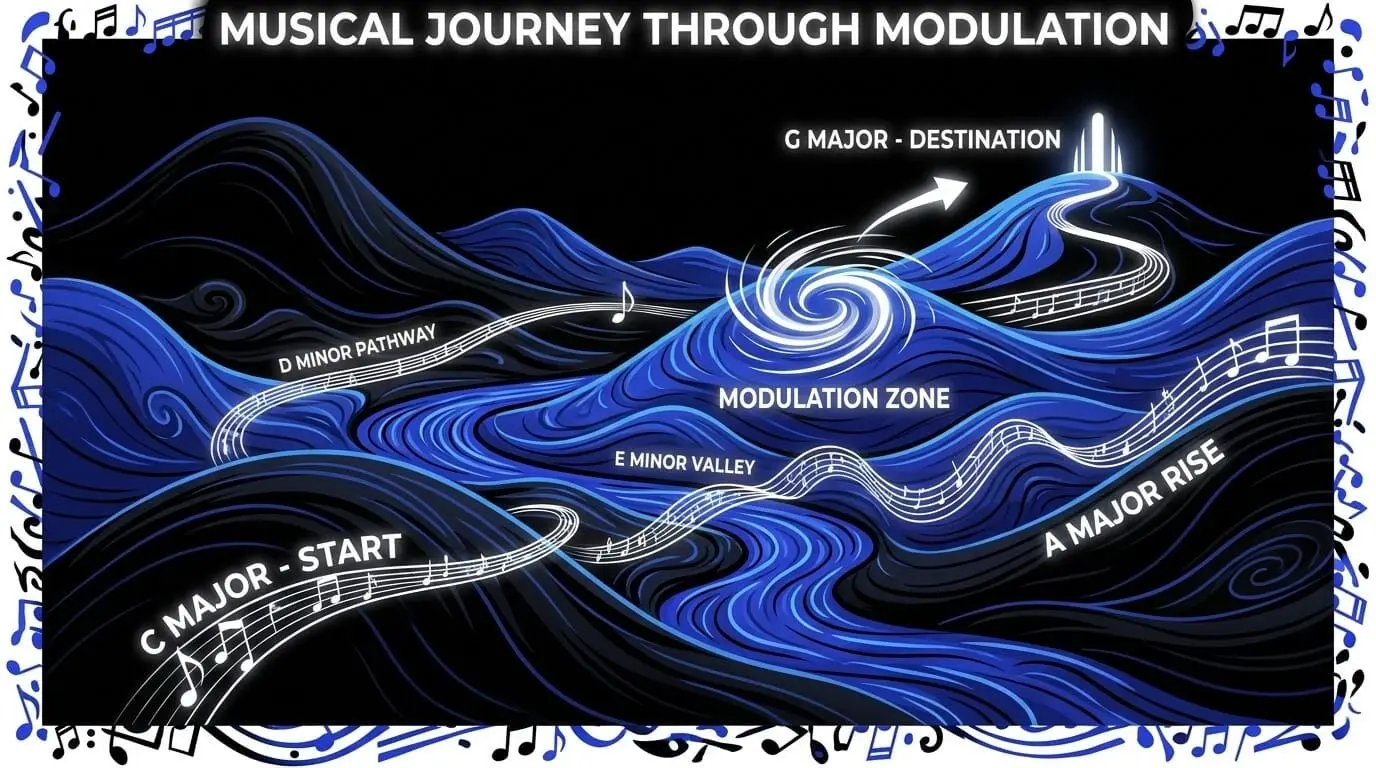
The mechanical reality of this transition relies heavily on the manipulation of the scale changes and harmonic progressions. Within any given key signature, the relationship between chords establishes a specific emotional and structural narrative. When a composer introduces tonal modulation, they disrupt this established framework, forcing the listener to adjust their baseline perspective. This process is essential for preventing acoustic fatigue and extending the structural possibilities of long-form musical works.
Shifting the Key Signature
A true modulation involves a fundamental reconfiguration of the underlying scale structures. Unlike tonicization, which briefly borrows chords from an adjacent key without discarding the primary home key, a complete modulation re-establishes a new key signature as the permanent anchor point of the section. This transformation requires careful handling of the harmonic structure to ensure the new tonic is perceived as a valid resolution point.
The structural trajectory of this process moves systematically from an established original tonic center, enters a transitional modulation phase defined by a pivot or chromatic shift, and establishes resolution within the new target tonic center.
The process of shifting key signatures can occur between closely related keys, which share several common pitches, or distantly related keys, which share few or no common pitches. The proximity of the original key to the target key on the circle of fifths dictates the harmonic tension generated during the transition. Shifts to closely related keys feel smooth and organic, whereas shifts to distant keys create stark, highly visible contrasts in the musical landscape.
Core Purpose of Tonal Variation
The primary purpose of modulation in music is to sustain intellectual and emotional engagement over time. Without structural key shifts, extended compositions risk becoming static, limiting the capacity for narrative development. By introducing new pitch landscapes, composers can mirror the evolution of thematic concepts, text settings, or dramatic arcs.
From a structural perspective, modulation creates a macro-level sense of tension and release. Just as an unresolved dominant chord creates a micro-level desire to return to the tonic, an entire section written in a foreign key creates a large-scale desire to return to the primary home key. This manipulation of musical dynamics and structural gravity forms the foundation of sonata form, rondo form, and various traditional and contemporary popular songwriting frameworks.
Auditory Perception and Cognitive Impact
The human brain processes pitch relationships through a psychological framework known as tonality. When a piece remains within a single key, the auditory cortex maps all incoming frequencies relative to the established tonic. When a modulation occurs, the brain experiences a cognitive shift, re-evaluating the musical hierarchy as the scale changes unfold.
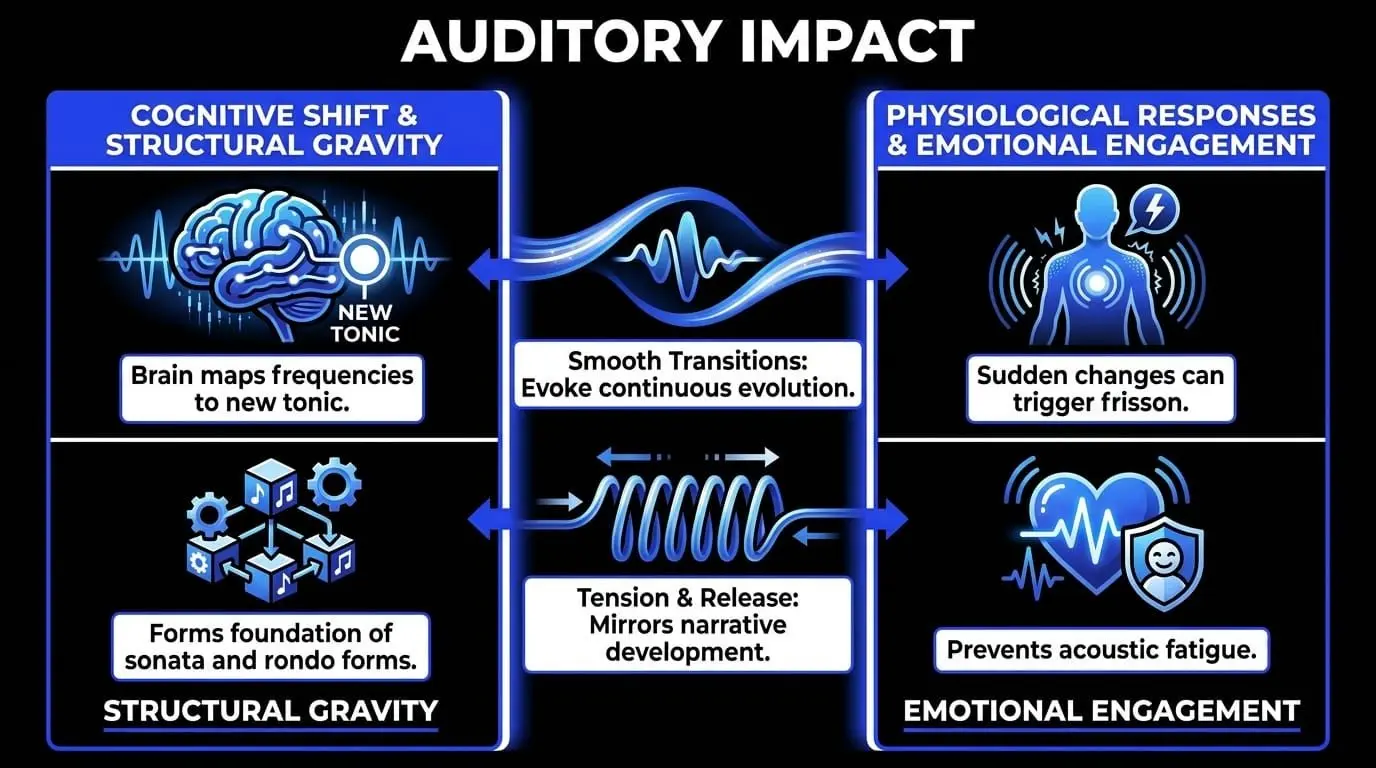
This process profoundly influences auditory perception. A sudden or highly dramatic change in key can trigger physiological responses, such as heightened alertness or goosebumps, often referred to as frisson. Conversely, a smooth, imperceptible transition can evoke a sense of continuous evolution, guiding the listener through complex emotional landscapes without causing cognitive disorientation. Understanding these perceptual mechanics allows composers to deploy specific modulation methods with calculated precision.
Structural Types of Key Modulation
Common Chord or Pivot Methods
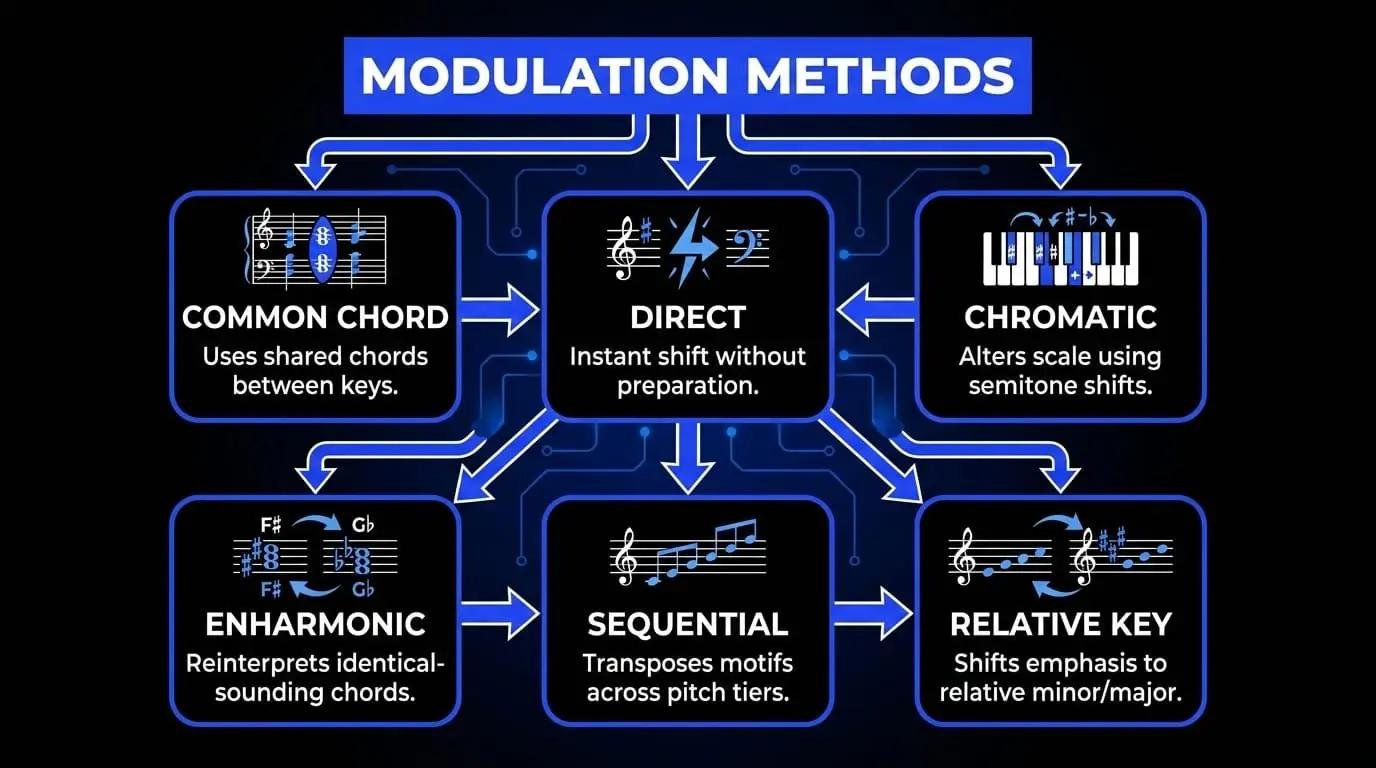
Common chord modulation, frequently termed pivot modulation, stands as one of the most elegant and seamless modulation techniques in traditional harmonic analysis. This method relies on identifying one or more chords that are native to both the home key and the target key. This shared chord acts as a structural bridge, allowing the harmony to transition smoothly without creating an abrupt sonic shock.
To execute a common chord modulation, the composer constructs a chord progression within the initial key, arrives at the designated pivot chord, and then reinterprets that exact chord function within the context of the new key.
For example, when modulating from the key of C major to the key of G major, an A minor chord serves as an ideal pivot point. In the initial key of C major, the A minor chord functions naturally as the submediant six chord. At the designated pivot point, this exact same harmony is reinterpreted as the supertonic two chord within the target framework of G major. From there, the progression moves seamlessly to a D major dominant five chord, before resolving completely to the new one chord of G major.
Direct and Abrupt Transitions
Direct modulation, also known as phrase modulation or abrupt modulation, dispenses with transitional bridges entirely. In this framework, a musical phrase concludes decisively in the original key, and the subsequent phrase begins immediately in the new key center without any unifying harmonic preparation. This technique creates an instantaneous, highly visible shift in the acoustic environment.
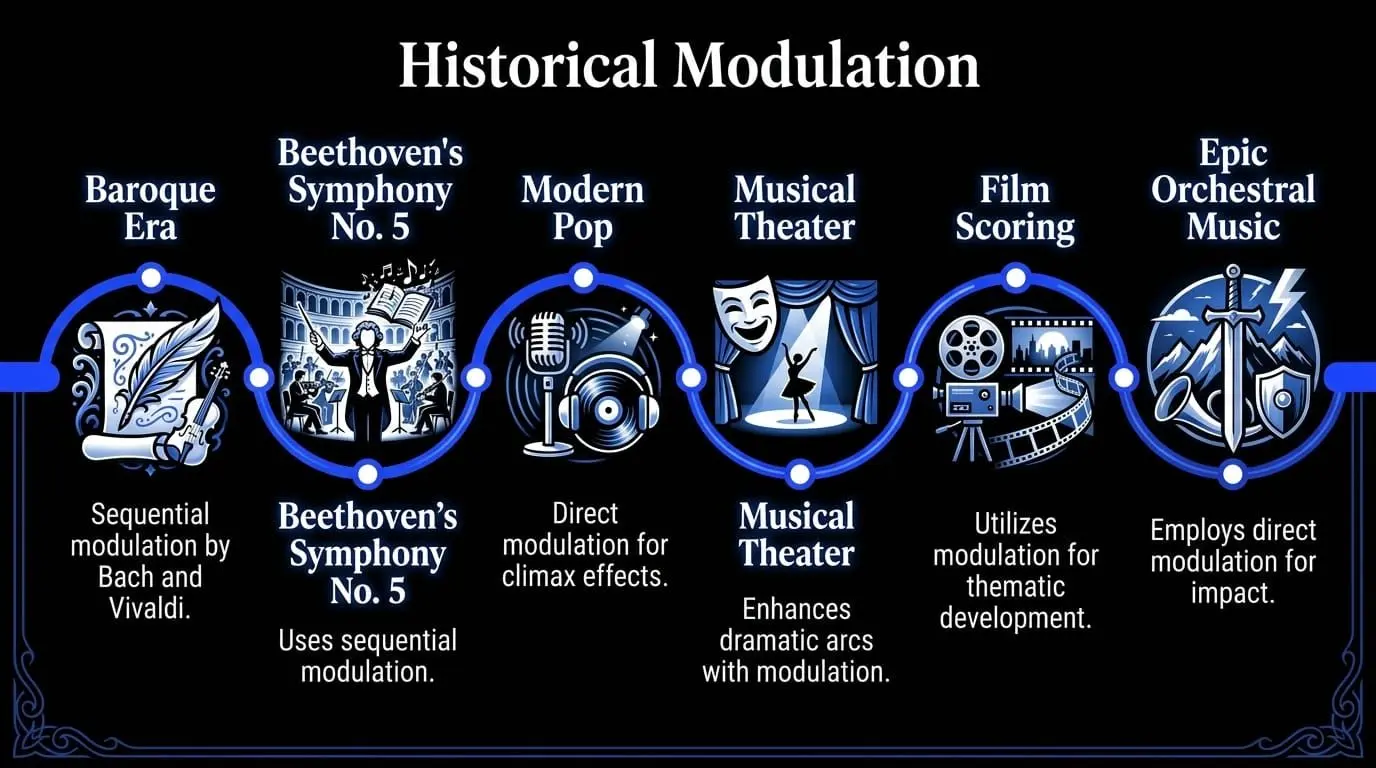
This method is highly prevalent in commercial pop production, musical theater, and epic orchestral music. It is frequently applied as a modulation technique at the climax of a song, typically raising the final chorus by a half-step or whole-step to amplify the energetic output. Direct modulation capitalizes on raw contrast, maximizing the immediate impact on the listener sensory system by subverting traditional harmonic preparation.
Chromatic Dynamics
Chromatic modulation achieves a change of key through the implementation of chromatic voice leading. This occurs when a pitch from the home key is raised or lowered by a semitone within the same musical voice, directly altering the scale structure and pointing towards a new tonal center. This method introduces notes foreign to the diatonic scale, bypassing the need for shared pivot chords.
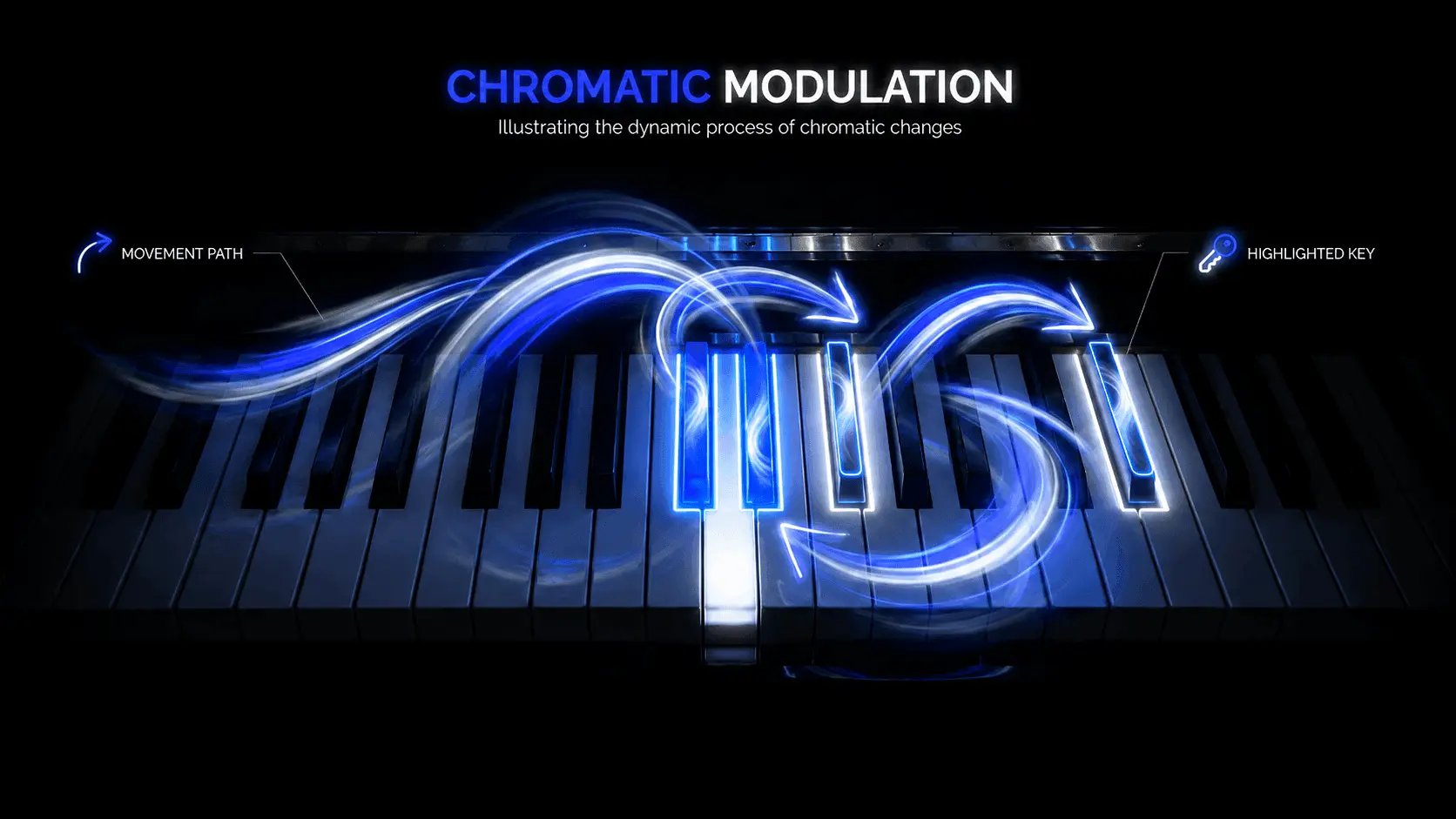
The mechanics of chromatic modulation involve creating an intense internal pull toward the target key. For instance, mutating a standard minor triad into a major triad by raising the third scale degree can instantaneously transform that chord into a secondary dominant, which then strongly resolves to a new tonic. This technique allows for rapid, highly dramatic shifts between keys that do not share close structural relationships on the circle of fifths.
Enharmonic Shifts and Reinterpretations
Enharmonic modulation represents one of the most sophisticated types of modulation in music, relying on the reinterpretation of chords that sound identical but are spelled differently according to their grammatical function. By changing the theoretical spelling of a chord, its resolution trajectory shifts entirely, allowing the composer to leap across vast distances on the circle of fifths in an instant.
The two primary vehicles for enharmonic modulation are the diminished seventh chord and the German augmented sixth chord. Diminished seventh chords are composed entirely of minor thirds, meaning any note in the chord can be treated as the root, leading to four entirely distinct resolution paths. German augmented sixth chords sound identical to a dominant seventh chord, allowing a German sixth to be enharmonically reinterpreted as a secondary dominant, resolving smoothly to keys located far away from the original expectation.
Sequential Variations
Sequential modulation involves the literal transposition of a melodic or harmonic motif across successive pitch tiers. In this approach, a specific chord progression or melodic pattern is stated in the home key, then repeated exactly or with slight modifications at a higher or lower pitch level, carrying the entire harmonic framework into a new tonal center.
This technique is a cornerstone of the Baroque era, notably utilized by composers such as Johann Sebastian Bach and Antonio Vivaldi, but it remains equally vital in modern film scoring and progressive rock. Sequential structures provide clear logical cohesion; because the listener recognizes the recurring pattern, they accept the rapid transition through foreign keys, facilitating substantial thematic development while maintaining structural intelligibility.
Relative Key and Tonicization Methods
Modulating between relative keys, such as moving from a major key to its relative minor located a minor third below, represents a highly natural form of tonal shift. Because relative keys share the exact same pitch collection and key signature, the modulation does not require complex chromatic preparation. Instead, the composer simply shifts the emphasis of the cadence structures to favor the new tonic chord.
It is critical to distinguish complete key modulation from temporary modulation, which is more accurately termed tonicization. Tonicization occurs when a composer uses a secondary dominant or a secondary leading-tone chord to briefly draw attention to a non-tonic chord, making it feel like a temporary home base. However, if the harmony immediately returns to the primary key without establishing a sustained cadence structure in the new key, the core scale structure remains unchanged, classifying the event as a brief harmonic inflection rather than a structural modulation.
Practical Applications of Modulation in Music Composition
Famous Examples Across Classical and Modern History
Analyzing established masterworks provides definitive insight into the practical execution of modulation techniques. Throughout centuries of music composition, creators have relied on these frameworks to articulate form and heighten emotional expression. The transition from classical architecture to modern popular forms demonstrates the enduring utility of shifting tonal centers.
Ludwig van Beethoven: Symphony Number 5 in C Minor
Beethoven Symphony Number 5 offers a masterful demonstration of how harmonic modulation can drive an entire symphonic narrative. The first movement is rooted in a turbulent C minor environment, but it constantly threatens to burst past its structural boundaries. Beethoven utilizes sequential modulation to climb through intense developmental sections, testing the limits of the orchestral ensemble.
The structural trajectory drives from a C minor allegro full of tension, moves through an upwardly urgent developmental sequential shift, and lands temporarily in an E-flat major secondary theme to provide relief.
The macro-level masterstroke occurs across the third and fourth movements. The third movement transitions from C minor directly into the fourth movement blazing C major through an extended, suspenseful bridge section. This major-mode modulation represents far more than a simple variation; it serves as a massive emotional resolution, redefining the entire piece from a state of tragedy to triumph through a permanent transformation of the foundational scale structure.
Johann Pachelbel: Canon in D Major
Pachelbel Canon in D is frequently misunderstood regarding its handling of key centers. From a strict theoretical standpoint, the piece does not utilize traditional key modulation; it remains firmly anchored within the diatonic scale of D major throughout its entire duration. Its structure is defined by a strict, repeating eight-note ground bass and an unyielding chord progression that moves systematically from D Major to A Major, to B minor, to F sharp minor, to G Major, to D Major, to G Major, and finally back to A Major.
The piece serves as an instructive counter-example to modulation. It demonstrates how a composer can generate continuous variation, thematic development, and evolving textures entirely through contrapuntal voice leading and rhythmic stratification without ever altering the primary key signature. This highlights the distinction between internal chord progressions and true tonal modulation.
Queen: Bohemian Rhapsody
Written by Freddie Mercury, Queen Bohemian Rhapsody stands as a monumental modern example of complex modulation and key changes within popular songwriting. The track abandons standard verse-chorus architecture in favor of a multi-movement suite design, navigating through radically divergent key centers to demarcate its distinct stylistic chapters.
- The introductory choral section operates primarily within B-flat major.
- The subsequent ballad section establishes a solid foundation in B-flat major but introduces rich chromatic inflections.
- The operatic section undergoes rapid, destabilizing modulations, leaping through areas such as A major, E-flat major, and F major to mirror the frantic, theatrical narrative.
- The hard rock section shifts forcefully into E-flat major, utilizing aggressive riffs and heightened musical dynamics.
- The outro returns decisively to B-flat major, closing the macro-scale harmonic circle.
This track proves that complex modulation in music composition can be used outside classical symphonies to structure experimental art-rock, using tonal shifts to separate distinct narrative sections.
Modulation Effects in Music Production
Core Architecture of Modulators
In the domain of music production and sound engineering, the definition of modulation expands beyond music theory into the realm of signal processing. In this context, modulation effects involve using a secondary control signal, known as the modulator, to continuously alter a specific parameter of a primary audio signal, known as the carrier.
The internal architecture relies on the modulator signal, such as an LFO or envelope, applying real-time automation to induce continuous changes in the primary parameters of the carrier signal, such as an audio input or synth oscillator, which ultimately generates the finished modulated audio output.
The modulator itself does not usually pass through to the final audio output. Instead, its waveform acts as a real-time automation curve that continuously modifies parameters such as pitch, volume, filter cutoff, or pan positioning. This architecture forms the backbone of dynamic sound design, transforming static synthesizer waveforms into evolving, harmonically complex textures.
Low Frequency Oscillators
A Low Frequency Oscillator, universally abbreviated as an LFO, represents an oscillator that generates a control voltage cycling below the human threshold of hearing, typically spanning a frequency range from 0.1 Hz to 20 Hz. Instead of creating an audible tone, the LFO outputs geometric waveforms, such as sine, triangle, sawtooth, or square waves, that serve as cyclic continuous modulation sources.
When a producer routes an LFO to modulate a synthesizer pitch, it creates a cyclic variation known as vibrato. When routed to modulate the amplifier volume, it generates a tremolo effect. If assigned to a low-pass filter cutoff frequency, it creates rhythmic filter sweeps. The primary controls of an LFO include:
- Rate: Dictates the speed of the cycles, measured in frequency and often synchronized to the host digital audio workstation clock.
- Depth: Adjusts the amplitude of the control signal, determining how far the target parameter deviates from its baseline value.
Envelope Generation and ADSR Contours
Unlike the continuous, cyclic nature of an LFO, an ADSR envelope modulation system generates a single, non-repeating control curve triggered by an event, such as a MIDI note-on message. This envelope maps out a precise time-based contour that governs the behavior of a parameter over the lifetime of a note.
The control signal begins at zero when a note is triggered. During the attack phase, the level rises steadily over a set duration of time until it reaches its peak value. Once the peak is achieved, the decay phase takes over, causing the level to drop gradually down to a designated sustain level. The signal holds this constant sustain level for as long as the note remains held down by the performer. Finally, upon releasing the note, the release phase dictates the precise duration of time it takes for the signal to drop from the sustain level all the way back down to zero.
Routing an ADSR envelope to a filter allows the timbre of a sound to open up aggressively at the start of a note and warm up gradually as the note decays, which is critical for designing realistic acoustic emulations and sharp electronic synth plucks.
Hardware Controls and Performance Wheels
The physical modulation wheel, commonly located to the immediate left of standard synthesizer keyboards, serves as a real-time performance controller. Operating over MIDI continuous controller number one, this physical wheel allows a musician to manually inject expression into a performance by scaling the depth of internal modulation paths.
In standard factory configurations, raising the modulation wheel increases the routing depth of an internal LFO assigned to pitch, allowing the performer to introduce vibrato manually during sustained notes. However, modern virtual instruments allow the modulation wheel to be mapped to virtually any digital parameter, including wavetable position, effects wet and dry balances, or multi-sampled orchestral layer crossfades.
Step Sequencing Automations
Step sequencer modulation provides a highly rigid, grid-based approach to parameter automation. A step sequencer breaks down a musical bar into a specific series of discrete steps, typically 8, 16, or 32 segments, allowing the electronic music producer to draw or dial in an explicit, independent control value for each individual step.
As the sequencer advances in sync with the song tempo, it instantly snaps the target parameter to the value specified on the current step. This method bypasses the smooth transitions of standard LFOs, resulting in hard, rhythmic shifts. It is widely deployed in modern electronic sub-genres to create intricate, glitching patterns, step-filtered basslines, and hyper-precise percussive variations that would be impossible to execute manually.
Six Essential Time and Amplitude Effects
1. Chorus Systems
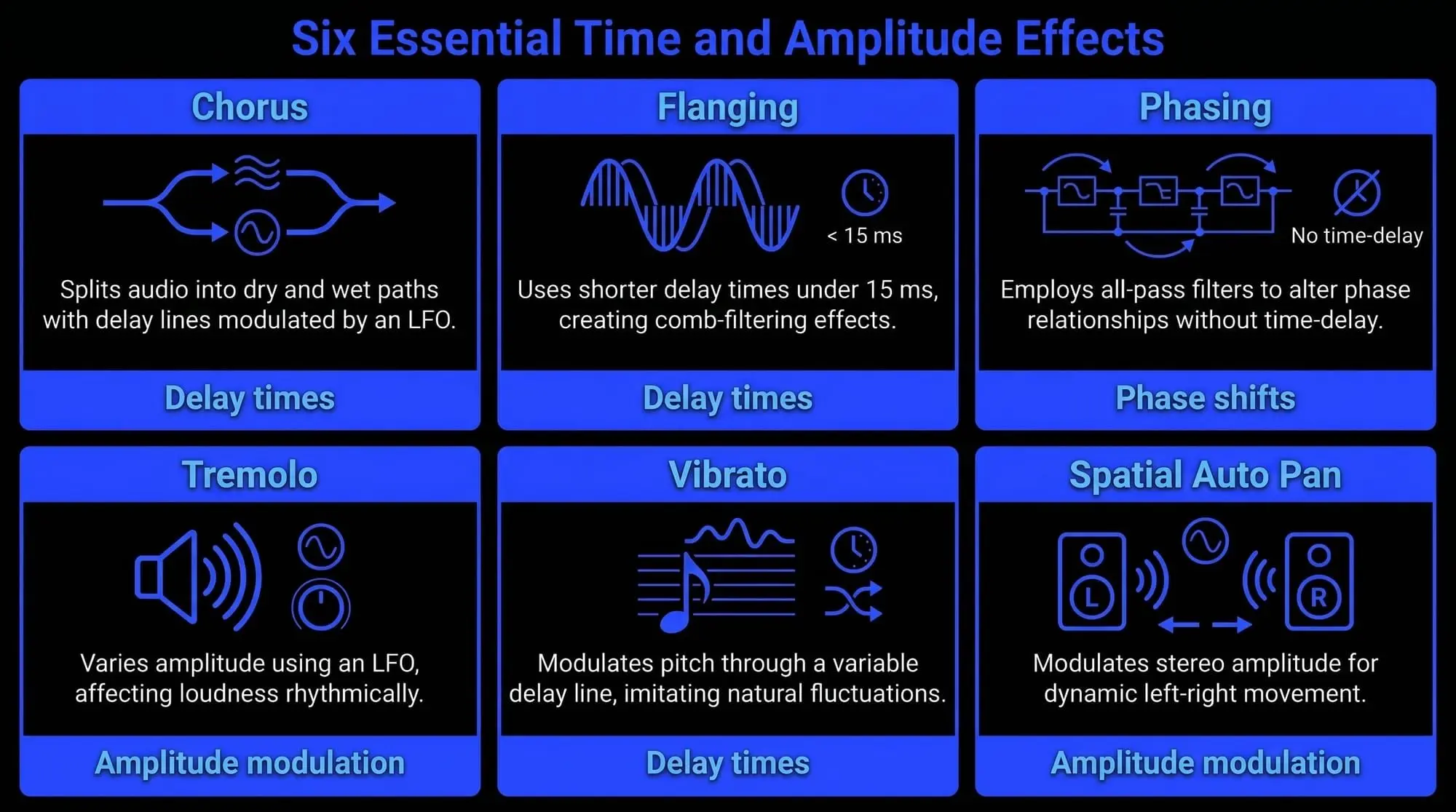
Chorus systems are designed to recreate the natural acoustic phenomenon where multiple musicians play the same part simultaneously but exhibit minute, unavoidable variations in pitch and timing. In the digital realm, a chorus effect splits the incoming audio signal into an unmodulated dry path and one or more wet paths. The wet paths are passed through short, variable delay lines.
The functional layout begins with the primary audio input splitting into a direct dry path and a parallel wet path. This wet path enters a modulated delay line operating between 15 and 35 milliseconds, driven continuously by an LFO. Both paths then meet at a summing component to form the blended output.
The delay time of these wet paths is continuously modulated by a low-frequency oscillator. As the delay time shifts, it induces subtle pitch deviations according to Doppler shift principles. When combined with the dry signal, this creates a thick, shimmering sound that expands the perceived width and density of vocals, guitars, and synthesizers.
2. Flanging Circuits
Flanging circuits operate on a highly similar structural architecture to chorus systems but utilize significantly shorter delay times, usually running under 15 milliseconds. Historically, this effect was discovered in early recording studios by playing two synchronized tape machines simultaneously and manually pressing a finger against the rim, or flange, of one of the tape reels to momentarily slow it down.
Because the delay time is shorter than the wavelength of many audible frequencies, mixing the modulated delayed signal back with the original dry signal causes severe, localized phase cancellations and reinforcements across the frequency spectrum. This creates a series of evenly spaced notches resembling a comb filter. By feeding a portion of the processed output back into the input via a regeneration or feedback loop, the comb-filtering peaks become highly pronounced, generating a distinctive jet-plane sweeping sound.
3. Phasing Processors
Phasing processors, or phasers, achieve a sweeping effect without relying on time-delay circuits. Instead, a phaser splits the audio signal and passes the wet portion through a series of all-pass filters. An all-pass filter does not attenuate frequencies; instead, it alters the phase relationship of the signal across specific frequencies.
The internal signal flow routes the audio input across a split path, where one side travels through a direct dry path and the parallel side passes through a series of all-pass filters modulated by an LFO. These two signals merge at a summing mixer to generate the final phase-shifted output.
When the phase-shifted output is summed back with the original dry signal, frequencies that are 180 degrees out of phase cancel each other out completely, creating asymmetrical notches across the spectrum. An LFO continuously modulates the center frequencies of these all-pass filters, causing the notches to slide up and down the frequency spectrum. This produces a smooth, swirling effect that sounds highly organic and lacks the metallic resonance characteristic of flanging.
4. Tremolo Mechanics
Tremolo mechanics operate strictly within the domain of amplitude manipulation, leaving the pitch and timing of the incoming audio completely untouched. A tremolo effect utilizes an LFO to cyclically vary the gain or volume of an amplifier circuit.
The resulting sound is characterized by a rhythmic pulsing or fluttering in perceived loudness. The texture of the tremolo is determined by the selected LFO waveform shape. Sine or triangle waves generate smooth, undulating volume shifts, characteristic of vintage guitar amplifiers. Square waves produce instantaneous transitions between full volume and total silence, resulting in a hard, stuttering effect widely utilized in modern electronic music production.
5. Vibrato Processing
Vibrato processing serves as the pitch-based counterpart to tremolo. Instead of modulating the volume of an audio signal, a dedicated vibrato processor utilizes an LFO to cyclically modulate the frequency or pitch of the signal.
In the digital domain, this is achieved by passing the audio signal through a variable delay line without mixing any dry signal back into the final output. As the LFO accelerates and decelerates the reading speed of the delay buffer, the pitch fluctuates up and down. This processing simulates the expressive pitch fluctuations naturally executed by classical string players, vocalists, and wind instrumentalists.
6. Spatial Auto Pan Automation
Spatial auto pan automation manipulates the stereo imaging of an audio signal by modulating its amplitude independently across the left and right output channels. This effect utilizes dual modulators operating in a synchronized, anti-phase configuration.
The audio input splits cleanly into two distinct amplification paths. The left channel path features a voltage controlled amplifier modulated by an LFO operating at zero degrees phase. The right channel path features an identical voltage controlled amplifier modulated by an LFO operating at 180 degrees phase, generating a continuous left-to-right movement across the stereo field.
When the LFO signal sent to the left channel amplifier reaches its peak value, the signal sent to the right channel amplifier hits its lowest value. As the LFO cycles, the audio appears to glide smoothly back and forth across the horizontal stereo field. This spatial modulation is highly effective for adding movement to static percussion, background synthesizers, and wide guitar soundscapes.

Theoretical Models of Modulation Synthesis
Amplitude Modulation Mechanics
Amplitude Modulation synthesis, commonly abbreviated as AM synthesis, occurs when the frequency of a modulating oscillator enters the audible spectrum, generally surpassing 20 Hz. Instead of creating a slow volume swell like a tremolo effect, audible AM synthesis generates entirely new frequencies known as sidebands.
In an AM system, a carrier oscillator operating at a specific carrier frequency has its amplitude multiplied by a modulating oscillator operating at a specific modulator frequency. This mathematical multiplication generates two distinct sidebands alongside the original carrier frequency. The upper sideband is located at the carrier frequency plus the modulator frequency. The lower sideband is located at the carrier frequency minus the modulator frequency. The original carrier frequency remains audible in the output, yielding a complex harmonic tone that is widely used to synthesize classic electronic chimes, organs, and evolving percussive timbres.
Frequency Modulation Systems
Frequency Modulation synthesis, or FM synthesis, was popularized in the late 1960s and commercialized in the 1980s. In an FM synthesis architecture, the output of a modulating oscillator is routed to directly alter the frequency of a carrier oscillator, with both waveforms cycling at audible rates.
The signal chain routes a modulator oscillator running at an audible frequency directly into a carrier oscillator. This causes the carrier oscillator to output an FM signal containing highly complex sidebands.
When the modulator frequency enters the audible range, the carrier frequency begins to shift up and down so fast that the human ear perceives it as a single, complex timbre rather than a changing pitch. FM synthesis generates a vast array of sidebands, occurring at intervals determined by the carrier frequency plus or minus the product of an integer and the modulator frequency. By adjusting the ratio between the carrier and modulator frequencies, as well as modulating the amplitude of the modulator over time using an envelope, FM synthesis can produce everything from pristine acoustic bell emulations to aggressive, tearing bass textures.
Ring Modulation Engineering
Ring Modulation engineering represents a specific variant of amplitude multiplication. A ring modulator takes two separate audio signals, traditionally labeled as frequency A and frequency B, and passes them through a specialized diode ring circuit or digital multiplication algorithm that completely suppresses both original input frequencies.
The resulting output contains exclusively the sideband frequencies, which consist of frequency A plus frequency B, and frequency A minus frequency B. Because the primary fundamental carrier tones are erased, the sidebands that remain are often highly inharmonic, meaning they do not conform to standard whole-number harmonic ratios. This gives ring modulation its characteristically harsh, metallic, hollow, and robotic sound, making it a legendary tool for avant-garde sound design, sound effects creation, and sci-fi vocal processing.
Strategic Use Cases for Creators and Engineers
Acoustic and Orchestral Composers
For creators working within classical or acoustic scoring frameworks, understanding the nuances of musical modulation theory is vital for structuring long-form compositions. When scoring a film scene or constructing a symphony, composers use modulation to delineate shifting narrative acts or changing emotional states within characters.
Shifting from a bright major key to its parallel minor via chromatic voice leading can instantly darken a scene, signaling an impending threat without changing the melodic motif. To ensure smooth transitions, orchestral arrangers frequently use common chord modulation, leveraging woodwinds or horns to sustain the pivot harmony before the full ensemble enters in the new key signature.
Electronic Music Producers and Beatmakers
Modern electronic beatmakers rely heavily on step sequencer modulation and LFO configurations to inject analog-style unpredictability into digital environments. In genres such as trap, techno, and future bass, a completely static synthesizer sound quickly loses listener interest.
Producers frequently route a random-wave LFO or a sample-and-hold modulator to a synthesizer filter cutoff or wave position parameter at a very low depth. This ensures that every time a MIDI note triggers, the timbre exhibits subtle, non-repeating variations, mimicking the organic instability of vintage analog hardware. Additionally, utilizing step sequencers to modulate effects sends on specific drum hits allows for highly intricate, rhythmically complex mixing arrangements.
Mixing and Mastering Engineers
For mixing engineers, modulation tools are primarily deployed to address spatial congestion and enhance separation across the stereo field. A major challenge in dense rock or pop mixes is preventing the lead vocal, center-panned guitars, and keyboards from masking one another.
To combat this, an engineer can apply a subtle stereo chorus or a dual all-pass phaser to background keys or rhythm acoustic guitars. This introduces micro-variations in phase and time delay, spreading those elements away from the center toward the far edges of the stereo field. This technique carves out a clear pocket in the center image for the lead vocal and bass elements to sit without requiring aggressive equalization adjustments.
Using ACE Studio to Shape Modulation Ideas in Real Music
Modulation is easier to understand when you can hear it inside a real musical part, not just study it on a staff or diagram. That is where ACE Studio becomes useful for composers, producers, and songwriters who want to test how a key change, vocal lift, instrumental shift, or harmonic transition actually feels.
Instead of treating modulation as a theory exercise, ACE Studio lets you build the musical material around it. You can write a MIDI melody, add lyrics, choose an AI voice, and hear how the vocal responds when the song moves into a new key center. This is especially helpful for direct modulation, chromatic movement, and final-chorus lifts, where the emotional effect depends heavily on the singer’s range, tone, phrasing, and energy.
For example, if a chorus modulates up a whole step, the question is not only whether the harmony works. The real question is whether the performance still feels natural. Does the vocal become brighter without sounding strained? Does the phrase need more breath before the higher entrance? Should the vibrato widen slightly at the peak, or should the line stay clean and direct? ACE Studio gives you control over pitch, timing, vibrato, breath, phonemes, and vocal expression, so you can shape those details instead of accepting a flat generated result.
This matters because modulation changes more than chords. It changes pressure. A phrase that felt relaxed in the original key may feel more urgent after the key shift. A note that sat comfortably before may need a different attack, softer consonants, or a more controlled release. With ACE Studio, you can adjust the performance until the modulation sounds intentional, not accidental.
AI Instruments let you turn MIDI parts into expressive instrumental performances, including strings, saxophones, trumpets, and duduk. That opens practical options for composers working with common chord modulation, sequential modulation, or cinematic key movement. A sustained string harmony can make a pivot chord feel smoother. A trumpet line can make a direct modulation feel bold. A cello or viola part can darken a chromatic transition without adding more harmonic clutter.
The advantage is precision. You are not locked into a static MIDI playback sound while judging whether the modulation works. You can shape articulation, layer parts, and test how the musical movement behaves when performed by more expressive sources. This makes the transition easier to evaluate: the ear hears phrasing, tension, release, and color, not just note names.
ACE Studio can also help when the modulation idea starts from existing audio. With Stem Splitter and Audio to MIDI, you can separate musical material, convert a phrase into editable MIDI, and rebuild it in a new key or with a different voice or instrument. That is useful when a demo has a strong hook but the bridge, final chorus, or outro needs a stronger tonal shift. You can keep the musical idea, then reshape the key center, register, and performance around it.
For producers exploring modulation effects, ACE Studio’s Voice Changer and vocal editing tools offer another practical angle. A vocal line can be transformed into a different character, layered into a choir texture, or used as a creative sound design source. This connects directly with the production side of modulation: chorus-like width, vibrato movement, pitch variation, and spatial layering all become part of how the vocal or instrument occupies the track.
The important point is control. ACE Studio does not decide where the modulation should happen, what key you should move to, or how dramatic the shift should feel. You make those decisions. The software gives you a fast, detailed way to hear the consequences of those choices across vocals, instruments, choirs, stems, and MIDI-based arrangements.
A few practical ways to use ACE Studio when working with modulation include:
- Testing whether a final chorus key change gives the song more lift or simply feels forced.
- Rebuilding a vocal melody in a new key to check range, phrasing, and emotional intensity.
- Using AI strings or brass to support a pivot chord before the new tonic arrives.
- Turning an existing vocal or instrumental phrase into MIDI, then reshaping it for a new harmonic section.
- Creating layered choir parts that make a modulation feel wider, brighter, or more dramatic.
- Comparing different vocal tones to hear which one carries the new key most naturally.
- Adding a fresh instrumental layer to make a bridge or outro feel like a true tonal departure.
Used this way, ACE Studio is not just a vocal generator. It becomes a practical composition and production space for testing how modulation feels when real musical expression is attached to it. You still write the progression, choose the target key, refine the melody, and decide how much tension the listener should feel. ACE Studio simply gives you stronger material to judge those decisions with confidence.
Future Outlook of Algorithmic Modulation Technology
As music technology progresses, modulation processing is expanding beyond simple cyclic LFOs and basic ADSR envelopes. The integration of machine learning and advanced artificial intelligence algorithms is pioneering a new era of adaptive, intelligent modulation tools. Modern software processors can now analyze the spectral fingerprint of an incoming audio stream in real time and automatically generate custom, dynamic modulation curves tailored to the specific rhythmic and harmonic attributes of the performance.
Furthermore, the emergence of multi-dimensional vector modulation networks allows sound designers to map dozens of independent synthesis parameters onto an interactive, multi-axis control grid. This grid can then be driven by behavioral algorithms that simulate complex physical phenomena, such as fluid dynamics, gravitational orbits, or biological colony growth. These technological advances allow sound designers to step away from repetitive linear LFO waves and embrace organic, highly complex parameter variations, continuously pushing the boundaries of what is possible in auditory art.
Frequently Asked Questions
What is the core difference between modulation and transposition?
Modulation refers to an internal structural change of key center that occurs within a single, continuous piece of music. Transposition, conversely, represents the process of shifting an entire composition, section, or track up or down by a fixed interval before a performance or recording begins, usually to accommodate the comfortable pitch range of a specific vocalist or instrument.
Why do some modulation effects cause phase cancellation problems?
Modulation effects such as chorus, flanging, and phasing rely on splitting an audio signal, applying time delay or phase shifts to the wet path, and summing the paths back together. If the delayed or shifted path aligns exactly 180 degrees out of phase with the original dry signal at certain frequencies, those frequencies will completely cancel each other out. While this comb-filtering or notch creation is the exact source of the desired effect, it can severely degrade the punch and clarity of a sound if the effect is applied too aggressively, particularly when the stereo mix is summed down to mono.
How can I make a key modulation feel completely seamless to the listener?
To make a key modulation feel entirely natural and smooth, utilize common chord or pivot modulation techniques. By identifying a chord that exists natively within both the current key signature and the target key signature, you can use that shared harmony as a neutral transition point. Following the pivot chord with a strong cadential progression native to the new key, such as a secondary dominant resolving cleanly to the new tonic, allows the listener brain to accept the scale changes without experiencing a jarring sonic interruption.
Is an LFO audible on its own in a music production project?
Under standard circumstances, a Low Frequency Oscillator is not directly audible on its own because it operates below the human hearing frequency threshold, which starts at 20 Hz. You do not hear the sound wave generated by the LFO itself; instead, you hear the cyclical, automated results of the LFO modifying an audible parameter of another sound source, such as volume, pitch, or filter position. However, if an LFO rate control is accelerated past 20 Hz into the audible audio spectrum, it transitions into an audible modulator, entering the territory of amplitude or frequency modulation synthesis.
What is the difference between tonicization and a true modulation?
Tonicization is a brief harmonic illusion where a composer utilizes a secondary dominant or leading-tone chord to make a non-tonic chord feel like a temporary home base. The primary key signature is never discarded, and the piece immediately returns to its original harmonic structure. A true modulation, by contrast, requires a sustained structural change where the original key signature is abandoned, a new key center is firmly established through authentic cadence structures, and subsequent musical phrases remain anchored to this new scale center for a prolonged duration.