

Key Takeaways
- Mono audio uses one signal path, which makes it clear, focused, and reliable across phones, smart speakers, clubs, PA systems, and other playback environments where stereo width may not translate well.
- Stereo audio uses left and right channels to create width, movement, and depth, making it ideal for immersive listening, ambience, effects, doubled parts, and spatially rich arrangements.
- Phase problems are one of the biggest risks in stereo mixing, especially when wide sounds are collapsed to mono and lose punch, low end, or clarity.
- Core mix elements such as lead vocals, kick drums, bass, and important melodic hooks often work best near the center, while reverbs, delays, harmonies, pads, and supporting layers can create width around them.
- ACE Studio can help producers shape cleaner vocals, harmonies, instruments, and stems before mixing, making it easier to decide which parts should stay mono, which should become stereo, and how to keep the mix strong on every playback system.
Why Mono and Stereo Shape How a Mix Feels, Translates, and Connects
The choice between mono audio and stereo audio is a foundational decision that shapes how an audience experiences a sonic landscape. Far from being a simple toggle switch on a media player or digital audio workstation, the selection between these formats dictates phase relationships, spatial distribution, structural translation across public playback systems, and the overall emotional resonance of a mix.
Understanding the technical nuances of single-channel audio versus multi-channel reproduction is critical to ensuring that your acoustic work retains its clarity, impact, and structural integrity across diverse listening environments. This comprehensive guide delivers an exhaustive analysis of mono and stereo configurations, exploring their historical development, physical principles, engineering applications, electroacoustic dynamics, and future trajectories.
Defining Audio Formats: Core Technical Specifications
To master the application of sound fields, an engineer must first comprehend the foundational physics and technical specifications of mono and stereo sound reproduction.
Fundamentals of Monaural Audio and One-Channel Playback
Monaural audio, widely referred to as mono audio or single-channel audio, is defined by the utilization of a solitary audio signal path. Regardless of the number of microphones used during the initial recording stage or the number of loudspeakers deployed during playback, a mono signal contains no directional variance between channels.
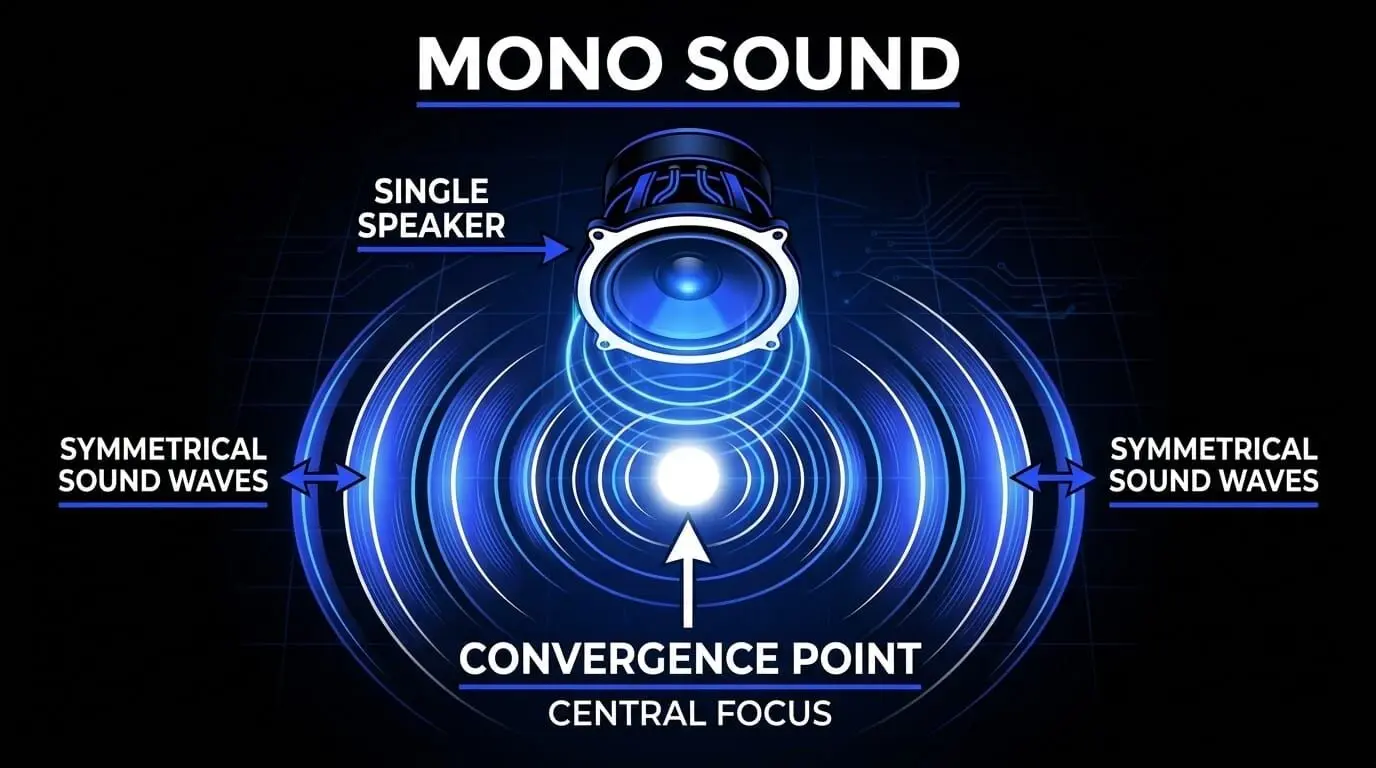
When a mono recording is played through a dual-loudspeaker monitor system, the left and right speakers emit identical acoustic waveforms. This simultaneous, equal acoustic pressure causes the human auditory system to localize the sound source directly in the center of the listening space, an acoustic phenomenon known as the phantom center.
Historically, monaural audio was the sole method available during the infancy of sound reproduction. From Thomas Edison’s early wax cylinders to the lacquer and vinyl discs that dominated the early twentieth century, acoustic energy was transcribed into a single mechanical groove. In a modern context, mono playback remains a crucial benchmark. It represents the lowest common denominator for transmission clarity, serving as the standard for AM radio, public address networks, telecommunications, and smart speakers.
Architectural Dynamics of Stereophonic Sound and Multi-Channel Architecture
Stereophonic sound, or stereo audio, introduces a multi-channel architecture that uses two distinct audio channels. These independent channels allow sound engineers to simulate the natural human listening experience, which relies on binaural hearing to perceive localization, distance, and environmental geometry.
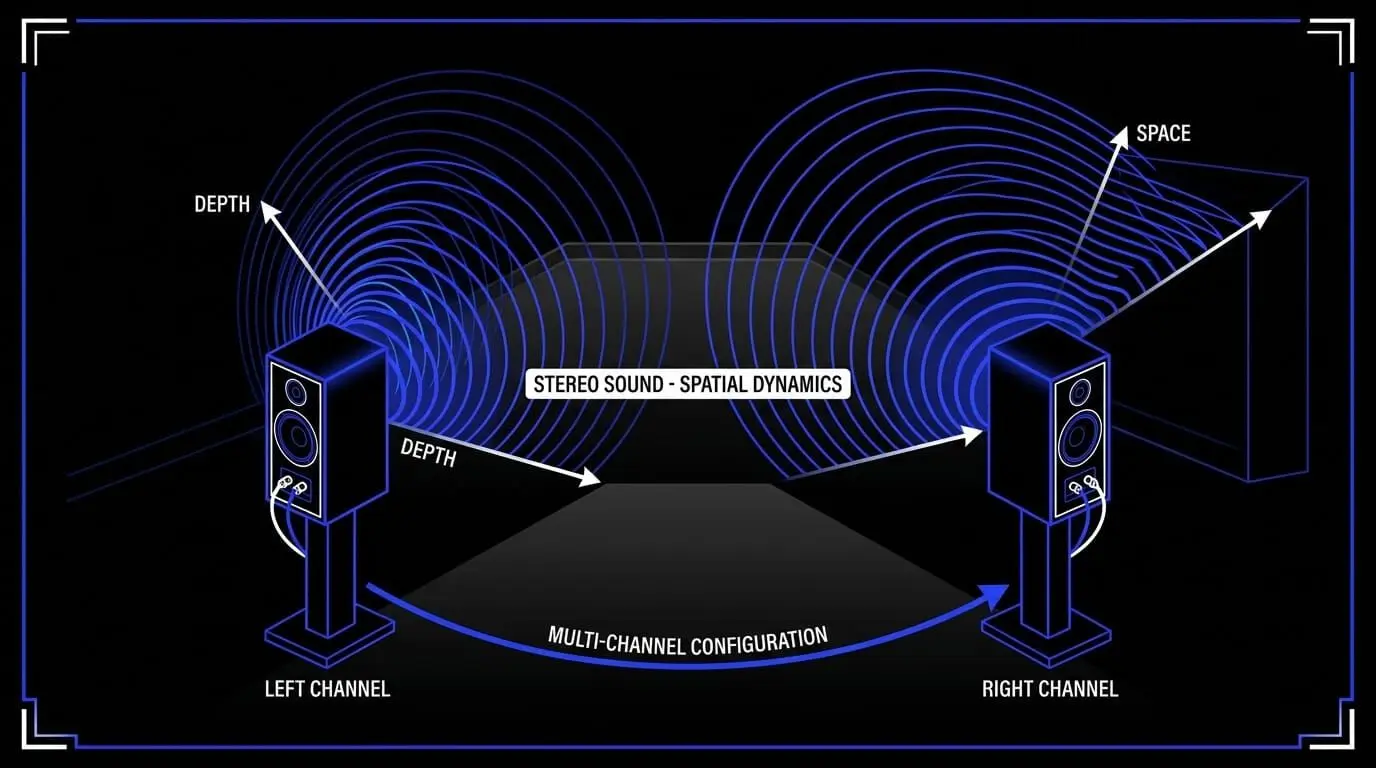
The human brain decodes the position of a sound source by analyzing two primary cues:
- Interaural Time Differences (ITD): The minor variance in time it takes for a sound wave to reach one ear versus the other.
- Interaural Intensity Differences (IID): The variance in amplitude or volume caused by the acoustic shadow of the human head.
Stereo sound systems replicate these natural phenomena by distributing distinct waveforms to the left and right channels. Developed in the 1930s by pioneering British engineer Alan Blumlein at EMI, stereophonic technology revolutionized the industry by allowing a performance to be captured with geometric accuracy. When mixed properly, a stereo field allows an asset to possess an apparent width, height, and depth, transforming a flat point source into an expansive three-dimensional soundstage.
Comparing Mono and Stereo Formats: Technical Analysis
The operational divergence between mono and stereo configurations influences every phase of the audio lifecycle, from initial capture to final consumption.
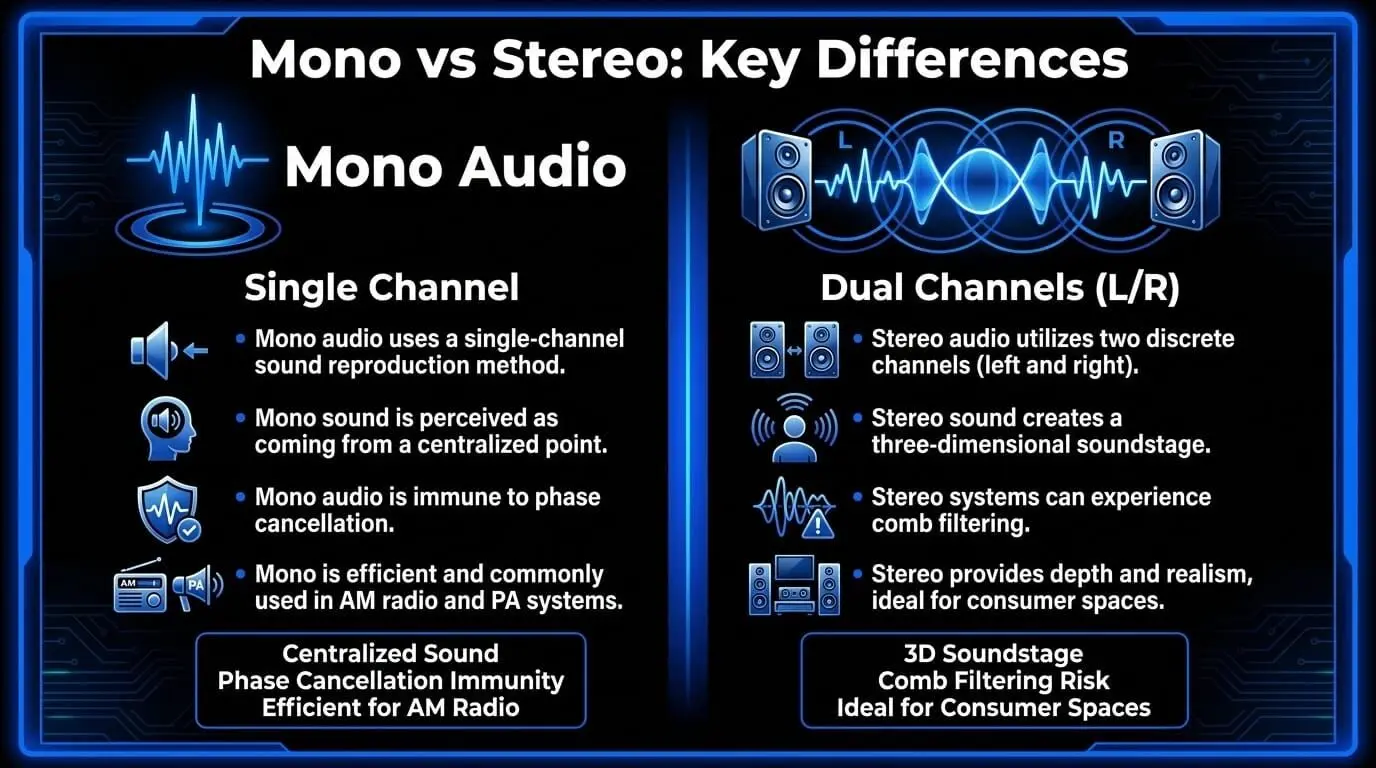
Primary Engineering Differences in Audio Reproduction
The core distinction between the two formats centers on the preservation of spatial localization data. The following technical feature sheet breaks down the key performance indicators that separate these two formats:
| Technical Parameter | Mono Audio Configuration | Stereo Audio Configuration |
| Channel Count | Single distinct signal path | Dual discrete signal paths (Left/Right) |
| Spatial Field | Centered, one-dimensional point source | Broad, three-dimensional soundstage |
| Phase Cancellation Risk | Zero risk of internal phase variance | High risk due to channel summation |
| Data Footprint / Bandwidth | Highly efficient; half the size of stereo | Double the data footprint of mono |
| Sweet Spot Dependency | Minimal; consistent across locations | High; relies on proper listener positioning |
| Primary Focus | Absolute mid-range clarity and punch | Depth, movement, and atmospheric realism |
Phase Correlation, Comb Filtering, and Decorrelation Phenomena
When combining or manipulating multiple audio channels, audio engineers must navigate the laws of phase correlation. Phase refers to the position of a sound wave at a given point in time, measured in degrees from zero to 360. If two identical mono signals are combined completely in phase, their amplitudes sum constructively, resulting in a six-decibel boost in volume. However, if one channel is inverted by 180 degrees, the peaks of one wave align precisely with the troughs of the other, resulting in total phase cancellation and complete silence.
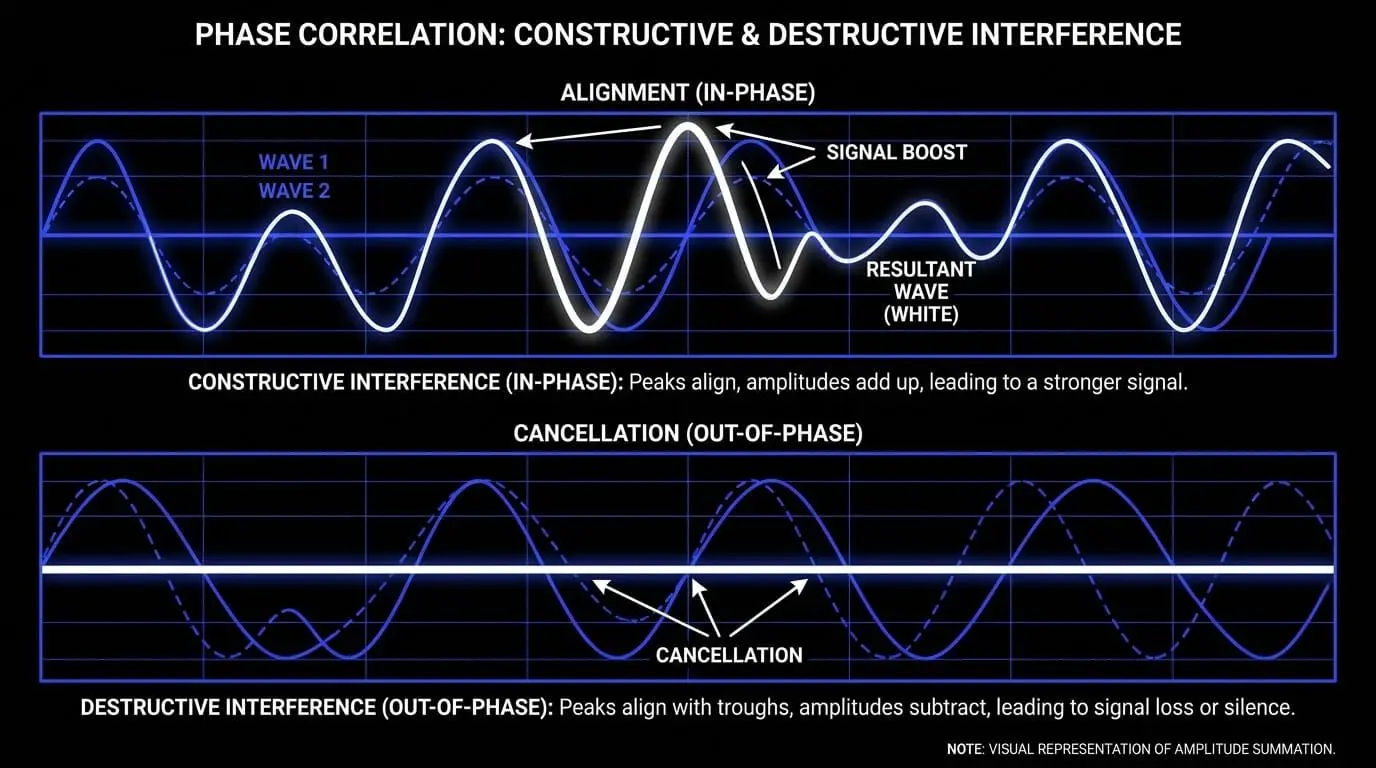
In a stereo track, the differences between the left and right channels can introduce partial phase cancellation when the mix is collapsed into a single channel. This issue is known as comb filtering. Comb filtering occurs when a signal is mixed with a slightly delayed version of itself, creating a series of destructive and constructive interference peaks across the frequency spectrum that resemble the teeth of a comb. This artifacts strips away fundamental low-end frequencies and leaves the mid-range sounding hollow and weak.
To mitigate these issues, sound engineering workflows routinely leverage a correlation meter. This tool measures the phase relationship between channels on a scale from minus one to plus one:
- A reading of plus one indicates a perfect, identical mono relationship.
- A reading fluctuating between zero and plus one indicates a healthy, wide stereo image with acceptable phase coherence.
- A reading dipping below zero toward minus one warns of heavy out-of-phase information, indicating that critical elements will disappear when summed to mono playback systems.
To safely generate width without inducing destructive phase cancellation, engineers utilize spatial decorrelation techniques. Decorrelation involves altering the phase, timing, or frequency distribution of the two channels so they feel distinct to the brain without losing alignment. Examples include using all-pass filters, introducing micro-timing offsets under thirty milliseconds, or applying subtle, complementary equalization adjustments to opposing channels.
Practical Engineering: Recording, Inputs, and Mixing
Implementing mono and stereo concepts correctly within a digital audio workstation (DAW) requires a firm grasp of signal flow, tracking methods, and pan law configurations.
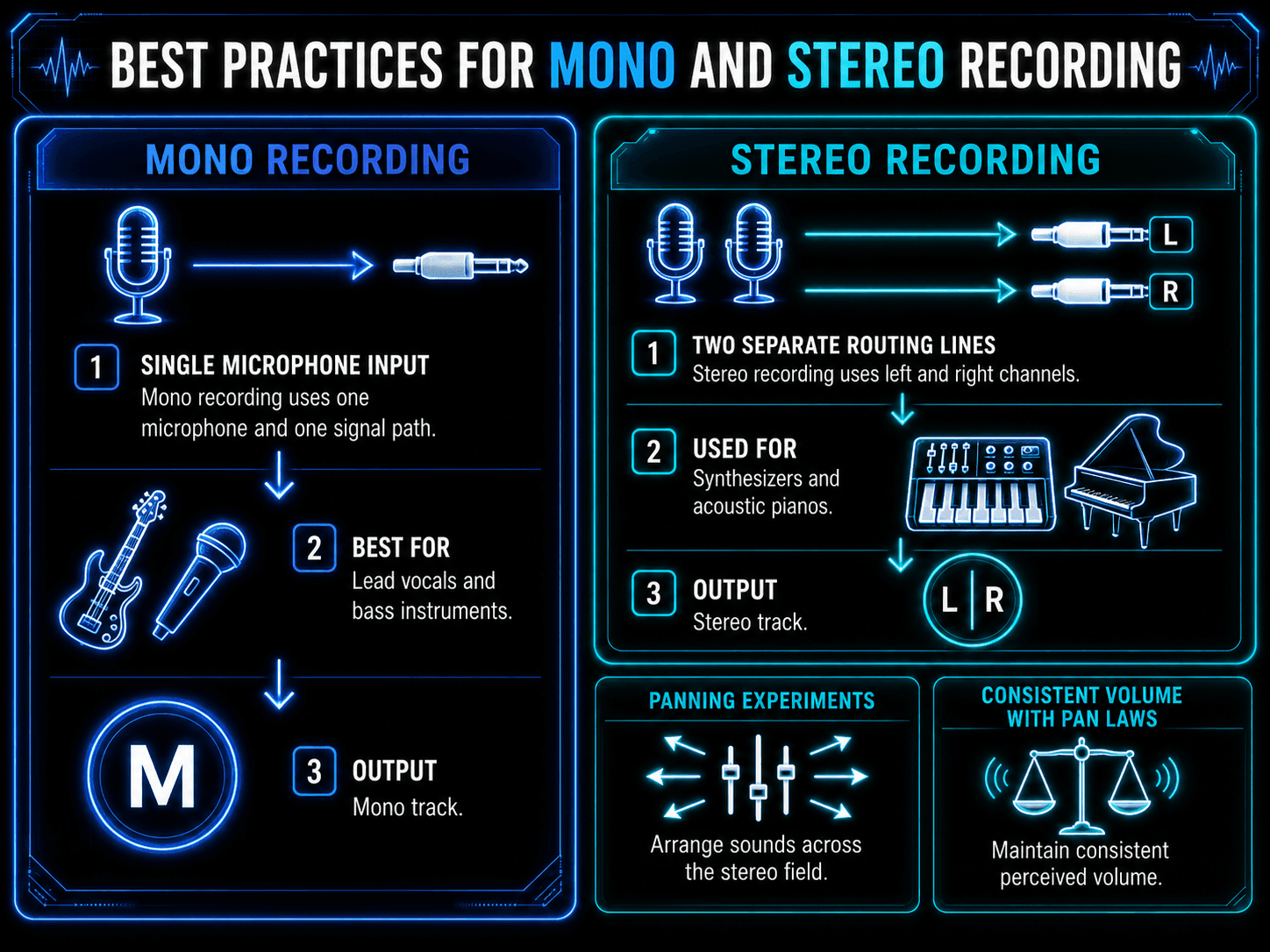
Best Practices for Mono Recording and Lead Isolation
A mono recording is captured using a single microphone routed to a single input channel on an audio interface or mixing desk. This tracking methodology is preferred for capturing isolated sound sources that require pinpoint definition, center-channel authority, and upfront intimacy.
Key applications for mono recording include:
- Lead Vocals: Capturing a vocal performance with a single cardioid or omnidirectional microphone ensures that the lyrical content remains anchored dead center, providing maximum intelligibility.
- Bass Instruments and Kick Drums: Low frequencies possess long acoustic wavelengths that require substantial amplifier power to reproduce. Keeping transient-heavy low-end elements in mono focus preserves valuable headroom in the mix and prevents a disorienting low-end stereo smear.
- Electric Guitar Cabinets: Placing a single dynamic microphone directly in front of a speaker cone yields a precise, hard-hitting transient response that can easily be positioned anywhere across the stereo horizon during the mix phase.
Signal Flow: Understanding Stereo Inputs and Hardware Routing
A stereo input consists of two separate physical or digital routing lines running concurrently. When tracking a stereo source—such as a synthesizer with dedicated left and right outputs, or an acoustic piano captured via an orthogonal pair of condenser microphones—the hardware preamp gains must be perfectly matched to maintain a balanced stereo image.
When these signals enter a DAW, they are handled either as a single stereo interleaved file containing both channels within a single digital container, or as a split mono configuration consisting of two separate audio tracks panned hard left and right. Understanding this path ensures that stereo processors, such as dual-mono compressors or mid-side equalizers, can manipulate spatial data accurately without unintentionally distorting the center image.
Creative Sound Design: Experimenting with Panning and Spatial Width
The process of audio mixing relies heavily on experimenting with panning to arrange sounds across the stereo field, preventing competing frequencies from masking one another. Panning functions by shifting the relative amplitude of a signal between the left and right outputs.
When a sound designer moves a pan pot from the center toward a specific side, the DAW modifies the signal output based on its internal pan law. A pan law dictates how much a signal is attenuated when it passes through the center position. Without a pan law adjustment, a sound panned dead center would sound noticeably louder than when panned hard left or right due to the acoustic summing of two speakers. Standard pan laws apply a compensation drop of minus three decibels or minus four point five decibels at the center to ensure consistent perceived volume as a sound sweeps across the stereo stage.
Advanced Spatial Dynamics: Implementing Effects in a Stereo System
Once a stable mix foundation is established using well-placed mono tracks, engineers can introduce immersive depth by implementing effects using a stereo system. Advanced spatial processors allow a sound stage to expand well beyond the physical boundary of the monitor enclosures.
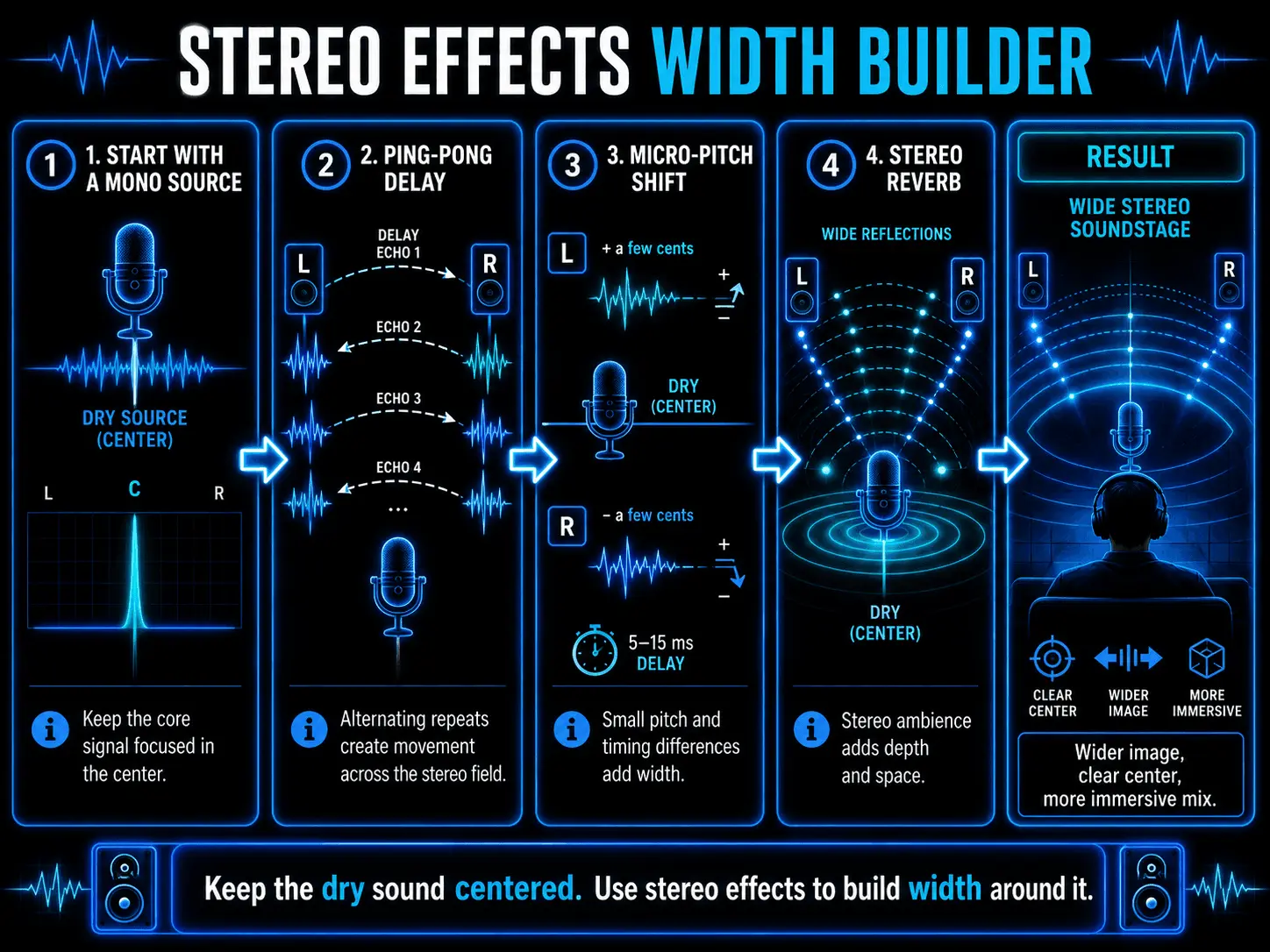
Common techniques for implementing stereo effects include:
- Ping-Pong Delays: Routing a mono source into a delay processor that alternates reflections between the left and right channels creates an engaging sense of horizontal movement.
- Micro-Pitch Shifting: Pitch-shifting the left channel up by a few cents and the right channel down by an equal amount—while applying a tiny delay of five to fifteen milliseconds—generates a thick, wide chorus effect that keeps the center clear for lead elements.
- Algorithmic and Convolution Reverbs: Sending a dry, focused mono tracking into a stereo reverb return generates realistic acoustic reflections, simulating the early reflections and late decay characteristics of physical environments like concert halls or stone cathedrals.
How ACE Studio Helps You Decide What Belongs in Mono or Stereo
A strong mono vs stereo decision starts before panning. It starts with the part itself.
If a vocal line, bass movement, string phrase, or harmony stack is unclear at the source, widening it will not fix the problem. It may only make the part feel bigger for a moment, then weaker when the song plays through a phone speaker, club system, mono PA, or social media clip. This is where ACE Studio gives producers a practical advantage: it lets you shape the musical part before you decide where it should live in the stereo field.
For lead elements, ACE Studio is useful because it keeps the performance editable. A lead vocal created from MIDI and lyrics can be refined note by note, with control over pitch, timing, pronunciation, breath, vibrato, and emotional delivery. That matters because lead vocals usually need to stay centered. In a mono vs stereo mix, the lead should not depend on width to feel present. It should already carry its weight as a focused, stable performance.
The same idea applies to AI instruments. If you create a cello line, brass phrase, violin counter-melody, or instrumental hook in ACE Studio, you can shape the notes, articulation, and expression before treating the sound as a stereo object. A single melodic line may work better near the center, especially if it supports the vocal or bass. A wider ensemble part can sit around the edges, adding lift without pulling attention away from the song’s core.
ACE Studio also helps when you are studying an existing mix. With Stem Splitter, you can separate a track into vocals, drums, bass, piano, guitar, and other parts, then listen to what actually holds the center. This is especially useful for producers learning why some records feel wide but still hit hard in mono. Often, the width comes from supporting layers, while the emotional and rhythmic weight remains centered.
ACE Studio does not make the mono or stereo decision for you. It gives you cleaner, more flexible source material so you can decide with confidence. You can build the lead, support it with harmonies or instruments, check how the arrangement holds together, then export the parts you need for final balancing. The result is not just a wider mix. It is a mix where the center stays strong and the stereo field has a clear purpose.
Electroacoustics: Transducers, Systems, and Live Environments
To fully understand how audio is reproduced, we must bridge the gap between digital software signals and physical speaker hardware.
How Does a Loudspeaker Function? Electroacoustic Foundations
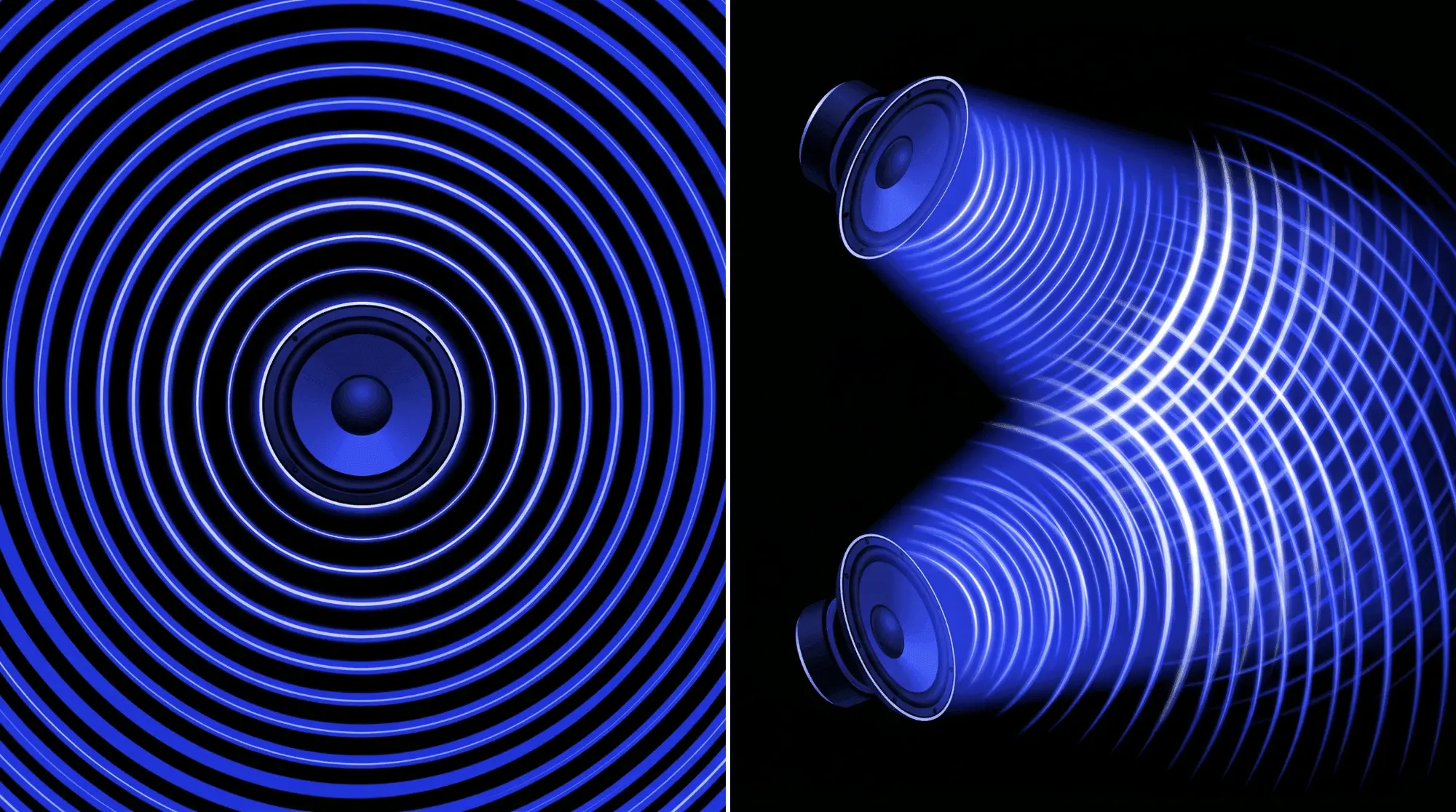
At its core, a loudspeaker is an electroacoustic transducer designed to convert an alternating electrical current into mechanical kinetic energy, which displaces air molecules to create sound waves.
The conversion process follows a clear sequence:
- The audio signal travels from an amplifier into the speaker voice coil, which is an insulated wire wound around a cylindrical bobbin.
- This voice coil is suspended within a magnetic field generated by a powerful permanent magnet.
- As the alternating current fluctuates in polarity and amplitude, it induces a shifting electromagnetic field around the voice coil, causing it to be pushed or pulled away from the permanent magnet.
- The voice coil is attached directly to a flexible speaker cone, or diaphragm. As the coil moves, the cone vibrates backward and forward, compressing and rarefying the surrounding air to produce audible sound waves.
Loudspeaker Configuration: Single Drivers vs. Dual Arrays
A sound system can range from a single driver unit enclosed in an isolated chassis to complex dual-monitor configurations. A single speaker driver is inherently monaural; it can only reproduce a single summed electrical signal. In contrast, standard studio monitor arrays consist of two separate speaker cabinets placed in an equilateral triangle relative to the listener’s head. This layout ensures that the left and right signals arrive at the listener's ears at the same time, maintaining accurate spatial imaging.
Speaker Impedance 101: Demystifying Electrical Ohms
When configuring sound systems for home or studio use, understanding speaker impedance is vital to prevent hardware damage and maximize audio quality. Impedance, measured in ohms, is the total electrical resistance a speaker offers to the alternating current delivered by an audio amplifier.
Impedance is not a static value; it changes based on the frequency of the audio signal. Standard consumer and professional speakers are rated at nominal values, typically four ohms, eight ohms, or sixteen ohms.
- Operating a low-impedance speaker (such as a four-ohm driver) requires an amplifier capable of supplying substantial electrical current.
- If an engineer connects a four-ohm speaker to an amplifier designed exclusively for an eight-ohm load, the speaker will draw more current than the amplifier can safely handle. This strains the output stage, causing thermal buildup, harmonic distortion, and eventual component failure.
- Matching speaker ohms accurately ensures maximum power transfer, clean transient response, and a stable frequency range.
Sound Reinforcement: Challenges and Solutions in Live Performance Venues
While stereo setups are preferred for consumer listening, live sound reinforcement in large commercial spaces, sports arenas, and outdoor music festivals presents a completely different set of acoustic challenges.
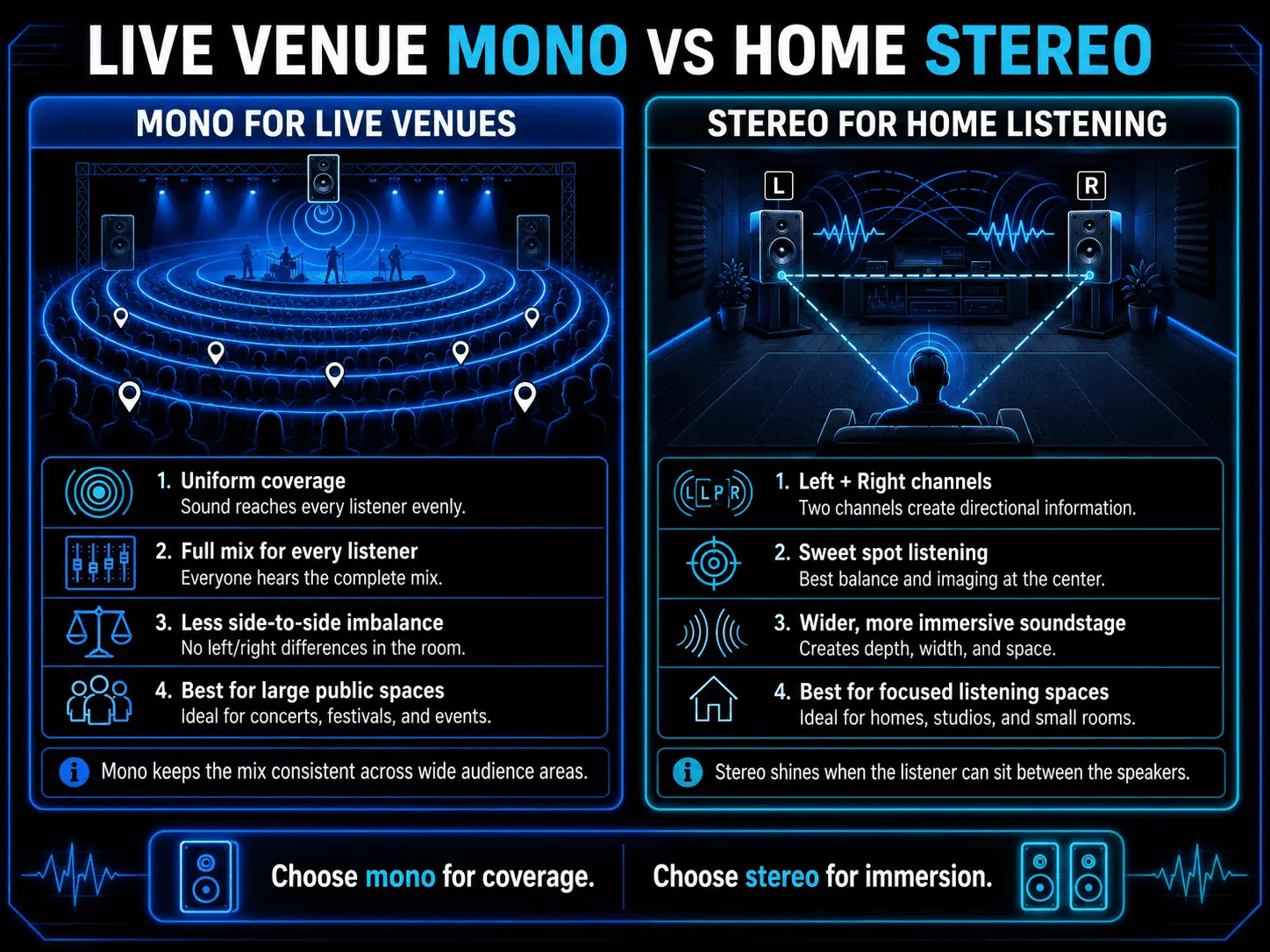
In a home or studio setting, the listener sits directly in the sweet spot between two speakers. In a massive live concert venue, however, the audience is distributed across a large floor area. If a live sound engineer mixes a concert in true stereo—panning guitar tracks hard left and keyboard tracks hard right—an audience member standing on the left side of the venue will only hear the guitars, missing out on the keyboards entirely.
Furthermore, large architectural spaces introduce long acoustic arrival times. A stereo signal reflecting off distant concrete walls can cause phase cancellation and time-alignment issues across the room. To combat these environmental limitations, professional live sound networks are almost always configured to deliver a mono audio mix. Summing the entire mix to a centralized mono network ensures that every audience member enjoys a balanced frequency response and equal volume, regardless of their location on the floor.
Format Evolution: Beyond Two Channels
Audio consumption continues to evolve beyond traditional single and dual-channel formats, driven by advancements in digital processing.
Multi-Dimensional Audio: Stereo Reproduction vs. Surround Sound Systems
Traditional stereo reproduction creates a horizontal soundstage directly in front of the listener. Surround sound systems expand this field by adding discrete audio channels behind and beside the audience.
The most common surround format is a 5.1 configuration, which uses:
- Three front channels (Left, Center, Right) to handle on-screen action and centered dialogue.
- Two surround channels (Left Surround, Right Surround) to reproduce ambient environmental noises and directional panning effects.
- One Low-Frequency Effects (LFE) channel (the point-one) dedicated to driving a subwoofer for low-end punch.
Advanced formats like 7.1 introduce two additional rear surround channels to further smooth out spatial transitions behind the listener.
Next-Generation Audio Formats: Spatial Audio vs. Dolby Atmos Technology
The modern frontier of sound engineering has shifted from channel-based setups to object-based immersive audio formats, spearheaded by spatial audio and Dolby Atmos technology.
| Feature | Channel-Based Stereo / Surround | Object-Based Dolby Atmos / Spatial Audio |
| Routing Basis | Fixed target speakers (e.g., Left, Right) | Dynamic audio objects placed in 3D space |
| Height Dimension | Limited to a horizontal plane | Fully supports overhead height channels |
| System Scalability | Rigid; requires specific speaker layouts | Highly scalable; adapts to any speaker array |
| Metadata Reliance | Low; relies on simple channel amplitude | High; metadata dictates real-time rendering |
In a traditional stereo or surround workflow, an engineer pans a sound directly to a specific channel speaker. In a Dolby Atmos environment, the engineer treats an audio track as an independent audio object located within a continuous three-dimensional hemisphere. Each object contains real-time spatial metadata that describes its coordinate position, velocity, and perceived size.
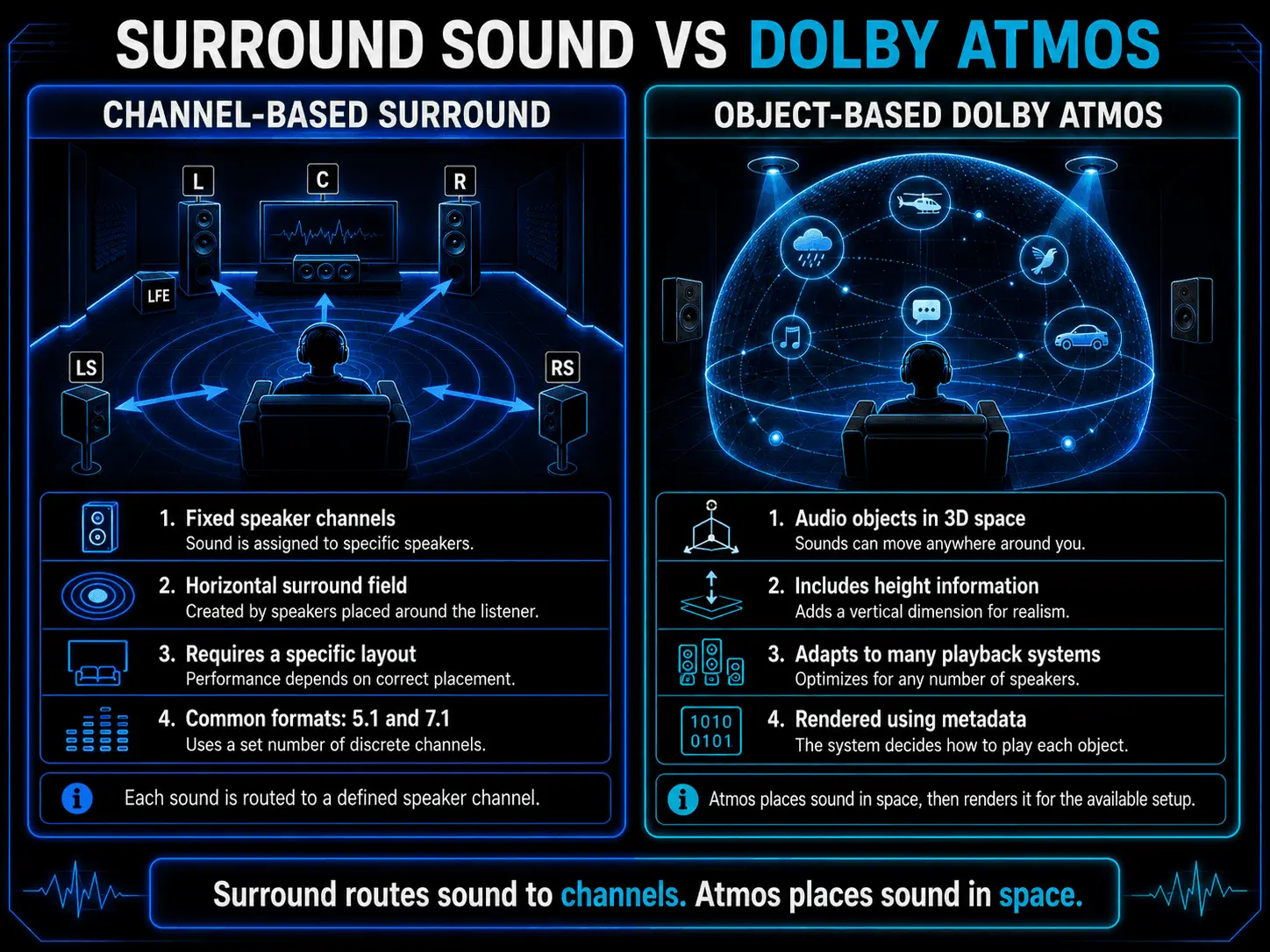
When this file is played back, the local Dolby Atmos decoding processor reads the metadata and renders the audio in real time based on the available speaker layout. Whether the consumer is listening on a 22.2 channel theater array, an overhead-equipped soundbar, or a pair of standard headphones utilizing binaural head-tracking spatial audio algorithms, the file scales down intelligently to provide an immersive experience.
Environmental Optimization: Selecting Equipment for Production and Playback
Achieving professional results requires selecting and positioning audio equipment tailored to your specific environment.
Choosing the Optimal Sound System for Studio and Live Environments
For audio creators, selecting studio monitors requires flat-frequency response drivers that do not artificially boost bass or treble frequencies. Studio monitors should use bi-amplified designs, where separate internal amplifiers power the low-frequency woofer and high-frequency tweeter independently. This architecture minimizes intermodulation distortion and preserves clean transient responses.
When setting up your listening space:
- Position your monitors to form an exact equilateral triangle with your mixing seat.
- Ensure the tweeters sit at ear level to prevent high-frequency roll-off.
- Decouple the speaker enclosures from your desk using isolation pads to prevent physical bass resonances from muddying your low-end.
- Address room acoustics by placing bass traps in corners and acoustic absorption panels at primary reflection points to control comb filtering within the room.
Consumer Playback: Finding the Ideal Speakers for Your Home Architecture
For home consumers, finding the right speakers depends on how the room will be used. For multi-room spaces, kitchens, or patios where people move around constantly, a monaural omnidirectional smart speaker is often the best choice, as it distributes clear, uniform sound across the entire room.
For dedicated living rooms, home theaters, or listening areas, a high-quality stereo or multi-channel setup is ideal. When shopping for home audio equipment, always check the speaker impedance and power handling ratings against your receiver or amplifier specifications. Investing in speakers with high sensitivity ratings—measured in decibels per watt at one meter—ensures that your system delivers clean, dynamic range without distortion, even at lower amplification levels.
Frequently Asked Questions
Why do some vintage recordings sound completely separated in stereo?
During the early days of multi-track recording in the 1960s, hardware mixing consoles were primitive and often featured simple three-way selector switches instead of variable pan pots. Engineers could only route an instrument hard left, dead center, or hard right. This led to famous vintage stereo mixes—such as early albums by The Beatles—where the drums and bass are panned entirely to one channel while the vocals sit entirely in the opposite channel.
How can I verify if my stereo mix is mono compatible?
The most reliable method is to insert a utility or gain plugin on your DAW master output bus that allows you to sum the entire output signal to mono. Toggle this switch frequently during your mixing workflow. If you notice that your lead vocals drop significantly in volume, or your rhythm guitars lose their low-end punch when summed to mono, open your channel correlation meters to identify and correct phase alignment issues.
Does mono audio save data storage space compared to stereo?
Yes. A mono digital audio file only needs to record a single channel of sample data, making its file size exactly half that of a standard stereo interleaved file encoded at the same bit depth and sample rate. This efficiency makes mono compression formats highly valuable for podcasts, voiceover archives, and telecommunications networks where bandwidth usage must be minimized.
What is the difference between true stereo and joint stereo encoding?
True stereo encodes the left and right channels as two completely separate streams of data. Joint stereo is a data-rate reduction technique used in formats like MP3 and AAC. It exploits the fact that the two channels often share identical information. Joint stereo combines common frequencies into a single summed channel, while storing the differences between channels in a separate, lower-bandwidth stream, shrinking the overall file size without causing significant loss in spatial width.
Can a single speaker deliver a true stereo listening experience?
A single speaker chassis containing only one driver unit cannot deliver true stereo because it cannot physically separate the left and right signals. However, some premium standalone consumer speakers house multiple angled drivers alongside digital signal processing chips. These systems use phase manipulation and wall reflections to bounce sound waves around the room, creating an artificial illusion of stereo width from a single enclosure.
Why do club subwoofers always run in mono?
Low frequencies below eighty hertz are omnidirectional, meaning the human ear cannot easily identify where they are coming from in space. Because stereo imaging is ineffective at these low frequencies, and because splitting bass across separate channels can introduce destructive phase cancellation on a large dancefloor, venue sound designers route all low-end signals to a summed mono subwoofer matrix. This ensures maximum acoustic impact and consistent low-end energy across the entire club.