
Rhythm forms the foundational scaffolding of all musical expressions. Across every genre, from classical orchestral masterpieces to modern electronic dance music productions, the organization of sonic events over a temporal axis determines how a piece moves, breathes, and communicates with the listener. At the core of this structural framework lies the time signature, a critical element of musical notation that codifies temporal relationships for performers, composers, and audio engineers alike.
Developing an advanced comprehension of musical time and rhythmic categorization is essential for any serious music creator. This comprehensive guide breaks down the structural, musicological, and technological dimensions of time signatures, offering actionable insights for contemporary studio environments.
Key takeaways
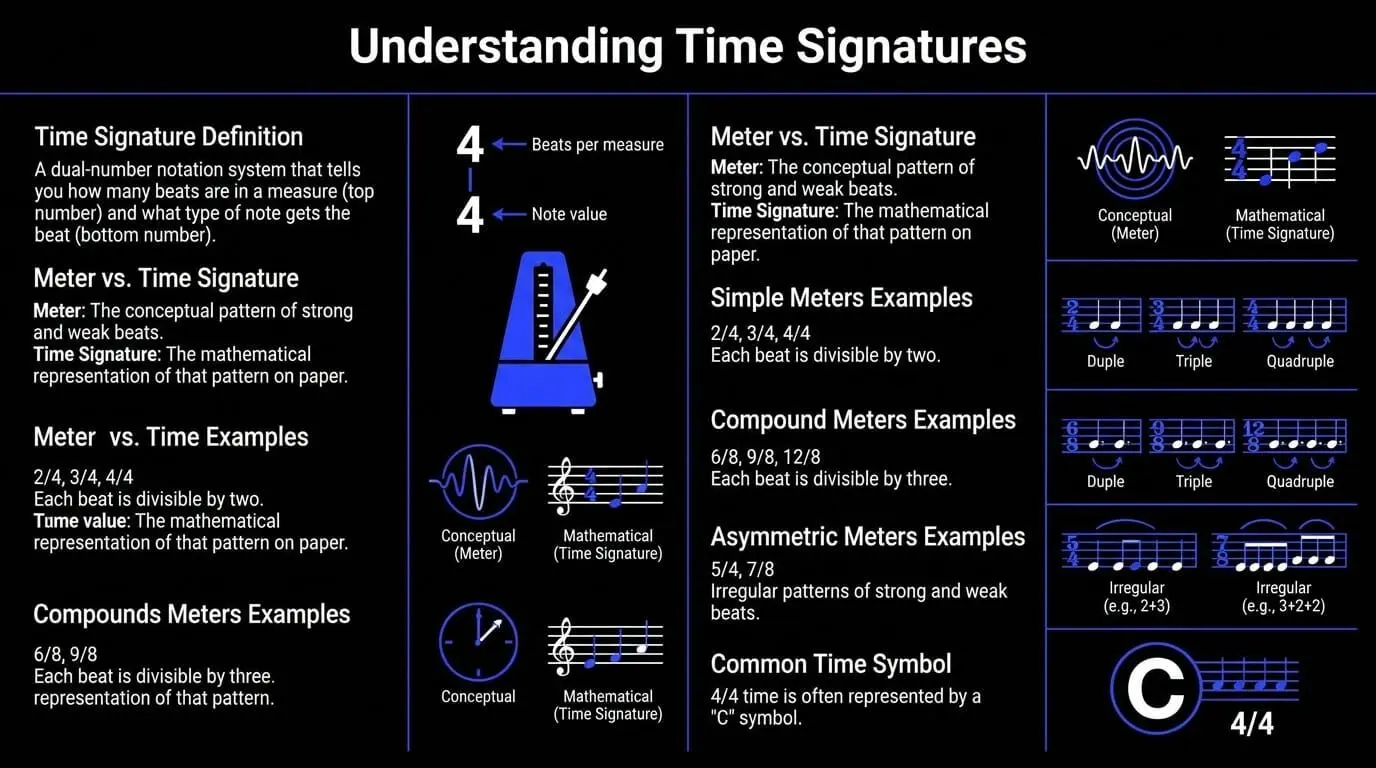
- A time signature tells musicians and producers how many beats are in each measure and which note value receives the beat.
- Meter and time signature are related, but not identical: meter describes the felt pattern of strong and weak pulses, while the time signature shows that pattern in written or digital form.
- Simple meters like 2/4, 3/4, and 4/4 divide each beat into two parts, while compound meters like 6/8, 9/8, and 12/8 divide each main beat into three parts.
- Odd meters such as 5/4 and 7/8 create rhythmic tension because their beat groupings feel less predictable than standard 4/4 patterns.
- In music production, choosing the right time signature affects DAW grids, quantization, click tracks, MIDI programming, vocal phrasing, and the overall feel of an arrangement.
Defining the Mechanics of Musical Time
To understand the function of a time signature, one must first isolate the core components of temporal organization in music theory. The human perception of sound relies heavily on identifying recurring patterns. Without a structural reference point, a sequence of musical pitches remains floating, lacking the momentum required to drive a composition forward.
Defining Rhythm and Musical Time
The broader concept of rhythm in music refers to the placement of sounds and silences over the passage of time. Musical time is not merely a chronological measurement tracked in minutes and seconds; it is a relative psychological experience shaped by tempo, note duration, and stress patterns.
Within this space, the time signature definition can be articulated as a standardized typographic symbol placed at the initiation of a musical staff—or embedded within a digital timeline—to dictate the structural framework of successive measures. It partitions the continuous flow of time into predictable, manageable segments known as bars or measures. By doing so, it provides a stable environment where musical motifs can be contextualized.
The Core Function of Time Signatures in Music Theory
In traditional music theory, the time signature establishes the underlying grid. It informs the performer how to group notes and where to place natural structural accents. Every composition relies on a hierarchy of dynamics; certain beats naturally carry more weight than others. The placement of these primary and secondary accents is dictated entirely by the chosen metric structure.
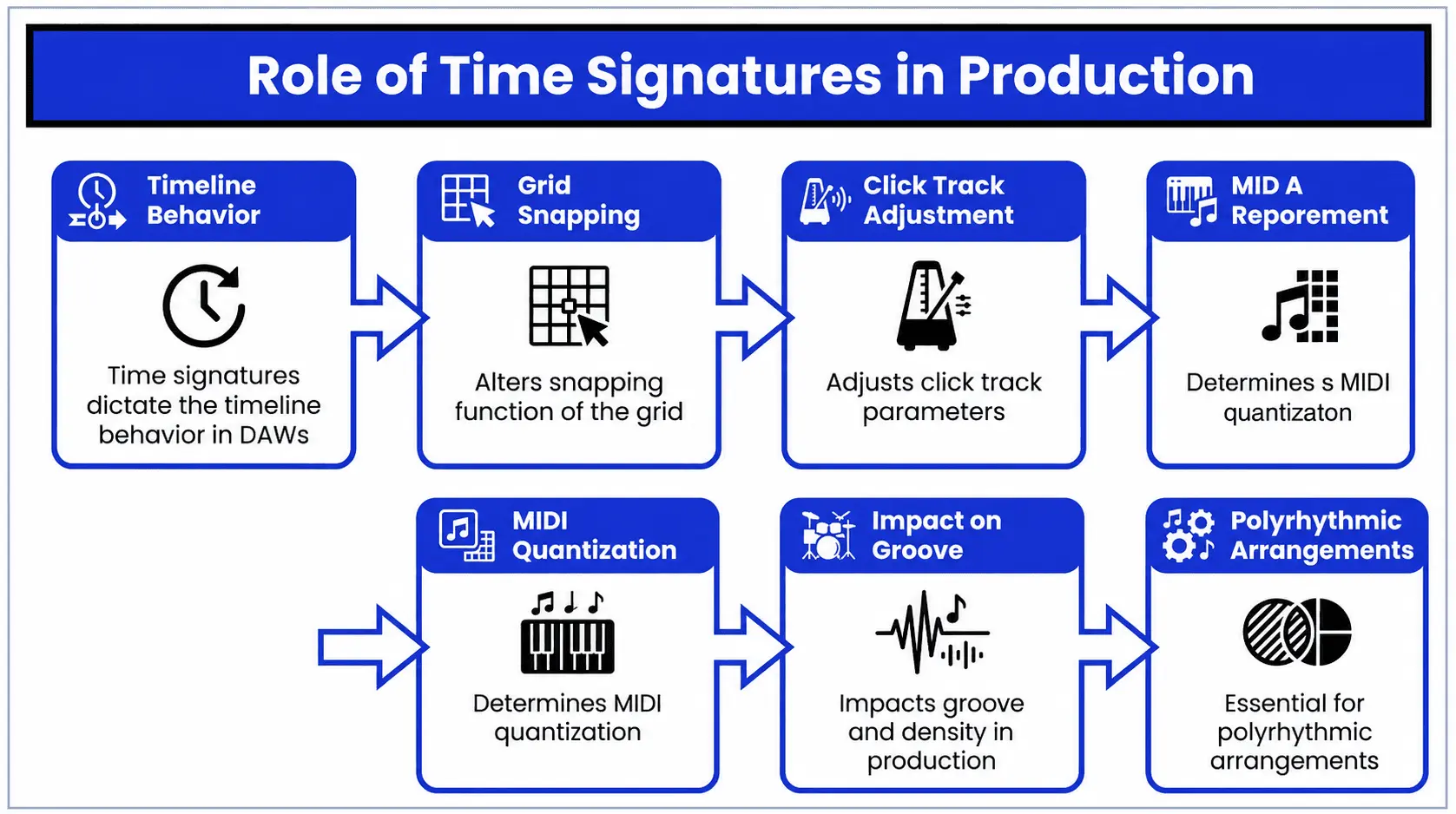
For the modern music producer operating entirely within a digital environment, the time signature dictates the behavior of the timeline. It alters the snapping function of the grid, adjusts the click track parameters, and determines how MIDI data behaves during quantization processes. Selecting a time signature is one of the most consequential decisions made during the pre-production phase, as it fundamentally dictates the groove, density, and formatting of the entire track.
Deconstructing the Numbers: How to Interpret Rhythmic Notation
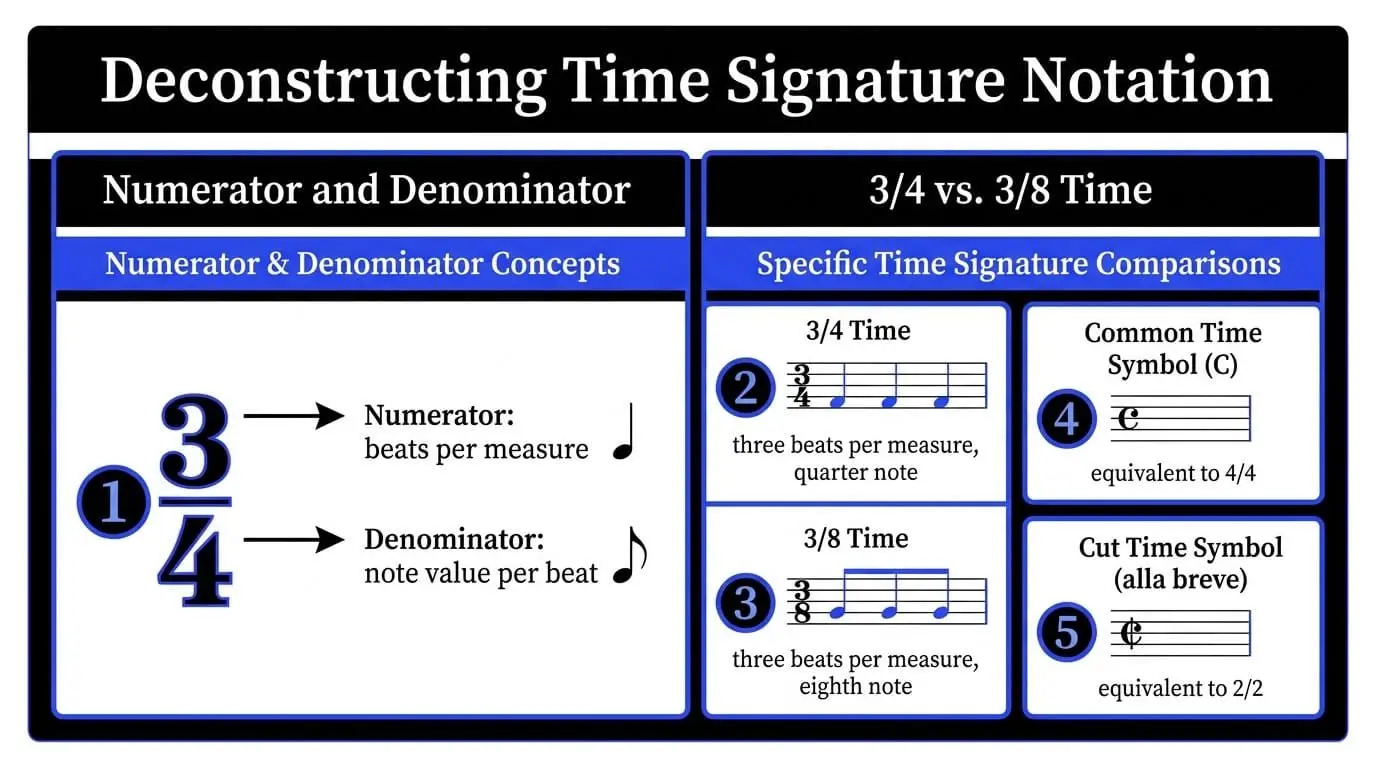
A standard time signature consists of two numbers stacked vertically on top of one another. Unlike a mathematical fraction, there is no horizontal line separating these digits, and they must not be interpreted as fractional values of a whole. Instead, each number operates independently to convey a unique piece of structural data regarding the beats per measure and note durations.
The Numerator: Quantifying Beats per Measure
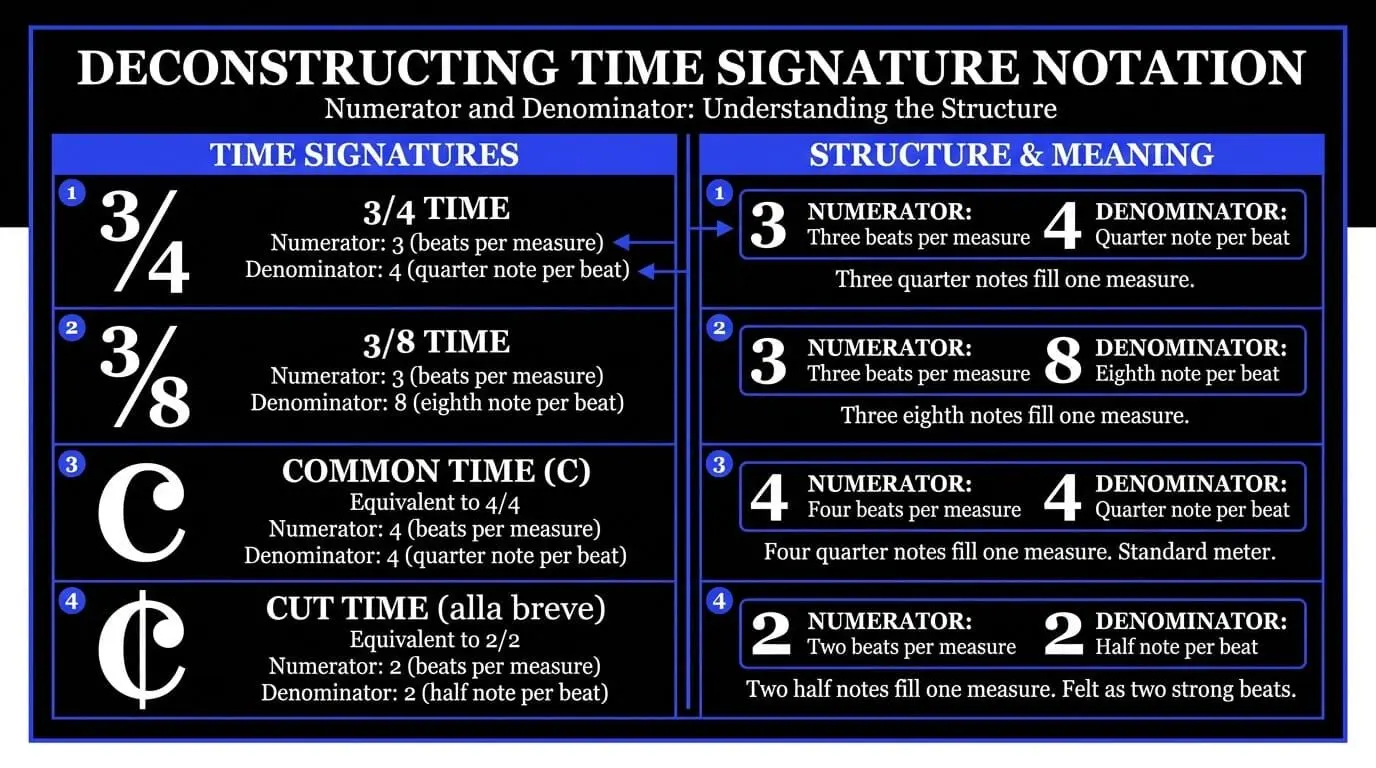
The top number of the signature is the numerator. Its sole function is to declare the exact quantity of pulses contained within a single isolated measure. If the numerator is a four, every bar must contain precisely four units of time before a barline indicates the start of the next structural block. If the numerator shifts to a three, the duration of the bar shrinks to accommodate only three units. The top number can theoretically range from one to double digits, depending entirely on the complexity of the rhythmic patterns being executed.
The Denominator: Determining Note Values
The bottom number, or denominator, identifies the specific class of note value assigned to represent one individual pulse. This value is derived from a subdivision of a whole note.
- A denominator of 2 represents a half note.
- A denominator of 4 represents a quarter note.
- A denominator of 8 represents an eighth note.
- A denominator of 16 represents a sixteenth note.
Therefore, when analyzing a 3/4 time signature, the numbers indicate that each measure contains exactly three beats, and each of those beats is equivalent to the duration of one standard quarter note. If the signature is adjusted to 3/8, the measure still contains three distinct beats, but the structural unit tracking those pulses shifts to an eighth note. This technical shift completely changes how the music looks on a page of standard musical notation and alters how a digital audio workstation (DAW) indexes its timeline ruler.
Alternate Graphic Symbols for Standard Notation
In historical and modern notation, creators frequently encounter stylistic shorthand symbols that replace the standard stacked numerical configurations. These alternate time signature symbols carry precise regulatory meanings rooted in centuries of western notation development.
The symbol resembling a capital letter C is universally recognized as common time. This is a direct substitute for the 4/4 time signature, which remains the most dominant metric structure in contemporary popular music.
When this symbol is bisected by a vertical line, it indicates cut time, historically referred to as alla breve. Cut time represents a 2/2 time signature. While a bar of cut time contains the same total rhythmic duration as a bar of 4/4 time (four quarter notes equal two half notes), the underlying metric pulse changes. Instead of counting four distinct quarter-note steps, the performer tracks two broader half-note pulses per measure. This effectively shifts the primary weight accents and alters the felt momentum of the arrangement, making it highly effective for fast-tempo compositions like marches, orchestral allegros, and fast-paced musical theater numbers.
Understanding Musical Meter and Beat Patterns
A frequent point of confusion among developing musicians and self-taught producers is the conflation of a time signature with a musical meter. While closely linked, they describe two distinct layers of rhythmic architecture.
The Distinction Between Time Signatures and Meter
Meter is the abstract, conceptual system of recurring patterns of strong and weak pulses that shapes human perception of a rhythm. It is the psychological phenomenon that causes a listener to tap their foot or nod their head in a predictable pattern. A time signature, by contrast, is the concrete typographic tool used to encode that specific meter into written form.
For example, a composer might wish to write a piece utilizing a triple meter—a recurring cycle of one strong pulse followed by two weaker pulses. To realize this meter in music, the composer has multiple options. They can implement a 3/4 time signature, a 3/8 time signature, or even a 3/2 time signature. The choice of signature alters the visual notation and the resolution of the grid, but the macro-level behavior of the triple meter remains identical across all three configurations.
Classification by Beat Groupings: Duple, Triple, and Quadruple Meters
Meters are classified scientifically based on the number of primary pulses that occur within a single metric cycle. These macro-level groupings dictate the fundamental conducting time patterns utilized by ensemble leaders to guide live performers.
- Duple Meter: Consists of a two-beat metric cycle. The accent pattern follows a strict strong-weak format. It mimics the natural bipedal locomotion of human walking (left-right, left-right).
- Triple Meter: Consists of a three-beat metric cycle. The accent pattern follows a strong-weak-weak format. This structure provides a cyclical, rotating sensation that prevents the music from feeling overly linear.
- Quadruple Meter: Consists of a four-beat metric cycle. The structural accent pattern is typically arranged as strong-weak-secondary strong-weak. This format offers a balanced framework, making it the preferred choice for regular groove stabilization across global dance and popular music styles.
Categorizing the Primary Types of Time Signatures
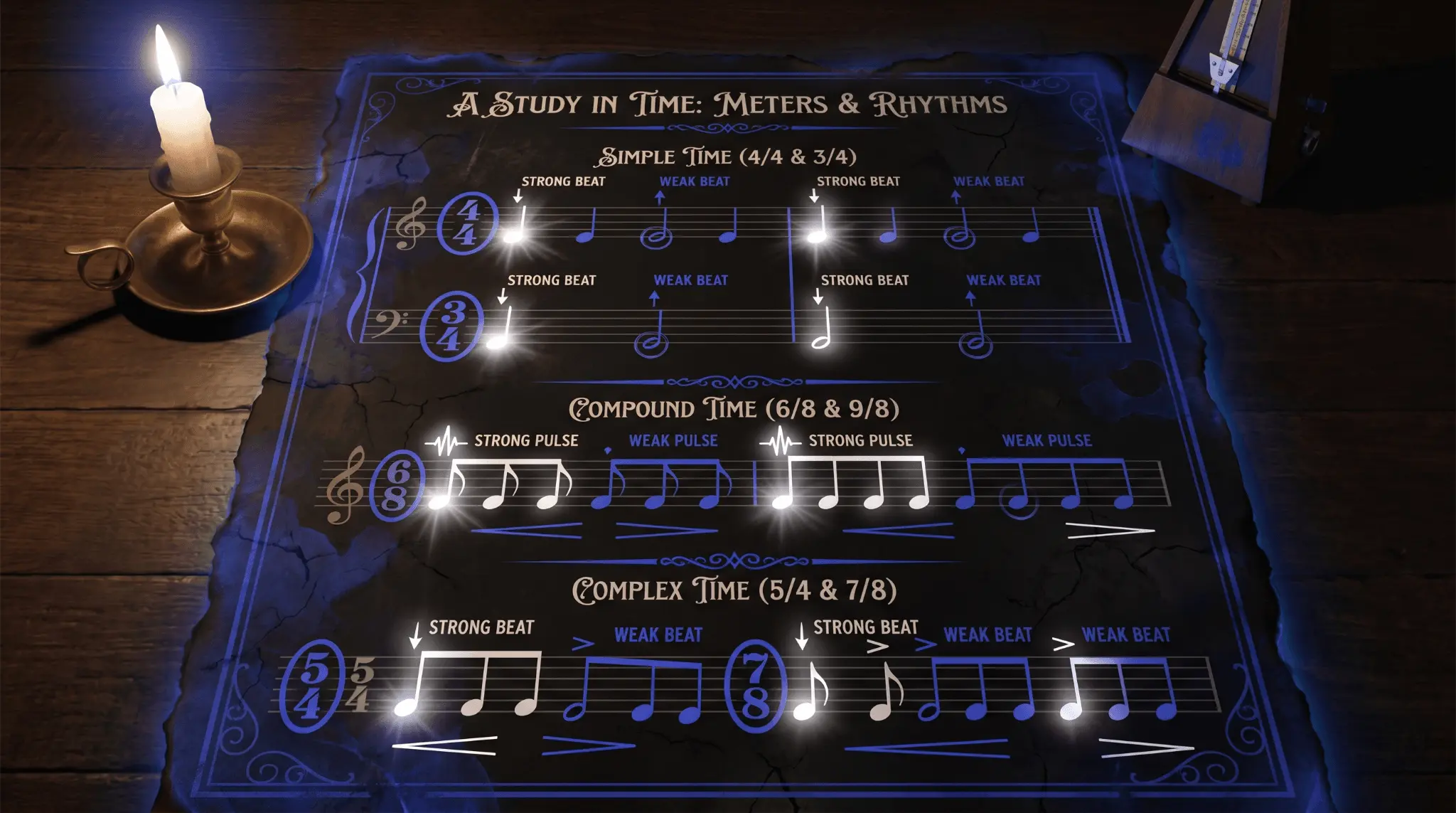
Every time signature falls into one of three macro-categories based on how its internal beats are subdivided. Understanding these sub-categories is vital for mastering types of time signatures and implementing sophisticated rhythm patterns within your compositions.
Simple Meters Explained
Simple meters are defined by a straightforward structural rule: the primary pulse of the measure can be cleanly divided into two equal halves. In simple meters, the main beat is always a standard, un-dotted note value, such as a quarter note or a half note. The top number of a simple time signature is almost exclusively restricted to 2 (simple duple), 3 (simple triple), or 4 (simple quadruple).
- 2/4 Time: A simple duple structure containing two beats per measure, with the quarter note receiving the primary pulse. Each quarter note splits cleanly into two eighth notes. This meter is heavily utilized in traditional polkas, classical military marches, and electronic drum-and-bass structures.
- 3/4 Time: A simple triple structure containing three beats per measure. It serves as the foundation for the classic 3/4 waltz. The three quarter-note pulses split into pairs of eighth notes, providing a clean, un-dotted division of time.
- 4/4 Time: The archetypal simple quadruple meter, known globally as 4/4 time. It contains four beats per measure, with each quarter note splitting into two eighth notes. It is the default setting for the vast majority of Western musical output.
Compound Meters Detailed
In contrast to simple meters, compound meters feature primary pulses that naturally subdivide into three equal parts instead of two. To accommodate this triple subdivision, the primary beat unit must be a dotted note value, such as a dotted quarter note.
The numerator of a compound time signature is almost always 6 (compound duple), 9 (compound triple), or 12 (compound quadruple). When analyzing a compound signature, the numbers do not explicitly show the macro-pulse; instead, they show the underlying triple subdivisions.
- 6/8 Time: A compound duple meter. Although the numerator indicates six eighth notes per measure, the human ear perceives this as two macro-beats, each consisting of a dotted quarter note. The six eighth notes are grouped into two clusters of three (1-2-3, 4-5-6). The primary accents fall heavily on beat one and beat four. This creates a swinging, fluid momentum.
- 9/8 Time: A compound triple meter. It contains nine eighth notes per measure, organized into three macro-beats of dotted quarter notes (1-2-3, 4-5-6, 7-8-9). It delivers a cascading, rolling texture frequently found in traditional Irish jigs and classical impressionist works.
- 12/8 Time: A compound quadruple meter. It contains twelve eighth notes structured into four macro-beats of dotted quarter notes. This format bridges the gap between simple quadruple time and triplet swing feels, serving as a primary structural driver for classic blues, soul, and early rock-and-roll ballads.
Complex and Irregular Meters Explored
Complex, irregular, or asymmetric meters occur when a measure contains a combination of both simple (double) and compound (triple) beat subdivisions. The numerators for these signatures are typically odd numbers that cannot be cleanly divided by two or three without leaving a remainder, such as 5, 7, or 11.
Because these meters are structurally asymmetrical, they do not possess a uniform, unchanging pulse pattern. Instead, the composer must organize the inner eighth-note or quarter-note values into micro-groups.
- 5/4 Time: A quintuple meter containing five beats per measure. To make this meter coherent to an audience, the five beats are broken down into an additive pattern. It can be grouped as a 3+2 structure (one compound group followed by one simple group) or a 2+3 structure (one simple group followed by one compound group). The choice of grouping radically alters where the secondary accents fall, completely reshaping the internal groove of the bar.
- 7/4 or 7/8 Time: A septuple meter containing seven pulses per measure. This asymmetrical layout is typically subdivided into groupings such as 2+2+3, 3+2+2, or 2+3+2. It generates a distinct sense of rhythmic urgency, as the unequal length of the internal groupings makes the bar feel as though it is intentionally skipping or rushing forward.
Direct Structural Comparisons of Common Meters
To accurately deploy these structures during composition or DAW timeline configuration, it helps to compare their technical attributes side by side.
Comparative Analysis Technical Sheet
| Time Signature | Metric Category | Beats Per Bar | Primary Beat Unit | Internal Subdivision Pattern | Primary Accent Placements |
|---|---|---|---|---|---|
| 2/4 | Simple Duple | 2 | Quarter Note | Binary (2 eighth notes per beat) | Beat 1 (Strong) |
| 3/4 | Simple Triple | 3 | Quarter Note | Binary (2 eighth notes per beat) | Beat 1 (Strong), Beats 2 & 3 (Weak) |
| 4/4 | Simple Quadruple | 4 | Quarter Note | Binary (2 eighth notes per beat) | Beat 1 (Strong), Beat 3 (Medium) |
| 6/8 | Compound Duple | 2 (Macro) | Dotted Quarter | Ternary (3 eighth notes per beat) | Notes 1 (Strong) and 4 (Medium) |
| 9/8 | Compound Triple | 3 (Macro) | Dotted Quarter | Ternary (3 eighth notes per beat) | Notes 1 (Strong), 4, and 7 (Weak) |
| 12/8 | Compound Quadruple | 4 (Macro) | Dotted Quarter | Ternary (3 eighth notes per beat) | Notes 1 (Strong), 4, 7, and 10 |
| 5/4 | Complex Quintuple | Variable | Quarter Note | Additive (e.g., 2+3 or 3+2) | Dependent on chosen additive group |
| 7/8 | Complex Septuple | Variable | Eighth Note | Additive (e.g., 2+2+3 or 3+2+2) | Dependent on chosen additive group |
Contrasting Duple Time and Quadruple Time
A common technical point of discussion is the difference between a 2/4 time signature and a 4/4 time signature. From a purely mathematical perspective, two measures of 2/4 contain the exact same duration and number of notes as a single measure of 4/4. However, from a performance and musicological standpoint, they yield completely unique energetic results.
In a 2/4 signature, the cycle of renewal is rapid. The primary downbeat accent occurs every two beats. This high-frequency recurrence of the strongest beat infuses the music with an urgent, driving, physical momentum. It forces an immediate physical reaction, which is why it is the default framework for high-energy polkas, military marches, and samba dance structures.
Conversely, a 4/4 signature provides a wider, more relaxed structural canvas. The primary downbeat occurs only once every four beats, with beat three serving as a weaker, stabilizing secondary accent. This allows melodic phrases to unfold with greater breathing room and enables a much wider variation in syncopated patterns between the primary accents.
A similar contrast exists when comparing 3/4 time to 6/8 time. A bar of 3/4 contains three quarter notes, while a bar of 6/8 contains six eighth notes. Mathematically, the space occupied is identical. However, 3/4 is a simple triple meter with three distinct downbeats per measure.
On the other hand, 6/8 is a compound duple meter containing only two macro-beats per measure, with each beat carrying a triplet subdivision. A 3/4 meter steps firmly across the timeline (1-and, 2-and, 3-and), whereas a 6/8 meter swings fluidly (1-2-3, 4-5-6), completely altering the rhythmic momentum.
Case Studies and Iconic Song Examples
Analyzing historical and commercial recordings across various genres provides clear, real-world context for how these metric structures shape commercial music production.
Works Written in Four-Four Time
Because 4/4 time is the bedrock of contemporary commercial music, time signature examples in this space are endless. Two distinct examples showcase its versatility:
- Billie Jean by Michael Jackson: This track demonstrates the absolute stability of 4/4 time. The legendary drum groove locks the listener into a flawless quadruple meter, where the kick drum anchors beats one and three, while the snare drum punches through on beats two and four. This predictable distribution of weight is what made the track a universal dancefloor success.
- Stayin Alive by the Bee Gees: A masterclass in disco rhythm arrangements. The driving, unyielding 4/4 framework interacts with syncopated basslines and vocal hooks to create a rhythmic drive perfectly calibrated to the natural human walking cadence.
Works Written in Three-Four Waltz Meter
Moving into triple meter completely changes how a melody moves:
- The Blue Danube by Johann Strauss II: The definitive representation of the classic European waltz. The music emphasizes the heavy downbeat on beat one, followed immediately by two lighter, lifting pulses on beats two and three. This structure creates an unmistakable spinning sensation required for ballroom dance styles.
- Piano Man by Billy Joel: A modern popular example of 3/4 simple triple meter. The piano accompaniment maintains a clear, rolling triple-pulse pattern that gives the pop ballad a distinct storytelling quality, reminiscent of traditional sea shanties and folk waltzes.
Works Written in Six-Eight and Twelve-Eight Compound Meters
Compound signatures provide a unique fluid swing that cannot be replicated by standard simple meters:
- We Are the Champions by Queen: This arena rock anthem is tracked in 6/8 time. If you listen closely to the piano introduction, you can feel the heavy two-beat macro-pulse, with each beat containing a distinct triplet drive (One-two-three, Two-two-three). This compound duple setup gives the anthem its soaring power.
- The Way You Make Me Feel by Michael Jackson: This production relies entirely on a 12/8 compound quadruple layout. The track uses a shuffle rhythm where the four macro-pulses are subdivided into dense, driving triplets, creating an infectious blues-infused pop swing.
Works Written in Odd and Asymmetric Meters
Complex signatures are excellent for breaking listener expectations and injecting tension into an arrangement:
- Take Five by the Dave Brubeck Quartet: This jazz standard is written entirely in 5/4 time. Brubeck and drummer Joe Morello structured the five beats using a 3+2 additive configuration. The first three beats establish a flowing, swinging triplet feel, followed immediately by two sharp, stabilizing quarter-note pulses. This uneven pacing is precisely what gives the track its iconic hook.
- Money by Pink Floyd: A legendary rock example utilizing a 7/4 time signature during the primary riff. The loop of cash register sound effects and the iconic bassline run across seven distinct quarter-note counts. This creates a staggered, cyclical loop that perfectly mirrors the lyrical themes of instability and greed. Interestingly, the song temporarily shifts back to a standard 4/4 signature during the extended guitar solo to provide a stable, high-energy environment for the performance before returning to the jarring 7/4 structure.
The Practical Significance of Rhythmic Structures in Composition
The choice of meter directly influences the psychological and emotional response of the audience. Metric design dictates how a listener experiences physical movement, structural tension, and emotional resolution.

Structural Architecture and Psychological Movement
The impact of time signatures on musical composition cannot be overstated. A four-beat quadruple meter provides a sensation of absolute stability, security, and predictability. This makes it ideal for genres designed to induce continuous movement or communal unity, such as electronic dance music, pop anthems, and hip-hop.
Shifting a composition into a triple meter, like 3/4 or 9/8, introduces a lighter, more graceful quality. Triple meters break the linear forward drive, replacing it with a fluid, cyclical trajectory.
When a composer steps into complex or asymmetric territory (e.g., 5/4 or 7/8), they are intentionally introducing instability. Because the internal divisions of the bar are unequal, the listener cannot entirely predict when the next major downbeat will land. This triggers a mild, subconscious psychological tension, making irregular meters highly effective for cinematic suspense sequences, progressive rock suites, and complex avant-garde jazz layouts.
Syncopation and Rhythmic Tension
Once a time signature establishes a predictable grid, composers can systematically subvert expectations through syncopation. Syncopation involves placing dynamic accents, notes, or percussive hits on the weak beats or the internal spaces between the pulses, rather than on the expected downbeats.
By intentionally emphasizing the off-beats, syncopation creates a brief moment of rhythmic tension. The listener's brain expects a pulse on the strong structural beat, but when that pulse is delayed or anticipated, it generates an energetic lift. This interaction between the strict timeline of the time signature and the unpredictable placement of syncopated notes is what gives funk, jazz, reggae, and modern trap music their signature groove.
Dynamic Shifts: Executing Time Signature Changes
To maximize narrative drama within a long-form composition, creators frequently employ time signature changes between different sections of a song. Shifting metrics is a powerful tool for instantly modulating energy levels without needing to alter the absolute tempo of the project.
A classic production workflow involves writing a song's verse in a straightforward, grounding 4/4 time signature to establish a clear lyrical narrative. As the song transitions into the chorus or a dramatic bridge, the project can switch into a compound 6/8 or a driving 2/4 signature. This structural transition forces an immediate change in the behavior of the drums and rhythm section. The sudden repositioning of primary downbeats instantly alters listener focus, re-energizing the track and preventing auditory fatigue across extended arrangements.
Production and Technology Integration: Workflows for Modern Creators
For the contemporary music producer, audio engineer, and sound designer, time signatures are not merely theoretical abstractions on paper. They are active technical parameters that govern how hardware and software systems process digital audio and MIDI data.
Using ACE Studio to Hear How Time Signatures Shape a Real Arrangement
Understanding a time signature on paper is useful. Hearing what it does to a vocal line, string phrase, choir part, or rhythm-based arrangement makes the concept much clearer.
ACE Studio 2.0 gives producers and composers a practical way to test that relationship in sound. Instead of treating time signatures as static theory, you can place musical ideas on a timeline, change the metric structure, and hear how the phrasing responds. This is especially helpful when comparing meters that look similar mathematically but feel completely different, such as 3/4 and 6/8.
In ACE Studio, the Canvas gives you a visual arrangement space where tracks and clips sit on a timeline. The project also includes dedicated global controls for tempo, time signature, and chord information, which makes it easier to organize musical sections when a song changes meter. For multi-signature projects, ACE Studio lets you adjust the time signature at specific points in the timeline rather than forcing the entire composition into one grid. That matters when a verse sits comfortably in 4/4, but a bridge needs the lift of 6/8 or the tension of 7/8.
This is where ACE Studio becomes especially useful for musicians learning how meter affects performance. A simple melody can be entered as MIDI, then shaped with AI vocals, AI instruments, or both. The same melodic idea can be tested in different rhythmic settings to hear how the accent pattern changes its emotional weight. In 4/4, the phrase may feel grounded and direct. In 3/4, it may start to rotate. In 6/8, it can feel more fluid because the pulse is grouped in two larger beats. In 5/4 or 7/8, the phrase may gain a deliberate sense of imbalance.
ACE Studio is not limited to vocal generation. ACE Studio 2.0 expands into a broader AI music workstation with AI voices, AI instruments, generative kits, a redesigned Canvas, and performance improvements. Its AI Instruments use MIDI input and include articulation and expression controls, so a producer can shape more than pitch alone. For example, a string line in 7/8 can be adjusted with articulation, vibrato, timing, and ensemble settings so the odd meter feels intentional rather than stiff.
For vocal writing, ACE Studio can generate singing from MIDI notes and lyrics while still giving the creator control over pitch, timing, vibrato, breath, phonemes, and emotional detail. That makes it useful when exploring how lyric stress interacts with meter. A line that feels natural in 4/4 may need different syllable placement in 6/8. A phrase in 5/4 may need a longer held note, a shorter pickup, or a stronger breath before the downbeat. ACE Studio lets you refine those details directly instead of guessing from notation alone.
It also helps when working with existing musical material. If you import MIDI, ACE Studio can preserve the original tempo and time signature information, which is important for pieces with tempo changes, compound meter, or unconventional rhythmic structures. For producers who already build in a DAW, ACE Bridge can synchronize tempo maps, time signature changes, and transport between the DAW and ACE Studio, keeping the musical grid consistent while you shape vocals or instruments.
A practical way to use ACE Studio while studying time signatures is simple:
- Write a short MIDI phrase in 4/4.
- Change the project section to 3/4, 6/8, or 5/4.
- Listen for where the phrase starts to lean, rush, breathe, or feel unresolved.
- Add an AI vocal, AI choir, or AI instrument part to hear how the meter affects phrasing.
- Adjust note length, lyric placement, articulation, and expression until the performance supports the chosen meter.
This makes time signatures less abstract. You are not only counting beats per measure. You are shaping how a musical idea moves, where it breathes, and how the listener feels the next downbeat coming. ACE Studio gives that process a clear sound: vocals, instruments, choirs, and MIDI-based arrangements that let you test the creative consequences of meter with precision and control.
Managing Metric Configurations in Modern DAWs
Whether operating in Ableton Live, Logic Pro X, Pro Tools, Cubase, or FL Studio, configuring the global time signature settings is a critical early step in session setup. Every modern digital audio workstation relies on a master transport timeline that aligns its visual ruler to bars and beats rather than purely hours, minutes, and seconds.
To execute a metric transition within a DAW timeline, producers must utilize the global time signature lane or insert specific timeline markers. For example, in Ableton Live, typing a new metric value into a clip slot or a master track scene instantly forces the playback engine to re-index its grid lines. This adjustment ensures that all MIDI clip editors, step sequencers, and built-in drum machines accurately map their note entries to the newly selected rhythmic framework.
Audio Engineering, Quantization, and Grid Manipulation
For audio engineers handling multi-track recordings or programming intricate electronic beats, the interaction between time signatures and software quantization grids is a vital technical focus.
- Quantization Alignment: When applying quantization to a performance, the DAW shifts MIDI notes or warped audio transients onto the nearest grid line. If an engineer attempts to quantize a performance recorded in a compound 6/8 meter while their DAW grid is set to a simple 4/4 quarter-note resolution, the software will systematically destroy the performance. It will force the fluid triple subdivisions onto rigid binary lines, resulting in severe rhythmic errors. Engineers must manually change the quantization grid parameters to triplets or compound settings to match the underlying signature.
- Time-Based Effects Synchronization: Modern delay pedals, modulation plugins, and rhythmic gating effects rely on host-sync automation to lock their processing times to the project tempo and meter. A delay plugin set to a dotted-eighth-note feedback loop will automatically calculate its echo intervals based on the active time signature. If the session transitions from 4/4 to a complex 7/8 meter, the plugin recalculates its delay times on the fly to remain perfectly synchronized with the changing metric architecture, preserving spatial clarity within the mix.
- Transient Detection and Elastic Audio: When editing live drums or acoustic instruments in an irregular or changing time signature, automated transient detection algorithms can occasionally misinterpret the intended downbeats. Engineers must manually review anchor points on the timeline, ensuring that rhythmic analysis markers correctly align with the primary accent structures defined by the composition's time signature.
Conducting Patterns and Live Instrumentation Workflows
When working with live sessions involving session musicians or orchestral tracking, understanding the physical translation of time signatures into conducting gestures is essential for maintaining efficient studio communication.
A conductor or session leader translates the theoretical numbers of a time signature into spatial movements. In a simple duple meter (2/4), the arm moves down on beat one and up on beat two. In a simple triple meter (3/4), the pattern forms a triangle: down on one, outward on two, and up on three. In a simple quadruple meter (4/4), the pattern traces a cross shape: down on one, inward on two, outward on three, and up on four.
Understanding these physical tracking patterns allows producers to communicate clearly with instrumentalists during live tracking dates. It ensures that everyone in the studio shares an identical mental map of the song's internal timing mechanics, drastically reducing tracking errors and optimizing studio time.
Frequently Asked Questions
What does the letter C mean when used instead of numbers at the beginning of a piece?
The letter C stands for common time, which is a direct alternative symbol for a standard 4/4 time signature. It dictates that the measure contains four quarter-note beats. If the C has a vertical line cutting directly through it, it signifies cut time (alla breve), which represents a 2/2 time signature where the music is felt and counted in two broader half-note pulses per measure.
Can a song change its time signature in the middle of a performance?
Yes. Many compositions across classical, jazz, film scores, and progressive rock feature intentional time signature changes between different sections. These transitions are used to shift the energy, alter the focus of the arrangement, or create structural contrast between verses and choruses without necessarily changing the absolute BPM of the performance.
Is a 6/8 time signature just another way of writing a 3/4 time signature?
No. While a bar of 6/8 and a bar of 3/4 contain the exact same total duration of notes (six eighth notes total), they are structurally and rhythmically unique. A 3/4 signature is a simple triple meter with three clear quarter-note pulses that split into binary pairs. A 6/8 signature is a compound time duple meter that contains two macro-pulses, each divided into three eighth notes. They create completely different rhythmic flows and accent structures.
Why do some time signatures feel unstable or hard to dance to?
Time signatures with odd numerators like 5/4, 7/8, or 11/8 are classified as irregular or asymmetric meters. Unlike 4/4 or 2/4, they combine uneven groupings of two and three beats within a single bar. Because the internal intervals are unequal, the human body cannot establish a perfectly symmetrical physical loop, which creates a feeling of rhythmic tension and unpredictability.
How do I choose the right time signature for my music project?
The choice depends entirely on the intended genre and emotional framework of your track. If you are producing commercial pop, hip-hop, or driving electronic dance music where stability and physical dancing are paramount, 4/4 time is the global standard. If you want to evoke an elegant, floating, or cyclical quality, experiment with a triple meter like 3/4. If your goal is to introduce groove complexity, rhythmic swing, or cinematic tension, explore compound meters like 6/8 or asymmetric meters like 5/4.