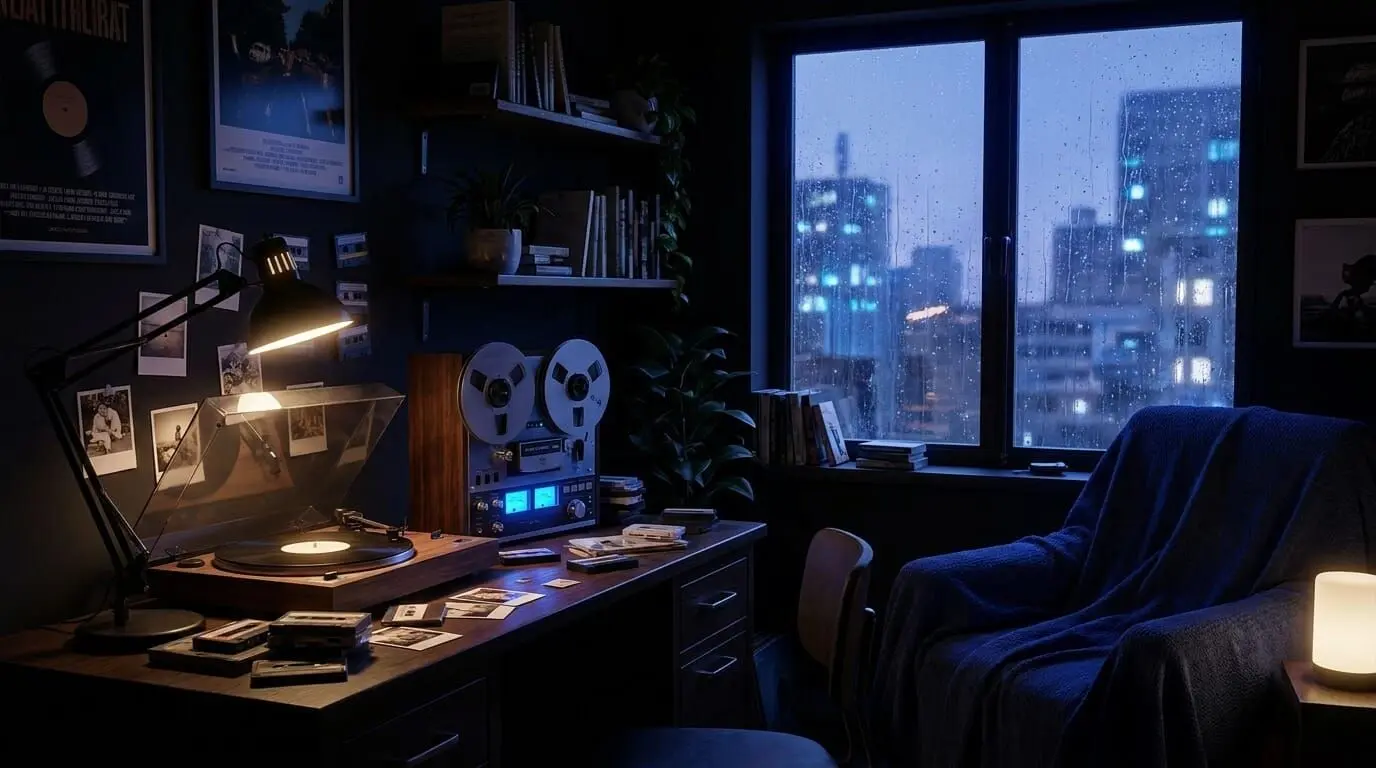

LoFi music has evolved from a niche underground subculture into a global phenomenon. It serves as the ultimate soundtrack for late-night study sessions, creative workflows, and quiet reflection.
While many discover it as background noise, LoFi often becomes a deeply personal part of a listener's daily routine. Its appeal lies in the effortless blend of "chill beats," atmospheric textures, and an emotional warmth that feels familiar from the very first listen.
Key Takeaways
- LoFi music is built around warmth, simplicity, and intentional imperfection, using elements like vinyl crackle, tape hiss, off-grid drums, soft melodies, and ambient background textures to create a calm, nostalgic sound.
- The genre has grown from underground home recording culture into a global movement, shaped by hip-hop sampling, chillhop, jazz-inspired beats, bedroom producers, and 24/7 study music livestreams.
- LoFi is popular because it supports focus, relaxation, and emotional comfort without demanding full attention, making it a useful soundtrack for studying, working, reading, and unwinding.
- For creators, LoFi is one of the most accessible forms of DIY music production because a strong track can start with simple tools, a clear mood, thoughtful sampling, subtle textures, and restrained arrangement choices.
- ACE Studio can support LoFi production by helping producers generate prompt-based musical sketches, arrange ideas on the Canvas, add AI instrument layers, refine MIDI performances, and finish tracks in a DAW through ACE Bridge.
What is LoFi music?
At its core, LoFi is more than just a genre—it is a production philosophy. While traditional studio engineering chases flawless clarity, LoFi intentionally preserves (and even highlights) imperfections.
It values emotional honesty over technical perfection. One famous anecdote tells of a producer whose track was nearly rejected because of background noise—the sound of a chair creaking in the recording room. Instead of removing it, he kept it. Listeners later remarked that the tiny sound made the music feel "human," as if someone was in the room with them. This is the essence of LoFi: it creates closeness.
Defining "low fidelity"
The term LoFi stands for low fidelity. In a world of polished, digital sounds, LoFi embraces "warmth" through textures that traditional engineers once tried to remove.
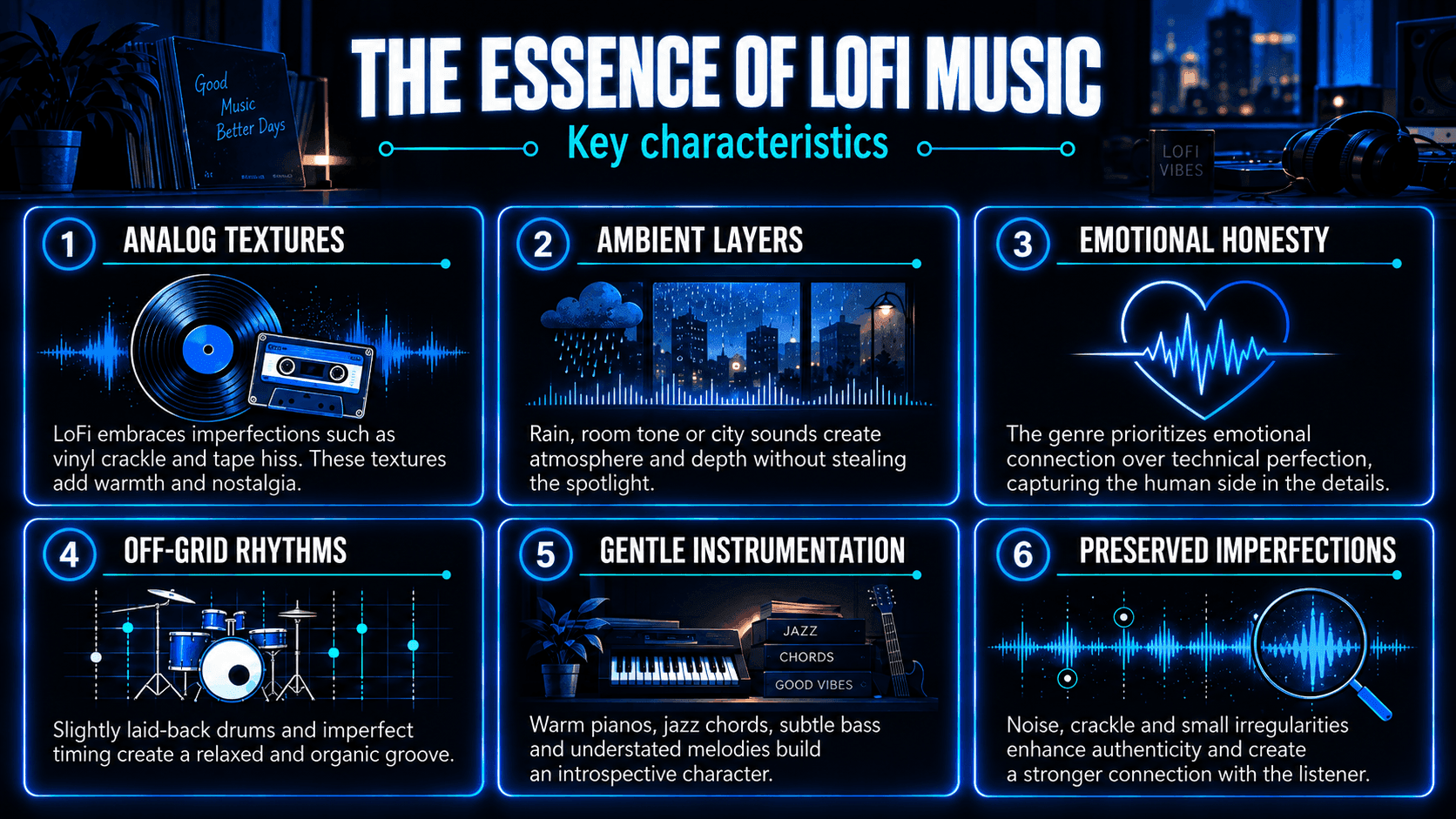
Key characteristics of the LoFi sound:
- Analog Textures: The crackle of vinyl, the hum of tape machines, and soft hiss.
- Ambient Layers: Environmental sounds like rainfall, distant chatter, or birds chirping.
- "Off-Grid" Rhythms: Slightly imperfect drum timing that feels like a human drummer rather than a computer.
- Mellow Instrumentation: A blend of jazz chords, hip-hop patterns, and ambient motifs.
The evolution: from "chill beats" to global phenomenon
Many listeners first discover the genre through viral playlists like "Chill Beats LoFi." These instrumental tracks act as a hypnotic backdrop, using repetitive loops to create a flow state for reading or working.
However, the genre has grown far beyond simple loops. Modern LoFi is a sophisticated fusion influenced by:
- Chillhop & Jazz Hop: Using dusty jazz samples and soulful melodies.
- Downtempo & Ambient: Prioritizing atmosphere to help lower the listener's heart rate.
- DIY Culture: The rise of "bedroom producers" who use home studios to reach millions, proving that you don't need a million-dollar studio to create a global impact.
Why we listen: the psychological appeal
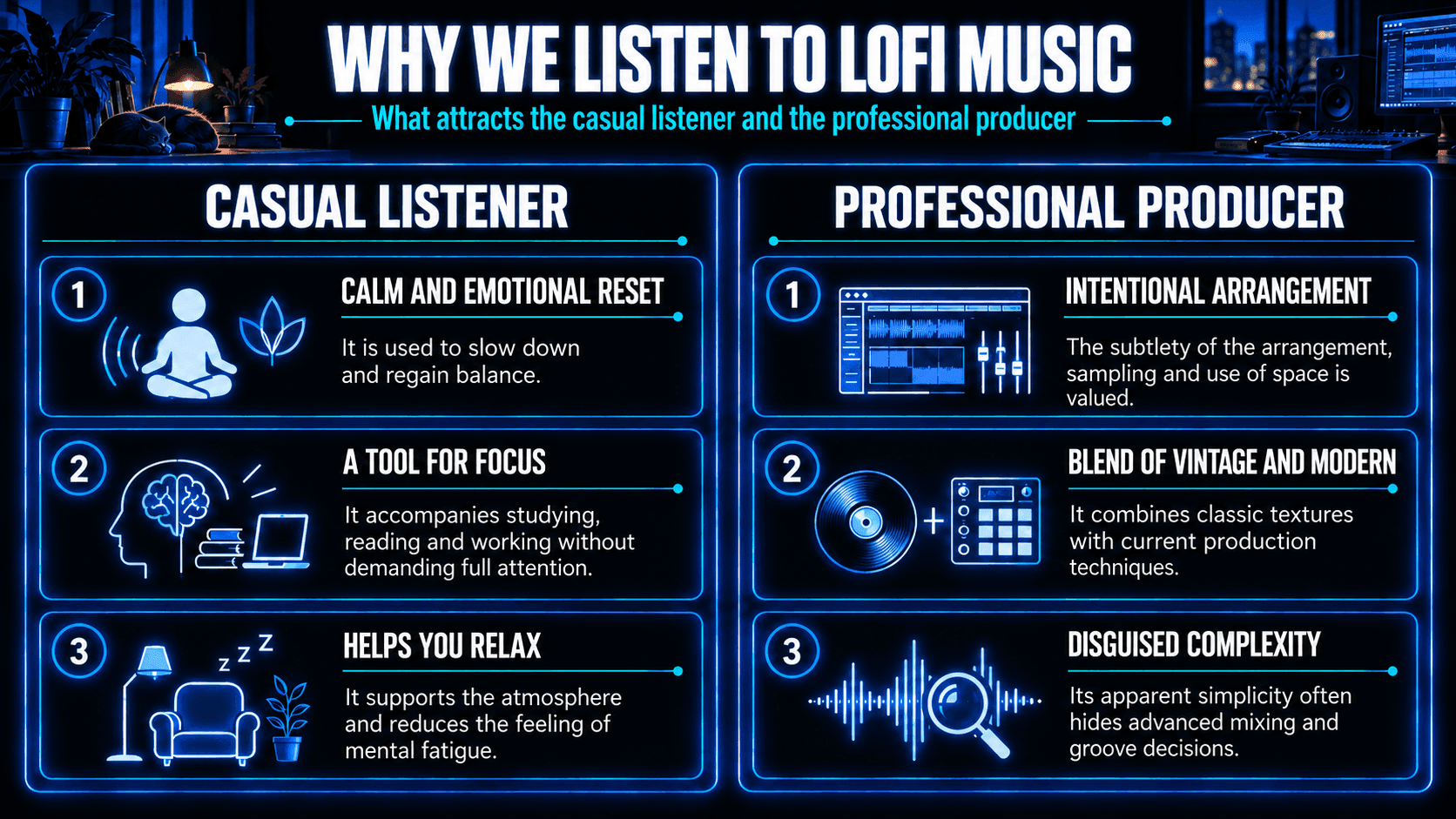
What makes LoFi especially interesting is that it speaks to two different audiences:
- The Casual Listener: Hears calm, comfort, and a tool for "emotional resets" or sleep.
- The Professional Producer: Hears thoughtful arrangement, subtle sampling, and the deliberate use of "flaws" to build a specific vibe.
By combining vintage textures with modern sampling techniques, LoFi has become the ultimate tool for concentration and relaxation. It doesn't demand your full attention; instead, it shapes the emotional tone of your environment.
Historical evolution of LoFi music
The history of LoFi is a story of turning technical limitations into artistic breakthroughs. It is the journey from "low-budget" to a "high-concept" global culture.
The early days: home recording culture
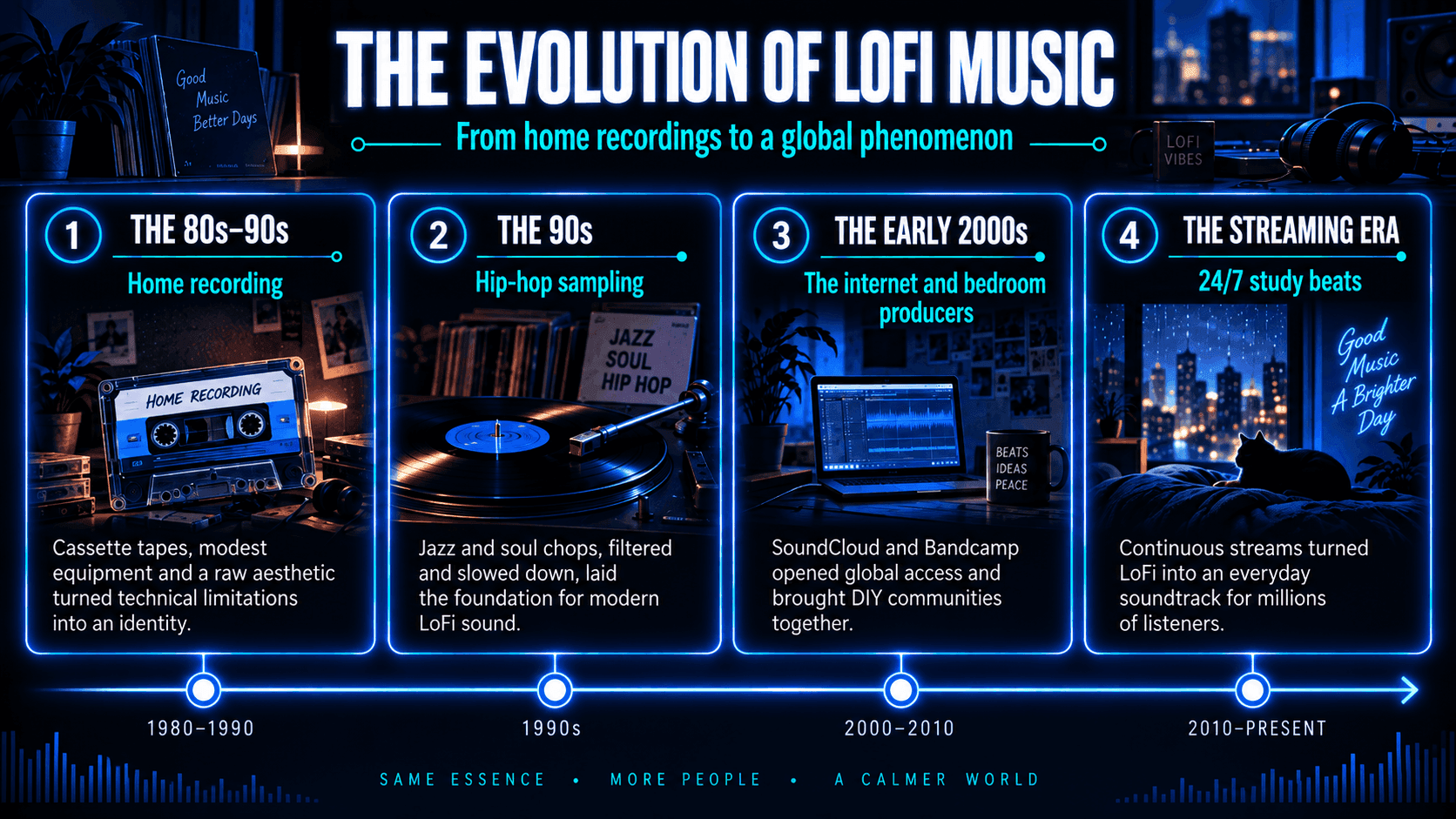
The roots of LoFi can be traced back to the early days of home recording culture. Before digital software made editing seamless, artists working with inexpensive tape machines and analog equipment naturally produced recordings with hiss, distortion, and uneven balances.
In the 1980s and 1990s, underground musicians began embracing these "rough" recordings as a rebellion against the polished, sterile sound of commercial studio releases. Independent artists working in DIY (Do-It-Yourself) environments discovered that raw recordings felt more sincere. Instead of hiding the imperfections, they turned them into the focal point of the music.
The hip-hop foundation: sampling and soul
The modern LoFi sound owes a massive debt to the evolution of hip-hop sampling. As producers began pulling fragments from old jazz records, soul tracks, and film dialogue, they developed a specific "vibe":
- They would slow down samples, apply heavy filters to remove high-end frequencies (creating a "muffled" warmth), and layer them into dreamy loops.
- Influence from legends like J Dilla and Nujabes helped bridge the gap between hard-hitting hip-hop and atmospheric, soulful "beat-making."
The digital revolution: the rise of the "bedroom producer"
By the early 2000s, the internet transformed LoFi from a production style into a global community.
- Global Access: Platforms like SoundCloud and Bandcamp allowed "bedroom producers" to bypass record labels and upload instrumental tracks directly to a worldwide audience.
- Community Building: Niche groups formed around sub-genres like chillhop, downtempo, and atmospheric beats.
- The Livestream Era: Eventually, 24/7 YouTube livestreams introduced the world to continuous "study beats," turning LoFi into a permanent fixture in the daily routines of millions.
The human connection
What truly defines the history of LoFi is its unexpected emotional impact. A producer once shared how he uploaded a beat he finished in under an hour, thinking no one would ever hear it. Months later, he was flooded with messages from students using that track to get through exams and people playing it during difficult life moments.
This transformation—from a "quick beat" to an emotional lifeline—is exactly why LoFi continues to grow.
Characteristics and features of LoFi music
LoFi stands apart because of its texture, pacing, and emotional restraint. Instead of dramatic changes, it often relies on subtle development. Tracks usually move slowly, giving listeners space to think.
The sound is often shaped by:
- Warm analog textures that feel aged and familiar.
- Soft drum grooves with slightly imperfect timing.
- Minimal harmonic movement that avoids tension.
- Field recordings like rain, room tone, or distant city noise.
- Creative sampling from old records or found sounds.
Because of these elements, LoFi often overlaps with ambient music and downtempo music, creating a hybrid sound that feels peaceful but emotionally rich.
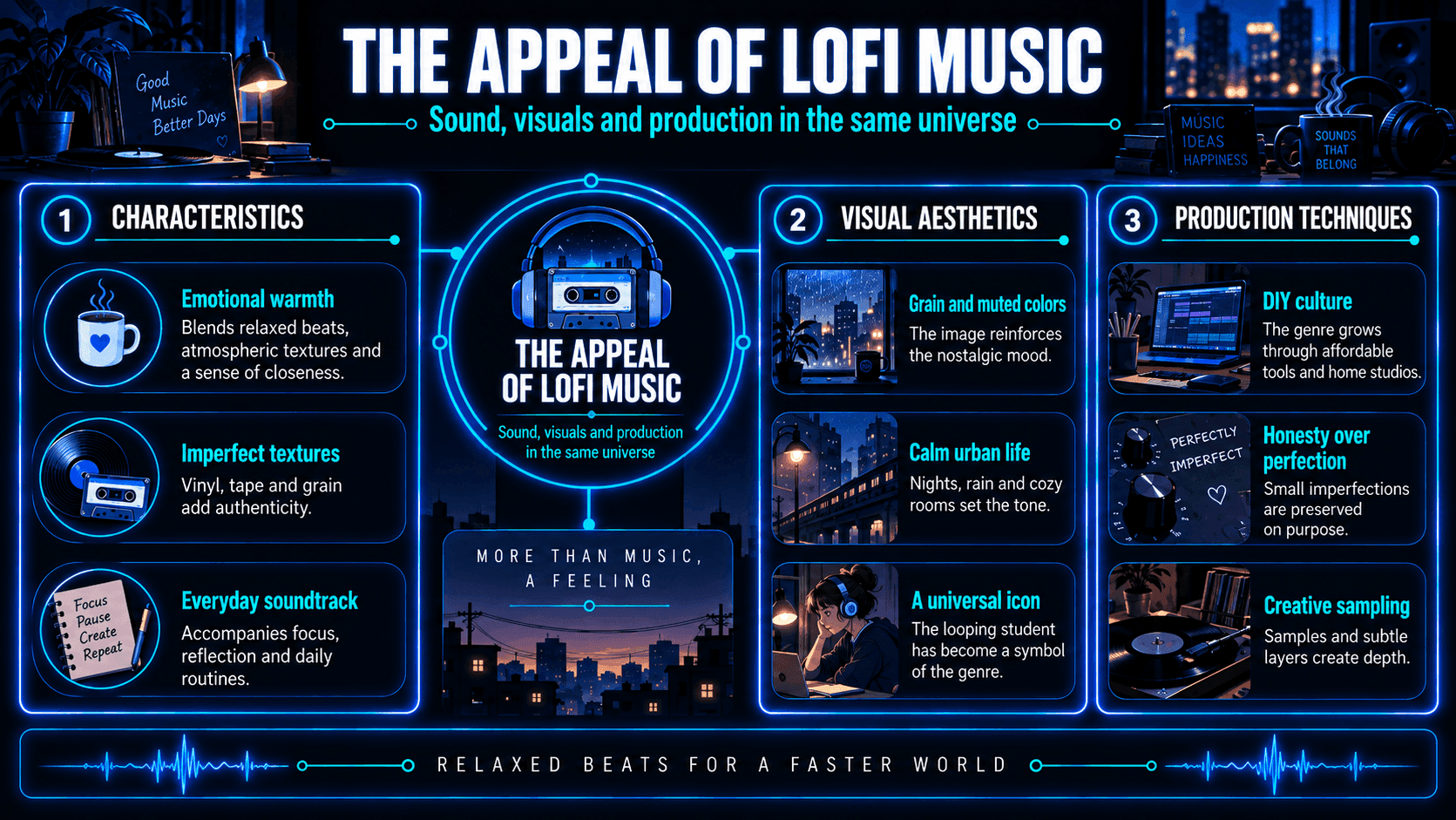
Professional producers often notice how carefully these “imperfect” sounds are placed. What seems casual may actually involve precise decisions about compression, filtering, stereo width, and timing. The relaxed mood can hide surprisingly advanced production.
The aesthetics of LoFi: why visuals matter
The nostalgic sound of LoFi extends far beyond audio; it has created a distinct visual language. Muted colors, grainy animations, and scenes of quiet urban life aren't just decorations—they are essential to how the listener experiences the music. Because LoFi is often treated as atmosphere rather than a primary focus, the visuals help "anchor" the mood.
The "LoFi Girl" phenomenon
You cannot discuss LoFi aesthetics without mentioning the "LoFi Girl" (originally the ChilledCow study girl). This looped animation of a girl studying at her desk with a cat in the window has become the universal face of the genre.
- The visual works because it reflects the listener’s own reality. Whether you are a student in Tokyo or a designer in New York, the image of focused, quiet productivity in a cozy room feels universally relatable.
- The art style draws heavily from the "slice of life" scenes in 90s anime and Studio Ghibli films. These visuals emphasize the beauty in mundane, everyday moments—exactly what the music does.

The texture of memory
Visuals in the LoFi community often lean on retro nostalgia. A listener once shared online how a rain-soaked LoFi track, paired with a grainy animation of a city window, reminded him of studying in a small apartment years earlier. Even though he had never heard the song before, the "texture" of the sound and image felt like a personal memory.
This emotional response shows how deeply visual and sonic textures influence our perception. In a LoFi playlist, the "comfy" setting—rain-streaked windows, steaming coffee, and messy desks—reinforces the idea that this is a safe space for the mind to wander.
Production techniques
Modern DIY music production has made LoFi more accessible than ever. A producer can build complete, professional tracks using only a laptop, a pair of headphones, and a few key plugins. However, while the barrier to entry is low, creating a track that truly resonates depends on thoughtful execution and a disciplined "less is more" approach.
1. Sampling and melodic "chops"
The heart of LoFi is the sample. Producers often "chop" short melodic phrases from old jazz or soul recordings to create something entirely new.
- The Technique: These fragments are often pitched down to change the mood and run through a low-pass filter to remove harsh high frequencies. This creates that signature "muffled" warmth that feels like listening to music through a wall.
- Pro Tip: Look for samples with "blank space"—a single piano chord or a lone saxophone note often provides more emotional weight than a busy melody.
2. "Drunken" drums and off-grid rhythms
In most modern music, drums are snapped to a perfect digital grid. LoFi does the opposite.
- The Technique: Producers intentionally shift drum hits (especially snares and hi-hats) slightly off-grid. This creates a "lazy" or "swing" feel that mimics a human drummer's natural inconsistencies.
- Pro Tip: Use "sidechain compression" to make the melodic samples "duck" every time the kick drum hits. This creates the rhythmic, breathing "pump" found in classic LoFi beats.
3. Tape emulation and analog imperfection
To give a digital track an "analog soul," producers use specialized plugins that mimic vintage hardware.
- The Technique: Tape emulation and vinyl plugins add subtle imperfections like "wow and flutter" (slight pitch wobbles), static, and pops. These elements soften the sound and make it feel like a physical object rather than a digital file.
4. Layering "found sounds" (Foley)
Strong LoFi often features environmental recordings layered quietly under the music. One creator explained how he recorded the sound of a train station near his home and blended it under a piano loop.
- While listeners may never consciously notice the station, these sounds make the track feel "alive" and grounded in reality.
- Pro Tip: Common layers include rainfall, coffee shop chatter, or the sound of pages turning, which subtly cues the brain that it’s time to focus or relax.
The best LoFi creators understand that simplicity requires discipline. In this genre, every sound must work toward one goal: supporting the mood.
How to produce LoFi music with ACE Studio
LoFi is one of the most approachable genres for DIY music production because it does not depend on huge recording rooms or overly polished performances. A strong LoFi track can begin with a simple mood: rainy evening, soft piano, dusty drums, late-night focus, warm tape texture. From there, the producer’s job is to shape the atmosphere carefully instead of filling every space.
ACE Studio can fit into this process as a creative sketchpad and performance tool. In ACE Studio 2.0, producers can work with prompt-based music ideas, AI instruments, editable MIDI performances, stems, and vocal parts in the same broader music creation workflow. That makes it useful for LoFi, where texture, restraint, and small arrangement choices matter more than complexity.
A simple way to start is with Inspire Me, ACE Studio’s prompt-based idea generator. Instead of beginning from a blank timeline, you can describe the emotional direction of the track and let ACE Studio give you a starting point to react to.
For example, a LoFi prompt might look like this:
Create a warm LoFi beat for late-night studying. Use soft dusty drums, mellow jazz piano chords, subtle vinyl texture, relaxed bass, and a calm nostalgic mood. Keep the arrangement simple and spacious.
The goal is not to accept the first result as a finished song. The better approach is to listen like a producer. Maybe the chord mood is right, but the drums need to feel lazier. Maybe the bass is useful, but the piano needs more space. Maybe only one small melodic phrase is worth keeping. That is still a good result because it gives you material to shape.
From there, you can build the LoFi track step by step:
- Start with a mood prompt
Use Inspire Me to generate a few musical sketches based on the feeling you want. LoFi works well with prompts that describe atmosphere, tempo, instrumentation, and texture. - Choose one idea to refine
Pick the version with the strongest emotional center. Do not worry if it is rough. LoFi production often becomes interesting through editing, filtering, and subtraction. - Shape the arrangement on the Canvas
ACE Studio’s Canvas lets you arrange clips in a visual timeline, so you can decide where the beat enters, where the piano drops out, and where the track needs a small change to avoid feeling too static. - Use AI instruments for soft musical layers
If the beat needs more warmth, you can use ACE Studio’s AI instruments to create editable MIDI-based parts. A simple piano phrase, soft string pad, muted saxophone line, or gentle melodic counterline can add depth without making the track feel crowded. - Add texture with intention
LoFi does not need endless layers. A short instrumental phrase, a subtle background part, or a soft harmonic movement can be enough. The important question is always: does this support the mood? - Finish the track in your DAW if needed
With ACE Bridge, you can connect ACE Studio to your existing DAW workflow, then finish the balance, effects, panning, automation, and final mix in the environment you already use.
This workflow keeps the human decision-making at the center. ACE Studio can help you generate a starting point, shape MIDI-based instrument performances, and organize ideas, but you still decide what the track is supposed to feel like. You decide which imperfections stay, which parts need to be removed, and where the emotional weight should sit.
For LoFi specifically, that matters. The genre is not about making the most complicated beat. It is about making a small loop feel lived-in. A slightly delayed snare, a warm chord, a soft melodic fragment, or a barely noticeable background layer can change the whole emotional color of the track.
ACE Studio is useful here because it gives you flexible material without forcing a fixed result. You can begin with a prompt, refine the arrangement, add a quiet instrumental layer, and keep shaping until the track feels personal. In that sense, it supports the same DIY spirit that made LoFi popular in the first place: start with what you have, listen closely, and turn simple ideas into something that feels human.
Benefits of LoFi music
Many listeners turn to LoFi because it fundamentally changes the "vibe" of a room. Unlike high-energy genres that demand your focus, LoFi rarely competes for attention. Instead, it acts as a support system for whatever the listener is doing.
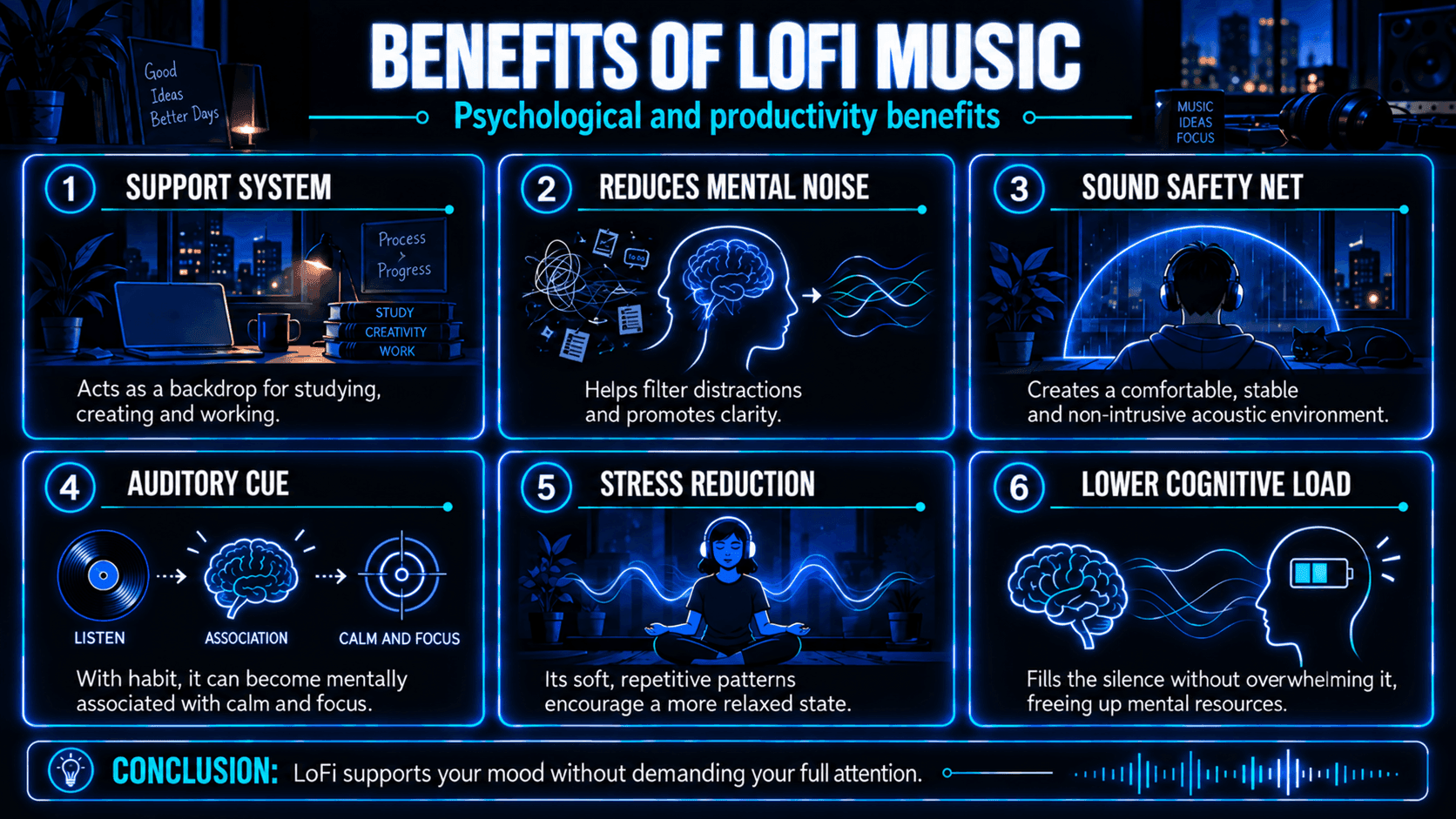
This is why "study beats" and "chill beats" have become more than just music; they are tools for productivity. Students use them while reading to drown out silence, while designers and writers use the steady rhythm to reduce "mental noise." For many, LoFi makes repetitive or draining tasks feel less exhausting by providing a calming, predictable structure that supports emotional regulation.
Mental health and relaxation: a sense of safety
One of the strongest emotional associations with LoFi is comfort. The slow tempo and warm, analog textures create a "sonic safety net" that many listeners seek out during stressful periods.
The power of the "auditory cue"
A university student once shared that during a period of intense academic pressure, she played the same LoFi playlist every evening. Over time, her brain began to associate the opening piano notes with relaxation. The music became a psychological cue—a signal to her body that it was time to slow down and decompress.
Why it calms the mind
Experts in sound therapy often explain that repetitive, gentle rhythms help lower perceived stress because the brain doesn't have to process sudden changes or "shocks" to the system.
- Reduced Cognitive Load: LoFi gives the mind less to "defend" against, allowing the nervous system to settle.
- Emotional Grounding: The nostalgic, vintage sounds often trigger a sense of familiarity. Even if a listener has never heard a specific track, the "dusty" texture can create a feeling of being grounded in a simpler time.
Impact on focus and productivity: entering the flow state
The primary reason professionals and students swear by instrumental LoFi is its stability. Music with aggressive vocals or rapid tempo shifts can pull you out of a "flow state," whereas LoFi remains steady and predictable.
Filling the silence without distraction
A software developer recently described how LoFi helped reduce the urge to "task-switch" or check his phone. The music filled the silence of his office without becoming a distraction itself. Similarly, a graphic designer noted that replacing random radio playlists with curated downtempo music led to fewer interruptions in her concentration.
The "golden middle" of stimulation
The balance in LoFi production is delicate:
- Too simple: The music feels empty, and the mind starts to wander.
- Too active: The music pulls attention away from the work.
LoFi sits perfectly in the middle. It provides just enough stimulation to keep the brain engaged without ever becoming the "main event." This makes it the ideal soundtrack for anyone needing to maintain deep focus for long periods.
Popular LoFi music artists
Several key figures helped transform LoFi from a production style into a global movement. While thousands of "bedroom producers" contribute to the genre today, these names provided the blueprint.
The architects: Nujabes & J Dilla
Before LoFi was a household name, two producers laid the foundation by blending soulful samples with hip-hop rhythms.
- Nujabes: This Japanese producer introduced a deeply emotional blend of jazz and hip-hop that influenced an entire generation. His work proved that instrumental music could feel cinematic and grand while maintaining a sense of private intimacy.
- J Dilla: Dilla completely changed how producers think about rhythm. He popularized "unquantized" or loose drum programming, which intentionally avoided the perfect timing of a computer. This "human" timing is the DNA of almost every LoFi beat made today.
The curator: LoFi Girl
While not an artist in the traditional sense, the LoFi Girl (formerly ChilledCow) platform is responsible for the genre's massive popularity. By hosting continuous, 24/7 livestreams, this channel turned LoFi into a daily ritual. It became the "digital fireplace" for millions of students and professionals, providing a consistent community and a platform for independent artists to be heard.
The modern wave
Today, the DIY production community is pushing the genre into new territory. Artists are no longer sticking to just jazz samples; they are blending LoFi with ambient music, electronic textures, and cinematic scoring. Key modern names to explore include:
- Idealism: Known for minimalist, piano-heavy tracks that define the "sad/cozy" aesthetic.
- L.Dre: A producer who bridges the gap between old-school hip-hop techniques and modern LoFi.
- Kupla: An artist who often uses live instruments and field recordings to create highly immersive soundscapes.
How to enjoy LoFi music
LoFi can be listened to casually, but the experience changes depending on how it is used. Some people play it quietly in the background. Others treat it like a personal environment.
The genre often works best when it supports an activity rather than replacing one. Reading, writing, studying, sketching, or walking can all feel different when paired with carefully chosen relaxing music.
Listeners often discover that the same track can feel different depending on the moment. What sounds comforting one evening may feel motivating the next morning.

Creating the ideal listening environment
Environment matters. LoFi often feels stronger in quiet spaces where subtle textures can be heard clearly. Good headphones reveal soft room noise, gentle sampling, and delicate background layers. Dim lighting can reinforce the atmosphere. Many listeners pair LoFi with rainy weather because the sonic texture naturally complements that mood.
One listener described sitting near an open window during a storm while a piano-based LoFi set played softly. He said the line between the outside rain and the recorded rain blurred until the room itself felt part of the track. That kind of immersive experience explains why LoFi often feels more personal than other genres.
Exploring different styles
LoFi is broader than many people realize. Some tracks lean toward jazz-inspired chill beats, while others blend deeply with ambient music. Some producers focus on dusty hip-hop grooves, while others build cinematic downtempo music.
There is also a growing crossover between LoFi and acoustic instrumentation. Guitar-based LoFi, piano-driven LoFi, and even orchestral LoFi are becoming more common.
For professionals, exploring substyles can reveal how production choices shape emotional response. A subtle change in filtering or sampling techniques can completely alter how a track feels.
LoFi music in popular culture
LoFi is no longer confined to niche underground audiences; it has become a cornerstone of modern digital culture. From viral social media clips to global marketing campaigns, the "chillhop" sound is now the universal language of approachability.
The sound of the digital age
You can find the influence of LoFi across almost every corner of the internet:
- Content Creation: YouTubers and educators use relaxing music to make technical or educational videos feel less rigid and more inviting.
- Social Media: TikTok and Instagram creators lean on LoFi beats to provide an emotional "vibe" for short-form storytelling.
- Modern Branding: Companies now use LoFi-inspired sound design in advertisements because it feels "human" and authentic, rather than corporate and aggressive.
The new "coffee shop" standard
Creative workspaces and coffee shops are increasingly swapping traditional radio for LoFi playlists. Because the music is designed to be non-intrusive, it supports conversation and deep work without dominating the room. It provides the "white noise" necessary for focus in a busy public environment.
A cultural shift toward "softness"
The rise of LoFi reflects a larger cultural movement. In a world defined by constant digital stimulation, high-definition screens, and loud notifications, people are actively seeking out sound that feels softer.
By embracing imperfection, LoFi offers a much-needed contrast to the polished pressure of modern life. It suggests that things don't have to be perfect to be meaningful—and that sometimes, the most "human" thing we can do is just slow down.
Future trends in LoFi music
The future of LoFi will likely involve deeper fusion with other genres. Producers are already blending LoFi with house, neo-soul, cinematic scoring, and experimental electronica.
Artificial intelligence tools may speed up DIY music production, but many creators believe human imperfection will remain central. One producer recently noted that software can generate melodies quickly, but it still struggles to recreate the emotional weight of accidental sounds.
Spatial audio may also reshape how LoFi is experienced. As immersive listening grows, producers may place textures around the listener rather than simply in stereo. Despite new technology, the heart of LoFi will probably remain the same: emotional honesty through imperfect sound.
FAQs about LoFi music
Why is LoFi music so relaxing?
LoFi music often feels calming because it avoids sudden changes that can interrupt concentration. The combination of slow rhythms, soft harmonies, and gentle sampling creates a stable environment for the brain. Many listeners describe the nostalgic sound as emotionally comforting because it feels familiar even when hearing a track for the first time.
Is LoFi music good for studying?
Many people use study beats because the repetitive structure helps maintain focus without becoming distracting. Unlike lyrical songs that compete for attention, instrumental chill beats can support concentration while reading, writing, or working for long periods.
What makes LoFi different from ambient music?
Although LoFi and ambient music often overlap, LoFi usually contains stronger rhythmic elements and beat-driven structure. Ambient styles can be more atmospheric and abstract, while LoFi often blends those textures with hip-hop-inspired grooves and melodic loops.
Can beginners create LoFi music at home?
Yes, modern DIY music production makes it possible for beginners to create LoFi from home with minimal equipment. Many producers start with a laptop, headphones, and a digital audio workstation. The genre is especially accessible because imperfections are often part of the artistic style rather than something that needs to be removed.
Why do producers use vinyl crackle in LoFi music?
Vinyl crackle helps create the warm nostalgic sound associated with classic recordings. Some producers add it subtly to make a track feel older and more personal. Others use environmental sounds the same way, blending texture into the arrangement through advanced sampling techniques.
Is LoFi music only instrumental?
Most LoFi tracks are instrumental, but not all. Some artists include vocal chops, spoken dialogue, or softly processed singing. The vocals are usually mixed as texture rather than the main focus, allowing the relaxing music atmosphere to remain intact.
Why has chillhop become so popular?
Chillhop has become popular because it fits modern listening habits. People want background sound that improves mood without demanding constant attention. The blend of jazz influence, mellow rhythm, and emotional atmosphere makes it suitable for both productivity and relaxation.
Can LoFi music help with anxiety?
Some listeners say LoFi helps reduce anxious feelings because of its slow pace and predictable structure. While it is not a medical treatment, many people use downtempo music and LoFi playlists as part of a calming routine during stressful moments.