
If you’re new to music production, learning how to sample a song is one of the fastest ways to start creating. This guide explains the basics in clear steps, shows you which tools to use, and helps you avoid common mistakes so you can turn any sound into your own original track.
What Is Music Sampling?
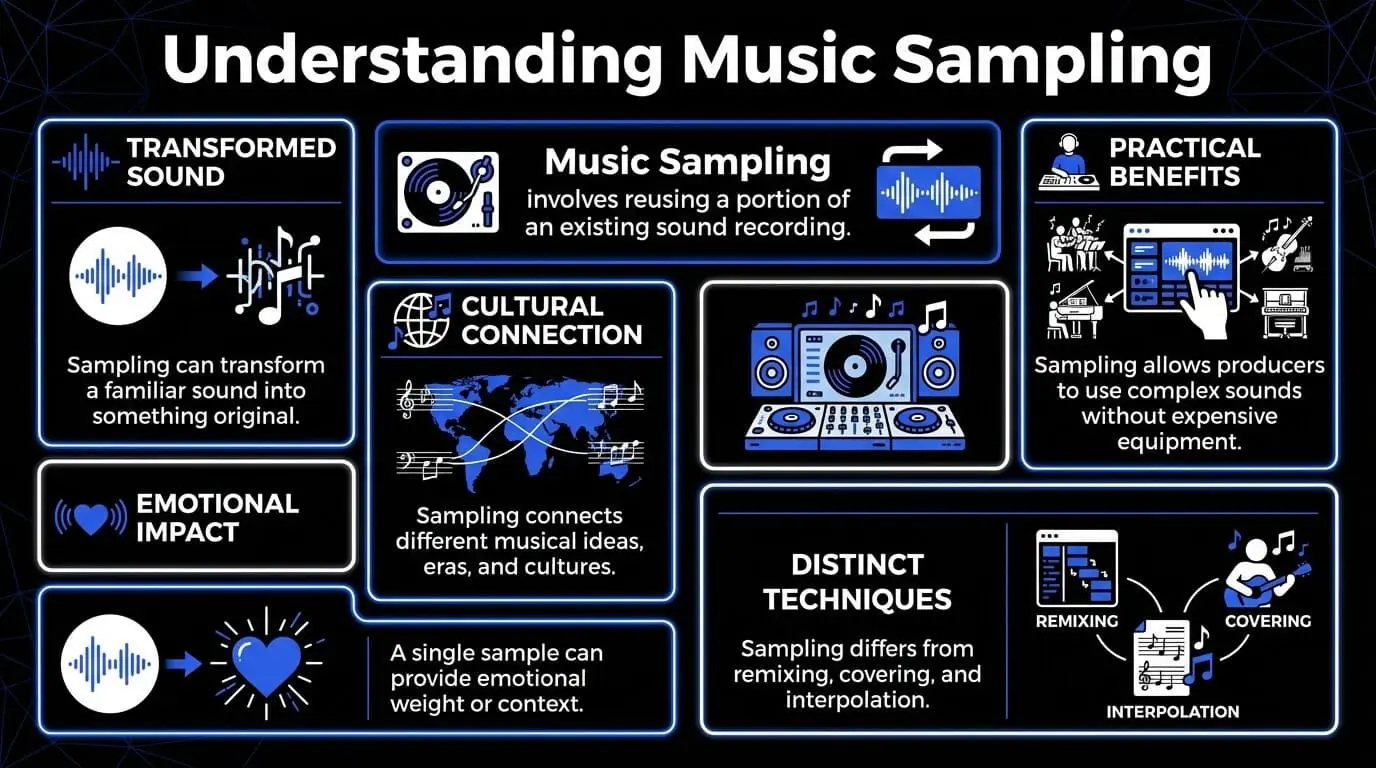
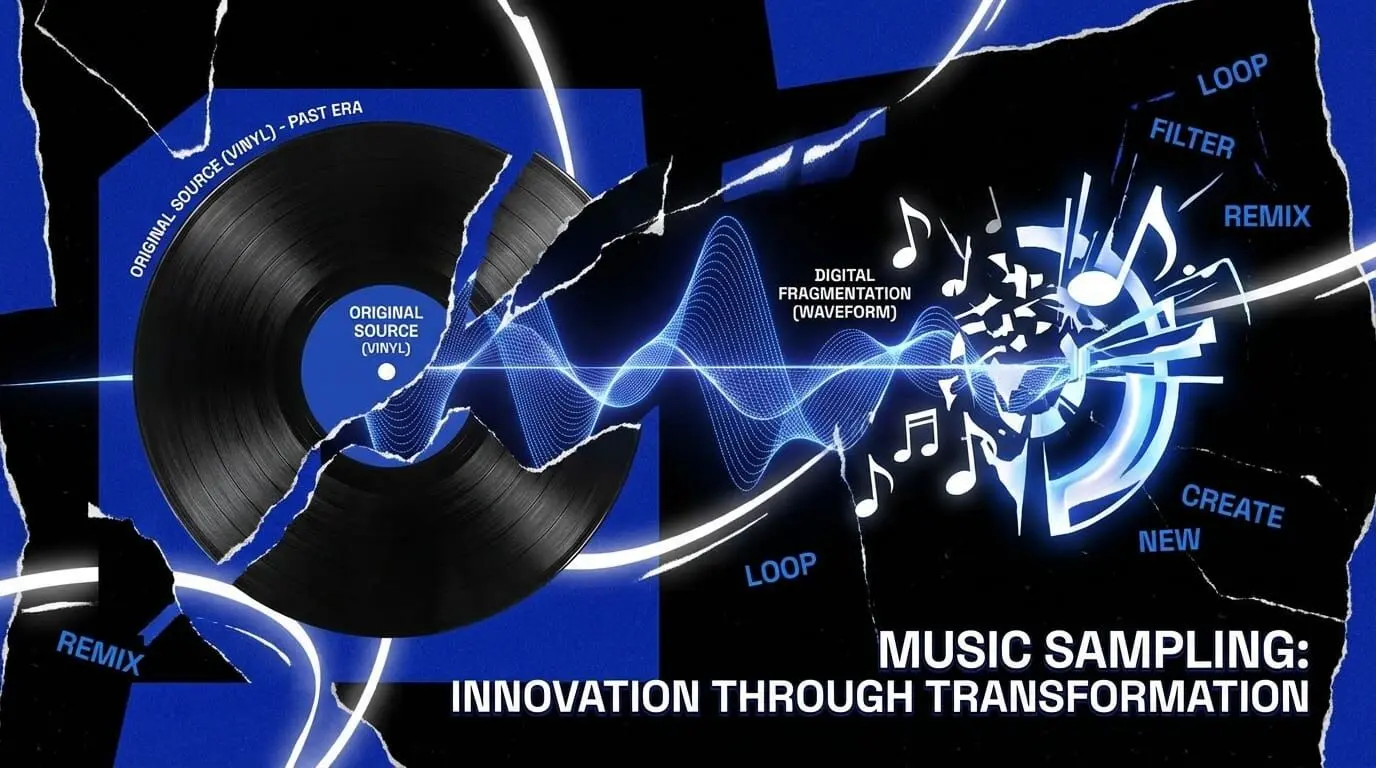
Music sampling is the practice of taking a portion of an existing sound recording and reusing it as a component in a new piece of music. This portion can be as short as a single drum hit or as long as a full instrumental phrase. Once extracted, the sample can be edited, rearranged, or processed to fit the style and structure of the new composition.
At its core, sampling is both a creative and technical process. It involves careful listening to identify sounds worth reusing, precise editing to isolate them, and thoughtful integration so that the sampled element feels like a natural part of the new track. This combination of selection, manipulation, and context is what distinguishes sampling from simple copying; it transforms a familiar sound into something original.
Why Sampling Is Popular in Modern Music
Sampling remains one of the most influential techniques in contemporary music production, owing to its unique ability to connect disparate musical ideas, eras, and cultures. Producers use it to enrich their compositions with textures that might be difficult or impossible to recreate from scratch. A single well-chosen sample can carry emotional weight, suggest context, or create instant familiarity with the listener.
Beyond aesthetics, sampling offers a practical advantage. It enables producers to work with complex, fully-realized sounds, such as live drums, choirs, or analog synthesizers, without needing access to expensive equipment or studio sessions. Instead of starting from a blank canvas, a sampled sound provides a creative prompt that can lead the direction of an entire track.
Sampling vs. Remixing vs. Covers
These terms are often used interchangeably, but they describe distinct creative approaches. Sampling involves extracting a portion of an existing recording and incorporating it into a new track. It utilizes the original audio source and may incorporate adjustments to timing, pitch, or arrangement.
A remix takes an entire song, usually with access to individual track stems, and reimagines it. The structure, rhythm, and mood might shift entirely, but the foundation remains traceable to the original work. Remixes are typically authorized and maintain the identity of the original piece, even in altered form.
A cover version is a new performance of a previously recorded song. The artist recreates the composition, often staying close to the original structure and lyrics, but reinterpreting it vocally or instrumentally. Unlike sampling or remixing, a cover doesn't reuse any of the original audio.
Interpolation refers to re-recording a part of a song, usually a melody or lyric, rather than sampling the original recording. This method is often used to avoid licensing the original master recording, though permission from the composition’s rights holders is still required.
Understanding these differences is essential not only from a creative standpoint but also for legal and ethical clarity. Each technique carries its own artistic and licensing implications, which will be explored further in later sections.
When to Use Each Approach
Choosing between sampling, remixing, covering, or interpolating depends on the artistic goal and the level of creative control required. Sampling is often the preferred method when the original audio has a distinct character that cannot be replicated. Producers may sample a vinyl crackle, a vintage breakbeat, or a vocal tone that carries emotional or historical significance. Sampling is also useful when the goal is to deconstruct and reframe a specific moment within a larger sonic context.
A remix is more appropriate when the intention is to reinterpret a full song while preserving its core identity. This is common in electronic music, where the beat, tempo, or instrumentation might change significantly, but the melodic or vocal elements remain recognizable. Remixes are usually authorized and created for official releases, competitions, or as part of promotional strategies.
A cover version is best suited for artists who want to pay tribute to an existing song while offering their own vocal or instrumental interpretation. Covers allow for creative freedom within a fixed structure and are often used in live performances, acoustic versions, or social media content.
Interpolation is typically used when a producer wants to reference a melody or lyrical phrase but re-records it instead of sampling the original audio. This can be a strategic choice to simplify licensing while maintaining the thematic connection to the source material.
Each method offers different degrees of originality, legal complexity, and emotional impact. The right choice depends on how much of the original the artist wants to retain and how much they intend to transform.
A Brief History of Sampling
Sampling began long before the rise of digital production tools. In the 1950s and 1960s, avant-garde composers such as Pierre Schaeffer and Karlheinz Stockhausen pioneered musique concrète, manipulating recorded sounds on magnetic tape by cutting, looping, and layering them. These early experiments treated audio as raw material to be sculpted—proving that recorded sound could be removed from its original context and transformed into something entirely new.
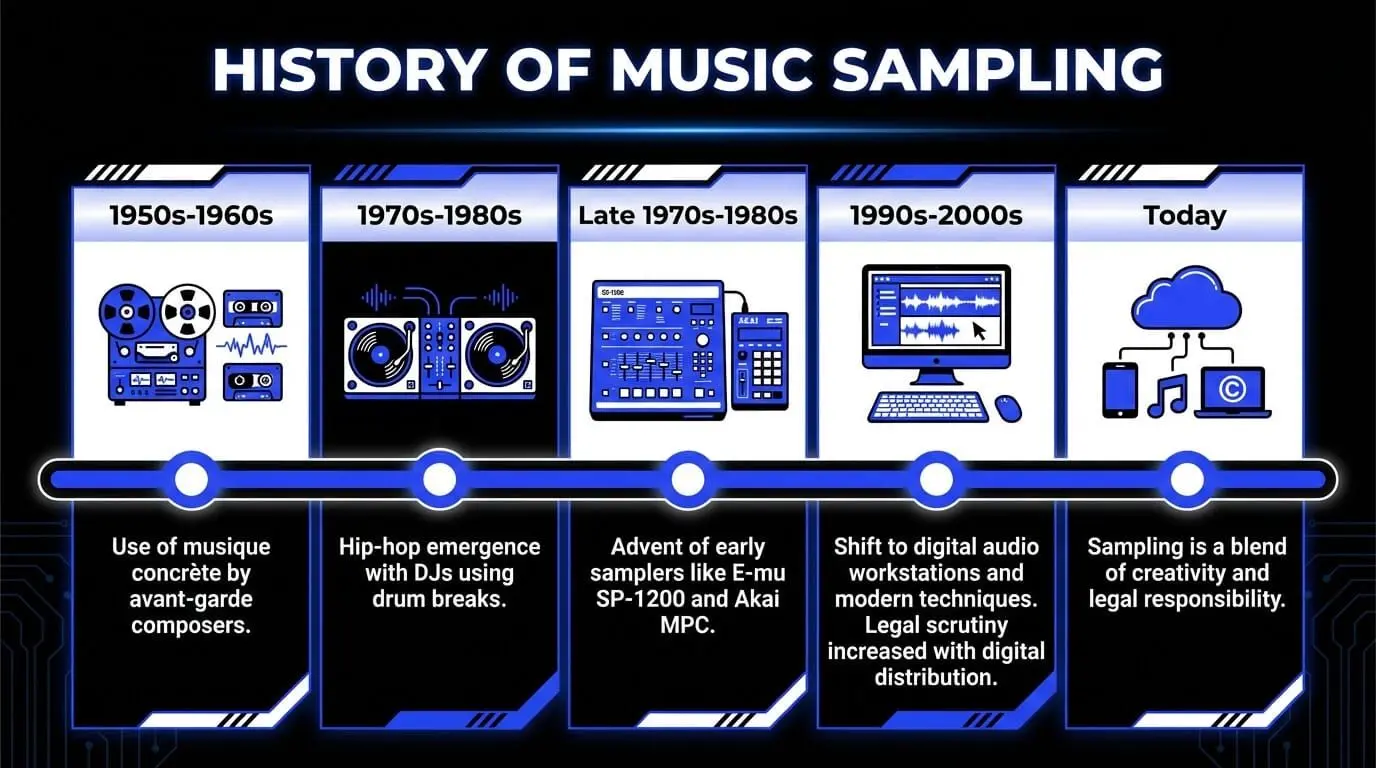
By the late 1970s and early 1980s, sampling had become a central component in the emergence of hip-hop. DJs such as Kool Herc and Grandmaster Flash looped drum breaks from funk and soul records to create extended rhythms for MCs to rap over. With the arrival of early samplers like the E-mu SP-1200 and Akai MPC, producers including Marley Marl, DJ Premier, and J Dilla began slicing and reassembling fragments from jazz, soul, funk, and classical recordings—blending technical innovation with cultural commentary. Sampling evolved into both a production technique and a creative dialogue with the past.
The transition to the digital age in the late '90s and early 2000s fundamentally changed how sampling was approached. Hardware limitations gave way to the power and flexibility of modern digital audio workstations (DAWs), where tools such as time-stretching, pitch shifting, and non-destructive editing have become standard. Sampling shifted from working within constraints to exploring near-limitless creative possibilities. What was once a byproduct of technical restrictions, like the gritty texture of early samplers, has evolved into a deliberate aesthetic choice, now emulated through plugins and effects.
At the same time, the democratization of music distribution brought increased legal scrutiny. Unauthorized sampling became easier to detect, prompting many producers to create their own sample libraries or turn to platforms offering pre-cleared material. Today, sampling sits at the intersection of creativity and legality, still a powerful artistic engine, but one that requires awareness of both innovation and responsibility.
How to Sample a Song, Step-by-Step
Sampling isn’t just about grabbing a sound and dropping it into your track. Here’s a clear, structured process to turn raw audio into something original and expressive.
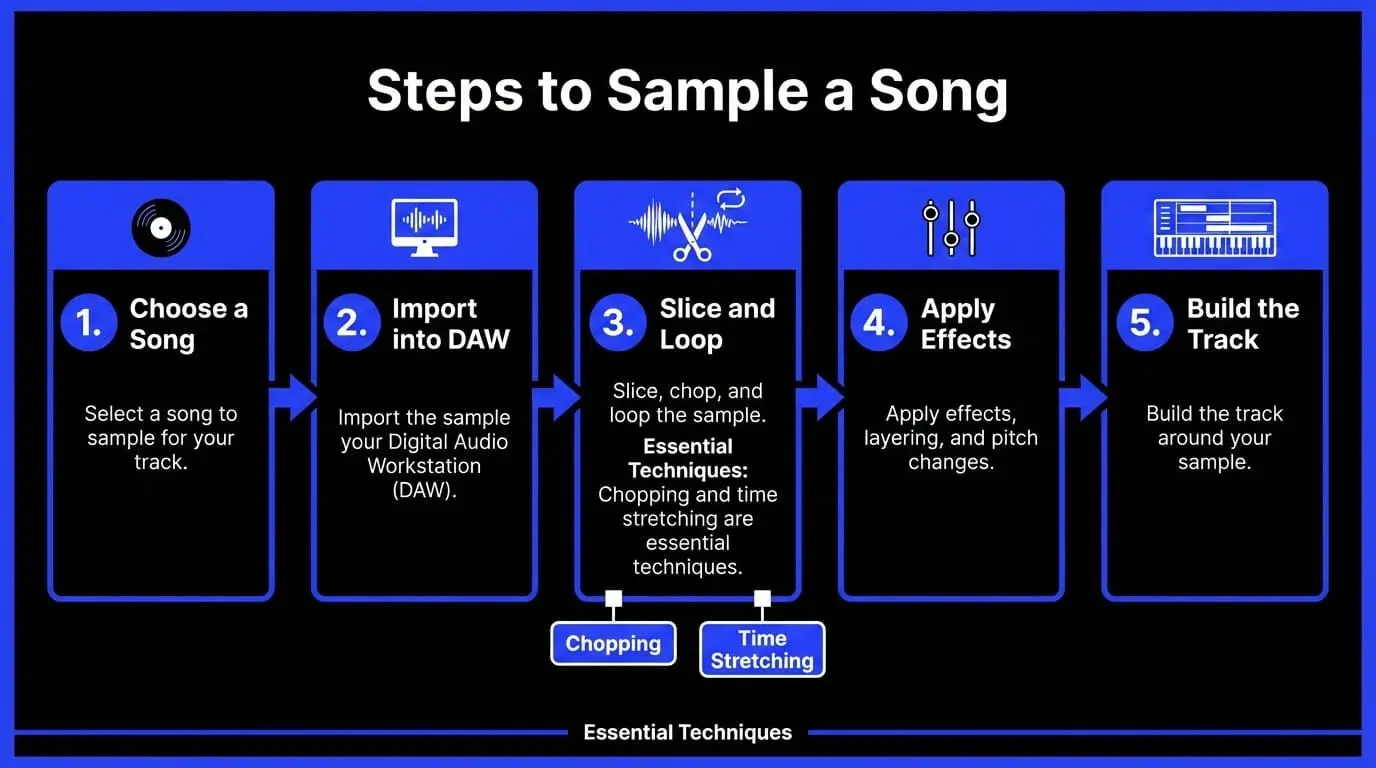
Step 1 – Choose a Song to Sample
Everything starts with the source. A great sample can inspire an entire track, so it’s worth taking time to find the right one. Beginners often lean toward familiar songs, but more seasoned producers usually dig deeper, hunting for obscure recordings, emotive textures, or sonic imperfections that spark creativity. A dusty jazz riff or ambient field recording might offer more character than a polished pop chorus.
Legal considerations matter from the beginning. If you’re planning to release your music commercially, make sure to clear the sample, use royalty-free material, record your own, or rely on platforms that offer pre-cleared content.
Step 2 – Import the Sample into Your DAW
Once you’ve selected your sample, bring it into your digital audio workstation (DAW). You can drag and drop the file directly, load it into a sampler plugin, or slice it into clips for manipulation.
Before you dive into arranging, prep your sample: trim unnecessary silence, normalize volume, or apply light EQ if needed. This stage is about establishing a clean and organized foundation for what comes next, allowing your ideas to flow uninterrupted.
Step 3 – Slice, Chop, and Loop
Now comes the transformative part. Break the sample down into usable parts: slice a loop, chop individual hits or phrases, and re-sequence them in a new way. Even a single breath, snare hit, or vocal phrase can become the centerpiece of a new rhythm or melody.
Think like a sculptor, decide what to keep, rearrange, or remove entirely. A loop can provide structure, while chopped elements offer unpredictability. This step turns borrowed material into a building block for your own ideas.
Step 4 – Apply Effects, Layering, and Pitch Changes
With the raw material shaped, you can now color it. Use EQ to carve space in the mix, reverb or delay to add atmosphere, and compression to control dynamics. These tools help the sample sit naturally in your track.
You can also layer the sample with other sounds, such as pads, basslines, and textures, to enrich its tone and make it uniquely yours. Pitch adjustments open up emotional possibilities: lower it for depth and grit, raise it for brightness or tension. This is where the sample truly comes alive.
Step 5 – Build the Track Around Your Sample
With the sample refined, it’s time to construct the full track. Add drums, basslines, melodies, transitions, and automation. The sample can act as a recurring motif or appear just once as a dramatic moment.
What matters is that the final arrangement reflects your own musical voice. Sampling isn’t about imitation. It’s about transformation. The best sampled tracks feel complete, intentional, and emotionally resonant.
Essential Sampling Techniques
Chopping
Chopping is the art of breaking a sample into smaller segments that can be rearranged, re-pitched, or triggered independently—like taking apart a sentence and turning the words into poetry.
Unlike slicing, which usually follows the grid and aims for precision, chopping is interpretive and instinctive. It’s about isolating raw, expressive moments that carry groove, emotion, or texture.
This technique is at the heart of hip-hop and experimental electronic music, where surprise and rhythm often trump perfection. A smooth melody can be fractured into jagged, percussive hits; a vocal phrase flipped into something entirely rhythmic. When done well, chopping obscures the source and creates a completely new instrument that feels alive and personal.
Time Stretching
Time stretching adjusts a sample’s length without changing its pitch. It’s useful when a sample’s rhythm is strong but its tempo doesn’t fit your track.Beyond correction, stretching is a creative tool. Extending a vocal phrase can reveal hidden textures, while extreme stretching of ambient sounds can produce evolving atmospheres perfect for sound design. Modern DAWs make this process simple, turning what was once a technical fix into a powerful artistic choice.
Pitch Shifting
Pitch shifting raises or lowers the frequency of a sample while keeping its duration intact. It can help match the sample to your track’s key or completely transform its emotional impact—turning a cheerful melody somber or a dark vocal bright.Advanced techniques like formant shifting or granular pitch processing let producers reshape timbre without losing realism, or push sounds into abstract territory. Pitch shifting is more than corrective; it redefines the sample’s role in your composition.
Reversing
Reversing plays audio backward, often resulting in unexpected textures. A reversed cymbal swell can create suspense before a drop, while reversed vocals can add an eerie or mysterious quality.It’s a simple but effective technique. When used sparingly, reversing disrupts predictability and adds tension, helping the track feel more dynamic and surprising.
EQ and Filtering
EQ and filters shape the frequency content of a sample so it fits within your mix—or deliberately stands out.Use high-pass filters to remove low-end mud, low-pass filters to tame harsh highs, or band-pass filters to focus attention on specific sonic elements.Beyond correction, EQ and filtering are compositional tools. They determine whether a sound becomes a background texture, a rhythmic element, or the track’s central hook.
Resampling
Resampling is the process of recording a processed sound into a new audio file for further manipulation. Instead of endlessly tweaking, you commit your changes—then transform them again.For example, a vocal chop can be resampled into a pad, then flipped into a percussive hit. Each round of processing adds a new character, creating textures that are difficult to replicate.Resampling isn’t just a workflow technique—it’s a mindset. It invites experimentation and helps producers shape a truly unique sonic identity.
Best Tools for Sampling
DAWs for Sampling
The digital audio workstation (DAW) is the central hub for sampling. While nearly all DAWs support basic audio editing, some are optimized for creative workflows.
Ableton Live is a favorite among sample-based producers thanks to its warp markers, clip launching, and built-in tools like Simpler, which enable fast, non-destructive editing. FL Studio is especially popular with beatmakers, offering intuitive sequencing, a strong piano roll, and plugins like Slicex that simplify chopping.
Other DAWs, such as Logic Pro or Bitwig Studio, also provide powerful sampling options. In practice, the best DAW is the one that matches your workflow and lets you move from idea to execution quickly.
VST Plugins and Effects
Beyond the DAW, plugins expand the possibilities of sampling. Instruments such as Kontakt or Serato Sample provide detailed control over slicing, mapping, and playback, surpassing what stock samplers typically offer.
On the effects side, tools like RC-20 or Decimort add texture and analog-style grit, while granular processors and spectral filters can turn a simple one-shot into something unrecognizable. These creative plugins are where producers often push samples into new sonic territory.
Sample Libraries and Packs (Free and Paid)
Sample libraries offer a convenient way to access professional-quality sounds without the need for lengthy recording sessions. Platforms like Splice and Loopmasters offer massive catalogs of royalty-free material, searchable by instrument, key, or BPM.
Premium packs from boutique sound designers go a step further, focusing on distinctive textures or rare instruments. These are especially useful when you need sounds that stand out.
The main advantage of sample libraries is legal clarity: most come with clear licenses for commercial use. Still, advanced producers often process and resample these sounds heavily to ensure originality.
Using Ace Studio to Preview and Tweak Your Compositions
Ace Studio is a valuable tool for composers and producers who want to hear how their songs sound during the early stages of development. By inputting melodies, lyrics, or MIDI data, users can generate full vocal performances that help bring musical ideas to life before any recording sessions take place.
This allows for experimentation with phrasing, harmony, and arrangement, making it easier to refine a composition before involving session musicians or vocalists. Instead of relying solely on imagination, producers can quickly audition different vocal styles or melodic interpretations and make informed, creative decisions.
In addition to vocals, Ace Studio provides a range of virtual instruments that can serve as placeholders or sketch layers within a project. This makes it easier to build a complete musical structure and shape the emotional tone of the track, even in its earliest form.
Ultimately, Ace Studio helps bridge the gap between songwriting and production, offering a flexible and practical way to test and develop musical ideas with clarity and confidence.
Legal and Ethical Aspects of Sampling
Sampling is both an artistic and a legal act. While it has driven innovation across genres, using another artist’s recording without permission can lead to copyright claims, takedowns, and lawsuits. For any producer seeking to release music commercially, understanding the legal framework is as crucial as mastering creative techniques.
What Is Sample Clearance?
Sample clearance is the process of securing the legal right to use a portion of a copyrighted recording in a new track. Two separate permissions are required: the master rights, which cover the actual sound recording (often controlled by a label), and the publishing rights, which cover the underlying composition (usually held by the songwriter or publisher).
Without both, the use of a sample remains unauthorized. Even a very short or heavily processed fragment can qualify as infringement if it is recognizable. Courts have consistently ruled that there is no “safe” minimum length, so if a producer intends to release a track publicly, clearance is almost always necessary.
From an ethical perspective, the debate around sampling is more nuanced. Many artists view it as a form of cultural dialogue, taking sounds from the past and placing them in new contexts. In contrast, others argue that it becomes exploitative if the original creators aren’t credited or compensated. This duality is part of what has kept sampling at the center of both musical creativity and legal controversy.
How to Clear Samples
Clearing a sample means obtaining legal permission to use a portion of an existing recording in your own music. This typically involves two separate rights:
- Master rights – cover the actual sound recording (usually owned by a label)
- Publishing rights – cover the composition itself (often controlled by the songwriter or publisher)
The first step is identifying the rights holders. This can be done through performance rights organization (PRO) databases, discographies, or rights management platforms. Once identified, you’ll need to reach out—typically to labels, publishers, or artist representatives—and explain how the sample will be used.
If the request is approved, the next step is to negotiate the terms. This may include a flat fee, royalty share, or even a co-writing credit. Once agreed upon, both parties sign a license agreement, which legally secures your use of the sample.
Because this process can be time-consuming and unpredictable, many producers opt for simpler alternatives. Platforms like Tracklib offer catalogs of pre-cleared music with clear pricing and usage terms, eliminating the need for direct negotiation. Others turn to royalty-free packs or generate their own material to avoid legal hurdles entirely.
For custom content, tools that allow you to create original vocal or instrumental parts—designed for resampling and manipulation—can be especially useful, particularly when clearance isn’t feasible.
Ultimately, the right approach depends on your project’s scale, timeline, and level of legal risk tolerance. Whether you're working on a commercial release or a personal experiment, treating the legal process with the same care as the creative one ensures your music is built on solid ground.
Where to Find Songs to Sample
Digging Through Vinyl or YouTube
Traditional sample digging involves searching through old vinyl records, cassette tapes, or online sources like YouTube for unique audio moments. This method offers a sense of discovery and unpredictability, finding textures, imperfections, and performances that can’t be replicated digitally.
Producers who dig through vinyl often look for forgotten tracks, obscure B-sides, or international releases. These recordings tend to carry historical or cultural weight, and their imperfections, background noise, room ambiance, and tape hiss are often what give them charm. YouTube offers a digital parallel, allowing producers to discover rare performances, live recordings, or field audio with minimal effort.
While this method can be creatively rewarding, it also presents legal and technical challenges. Most of the content is copyrighted, which means clearance is required for commercial use. Additionally, audio quality can vary widely, requiring more corrective processing in the DAW.
Still, for producers who value depth, history, and unexpected inspiration, this approach remains essential.
Sample Packs and Royalty-Free Libraries
Sample packs and royalty-free libraries offer a streamlined way to access high-quality audio material without the legal complexity of clearing copyrighted works. These collections are designed for immediate use in commercial and non-commercial projects, and often come with clear licensing terms that eliminate ambiguity.
Platforms like Splice, Loopcloud, and Noiiz offer vast catalogs of loops, one-shots, and musical phrases spanning multiple genres, ranging from jazz guitar licks to modular synth textures. Many of these packs are created by professional musicians and sound designers, ensuring that the material is both sonically rich and compositionally valuable.
For producers focused on workflow speed or working under deadlines, these libraries provide consistency and convenience. More importantly, they can serve as raw material for further transformation, chopping, resampling, and layering, giving each producer the freedom to imprint their own sonic identity.
Royalty-free content doesn't mean generic content. Advanced users often use these packs as building blocks, heavily processing them to extract unique fragments that evolve into original compositions.
Platforms Like Tracklib
Tracklib has become one of the most trusted platforms for producers who want to sample real, commercially released music without navigating complex legal negotiations. Instead of contacting labels and publishers directly, users can explore a curated catalog of pre-cleared tracks, complete with transparent licensing terms. Songs are searchable by genre, decade, key, or mood, and many offer access to multitrack stems—making integration into a session seamless.
This model preserves the authenticity and emotional weight of original recordings while eliminating the legal uncertainty that often surrounds sampling. For professional or high-visibility projects, this level of clarity is invaluable.
Alongside Tracklib, other modern tools have expanded how producers source usable material. Some platforms allow users to generate original vocals or instrumental phrases on demand, offering a customizable alternative when licensing isn’t practical. These elements can be manipulated just like traditional samples—chopped, pitched, layered—but without the clearance concerns tied to existing recordings.
For many producers, combining licensed catalogs like Tracklib with original or generative content creates a flexible workflow that honors the past while shaping something entirely new.
FAQ About Sampling
Can I sample music for free?
You can freely sample for learning, practice, or private projects. But the moment you want to release or monetize a track, clearance is required if the source is copyrighted. Even a very short or heavily altered fragment can be flagged as infringement.For worry-free sampling, many producers rely on royalty-free packs, public domain recordings, or AI-generated content (like Ace Studio outputs), which don’t require clearance and can be used commercially without risk.
What makes a sample legally recognizable?
There is no safe minimum length. A single note, drum hit, or short phrase can still be considered infringement if it’s recognizable or traceable to the original work. Courts focus less on length and more on whether the borrowed material is identifiable. If your track relies on a sample as a key element, assume it needs clearance.
How do producers make samples sound original?
The art of sampling isn’t just copying; it’s transformation. Producers chop audio into fragments, rearrange timing, pitch-shift, add effects, or resample it into entirely new textures. A vocal phrase can become a pad, a guitar riff can be flipped into a percussive hit. The more you recontextualize a sound, the more it becomes part of your own musical vocabulary.
Is it better to use royalty-free samples or clear copyrighted ones?
Both approaches have value. Royalty-free and AI-generated samples are safe, fast, and cost-effective, which is why many independent producers rely on them for their projects. Cleared copyrighted samples, on the other hand, bring the cultural weight of recognizable recordings and can create an instant emotional impact, but require negotiation, time, and sometimes significant fees. The choice depends on your artistic goals, budget, and release plans.
What happens if I release a track with uncleared samples?
If a track goes unnoticed, you might get away with it temporarily, but if it gains traction, you risk takedowns, lost revenue, or legal action. Platforms like Spotify and YouTube, as well as distributors, increasingly use automated systems to detect copyrighted audio. In practice, uncleared samples are a gamble: they can stall your release or even result in your earnings being redirected to the rights holders.