

Key Takeaways
- Metric modulation changes how the listener feels the pulse by turning an existing note value, subdivision, or rhythmic grouping into a new beat.
- Rhythmic pivot points are the key to making the shift sound intentional, because they connect the old groove to the new rhythmic feel.
- Implied metric modulation can create the feeling of a tempo or meter change without changing the DAW BPM, which makes it useful for modern production, live performance, and loop-based music.
- Polyrhythms, displacement, time signature changes, and tempo automation can all support metric modulation, but they are not the same thing and should be used with different production goals in mind.
- ACE Studio can help producers test metric modulation with editable AI voices, instruments, stems, and MIDI, making it easier to hear whether a rhythmic pivot feels musical before committing to the full arrangement.
How Metric Modulation Reshapes the Feel of Time
Metric modulation is one of the most effective advanced rhythm techniques for making music feel as if it has changed speed, meter, or gravity without losing its internal logic. It can make a groove feel wider, tighter, heavier, lighter, more unstable, more cinematic, or more improvisational. For composers, producers, drummers, beatmakers, arrangers, and jazz musicians, it offers a controlled way to reshape time itself.
This guide explains metric modulation techniques from the ground up, including rhythmic pivot points, implied metric modulations, musical meter changes, polyrhythmic structures, time signature shifts, and practical DAW workflows for modern music production.
What metric modulation means
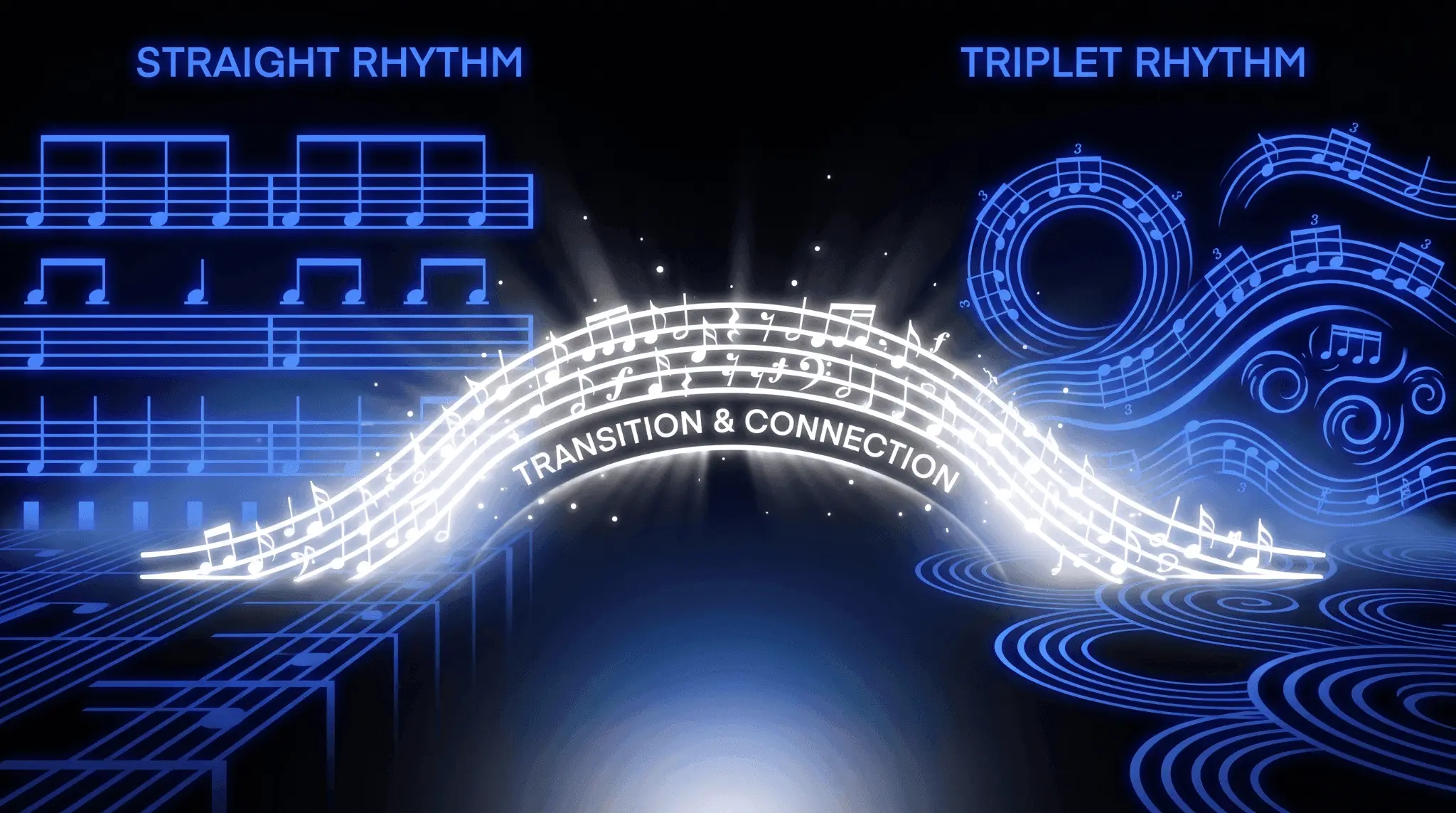
Metric modulation is a rhythmic process where a note value, subdivision, or grouping from one pulse becomes the reference point for a new pulse. In tonal harmony, modulation moves from one key center to another through a relationship the ear can follow. In rhythm, metric modulation moves from one sense of time to another through a shared rhythmic value.
The most important idea is simple: the listener hears something that already exists in the first groove, then that same thing becomes the organizing beat of the next groove. The transition feels surprising because the music has changed its rhythmic frame. It feels coherent because the change was prepared by an audible connection.
A producer might start with a straight four beat drum groove, introduce a repeating triplet figure, and then allow that triplet figure to become the new perceived beat. A jazz drummer might imply a faster tempo by phrasing over dotted quarter groupings. A composer might use a notated relationship where a note value from the old meter becomes a different note value in the new meter. In every case, the ear follows a rhythmic bridge.
Metric modulation vs related rhythm concepts
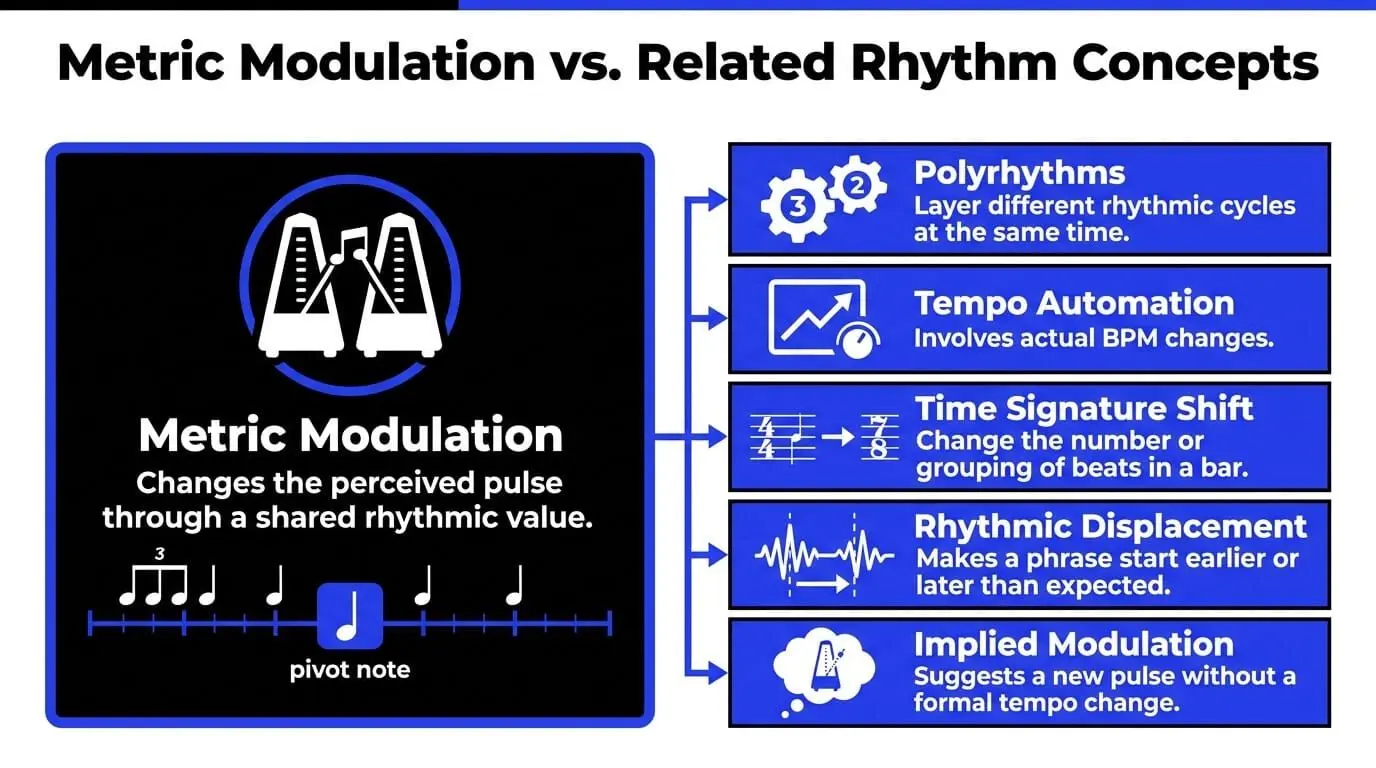
Many producers confuse metric modulation with polyrhythm, tempo automation, syncopation, or time signature changes. These concepts overlap, but each one answers a different musical question.
| Concept | What changes | How it feels | Common use |
|---|---|---|---|
| Metric modulation | The perceived pulse changes through a shared rhythmic value. | A smooth but surprising shift in tempo feel or meter. | Jazz phrasing, prog transitions, cinematic pivots, EDM buildups. |
| Tempo automation | The actual BPM changes in the DAW or score. | The whole track speeds up or slows down. | Risers, film cues, rubato passages, dramatic transitions. |
| Time signature shift | The number or grouping of beats in the bar changes. | The bar length or accent cycle changes. | Odd meter sections, progressive rock, metal, fusion. |
| Polyrhythm | Two or more rhythmic patterns run together. | Layered tension between different cycles. | Drums, percussion, Afro-diasporic grooves, jazz, electronic music. |
| Rhythmic displacement | A phrase starts earlier or later than expected. | A groove feels pushed, delayed, or off balance. | Hip-hop drums, syncopated bass, melodic motifs, fills. |
| Implied modulation | The performance suggests a new pulse without a formal tempo change. | The listener feels a temporary alternate tempo. | Solos, fills, breakdowns, transitions, live improvisation. |
Why metric modulation matters in modern music production
Metric modulation is not only a notation technique for concert music. It is a practical production tool. It helps creators solve a common problem: how to create motion and surprise without relying on the same predictable arrangement devices. Filter sweeps, snare rolls, risers, reverse cymbals, and automation ramps are useful, but they can become generic. Rhythmic modulation changes the structural feel of the music itself.
In a DAW environment, metric modulation can be created with MIDI grids, clip lengths, audio warping, loop slicing, automation, groove templates, effect timing, delay subdivisions, or live performance layers. It can be obvious, as in a dramatic shift from a straight feel to a triplet feel. It can also be nearly hidden, as when a hi-hat pattern makes the groove lean into a new pulse while the kick remains stable.
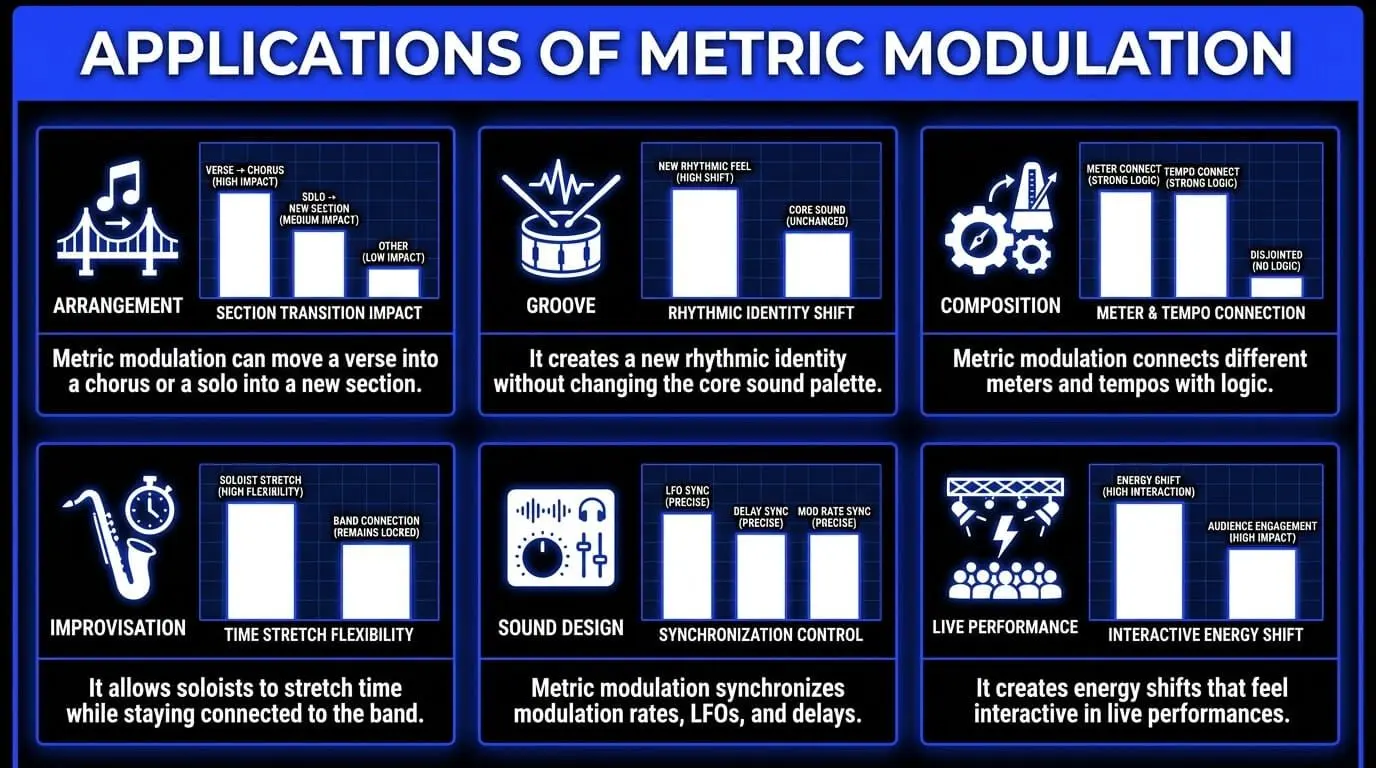
The technique is especially valuable because it works on multiple levels:
- Arrangement: It can move a verse into a chorus, a breakdown into a drop, or a solo into a new section.
- Groove: It can create a new rhythmic identity without changing the core sound palette.
- Composition: It can connect different meters and tempos with logic rather than abrupt cuts.
- Improvisation: It gives soloists a way to stretch time while staying connected to the band.
- Sound design: It can synchronize modulation rates, LFOs, delays, and gates to changing rhythmic feels.
- Live performance: It can create energy shifts that feel interactive rather than pre-programmed.
The core mechanism: rhythmic pivot points
Rhythmic pivot points are the heart of metric modulation. A pivot point is the note value or rhythmic grouping that belongs to both the old pulse and the new pulse. It is the common element that allows the ear and the performer to cross from one metric world into another.
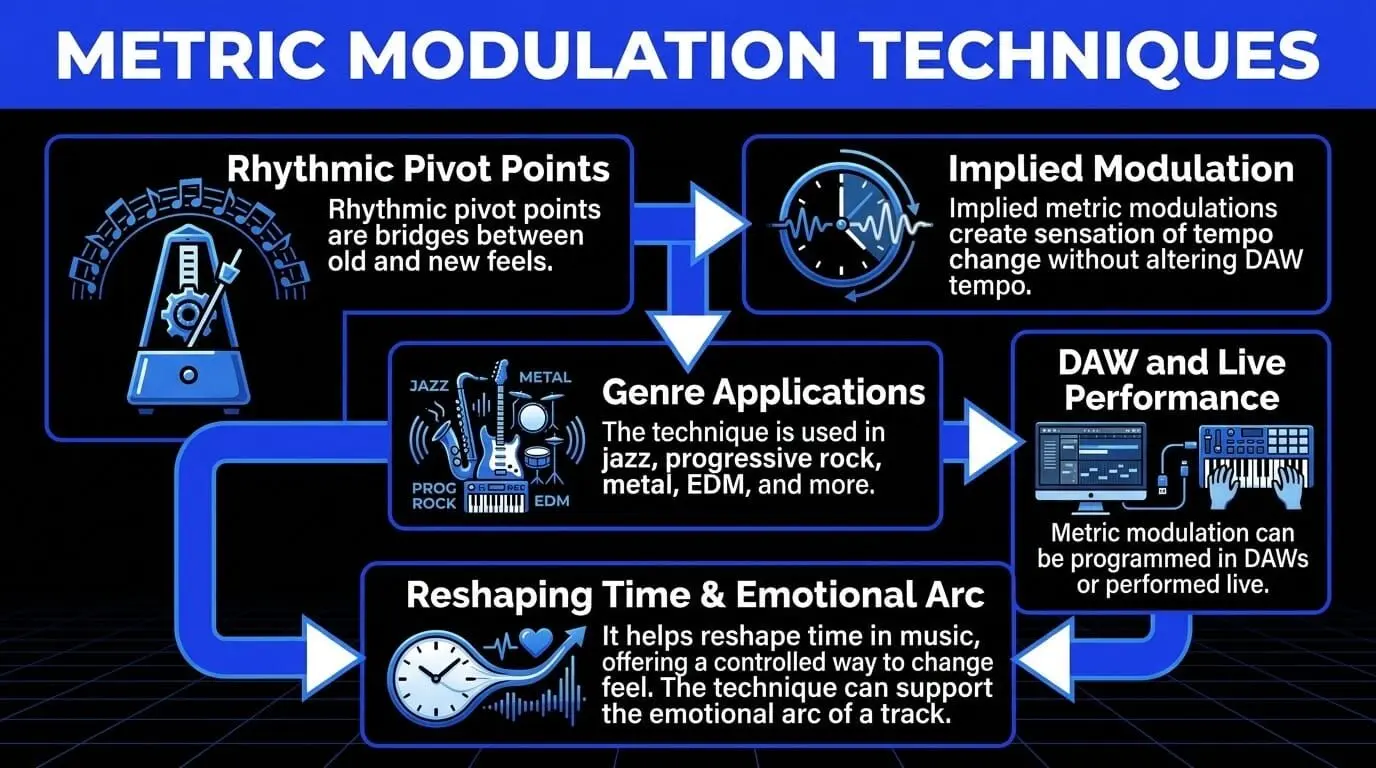
Think of a pivot point as a handshake between two rhythmic systems. In the first system, the shared value may function as a subdivision. In the second system, that same value may function as the main beat. When the music reassigns the role of that value, the listener experiences a new tempo feel.
How a pivot works in practice
Imagine a groove where the main beat is steady, but a percussion part repeatedly accents every three subdivisions. At first, the listener hears those accents as syncopation inside the original groove. After several repetitions, the arrangement can make those accents feel more important by thinning the kick, changing the bass rhythm, or moving the snare to support the new accent cycle. The repeated subdivision becomes the new center of gravity. This is a metric modulation in practical production terms.
The same idea can happen in notation. A composer can show that a subdivision from the previous meter becomes the new beat in the next meter. The notation may look technical, but the musical point is direct: the performer does not guess the new tempo. The performer follows the shared rhythmic value.
Types of pivot points
- Subdivision pivots: A smaller note value, such as an eighth note or triplet subdivision, becomes the basis of the new pulse.
- Beat pivots: The existing beat is regrouped into a new meter or accent pattern.
- Tuplet pivots: Triplets, quintuplets, or septuplets become the foundation for a new rhythmic feel.
- Pattern pivots: A repeating rhythmic cell, rather than a single note value, becomes the new reference point.
- Accent pivots: The timing does not change, but the accents make the listener perceive a different pulse.
- Texture pivots: A rhythmic sound design layer, such as a gated pad or delay feedback pattern, becomes the perceived pulse.
Implied metric modulation
Implied metric modulation occurs when the music makes the listener feel a new meter or tempo without fully changing the notated tempo or DAW BPM. This is especially useful in jazz, hip-hop, electronic music, and live performance because it allows rhythmic freedom while keeping the track or ensemble anchored.
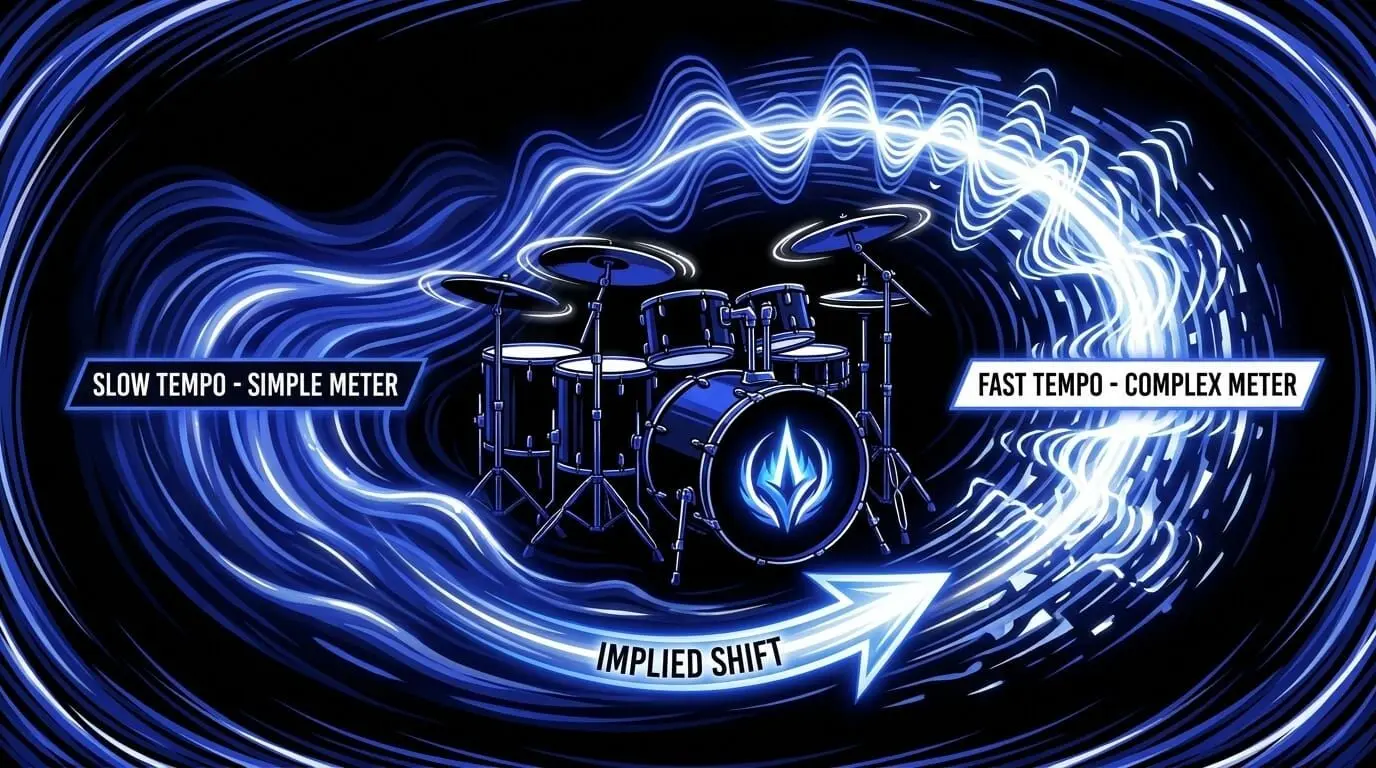
In implied modulation, the grid may stay the same. The drummer, producer, or soloist changes the phrasing. A hi-hat line may suggest triplets against a straight kick. A bass riff may accent every five subdivisions across a four beat bar. A synth arpeggio may repeat in a cycle that does not restart with the bar. The listener senses a temporary metric shift even though the master tempo has not changed.
Why implied modulation is powerful
Implied modulation is often more useful than a literal tempo change because it creates tension without breaking the track. It lets a producer build excitement while avoiding technical problems such as warped audio artifacts, mismatched delays, or awkward tempo map edits. It also lets performers return to the original groove with dramatic clarity.
For example, a trap beat can keep a steady kick and snare pattern while the hi-hats move from straight sixteenth notes to triplet bursts and then to a grouping that suggests a new tempo. The underlying BPM remains stable, but the surface rhythm feels transformed. In a jazz setting, a drummer can play a phrase that suggests a different tempo over the same walking bass, then resolve back into the original swing feel.
Metric modulation, polyrhythms, and polyrhythmic structures
Polyrhythms are a major doorway into metric modulation, but they are not the same thing. A polyrhythm layers two rhythmic divisions against each other. Metric modulation uses one of those divisions as a bridge into a new pulse. In other words, a polyrhythm can prepare the modulation, while the modulation changes the listener's point of reference.
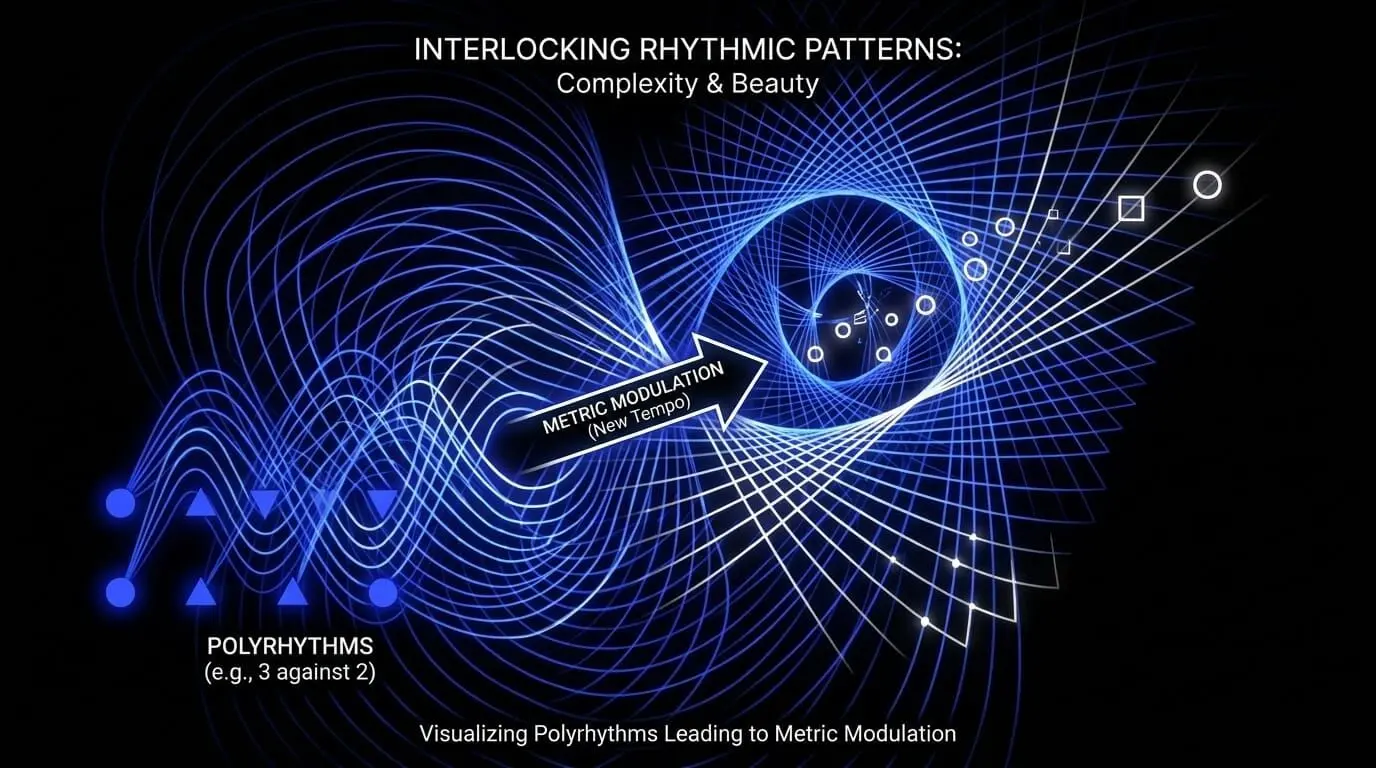
A simple example is a two against three relationship. One layer divides a span of time into two equal parts, while another divides the same span into three equal parts. If the three part layer is repeated and emphasized, it can start to feel like the dominant pulse. The producer can then make that pulse the basis of a new groove. The result is a smooth rhythmic pivot rather than an arbitrary change.
The same principle applies to larger polyrhythmic structures. A four beat drum loop can be layered with a three beat synth sequence, a five step percussion loop, or a seven note bass pattern. These polyrhythmic patterns create a field of rhythmic tension. When one pattern becomes the new anchor, the listener experiences metric modulation.
A note on multiphonic rhythms
The phrase multiphonic rhythms is not as standardized as polyrhythms or metric modulation in formal music theory. In music production, however, it can describe layered rhythmic sound events where several timbres or voices create a composite rhythmic texture. A gated pad, chopped vocal, percussion loop, and delay pattern can combine into one rhythmically active mass. When that mass begins to imply a new pulse, it can function like a production-based path into metric modulation.
For clarity in professional writing, use precise terms when possible. Say polyrhythmic structures, layered rhythmic cells, cross-rhythms, tuplets, or composite rhythm. Use multiphonic rhythms only when describing timbral layers that behave rhythmically as a group.
Practical metric modulation examples
The following examples use plain language rather than notation formulas, so they can be read easily in Google Docs and adapted to any DAW or instrument.
Example one: straight pulse to triplet pulse
Start with a beat in a straight four feel. The kick lands on the main beats, the snare supports the backbeat, and the hi-hats play straight subdivisions. Next, introduce a percussion or melodic phrase that accents every third subdivision. At first, this phrase sounds like syncopation. Repeat it long enough for the listener to recognize it. Then reduce the original groove elements and let the three based accent pattern become the new pulse.
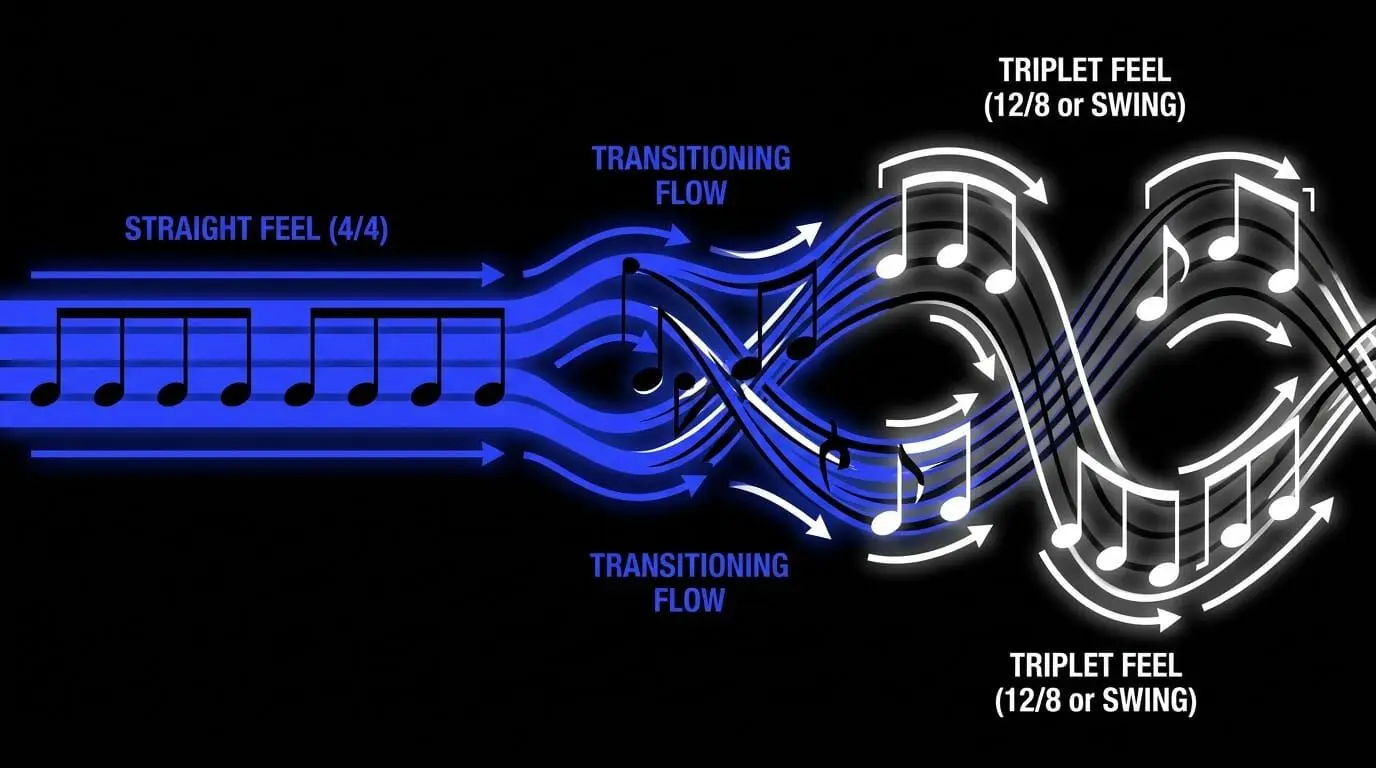
This creates the feeling of a faster or rolling tempo without necessarily changing the DAW BPM. It works well in buildups, drum fills, jazz solos, progressive rock transitions, and electronic breakdowns.
Example two: six against four
A six against four relationship divides the same span of time into six pulses in one layer and four pulses in another. In beginner practice, clap or program the four pulse layer first so the original meter feels stable. Then add the six pulse layer on top. Once the six pulse layer becomes comfortable, start phrasing as if those six pulses are the new organizational grid.
This is useful because it teaches the body and ear to move between two tempos without losing the shared span of time. In production, a six against four modulation can make a transition feel like it widens into compound meter or tightens into a faster subdivision depending on which layer becomes the anchor.
Example three: two against three
A two against three relationship is one of the most useful entry points into metric modulation. One layer has two evenly spaced pulses, while the other has three evenly spaced pulses across the same duration. In a DAW, program a two pulse kick or chord rhythm, then add a three pulse percussion or pluck pattern. After the listener hears both layers, remove or soften the two pulse layer and let the three pulse layer lead.
This can create an elegant tempo modulation because the new pulse was present before it became dominant. It is especially effective in jazz improvisation, neo-soul drum programming, progressive electronic music, and cinematic underscore.
Example four: rhythmic displacement into modulation
Rhythmic displacement shifts a phrase earlier or later than expected. On its own, displacement creates syncopation. When repeated and emphasized, it can also prepare metric modulation. For example, move a snare ghost note pattern forward by one subdivision every bar. The listener first hears a groove variation, then a growing instability. If a later section locks into one of those displaced accents as the new pulse, the displacement becomes the setup for modulation.
How to practice metric modulation without notation
Competitor content often jumps from examples into instructions without fully explaining how to internalize the technique. The best practice method is gradual. You want to train the body, then the voice, then the instrument or DAW. If you try to solve everything intellectually, the modulation will sound stiff. If you only feel it without understanding the pivot, it may fall apart under pressure.
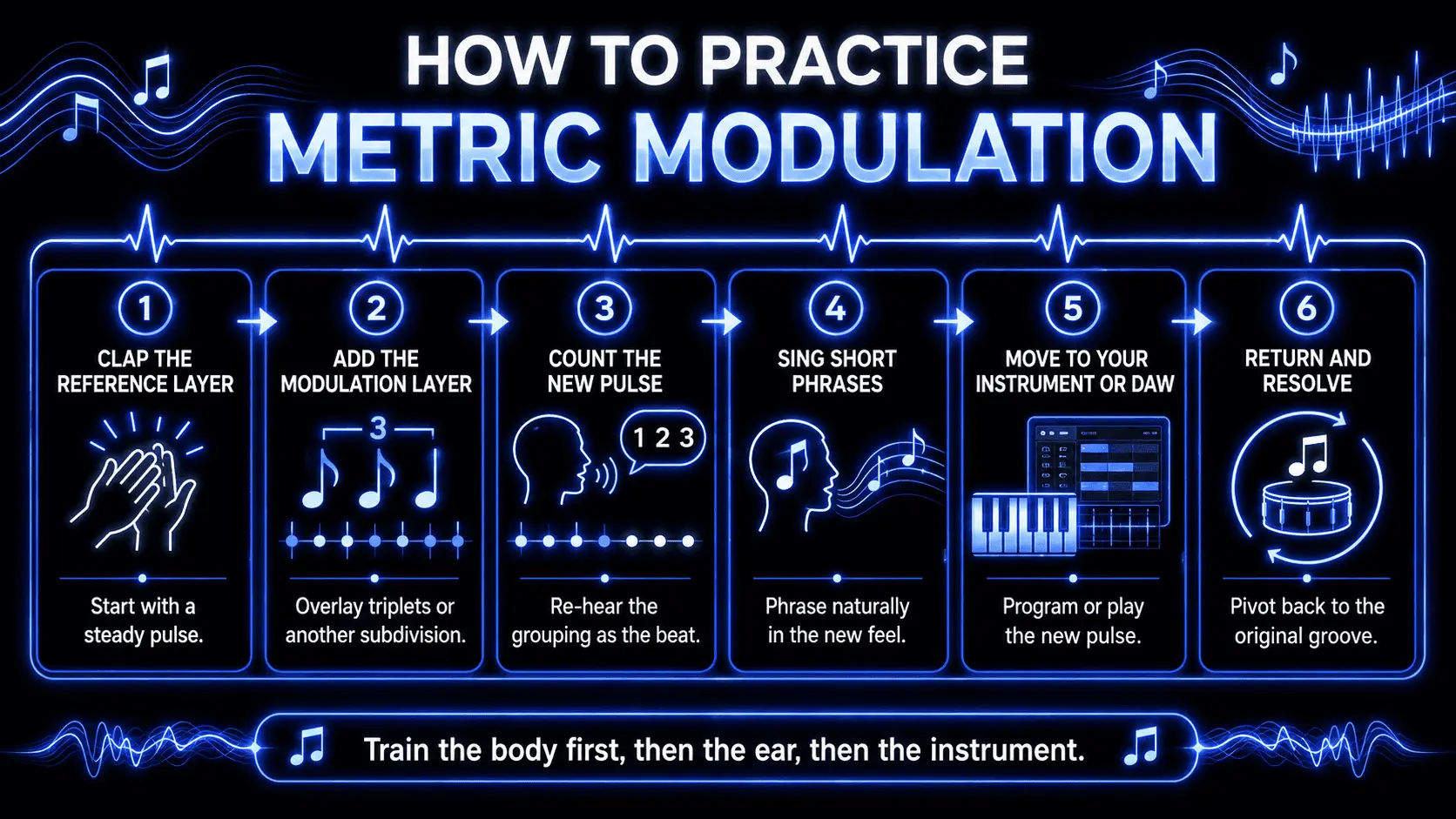
Step one: clap the reference layer
Choose a simple pulse and clap it steadily. Do not add complexity yet. Count out loud until the pulse feels stable. The purpose is to establish an internal clock. Producers can do this by programming a simple click, kick, rim, or closed hat pattern.
Step two: add the modulation layer
Add the second layer, such as a triplet pattern, a six pulse pattern, or a three pulse pattern over a two pulse reference. At this stage, the original pulse remains stronger. The modulation layer should feel like an overlay, not the new tempo yet.
Step three: count the new pulse
Once the second layer feels stable, count it as if it is the main pulse. This is the turning point. The same physical rhythm now has a new meaning. That shift in meaning is the essence of metric modulation.
Step four: sing phrases in the new feel
Before using an instrument, sing short rhythmic ideas over the new pulse. Singing forces musical phrasing rather than mechanical execution. It also reveals whether the modulation is truly internalized. If you can sing a phrase naturally in the new feel, you can probably perform or program it more convincingly.
Step five: move to your instrument or DAW
Play the new phrase on drums, bass, guitar, keys, voice, or MIDI. In a DAW, duplicate the original loop, change the rhythmic grid, and program the same idea against the new pulse. Keep one anchor from the old groove so the listener has a point of reference.
Step six: move back and forth
The final skill is returning. Play or program a phrase in the original pulse, pivot into the new pulse, then resolve back. This is where metric modulation becomes musical rather than academic. The resolution tells the listener that the shift was intentional.
Metric modulation in DAWs
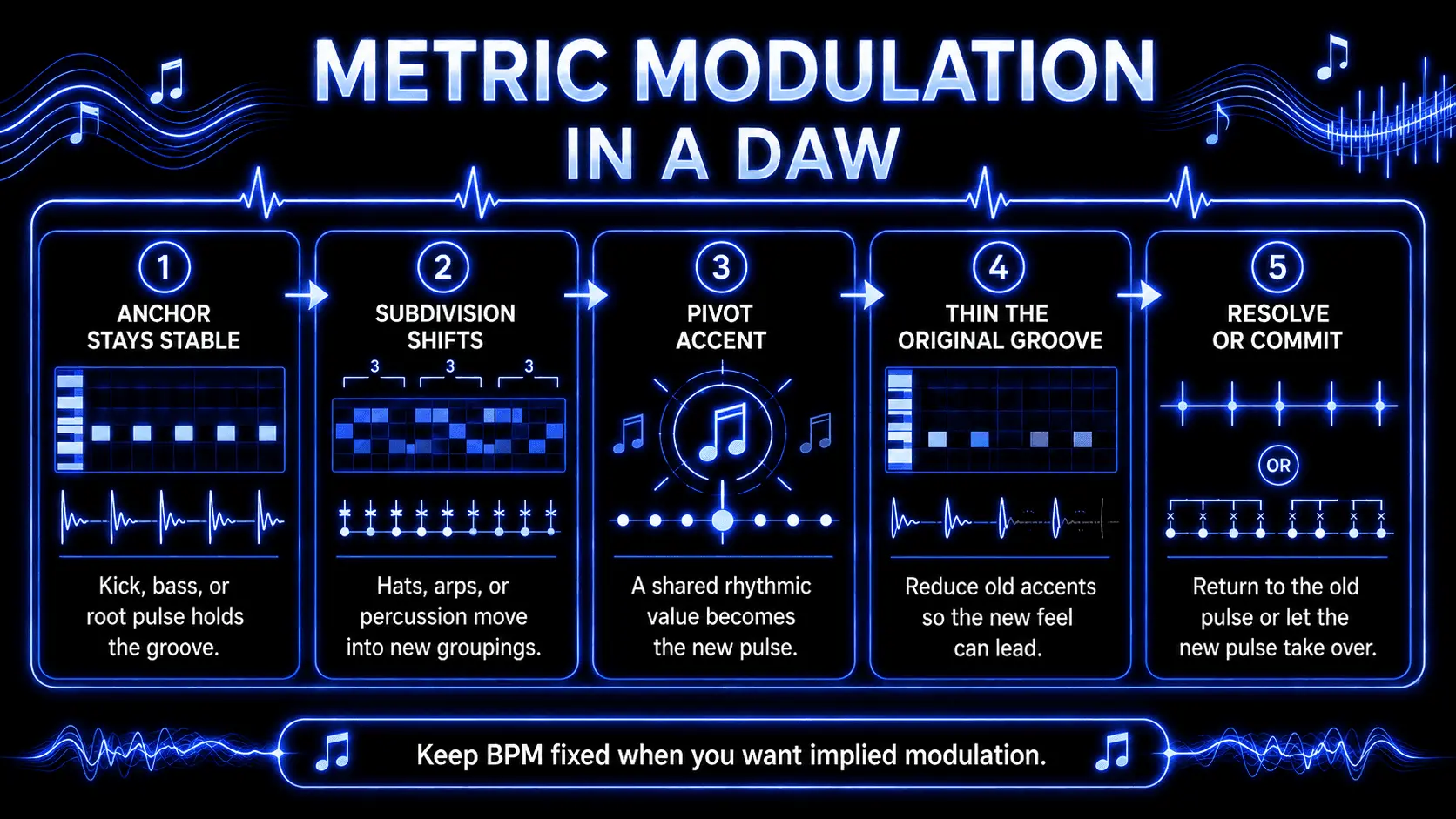
Modern DAWs make metric modulation easier to explore because you can separate the actual tempo from the perceived rhythmic feel. You can keep the BPM fixed while changing grids, subdivisions, clip lengths, MIDI note groupings, and effect timing. You can also create true tempo maps when the piece requires formal tempo modulation.
MIDI grid manipulation
The simplest DAW method is to change the grid used by one element while leaving the rest of the arrangement stable. For example, keep the kick and bass on a straight grid while the hi-hats, arpeggio, or percussion loop move into triplets or quintuplet-style groupings. The contrast creates rhythmic tension. If the new layer becomes dominant, the listener begins to feel a new pulse.
- Use a straight grid for the anchor element.
- Use triplet or irregular subdivisions for the modulation layer.
- Emphasize the pivot with accents, velocity, filter movement, or transient shaping.
- Reduce the original anchor when you want the new pulse to take over.
- Bring the anchor back clearly when you want the modulation to resolve.
Audio warping and loop slicing
Audio loops can also participate in metric modulation. Slice a drum break into hits, then rearrange those hits into a new grouping. Alternatively, use warping or time stretching to make a loop fit a new rhythmic context. The key is to avoid random stretching. The new feel should connect to a clear pivot from the original material.
For sampled music, metric modulation can be especially expressive. A vocal chop can start as a syncopated texture, then become the new rhythmic center. A guitar loop can be sliced into a five note pattern that repeats over a four beat drum groove. A field recording can be gated into a repeating pulse that gradually takes over the arrangement.
Tempo automation vs implied modulation
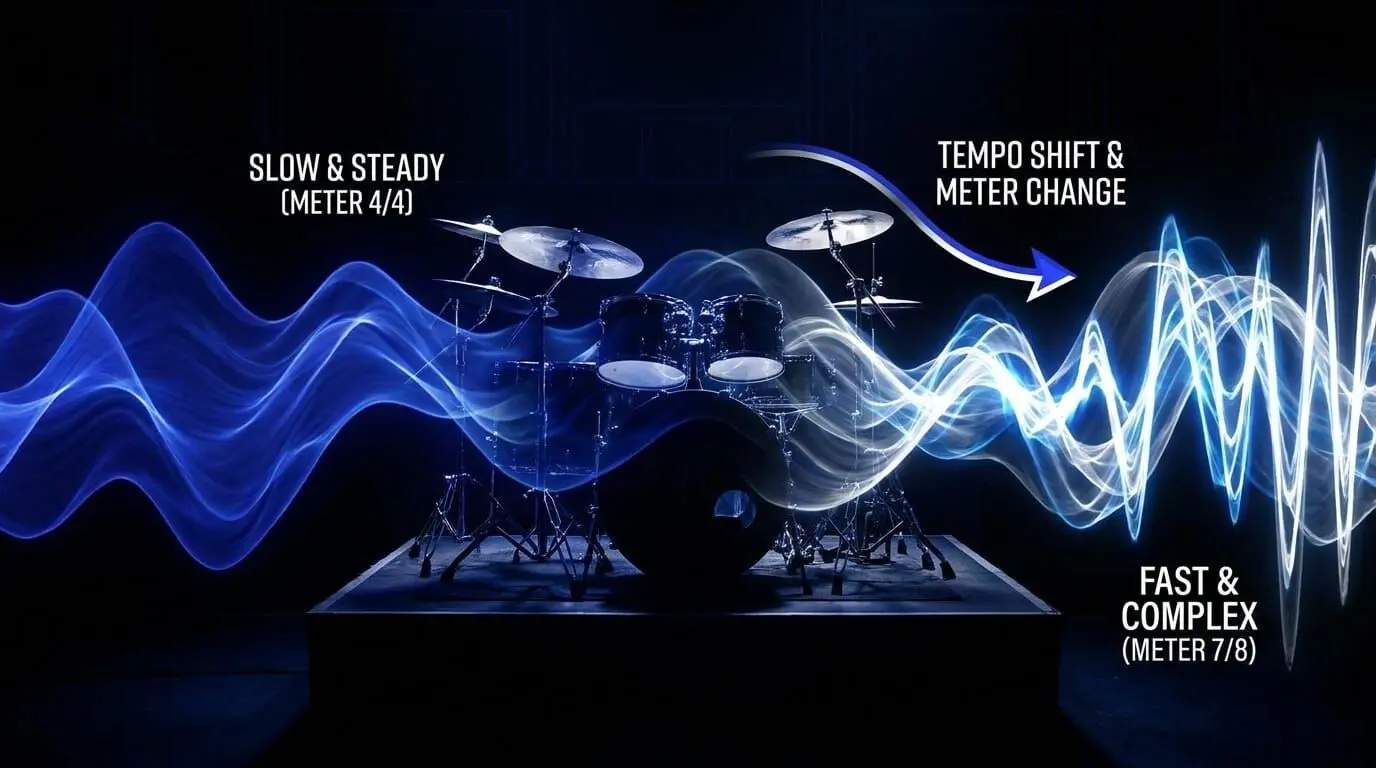
Tempo automation changes the actual BPM. Implied modulation changes what the listener feels as the beat. Both can be useful, but they solve different problems. Use actual tempo automation when every element must physically speed up or slow down. Use implied modulation when you want the excitement of a tempo change without disturbing the master grid.
| Production choice | Best when | Risk | Practical solution |
|---|---|---|---|
| Actual tempo automation | Film cues, rubato passages, live band arrangements, dramatic transitions. | Delay, reverb, and warped audio can behave unpredictably. | Print important effects or automate them carefully through the tempo change. |
| Implied modulation | EDM, hip-hop, loop-based production, live sets, beat switches. | The listener may miss the shift if the accent pattern is unclear. | Use velocity, arrangement thinning, and sound selection to highlight the pivot. |
| Time signature change | Progressive rock, metal, fusion, contemporary composition. | The groove can feel interrupted if the phrase is not prepared. | Preview the new meter with a motif before changing the bar structure. |
| Polyrhythmic layering | Ambient, techno, Afro-influenced grooves, experimental music. | Too many cycles can clutter the mix. | Keep the low end simple and place complex layers in mid or high frequencies. |
How ACE Studio Helps You Hear Metric Modulation Before You Commit
Metric modulation is easy to explain on a grid and much harder to judge by ear. A dotted-quarter pulse can look correct. A triplet pivot can be mathematically clean. A five-note ostinato can line up exactly where you planned it. But the real question is not whether the calculation works. The question is whether the listener feels the shift as music.
That is where ACE Studio can be useful in a very specific way. It lets you turn rhythmic ideas into editable performances, so you can hear how a modulation behaves through voices, instruments, stems, and MIDI before building the full arrangement around it.
For example, imagine a section in 4/4 where the hi-hats begin accenting every third sixteenth note. At first, that pattern feels like syncopation. After a few bars, you want that grouping to become the new pulse. In a normal MIDI sketch, you may only hear clicks, drums, or a basic piano sound. In ACE Studio, you can assign the same rhythmic idea to an AI voice, string line, saxophone phrase, trumpet part, or layered ensemble and hear whether the phrase actually breathes.
That matters because metric modulation is often carried by phrasing, not only by drums. A vocal line can stretch across the barline and make the old tempo feel unstable. A cello ostinato can repeat in a grouping of three while the kick stays grounded. A choir entrance can reinforce the new pulse by placing syllables on the pivot accents. A brass stab can make the listener accept the new downbeat before the drums fully move there.
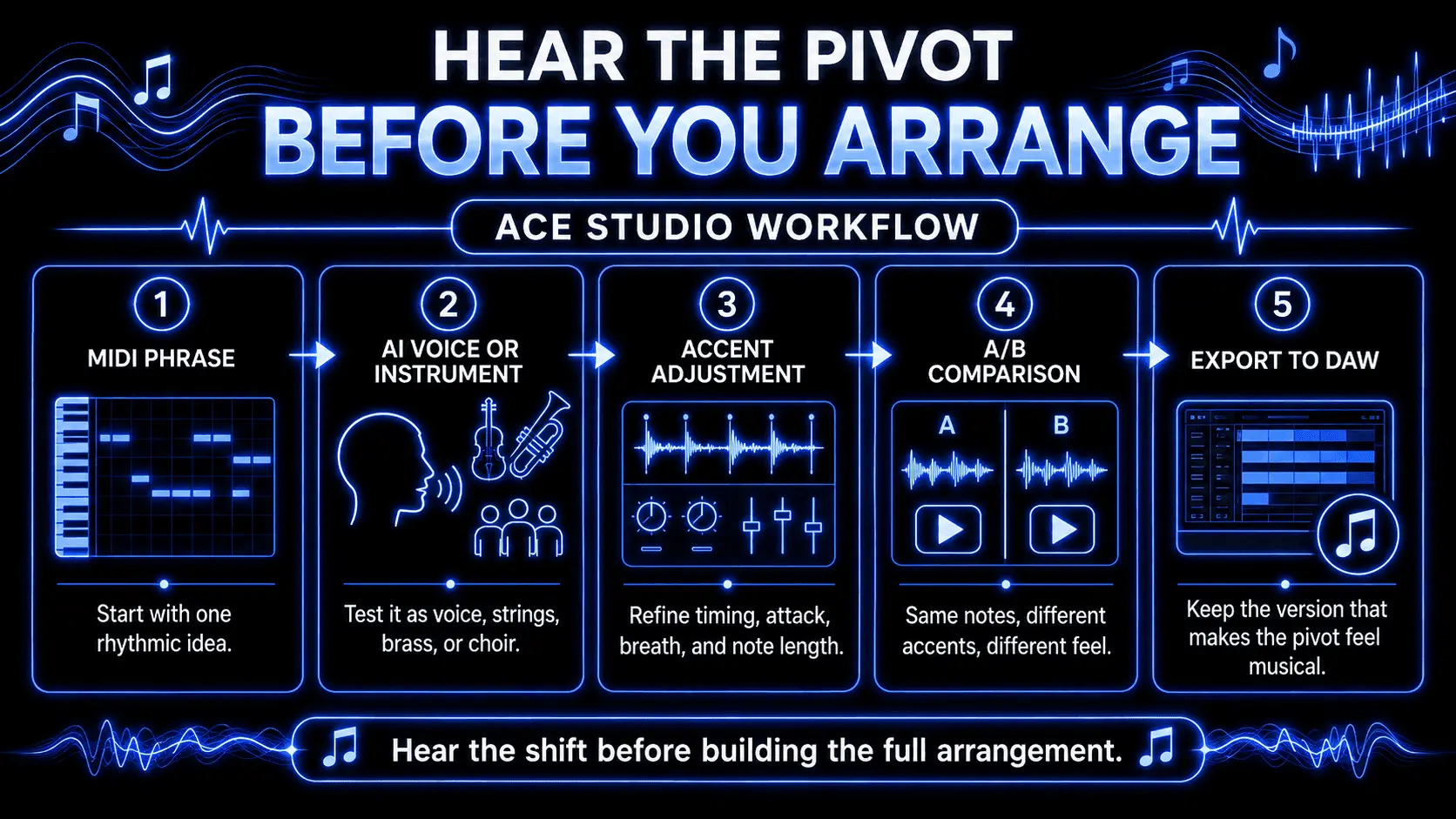
ACE Studio is especially useful when the modulation depends on a melodic or vocal phrase. You can write the line with MIDI and lyrics, then adjust the timing, note length, pitch, pronunciation, breath, and expression until the phrase supports the rhythmic shift. If the modulation feels too mechanical, you can soften the attack. If the new pulse is not clear enough, you can make the accent pattern more deliberate. If the phrase rushes the transition, you can stretch the syllables so the listener has more time to follow the pivot.
A practical use case would be a vocal hook that moves from a straight feel into a triplet-based chorus. Instead of forcing the drums to announce the change, you can let the vocal prepare it. The last line of the verse might start placing important syllables on triplet accents. The backing vocals can then repeat that grouping. By the time the chorus arrives, the listener has already heard the new pulse inside the old one. The modulation feels earned rather than pasted on.
ACE Studio also helps with instrumental metric modulation. Because its AI instruments respond to MIDI phrasing and articulation, you can test whether a string, brass, saxophone, or duduk part makes the pivot clearer. This is useful for cinematic music, progressive arrangements, jazz fusion, ambient pulses, and electronic breakdowns where the modulation is not just a drum trick. You can use a repeated instrumental cell as the shared rhythmic value, then let that cell become the new center of gravity.
One simple test is to create two versions of the same phrase:
- The first version follows the original pulse.
- The second version reinterprets one subdivision as the new beat.
- Both versions use the same notes, but the accents change.
- An AI voice or instrument performs each version.
- You compare which one makes the transition feel more natural.
This gives you a more musical answer than looking at the piano roll alone. Metric modulation lives in the listener’s body. If the phrase does not make the listener lean into the new pulse, the math is not enough.
ACE Studio can also help when you are studying an existing recording. Stem Splitter can separate a full mix into parts such as vocals, drums, bass, piano, guitar, and other instruments. That makes it easier to isolate the part that is creating the rhythmic illusion. Maybe the drums are stable, but the bass is implying the modulation. Maybe the vocal phrasing is what makes the tempo feel like it has shifted. Maybe the guitar riff is repeating across the barline and pulling the groove into a different accent cycle.
Once you isolate the part, Vocal to MIDI can be useful for sung material. If a singer phrases across the beat in a way that suggests a new pulse, converting that line into MIDI with lyrics lets you inspect the placement more closely. You can see where the syllables land, reshape the timing, and test a new version with a different voice or harmony stack. That is valuable for producers who want to learn from performed rhythm rather than only program from theory.
For producers working between ACE Studio and a DAW, ACE Bridge is also relevant to metric modulation because tempo maps and time signature changes need to stay clear. Some modulations are implied, meaning the BPM stays fixed while the accents change. Others use actual tempo or meter changes. When your DAW session and ACE Studio stay aligned, you can test both approaches without losing track of the bar structure.
A useful ACE Studio exercise for metric modulation is:
- Keep a simple anchor in the DAW, such as kick, bass, drone, or chords.
- Create a MIDI phrase in ACE Studio using a voice or instrument.
- Accent a subdivision that could become the new pulse.
- Duplicate the phrase and make that subdivision feel like the main beat.
- Add a second layer, such as a choir, string line, or brass response, only after the pivot is clear.
- Return to the original pulse and listen for whether the resolution feels intentional.
The strongest benefit is not speed. It is confidence. ACE Studio lets you hear whether a rhythmic pivot has emotional weight before you spend hours arranging around it. You can test the modulation with a sung phrase, an instrumental ostinato, a choir entrance, or a separated stem. You can refine the timing until the shift feels physical. You can decide whether the new pulse should feel smooth, tense, cinematic, unstable, or quietly hidden inside the groove. Metric modulation is ultimately about changing how time feels. ACE Studio gives you a practical way to shape that feeling with performances you can still edit.
Sound design applications
Metric modulation can shape sound design as much as rhythm. Any parameter that moves in time can support or imply a new pulse. This includes LFO rate, filter cutoff, amplitude gating, delay time, reverb pre-delay, tremolo, autopan, granular density, wavetable position, and sidechain triggers.
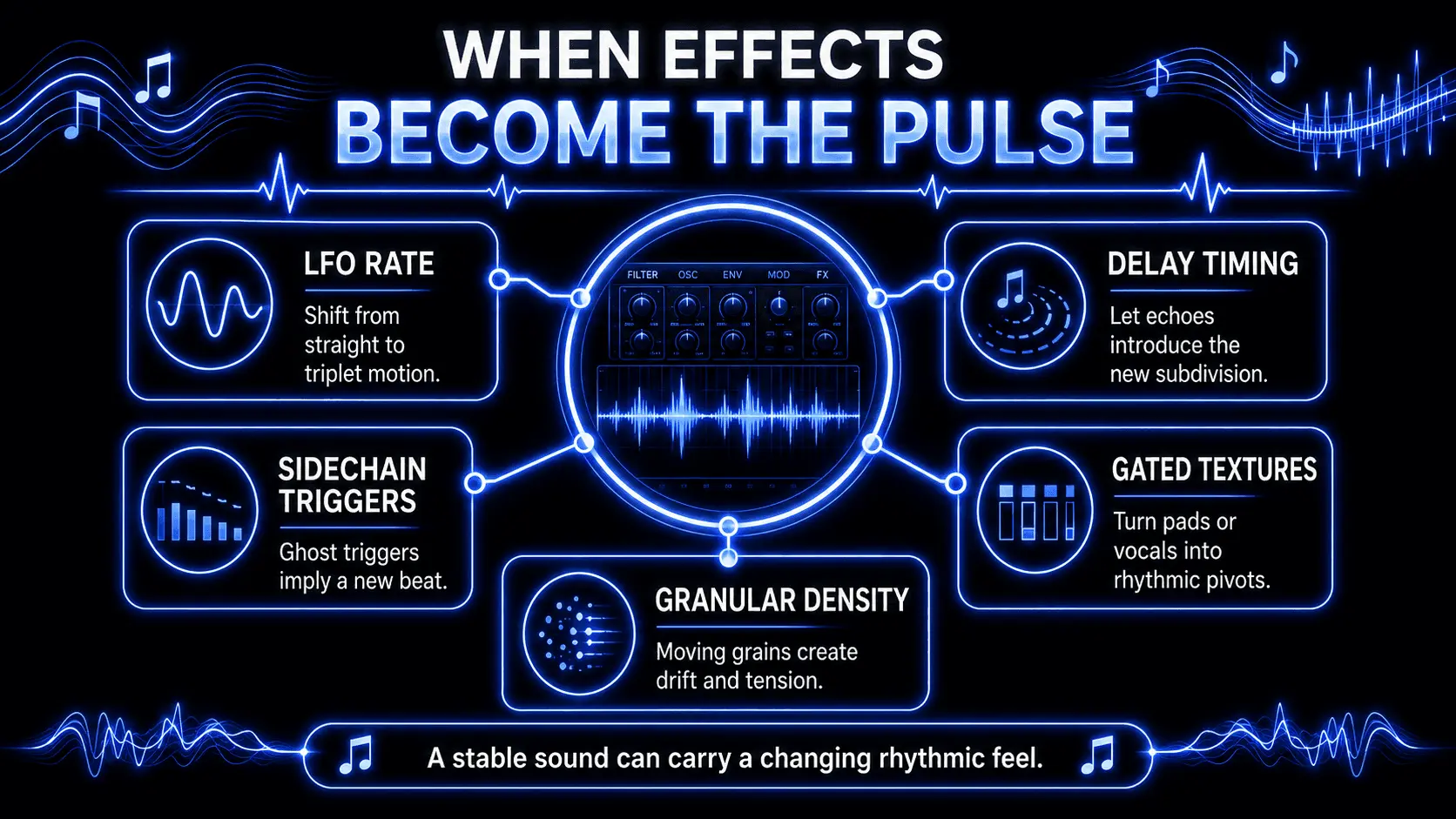
A common method is to create a synth pad that sustains harmonically while its gate pattern changes rhythmically. At first, the pad may pulse in the same rhythm as the drums. During a transition, the gate can shift into triplets or another grouping. Because the harmonic sound stays constant while the rhythm changes, the listener perceives motion without losing the emotional bed of the track.
- LFO modulation: Change a filter or amplitude LFO from a straight value to a triplet value during a buildup.
- Delay timing: Let a delay pattern introduce the new subdivision before the drums follow.
- Sidechain triggers: Use a ghost trigger pattern that gradually implies a different pulse.
- Granular processing: Set grain density or playback windows to rhythmic groupings that drift against the main meter.
- Gated textures: Turn pads, noise beds, or vocal layers into rhythmic pivot material.
Applications in different music genres
One of the biggest gaps in many explanations is that metric modulation is treated as a niche jazz or classical idea. In reality, the technique adapts well to many styles when the producer understands the function of the groove.
| Genre | How metric modulation works | Best production use |
|---|---|---|
| Jazz and fusion | Soloists and rhythm sections imply alternate tempos through phrasing, ride patterns, comping, and bass movement. | Solos, drum trades, arrangement pivots, reharmonized sections. |
| Progressive rock and metal | Riffs move through odd meters, tuplets, and accent cycles while the band maintains a shared pulse. | Riff transitions, breakdowns, technical fills, section changes. |
| EDM and techno | Percussion, arps, and effects shift subdivisions while the kick anchors the dance pulse. | Buildups, drops, breakdowns, hypnotic tension, live set variation. |
| Hip-hop and trap | Hi-hats, snares, 808s, and vocal flows suggest new subdivisions without changing the beat grid. | Hooks, beat switches, fills, bounce variations, rapper flow support. |
| Ambient and cinematic | Textures, delays, pulses, and ostinatos drift into new rhythmic centers. | Scene transitions, suspense, dreamlike time shifts, emotional development. |
| Experimental electronic | Loops of different lengths create evolving polyrhythmic structures that can become new meters. | Generative systems, modular sequencing, IDM, sound art. |
Jazz improvisation and metric modulation
Jazz musicians often use metric modulation as a performance language rather than a fixed production trick. A drummer may imply a different tempo through ride cymbal phrasing. A pianist may comp in a pattern that suggests another beat cycle. A soloist may play lines that temporarily organize around a different subdivision, then resolve back to the rhythm section.
The musical value is tension and release. The audience hears the solo stretch the time, but the band keeps enough of the original pulse alive to make the return satisfying. This is why metric modulation is so closely tied to advanced jazz improvisation. It allows a performer to create rhythmic complexity without abandoning the form.
Practice method for jazz players
- Start with a metronome on the main beat and sing a short phrase in the original tempo.
- Move the phrase into a triplet or dotted grouping while keeping the metronome unchanged.
- Play the phrase on your instrument, then leave space so the new pulse can be heard.
- Use simple motifs first. Complex pitch material can hide the rhythmic lesson.
- Resolve clearly back into the original swing, straight, or ballad feel.
Composition and arrangement strategies
Metric modulation is a compositional technique because it can shape form. It can mark the beginning of a new section, create acceleration without an obvious tempo ramp, connect two unrelated themes, or give a piece a sense of psychological movement. In long-form writing, the technique can prevent repetition while maintaining unity.
The most effective approach is to decide the emotional purpose before choosing the math. Do not use metric modulation only because it is clever. Use it because the track needs to feel as if the ground shifts. A verse may feel boxed in, then the pre-chorus opens into a wider pulse. A bridge may become unstable before the final chorus. A film cue may narrow time as a scene becomes tense. The rhythmic decision should serve the narrative.
Common arrangement functions
- Acceleration: The music feels faster even when the BPM does not change.
- Deceleration: The groove feels broader, heavier, or more spacious.
- Destabilization: The listener temporarily loses the obvious downbeat.
- Release: The original pulse returns with more impact after the modulation.
- Contrast: A new section gains identity without changing key, harmony, or instrumentation.
- Continuity: Two different tempos or meters are connected by a shared rhythmic value.
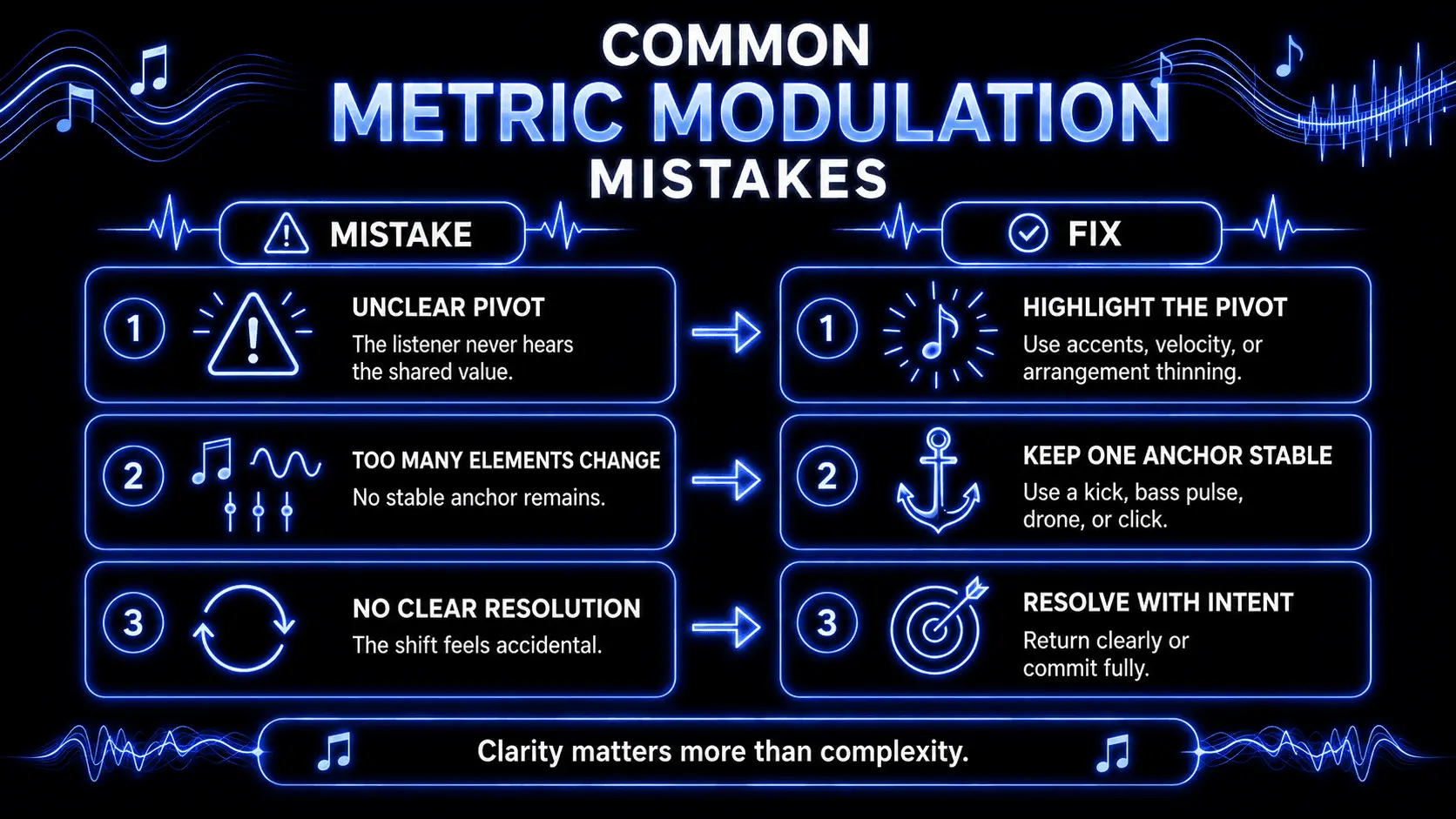
How to keep metric modulation musical
The biggest danger is making the listener aware of the technique instead of the music. Metric modulation should create expressive motion. It should not feel like a math demonstration unless the genre specifically celebrates technical display.
Anchor one element
Keep one musical element stable while the modulation develops. This anchor can be the kick, bass, chord pad, vocal phrase, drone, percussion loop, or even a repeating delay. The anchor gives the listener enough continuity to understand the change.
Make the pivot audible
A hidden pivot may be impressive on paper, but it will not communicate. Emphasize the pivot through accents, repetition, dynamics, register, timbre, or arrangement space. If the pivot is a triplet figure, make sure the figure is heard before it becomes the new pulse.
Use complexity selectively
Not every part should modulate. If the drums, bass, chords, melody, vocal chops, and effects all change at once, the result may feel confusing. Choose the elements that carry the modulation and let the rest support the transition.
Resolve with intention
The return matters as much as the shift. A strong resolution can make the original groove feel heavier, clearer, or more satisfying. In production, this might mean bringing the kick back in full, simplifying the hats, returning the bass to the root rhythm, or opening the mix after a dense transition.
Common mistakes and fixes
| Mistake | Why it weakens the music | Better approach |
|---|---|---|
| Changing everything at once | The listener cannot identify the pivot or the new pulse. | Keep one anchor stable and modulate one or two layers first. |
| Using math without phrasing | The pattern may be correct but emotionally flat. | Sing or tap the phrase before programming it. |
| Overcrowding the mix | Complex rhythms compete for space and blur the groove. | Put the most complex rhythm in a clear frequency range. |
| No preparation | The modulation feels random instead of intentional. | Introduce the pivot pattern before the section change. |
| No resolution | The listener feels disoriented with no payoff. | Return to the original pulse or establish the new pulse decisively. |
| Relying only on notation or grid edits | The result can sound mechanical. | Use dynamics, velocity, timing feel, and arrangement context. |
A producer friendly workflow
The following workflow works for electronic producers, beatmakers, composers, and songwriters who want to add rhythmic modulation without derailing the track.
- Choose the anchor: Decide what will stay stable. This is usually kick, bass, vocal, drone, or chord bed.
- Choose the pivot: Pick the subdivision or pattern that will connect the old feel to the new feel.
- Introduce the pivot early: Let the listener hear it as a secondary rhythm before it becomes primary.
- Thin the arrangement: Remove competing layers during the shift so the pivot is clear.
- Reframe the groove: Move drums, bass, or accents so the pivot becomes the new pulse.
- Support with sound design: Align delay, gating, filter movement, or sidechain with the new feel.
- Resolve or commit: Either return to the original pulse or let the new pulse become the next section.
Feature sheet: use cases by creator type
| Creator type | Best use case | Practical starting point |
|---|---|---|
| Beatmaker | Create a hook variation or beat switch without changing the entire song. | Use hi-hat groupings to imply a triplet or dotted pulse. |
| Electronic producer | Build tension before a drop or create an evolving breakdown. | Let an arpeggio or percussion loop introduce the new subdivision. |
| Jazz musician | Stretch a solo rhythmically while staying connected to the form. | Practice singing a motif through two against three and resolving back. |
| Composer | Connect sections with different tempos or meters. | Design a rhythmic pivot before writing the transition. |
| Drummer | Create fills that move the band into a new feel. | Phrase fills over a repeated subdivision that becomes the new beat. |
| Sound designer | Make textures evolve rhythmically without changing harmony. | Automate gates, LFOs, delays, and sidechain triggers into new subdivisions. |
| Live performer | Create dynamic audience-facing shifts without stopping the set. | Trigger prepared clips that imply alternate pulses over the main groove. |
FAQ
Is metric modulation the same as a tempo change?
No. A tempo change alters the actual BPM or performed speed. Metric modulation changes the pulse through a rhythmic relationship. It may result in a new tempo, but the defining feature is the pivot from an old rhythmic value to a new rhythmic role.
Can metric modulation happen without changing the DAW BPM?
Yes. This is common in production. A track can keep the same BPM while the hats, percussion, bass, synths, or vocal chops imply a different pulse. This is implied metric modulation.
What is the difference between metric modulation and polyrhythm?
A polyrhythm layers different rhythmic divisions at the same time. Metric modulation uses a shared rhythmic value or pattern to move the listener into a new pulse. A polyrhythm can prepare a modulation, but it is not automatically a modulation.
Is metric modulation only for jazz or classical music?
No. It is common in jazz and contemporary composition, but it can also be used in EDM, techno, hip-hop, trap, progressive rock, metal, ambient, film music, and experimental electronic production.
How can beginners start using metric modulation?
Start with a stable groove, add a simple triplet or two against three layer, repeat it until it feels familiar, then let that layer become the focus. Keep the first attempts short and resolve clearly back to the original groove.
Why does metric modulation sometimes sound confusing?
It usually sounds confusing when the pivot is not audible, too many elements change at once, or the modulation has no clear resolution. Keep one anchor stable and introduce the pivot before the main shift.
Can vocal phrasing use metric modulation?
Yes. A vocalist or rapper can phrase across the beat in a way that suggests a different pulse. This can make a flow feel more complex while the instrumental remains stable.
Should I write metric modulation into notation?
Use notation when performers need to reproduce the modulation precisely. In DAW production, you can often build the same result through grids, clip lengths, MIDI editing, and arrangement cues.