
Key takeaways
- Music arrangement is the process of turning a basic song idea into a complete listening experience by deciding which instruments play, how sections develop, and how the energy changes over time.
- A strong arrangement supports the emotion of the song, whether that means keeping a verse sparse and intimate, building a powerful chorus, or using texture and dynamics to guide the listener.
- Arrangement is different from composition: composition creates the core melody, lyrics, and harmony, while arrangement decides how those ideas are performed, produced, and presented.
- Modern arrangers work with both musical choices and production tools, including DAWs, stems, vocal layers, synths, effects, automation, and score-writing software.
- Arranging another artist’s copyrighted song usually requires permission, because commercial arrangements are typically treated as derivative works.
Why music arrangement matters in modern production
In the contemporary landscape of audio production, a song is only as strong as its execution. You can write a timeless melody accompanied by a profound chord progression, but without an intentional, evocative structure, the core emotional message can easily become lost in the noise. This is where the specialized discipline of music arrangement comes into play.
A masterfully executed musical arrangement bridges the raw creative energy of initial music composition with the polished precision of modern engineering. This high-authority guide explores the historical development, foundational theory, practical production steps, software tools, and complex legal frameworks that define music arrangement. Whether you are an indie singer-songwriter, an orchestral media composer, or an electronic music producer, mastering this craft will fundamentally transform your approach to sound arrangement.
What is arranging in music?
At its architectural core, a musical arrangement is the adaptation of an underlying composition for performance or recording. It dictates which instruments play which notes, how sections transition into one another, and how sonic density shifts over time. While the primary songwriter establishes the DNA of a track—typically the melody, lyrics, and basic harmonic progression—the arranger determines how that DNA manifests in the physical airwaves.
Defining sound arrangement and musical arrangement
While the terms are often used interchangeably in casual studio banter, a clear distinction has emerged within modern audio production:
- Musical Arrangement: Focuses on the music theory, notation, part-writing, and orchestration of a piece. It answers questions regarding instrumentation, key selection, voice leading, and part allocations for acoustic ensembles or electronic synthesis.
- Sound Arrangement: Expands into the spatial and temporal manipulation of recorded assets within a Digital Audio Workstation (DAW). It encompasses modern production techniques such as sample placement, frequency bracketing, dynamic automation, and the curation of ambient spaces to guide the listener's subconscious attention.
Learn how music arrangement shapes sound, emotion, and style across every genre
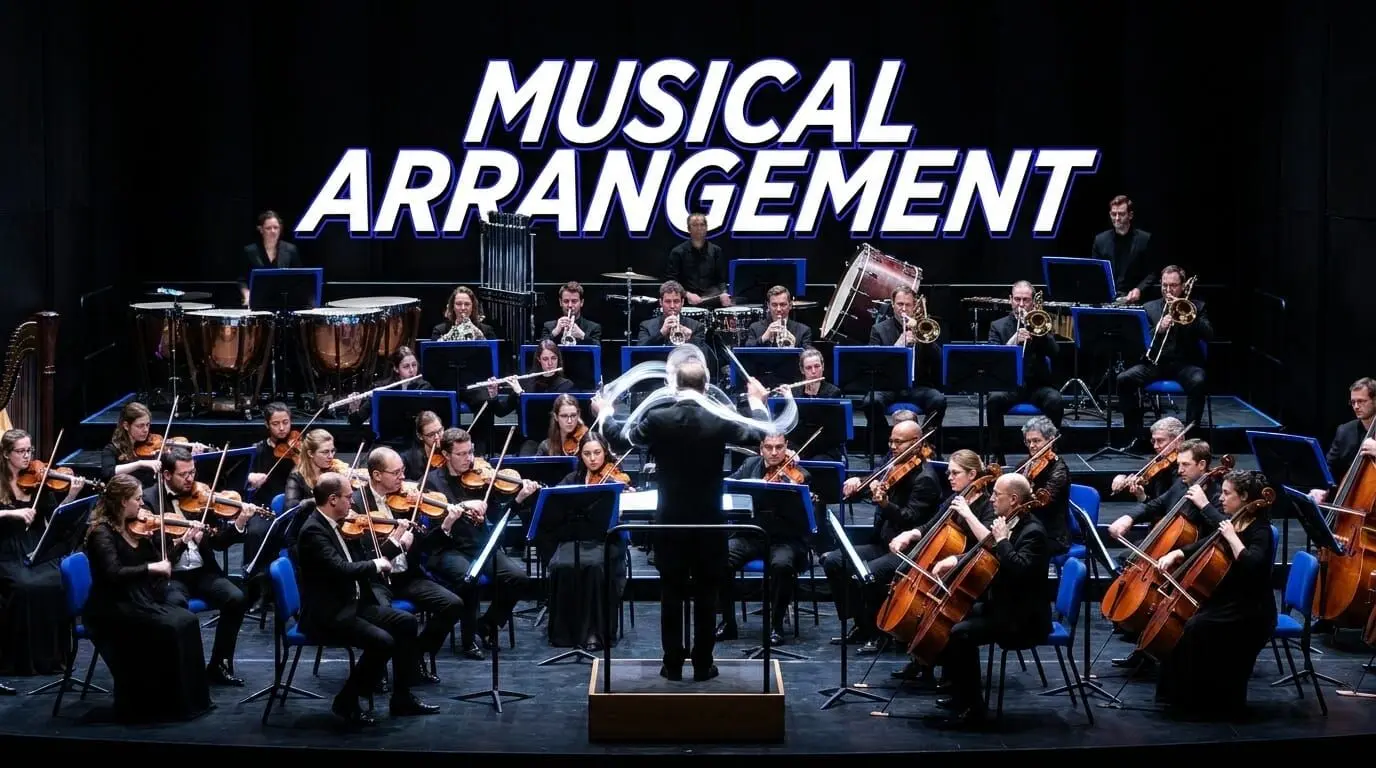
Arranging is not a secondary, mechanical process; it is a highly expressive art form. An arranger can take a melancholic folk acoustic ballad and reimagine it as a driving synth-wave anthem without altering a single word of the lyric or a single note of the lead vocal melody. By shifting the context surrounding the core motif, the arranger fundamentally alters how the human brain processes the emotional arc of the piece.
Through intentional manipulation of instrumental textures, the arranger guides the listener through a pre-meditated psychological journey. A sudden drop in instrumentation can create a feeling of intense vulnerability, while a massive, multi-layered crescendo can evoke triumph, anger, or awe. This intentional design is what separates a collection of musical ideas from a polished, commercially viable song arrangement.
Arranging for rhythm section
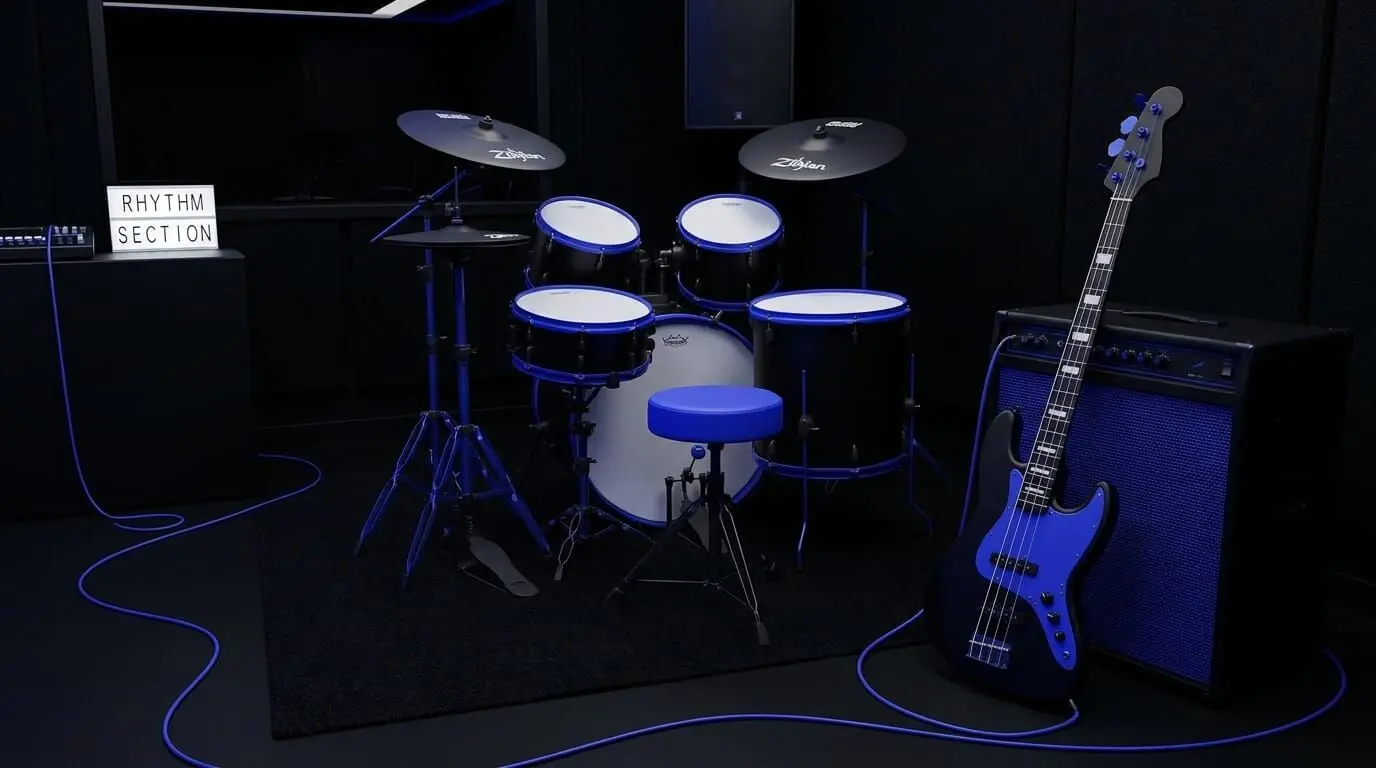
The rhythm section forms the structural foundation of almost all contemporary popular genres. A weak rhythm section arrangement will undermine even the most beautiful vocal performance.
Drums and percussion architecture
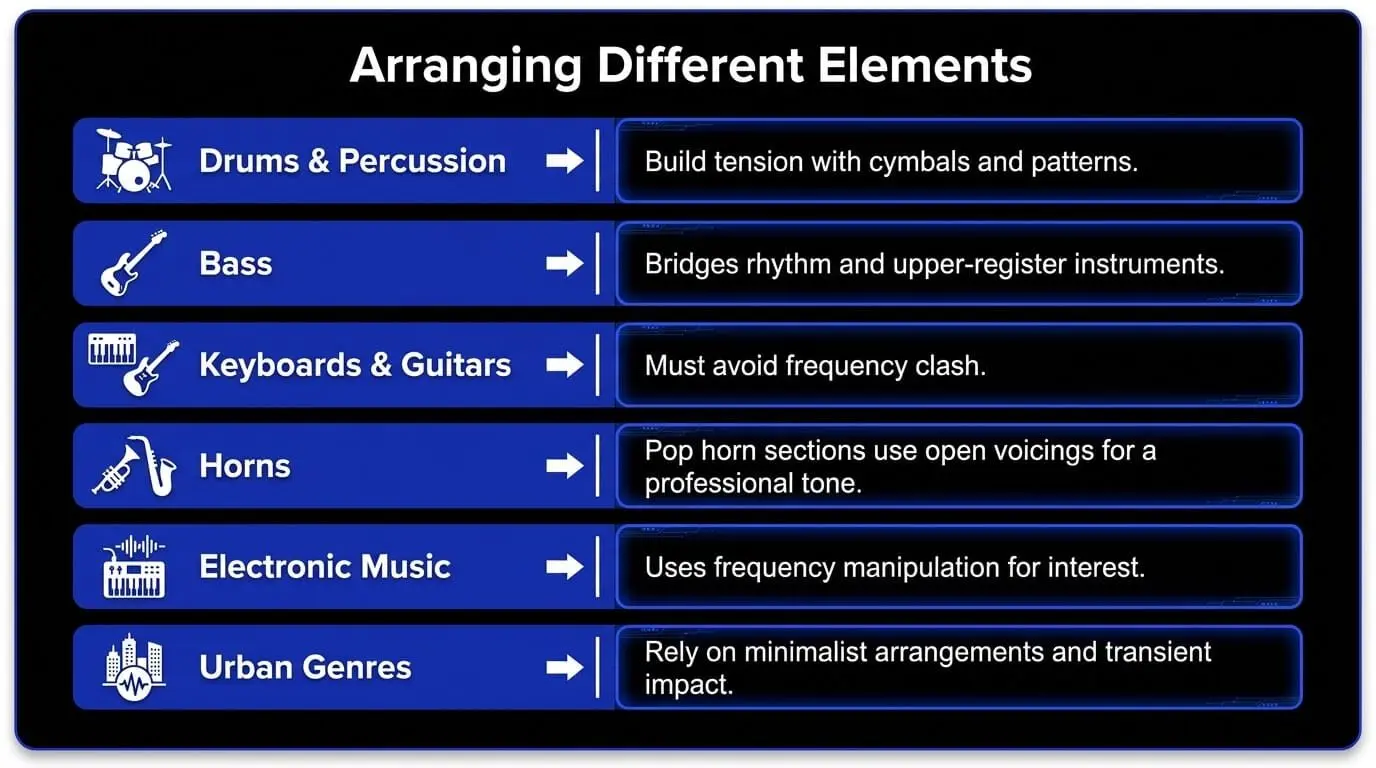
The arranger must dictate not only the foundational beat but also the choice of cymbals and micro-timings. Heavy, sustained crash cymbals build tension, while tight, syncopated hi-hat patterns drive subtle forward momentum. You must determine where the drums should play a simple driving pattern to anchor a verse, and where they should open up into a complex, expressive fill to signal an upcoming chorus.
The bass guitar and synth bass
The bass serves as the crucial harmonic bridge between rhythmic percussion and upper-register chordal instruments. The arranger must decide whether the bass locks in step with the kick drum for maximum physical punch, or moves counter-melodically to add sophisticated harmonic depth. In electronic styles, selecting the right type of bass—such as a warm analog sub-bass versus a gritty, distorted digital wave—is a core arrangement choice that defines the track's genre.
Keyboards and guitars
These instruments supply the fundamental harmonic tissue of the track. Arrangers must prevent these elements from fighting for the exact same frequency territory. If a guitar is performing wide, mid-range strummed bar chords, the keyboard parts should be arranged in a higher register using sparse, open chord extensions. Conversely, if the piano is handling the heavy low-mid rhythmic chording, the guitar should stick to single-note lines, ambient textures, or rhythmic chucks.
Arranging for horns
Writing for brass and woodwinds requires meticulous attention to range, breath control, and harmonic voicing.
Pop horn section strategies
When arranging for a standard pop horn section, which typically features a trumpet, a tenor saxophone, and a trombone, avoid writing simple block triads in close position. This approach can quickly sound cluttered and thin in a modern audio production.
Instead, utilize open voicings. Distribute root notes and fifths to the outer voices, and inject tasteful jazzy tensions, such as ninths and sharp elevenths, into the inner horn lines to craft an expensive, professional tone.
Managing instrumental registers
Every horn instrument changes its tonal character based on the register it is playing in. A trumpet played at the top of its usable range sounds aggressive, bright, and piercing—perfect for high-energy climaxes.
The same trumpet played in its lower register sounds warm, breathy, and intimate. An arranger must intimately understand these sonic shifts to ensure the horn section complements the emotional state of the song.
Arranging and producing contemporary music styles
Modern electronic and urban genres demand an entirely different approach to song arrangement compared to traditional acoustic styles.
Electronic music and sound design
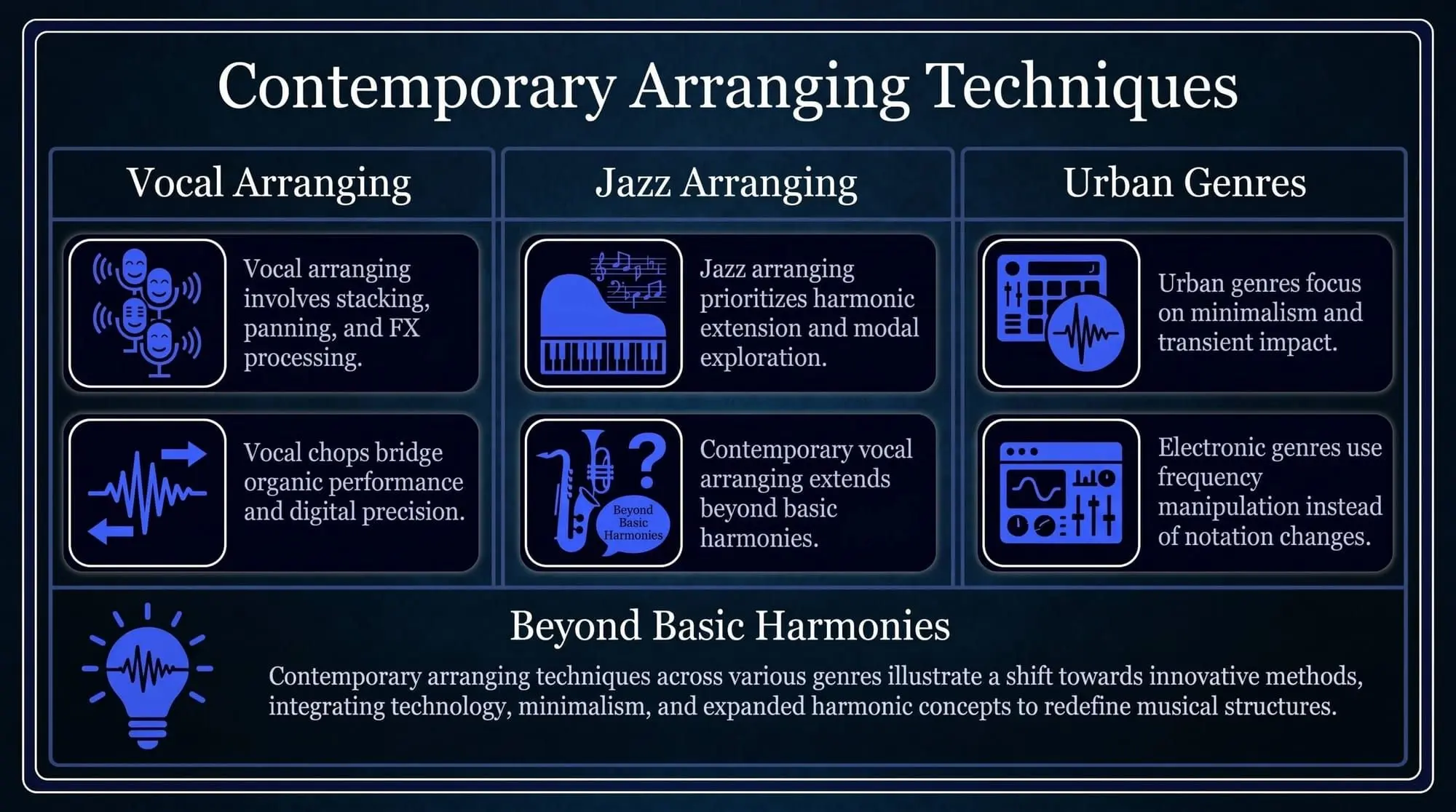
In genres like EDM, synth-wave, and ambient techno, the arrangement is often driven by frequency manipulation rather than notation changes. An arranger might keep a single chord progression looping for minutes, building interest entirely through the gradual opening of a low-pass filter, the introduction of automated delay effects, or the subtle layering of white noise risers. This is where sound arrangement and composition become completely synthesized.
Hip-Hop, trap, and urban workflows
Contemporary urban music relies heavily on minimalist arrangements with extreme transient impact. The arrangement choices revolve around the interplay between the 808 bass, the pitch-sliding hi-hat patterns, and the lead vocal hook.
Arrangers in this space frequently use sudden drop-outs—where the entire instrumental track cuts out for half a bar—to emphasize a particularly potent lyrical punchline delivered by the artist.
Arranging for songwriters: Instrumentation and production in songwriting
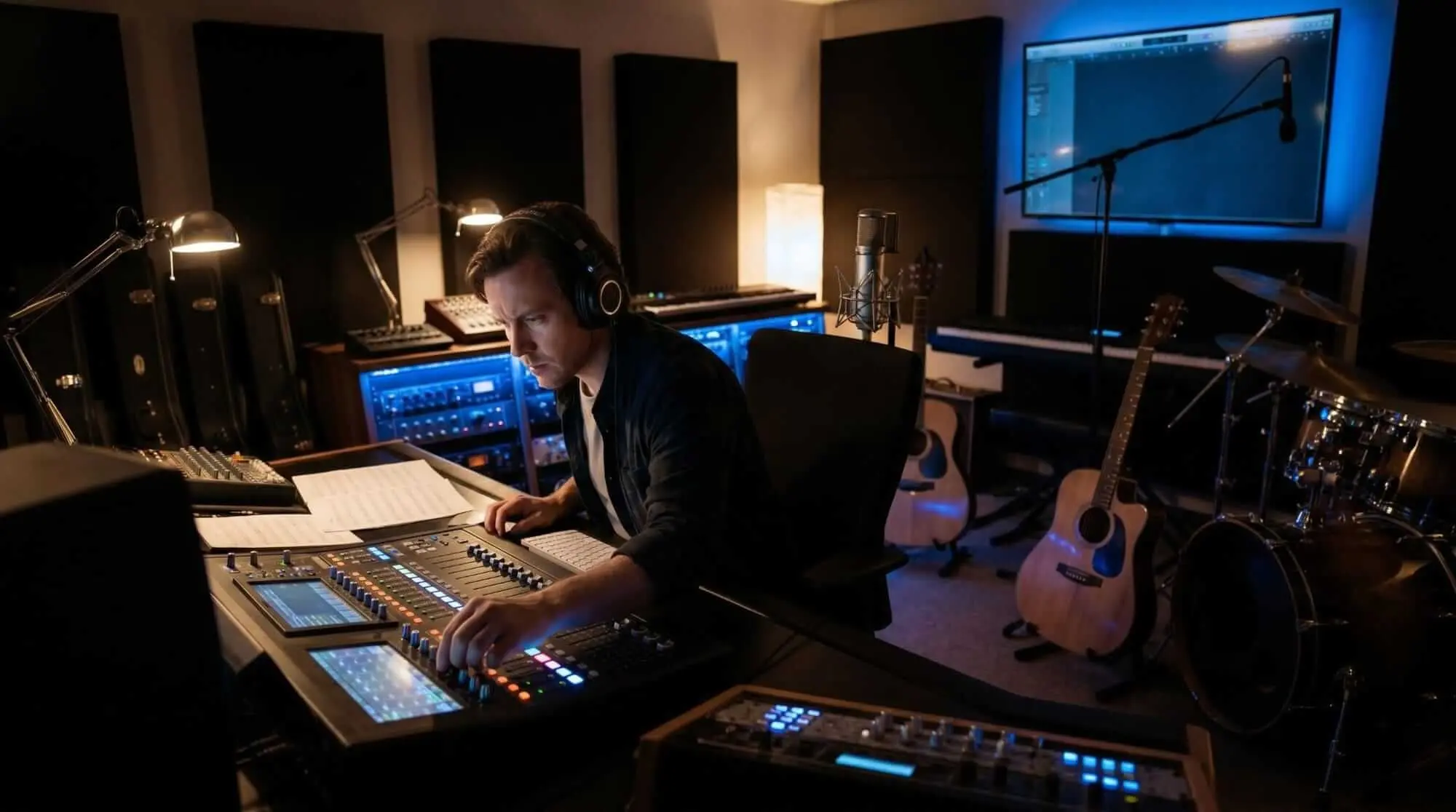
For solo songwriters, the arrangement process is about choosing the proper musical attire for their vulnerable lyrical concepts. The primary objective here is to support the lead vocal melody at all costs.
Lyric-driven instrumentation choices
Every instrumentation choice should be directly informed by the lyrics. If the lyrics speak of isolation, cold distance, or heartbreak, the arrangement should remain sparse, utilizing distant ambient reverbs, minimal sub-bass, and isolated acoustic elements. If the narrative turns to triumphant rebirth or joy, the arranger should systematically introduce wide acoustic guitars, soaring backing vocals, and driving drum patterns to mirror that emotional evolution.
The power of economy
Amateur songwriters often make the mistake of trying to make their song sound big by adding every instrument available in their DAW library. Professional arrangers know that true power lies in economy. Leaving wide open spaces in the arrangement allows the listener to connect deeply with the vocal performance, making the moments where the instrumentation finally explodes feel infinitely more impactful.
Contemporary vocal arranging
In modern audio production, the human voice is frequently treated as both a lyrical delivery mechanism and a highly versatile synthesizer instrument. Contemporary vocal arranging goes far beyond basic three-part harmony lines.
Vocal stacking and panning
Recording numerous identical vocal takes and panning them wide across the stereo field creates a thick, unified chorus texture. This vocal stacking technique makes a chorus feel massive and wide, providing a stark contrast to a dry, centered lead vocal in the preceding verse.
Counter-melodic backing pad lines
Arrangers frequently write background vocal lines that perform long, sustained vowel tones. These lines act as an organic, evolving synthesizer pad beneath the main lead vocal, adding warmth and harmonic movement without introducing competing lyrical content.
Vocal chops and FX processing
Chopping up recorded vocal phrases, shifting their pitch, and rearranging them into modern, rhythmic hooks is a staple of pop and electronic arrangement. This technique injects a distinctly human element into electronic genres, bridging the gap between organic performance and digital precision.
Jazz arranging
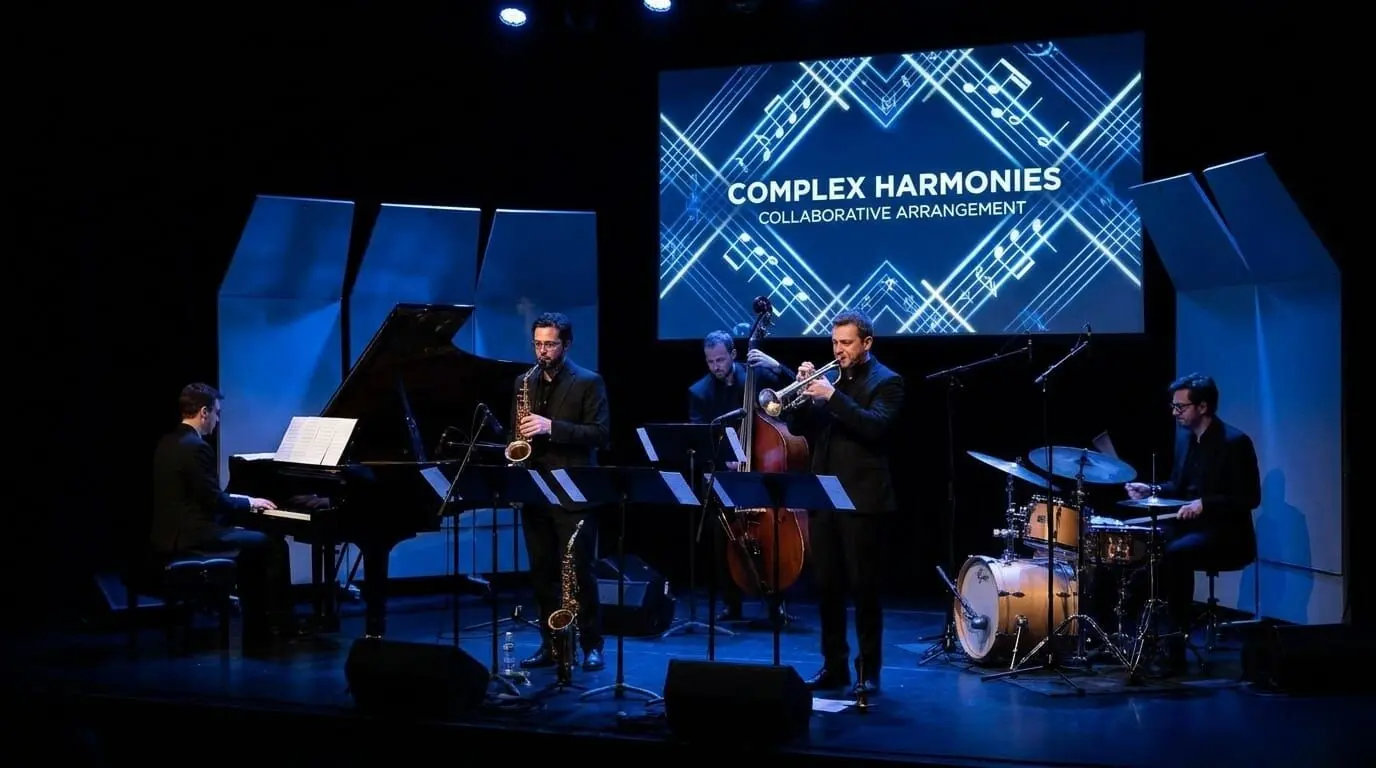
Jazz arranging is a highly sophisticated discipline that prioritizes harmonic extension, modal exploration, and the deliberate curation of space for individual improvisation.
Extended chords and modal volatility
A jazz arranger must look far beyond basic major and minor triads. The standard vocabulary includes major seventh, minor ninth, dominant thirteenth, and altered chords. Understanding how to voice these dense harmonies across a large ensemble without creating acoustic mud is the hallmark of a master jazz arranger.
Voice leading and shout choruses
Smooth voice leading ensures that individual instrumental lines move by the smallest possible intervals from chord to chord. This creates an elegant, sophisticated flow.
Additionally, jazz arrangements frequently build up to a shout chorus—a section where the entire ensemble performs a blistering, high-energy, rhythmically unified passage that drives the arrangement to its ultimate creative climax before returning to the main theme.
What is a musical arrangement?
To understand a musical arrangement on a deeper level, one must view it as a blueprint for sonic distribution. It is the process of taking a core musical idea and dividing it across a specified timeline and a specific group of performers or sounds.
A musical arrangement determines the density, texture, register, and pacing of a piece of music. It ensures that the underlying song is presented in its absolute best light, tailor-made for the specific medium through which it will be consumed—whether that is a live acoustic concert hall, a smartphone speaker, or a cinematic surround-sound theater.
The history and importance of arrangement in music
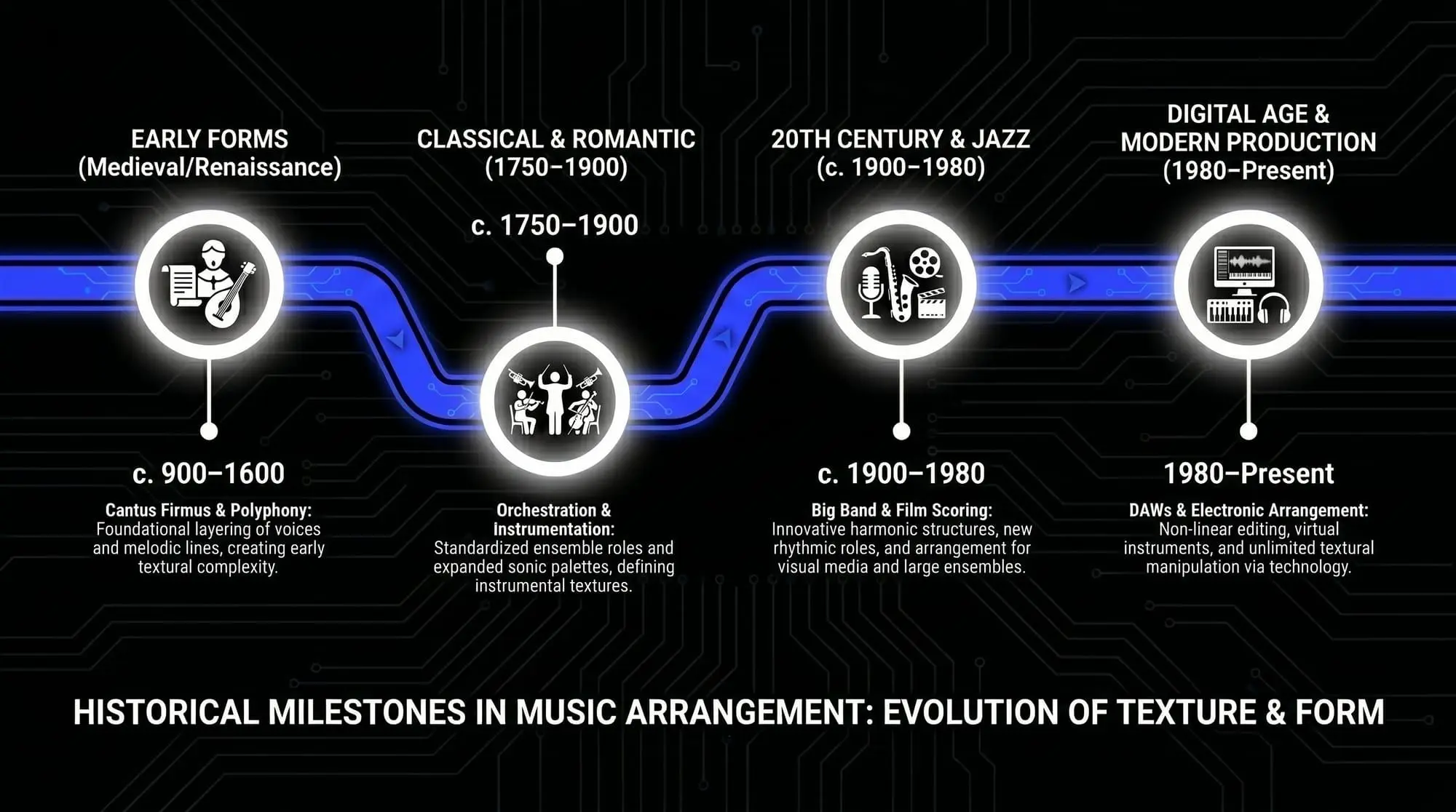
The historical trajectory of music arrangement mirrors the technological advancement of human performance and recording capabilities.
The classical and big band foundations
In the Western classical tradition, transcription and arrangement were vital tools for cultural dissemination. Master composers like Franz Liszt frequently arranged massive symphonic works by Ludwig van Beethoven for solo piano, making complex orchestral music accessible to households and small salons across Europe.
With the advent of big band jazz in the 1930s and 1940s, the arranger became the true architect of an ensemble's signature style. Legendary figures like Fletcher Henderson and Duke Ellington proved that how a collection of brass and woodwind instruments interacted was just as crucial to the listener as the underlying melody itself. They introduced sophisticated call-and-response patterns, intricate counterpoint, and rich extended harmonies that transformed basic popular tunes into high-art jazz masterpieces.
As the industry transitioned into the era of multi-track tape recording and modern digital audio production, the importance of arrangement expanded exponentially. The studio itself became an instrument. Arrangers no longer just wrote for physical performers; they began arranging textures, frequency ranges, and early synthetic elements, establishing a lineage of sonic curation that informs every contemporary hit record.
Modern cinematic titans
The high-stakes world of Hollywood film scoring illustrates the intense demands placed on modern orchestration techniques and arrangement strategies. Emmy-winning arranger and orchestrator Vivian Aguiar-Buff has provided invaluable insight into this world through her extensive work with Hollywood icon Hans Zimmer and major studios like DreamWorks.
In major studio ecosystems, the primary composer often generates brief, highly emotional musical suites or synthesizer mockups containing the core thematic material. It is the responsibility of the senior arranger and orchestrator to scale these concepts into gargantuan, immersive cinematic experiences.
Aguiar-Buff’s workflows demonstrate that modern cinematic arrangement requires an intimate understanding of both classical orchestral capabilities and cutting-edge hybrid synthesis. To achieve an award-winning score, an arranger must masterfully balance traditional brass, woodwinds, and strings with heavily processed sub-bass elements, custom sound design, and ethnic percussion modules. This hybrid approach ensures that the arrangement fulfills its primary narrative objective: driving the emotional subtext of the visual media.
Types of arrangements in music production
Depending on the final delivery platform and the creative intent, an arrangement can take several distinct forms:
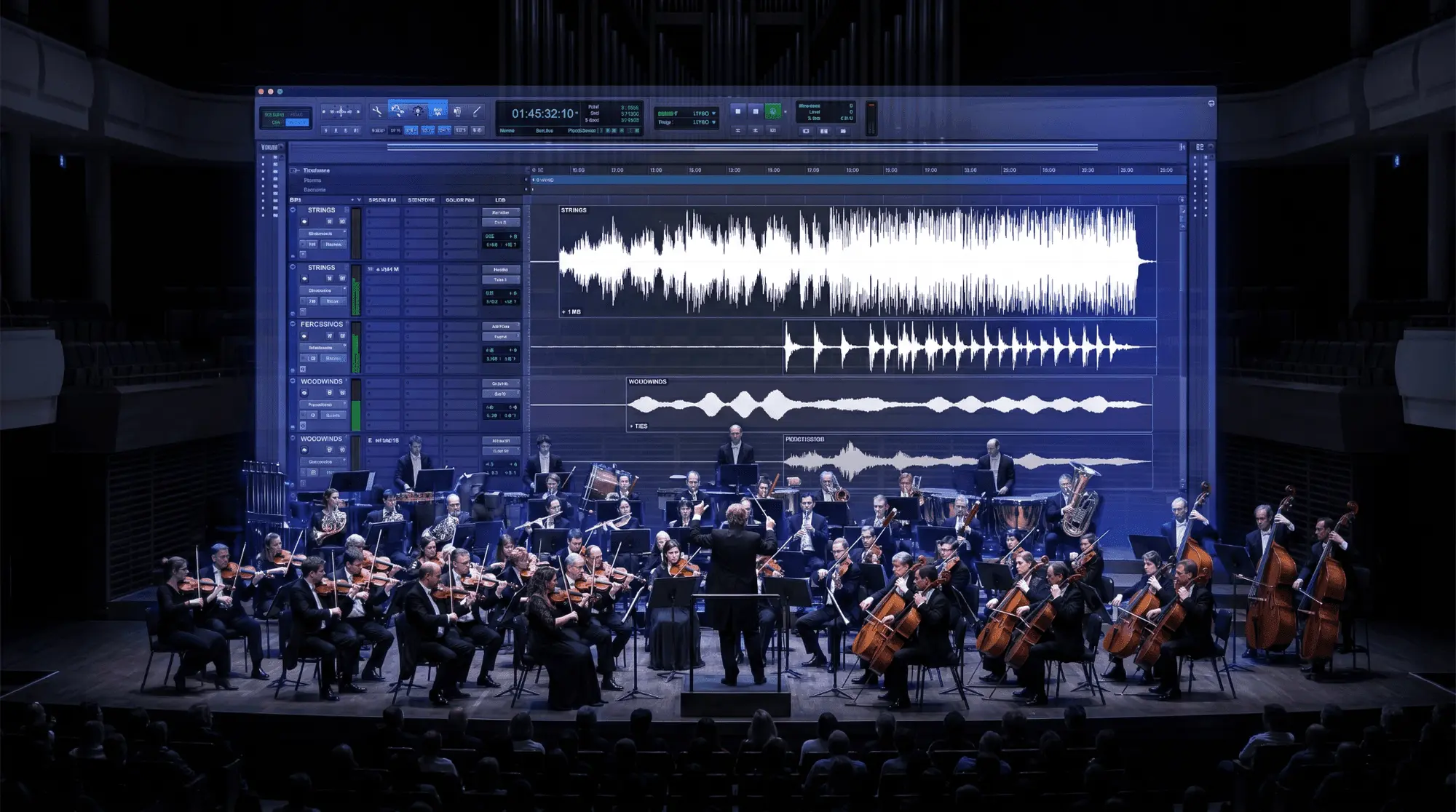
- Live Ensemble Arrangements: Written specifically for physical musicians to perform in real-time. These rely heavily on traditional score arrangement, precise notation, and an acute awareness of instrumental ranges and human physical limitations.
- Studio Production Arrangements: Created within a DAW environment, utilizing a hybrid mix of live recorded tracks, virtual instruments, and pre-recorded samples. This type focuses heavily on sound arrangement, frequency separation, and spatial panning.
- Minimalist/Unplugged Arrangements: Stripping a dense, heavily produced track down to its bare essentials—such as a solo voice accompanied by a single piano or acoustic guitar. This tests the core strength of the underlying composition.
- Derivative/Remix Arrangements: Taking the isolated vocal or melodic stems of an existing commercial track and building an entirely new harmonic, rhythmic, and stylistic instrumental framework around them.
Examples of great arrangements
To fully grasp how arrangement shapes commercial success and artistic permanence, let us deconstruct five historical masterpieces that redefined the boundaries of audio production.
Eleanor Rigby by The Beatles
Arranged by visionary producer George Martin, this track stripped away the conventional rock instrumentation of drums, electric guitars, and bass. Instead, Martin scored a stark, driving double string quartet consisting of four violins, two violas, and two cellos.
Inspired by the film scores of Bernard Herrmann, Martin instructed the string players to perform with aggressive, rhythmic staccato articulations while positioning the microphones exceptionally close to the instruments' bodies. This arrangement decision transformed a melancholy pop tune into a claustrophobic, urgent psychological portrait, proving that strings could sound raw and percussive rather than purely lush or romantic.
Bohemian Rhapsody by Queen
An absolute masterclass in complex, multi-sectional song arrangement. The track seamlessly welds a tender piano ballad, a grand multi-tracked operatic pastiche, and a blistering heavy metal movement into a single coherent piece.
The genius of the arrangement lies in its meticulous vocal layering—utilizing hundreds of analog tape overdubbing passes to create an imposing wall of sound—and the theatrical pacing that subverts every traditional expectation of commercial pop radio formatting.
Good Vibrations by The Beach Boys
Brian Wilson’s self-described pocket symphony represents a monumental achievement in modular sound arrangement. Wilson composed and recorded distinct musical segments across various commercial recording studios in Los Angeles, later splicing the disparate tape segments together.
The arrangement is defined by its highly unconventional instrumentation, prominently featuring an electro-theremin, a deep tack piano, a harmonica, and cello lines acting as a rhythmic motor beneath a soaring pop vocal. It shattered the boundaries of what could be accomplished within a three-minute pop runtime.
Kashmir by Led Zeppelin
This arrangement thrives on a brilliant display of polyrhythmic tension. Guitarist Jimmy Page and drummer John Bonham lay down a cyclical, heavy rhythmic phrase based on a triple meter (3/4 time), while the underlying drum groove resolutely maintains a standard quadruple meter (4/4 time).
To elevate the hypnotic, driving quality of the track, a brass and string section was arranged to double the ascending modal riff, creating an exotic, sweeping epic that remains a benchmark of hard rock production.
What's Going On by Marvin Gaye
A masterclass in dense, atmospheric soul arrangement. The track expertly layers ambient background conversation, jazz-influenced saxophone improvisations, multiple percussion tracks, and Marvin Gaye’s distinctly layered dual lead vocals.
Crucially, the arrangement leaves wide sonic lanes for bassist James Jamerson’s iconic, hyper-melodic bassline. Jamerson's syncopated counter-melodies drive the emotional heartbeat of the anti-war anthem, demonstrating how an arranger can use a bass instrument as a primary storytelling voice.
What is the difference between an arrangement and a composition?
To build a sustainable workflow in the music industry, one must understand the distinct operational lines between music composition and song arrangement.
Is it illegal to arrange another artist's music?
The legal realities of music arrangement require a clear understanding of global copyright laws. An arrangement can be an incredibly lucrative asset, but only if you respect intellectual property boundaries.
Public domain works
If the underlying song was composed by a creator who has been deceased for more than 70 years (or falls under specific historical cut-offs, such as works published before 1930), the music resides safely in the Public Domain. Anyone is legally free to arrange, record, perform, and commercialize that music without seeking permission or paying licensing fees. This is why classical compositions are so frequently rearranged across modern pop and cinematic projects.
Copyrighted works
If the song is still actively protected by copyright, creating an arrangement technically constitutes creating a derivative work. To legally distribute, stream, or sell a derivative arrangement, you must secure explicit permission or a formal mechanical/derivative license from the original copyright holder, which is typically managed by their music publishing company. Performing or selling a copyrighted arrangement without this authorization can immediately trigger severe copyright infringement claims and lead to the complete removal of your audio production from streaming services.
Can you copyright an arrangement?
Yes, but with strict legal caveats. You can copyright an arrangement as a derivative work only if your adaptation introduces significant, original creative expression that goes far beyond a basic transcription, and only if you have obtained the legal right from the original copyright holder to create that derivative work in the first place. Your new copyright will protect only your specific arranged additions—such as your unique horn lines, string voicings, or counter-melodies—never the underlying original song itself.
How stems support arrangement, collaboration, and final production
A stem is a consolidated, stereo audio export of a distinct category of instruments within an arrangement. Stems are completely different from individual raw multi-tracks; they are pre-mixed groupings. For example, an arranger will export a single drum stem, a bass stem, a string stem, and a vocal stem from their audio production environment.
Hybrid orchestral workflows
Composers can easily export their synth and percussion stems from a DAW to play along in the background while a live orchestra records the acoustic string parts on top of them. This allows the acoustic performers to hear the contextual energy of the track without cluttering their headphone mixes.
Live performance backing tracks
Touring bands use stems to run their live playback systems, allowing them to route specific arranged elements—such as backing vocals, intricate percussion layers, or complex synth sequences—to the front-of-house PA system while keeping the live drums and guitars raw on stage.
Remixing and collaboration
Stems allow third-party producers and international collaborators to quickly import your arranged musical building blocks into their own native DAWs without needing the exact same virtual instrument plugins or software setups. It streamlines the mixing and mastering process immensely.
The basics of arranging a song
To demystify the creative process, follow this rigorous three-step operational protocol to transform a basic musical concept into a professional, commercial-ready arrangement.
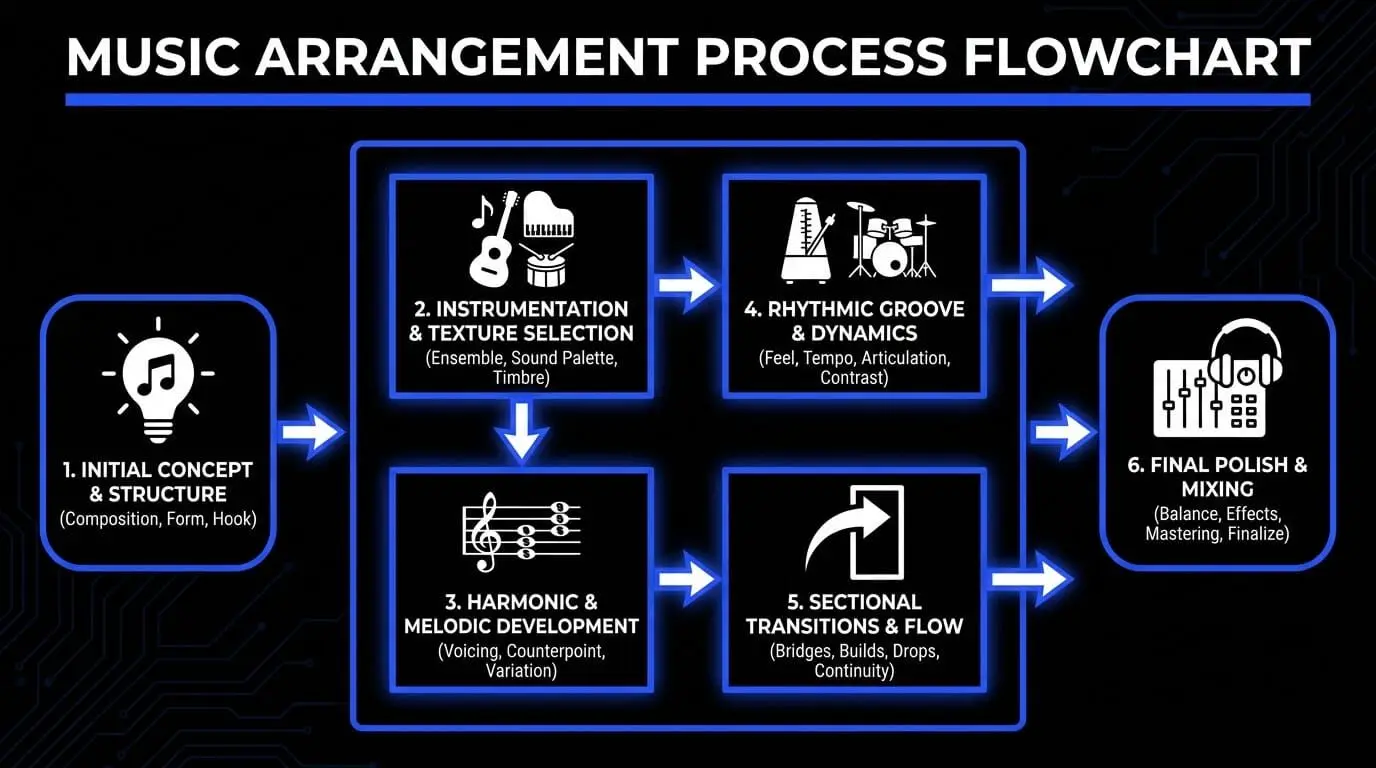
Step 1: Analyzing the song
Before you record a single note or drag a single sample into your timeline, you must thoroughly diagnose the raw material. Sit down with a basic piano or acoustic guitar demo and explicitly map out the song's fundamental characteristics:
- Identify the exact tonal key center and check for potential vocal range limits.
- Transcribe the core vocal melody and pinpoint the precise emotional peak of the lyric sheet.
- Determine the basic underlying song structure (e.g., establishing an ABABCB framework).
- Create a simple written roadmap outlining the intended energy flow across the timeline.
Step 2: Developing melodic, rhythmic, and harmonic elements
With your structural roadmap complete, begin building out the musical foundation:
- Establish the groove: Program or track your core rhythm patterns, making sure the kick drum and bass guitar form an unyielding, unified foundation.
- Flesh out the harmony: Lay down your primary keyboard or guitar chord voicings, paying close attention to smooth voice leading to avoid sonic clutter.
- Introduce countermelodies: Weave in subtle background instrumental lines or vocal counterpoints to fill the gaps between primary lead vocal phrases.
- Apply advanced orchestration and layering techniques: Stack complementary timbres to build depth, and use high-pass filters to keep individual frequency bands clean.
Step 3: Reviewing and releasing the arrangement
The final phase focuses on polishing your sonic architecture for commercial distribution:
- Listen to the complete track from start to finish with a critical ear, ruthlessly cutting out any elements that distract from the main vocal melody.
- Fine-tune your transitions: Ensure that every fill, riser, or arrangement cut functions flawlessly to propel the listener into the next section.
- Engage in the audio mixing phase: Use precise panning choices to spread your instruments wide across the stereo field, and apply volume automation to make the overall mix breathe organically.
- Export your master files, instrument stems, and comprehensive score arrangements for archive and release.
Leveraging arrangement software
Modern arrangers have access to an incredible suite of digital tools that streamline both notation and sound arrangement.
Digital Audio Workstations (DAWs)
- Ableton Live: The industry standard for real-time live performance loops, electronic sound design, and experimental clip arrangement.
- FL Studio: Renowned for its hyper-efficient Step Sequencer and fluid Piano Roll, making it an exceptional laboratory for urban and electronic producers.
- Logic Pro X: Apple's flagship DAW provides an incredibly comprehensive out-of-the-box solution, featuring massive orchestral libraries and powerful MIDI editing tools.
- Pro Tools: The absolute industry standard for tracking, mixing, and managing massive linear multitrack sessions for live acoustic ensembles.
Score writing programs
When your arrangement needs to be performed by live musicians, notation software like Sibelius and Finale is indispensable. These programs allow you to input notes onto a traditional musical staff, manage complex instrument transpositions automatically, and print out pristine, professional charts that musicians can sight-read flawlessly on the scoring stage.
ACE Studio supporting music arrangement flow: Build the parts the song is asking for
Great arrangement comes from knowing what a song needs next. Not more tracks. Not more decoration. The right part, at the right moment. A verse may need restraint. A chorus may need vocal width. A bridge may need a new color. A final hook may need a choir, a string lift, or a countermelody that raises the emotion without stealing attention from the lead.
ACE Studio gives arrangers a direct way to build and test those parts. It is not limited to AI vocals. In this AI music generator, you can shape singing voices, create choirs, build instrumental parts from MIDI, separate stems, convert vocals into editable MIDI and lyrics, and add new musical layers when a section needs more movement.
That makes it especially strong for arrangement work because arrangement is all about contrast, pacing, density, and emotional lift.
For vocal arranging, ACE Studio lets you turn MIDI and lyrics into detailed singing parts. You can create a lead vocal, add doubles, write harmonies, build background responses, or create choir sections for a chorus or outro. Then you can shape the performance with pitch, timing, breaths, phrasing, vibrato, and vocal expression. This gives you control over the small details that make a vocal arrangement feel intentional.
A second verse can gain warmth from a low harmony. A pre-chorus can build tension with a rising background line. A final chorus can feel wider with stacked vocals and choir support. These are arrangement choices, and ACE Studio lets you hear them clearly before you commit.
ACE Studio also strengthens instrumental arrangement. With AI Instruments, you can turn MIDI into expressive instrumental parts instead of relying only on static sample playback. That opens up practical options for strings, brass, and other melodic layers. A simple piano progression can become a fuller arrangement with a cello line under the vocal. A chorus can gain lift from short brass accents. A bridge can shift mood with a darker string texture or a new instrumental response.
The value is speed with control. You are not waiting until late in production to discover whether a part works. You can test the shape of the arrangement while the song is still flexible.
The stem and audio tools are just as important. If you are working from a demo, reference track, old session, or full mix, ACE Studio’s Stem Splitter can separate core musical elements so you can study, rebuild, or reshape the arrangement. You can pull the vocal away from the instrumental, examine the rhythm section, simplify a crowded section, or create space for a new part.
Vocal-to-MIDI is another strong tool. A recorded vocal idea can become editable notes and lyrics, which means you can rewrite phrasing, create harmonies, double the melody with an instrument, or turn a vocal motif into a new hook. That is powerful for songwriters who start with voice memos and producers who want to develop melodic material without losing the feeling of the original performance.
ACE Studio can support arrangement decisions such as:
- building vocal harmonies for a chorus
- creating choir layers for emotional lift
- turning a vocal recording into editable MIDI and lyrics
- separating stems from a demo to rebuild the track
- adding string or brass movement behind a lead vocal
- testing countermelodies before recording final parts
- creating alternate versions of a verse, bridge, or outro
- adding instrumental layers when a section feels too thin
- shaping vocal doubles, stacks, and background parts with precision
This is where ACE Studio earns its place in a modern arranger’s toolkit. It helps you move from guessing to hearing. You can ask better questions and answer them in sound: Does the chorus need a higher harmony? Should the bridge strip down or expand? Would strings support the lyric? Is the outro strong enough? Does this section need a new texture or more space?
The arranger still makes the call. ACE Studio simply gives you the material to make that call with confidence. You decide what enters, what drops out, what stays intimate, and what grows. That is the heart of arrangement: shaping the listener’s experience one section at a time.
Applying music theory for arrangers
A solid command over applied music theory provides you with the exact technical vocabulary needed to solve arrangement blocks instantly.

Harmony, counterpoint, and reharmonization
Understanding how notes interact simultaneously allows you to craft rich, expensive-sounding textures. Master the art of voice leading to ensure every instrumental line flows elegantly. Implement sophisticated reharmonization techniques—such as diatonic substitutions, modal mixture, and secondary dominants—to completely refresh a recurring melody line and surprise your listener.
Rhythm patterns and groove mechanics
Rhythm is the physical motor of your arrangement. Learn to manipulate time subdivisions across your ensemble. Utilize syncopations to inject energy into pop and urban styles, employ polyrhythms to build complex tension, and experiment with metric modulations to give your progressive arrangements an unpredictable, forward-thinking edge.
Conclusion: The power of music arrangement
In summary, music arrangement is the ultimate tool for any producer, songwriter, or composer looking to breathe true life into a raw musical concept. By mastering the delicate balance of song structure, orchestration techniques, music theory, and modern digital software workflows, you can craft unique, captivating interpretations that resonate deeply with audiences worldwide.
As we look across the landscape of modern production, artificial intelligence assistive technologies are becoming heavily integrated into digital audio workstations. These advanced algorithms can instantly suggest chord progressions, generate basic orchestral mockups, or handle the tedious elements of frequency bracketing.
Yet, this technological shift does not make the human arranger obsolete. Rather, it dramatically elevates the importance of authentic creative vision. An algorithm can generate a textbook-perfect voicing, but it fundamentally lacks the human empathy, cultural memory, and emotional soul required to create a timeless masterpiece. The true power of music arrangement will always reside in the human heart—the final frontier of sonic storytelling. Embrace the journey, master your tools, and let your unique musical voice shine through every arrangement you create.
Frequently Asked Questions About Music Arrangement
What is the primary operational difference between a music composer and a musical arranger?
A music composer is the architect who creates the initial fundamental identity of a piece of music, which includes writing the core melody, the underlying chord progression, and the lyrics. A musical arranger takes that foundational identity and determines how it will be executed, clothing the melody with specific instrumentation, organizing the song structure, managing the dynamic pacing, and designing the precise interactions between different instrument groups.
Is an explicit license required to sell or stream an arrangement of a copyrighted song?
Yes. Legally, a musical arrangement of a protected song is classified as a derivative work. To distribute, stream, sell, or perform this arrangement commercially, you must secure a formal derivative work license or explicit permission from the music publisher holding the copyright to the underlying composition. Distributing an unauthorized arrangement on modern digital streaming platforms can result in immediate copyright strikes, demonetization, or legal liability.
Can an arranger claim full copyright ownership over an arrangement?
An arranger can only claim copyright ownership over their specific, original creative additions to a piece of music, such as unique countermelodies, horn section voicings, or string orchestrations, and this is only legally valid if the arrangement was created with explicit permission from the original creator. The underlying song, melody, and lyrics remain the exclusive intellectual property of the primary songwriter or publisher. If the underlying work is in the public domain, the arranger can copyright their specific arrangement as a new derivative edition.
How do audio multi-tracks differ from stems in a modern sound arrangement workflow?
Multi-tracks refer to the individual, raw recorded elements within a Digital Audio Workstation, such as a single microphone placement on a snare drum, an isolated bass guitar input, or a lone backing vocal take. Stems are consolidated, stereo exports of entire instrument categories that have been pre-processed and mixed together. Examples of stems include a single stereo file containing all drum elements, a stereo file of the entire string section, or a stereo file of all backing vocals. Stems are used extensively for live performance playback, film scoring workflows, and rapid collaborative mixing.
What technical strategy should an arranger implement to prevent a dense, layered arrangement from sounding muddy?
To maintain absolute clarity across a dense sound arrangement, an arranger must enforce strict frequency separation and instrumental economy. Use high-pass filters on an equalizer plugin to systematically roll off unnecessary low-end frequencies from non-bass instruments, such as acoustic guitars, keyboards, and backing vocals. This leaves the sub-bass frequency spectrum entirely open for the kick drum and bassline. Additionally, ensure that instruments playing simultaneously are arranged in different registers or perform contrasting rhythmic patterns to avoid frequency masking.
How is artificial intelligence transforming the professional music arrangement workflow?
Artificial intelligence operates as an advanced assistive tool within modern audio production setups. AI systems can rapidly analyze a single lead vocal melody and suggest sophisticated reharmonization pathways, automatically generate rough orchestral instrument mockups, or handle mechanical tasks such as formatting traditional sheet music layouts. However, these tools function strictly as collaborators. They lack the emotional empathy, human nuance, and cultural intuition required to make intentional, narrative-driven arrangement choices that truly connect with human listeners.
What is the most effective method for arranging music for an amateur or community ensemble?
When creating a score arrangement for non-professional or student musicians, the arranger must prioritize accessibility and practical instrument ranges. Avoid writing hyper-complex, chromatic passages or rapid intervallic leaps that could cause performance anxiety. Distribute the primary melodic material cleanly across the principal players, and ensure that lower-tier chairs are provided with engaging, supportive lines rather than repetitive, monotonous root notes.