
Music Royalties Explained: How Artists and Songwriters Get Paid

Key Takeaways
- Every released track contains two separate copyrights: the musical composition and the master recording, each generating distinct royalty streams for different rights holders.
- Music can earn performance, mechanical, synchronization, master, and digital performance royalties depending on how it is streamed, reproduced, broadcast, performed, or used with visual media.
- Distributors alone do not collect every revenue stream. Creators may also need appropriate publishing administrators, performance rights organizations, mechanical collection bodies, and master-rights agencies.
- Streaming platforms do not generally pay one fixed amount per play. Earnings vary according to revenue pools, listener location, subscription type, platform agreements, ownership splits, and other factors.
- Accurate metadata, documented ownership splits, correct registrations, and clearly defined licensing terms are essential for preventing unmatched payments and maximizing long-term royalty income.
Understanding the Rights and Revenue Behind Every Release
Navigating the global music economy requires a sophisticated understanding of music royalties, copyright frameworks, and administrative pipelines. For artists, songwriters, record producers, and music executives, royalties serve as the core economic mechanism driving commercial viability. This document serves as an authoritative operational guide to the modern royalty ecosystem, addressing structural divisions, statutory calculations, international collection, and long-term asset management.
Fundamental Concepts of Music Intellectual Property
To comprehend the flow of financial capital within the music business, one must first analyze the legal foundations established by copyright law. Music royalties are not generalized compensation; they are legally mandated licensing fees paid for the exploitation of specific intellectual property rights.
The Two Pillars of Music Copyright
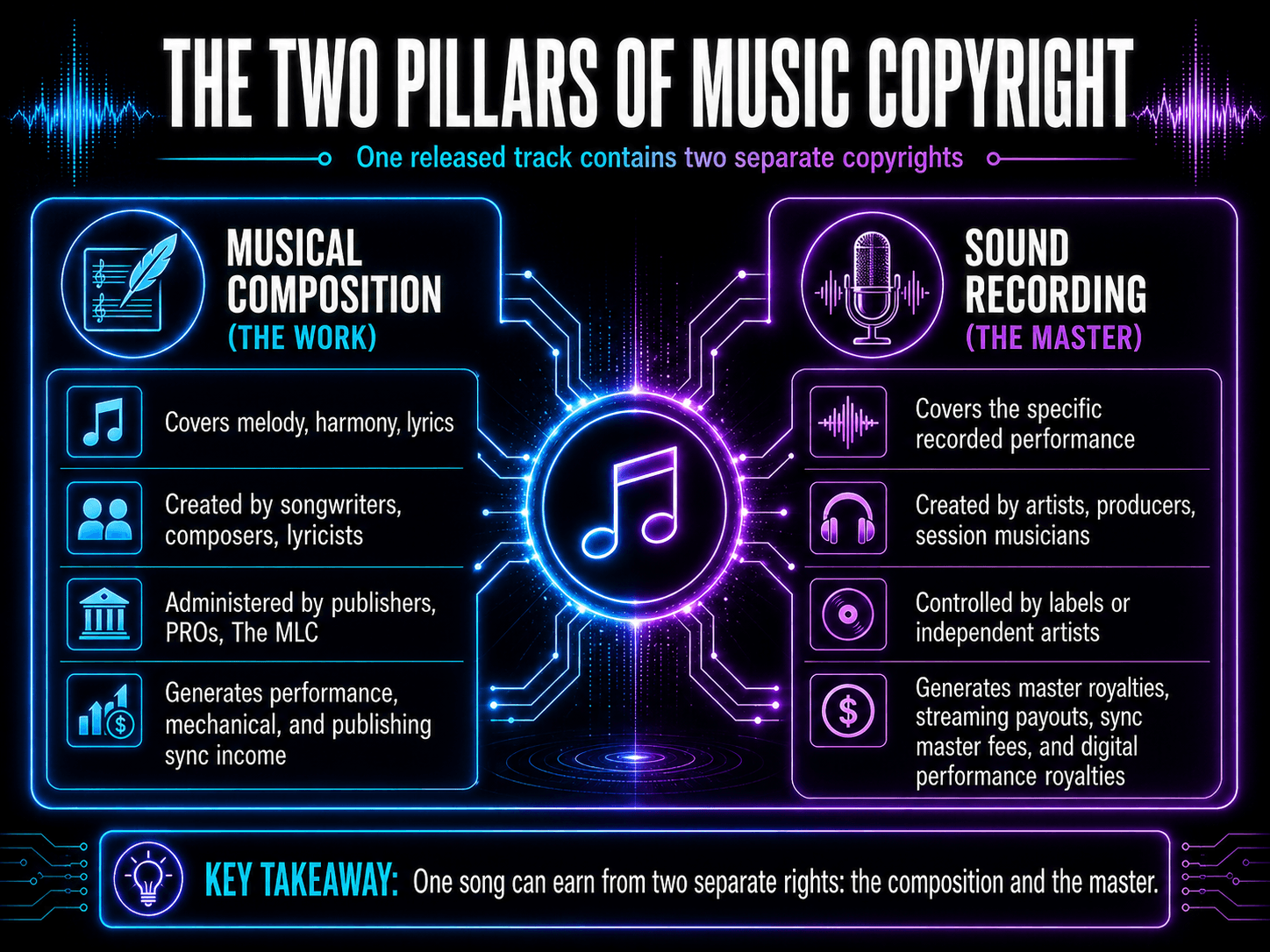
Under international legal frameworks, a single audio track contains two entirely separate layers of copyright music. Each layer is owned, managed, and monetized independently.
The Musical Composition (The Work)
This copyright covers the underlying musical notes, chords, melodies, arrangements, and lyrics. This asset is created by songwriters, lyricists, and composers, and it is administered by music publishers. The exploitation of this copyright yields songwriter royalties and publishing rights revenues.
The Sound Recording (The Master)
This copyright covers the specific physical or digital fixation of a performance in an audio medium. This asset is captured by performing artists, session musicians, and record producers, and it is traditionally owned or controlled by record labels or independent artists who finance the recording process. The exploitation of this copyright generates master royalties, commonly referred to as digital music royalties or streaming payouts.
Copyright Royalties and Licensing Categories
The monetization of these two assets occurs through distinct forms of music licensing, each governed by specific statutes and contractual precedents.
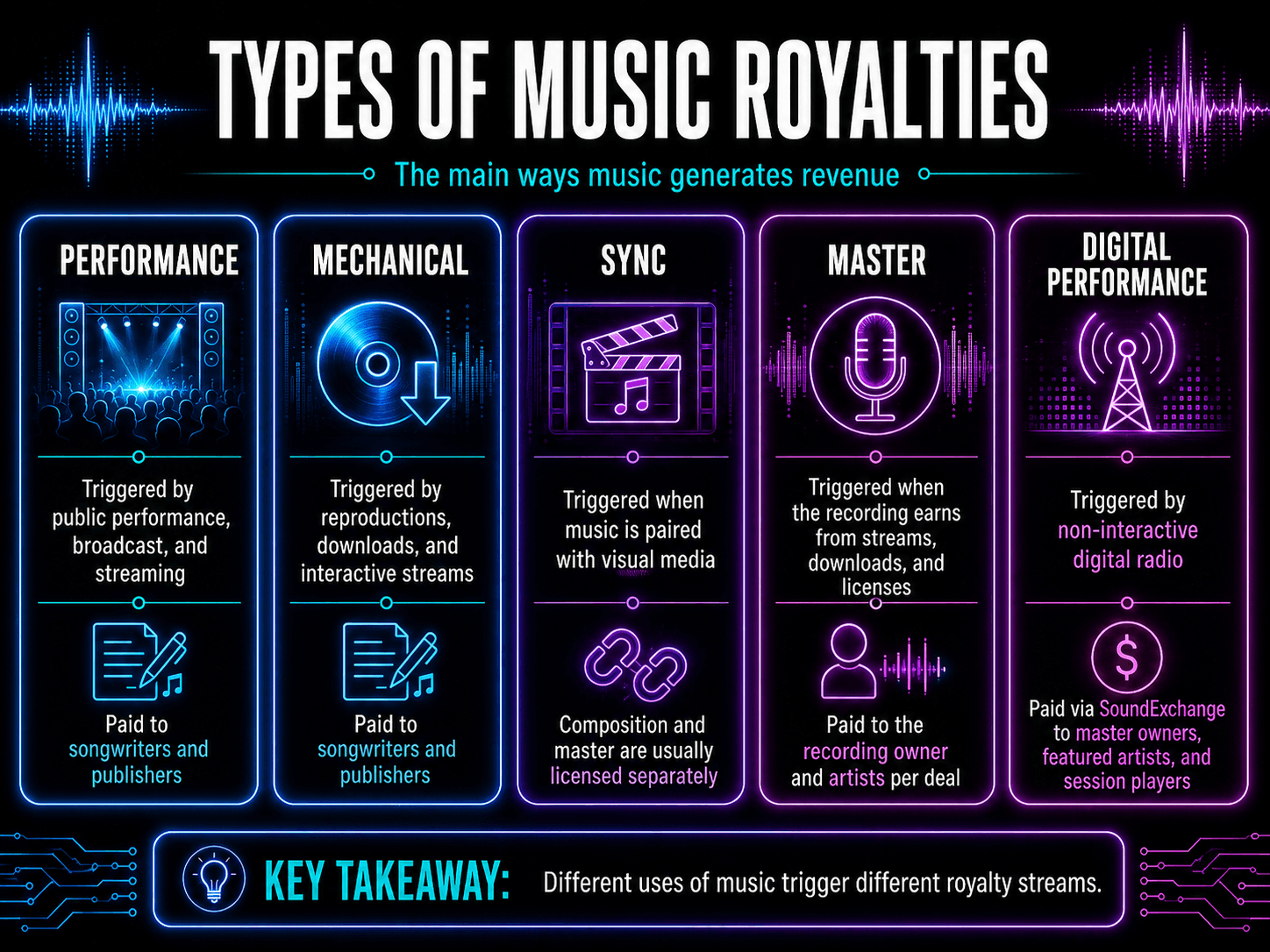
- Performance Royalties: Revenue generated when a musical composition is broadcast, streamed, or performed publicly. This includes terrestrial radio, television synchronization, live concert venues, digital streaming platforms, and ambient background music in commercial establishments.
- Mechanical Royalties: Revenue generated when a musical composition is reproduced and distributed in a physical or digital format. This includes the manufacturing of vinyl records, compact discs, permanent digital downloads, and interactive digital streaming.
- Synchronization (Sync) Royalties: Fees negotiated for the right to visually pair a composition and a sound recording with moving images, such as motion pictures, television broadcasts, video games, and advertisements.
- Digital Performance Royalties: Statutory revenue generated specifically from the non-interactive digital transmission of a sound recording. This applies to satellite radio, internet radio, and customized digital webcasts where the end user cannot select the specific track played next.
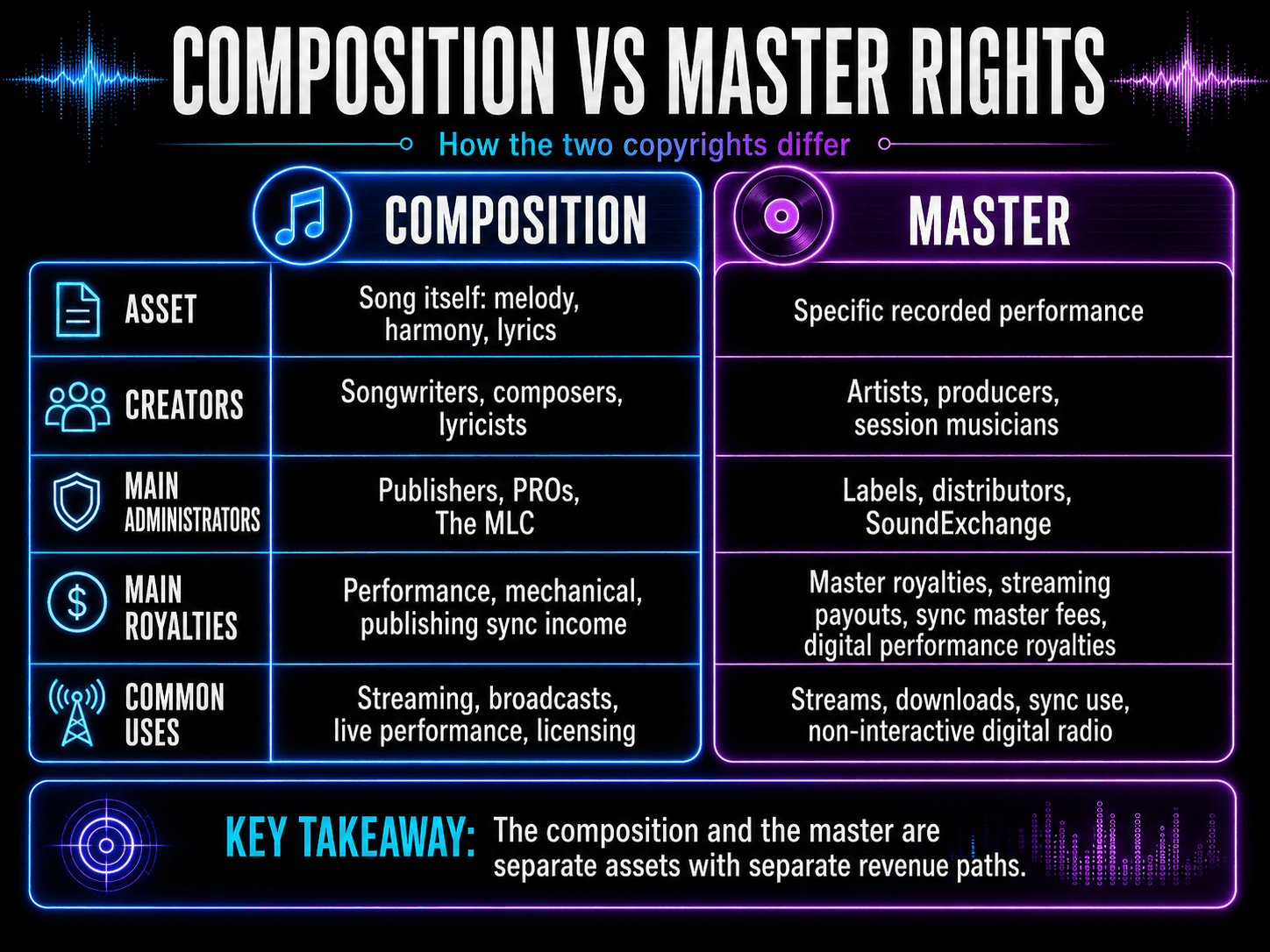
Comparative Feature Sheet: Composition vs. Master Rights
From AI Music Production to Royalty-Earning Releases
Before royalties can be registered, collected, or divided, the music itself must be created and prepared for release. ACE Studio is an AI music production platform that helps creators produce singing vocals, instrumental parts, arrangements, and visual content within one creative environment. It turns MIDI and lyrics into editable vocal performances, supports AI-generated instruments and custom voice models, and gives artists and producers more ways to develop a song before it enters the distribution and royalty system.
The term “royalty-free” can be misleading in this context. It does not mean that a finished song cannot earn royalties; it means creators do not owe recurring payments for using an eligible production resource. Most premade AI singing voices and all premade AI instruments in ACE Studio are royalty-free, with licence certificates available for eligible models. A small number of third-party voices require separate commercial permission and are clearly labelled before use.
Once a song is created, ACE Studio can help expand it into a broader collection of release assets. Creators can prepare instrumental versions, isolated vocals, alternate arrangements, language variations, and separate stems for synchronization, remixing, and promotional use. The AI Music Video Generator extends the same project into visual formats, guiding creators from a finished track through the concept, script, visual style, storyboard, and synchronized scenes for full music videos, vertical clips, streaming loops, and live-performance visuals.
These additional audio and visual assets do not generate royalties automatically, but they give a release more opportunities to reach audiences, support campaigns, and attract licensing interest. The finished music can still generate composition royalties for its songwriters and master revenue for the owner of the recording. ACE Studio supports the creative and production stage, while copyright registration, ownership splits, metadata, distribution, licensing, and royalty collection remain managed through the appropriate industry channels.
The Six Stages of the Royalty Lifecycle
The transition of a musical idea from a creative session into a yielding financial asset follows a rigorous logistical sequence. Failure to properly manage any single stage of this lifecycle results in unallocated or lost revenue, frequently referred to in the industry as black box income.
Stage 1: Composition and Sound Recording Creation
The lifecycle begins during the writing and recording process. At this stage, creators must document their contributions. Songwriters establish split sheets that define the exact percentage of the musical composition owned by each contributor. Concurrently, producers and artists negotiate master splits and producer points, which represent percentages of the net revenue derived from the sound recording copyright.
Stage 2: Metadata Standardization and Registration
Once the audio asset is finalized, it must be assigned global identifiers. The underlying composition requires an International Standard Musical Work Code (ISWC), while the specific sound recording requires an International Standard Recording Code (ISRC).
These codes act as digital passports. Creators or their representatives must register these codes along with complete split documentation with relevant royalty collection agencies across all target territories.
Stage 3: Commercial Distribution and Licensing
The sound recording is delivered to digital service providers and physical retailers via a music distribution service. Simultaneously, the underlying composition is cleared for digital reproduction and public performance.
Licensing frameworks are established, ensuring that entities utilizing the track—whether a streaming platform, a television network, or a retail venue—have the legal authorization to exploit the intellectual property.
Stage 4: Consumption Tracking and Auditing
As consumers interact with the music, data is generated. Interactive streams, radio broadcasts, and retail plays are logged via automated content identification systems, fingerprinting technologies, and cue sheets.
Digital service providers compile logs detailing exact play counts, subscriber tiers, and geographic origins. These logs are then submitted to designated collection societies for processing.
Stage 5: Collection and Financial Disbursal
Collection agencies ingest consumption reports, match them against their registration databases, and extract the appropriate financial fees from the users. After deducting administrative overhead costs, these agencies distribute the remaining royalty payments to the verified rights holders according to their registered split percentages.
Stage 6: Catalog Management
As a music catalog develops a reliable earnings history, rights holders can choose to retain it for long-term royalty income, pursue additional licensing opportunities, or sell some or all of their ownership for an upfront payment. These decisions can affect future income, creative control, tax obligations, and inheritance rights, so creators should seek qualified legal and financial advice before assigning, selling, or using music rights as collateral.
Administrative Infrastructure and Collection Bodies
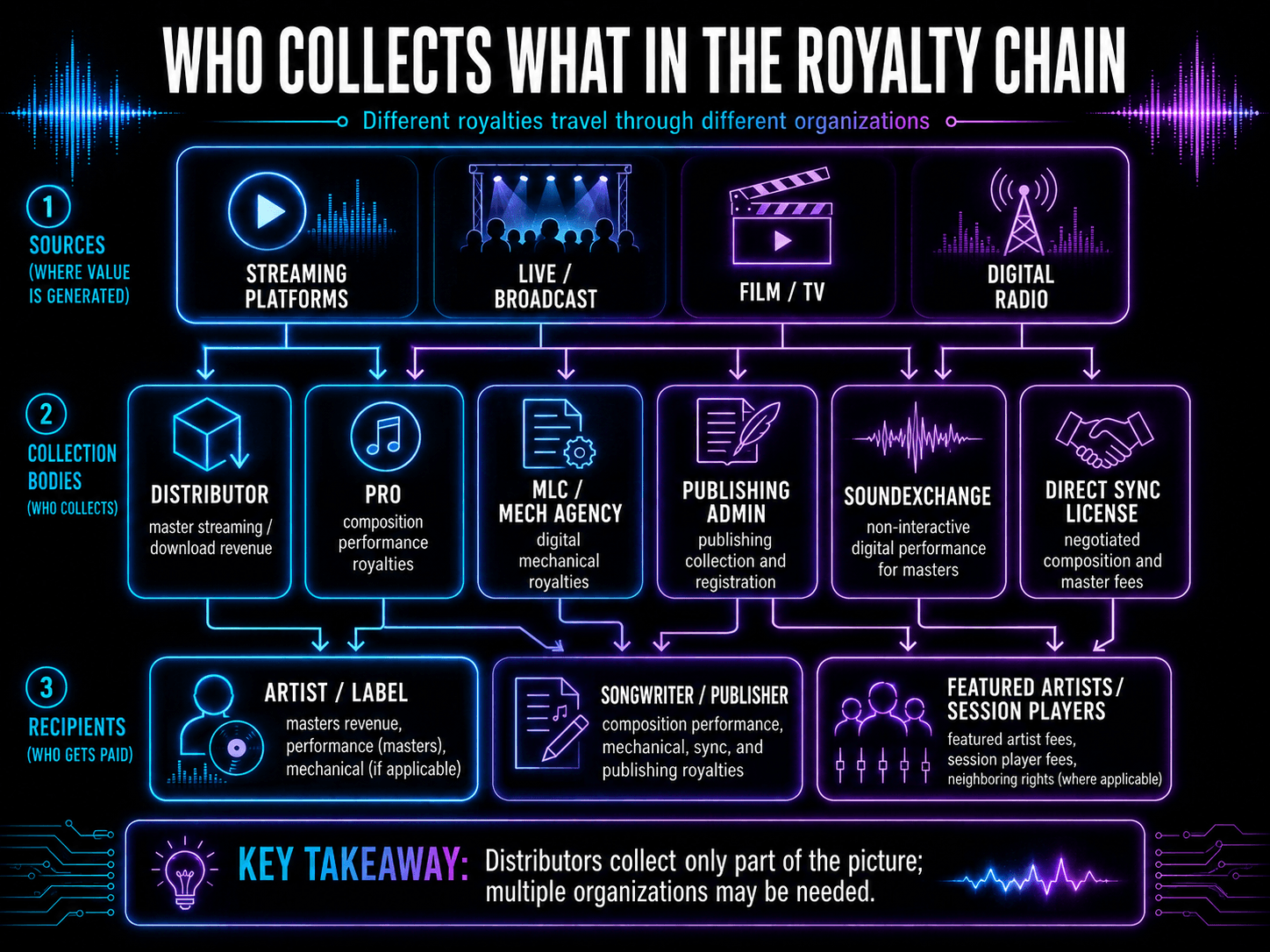
The administrative layer of the music industry functions through specialized collection agencies and structural partnerships. Rights holders must understand which organization is legally responsible for capturing each specific revenue stream.
Performance Rights Organizations (PROs)
Performance Rights Organizations are responsible for the administration of public performance rights associated with musical compositions. In the United States, the primary entities are ASCAP (American Society of Composers, Authors and Publishers), BMI (Broadcast Music, Inc.), and SESAC (Society of Stage Authors and Dramatic Composers).
PROs issue blanket licenses to radio stations, television networks, digital streaming platforms, and physical venues. These licenses grant the user the right to play any song in the organization’s catalog. The collected fees are pooled and distributed back to songwriters and publishers based on logged performances.
A foundational rule of PRO administration is the mandatory splitting of payments into a 50% writer share and a 50% publisher share. The writer's share is paid directly to the songwriter, bypassing any publishing administrators to protect the creator’s fundamental compensation.
SoundExchange
SoundExchange is a non-profit designation authorized under United States federal law to collect and distribute statutory digital performance royalties for sound recordings. Unlike PROs, which protect the songwriter, SoundExchange protects the recording artist and master owner.
When an audio track is played on non-interactive digital radio platforms like SiriusXM, Pandora, or internet webcasts, the platform pays a statutory fee to SoundExchange. This revenue is legally distributed according to a strict statutory breakdown:
- 50% to the copyright owner of the master recording (typically a record label or an independent artist).
- 45% to the featured recording artist.
- 5% to a non-featured artist contract pool, which compensates session musicians and background vocalists through a collective industry trust.
The Mechanical Licensing Collective (MLC)
Established under the Music Modernization Act of 2018, The Mechanical Licensing Collective is tasked with managing blanket compulsory mechanical licenses for interactive digital streaming in the United States.
Prior to its inception, streaming services struggled to identify the publishers of individual songs, resulting in significant unpaid mechanical royalties. The MLC maintains a comprehensive public database matching compositions to sound recordings.
Digital service providers pay a blanket license fee directly to the MLC, which then calculates and distributes 100% of the digital mechanical royalties to music publishers, self-published songwriters, and foreign collective management organizations.
Record Labels and Independent Distributors
Record labels operate as the primary commercial vehicle for the exploitation of the sound recording copyright. In traditional music industry contracts, a record label advances capital for production, marketing, and distribution in exchange for exclusive ownership or control of the master rights.
The label distributes the music via physical networks and digital pipelines, collects gross master revenues, deducts recoupable expenses (such as recording costs, video production, and tour support), and pays the remaining percentage to the artist based on the negotiated royalty rate.
In the independent sector, artists bypass traditional labels by utilizing distribution companies like DistroKid, TuneCore, or Downtown Music. These distributors do not own the master copyrights; instead, they pass 100% of collected interactive streaming and download revenues directly to the artist in exchange for a flat annual fee or a small percentage commission.
Music Publishers
Music publishers handle the administration of the musical composition copyright. Their operations focus on maximizing digital music revenue through licensing, administrative enforcement, and creative placement. Publishers protect songwriters by registering works internationally, auditing collection societies, and actively pitching the catalog for commercial synchronization opportunities.
In standard co-publishing agreements, a songwriter transfers 50% of their publishing ownership to the publisher in exchange for an upfront financial advance and creative infrastructure. In pure administration agreements, the publisher takes zero ownership, instead retaining a standard commission fee of 10% to 25% of gross publishing revenues for managing registrations and collection pipelines.
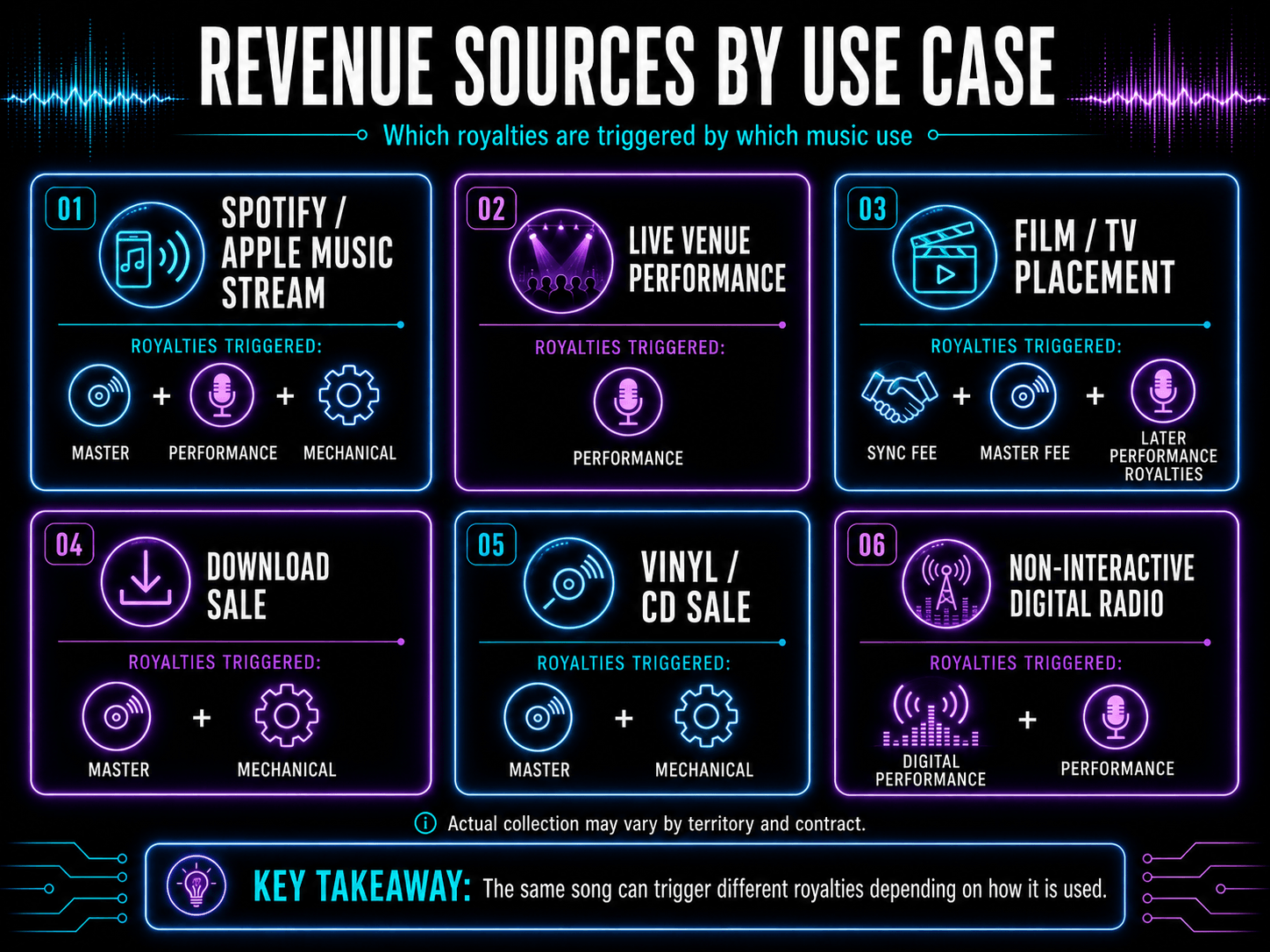
The Metrics of Royalty Calculations
Understanding music royalty calculations requires moving past generalized metrics to examine the exact financial mechanisms used by streaming services, mechanical rights bodies, and publishing administrators.
The Streaming Pro-Rata Model
A common misconception is that platforms like Spotify, Apple Music, and Amazon Music pay rights holders a static rate per individual play. Instead, these digital service providers operate under a pro-rata pool model.
Every month, a platform aggregates its gross revenue within a specific territory, combining subscription fees and advertising income. The platform immediately retains approximately 30% of this gross revenue as its operational margin.
The remaining 70% forms the royalty pool, which is split into separate pots for master rights and publishing rights. The master pool typically accounts for roughly 50% to 55% of total revenue, while the publishing pool receives 12% to 15%.
To calculate individual payouts, the platform determines the total number of qualifying streams across its entire system within that specific month and territory. A stream is counted only if the user listens for thirty seconds or longer.
The rights holder's specific payout is determined by their total platform market share. If an independent label's catalog accounts for exactly 1% of all eligible streams on a platform in a given month, that label receives 1% of the available master royalty pool.
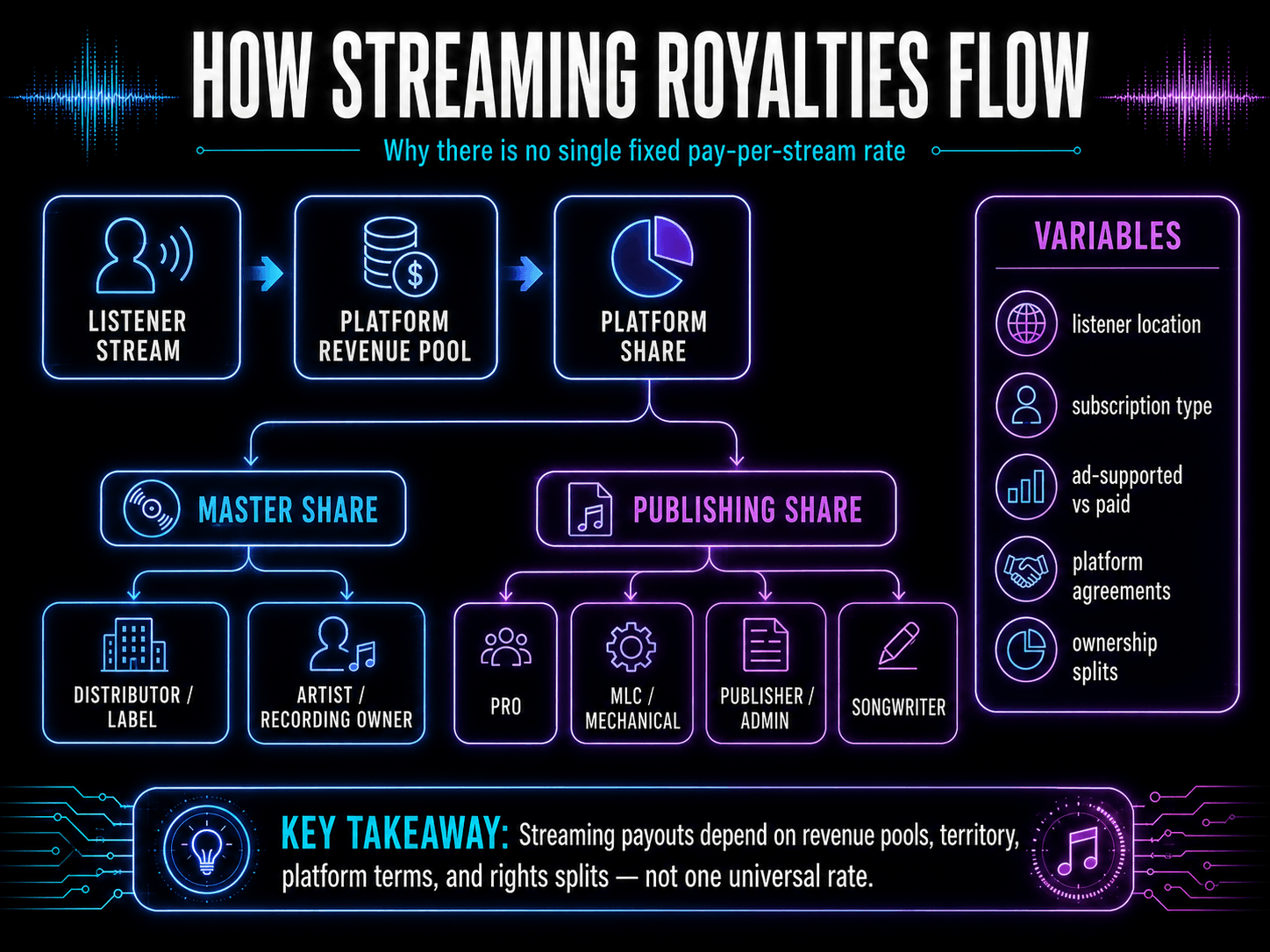
Several critical factors influence the final payout value of these streams:
- Subscriber Tier: A stream from a paid premium subscriber draws from a much larger financial pool than a stream from a free, ad-supported user account.
- Geographic Origin: Subscription costs vary significantly by nation due to local purchasing power parity. A premium stream originating from a region with higher subscription fees generates substantially more pool revenue than a stream originating from a market with lower pricing structures.
- Platform Subscription Mix: Payouts fluctuate dynamically based on the ratio of family plans, student discounts, bundled telecom offerings, and standard individual plans active within the billing cycle.
Mechanical Royalty Rate Calculations
Mechanical royalties for physical formats and permanent digital downloads are structured under a statutory compulsory rate set by government regulatory bodies. In the United States, this rate is determined by the Copyright Royalty Board (CRB).
For physical reproductions (vinyl, CDs) and permanent digital downloads (such as iTunes purchases), the statutory mechanical rate is fixed at 12.4 cents per track for compositions up to five minutes in length. For compositions exceeding five minutes, the statutory rate escalates to 2.38 cents per minute or fraction thereof. This provides a predictable baseline revenue calculation for physical pressings.
For interactive digital streaming platforms, the calculation does not use a fixed cent rate per play. Instead, the CRB establishes an escalated percentage-of-revenue formula.
The statutory rate structure dictates that digital service providers must allocate a specific percentage of their net revenues or total service expenditures to composition mechanical royalties. This percentage scales dynamically based on the specific operational costs and platform parameters defined in periodic CRB rate proceedings.
Publishing Splits: Writer vs. Publisher Shares
When publishing revenue is collected from performance and mechanical sources, it is broken down into two distinct financial tranches: the writer share and the publisher share. Both components represent exactly 50% of the total economic value of the composition.
This strict division protects creators. Performance Rights Organizations enforce this rule by sending the writer share directly to the creator's personal bank account. Even if a songwriter signs an aggressive publishing deal, the publisher cannot touch the writer share unless the songwriter explicitly signs over those administration rights via specialized contractual exceptions.
If an artist is self-published and does not work with a publishing company, they must establish a shell publishing entity to register and collect the remaining 50% publisher share. Otherwise, that half of the revenue remains unclaimed in collection agency accounts.
Cross-Border and International Royalty Administration
The monetization of music is inherently global, yet copyright enforcement remains strictly territorial. This friction requires a highly organized approach to international royalty administration.
Reciprocal Agreements and Collective Management Organizations
Outside the United States, most nations utilize unified, government-sanctioned entities known as Collective Management Organizations (CMOs). These bodies, such as PRS for Music in the United Kingdom, GEMA in Germany, and SACEM in France, handle both performance and mechanical rights within a single institution.
To manage global consumption, domestic PROs and international CMOs establish reciprocal representation agreements. Under these frameworks, ASCAP represents PRS works within the United States, while PRS collects ASCAP revenue from UK broadcasters and venues, routing those funds back across the Atlantic.
While this network provides baseline global coverage, it introduces significant administrative delay, with international performance funds often taking twelve to twenty-four months to clear. Additionally, local taxation policies and currency exchange fluctuations can erode net earnings during transit.
Territorial Variations in Mechanical Administration
Mechanical royalty collection methods diverge sharply between North America and the international market. In the United States and Canada, mechanical royalties have traditionally been routed through specialized clearinghouses like the Harry Fox Agency or automated through the MLC for streaming.
In stark contrast, regions like Europe and Japan manage mechanical collection through centralized statutory frameworks. In Japan, JASRAC serves as a singular administrative point, collecting both mechanical and performance fees directly from physical pressing plants, digital platforms, and media networks.
Furthermore, many international territories levy an administrative mechanical deduction directly at the source of physical sales, calculated as a strict percentage of the Suggested Retail Price (SRP) or the Published Price to Dealers (PPD).
The Global Black Box Challenge
When international streams or sales occur without flawless metadata, the generated revenue cannot be assigned to a specific rights holder. This unmatchable income is held in suspense accounts by foreign CMOs and is colloquially known as black box royalties.
International tracking systems usually hold these funds for a statutory period, typically three years. If a work remains unregistered or unmatched when this window closes, the black box funds are released from suspense.
Instead of being returned to the original creator, these funds are distributed across the local territory's dominant domestic publishers based on their localized market share. This redistribution underscores the absolute necessity of maintaining direct international publishing administration or utilizing global sub-publishers to actively audit foreign territories.
Legal Frameworks and Contractual Governance
Every financial transaction in the music business is governed by binding legal documentation. Navigating these agreements requires a clear understanding of standard industry terminology and structural clauses.
Key Structures in Music Industry Contracts
Co-Publishing Agreements
The most common structure for professional songwriters. Under a co-publishing framework, the songwriter assigns 50% of their publishing ownership (the publisher share) to the music publisher. The publisher then administers 100% of the composition.
Net revenues are split evenly, meaning the songwriter retains their full 50% writer share plus 25% of the publisher share, resulting in a total 75% financial position for the creator, while the publisher retains 25% for their administrative and creative services.
Administration Agreements
Designed for creators who retain significant commercial leverage or independent catalogs. The songwriter retains 100% ownership of the copyright.
The publishing administrator handles global registration, licensing, and collection pipelines in exchange for a pure service fee, typically ranging from 10% to 25% of gross publishing revenue. The contract term is strictly limited, usually running for three to five years.
Work-For-Hire Agreements
A highly restrictive legal mechanism common in film scoring, advertising, and sound design. Under a work-for-hire provision, the creator receives a flat upfront payment to compose or record audio, but explicitly waives all structural intellectual property ownership.
The hiring entity is legally classified as both the author and the owner of both the composition and master copyrights from inception, leaving the original creator with zero ongoing claim to recurring royalty payments.
Fundamental Legal Clauses
- Controlled Composition Clause: A historical yet persistent clause in record label contracts affecting singer-songwriters. It dictates that if an artist writes the songs they record, the label will only pay them a reduced rate (typically 75% of the statutory rate) for physical mechanical royalties. It also sets a strict cap on the total number of tracks the label will pay mechanicals on per album, usually capping the payout at ten tracks.
- Recoupment and Cross-Collateralization: Most music contracts involve financial advances. An advance is a pre-payment of anticipated future royalties. These funds are recoupable, meaning the label or publisher retains all generated royalty revenue until the initial advance is completely paid back. Cross-collateralization allows an investor to combine multiple accounts. If an artist signs a multi-album deal, the losses from an unsuccessful first album can be legally deducted from the profits of a highly successful second album, delaying individual payouts.
Strategic Revenue Optimization and Risk Mitigation
Maximizing music royalties requires a proactive operational strategy that combines targeted licensing with clean data management.
The Mechanics of Synchronization Licensing
Synchronization licensing represents one of the most lucrative sectors of modern music rights management. A sync placement generates immediate upfront fees and creates an ongoing pipeline of performance royalties as the visual media is broadcast globally.
To complete a sync placement, the licensee must secure permissions from two completely separate entities: the master owner (label) and the composition owner (publisher). If either party refuses or charges an unviable fee, the placement fails.
Smart independent artists maintain complete control of both their master and composition rights, allowing them to pitch their music as one-stop. This efficiency gives them a massive competitive edge with time-constrained music supervisors who can clear a track through a single signature.
Auditing and Cleaning Metadata Gaps
The primary cause of lost revenue in the digital era is metadata fragmentation. If a song's digital information contains errors, tracking algorithms cannot resolve payments. Rights holders should conduct a thorough self-audit using the following technical checklist:
- [ ] Verify that every master recording file contains embedded ISRC codes within the ID3 metadata tags prior to distribution.
- [ ] Cross-reference the MLC database to ensure your ISRC codes are accurately matched to the corresponding ISWC composition codes.
- [ ] Confirm that your split sheet percentages match the exact data filed with ASCAP, BMI, or your local PRO.
- [ ] Ensure your legal name, performance moniker, and unique International Standard Name Identifier (ISNI) are unified across all collection systems.
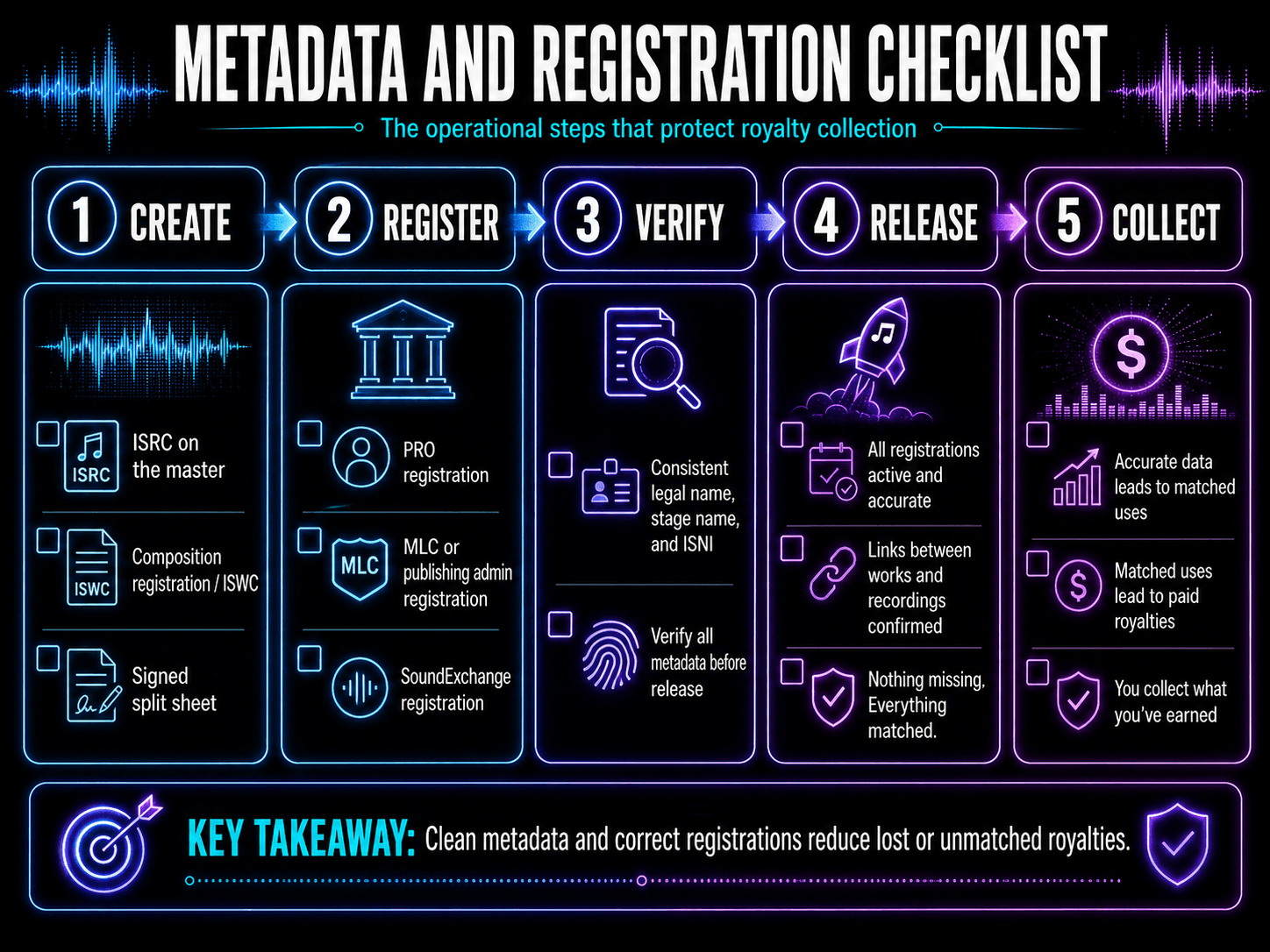
Creator-Specific Operational Blueprints
Independent Producer Strategy
Independent producers should avoid relying entirely on upfront production fees. They must secure explicit producer master split percentages via formal producer agreements.
Additionally, if a producer shapes the melodic or lyrical structure of a track, they are legally entitled to a co-writing share of the musical composition. This must be codified on a split sheet before the master is cleared for commercial release.
Record Label Catalog Management
Labels should maintain complete chain-of-title records and obtain written agreements from relevant performers, producers, vocalists, musicians, and other contributors. These documents should define ownership, compensation, permitted uses, credits, releases, and any continuing royalty participation before the recording is commercially released.
Furthermore, labels should actively register their masters with SoundExchange to secure the direct 50% copyright owner share of non-interactive digital performance funds.
Foreign Publishing Administrators
Administrators targeting global optimization should bypass distant reciprocal networks by establishing direct data portals with key international CMOs. By registering files directly with platforms like GEMA or PRS, administrators can drastically reduce the time it takes to collect international funds and eliminate foreign middleman fees.
Historical Duration and Asset Longevity
Music intellectual property is exceptionally durable, functioning as a long-term economic asset that can span multiple generations.
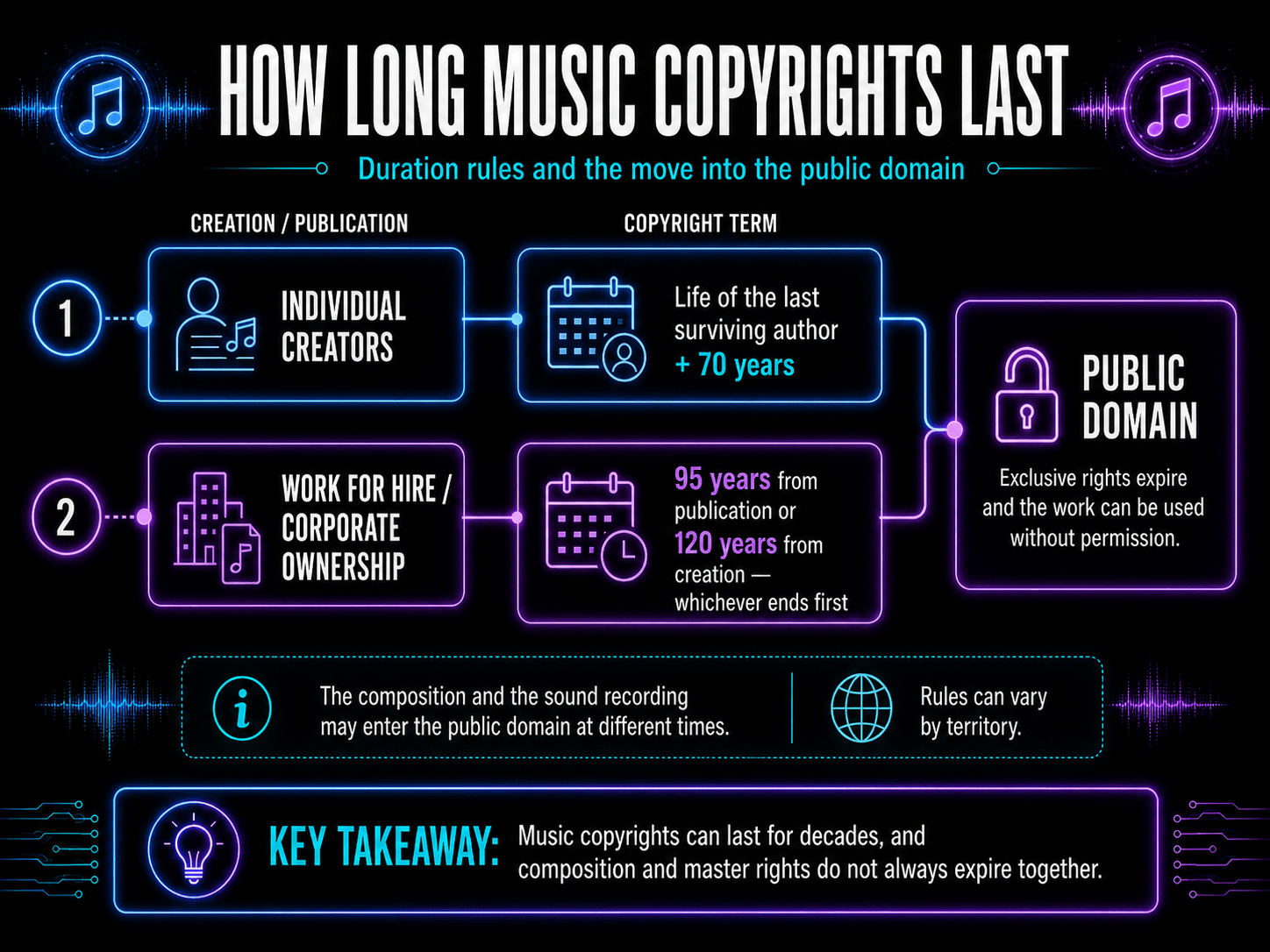
Statutory Protection Lifespans
The duration of music copyrights is strictly regulated by national statutes and international treaties like the Berne Convention. While minor variations exist between territories, the baseline lifespans follow clear legal rules:
Standard Personal Copyrights
For musical compositions and sound recordings created by individuals, protection extends for the entire life of the last surviving author plus exactly seventy years following their death. This ensures that a creator’s catalog can continue to provide financial support for their heirs across multiple decades.
Corporate and Work-For-Hire Copyrights
When an asset is created under a formal work-for-hire agreement or owned by a corporate entity from inception, the timeline shifts away from human lifespans. Protection lasts for 95 years from the date of first commercial publication, or 120 years from the date of original physical creation, whichever term expires first.
The Public Domain Transition
Once these statutory protection periods expire, the intellectual property undergoes a permanent legal transition into the public domain. When a work enters the public domain, all exclusive intellectual property protections cease.
The music can be copied, sampled, distributed, performed, and recorded by any citizen or corporation without requiring licensing permissions or generating royalty obligations.
Crucially, this transition affects the composition and master recording independently. A classic orchestral composition written in the nineteenth century resides safely in the public domain, meaning anyone can legally perform it.
However, a specific sound recording of that composition captured by a symphony orchestra in 2020 remains fully protected by master copyright law, requiring a license for any commercial exploitation.
Forward-Looking Shifts and Technological Adaptations
The music royalty landscape is undergoing structural changes driven by digital transformation and shifting legal frameworks.
The Integration of Generative Artificial Intelligence
The growing use of generative and assistive AI in music is creating new production opportunities while also raising questions about authorship, training permissions, voice rights, and royalty administration.
Licensed Training Data and Creator Consent
As AI becomes more established in music production, greater attention is being placed on how vocal recordings, compositions, and other creative materials are authorized for model training. Some developers work with licensed catalogs, commissioned recordings, technology partners, or user-provided datasets, while legal requirements continue to vary between territories.
For musicians, the practical priority is to choose tools with clear usage terms and to verify that they have permission to upload any vocals or recordings used to create a custom model. In ACE Studio, custom vocal models must be created from material the user owns or is authorized to use, with the necessary consent of the featured voice talent. This gives artists and producers a defined way to build private vocal models while retaining control over who can access and use them.
Synthetic Content and Persona Monetization
Copyright protection for AI-assisted music generally depends on the extent of human creative involvement and the laws of the relevant jurisdiction. Output produced with little meaningful human direction may receive limited or no protection, while music substantially shaped through human composition, editing, arrangement, performance decisions, and production may contain protectable human-authored elements.
Unauthorized use of a recognizable person’s voice, name, likeness, or recorded performance may create copyright, publicity, privacy, trademark, or contractual concerns. Voice-model providers and users should therefore document who supplied the recordings, what uses were authorized, whether commercial use is permitted, and who can access the resulting model.
Authorized voice licensing may create new commercial options for singers, session vocalists, and rights holders. The terms can define who may use the model, whether access is private or shared, which commercial uses are permitted, how long authorization lasts, and whether compensation takes the form of an upfront fee, ongoing royalties, or another negotiated structure. These arrangements are not standardized and should be documented through clear consent and licensing agreements.
Frequently Asked Questions
What is the operational difference between a PRO and SoundExchange?
A PRO collects performance royalties for the underlying musical composition, distributing those funds evenly between songwriters and music publishers. SoundExchange collects digital performance royalties for the specific sound recording (master), distributing those funds directly to record labels, featured performing artists, and session musicians when music is played on non-interactive digital platforms.
Can an independent artist collect mechanical royalties without a publisher?
Yes. An independent songwriter can collect digital mechanical royalties without hiring a publisher by registering as a self-administered songwriter with the MLC or the relevant collection body in their territory.
What happens to royalties when a song is sampled without prior clearance?
Utilizing an uncleared sample constitutes explicit copyright infringement of both the composition and the master recording. If the track is commercially released, the original rights holders can issue a formal takedown notice to remove it from digital platforms. Alternatively, they can legally demand 100% of all master and publishing royalties generated by the new track, completely stripping the new creator of any financial stake in the work.
How are royalties structured for cover songs?
Under United States copyright law, a creator does not need permission from the original author to record and distribute a cover song. Instead, they can secure a compulsory mechanical license by paying the standard statutory mechanical rate (currently 12.4 cents per physical copy or download) to the original publisher. On interactive streaming platforms, this mechanical fee is automatically calculated and routed to the original writer by the platform via the MLC, allowing the covering artist to retain the master streaming royalties.
How do buyouts affect long-term royalty collection?
In a catalog buyout, an artist or songwriter sells a portion or the entirety of their intellectual property rights to an investment fund or publisher for a lump-sum payment. Once finalized, the buyer steps directly into the shoes of the original creator, collecting all future royalty revenues associated with those purchased shares. However, unless explicitly waived via specialized contractual agreements, a songwriter typically retains their personal writer share of performance royalties, which continues to pay out directly from their PRO.