

Key Takeaways
- Melody is a sequence of notes organized through pitch and rhythm, creating the main musical idea listeners recognize and remember.
- Strong melodies combine smooth stepwise motion with occasional larger leaps to balance singability, movement, and emotional impact.
- Melodic phrases often follow question-and-answer patterns, using tension, repetition, climax, and resolution to create a clear structure.
- Scales, modes, intervals, contour, and rhythmic variation shape the mood of a melody and help distinguish different genres and styles.
- A memorable melody needs a clear focal point and enough space to stand above supporting chords, countermelodies, vocals, or instruments.
Why Melody Is the Heart of a Song
Understanding melody in music requires considering it the soul of a song, the unforgettable tune that resonates with listeners long after a track ends. Melody is the linear sequence of notes that creates a coherent musical phrase, acting as the primary part that audiences hum, whistle, and retain in memory. It serves as the distinct voice of a track, setting the emotional tone and guiding the listener through a sonic journey.
The iconic opening riff of Smoke on the Water by Deep Purple or the lilting lines of Beethoven’s Für Elise demonstrate how a melodic line captures human attention and drives emotional engagement. For music producers, composers, and vocalists, understanding melody is essential for crafting tracks that connect deeply with audiences. It serves as the foundational architecture around which harmony and rhythm revolve.
What is Melody?
At its most fundamental level, a musical melody definition refers to a succession of frequencies or tones perceived by the human brain as a single, cohesive entity. Unlike harmony, which deals with vertically stacked notes played simultaneously, a melody operates horizontally across a linear timeline. It is the surface layer of a musical composition, the narrative voice that communicates directly with the auditory cortex.

When analyzing a song, the melody functions as a primary storyline. It introduces ideas, builds tension, reaches a climax, and resolves to a state of rest. This horizontal progression allows composers to guide a listener through a structured emotional arc.
Historical and Etymological Evolution of Melody
The term melody originates from the Greek word melōdia, which combines melos (a song or tune) with aeidein (to sing). In ancient musical traditions, music was primarily monophonic, consisting entirely of a single melodic line without chordal accompaniment.

Throughout the evolution of Western classical music, from Gregorian plainchant through the Renaissance and Baroque eras, the conceptualization of melody shifted from strictly vocal trajectories to sophisticated instrumental lines. As complex harmonic frameworks developed in the classical and romantic periods, the melody retained its status as the primary focal point, serving as the vehicle for thematic development and emotional expression.
Does All Music Have to Have a Melody?
While melody is central to most commercial and classical music traditions, it is not an absolute requirement for all musical expressions. Certain genres and cultural traditions prioritize other musical elements over linear pitch successions.
- Percussion Traditions: African master drumming ensembles and Japanese Kodo drumming focus almost exclusively on intricate polyrhythms, timbral variations, and interlocking rhythmic frameworks, completely bypassing traditional pitch-based melodies.
- Minimalism and Drone Music: Ambient music and avant-garde drone compositions frequently rely on static harmonic clusters, textural shifts, and sustained frequencies where traditional melodic lines are intentionally omitted to create an atmospheric or meditative environment.
- Experimental Noise Music: Genres rooted in industrial soundscapes or concrete music isolate noise, texture, and rhythm, proving that music can exist as an acoustic experience without a recognizable tune.
Melody vs. Harmony vs. Rhythm: The Pillars of Musical Composition
A musical composition relies on the interaction of three primary pillars: melody, harmony, and rhythm. These musical elements do not operate in isolation; instead, they function as a symbiotic matrix.
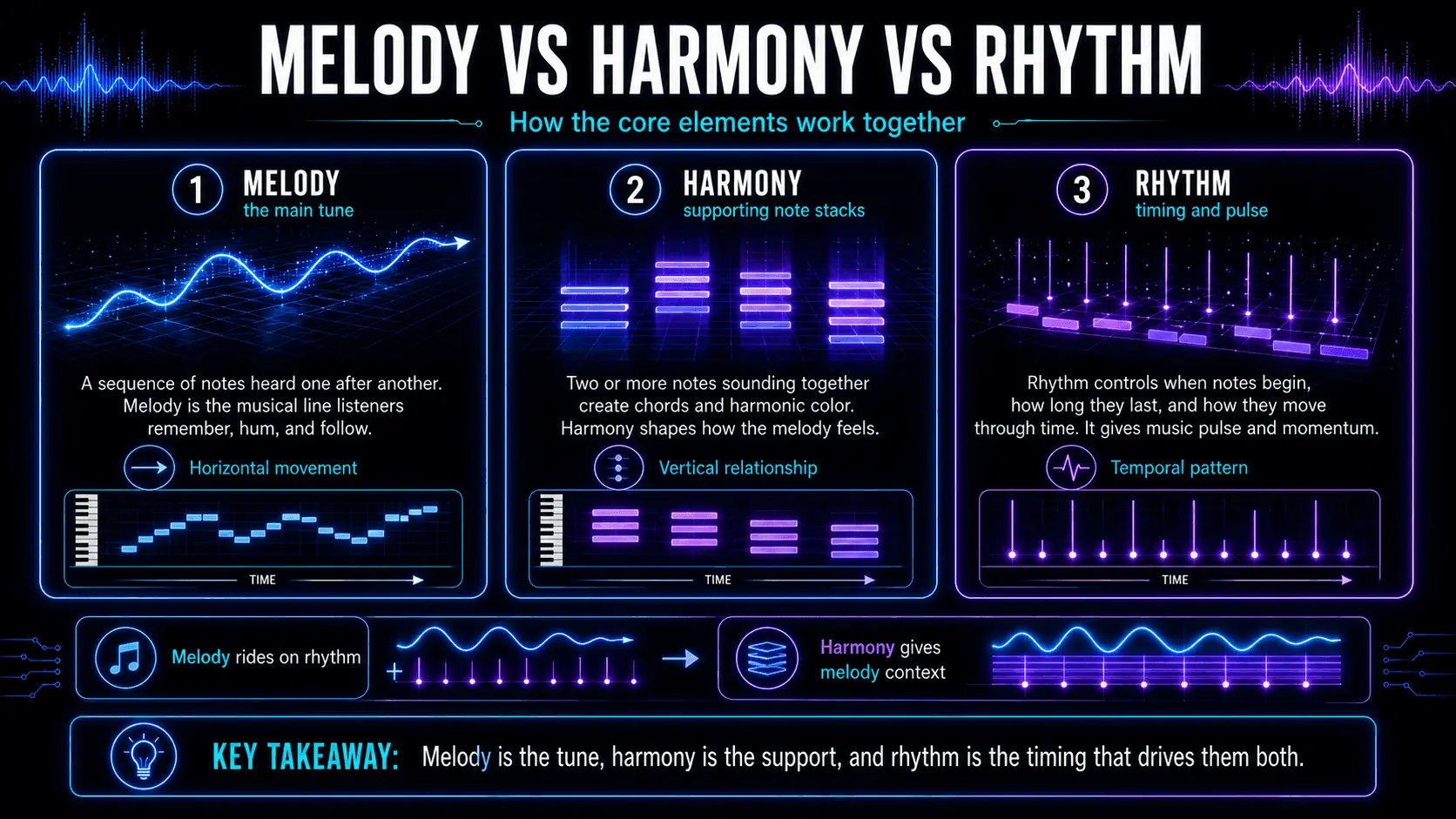
Rhythm provides the foundational grid and temporal skeleton. Harmony supplies the emotional environment, depth, and vertical context. Melody acts as the protagonist navigating the landscape created by the rhythm and harmony. Without a strong relationship between these components, a track risks sounding disorganized or emotionally flat.
Melody vs Harmony
The distinction of melody vs harmony is a fundamental concept in music theory. The primary difference lies in the directional axis of the musical notes:
- Melody (Horizontal Axis): Notes are played sequentially, one after another. It requires linear movement through time. It is singular, focusing on a single voice or instrument at any given moment.
- Harmony (Vertical Axis): Notes are played simultaneously to form chords, intervals, and harmonic clusters. It provides the context that defines how a melodic note feels. For example, playing the note C over a C major chord sounds stable and triumphant, while playing that same note C over an A-flat major chord introduces a lush, romantic tension.
Can Melody Exist Without Rhythm?
A melody cannot exist without rhythm. Because a melody is a sequence of sounds unfolding over time, every single note within that sequence must possess a specific duration. The moment a composer dictates when a note begins, how long it is held, and when it ceases, they are utilizing rhythm.
Even in free-form vocal music, such as a Gregorian chant or an unmetered instrumental rubato section, the varying lengths of the pitches create an inherent rhythmic structure. Rhythm gives a tune its unique bounce, stride, and momentum; without it, a melody would be a static, lifeless series of sustained frequencies.
Characteristics and Core Components of a Melody
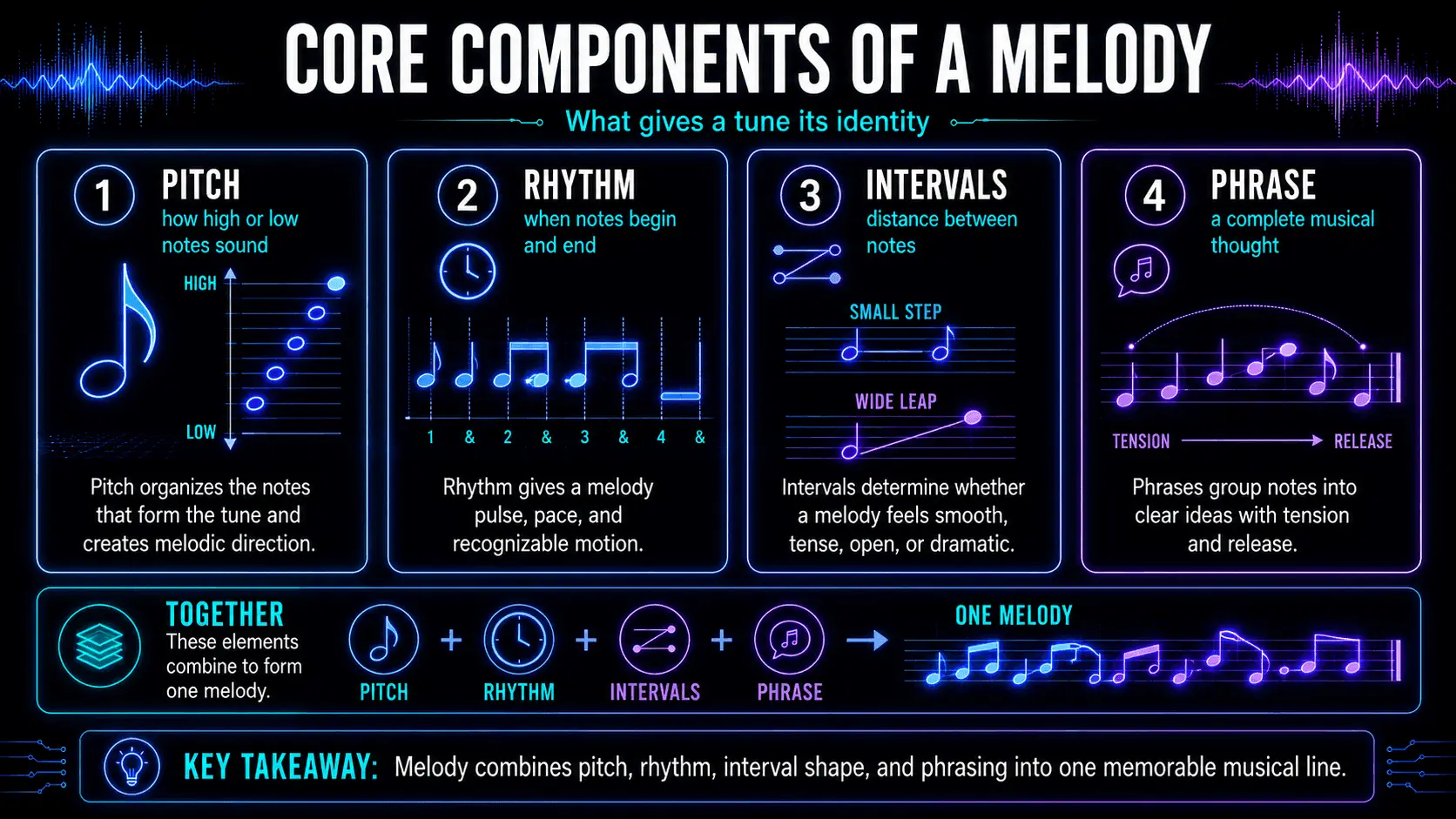
Pitch: The Vertical Dimension
Pitch refers to the specific frequency of a sound wave, measured in Hertz. In a musical composition, pitch dictates how high or low a note sounds on a musical staff.
Melodies rely on the careful arrangement of these pitches within established systems, such as the twelve-tone Western chromatic scale. The selection of specific pitches creates intervals—the distance between two notes—which form the building blocks of a memorable musical line.
Rhythm: The Horizontal Dimension
The temporal pacing of a melody is governed entirely by rhythm. This component dictates the onset, duration, and termination of each individual pitch.
Rhythm introduces critical structural features such as syncopation (accenting unexpected upbeats), triplets, and varying note lengths (such as combining short eighth notes with long, sustained whole notes). The rhythmic profile of a tune is often what makes it physically engaging and easily recognizable, even when stripped of its pitch information.
The Melodic Phrase and Melodic Structure
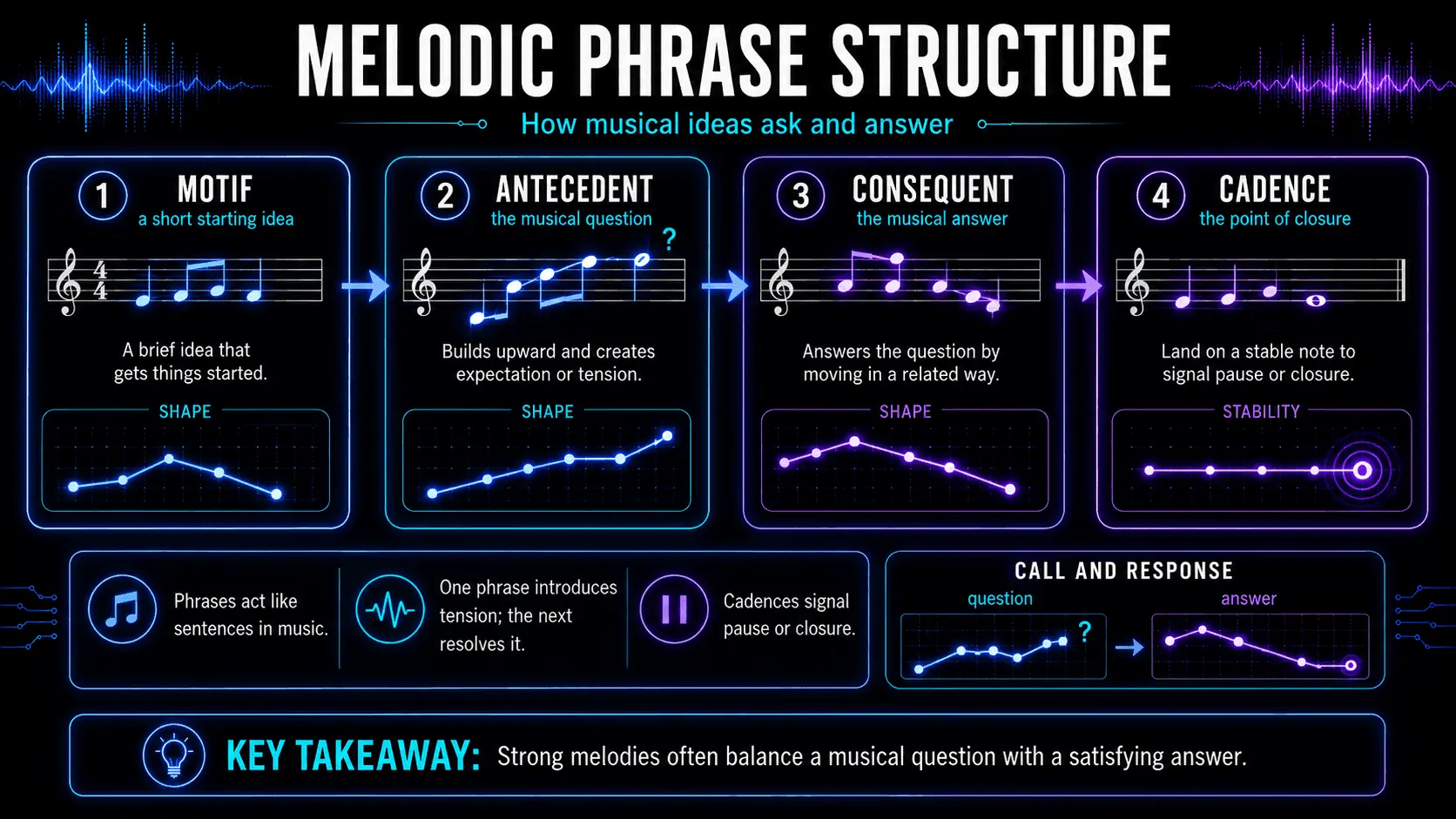
A melodic phrase is a distinct musical unit that functions much like a sentence in spoken language. Just as a sentence contains a subject and a verb to convey a complete thought, a musical phrase combines multiple notes to form a coherent statement.
Phrases typically conclude with a cadence, which acts as musical punctuation (such as a comma or a period) to signal a temporary pause or a final resolution. Standard melody structure relies on balancing these phrases using a call-and-response format:
- Antecedent Phrase: The call. It rises in tension and typically ends on an unresolved note, asking a musical question.
- Consequent Phrase: The response. It answers the antecedent phrase, typically moving downward to resolve on the tonal root note, providing a sense of closure.
How Many Bars and Notes Are in a Melody?
There is no rigid mathematical rule dictating the exact number of bars or notes required to form a melody. However, commercial songwriting and classical compositions rely heavily on symmetrical frameworks rooted in human cognitive processing limitations:
- The Four-Bar and Eight-Bar Phrase: In modern pop, rock, electronic, and hip-hop music, melodies are predominantly structured into four-bar or eight-bar phrases. This length provides enough time to establish a memorable theme without overwhelming the listener's short-term memory.
- Note Density: A single phrase within a melody can contain anywhere from three or four carefully chosen notes to dozens of rapid, virtuosic pitches, as seen in jazz bebop solos or classical violin concertos. The key is balance; a melody with too few notes can become boring, while a melody with too many notes can become difficult for an audience to track.
Types of Melodies and Melodic Motion
Melodic Contours and Directions
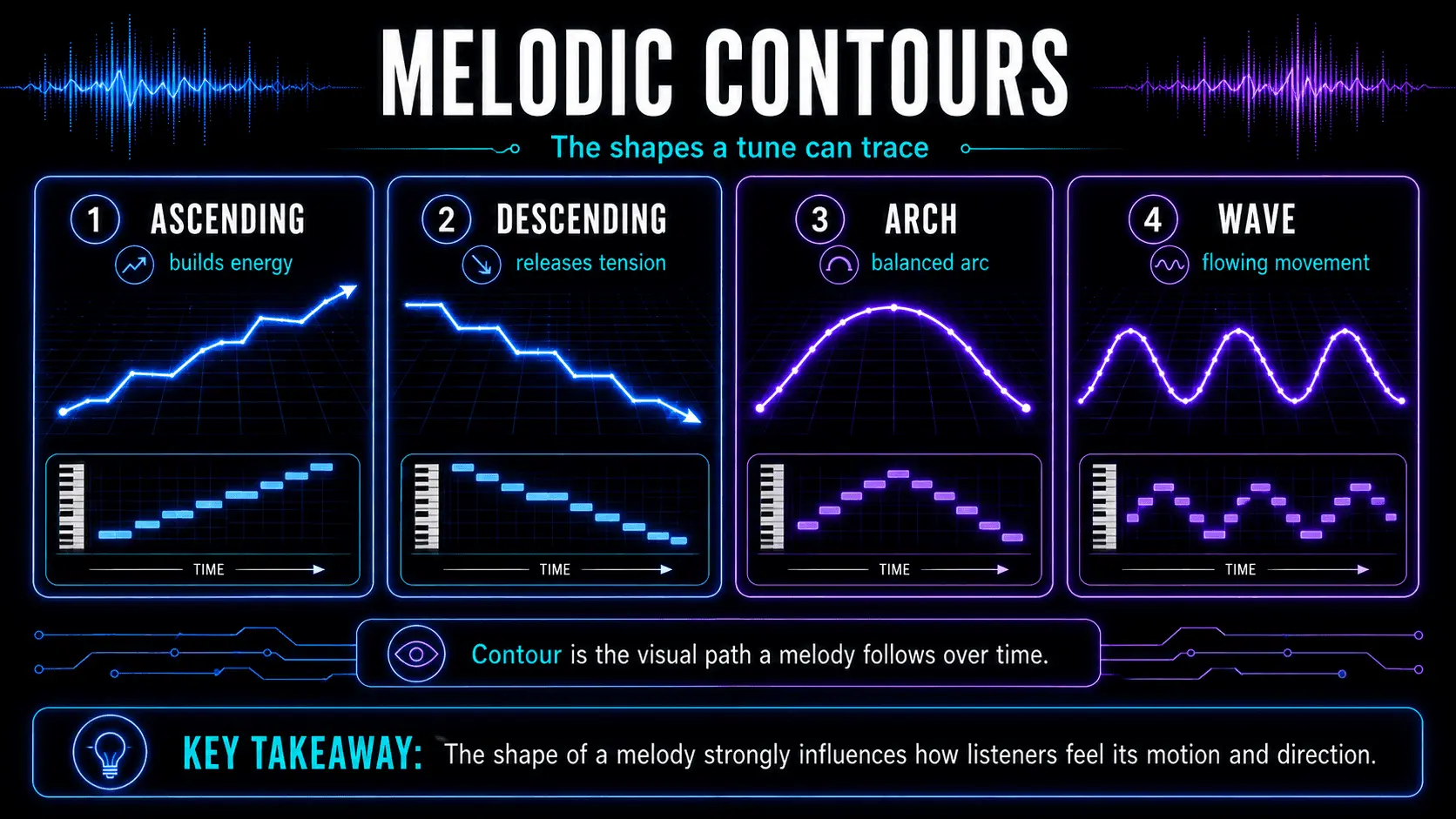
The geometric path that a melody carves as it transitions from note to note is known as its contour. Visualizing a melody on a musical notation staff or a digital audio workstation (DAW) piano roll reveals distinct shapes that directly influence how the music is perceived:
- Ascending Contours: The pitches rise over time, building tension, energy, and a sense of anticipation.
- Descending Contours: The pitches fall over time, releasing tension and conveying relaxation, grief, or final closure.
- Arch Contours: The melody rises to a peak pitch before gracefully descending, creating a balanced, symmetrical arc common in folk and classical music.
- Wave Contours: The melody alternates between rising and falling motions, creating an undulating soundscape.
Conjunct and Disjunct Melodic Motion: What Does It Mean?
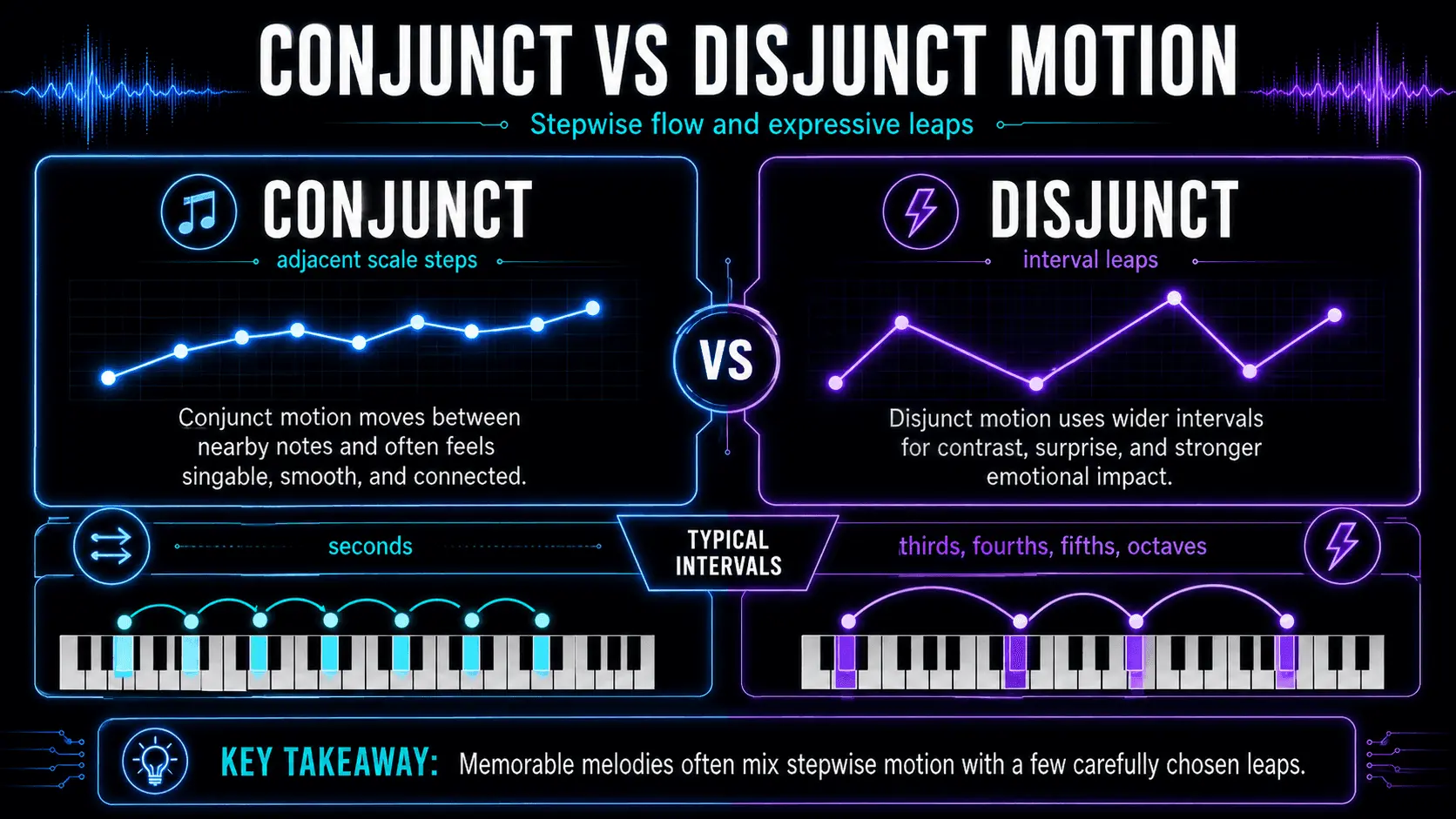
The physical distance between sequential notes determines whether a melody exhibits conjunct or disjunct motion. Both types of motion are critical tools for composers seeking to balance accessibility with dramatic flair.
Conjunct Melodies
A conjunct melody progresses primarily via small, stepwise intervals, meaning it moves to adjacent notes within a scale (typically whole steps or half steps). This stepwise motion results in a smooth, fluid, and flowing sound.
Because conjunct motion mirrors the natural tendencies of the human singing voice, these melodies are highly singable and memorable. A classic example is the main theme of Beethoven’s Symphony No. 9, widely known as Ode to Joy, where the notes step up and down with minimal leaping.
Disjunct Melodies
A disjunct melody moves using larger intervals, skipping over scale degrees and leaping across wide pitch gaps (such as minor sixths, major sevenths, or octaves). This motion creates a jagged, dramatic, and high-energy musical line.
Disjunct melodies require a wide vocal or instrumental range and inject excitement and surprise into an arrangement. The traditional melody of The Star-Spangled Banner or the soaring intervals in the main theme of the film Star Wars are excellent examples of highly disjunct melodic motion.
Textural Classifications of Melody
Melodies are also categorized by the broader musical texture in which they are embedded. These classifications define how many lines are playing at once and how they interact.
Monophonic Melodies
A monophonic texture features a single, solo melodic line entirely absent of harmonic support, background chords, or secondary voices. It is the purest form of melody, focusing the listener's attention strictly on the linear pitch sequence. Examples include ancient Gregorian chants, solo traditional flute performances, or an unaccompanied vocal solo.
Polyphonic Melodies
A polyphonic texture occurs when two or more independent, distinct melodies are played simultaneously. Rather than one melody taking the lead while chords support it, each voice carries its own unique thematic material.
These lines interlock using counterpoint, a foundational composition technique. The fugues of Johann Sebastian Bach stand as the peak of polyphonic melody construction, where multiple distinct lines weave together without losing their individual identities.
Homophonic and Heterophonic Variations
- Homophony: This is the most common texture in modern music, featuring a single prominent melody supported underneath by a series of chords or harmonic textures. The chords complement the melody rather than competing with it.
- Heterophony: This texture occurs when multiple performers play variations of the exact same melody simultaneously. One performer might play the core tune simply, while a second performer adds ornamentation, bends, and slight rhythmic shifts around it, a technique frequent in traditional Irish folk music and Middle Eastern classical ensembles.
What is a Countermelody in Music?
A countermelody is a secondary melodic line played alongside the primary melody. It is designed to be distinct and subordinate to the main theme, filling in the rhythmic gaps and adding linear depth to the arrangement.
A well-crafted countermelody avoids competing for the listener's attention by utilizing contrasting rhythmic patterns. For instance, when the main lead vocal sustains a long, held note, the countermelody might perform a quick, moving instrumental line, creating a conversational interplay between the two voices.
How Many Melodies Should a Song Have?
The total number of melodies within a single composition depends on the genre and song structure. However, a standard commercial song typically features a carefully organized hierarchy of melodies:
- The Verse Melody: Establishes the narrative voice, featuring a narrower pitch range and lower emotional intensity.
- The Chorus Melody (The Hook): The highest-energy, most memorable, and most repetitive melodic line in the track, designed for immediate recognition.
- The Pre-Chorus Melody: A transitional line designed to build harmonic and melodic tension between the verse and the chorus.
- Instrumental Counter-Melodies or Riffs: Secondary hooks played by guitars, synths, or brass sections that support the main vocal line without cluttering the frequency spectrum.
As a general rule of production, a song should rarely feature more than one primary focal melody at any single point in time, as human attention can easily become fractured.
How Melody Shapes Emotion: The Psychology of the Tune
The relationship between melody and emotion in music is rooted in human neurobiology and cognitive psychology. When a person listens to a well-crafted melody, the brain engages in predictive processing, attempting to anticipate the next note based on cultural exposure and familiarity with musical scales.
When a composer masterfully balances the fulfillment and subversion of these structural expectations, it triggers dopamine releases within the limbic system. This cognitive interplay allows music to evoke precise emotional states, bypassing logical language entirely.
The Impact of Intervals and Scale Modes on Mood
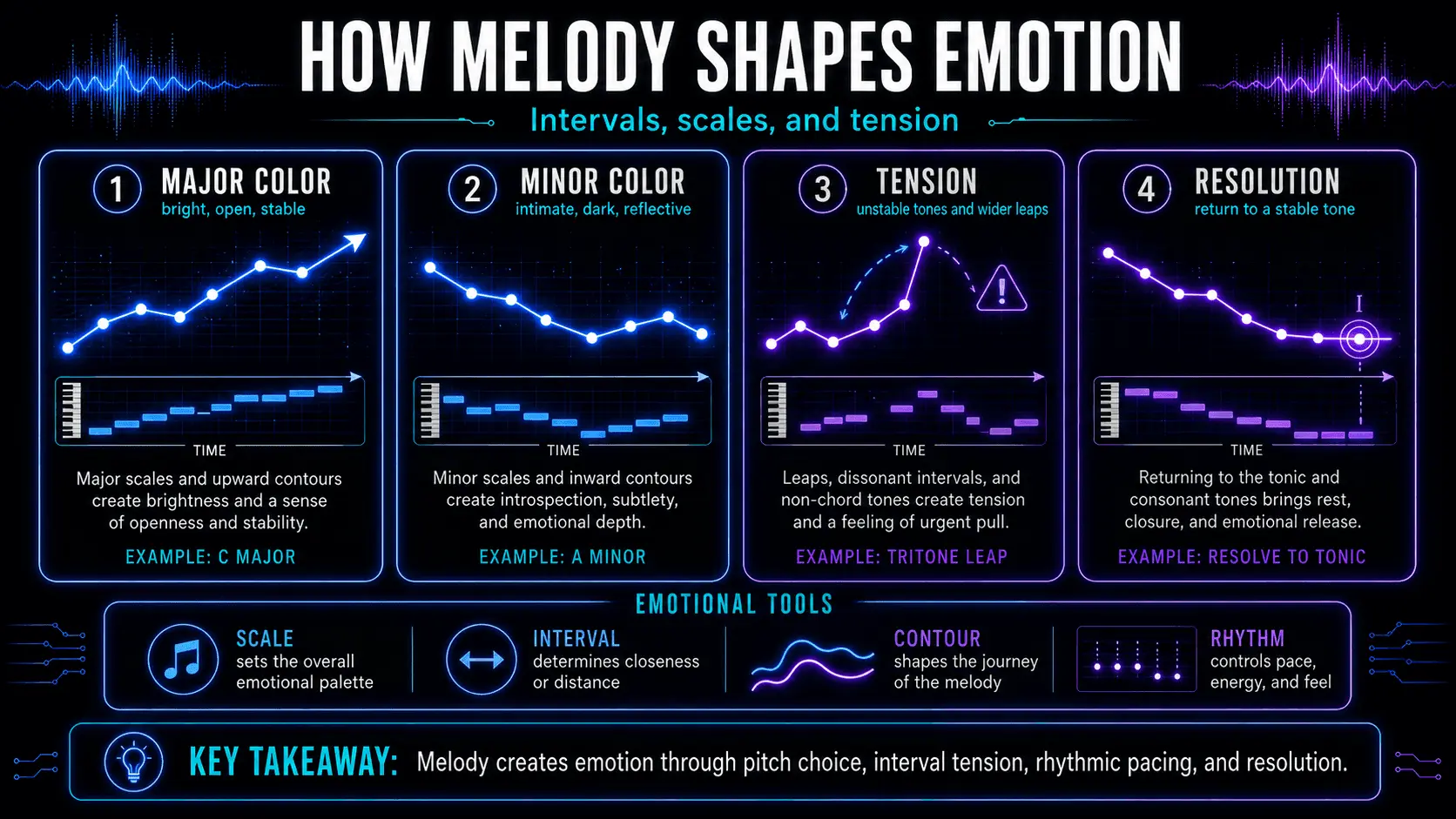
The specific structural choices a composer makes regarding scale degrees and intervals dictate the emotional color palette of a melody:
- Minor Seconds and Tritones: These intervals create acute dissonance, tension, and instability, frequently used in film scores to induce fear, anxiety, or suspense.
- Major Thirds and Perfect Fifths: These intervals evoke a sense of stability, openness, brightness, and triumphant resolution.
- Scale Modes: Writing a melody within the Dorian mode introduces a melancholic yet hopeful quality, while the Phrygian mode provides an exotic, dark, and tense atmosphere. Shifting a melody from a standard Major scale (Ionian) to a Minor scale (Aeolian) instantly transforms an optimistic tune into an expression of grief or introspection.
Thematic Development and Emotional Tension
To keep a melody engaging across a long arrangement, composers utilize thematic development. This involves taking a short melodic motif and systematically modifying it over time to reflect changing emotional narratives.
Techniques include melodic inversion (flipping the intervals upside down), retrograde (playing the melody backward), augmentation (stretching the note durations), and truncation (cutting the phrase short). By evolving the motif, the composer maintains structural unity while guiding the listener through a shifting emotional landscape.
The Role of Melody Across Different Music Genres
The implementation, prioritizing, and structural shaping of melody varies significantly depending on the genre of music. Understanding these stylistic conventions allows producers to craft authentic arrangements.
Classical Music and Motific Architecture
In classical composition, melody is rarely a static loop; it is treated as a living organism subject to development. In the Classical and Romantic eras, composers built entire symphonies out of tiny, multi-note melodic fragments called motifs.
Beethoven’s Symphony No. 5 is built on a four-note motif that repeats, shifts pitches, migrates across instrument sections, and changes harmonies. This structural depth allows classical melody to carry complex stories across multi-movement, long-form works.
Pop Music and the Architecture of the Hook
Pop music relies on immediate accessibility, repetition, and compression. The goal of a pop melody is to establish a memorable hook that sticks with the listener after a single play.
Pop melodies favor pentatonic scales, which are free of dissonant intervals, and use a step-by-step movement broken up by rhythmic syncopation. These hooks are placed at the very front of the audio mix, keeping the vocal line clear and highly polished over a supportive chord progression.
Jazz and Improvisational Melodic Development
In jazz, melody is a fluid, evolving concept. While a jazz performance begins with the statement of a written melody (the head), the core of the genre lies in spontaneous melodic creation over a changing chord progression.
Jazz musicians utilize advanced melody creation techniques by drawing from chromatic alterations, passing tones, and extended chord scales. This allows them to create intricate, complex melodies that challenge traditional tonal boundaries.
Electronic Dance Music (EDM) and Synth Leads
In electronic dance music, the human voice is frequently replaced or supplemented by electronic instruments. The melody is typically delivered via a bright synth lead or a series of vocal chops processed through samplers.
EDM melodies are designed around high-energy repetition and interactive rhythmic patterns that lock into the track's drum groove. These melodies are engineered to cut through heavy club sound systems, relying on arpeggiators and sidechain compression to create a driving movement on the dance floor.
Hip-Hop and R&B: Vocal Lines and Melodic Samples
The melodic landscape of hip-hop and modern R&B is a unique hybrid of vocal lines and found sounds. In early hip-hop, producers sourced melodies from vintage soul, funk, and jazz vinyl records, looping and chopping instrumental hooks to create a backdrop for the rapper's rhythmic delivery.
In modern hip-hop and contemporary R&B, the boundary between rapping and singing has dissolved. Artists use triplet patterns, auto-tuned vocal lines, and melodic cadences, embedding the melody directly into the vocal delivery over sub-bass patterns.
Famous Examples of Melody in Songs and Compositions
Analyzing classic compositions provides valuable insights into how different types of melodies work across history.
Classical Masterpieces
- Symphony No. 5 by Ludwig van Beethoven: A premier example of a motif-driven melody. The simple four-note pattern shows how a minimal phrase can form the foundation for an entire orchestral work through repetition and pitch variation.
- Für Elise by Ludwig van Beethoven: This melody uses an arching contour that alternates rapidly between two chromatic notes before descending into an arpeggiated chord pattern. It balances tension and resolution, making it recognizable across generations.
Contemporary Pop and Rock Icons
- Yesterday by The Beatles: Composed by Paul McCartney, this melody is a masterclass in conjunct movement combined with small, expressive leaps. It matches the melancholic, reflective tone of the lyrics by landing gracefully on chord extensions.
- Stairway to Heaven by Led Zeppelin: The introductory guitar line demonstrates a minor arpeggiated melody with a descending bassline. It showcases how a slow, folk-influenced melody can build structurally and dynamically into a high-energy rock anthem.
- Someone Like You by Adele: A contemporary pop classic that highlights the emotional impact of disjunct leaps. The chorus melody uses wide octave jumps to mimic the emotional strain and vulnerability of the lyrics, illustrating how melody can heighten emotional resonance.
How to Create a Melody: Advanced Melody Creation Techniques
For creators looking to write original music, adopting a structured methodology can help streamline the composition process.
Step-by-Step Melody Composition Workflow
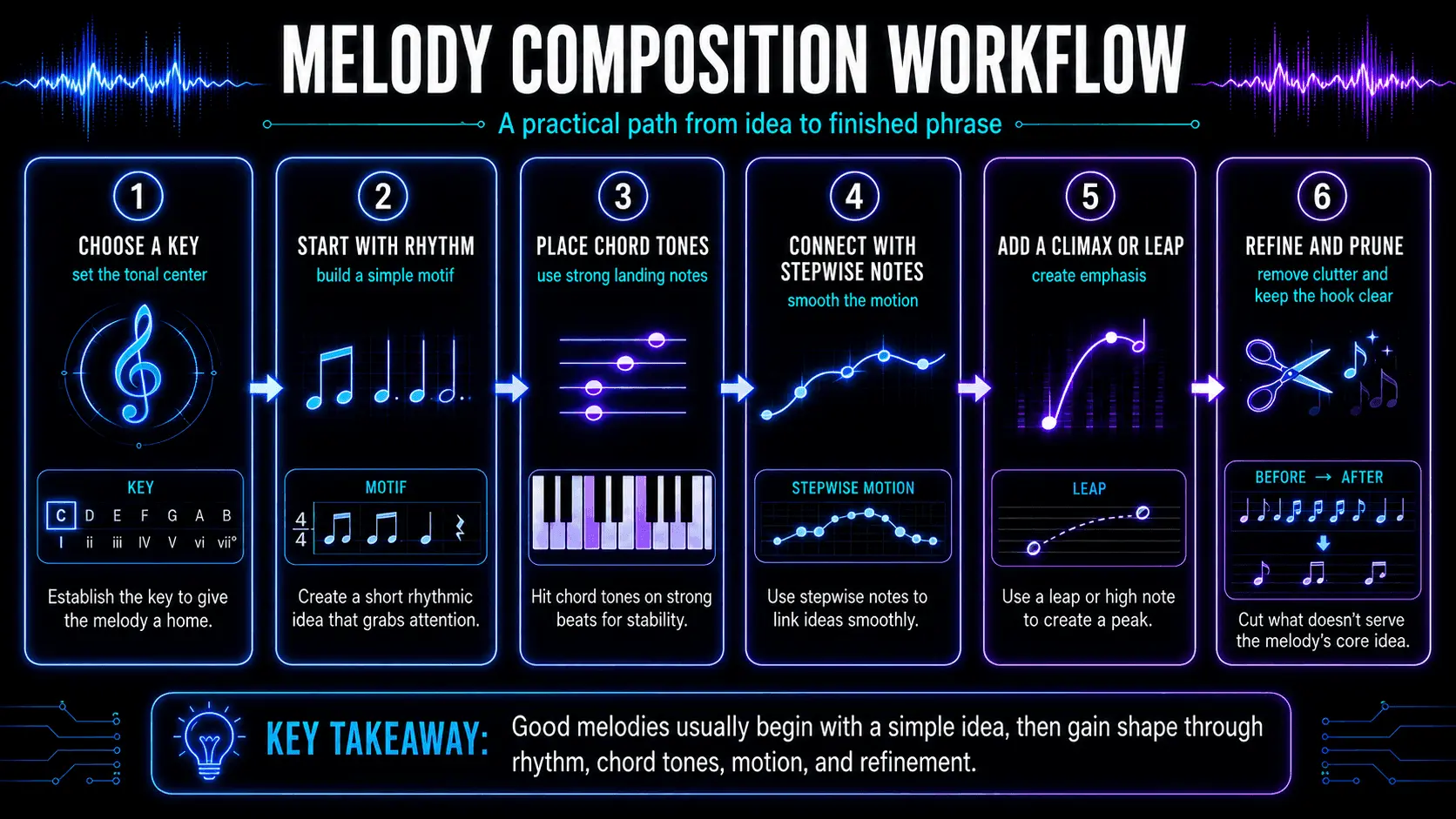
- Establish the Tonal Foundation: Select a musical key and generate a basic chord progression to serve as your harmonic landscape (e.g., a simple I - V - vi - IV progression in C Major).
- Improvise a Rhythmic Motif: Before choosing pitches, clap or tap out a simple rhythmic pattern. Establishing a compelling rhythm helps ensure your melody has momentum.
- Map Core Chord Tones: Begin placing notes on the downbeats of your bar grid. Target the root, third, or fifth intervals of the underlying chord. These stable landing zones help give your melody a sense of structural grounding.
- Introduce Stepwise Passing Tones: Connect your core chord tones by filling in the gaps with adjacent scale steps. This creates a smooth, conjunct flow that makes the line easy to sing.
- Incorporate an Expressive Leap: Break up the stepwise motion by introducing a single intentional leap of a fourth, fifth, or octave. This adds a moment of surprise and elevates the emotional energy of the line.
- Refine and Prune: Review your initial draft. Remove unnecessary notes to create breathing room, ensuring your phrase remains distinct and uncluttered.
How to Make a Melody for a Song on Piano
The piano offers a visual and intuitive layout for exploring melody. Here is a practical approach for composing on the keys:

- Left Hand Grounding: Use your left hand to play and hold sustained root notes or basic block chords. This establishes the harmonic environment.
- Right Hand Exploration: Use your right hand to improvise singular, linear lines within a single scale (such as the white keys of C Major or A Minor).
- Visual Interval Tracking: Take advantage of the piano grid. Moving to adjacent keys creates a smooth, conjunct movement, while jumping over black and white keys allows you to introduce disjunct leaps. This visual feedback makes it easier to balance structural shapes and track your melody's contour.
Digital Audio Workstation (DAW) Approaches for Modern Producers
Modern music production software provides powerful tools for refining and shaping melodies:
- MIDI Piano Roll Editing: Use your DAW's MIDI grid to adjust note lengths and placements. This allows you to easily experiment with variations, such as shifting note positions to create syncopation.
- Humanization Techniques: If you program your melody directly into the MIDI grid, turn off strict quantization. Introducing slight variations in note timing and velocity helps mimic the natural feel of a live performance.
- Pitch Correction and Vocal Transformation: Tools like Auto-Tune or Melodyne allow you to reshape audio recordings. You can adjust the pitch of a vocal performance or sample to create a completely new melody while retaining its original timbre.
How to Develop and Test a Melody in ACE Studio
A melody can sound convincing when hummed but behave very differently once it is assigned to a singer or instrument. ACE Studio lets you capture the initial idea as editable notes and then test how the same phrase performs in different musical roles. This makes it useful for deciding whether a melody should become a lead vocal, instrumental hook, harmony line, or subtle countermelody.
Turn a Hummed Idea Into Editable Notes
You do not need to play an instrument fluently to capture a melodic idea. Record or import a hummed phrase, then use ACE Studio’s Vocal to MIDI & Lyrics tool to extract its pitch and rhythm. The resulting notes appear in the piano roll, where you can shorten held notes, correct uncertain pitches, change intervals, move the melodic climax, or simplify an overcrowded phrase.
This is especially practical when you can hear a melody internally but cannot immediately reproduce it on a keyboard. Instead of losing the original phrasing of the voice memo, you can preserve the idea and refine its structure one note at a time.
Test the Same Melody as a Voice or Instrument
Once the melody exists as MIDI, ACE Studio can generate it with an AI singing voice and lyrics or perform it through an AI instrument. Its MIDI tracks support both AI voices and AI instruments, while the instrument models provide controls for expression and articulation.
Hearing the same phrase in several forms can reveal problems that are difficult to spot on a piano sound alone. A wide leap may feel expressive on strings but uncomfortable for a vocal line. A simple vocal hook may become more distinctive when played by a saxophone or brass instrument. A phrase that lacks enough presence to lead the chorus may still work well as an instrumental response between vocal lines.
Create Support Around the Main Melody
After establishing the primary melody, ACE Studio’s Add a Layer tool can generate a matching musical layer for a selected part of the arrangement. You can define the type of layer and describe its intended style, instrument, or function. The tool analyzes the existing project before producing a new part.
For example, you could explore a restrained string response beneath a sustained vocal note, a short instrumental phrase between two lyrical lines, or a backing vocal texture that appears only at the melodic climax. These generated parts should not replace deliberate arrangement decisions. They provide material to compare, edit, or discard while checking whether the supporting motion strengthens the main melody without competing with it.
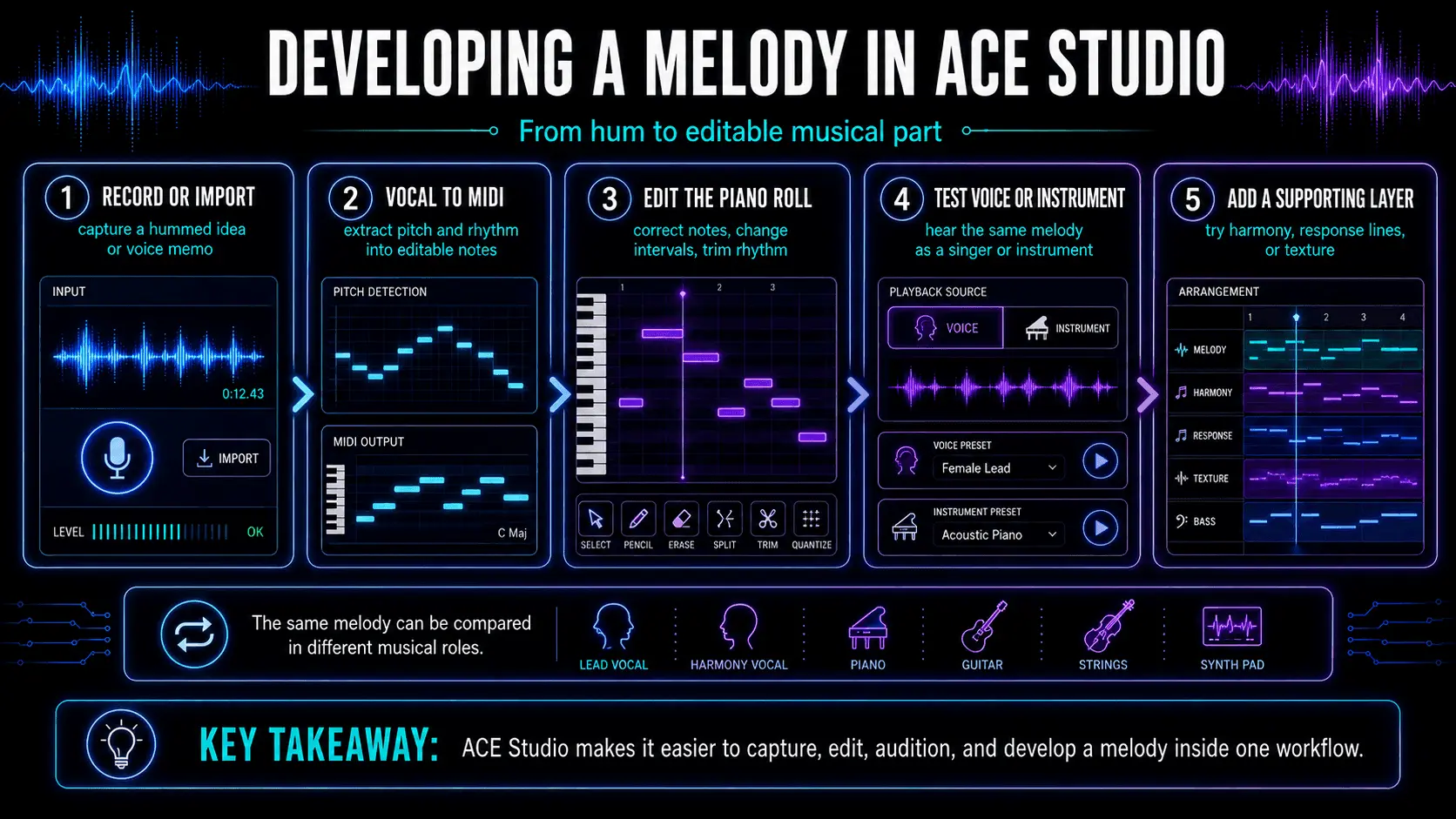
The main advantage of ACE Studio is the speed of comparison. The notes remain editable while their voice, instrument, phrasing, and musical purpose can change. This allows composers to judge a melody by how it actually functions in a song rather than relying only on how it looks in notation or sounds through a basic piano patch.
What Makes a Good Melody? Essential Criteria
While musical taste is subjective, highly successful melodies across genres typically meet four core criteria:
- Balance: They find a comfortable middle ground between conjunct steps and disjunct leaps.
- Rhythmic Variety: They utilize a mix of note durations and rests, avoiding monotonous patterns.
- Clarity of Focus: They feature a clear peak pitch that serves as the emotional climax of the phrase.
- Structural Space: They leave room for breaths and pauses, allowing the listener's brain to process the musical information.
The Lead Sheet: Documenting Melodic Composition
What is a Lead Sheet?
A lead sheet is a simplified form of musical notation that captures the essential structural elements of a song on a single page. It serves as a blueprint for performing musicians and producers, providing just enough information to perform or arrange the track without specifying every note of the accompaniment.
Guidelines for Lead Sheet Writing and Musical Notation
A professional lead sheet must include three core components:
- The Melody Line: Written clearly in standard notation on a single treble or bass clef staff, indicating the exact pitches and rhythms of the main vocal or lead instrument.
- Chord Symbols: Placed directly above the staff system, indicating the harmonic progression (e.g., Cmaj7, Am9) aligned with the corresponding bars.
- Lyrics: Placed directly underneath the staff lines, aligned with their matching melodic notes.
Practical Songwriting Tips and Creative Exercises
Ear Training and Active Listening Exercises for Melody Recognition
Improving your melodic skills requires consistent ear training. Try incorporating these active listening habits into your routine:
- Interval Transcription: Listen to a favorite song and attempt to identify the interval distance between the first two notes of the chorus melody. Associate these distances with familiar reference tunes (e.g., a perfect fourth sounds like the opening of Here Comes the Bride).
- Unaccompanied Vocal Tracking: Strip away the instrumental backing track in your mind. Focus entirely on the lead vocal line, mapping out its contour and phrasing on paper using simple line drawings.
- Solfege Practice: Sing basic melodic lines using standard sight-singing syllables (Do, Re, Mi, Fa, Sol, La, Ti). This builds a strong mental link between written notation and actual pitches.
Overcoming Creative Blocks in Melodic Writing
If you find yourself stuck writing the same patterns, try using intentional limitations to spark new ideas:
- The Three-Note Constraint: Limit yourself to composing a melody using only three selected notes. This forces you to focus on rhythm and phrasing rather than relying on complex pitch movements.
- Rhythmic Borrowing: Take the rhythmic pattern of a well-known melody from a completely different genre and apply it to a new set of pitches within your chosen scale.
- Randomized Contour Generation: Draw a random shape or line on a piece of paper, then translate that visual contour directly into your DAW's piano roll as a sequence of notes.
How Long Does It Take to Learn to Write or Recognize Melodies?
Developing a strong intuition for melody is a gradual process that rewards consistent practice.
- Initial Familiarity (1 to 3 Months): With daily ear training and basic instrument practice, you can expect to easily identify basic intervals and construct simple, functional four-bar melodies.
- Advanced Fluency (1 to 2 Years): Dedicated study of voice leading, scale modes, and transcription typically allows you to easily write complex, emotionally expressive melodies and transcribe intricate vocal lines by ear.
- Mastery (Continuous): Melodic composition is a lifelong journey. Even experienced professionals continue to refine their approach, finding new ways to balance simplicity and surprise.
Frequently Asked Questions (FAQ)
What is the definition of a countermelody?
A countermelody is a secondary melodic line played alongside the primary melody. It is designed to support the main theme, filling in rhythmic gaps and adding linear depth without competing for the listener's attention.
Can a melody have harmony within itself?
No, a melody on its own is a single, horizontal sequence of notes played over time. The moment you stack secondary notes directly on top of a melody line to play simultaneously, you are introducing harmony.
Is a riff or a hook considered a melody?
Yes, riffs and hooks are specialized forms of melody. A riff is a short, repeating melodic pattern that often serves as the rhythmic backbone of a section, while a hook is the most memorable, high-energy melodic phrase designed to catch the listener's attention.
What is the best scale for writing catchy melodies?
The Major Pentatonic scale (comprising degrees 1, 2, 3, 5, and 6 of the major scale) is widely considered an excellent choice for writing accessible, memorable melodies. Because it contains no dissonant half-steps or tritones, every note combination flows naturally and avoids harsh tension.
How do I protect my original melodies legally?
Under copyright law, a melody is protected the moment it is fixed in a tangible medium, such as a recorded audio file or written musical notation. To establish formal legal evidence of your ownership, you can register your completed composition with national copyright offices and perform public release documentation.