
Key Takeaways
- The octatonic scale is an eight-note symmetrical scale built by alternating whole steps and half steps in either a whole-half or half-whole pattern.
- Its balanced structure creates a mysterious, tense sound commonly used in jazz improvisation, film scoring, orchestral music, and modern composition.
- Only three unique octatonic note collections exist, as each scale repeats at intervals of a minor third and can support four related tonal centers.
- The scale works particularly well with diminished seventh chords and altered dominant harmony, providing colors such as the ♭9, ♯9, ♯11, and 13.
- Musicians should practice the scale through short motifs, rhythmic patterns, and tension-and-resolution exercises rather than simply playing all eight notes in order.
How the Octatonic Scale Creates Controlled Tension and Modern Harmonic Color
The octatonic scale has a distinct sound that grabs the ear immediately. Commonly used in jazz, film scores, and modern compositions, this eight-note scale feels both unstable and controlled. It can sound dark without being sad or tense without being chaotic.
Musicians often turn to this scale to find a more modern, angular sound that goes beyond standard major and minor systems.
- The scale may seem intimidating because it does not follow the traditional seven-note structure. However, its balanced pattern makes it a powerful tool for exploring new sounds.
- It offers a sophisticated harmonic palette that allows for complex movement without needing overly complicated theory.
Many players discover the octatonic scale while analyzing legendary jazz solos or suspenseful movie soundtracks. In these cases, the scale is more than just theory; it is a practical way to transform a melody.
What is the Octatonic Scale?
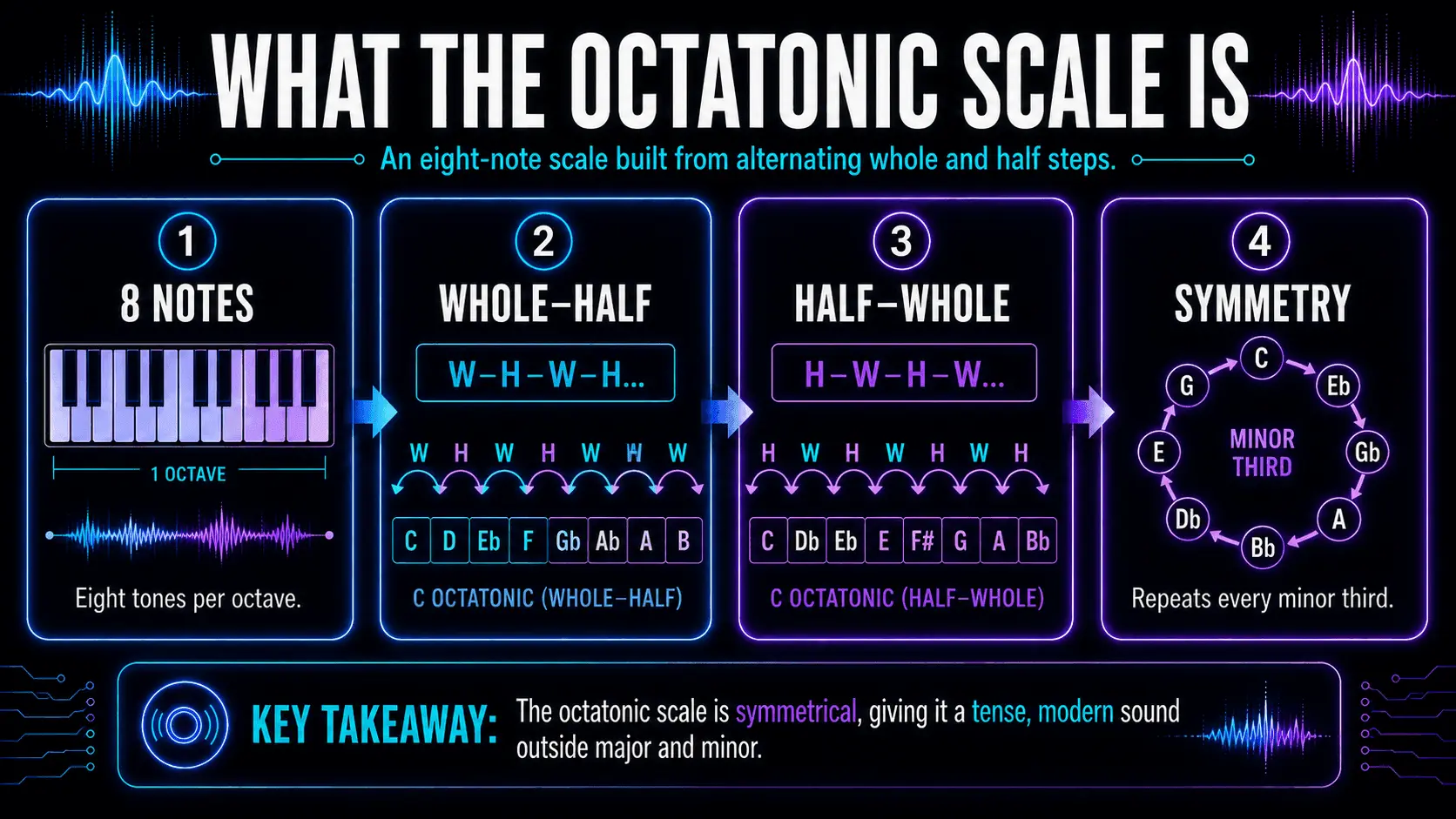
The octatonic scale is a symmetrical eight-note scale that alternates between whole and half steps or half and whole steps. Because of this pattern, there are two common forms. One starts with a whole step, often called the whole-half diminished scale, and the other starts with a half step, often called the half-whole diminished scale.
A C half-whole octatonic scale looks like this:
C – Db – Eb – E – F# – G – A – Bb
A C whole-half octatonic scale looks like this:
C – D – Eb – F – Gb – Ab – A – B
Both versions divide the octave evenly, creating a repeating interval pattern. Unlike a major scale, which has a clear tonal center, the octatonic scale can feel ambiguous. That ambiguity is one reason it works so well in advanced harmony.
Many players first encounter the scale while studying diminished seventh chords because each diminished chord can generate an entire octatonic sound world. Since the notes repeat in a symmetrical way, one fingering can often be moved in multiple directions across the instrument.
A common misunderstanding is that the octatonic scale is only for advanced players. In reality, many teachers encourage students to begin with simple exercises that isolate just four notes before expanding into the full eight-note system.
Historical Context of the Octatonic Scale
The octatonic scale became especially important during the late nineteenth and early twentieth centuries when composers began searching for sounds beyond traditional tonal harmony. Russian composers such as Rimsky-Korsakov used the scale to create exotic colors that sounded different from standard European harmonic language.
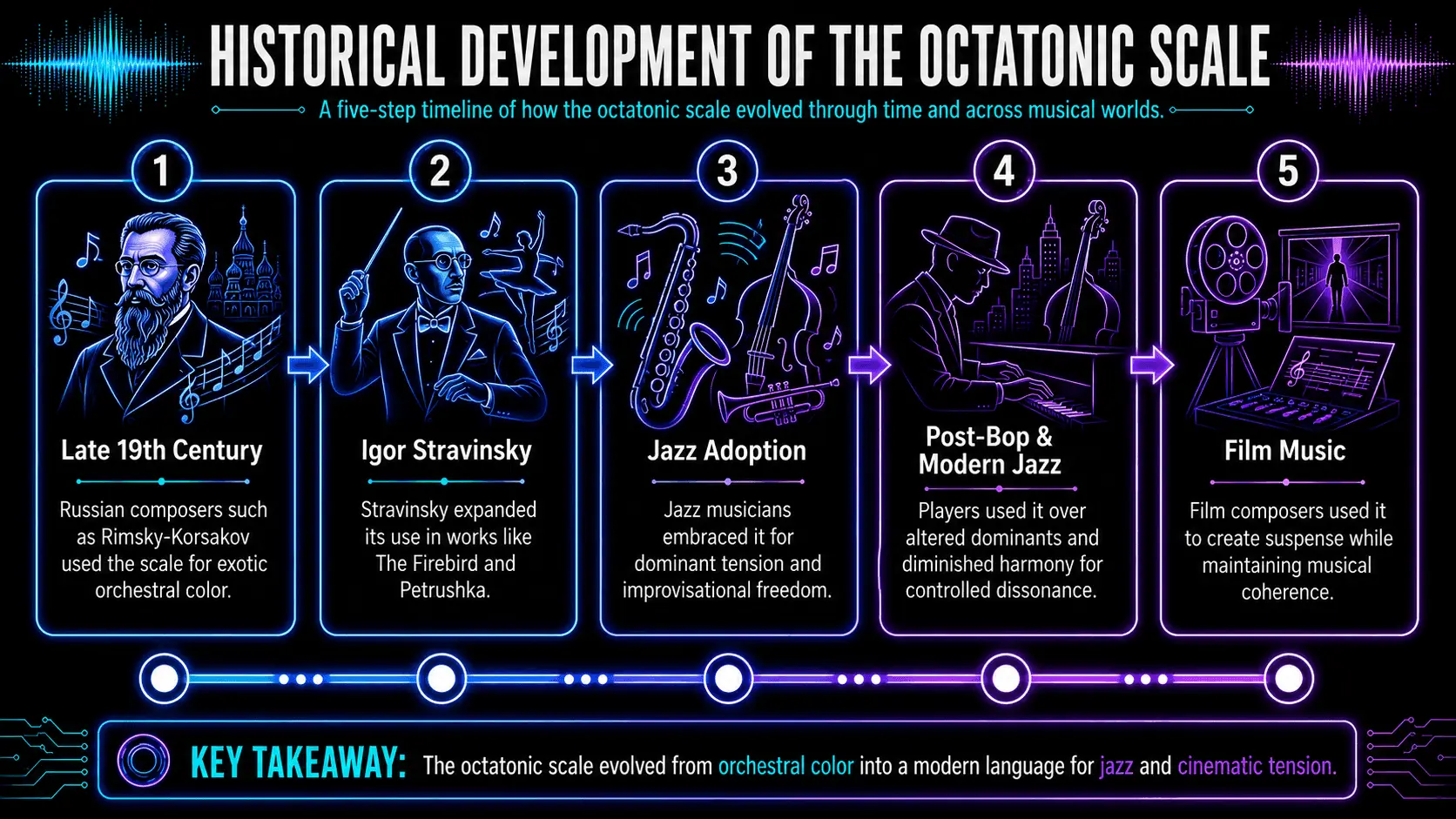
Later, Igor Stravinsky expanded its use dramatically. In works like The Firebird and Petrushka, the octatonic scale became part of a new harmonic language that sounded modern and unpredictable. The symmetry of the scale allowed him to create shifting harmonies without losing internal cohesion.
Jazz musicians later embraced the scale for different reasons. Instead of orchestral color, they heard improvisational freedom. During the post-bop era, players began using the octatonic scale over dominant chords and diminished harmony. It gave soloists a way to introduce controlled dissonance while still sounding intentional.
Unique Characteristics of the Octatonic Scale
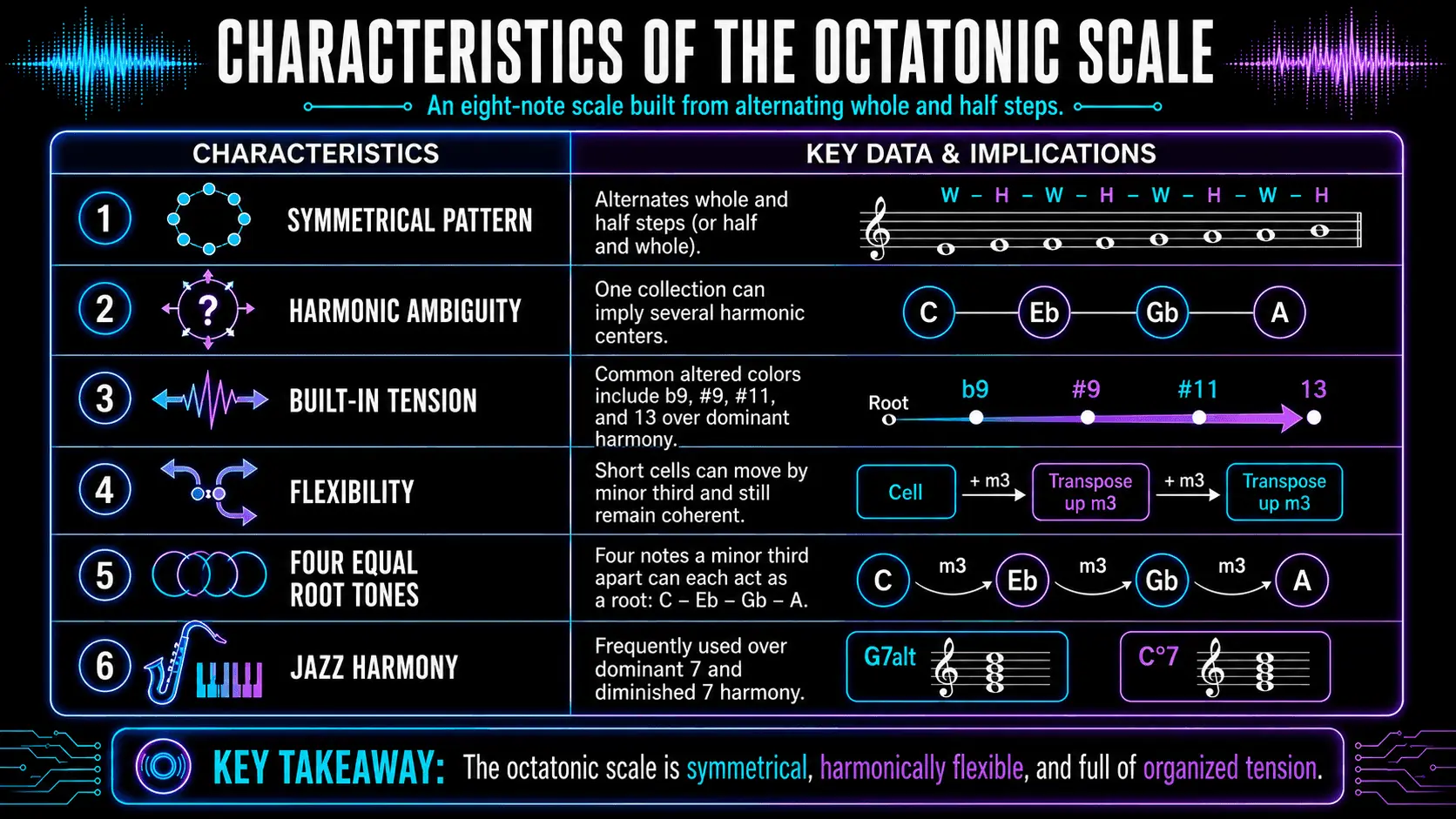
The most distinctive feature of the octatonic scale is its absolute symmetry. Most common scales use uneven patterns, but the octatonic scale follows a perfectly consistent, repeating sequence. This balance provides several advantages:
- Harmonic Versatility: The scale does not have a single mood. It can be used to imply several different chord types, including dominant and diminished sounds, depending on which notes you emphasize.
- Natural Resolution: Because of the way the notes are spaced, several tones naturally feel like they want to move toward a specific destination. This makes the scale excellent for building drama and suspense in a melody.
- Pattern-Based Movement: Since the interval pattern repeats, you can take a specific melodic shape and move it across your instrument. It will remain musically logical even when the notes themselves become more adventurous.
A Scale with Four Equal Root Tones
One of the most fascinating properties of the octatonic scale is that it contains four equally spaced tonal centers. Because the scale repeats every minor third, each note separated by three semitones can function like a root.
For example, a C octatonic scale also strongly relates to Eb, Gb, and A. This means a single scale can support multiple harmonic interpretations.
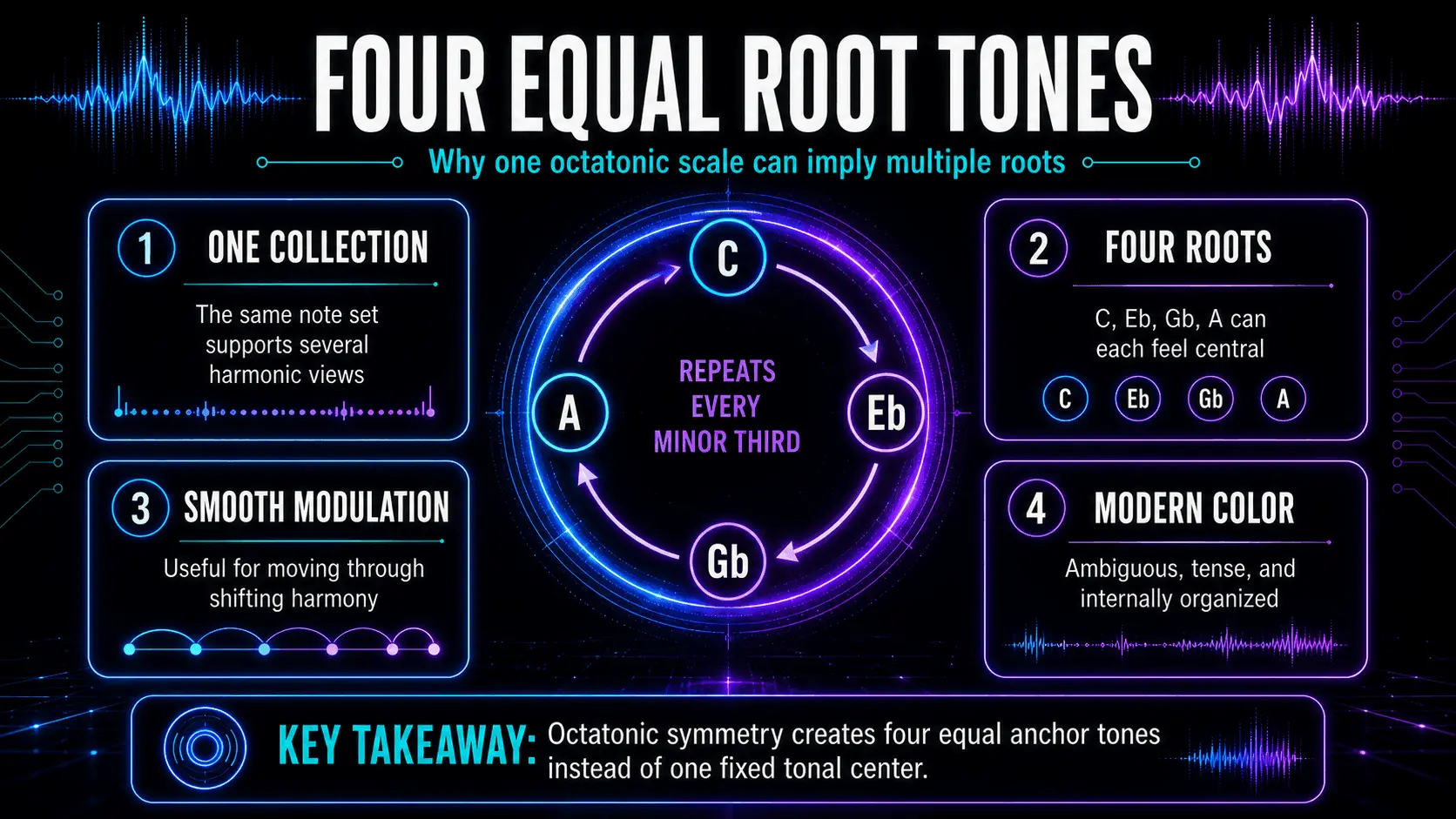
That is why jazz musicians often use it to move smoothly through shifting harmony. Instead of changing scales every chord, one octatonic collection can connect several harmonic destinations.
This can initially confuse beginners because they expect one scale to produce one tonal center. However, professionals often see this as one of the scale’s greatest strengths because it expands harmonic thinking beyond conventional rules.
The Three Unique Octatonic Collections
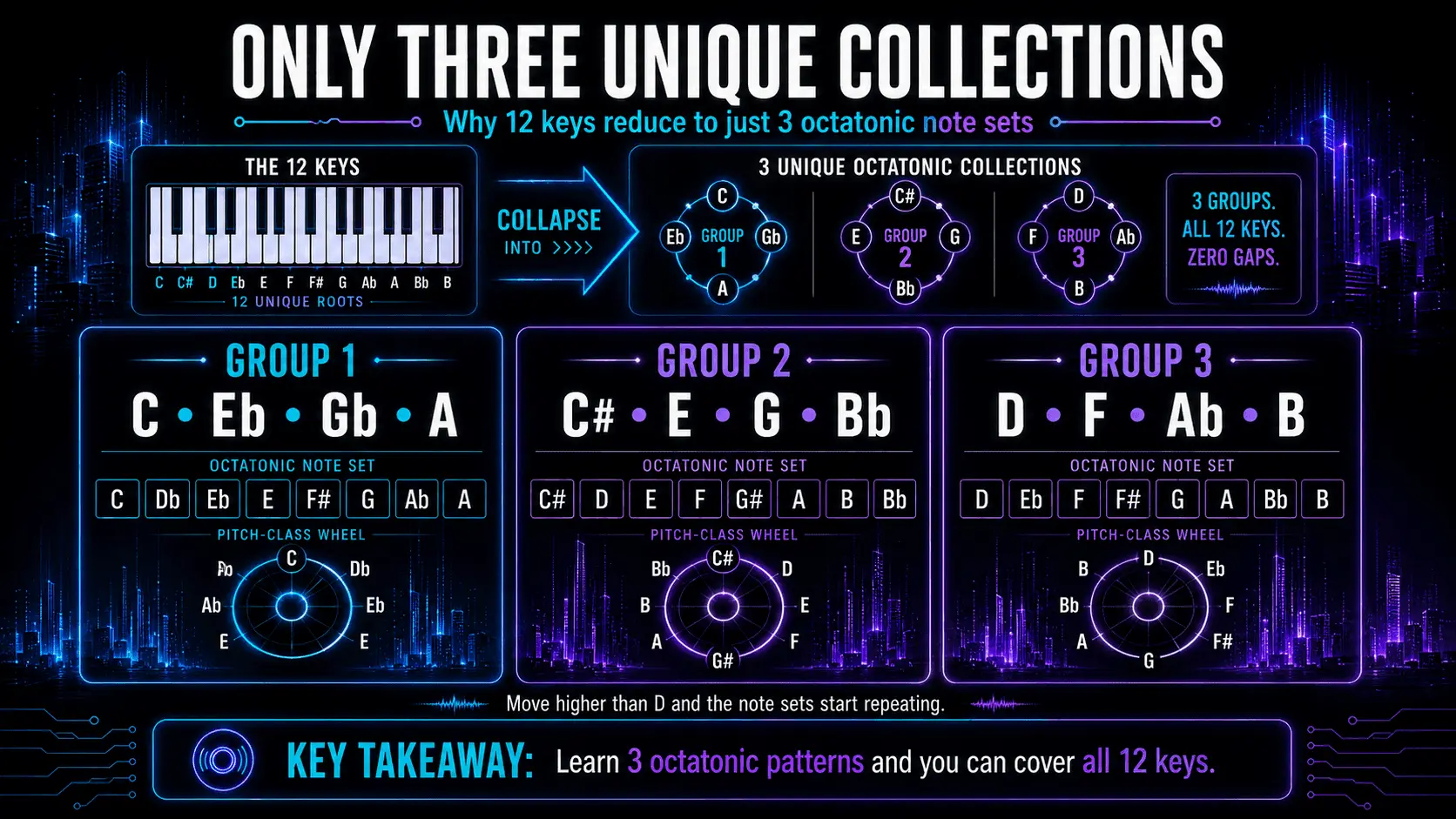
There are only three truly unique octatonic scales. Every other starting position is simply a repeat of one of these three:
- Group 1 (C Based): Covers the root tones C – Eb – Gb – A.
- Group 2 (C# Based): Covers the root tones C# – E – G – Bb.
- Group 3 (D Based): Covers the root tones D – F – Ab – B.
Once you move higher than D, you are back to the same notes found in the C group. This is a significant advantage for musicians because it means you only need to master three fingerings or patterns to cover all 12 keys.
Pro Tip: The Root Cycle of Three
To keep track of these tones without getting lost, use the cycle of three. Pick any of the three starting positions and move up or down by three semitones (half steps). These notes are your anchor points. As long as you stay within those related roots, your melodies will remain consistent and musically logical.
Using the Octatonic Scale in Composition
In composition, the octatonic scale can create atmosphere immediately. Film composers frequently use it to build suspense because the sound feels unstable while remaining coherent. Jazz writers often use it to create modern horn lines that sound angular without sounding random.
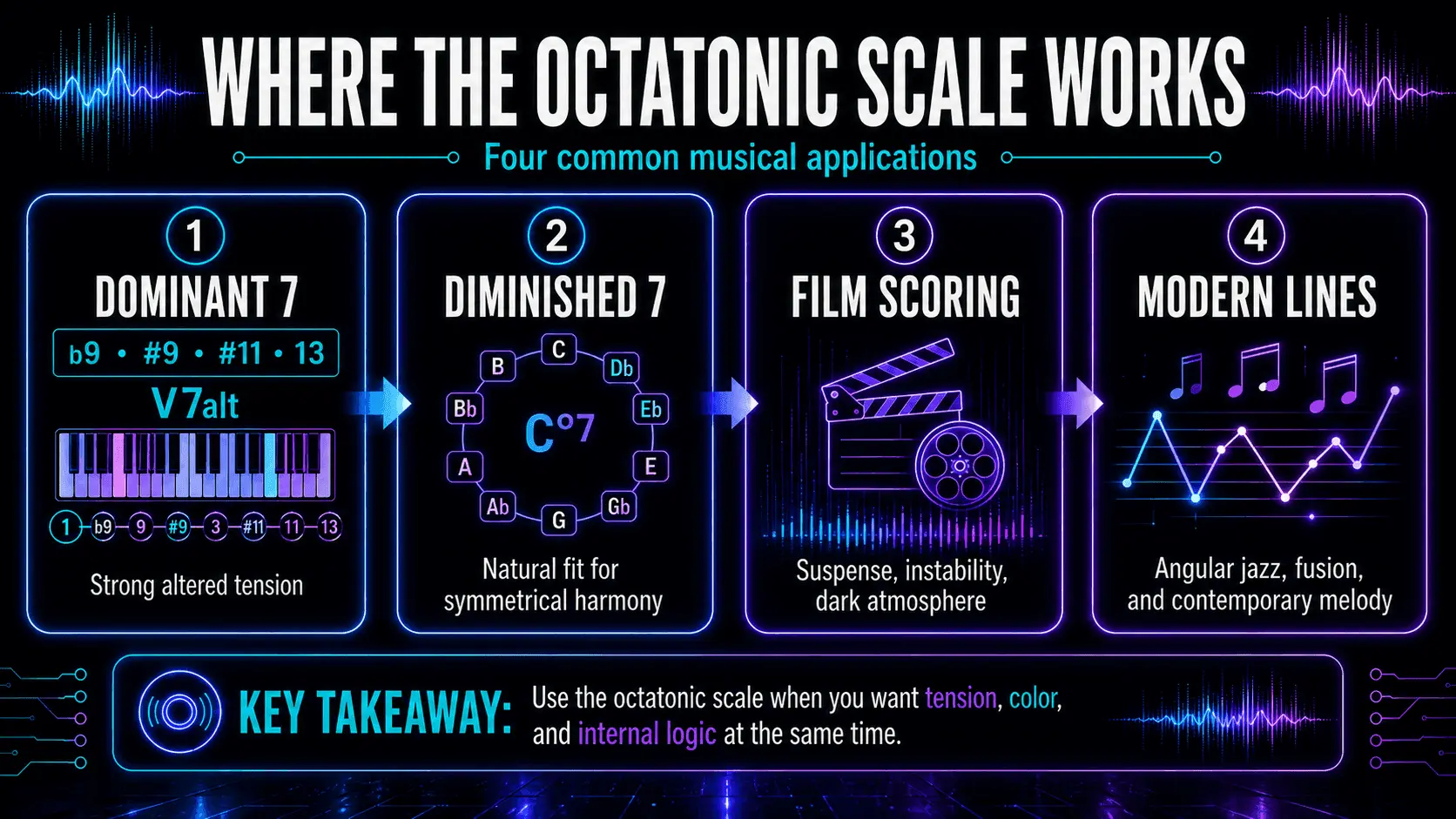
When writing with the scale, many professionals recommend starting with a simple motif instead of trying to use all eight notes immediately. The scale becomes more musical when treated as melodic language rather than a technical pattern.
Some of the most effective uses include:
- creating dominant chord extensions
- building suspense before resolution
- writing unusual passing lines
- connecting distant harmonic centers
- developing thematic material from symmetrical patterns
The key is restraint. Overusing the scale can make a piece sound overly dense. Many experienced musicians suggest introducing the sound briefly, then returning to more familiar tonal material.
Chord Relationships and Harmony
The octatonic scale has a strong relationship with diminished and dominant harmony. It naturally contains:
- dominant seventh chords
- diminished seventh chords
- minor triads
- major triads
- tritone substitutions
This makes it especially valuable in modern harmony. A single octatonic collection can outline several different chords depending on which notes are emphasized.
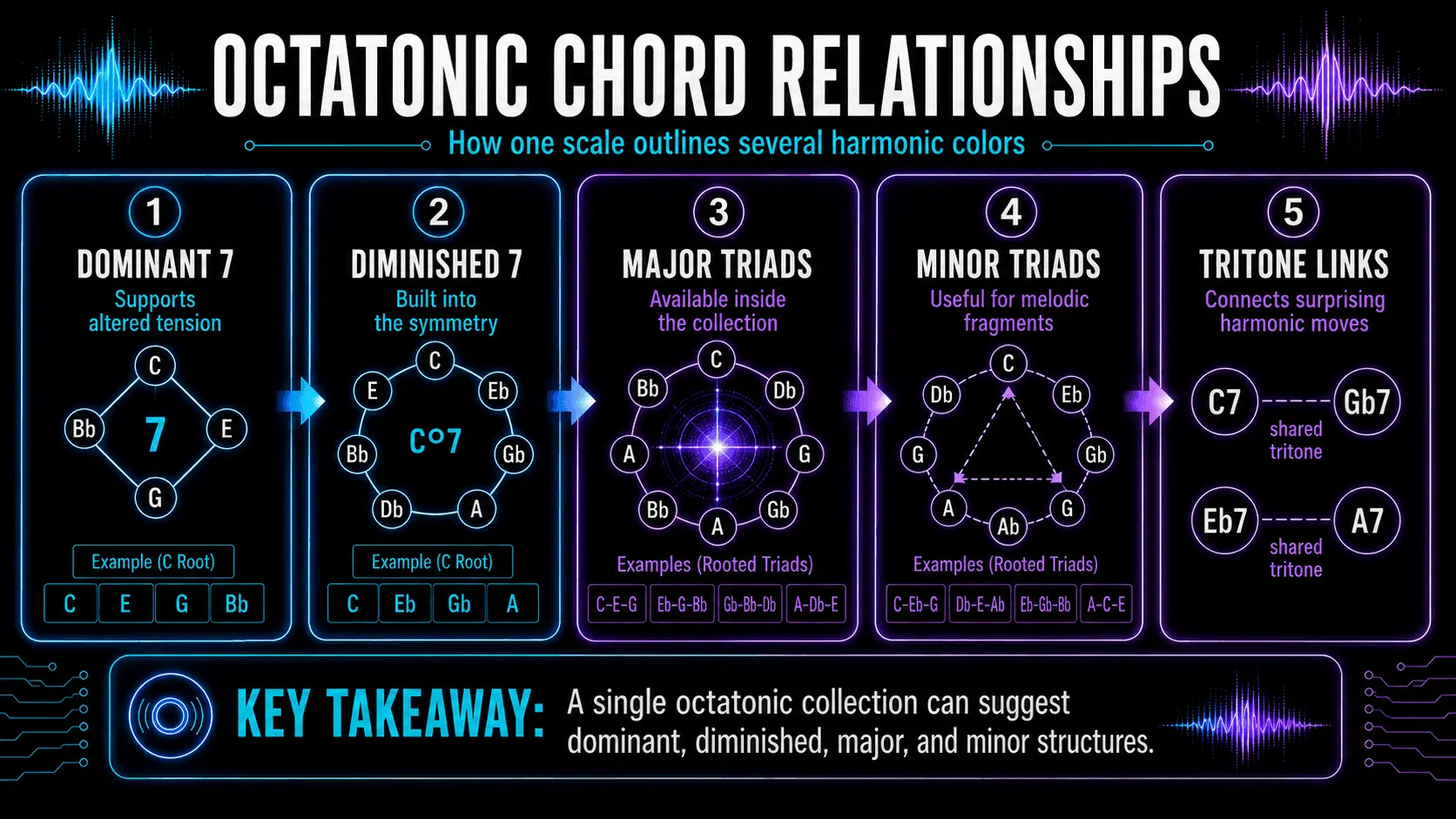
An octatonic chord progression can create movement that feels surprising yet connected. Instead of traditional tonal progressions, the harmony can shift by minor thirds while still sounding unified.
A common jazz application is using the half-whole octatonic scale over a dominant seventh chord with altered extensions. For example, over G7, players might use the G half-whole octatonic scale to access b9, #9, #11, and 13 colors simultaneously.
The related half-diminished scale concept also appears when musicians derive smaller note groups from the full octatonic collection. Some players simplify the scale into smaller harmonic fragments before applying it in improvisation.
Octatonic Scale Exercises
The best way to learn the octatonic scale is through practical exercises, not just memorization.
Start by playing the scale slowly in one key. Focus on hearing the sound rather than simply moving your fingers. Then isolate three-note and four-note patterns. These become the foundation of useful octatonic sequences.
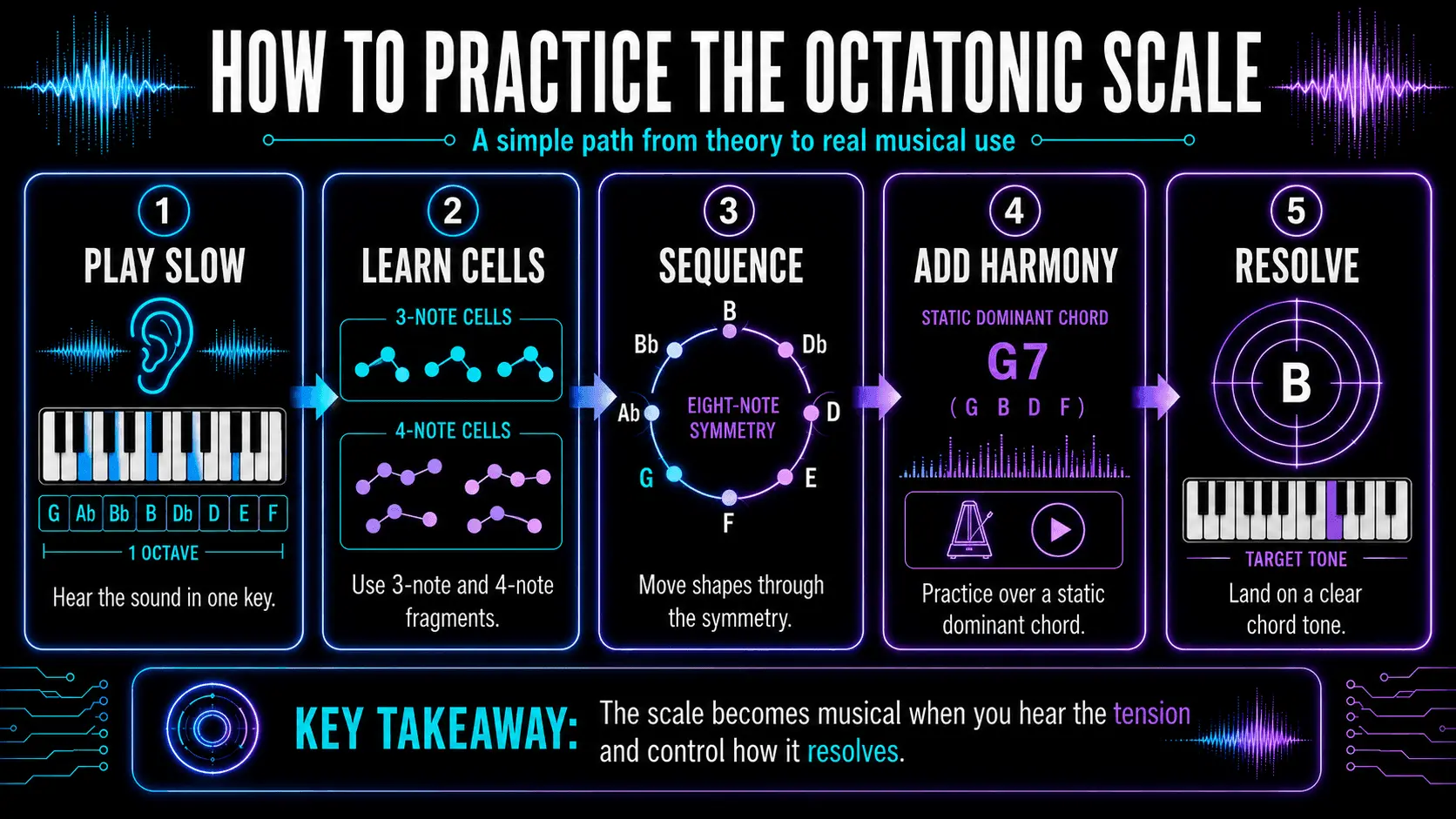
A valuable exercise is playing the scale over a static dominant chord and resolving phrases into a chord tone. This teaches control of tension and release.
Another exercise involves taking a short phrase and moving it through the symmetrical pattern. Because the scale repeats every minor third, the phrase creates naturally connected variations.
Practicing with backing tracks can help. Many musicians report that the scale only started making sense when they heard it against actual harmony rather than in isolation.
Comparisons with Other Scales
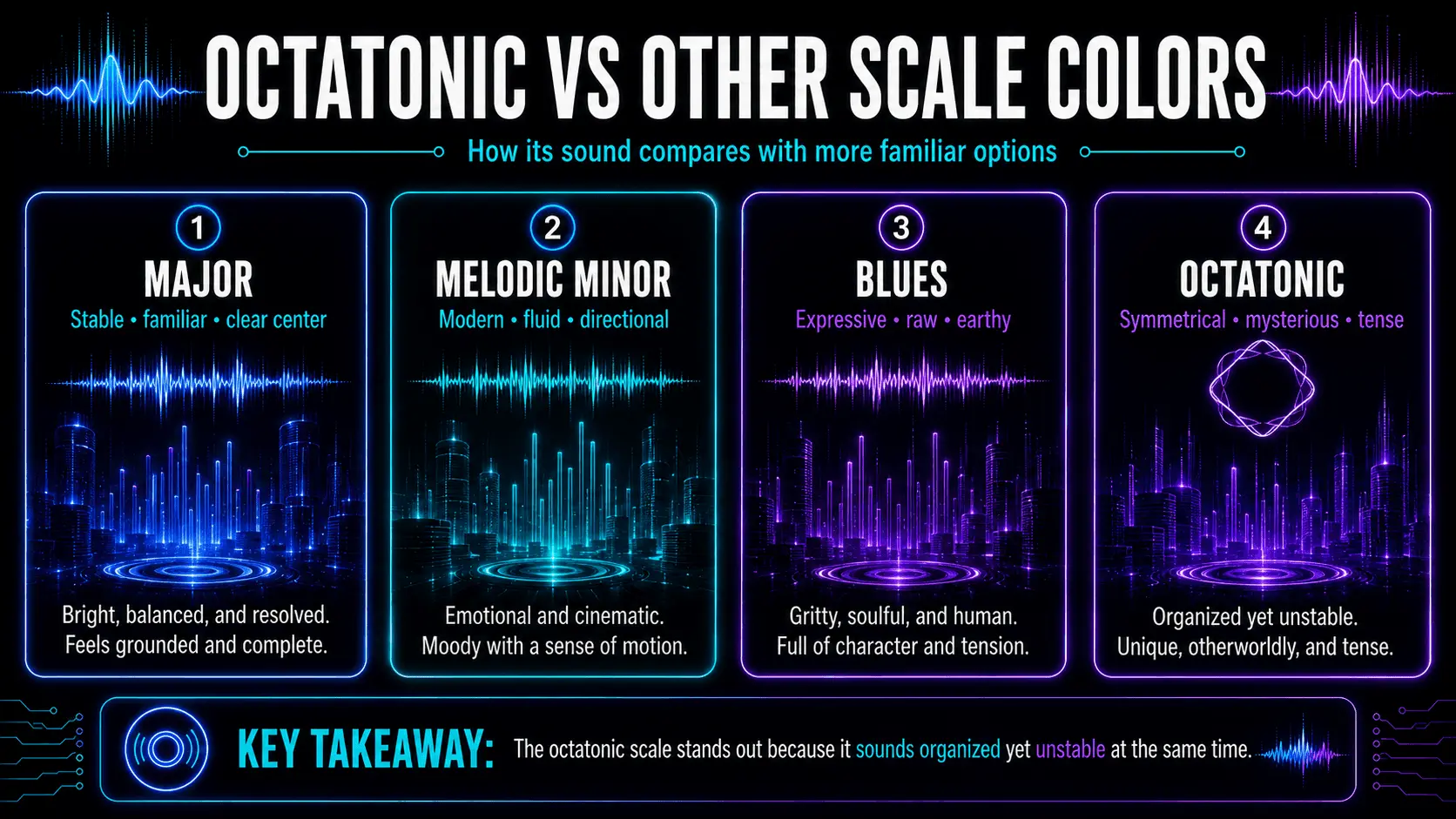
- Compared to other scales, the octatonic scale occupies a unique space.
- The major scale feels stable and familiar.
- The melodic minor scale sounds modern and fluid.
- The blues scale feels expressive and raw.
- The octatonic scale sounds symmetrical and mysterious.
Unlike the blues scale, the octatonic scale contains more internal harmonic options. Unlike melodic minor, it does not strongly imply one tonal center. Unlike the chromatic scale, it still sounds organized.
Some musicians initially confuse the octatonic scale with the diminished scale because the names are often used interchangeably. In jazz practice, they usually refer to the same system, though context determines whether players mean the whole-half or half-whole form.
Professionals often compare the octatonic scale with the altered scale. The altered scale can sound more aggressive, while the octatonic scale often sounds more balanced because of its internal symmetry.
Famous Compositions Using the Octatonic Scale
Many notable compositions feature the octatonic scale:
- Claude Debussy explored similar harmonic colors in impressionistic writing.
- Béla Bartók used symmetrical structures in orchestral and piano works.
- John Coltrane incorporated octatonic ideas into advanced harmonic language.
- Michael Brecker used the scale extensively in modern jazz solos.
Film composers also rely on the scale for tension. Its sound appears frequently in suspense scores because it creates uncertainty without losing cohesion.
Jazz Improvisation and Professional Application
In jazz improvisation, the octatonic scale can become a powerful voice-leading tool rather than just a color scale.
Experienced improvisers rarely play the scale straight up and down. Instead, they break it into fragments. These fragments become melodic cells that can be reshaped during a solo.
One advanced concept involves superimposing triads from within the scale. This allows a soloist to create outside tension while maintaining melodic clarity.
Professionals often emphasize that the scale works best when connected to rhythm. Even sophisticated harmonic ideas can sound forced if the phrasing lacks groove. Strong rhythm can make unusual note choices sound intentional.
That is why many teachers recommend practicing the scale with swing phrasing, triplets, and displaced accents instead of only straight technical drills.
Common Problems Musicians Face
Many musicians struggle with the octatonic scale for the same reasons:
- Some overuse it and make every phrase sound identical.
- Some memorize patterns but never hear the sound.
- Some apply it over the wrong chords.
- Some use it without resolving the tension.
Another common issue is using the scale too early in a solo. Since the sound is intense, many players find it more effective later in a solo when the emotional energy has already built.
Conclusion: Embracing the Octatonic Scale
The octatonic scale remains one of the most rewarding advanced tools in modern music. For beginners, it introduces a new way of hearing harmony. For professionals, it offers a deeper language for composition, arranging, and jazz improvisation.
Its symmetrical design, rich harmonic possibilities, and dramatic emotional effect give it a place that few other scales can match. Whether used in a subtle melodic phrase or a full octatonic chord progression, it can transform ordinary lines into something more compelling.
The musicians who gain the most from the scale are usually the ones who approach it patiently. They do not simply memorize notes. They learn to hear the sound, shape the tension, and use the scale musically.
When that happens, the octatonic scale stops being just theory. It becomes part of a musician’s voice.
FAQ
Is the octatonic scale the same as the diminished scale?
In most jazz contexts, yes. The octatonic scale and diminished scale usually refer to the same eight-note system, though musicians often distinguish between the whole-half and half-whole versions depending on the harmonic situation.
What chords work best with the octatonic scale?
The scale works especially well over dominant seventh chords with altered tensions, diminished seventh chords, and certain half-diminished scale applications.
Why does the octatonic scale sound mysterious?
Its symmetry removes the strong tonal pull found in major and minor scales. That creates a floating quality that listeners often perceive as mysterious.
How should beginners practice it?
Start with slow exercises, short motifs, and simple harmonic contexts. Focus on hearing the sound before trying to use it in fast solos.
Can the octatonic scale be used outside jazz?
Yes. It appears in orchestral writing, film scoring, progressive rock, fusion, and experimental electronic music, making it useful far beyond jazz alone.