
Key Takeaways
- A polyrhythm combines two or more contrasting rhythmic patterns within the same span of time, creating tension, movement, and rhythmic depth.
- Common polyrhythmic ratios include 3:2, 2:3, 3:4, and 4:3. Producers can use the least common multiple to place each rhythm accurately on a shared grid.
- Polyrhythm differs from syncopation, which shifts accents within one rhythmic framework, and polymeter, which combines parts with different measure lengths.
- Effective polyrhythms need a recognizable anchor, contrasting instrument ranges, and clear frequency separation to prevent the arrangement from sounding cluttered.
- ACE Studio lets producers build precise polyrhythms with editable MIDI, test them with expressive AI instruments, add supporting layers, and isolate stems to study rhythmic patterns in existing music.
How Competing Pulses Create Rhythmic Depth
In its most fundamental form, a polyrhythm is the simultaneous use of two or more contrasting rhythms that are not readily perceived as deriving from one another. While a standard rhythm might involve a single pulse divided into even increments, a polyrhythm introduces a second pulse—a competing heartbeat—that operates within the same window of time.
The result is a shimmering, textured soundscape that challenges the listener's perception of musical timing. This interplay creates a sense of forward motion and "swing" that a single, static rhythm cannot achieve. In the contemporary landscape of rhythm composition, polyrhythms serve as the bridge between the organic imperfections of human performance and the mathematical precision of AI music synthesis.
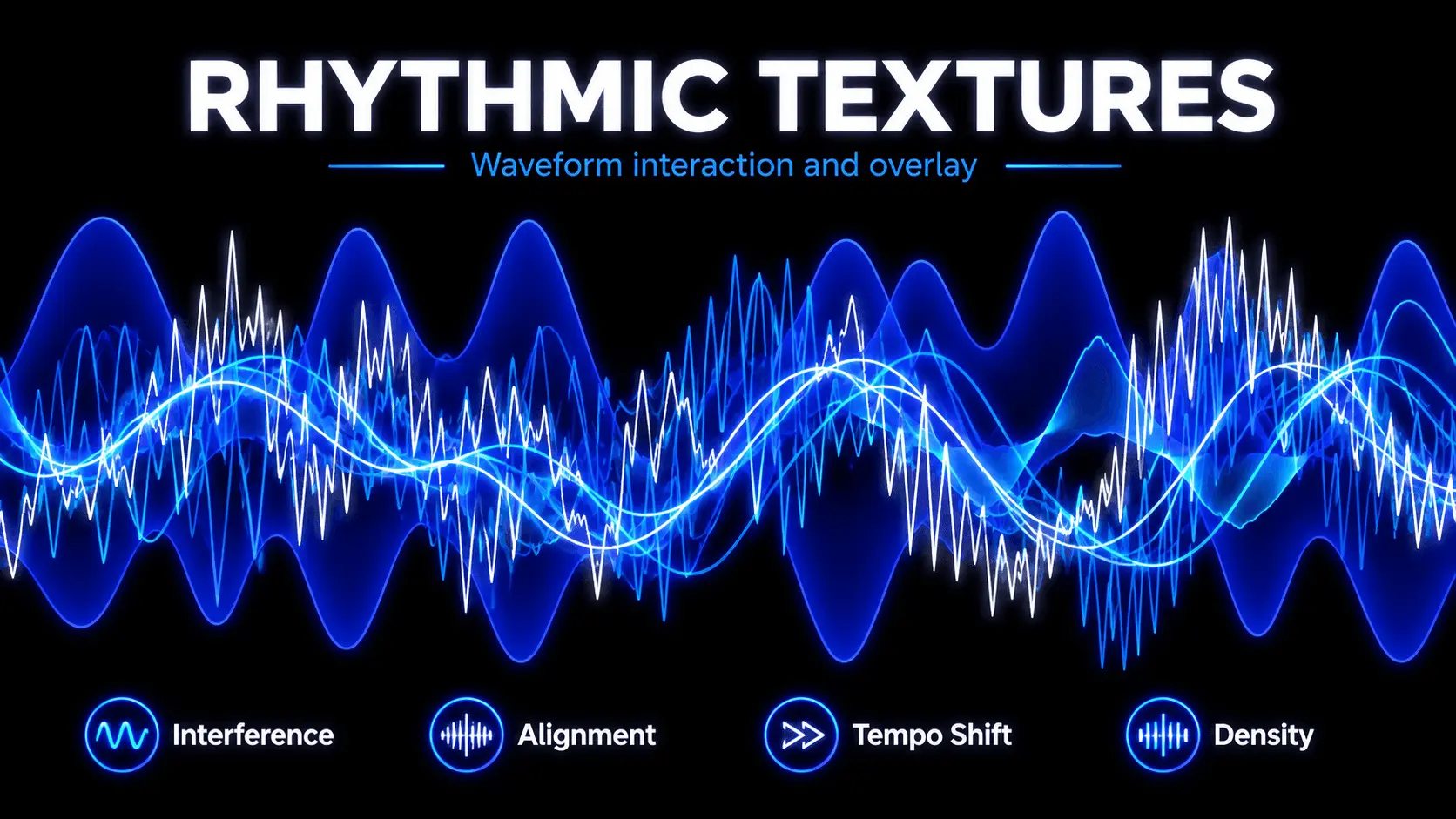
The Thesis of Modern Rhythm
As we move further into the era of algorithmic music generation, the ability to program and understand types of polyrhythms becomes a primary differentiator for SaaS platforms. A basic sequencer can trigger a 4/4 kick drum; however, a sophisticated AI engine must understand the mathematical relationship between competing meters to generate truly "human" grooves. This guide explores the depths of these structures, providing you with the theoretical and practical tools to elevate your productions to the industry standard.
Understanding the Pulse
Before one can master the complexity of a polyrhythm definition, one must first understand the fundamental pillars of rhythm theory. Rhythm is not merely a sequence of sounds; it is the organization of time into perceptible patterns.
The Pulse and Musical Timing
At the heart of every composition is the pulse, or the tactus. This is the steady heartbeat that the listener feels. Musical timing refers to how notes are positioned relative to this pulse. In standard compositions, notes are placed directly on the beat or on common subdivisions (eighth notes, sixteenth notes).
However, when we introduce polyrhythms, we are essentially asking the listener to track two different pulses at once. This creates a cognitive challenge. The human brain naturally tries to find a "common ground" between these pulses, a process known as entrainment.
Understanding Musical Meter
Musical meter is the framework of strong and weak beats that gives a piece of music its feel. It is typically defined by a time signature.
- Simple Meter: Pulses are divided into two equal parts (e.g., 2/4, 3/4, 4/4).
- Compound Meter: Pulses are divided into three equal parts (e.g., 6/8, 9/8, 12/8).
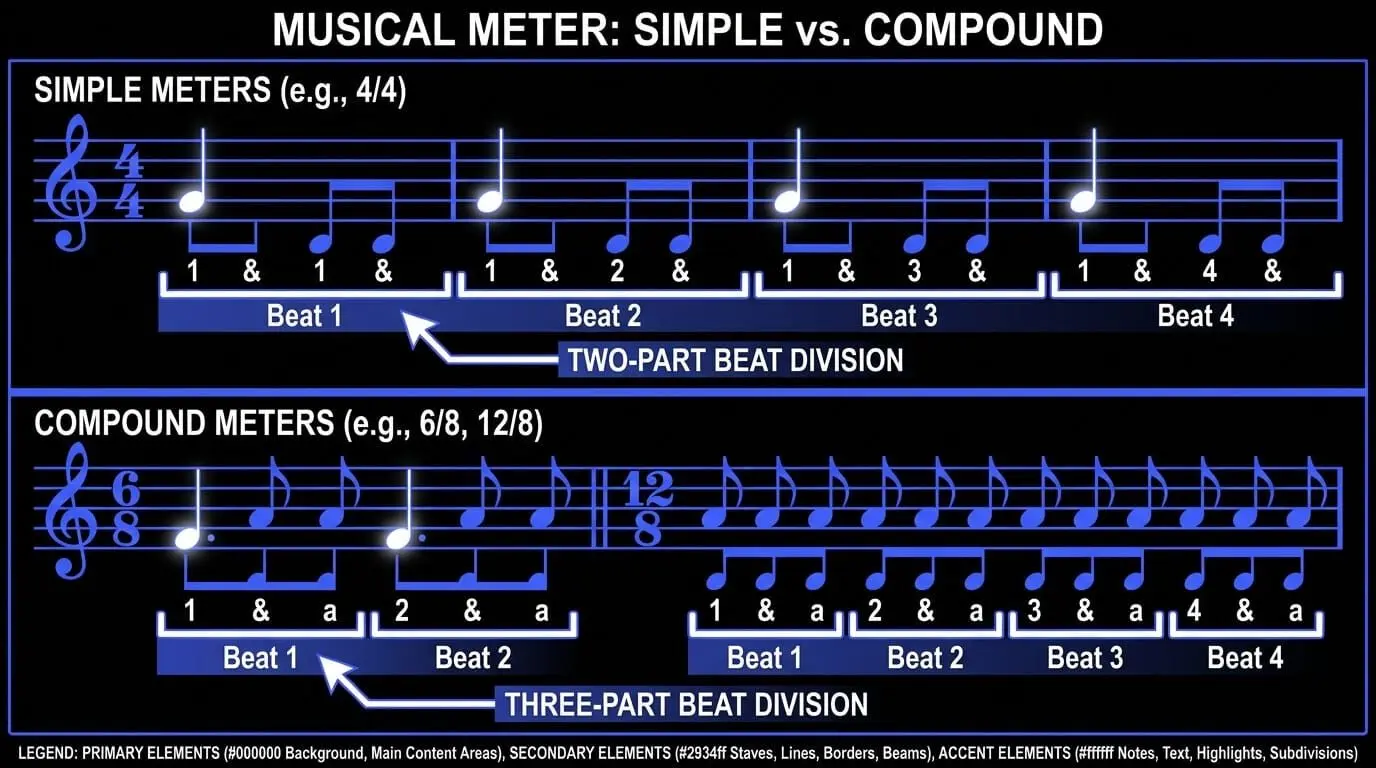
Polyrhythms often blur the lines between these meters. For instance, a 3:2 polyrhythm is effectively the sound of a compound meter (3) and a simple meter (2) occurring at the exact same time. This conflict is what creates the "shimmering" effect often found in examples of polyrhythms across global cultures.
The Four Core Ratios
The most effective way to categorize polyrhythms is through the ratio system. A ratio of X:Y indicates that X notes are being played in the same amount of time as Y pulses of the underlying beat.
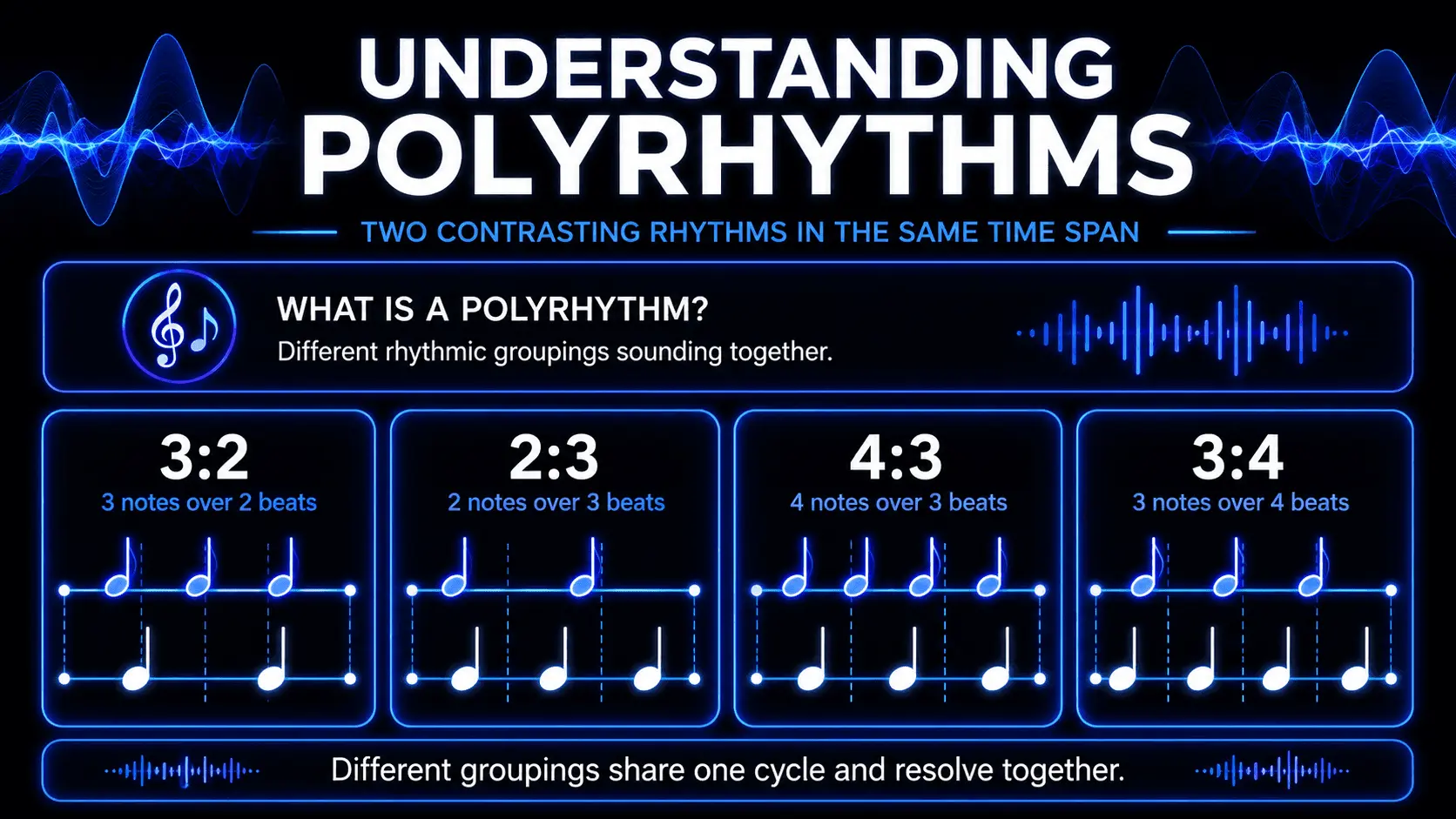
To achieve mathematical precision in rhythm composition, one must understand the Least Common Multiple (LCM). The LCM determines the smallest subdivision required to visualize both rhythms on a single grid.
The 3:2 Polyrhythm (Hemiola)
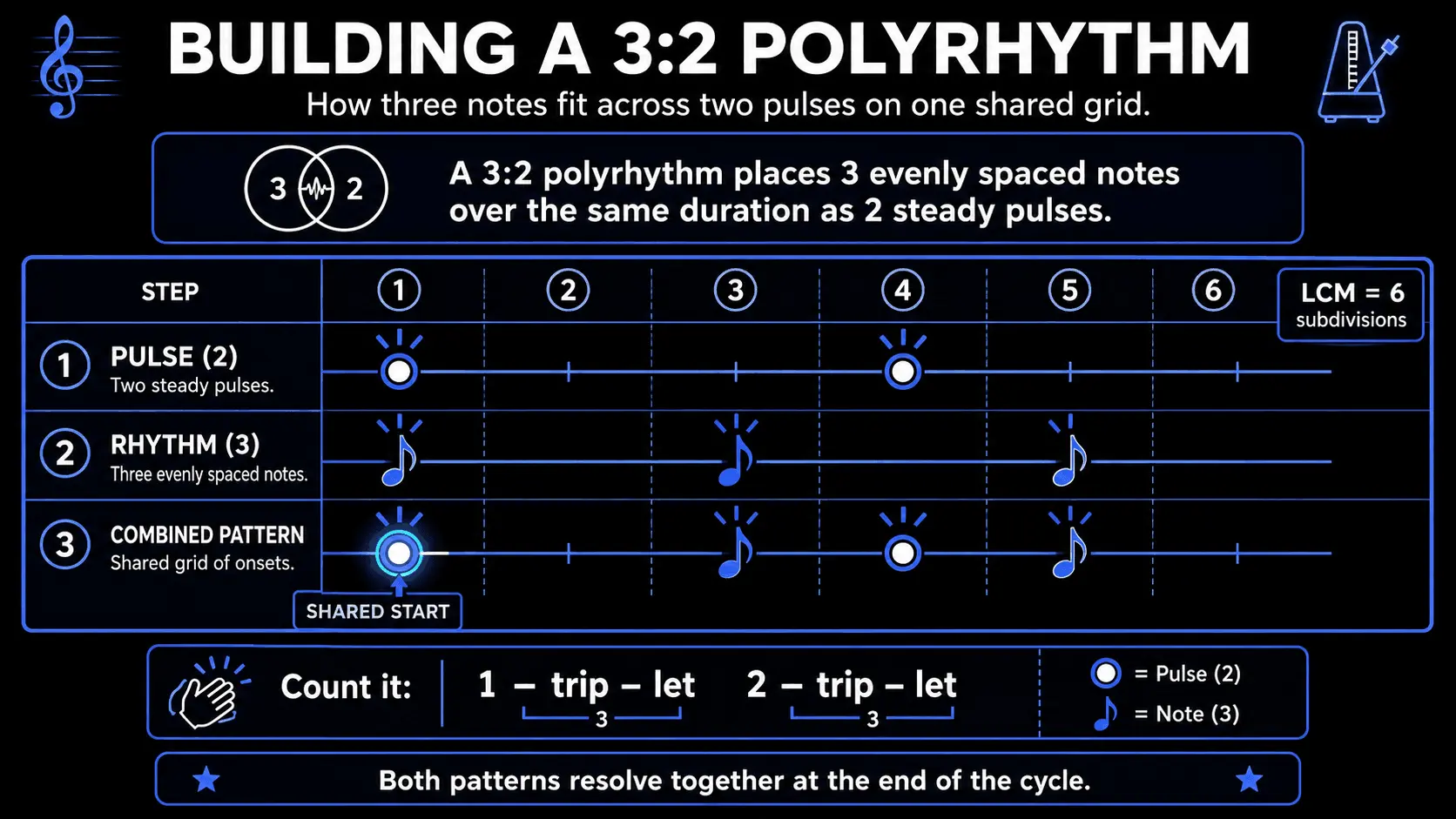
The 3:2 ratio involves playing three even notes over the duration of two pulses. This is the most common polyrhythmic structure in Western music and is historically known as a hemiola.
- Mathematical Grid: The LCM is 6.
- The Pulse (2): Hits on subdivisions 1 and 4.
- The Polyrhythm (3): Hits on subdivisions 1, 3, and 5.
- The Feel: It creates a triplet sensation over a steady duple pulse.
- Mnemonic for Practice: Hot Cup of Tea.
The 2:3 Polyrhythm
While mathematically related to the 3:2, the 2:3 ratio reverses the relationship, placing two notes over a three-pulse duration.
- Mathematical Grid: The LCM remains 6.
- The Pulse (3): Hits on subdivisions 1, 3, and 5.
- The Polyrhythm (2): Hits on subdivisions 1 and 4.
- The Feel: This produces a wide, expansive sensation. It is a hallmark of the Impressionist period, notably used by composers like Claude Debussy to create a floating, ethereal atmosphere.
The 3:4 Polyrhythm
The 3:4 ratio involves playing three notes over a four-pulse cycle. This is more common in jazz and contemporary electronic music.
- Mathematical Grid: The LCM is 12.
- The Pulse (4): Hits on subdivisions 1, 4, 7, and 10.
- The Polyrhythm (3): Hits on subdivisions 1, 5, and 9.
- The Feel: This ratio often feels like a halftime signature is being superimposed over a standard 4/4 groove. It provides a unique sense of syncopation that sounds less mechanical than standard displacement.
The 4:3 Polyrhythm
The 4:3 ratio is a highly kinetic structure where four notes are played over a three-pulse duration.
- Mathematical Grid: The LCM is 12.
- The Pulse (3): Hits on subdivisions 1, 5, and 9.
- The Polyrhythm (4): Hits on subdivisions 1, 4, 7, and 10.
- The Feel: This creates an urgent, galloping effect.
- Mnemonic for Practice: Pass the Golden Butter.
- Modern Example: This ratio is the driving force behind the piano motif in the song Fake Empire by The National, where the interplay between the left and right hand creates a sophisticated, rolling momentum.
Distinguishing Polyrhythm from Syncopation and Polymeter
Precision in technical language is critical when discussing rhythm theory. Many producers mistakenly use these terms interchangeably.
Polyrhythm vs. Syncopation
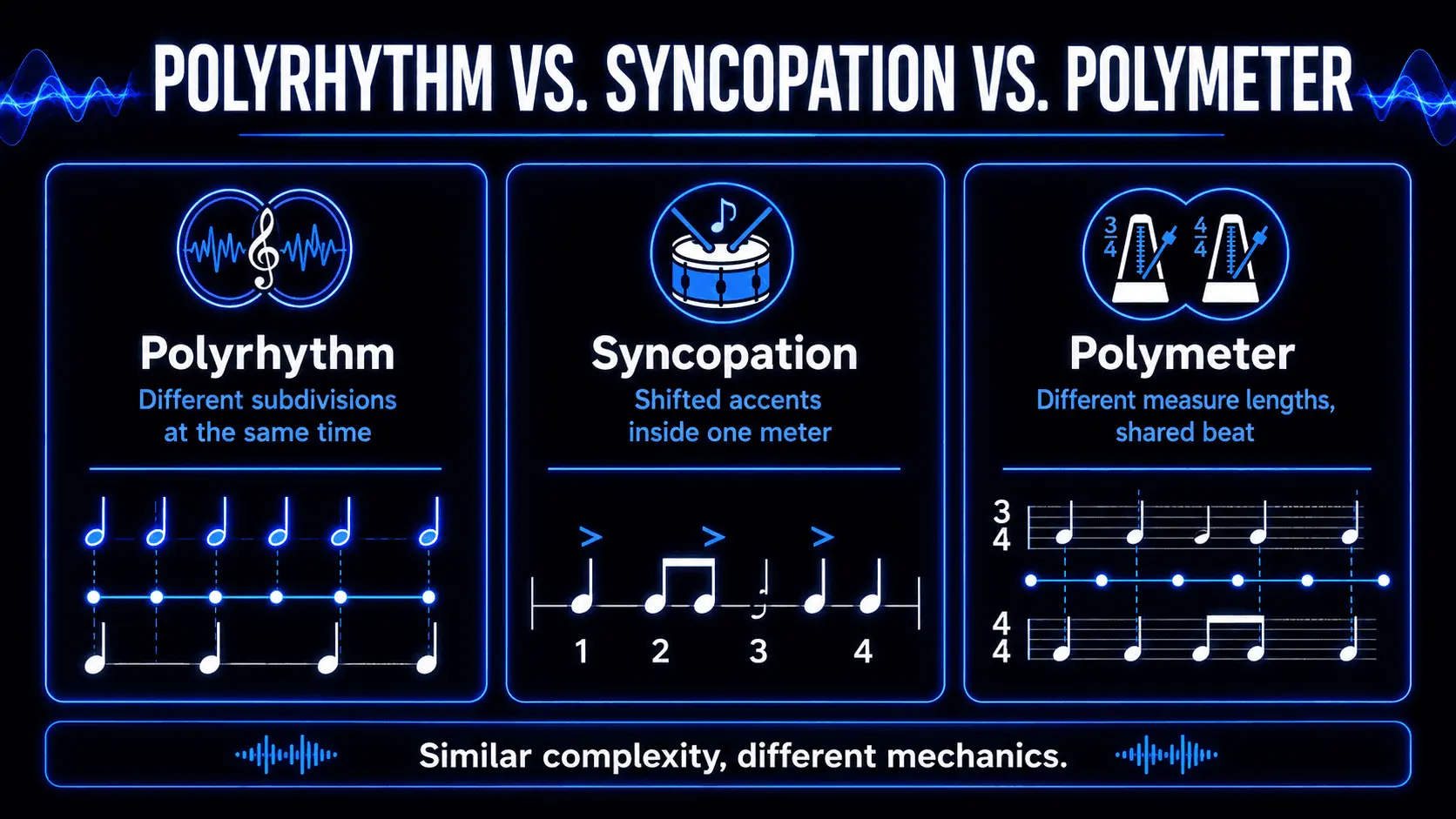
Syncopation is the practice of emphasizing the weak beats or the spaces between beats within a single meter. It does not change the subdivision of the beat; it merely shifts the accents.
- Syncopation: One meter, shifted accents.
- Polyrhythm: Two or more contrasting rhythmic subdivisions or patterns occurring at once.
Polyrhythm vs. Polymeter
Polymeter occurs when two instruments play in different time signatures but share the same beat duration. For example, one instrument plays in 4/4 while another plays in 5/4. They will eventually go out of phase and realign after 20 beats.
- Polymeter: Measure lengths are different; beat lengths are the same.
- Polyrhythm: Measure lengths are the same; beat subdivisions are different.
Mastering Polyrhythms: Practical Techniques for Creators
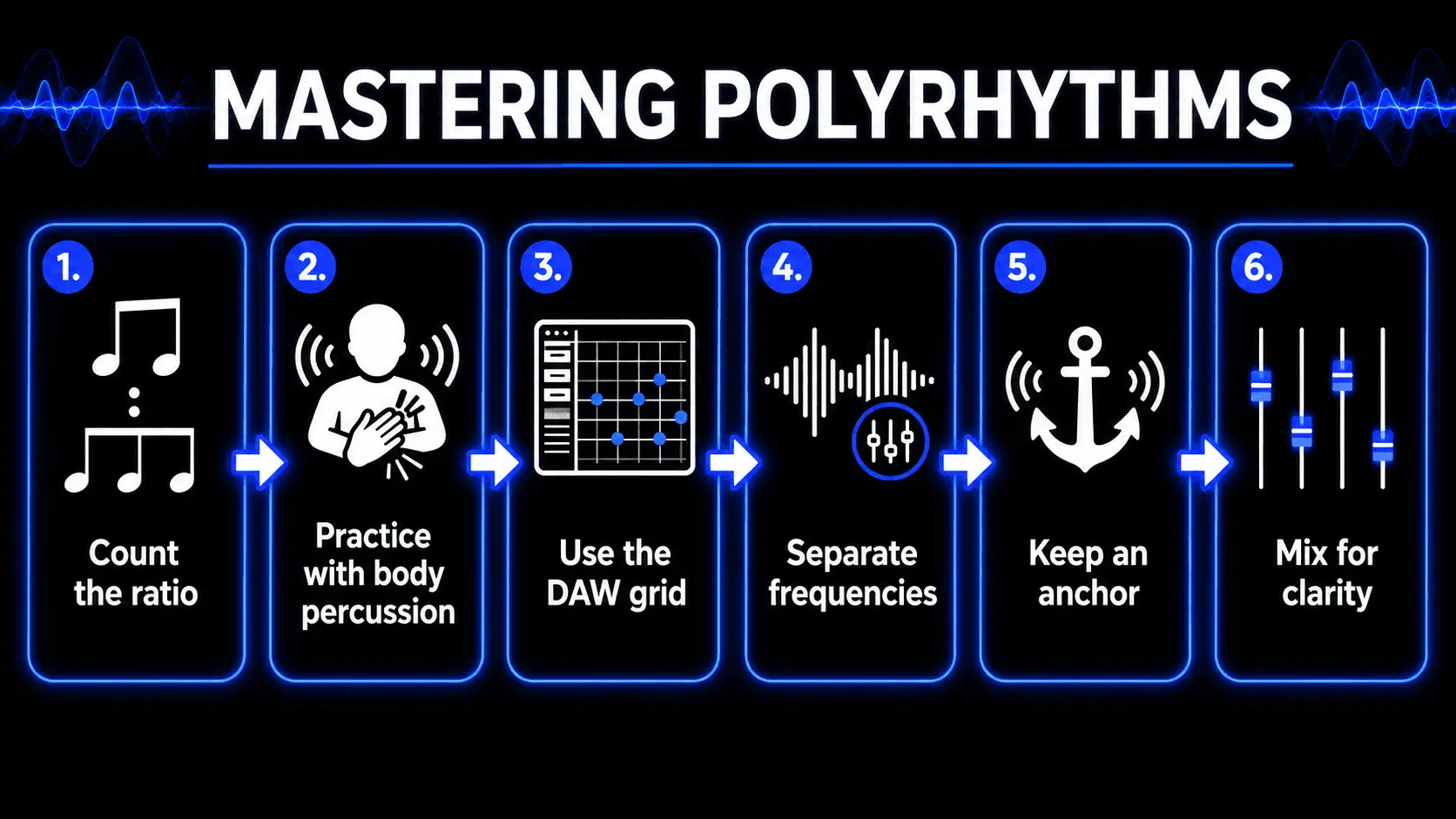
For a composer, the challenge of learning polyrhythms is as much physical as it is mental. The following methods are used by professionals to internalize these structures.
The Composite Rhythm Method
Instead of trying to track two separate pulses, composers learn the composite rhythm. This is the combined pattern of all notes from both rhythms as they appear on a single timeline. For a 3:2 polyrhythm, the composite rhythm is a specific five-note pattern. Once the ear recognizes the composite, the individual rhythms become easier to distinguish.
Body Percussion and Limb Independence
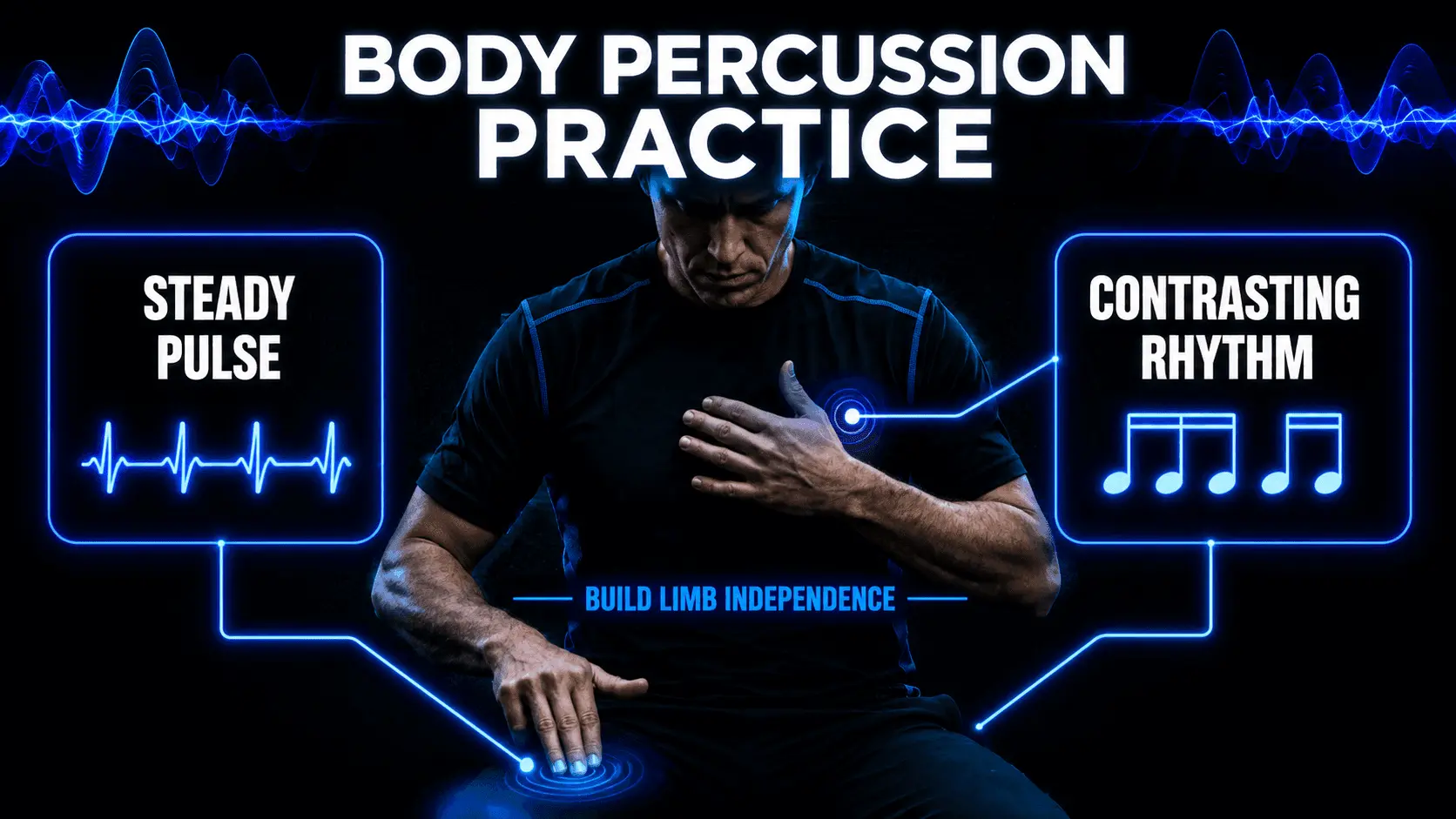
Mastery requires the ability to maintain two different pulses in different parts of the body.
- Set a metronome to a steady pulse.
- Tap the underlying pulse with your left hand.
- Tap the polyrhythmic subdivision with your right hand.
- Slowly increase the tempo as the brain begins to de-couple the movements of the two hands.
Visualization in Digital Audio Workstations
Modern DAWs allow producers to visualize these ratios by changing the grid settings. By layering a triplet grid over a standard sixteenth-note grid, a producer can see exactly where the 3:2 or 4:3 intersections occur. Our SaaS platform enhances this by providing an automated Polyrhythmic Ghosting feature, which highlights these mathematical intersections in real-time.
Strategic Use in Production: Mixing and Troubleshooting
Even with the best tools, implementing polyrhythms requires a strategic approach to mixing and arrangement.
Frequency Management
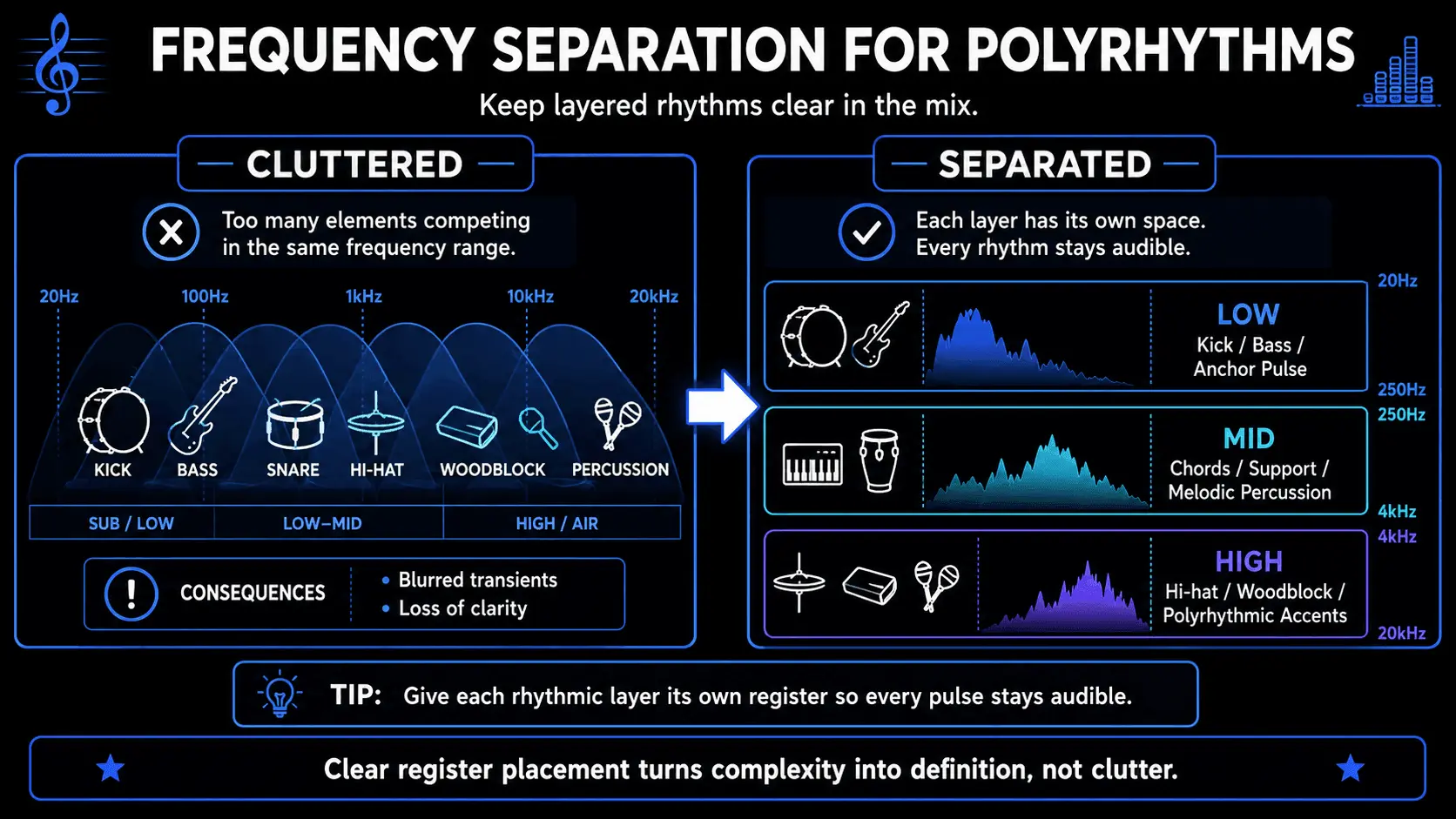
One of the primary risks of polyrhythm is sonic clutter. When two complex rhythms occupy the same frequency range, the transients can become blurred, resulting in a loss of clarity.
- The Solution: Use frequency separation. Assign the underlying pulse to a low-frequency instrument like a kick drum and the polyrhythmic layer to a high-frequency instrument like a closed hi-hat or a woodblock.
Establishing the Anchor
For a polyrhythm to be effective, the listener must have a reference point. If every instrument is playing a different ratio, the music will sound chaotic rather than complex.
- The Solution: Always maintain an anchor. This is usually a steady quarter-note or eighth-note pulse played by the bass or a secondary percussion instrument. This anchor provides the context that allows the ear to appreciate the polyrhythmic tension.
Turn Polyrhythms Into Playable Parts With ACE Studio
Understanding a 3:2 or 4:3 ratio mathematically does not always reveal whether it will feel convincing in a finished arrangement. ACE Studio lets you build the competing patterns as editable MIDI, assign them to expressive AI instruments, and judge the relationship as music rather than as a diagram.
Build the Ratio Precisely
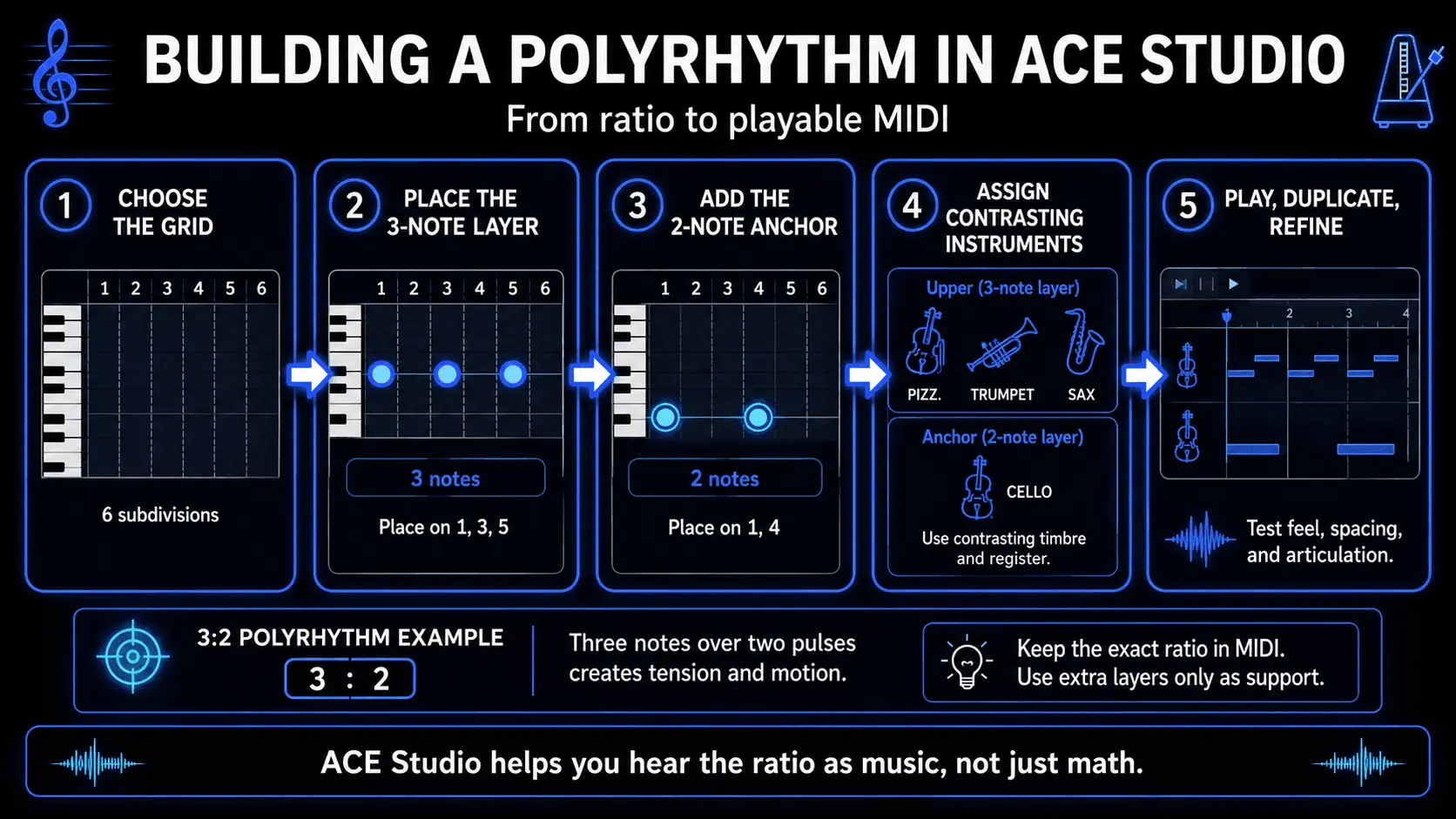
ACE Studio’s piano roll can divide each beat into between one and 16 grid cells. Selecting three cells per beat creates a triplet grid, which provides the six subdivisions needed to construct a clear 3:2 polyrhythm across two beats.
Place the three-note layer on subdivisions 1, 3, and 5, then place the two-note anchor on subdivisions 1 and 4. Both patterns now occupy the same duration and resolve together. You can duplicate the phrase across several bars, change its register, or disable snapping when you want to experiment with slightly looser timing.
Make Each Pulse Easy to Hear
A polyrhythm becomes much easier to evaluate when its layers have different musical identities. Instead of previewing both patterns with the same piano sound, place the anchor on a low cello or sustained string part and give the competing rhythm to a pizzicato string, trumpet, saxophone, or another contrasting AI instrument.
ACE Studio’s current AI instrument collection includes violins, violas, cellos, saxophones, trumpets, and duduk, with instrument-specific articulation controls. Short articulations such as pizzicato or mute can emphasize individual attacks, while legato or sustained notes can reinforce the slower underlying pulse. This makes it easier to hear which rhythm feels stable and which creates tension.
A practical 3:2 arrangement might use two long cello notes as the anchor while three short pizzicato notes move across the same span. The mathematical relationship remains unchanged, but the contrast in register, duration, and articulation makes the pattern immediately understandable.
Add Rhythmic Support Without Rebuilding the Main Pattern
Once the core ratio is established, ACE Studio’s Add a Layer tool can create supporting material around it. Select the bars containing the polyrhythm and describe a restrained layer such as “dry hand percussion with sparse accents” or “short plucked textures that leave space around the main pulse.”
The generated audio can provide movement, atmosphere, or additional percussion without requiring you to construct every secondary detail manually. The exact polyrhythmic ratio should remain in the MIDI parts you control; the generated layer is most useful for testing how that ratio behaves inside a fuller arrangement.
Study Polyrhythms Inside Existing Music
ACE Studio can also help when a rhythmic relationship is difficult to identify in a complete mix. Stem Splitter can separate a recording into components such as drums, bass, piano, guitar, vocals, and other detected instruments.
Listening to the drum and bass stems independently can reveal whether the effect comes from a true polyrhythm, displaced accents, or two ordinary patterns interacting across different instruments. You can then recreate the essential relationship with MIDI instead of trying to imitate every sound in the original production.
ACE Studio is valuable here because it closes the gap between counting a polyrhythm and hearing it perform a musical role. You retain precise control over the ratio while realistic instruments, articulations, and supporting layers show whether the result feels grounded, energetic, spacious, or unnecessarily crowded.
FAQ
What is the technical definition of a polyrhythm?
A polyrhythm is the simultaneous utilization of two or more contrasting rhythmic structures that do not share a common subdivision. Unlike standard rhythmic patterns that rely on a single pulse, a polyrhythm introduces a secondary, competing pulse within the same temporal window. This creates a complex soundscape characterized by a unique sense of forward motion and rhythmic tension.
How does a polyrhythm differ from syncopation?
While often confused, these two concepts serve distinct functions in rhythm theory:
Syncopation involves the displacement of accents within a single meter. It emphasizes the weak beats or the spaces between beats without altering the fundamental subdivision of the pulse.Polyrhythm involves the presence of two or more different meters occurring at the exact same time. It is a layering of pulses rather than a shift in emphasis.
What is the distinction between polyrhythm and polymeter?
The primary difference lies in the relationship between the measure and the beat:
Polymeter occurs when instruments play in different time signatures (such as 4/4 against 5/4) while maintaining the same beat duration. Consequently, the measures will end at different times and eventually realign.
Polyrhythm maintains consistent measure lengths, but the subdivisions within those measures differ. The rhythms always resolve simultaneously at the end of the bar.
What are the most common polyrhythmic ratios used in modern composition?
The most prevalent ratios are categorized by the number of notes played (X) against the underlying pulses (Y):
- 3:2 (Hemiola): Three notes played over two pulses.
- 2:3: Two notes played over three pulses.
- 4:3: Four notes played over three pulses.
- 3:4: Three notes played over four pulses.
How can a composer effectively internalize complex polyrhythms?
Professionals typically utilize the composite rhythm method. This involves learning the combined pattern of all notes from both rhythmic layers as they appear on a single, unified timeline. Additionally, developing limb independence through body percussion exercises—such as tapping the primary pulse with one hand and the polyrhythmic subdivision with the other—is essential for mastery.
Why is an anchor necessary when implementing polyrhythms?
An anchor provides the listener with a necessary reference point. Without a steady, perceptible pulse (usually a quarter-note or eighth-note pattern in the bass or percussion), the competing rhythms may be perceived as chaotic noise rather than intentional rhythmic complexity. The anchor provides the context required for the ear to appreciate the tension between the layers.
How should polyrhythms be handled during the mixing process?
To prevent sonic clutter and maintain clarity in rhythm composition, creators should employ frequency separation. Assign the foundational pulse to a low-frequency instrument, such as a kick drum, and place the polyrhythmic layers in higher frequency ranges using instruments with sharp transients, such as hi-hats or rimshots.