

Key Takeaways
- Synth pads are sustained, atmospheric sounds that support a track’s harmony and fill the background without competing with leads, vocals, or drums.
- A typical pad uses a slow attack, high sustain, long release, layered oscillators, and gradual modulation to create a smooth, evolving texture.
- Subtractive, FM, wavetable, sample-based, and granular synthesis produce different pad styles, from warm analog washes to metallic, cinematic, and experimental textures.
- Effective pad sound design combines ADSR shaping, filter movement, detuning, stereo modulation, reverb, delay, and chorus to prevent the sound from feeling static.
- Pads should be carefully EQed and arranged to avoid masking vocals, bass, and drums, with high-pass filtering, frequency cuts, sidechain compression, and mono checks helping maintain mix clarity.
How Synth Pads Add Atmosphere, Depth, and Harmony
A synth pad is a sustained chord or tone designed to fill the background of a musical arrangement. Unlike lead sounds, which are characterized by sharp attacks and melodic dominance, or basslines, which provide rhythmic and tonal grounding, pads focus on atmospheric effects and tonal harmony.
The Core Characteristics of a Pad
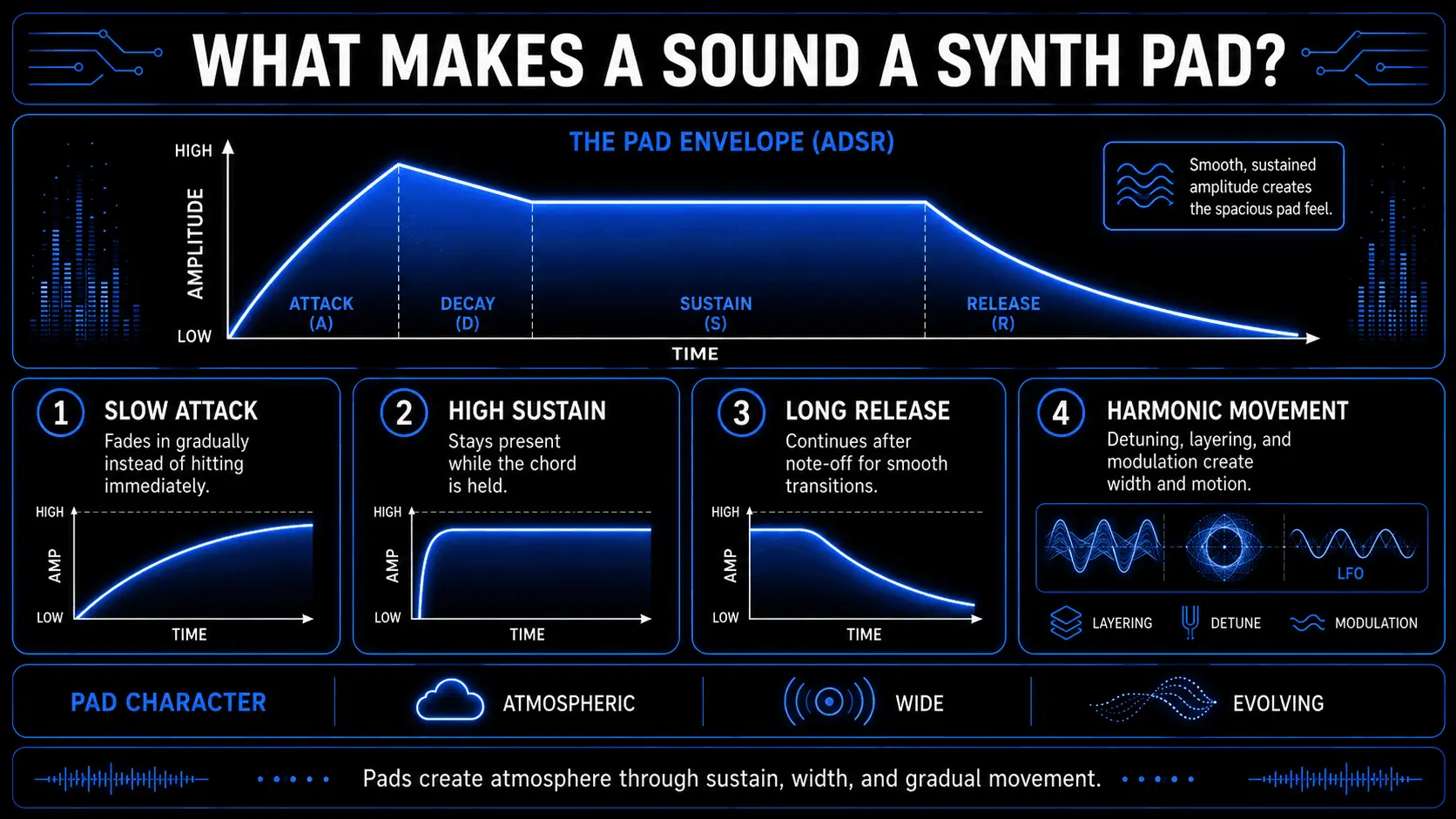
The primary function of a pad is to provide a wash of sound. This is achieved through specific technical parameters:
- Slow Attack: Most pads do not begin immediately. They swell into the mix, avoiding conflict with the transient-heavy elements like drums or plucked leads.
- High Sustain: Once the sound reaches its peak volume, it remains constant or evolves slowly as long as the key is held.
- Long Release: When the note is released, the sound lingers, creating a seamless transition between chord changes.
- Harmonic Complexity: Pads are rarely simple sine waves. They often utilize multiple oscillators, detuning, and modulation to create a thick, lush texture.
Synth Pad vs. Lead vs. Key
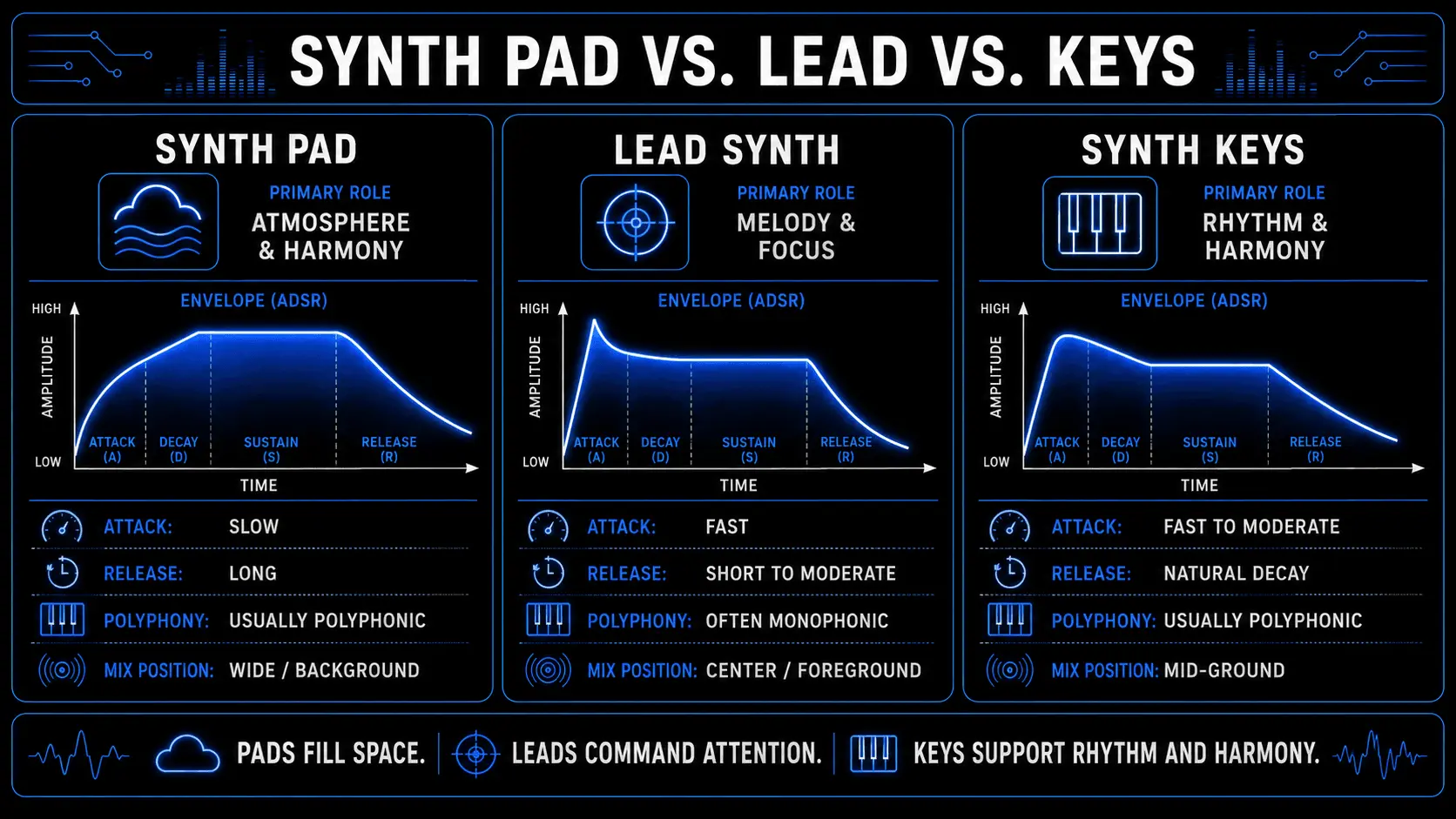
Understanding the distinction between these categories is essential for effective musical arrangement:
| Feature | Synth Pad | Lead Synth | Synth Keys |
|---|---|---|---|
| Primary Role | Atmosphere and Foundation | Melody and Focus | Rhythmic and Harmonic |
| Attack Time | Slow (200ms - 5s) | Fast (0ms - 50ms) | Instant to Moderate |
| Release Time | Long (1s - 10s) | Short to Moderate | Natural Decay |
| Polyphony | High (Chords) | Usually Monophonic | High (Chords) |
| Mix Position | Background/Wide | Foreground/Center | Mid-ground |
The Historical Evolution of Pads in Music
The concept of a pad predates digital technology. To understand the synth pad definition fully, one must look at the evolution of sound texture through the decades.
The Orchestral Origins
Before electronics, the role of the pad was filled by string sections and woodwinds. A soft, sustained violin section playing a whole-note chord is the acoustic ancestor of the modern ambient pad. In the mid-20th century, the Mellotron used magnetic tape loops of orchestral instruments to bring these sustained textures to rock and psychedelic music.
The Analog Revolution (1970s - 1980s)
The 1970s saw the rise of string machines like the ARP Solina and the Logan String Melody. These were specialized synthesizers designed specifically to create polyphonic, sustained textures. As polyphonic synthesizers like the Sequential Circuits Prophet-5 and the Roland Jupiter-8 emerged, producers gained the ability to create warm, swirling analog synth pads that defined the sound of 80s pop and film scores.
The Digital and Wavetable Era (1990s - Present)
With the introduction of the Yamaha DX7 (FM Synthesis) and the Korg M1 (Sample-based), pads became more complex and crystalline. Today, wavetable synthesizers like Xfer Serum and Vital allow for granular control over the movement of a pad, enabling textures that shift and evolve over long periods.
The Technical Taxonomy: Types of Music Pads
Not all pads are created equal. The method of synthesis used significantly alters the musical texture and its application in a mix.
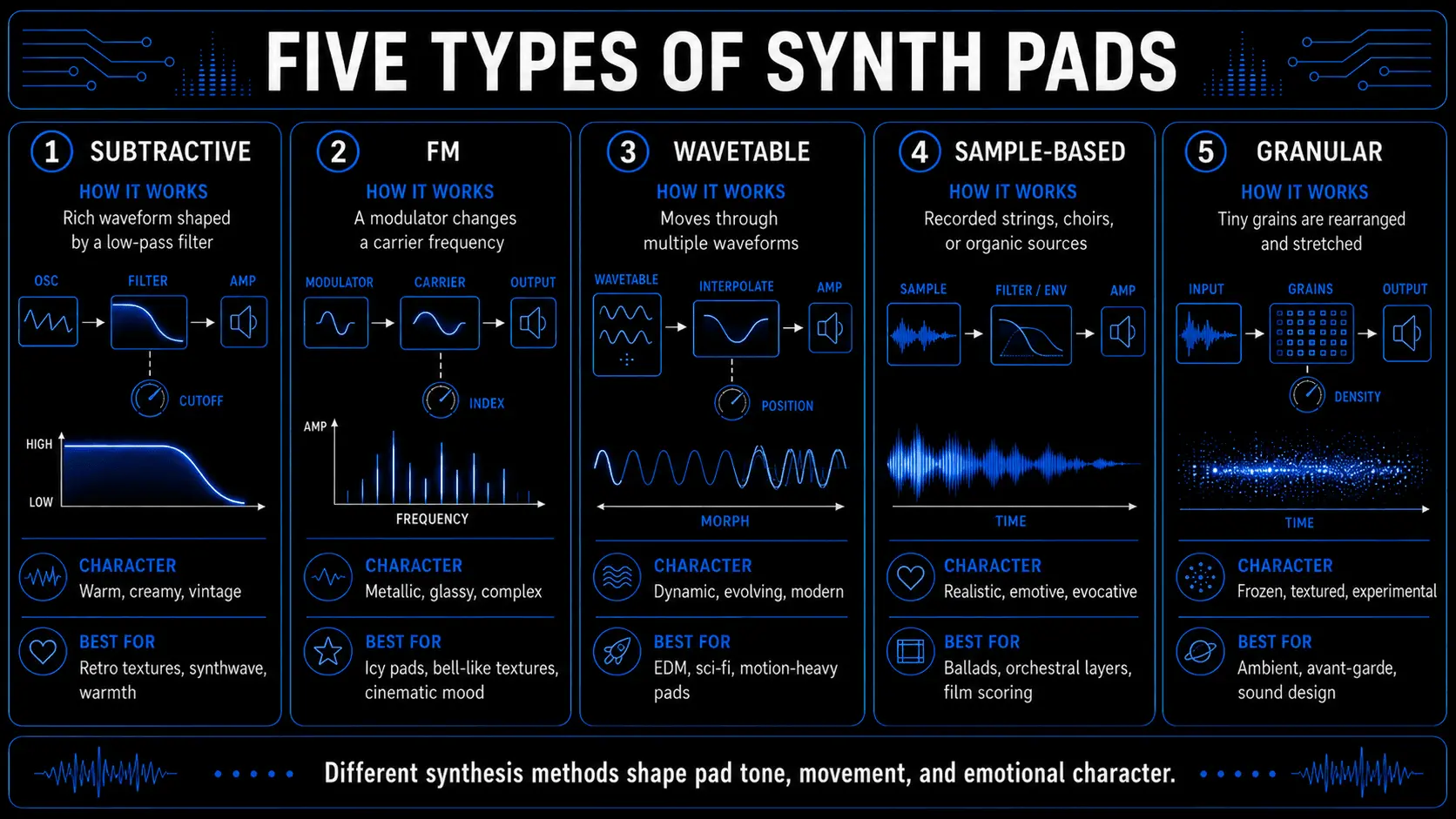
Subtractive Synth Pads
Subtractive synthesis is the most common method for creating warm analog pads. It involves starting with a harmonically rich waveform (like a Sawtooth or Square wave) and using a Low-Pass Filter (LPF) to "subtract" higher frequencies.
- Characteristic: Rich, creamy, and organic.
- Best for: Adding warmth to a cold digital mix or creating vintage synthwave textures.
Frequency Modulation (FM) Pads
FM synthesis uses one waveform (the modulator) to modulate the frequency of another (the carrier).
- Characteristic: Metallic, bell-like, and harmonically complex.
- Best for: Icy, ethereal textures and cinematic soundscapes. The Yamaha DX7’s "E. Piano" and "FullTines" often functioned as proto-pads in the 80s.
Wavetable Pads
Wavetable synthesis allows the producer to cycle through a series of different waveforms.
- Characteristic: Highly dynamic and evolving.
- Best for: Modern EDM and sci-fi scores where the sound needs to feel "alive."
Sample-Based (ROMpler) Pads
These pads use recordings of real-world instruments—choirs, orchestral strings, or even field recordings—as the sound source.
- Characteristic: Realistic and evocative.
- Best for: Emotive ballads and high-end film composition.
Granular Pads
Granular synthesis breaks a sample into tiny "grains" and reassembles them.
- Characteristic: Glitchy yet smooth, often sounding like a frozen moment in time.
- Best for: Experimental ambient music pads and avant-garde sound design.
How to Create Pads in Music
Creating a professional pad requires more than just holding down a chord. It involves intentional sound design and a deep understanding of audio layering.
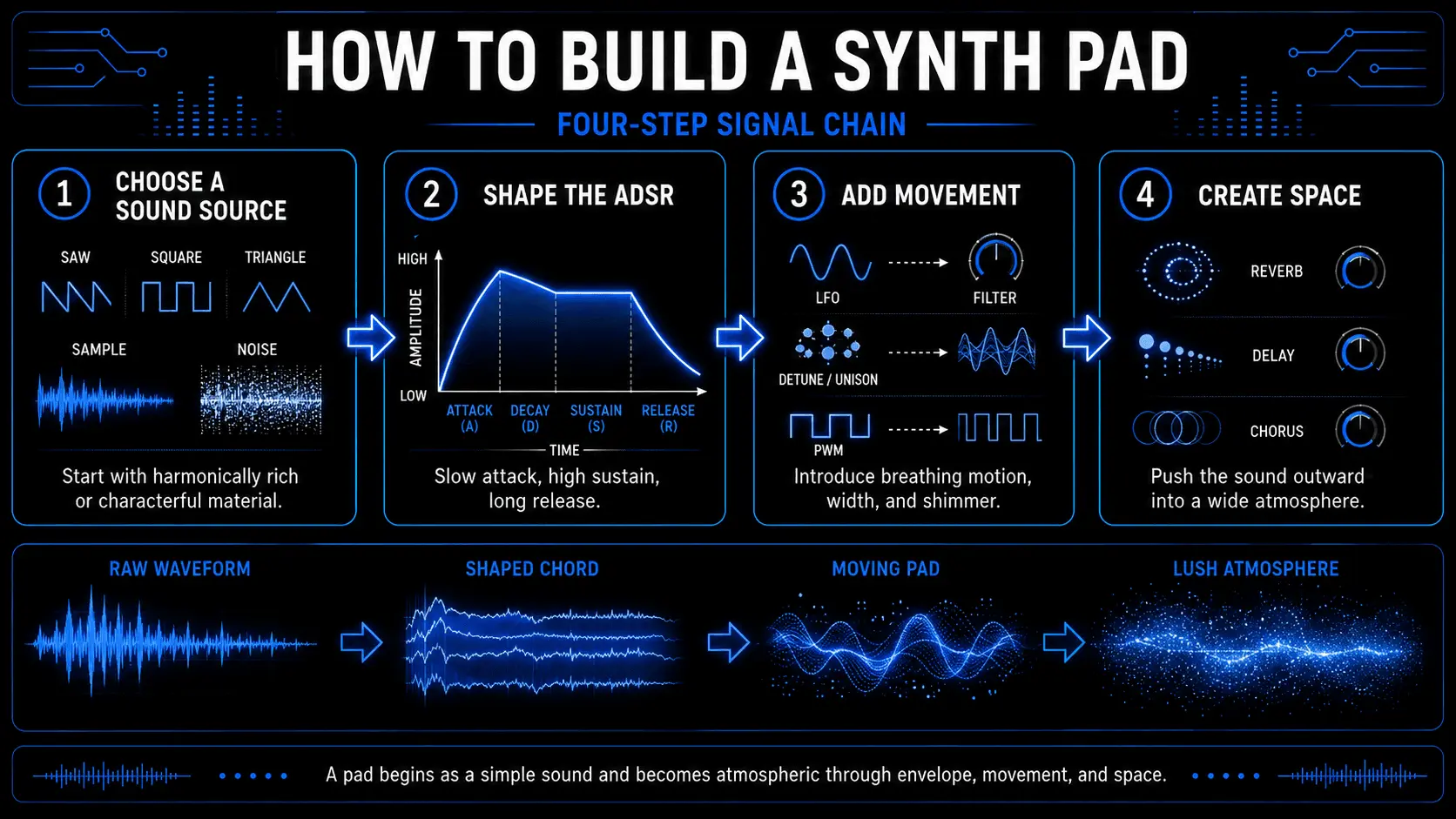
Step 1: Selecting the Sound Source
The foundation of your pad determines its "weight" in the mix.
- Sawtooth Waves: Provide the most harmonic content; ideal for thick, "supersaw" pads.
- Sine/Triangle Waves: Provide a pure, hollow sound; ideal for subtle, sub-harmonic support.
- Noise Generators: Adding a small amount of white or pink noise can provide a "breathy" quality to the pad.
Step 2: Sculpting the Amplitude Envelope (ADSR)
The Envelope Generator is the most critical tool for defining a pad.
- Attack: Set between 500ms and 3000ms. This ensures the pad fades in rather than clicking.
- Decay: Less critical for pads, but a moderate decay can provide a slight initial movement.
- Sustain: Keep this high (70% - 100%). The pad must remain audible as long as the chord is held.
- Release: Set between 1000ms and 5000ms. This prevents the sound from cutting off abruptly when the MIDI note ends.
Step 3: Filter Modulation and Movement
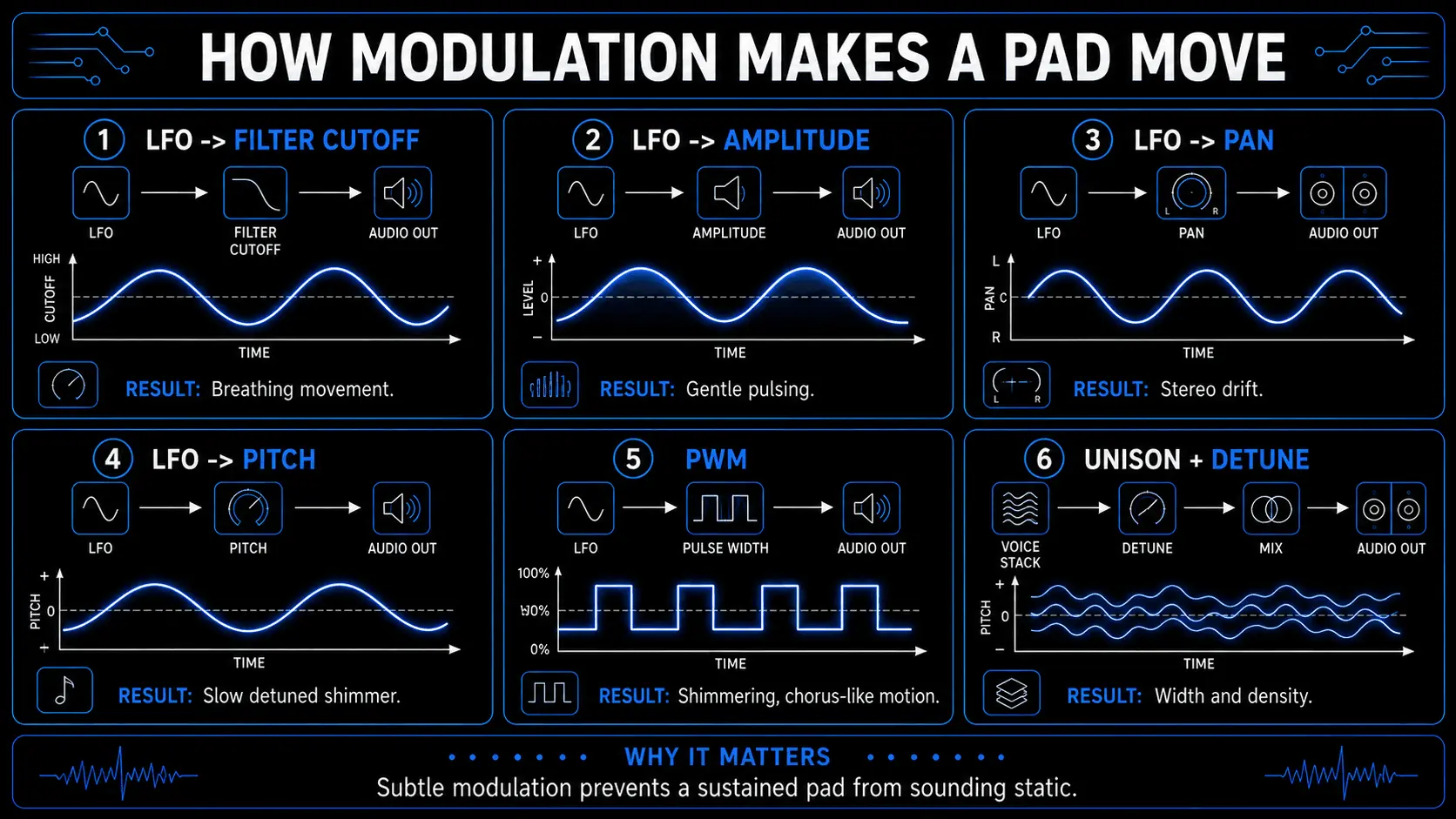
A static pad is a boring pad. To create professional pad sounds in music, you must introduce movement.
- LFO to Filter Cutoff: A slow Low-Frequency Oscillator (LFO) moving the filter cutoff creates a "breathing" effect.
- Choral and Unison: Increasing the unison count and detuning the oscillators creates a wide, lush stereo image.
- Pulse Width Modulation (PWM): Modulating the width of a square wave adds a shimmering, chorus-like quality without using external effects.
Step 4: Spatial Effects and Processing
Pad effects in production are what turn a basic synth sound into an immersive environment.
- Reverb: Use a large hall or plate reverb with a long decay time (4s+). This "washes out" the sound and pushes it back in the mix.
- Delay: A subtle ping-pong delay can add rhythmic interest and stereo width.
- Chorus/Phaser: These modulation effects add movement and help the pad feel "thicker."
Analog vs. Digital Synth Pads
The debate between analog and digital is particularly relevant when discussing pads, as the two formats offer vastly different sonic profiles.
| Feature | Analog Pads | Digital Pads |
|---|---|---|
| Harmonic Profile | Non-linear, saturated, warm. | Precise, clean, harmonically rich. |
| Stability | Tuning may drift, which adds character. | Perfectly stable. |
| Modulation | Limited to hardware knobs/LFOs. | Virtually limitless matrix modulation. |
| Stereo Image | Often mono and requires external processing. | Native stereo width and multi-channel support. |
| CPU/Hardware Load | Requires physical space and maintenance. | Can be CPU-intensive in software. |
| Best Use Case | Retro-pop, lo-fi, and rock. | EDM, cinematic, and modern pop. |
How to Place Pads in the Frequency Spectrum
One of the most common mistakes in music production is allowing pads to "muddy" the mix. Because pads are broad and sustained, they can easily mask other instruments.
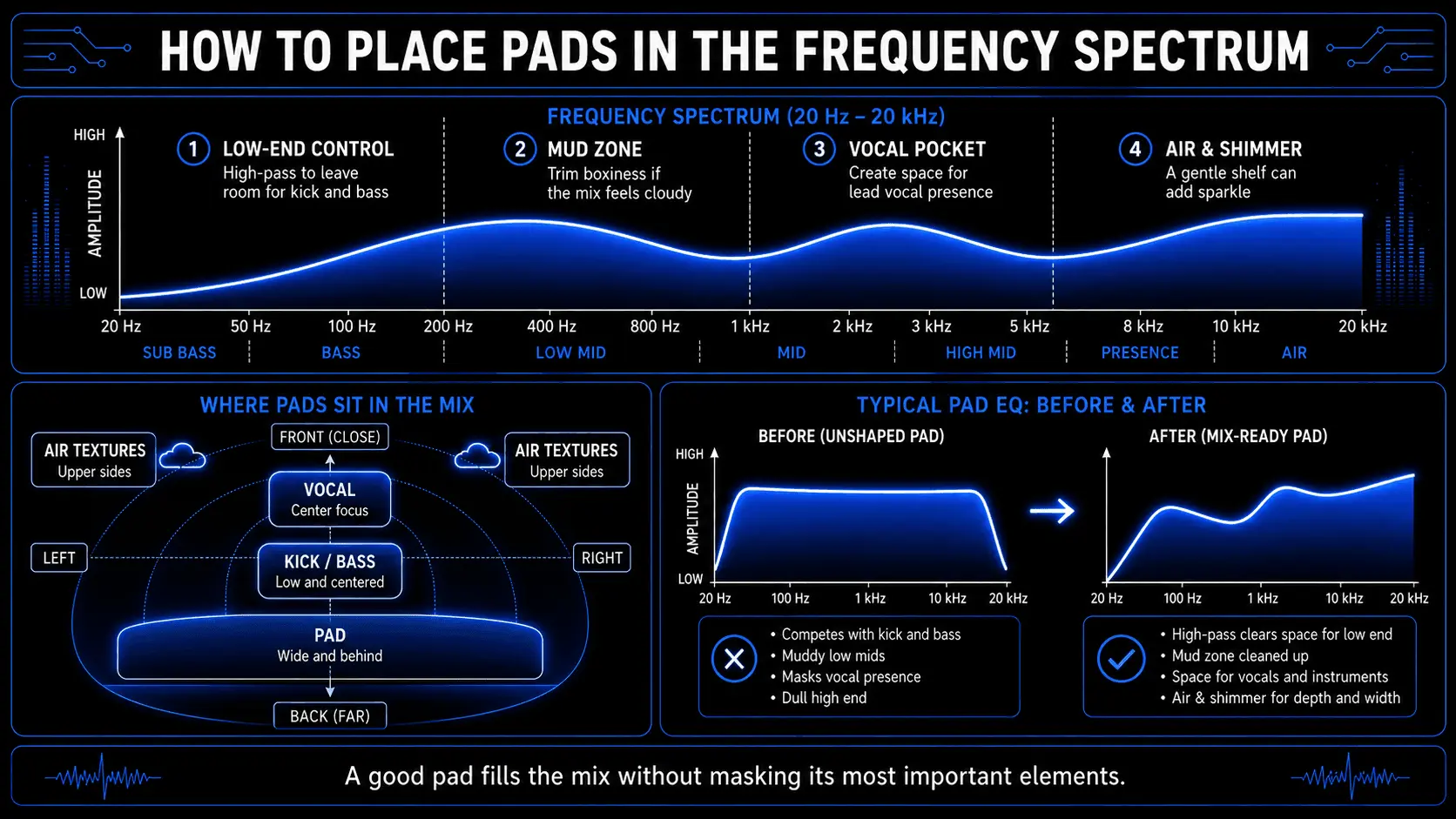
Surgical EQ Techniques
To maintain clarity, follow these EQ guidelines:
- High-Pass Filter (HPF): Cut everything below 200Hz - 400Hz. This reserves the low-end for the kick drum and bassline.
- The Mud Zone: Be wary of the 400Hz - 800Hz range. If the mix feels "boxy," a wide bell cut here can clear up the pad.
- Vocal Pocket: If you have a lead vocal, create a small dip (2-3dB) in the pad around 1kHz - 3kHz.
- Air and Shimmer: A gentle high-shelf boost above 8kHz can add "expensive" sounding air to a digital pad.
Dynamic Processing
- Sidechain Compression: Using a sidechain compressor triggered by the kick drum allows the pad to "pump," which is a staple of electronic music.
- Mid-Side Processing: Use an M/S EQ to remove the low frequencies from the "Side" signal and boost the high frequencies. This makes the pad feel incredibly wide while keeping the center of the mix clear for the snare and vocals.
Using Pads Across Different Music Genres
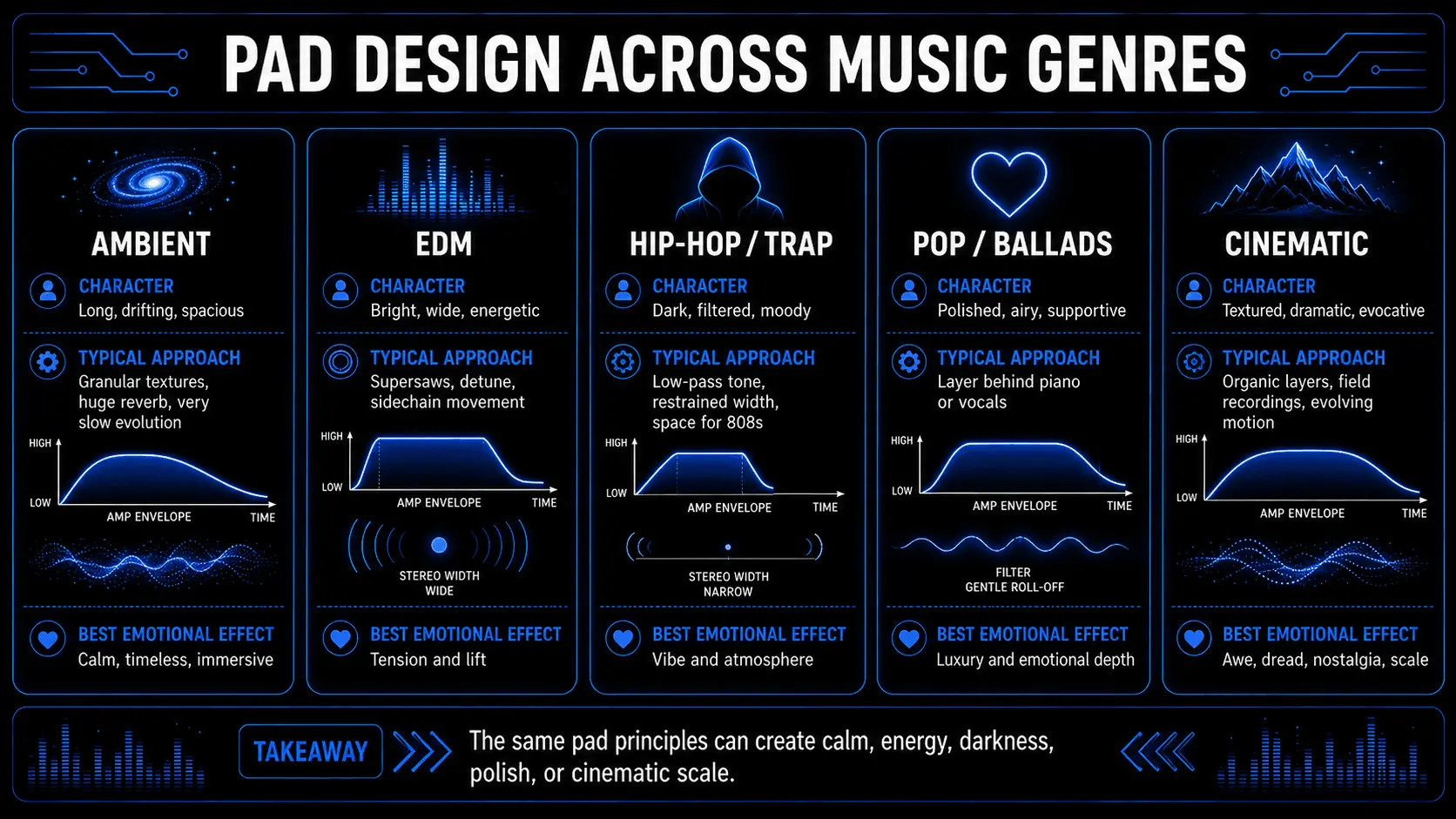
The application of pad instruments in music varies wildly depending on the emotional intent of the genre.
Ambient and New Age
In ambient music, the pad is often the lead instrument. These pads are extremely long, often featuring shifting textures that take 30 seconds or more to complete a cycle. Ambient music pads frequently utilize granular synthesis and massive convolution reverbs.
Electronic Dance Music (EDM)
In EDM, pads serve as the bridge between the breakdown and the drop. They build tension. A common technique is the "supersaw pad," which uses multiple detuned sawtooth oscillators to create a massive wall of sound.
Hip-Hop and Trap
In modern urban genres, pads provide the "vibe." Producers often use low-pass filters to make pads sound "underwater," creating a dark, moody atmosphere that allows the sharp transients of the 808 kick and hi-hats to pierce through.
Pop and Ballads
In pop, pads often replace or augment a real string section. They provide a sense of luxury and polish. Digital "air" pads are frequently layered with acoustic piano to add a dreamlike quality to the track.
Cinematic and Film Scoring
Film pads are designed to evoke specific emotions—dread, awe, or nostalgia. They often incorporate non-musical elements like recorded rain, industrial hums, or distorted orchestral fragments.
Advanced Sound Design
You are not limited to synthesizers when creating pads. One of the hallmarks of a high-level Senior Content Strategist in sound design is the ability to repurpose organic audio.
The "Paulstretch" Method
Named after the PaulStretch algorithm, this technique involves stretching a short audio sample (like a single vocal note or a guitar pluck) by 800% or more. The result is a lush, granular pad that retains the tonal characteristics of the original source but loses its rhythmic identity.
Creating Pads from Field Recordings
- Record a mundane sound (e.g., a dishwasher or city traffic).
- Loop a very small section of the recording.
- Apply a resonant Low-Pass Filter.
- Apply a 100% wet Reverb.
- This creates a "found sound" pad that adds a unique, organic layer to your electronic music.
What to Look for in Tools for Creating Synth Pads
The best pad-making tools are not defined by a specific brand or synthesis method. What matters is whether they provide enough control to shape the sound, introduce movement, and position the pad effectively within an arrangement.
Flexible Envelope Controls
Look for adjustable attack, decay, sustain, and release settings. A slow attack helps the pad fade in smoothly, while a long release allows notes and chord changes to blend without abrupt cutoffs.
Modulation Routing
LFOs, modulation envelopes, and routing controls help prevent pads from sounding static. These features can gradually alter filter cutoff, pitch, volume, stereo position, or other parameters over time.
Filter and Tone-Shaping Options
High-pass, low-pass, band-pass, and resonant filters allow you to control the pad’s frequency range and tonal character. Good filtering tools also make it easier to keep the pad from masking vocals, bass, and other instruments.
Unison, Detuning, and Stereo Control
Unison and detuning can turn a simple waveform into a wider, denser texture. Stereo controls help spread the sound across the mix, although the pad should still be checked in mono to avoid phase cancellation.
Sample Import and Audio Manipulation
Tools that support sample import allow you to transform vocals, instruments, and field recordings into original pads. Time-stretching, looping, pitch shifting, and granular processing can add further texture and movement.
Built-In Spatial Effects
Reverb, delay, chorus, phasing, and similar effects help create depth, width, and atmosphere. Flexible effect routing is especially valuable because it allows you to control how strongly each effect shapes the final pad.
Automation Support
Automation lets the pad evolve with the arrangement. You can gradually open a filter, increase the reverb, narrow the stereo image, or reduce the volume as the track moves between verses, choruses, and transitions.
Common Mistakes to Avoid When Using Pads
Even experienced producers fall into traps when utilizing pads. Avoid these common errors to ensure your musical arrangement remains professional.
- Over-Layering: Adding five different pads playing the same chord usually results in a cluttered, phase-cancelled mess. Instead, pick one "character" pad and one "foundation" pad.
- Static Energy: A pad that doesn't move sounds like a test tone. Always map an LFO or a hand-drawn automation curve to the filter or volume.
- Ignoring the Arrangement: Pads don't need to play throughout the entire song. Removing the pad during a verse can make the chorus feel much larger when the pad returns.
- Neglecting Mono Compatibility: Many "wide" pads sound hollow or disappear entirely when played on a mono speaker (like a phone or a club system). Check your mix in mono frequently.
- Clashing with the Bass: If your pad has too much low-end, your bassline will lose its impact. Always high-pass your pads.
Frequently Asked Questions
What is the primary difference between a synth pad and a synth lead?
The distinction lies in their functional role and amplitude envelope. A lead synth is designed for melodic prominence, featuring a fast attack and high frequency presence to cut through a mix. In contrast, a synth pad serves as a harmonic foundation. It utilizes a slow attack to swell into the arrangement and a long release to create a seamless musical texture. While leads are often monophonic (playing one note at a time), pads are polyphonic to accommodate chordal structures.
Can any sustained sound be considered a pad?
Technically, any sound that provides a sustained, background layer can function as a pad, but the synth pad definition typically implies a sound with purposeful atmospheric effects. For example, a sustained organ note might technically fill the space, but it lacks the evolving modulation and slow envelope characteristics that define a traditional pad sound.
Why are pads referred to as the glue of a mix?
In music production, pads fill the "sonic gaps" between the rhythmic elements (drums) and the melodic elements (vocals/leads). By providing a constant harmonic reference, they unify disparate sounds, making the transition between different sections of a song feel cohesive and professional.
What is the Paulstretch method mentioned in sound design?
Paulstretch is an extreme time-stretching algorithm. It allows a producer to take a short audio sample—such as a single piano note or a vocal intake—and stretch it by massive factors (e.g., 800%). This process smears the transients and creates a beautiful, metallic, or ethereal granular pad that retains the original timbre but becomes a sustained atmosphere.
What is a supersaw pad, and where is it used?
A supersaw pad consists of multiple detuned sawtooth waves. It creates a dense, harmonically rich wall of sound. It is a staple in Electronic Dance Music (EDM), particularly in Progressive House and Trance, where it is used to build immense energy during anthemic breakdowns.
How are pads used differently in Hip-Hop vs. Ambient music?
- In Hip-Hop, pads are often secondary, used to add a "dark" or "moody" vibe. They are frequently low-pass filtered (the underwater sound) to stay out of the way of the vocals and 808s.
- In ambient music, the pad is often the primary focus. It is allowed to occupy more frequency space and usually features much longer attack and release times to emphasize a sense of timelessness.
Why does my pad disappear when I listen in mono?
This is a result of phase cancellation. If you use a "widening" effect that simply inverts the phase of one side of the stereo signal, the two sides will cancel each other out when summed to mono. Always check your pad sounds in music with a mono-compatibility meter to ensure they maintain their presence on all playback systems.