
Key Takeaways
- Syncopation creates rhythmic tension by emphasizing weak beats, offbeats, or subdivisions instead of the expected strong beats.
- The underlying tempo and time signature remain stable; only the placement and accentuation of notes change against the established pulse.
- Syncopated rhythms make music feel more energetic, expressive, and physically engaging by balancing expectation, surprise, tension, and release.
- Common techniques include tied notes across bar lines, rests on strong beats, offbeat accents, ghost notes, muted strumming, and slightly shifted MIDI notes.
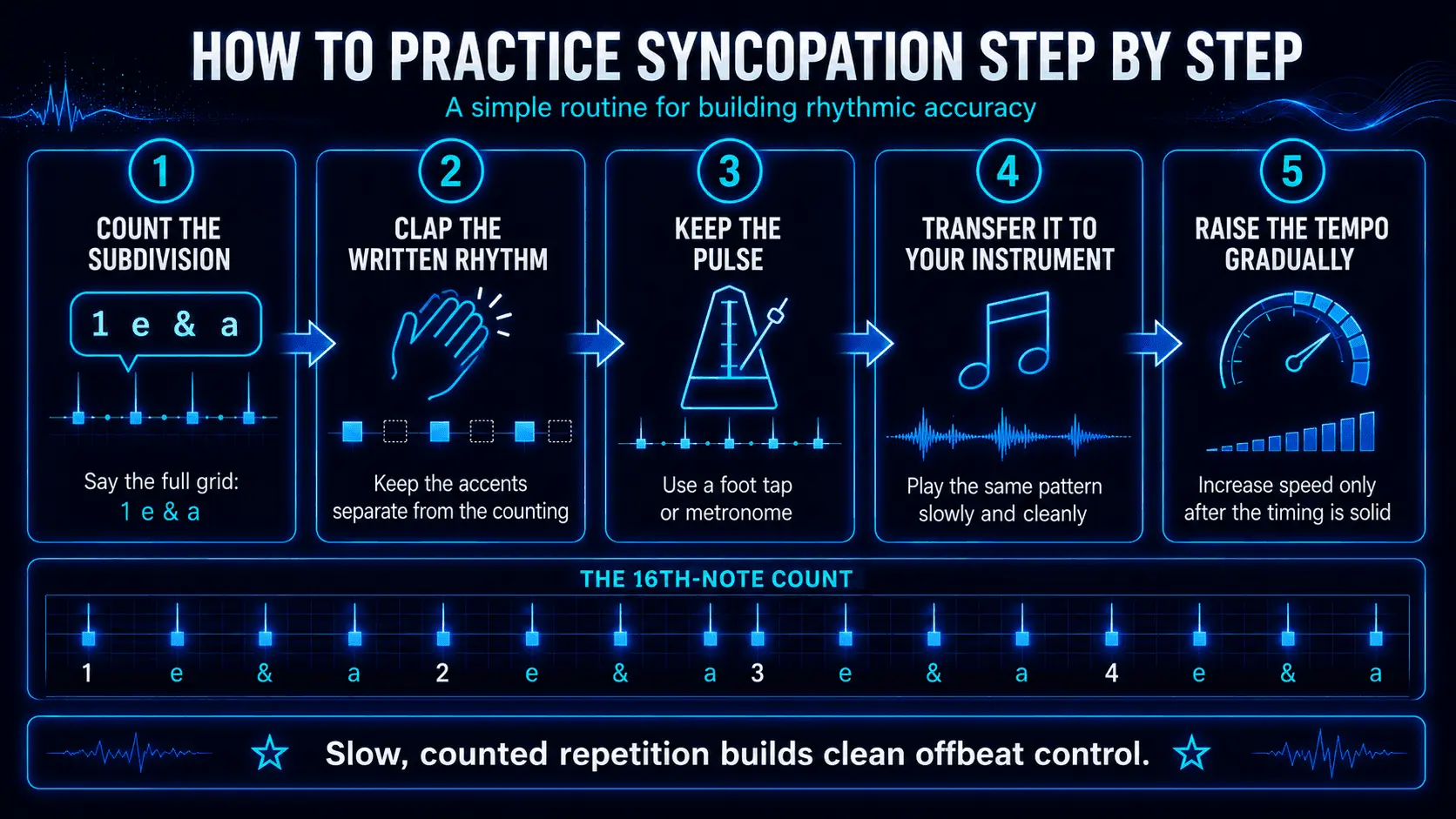
- The best way to practise syncopation is to slow the rhythm down, count its subdivisions, and maintain a steady internal pulse while performing the displaced accents.
How Syncopation Disrupts Rhythm and Creates Groove
The structural integrity of Western music depends heavily on predictability. For centuries, compositional frameworks have relied on a recurring grid of strong and weak pulses to establish order, allowing listeners to orient themselves within a timeline. However, the true vitality of composition emerges when this order is deliberately disrupted.
Syncopation represents the primary mechanism for this disruption. By shifting acoustic emphasis away from anticipated metric anchors, syncopation introduces tension, complexity, and physical momentum into musical phrasing.
This comprehensive guide delivers an exhaustive analysis of syncopation, examining its theoretical foundations, structural necessity, historical evolution, and practical application across various instrumentation and digital production workflows.
What Defines Syncopation?
To understand syncopation, one must first understand the structural grid of standard musical timing. Every time signature contains an internal hierarchy of pulses, categorized as strong beats and weak beats. In a standard 4/4 time signature, for example, beat 1 is the strongest anchor (the primary downbeat), beat 3 is a secondary strong anchor, while beats 2 and 4 function as weak beats.
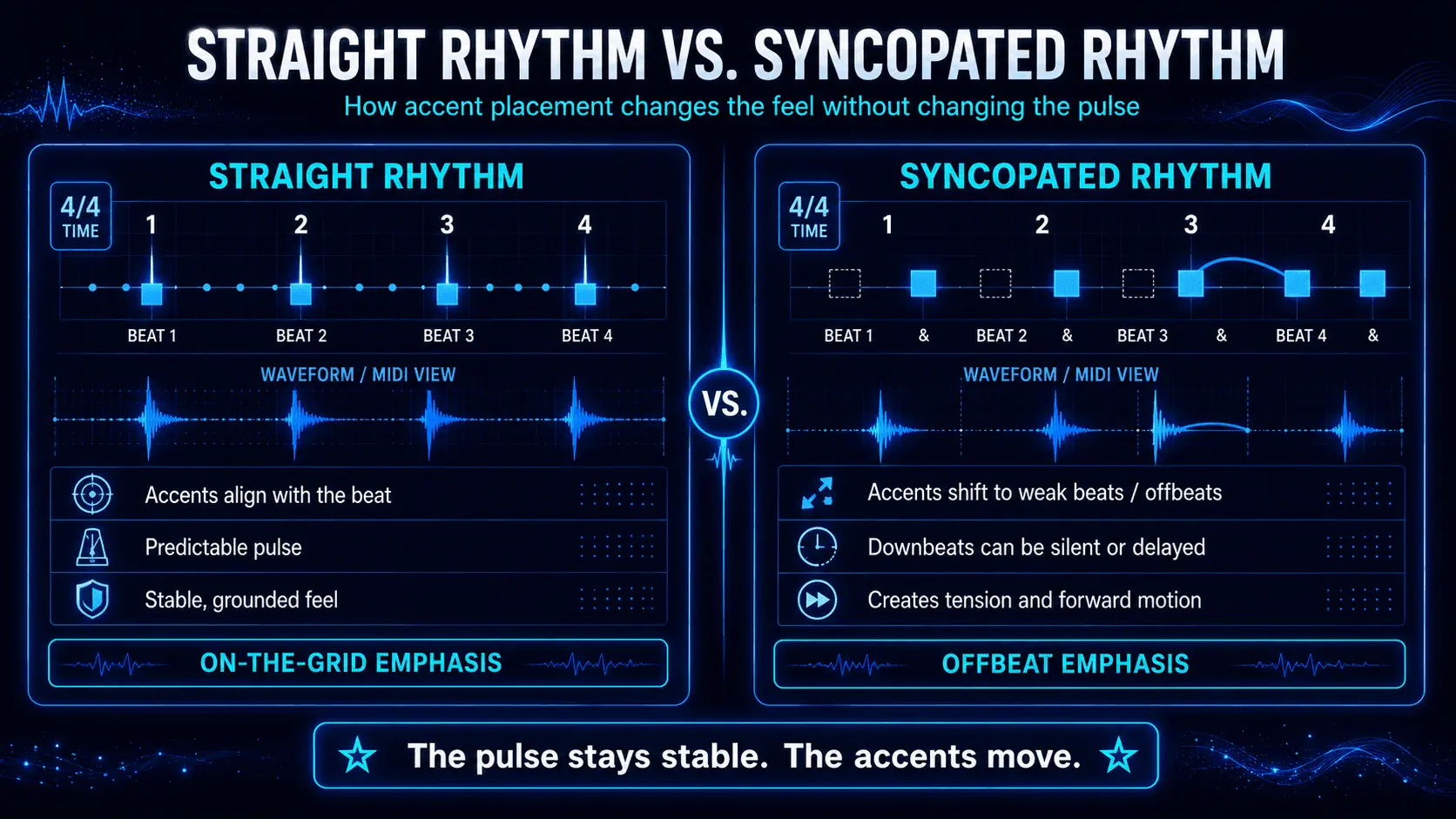
Syncopation occurs when an accent is deliberately placed on a weak beat or on the beat division between these primary pulses (the offbeat), while the surrounding strong beats are left unaccented, understated, or entirely silent.
The Mechanics of Beat Division and Musical Timing
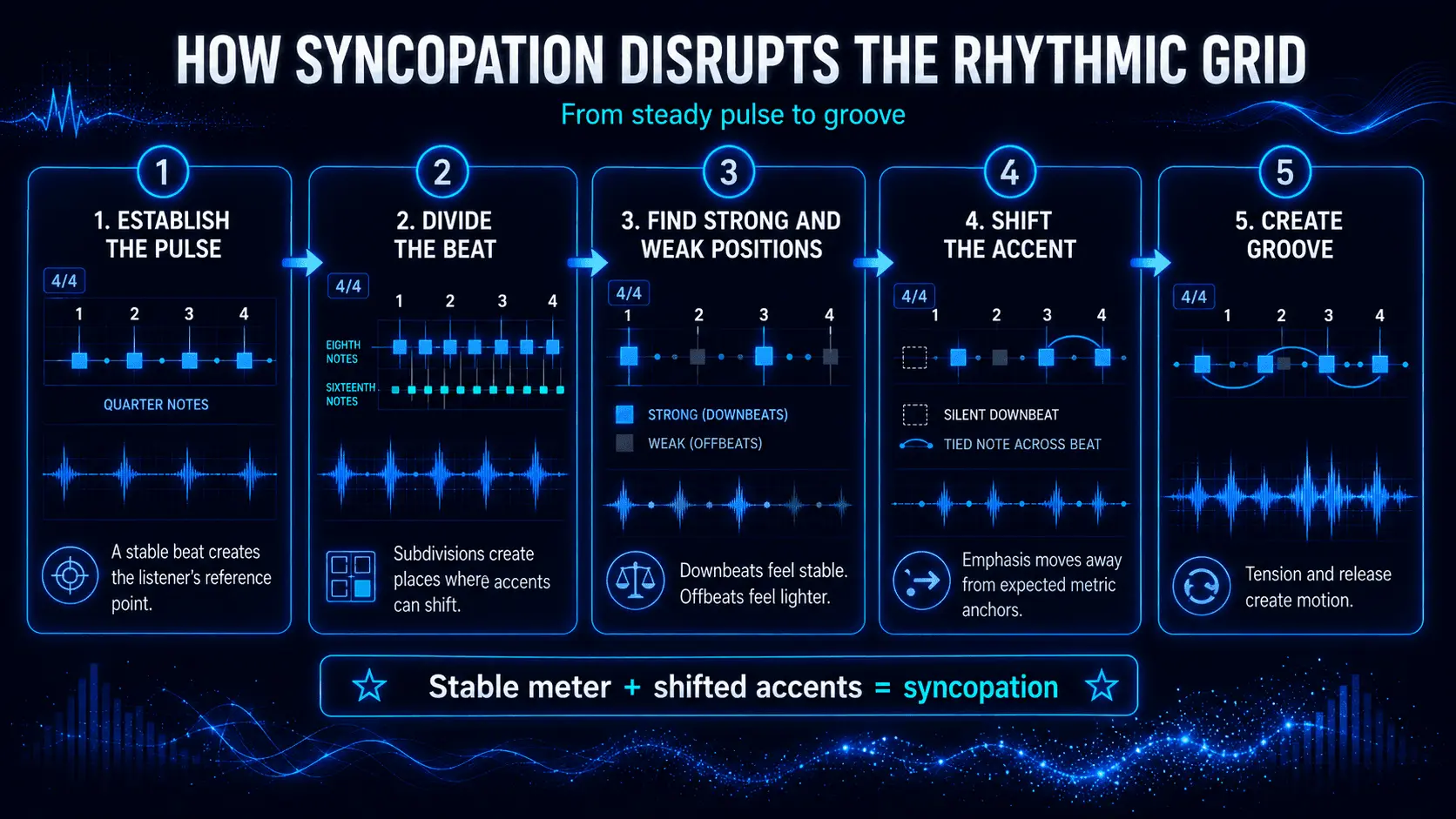
The execution of syncopation relies entirely on the precise manipulation of beat division. Within any given meter, a single beat can be divided into equal parts:
- Binary divisions yield eighth notes and sixteenth notes.
- Ternary divisions yield triplets.
When a musician performs a straight, non-syncopated rhythm, the musical notes align directly with the primary downbeats or follow an even distribution that reinforces the underlying meter.
Musical timing functions as a cognitive contract between the performer and the audience. The human brain naturally seeks out patterns, establishing an internal clock based on the initial bars of a piece. When a syncopated pattern emerges, it does not destroy this internal clock; rather, it superimposes a secondary, conflicting layer of timing over it.
This interaction forces the listener's mind to track two realities simultaneously: the implied, steady metric pulse and the explicit, irregular performance rhythm.
The Concept of Accentuation in Traditional vs. Offbeat Rhythms
Accentuation is the practice of applying dynamic modulation, agogic duration, or tonic shifts to specific notes to make them stand out. In traditional classical composition prior to the late nineteenth century, accentuation typically reinforced the meter. A conductor’s downbeat physically demonstrated this structural weight.
In offbeat rhythms, accentuation functions as an adversarial force against the meter. By using sudden dynamic shifts—such as sforzando strikes on the sixteenth-note subdivisions or tying an offbeat note across the structural boundary of a bar line—the composer prevents the music from resolving where the ear expects it to. This structural displacement transforms the melody from a passive sequence of pitches into an active, rhythmically independent voice.
Why Rhythmic Variation Matters
Without rhythmic variation, musical compositions run the risk of becoming mechanical, predictable, and artistically flat. While harmonic progressions provide emotional context and melodies deliver a narrative arc, rhythm governs how that information is physically processed by the human body and mind.
Syncopation acts as a catalyst for engagement, preventing monotony by continually recalibrating the relationship between tension and release.
Enhancing Musicality and Groove Through Tension
Musicality is the overarching quality of expression, sensitivity, and artistic choices in a performance. Syncopation enhances musicality by giving composers a tool to inject tension into a piece without relying solely on dissonant harmonies.
When an offbeat rhythm delays or anticipates an expected musical milestone, it creates an unresolved psychological state. The resolution of this state—when the rhythm finally realigns with a primary downbeat—produces a profound sense of emotional release.
In commercial, urban, and dance music genres, this tension-and-release mechanism forms the foundation of groove. Groove is the collective feel generated by a rhythm section when it plays with micro-timing adjustments and carefully placed syncopated patterns.
By avoiding a strict alignment with the grid, a syncopated bassline or drum pattern creates an infectious, human pocket that invites physical movement, such as foot-tapping or dancing.
The Relationship Between Syncopation and Musical Phrasing
Musical phrasing refers to the way a musician shapes a sequence of notes to express a distinct musical thought, much like a spoken sentence. Syncopation fundamentally alters the punctuation of these phrases. Instead of beginning and ending squarely on the first beat of a measure, a syncopated phrase might begin on the final sixteenth note of a preceding bar, a technique known as an anacrusis or anticipation.
This offbeat entry changes the trajectory of the entire melody. It shifts the weight of the lyrical or melodic emphasis, allowing long notes to sit on weak beats while short, percussive notes punctuate the strong beats.
Consequently, musical phrasing becomes more fluid and conversational, breaking away from the rigid boundaries imposed by bar lines.
How to Identify Syncopated Formations
Recognizing syncopation requires training both the ear and the eye to spot discrepancies between the underlying pulse and the articulated rhythm. In live environments and studio sessions, identifying these formations is crucial for accurate performance and effective collaboration.
Analyzing Musical Notation and Time Signature Alignments
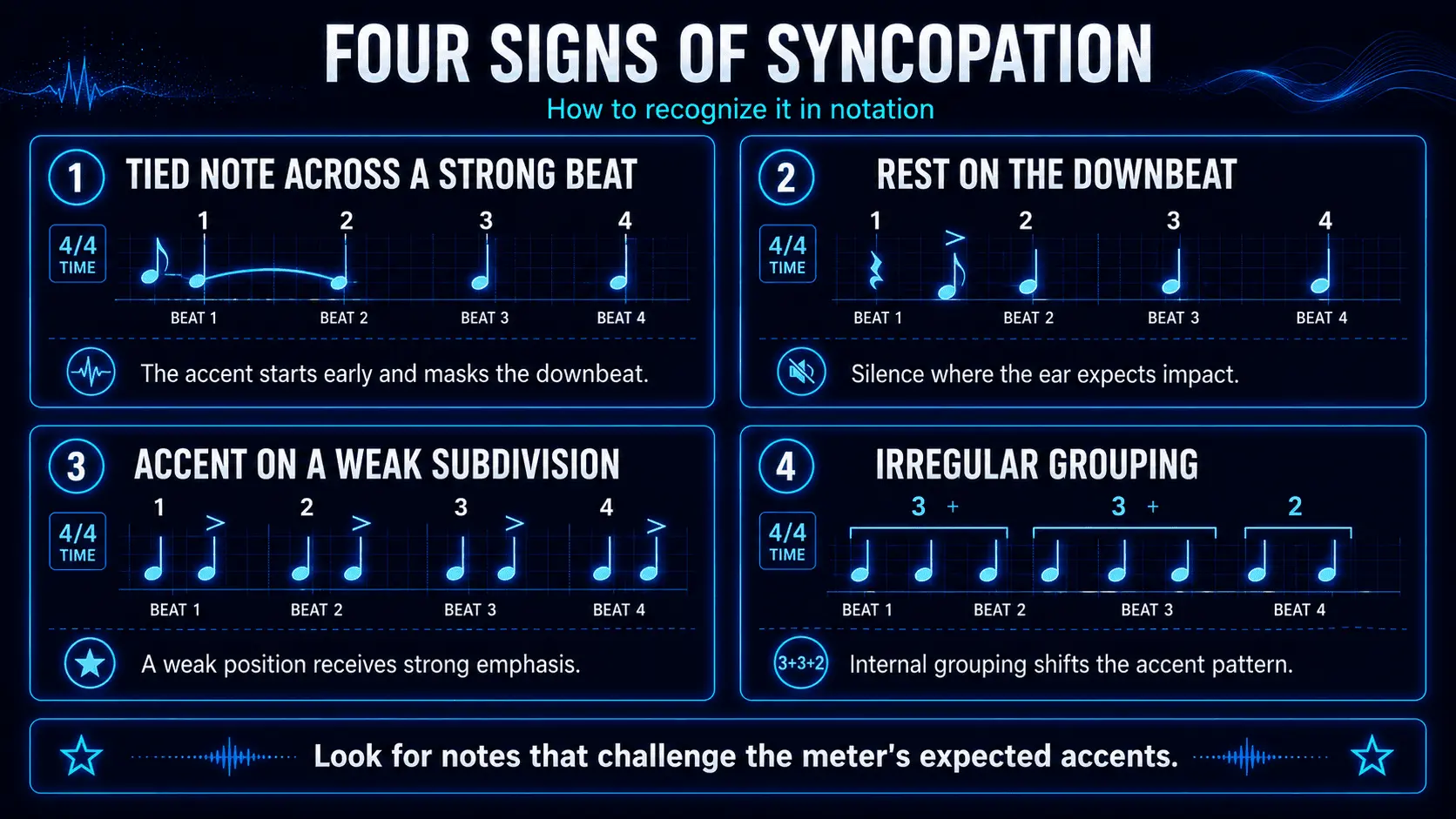
In sheet music, syncopation is instantly recognizable through specific notation techniques. The most common indicators include:
- Tied Notes Across Bar Lines: A note is articulated on an offbeat at the end of a measure and sustained across the bar line into the first beat of the next measure, silencing the strongest downbeat.
- Offbeat Rests: A rest replaces an expected note on beat 1 or beat 3, followed immediately by an accented eighth or sixteenth note.
- Accent Marks: Explicit directives placed above notes that fall on weak beats, instructing the performer to apply additional velocity or dynamic weight.
When analyzing a time signature, look closely at how the subdivisions are grouped. If a piece written in 4/4 groups eighth notes as 3+3+2 rather than the standard 2+2+2+2, it creates an inherent syncopated pattern, shifting the internal accents of the bar.
Detecting Tempo Shifts and Meter Changes
It is important to distinguish syncopation from other rhythmic techniques like tempo shifts and meter changes.
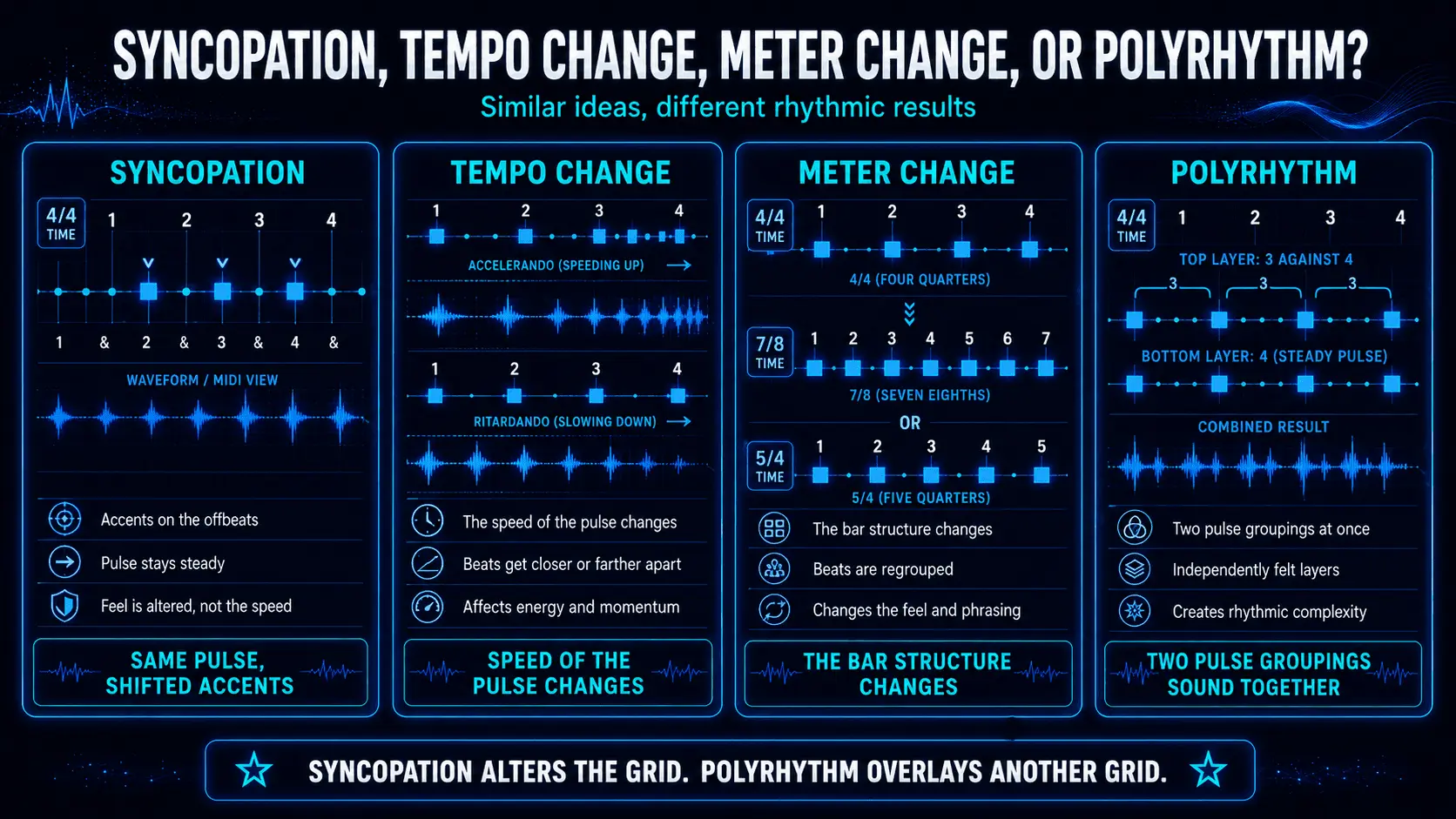
- A tempo shift (such as accelerando or ritardando) alters the absolute speed of the underlying pulse but leaves the metric hierarchy intact.
- A meter change redefines the time signature entirely, shifting from 4/4 to 7/8 or 5/4, which alters the number of beats per measure.
Syncopation, by contrast, operates within a stable tempo and meter. The underlying pulse remains unchanged; only the placement of the notes against that pulse shifts.
However, advanced composers often combine these techniques, using a sudden meter change to disorient the listener, followed immediately by a syncopated pattern to compound the rhythmic ambiguity.
Determining Strength and Accentuation in Syncopation
To effectively execute syncopation, a musician must understand the underlying power structure of musical meters. Not all weak beats are equal, and the degree of syncopated tension depends directly on which specific subdivision is being emphasized.
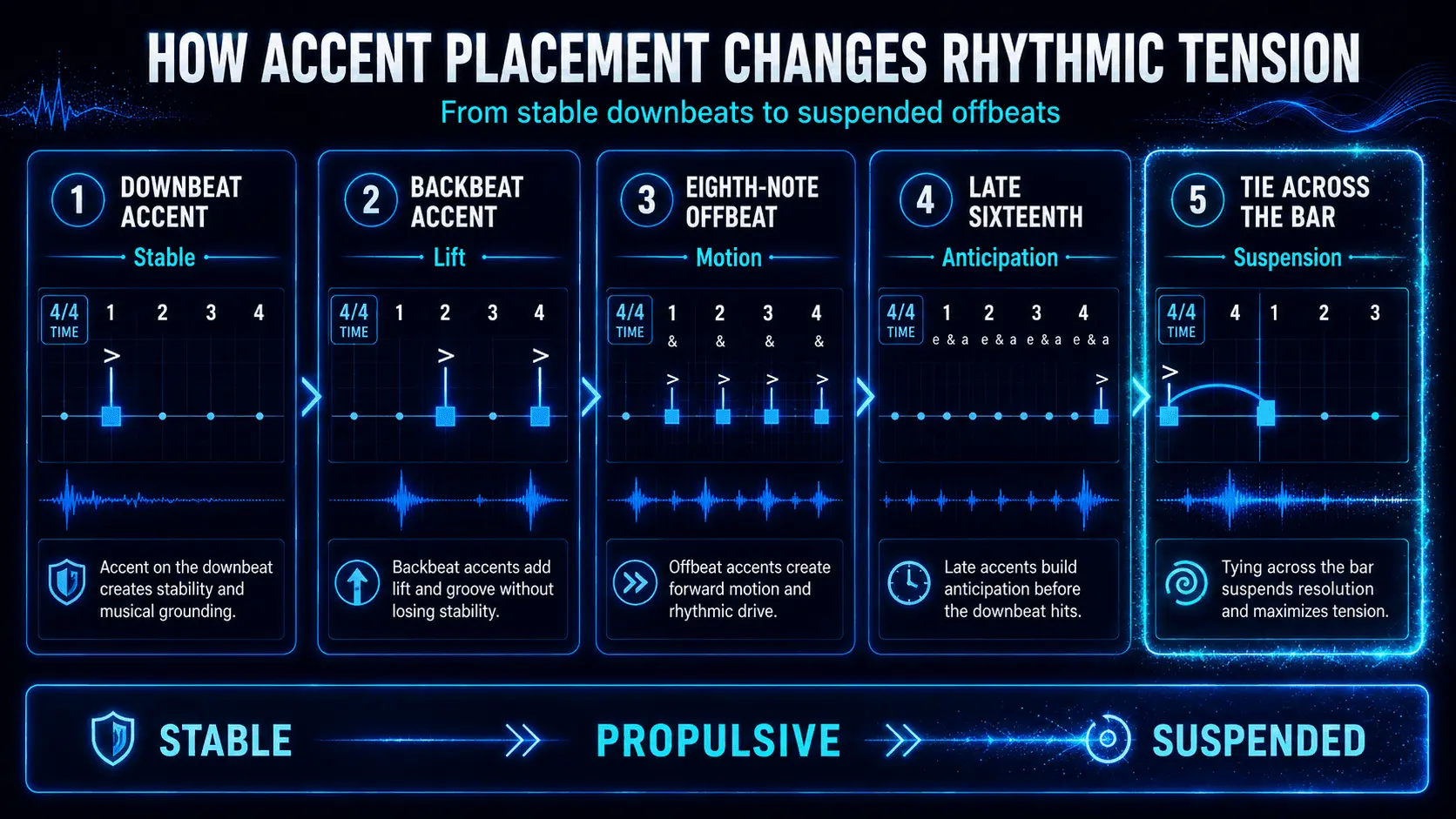
When a performer accents a tertiary weak beat (beat 2 or 4), the syncopation is relatively stable, often resolving cleanly into the next strong beat. This format serves as the foundation for the classic backbeat found in rock, pop, and blues music.
However, when the accentuation shifts to the quaternary or microscopic levels—the split-second windows between the beats—the syncopated tension increases dramatically. Accenting the final sixteenth-note subdivision of a beat creates an intense feeling of anticipation or suspension, as the note appears to hang in the air before the next downbeat arrives.
Analytical Case Studies: Canonical Examples Across Genres
Classical Masterpieces and Early Avant-Garde Works
In Igor Stravinsky’s The Rite of Spring (specifically the section titled Augurs of Spring), the orchestra executes a series of pounding chords in a steady duple meter.
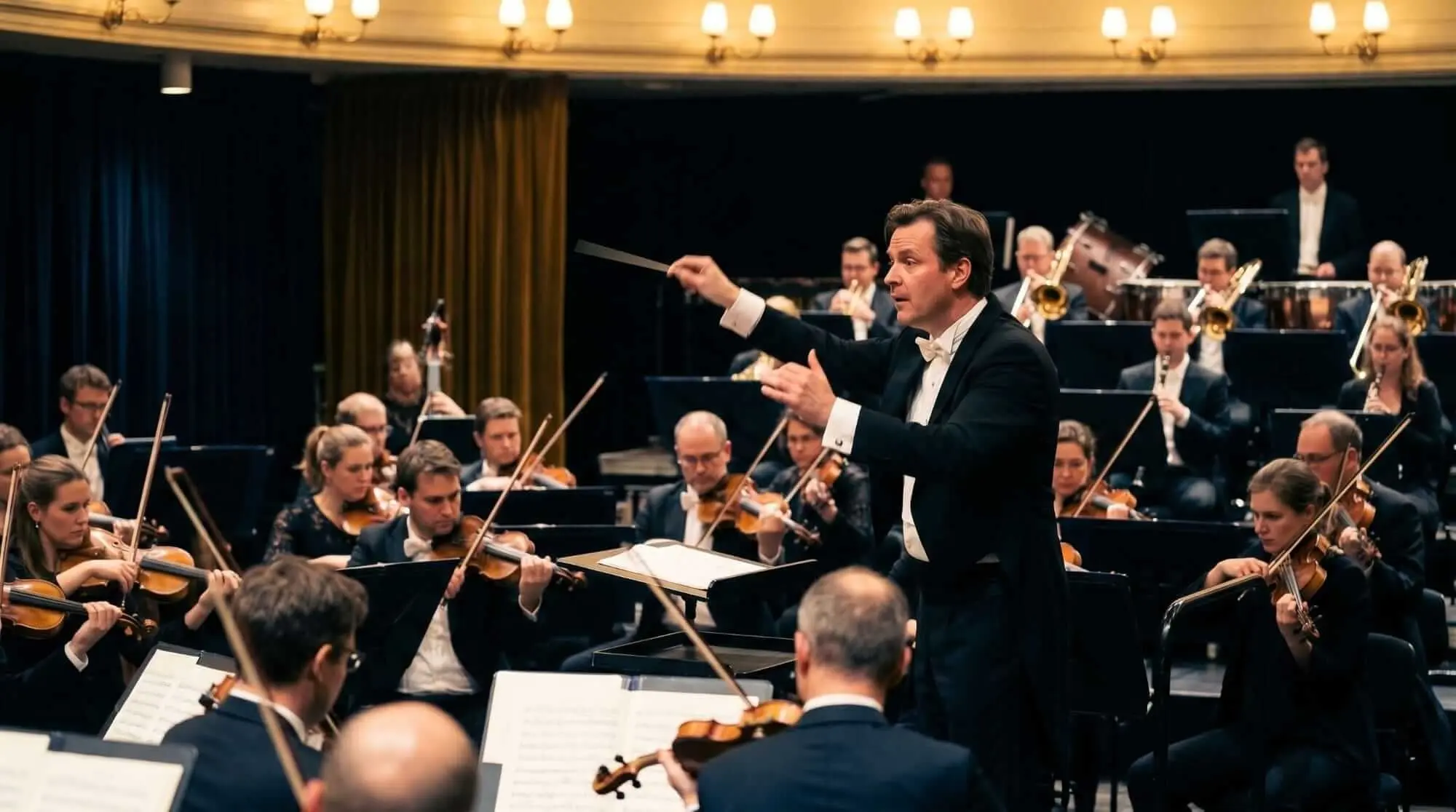
However, Stravinsky places unpredictable accents on various weak beats and offbeats, completely destroying any sense of metric regularity. The listener cannot predict when the next hammer-like strike will occur, creating an overwhelming feeling of primal energy and chaos.
The Golden Era of Jazz Improvisation and Swing
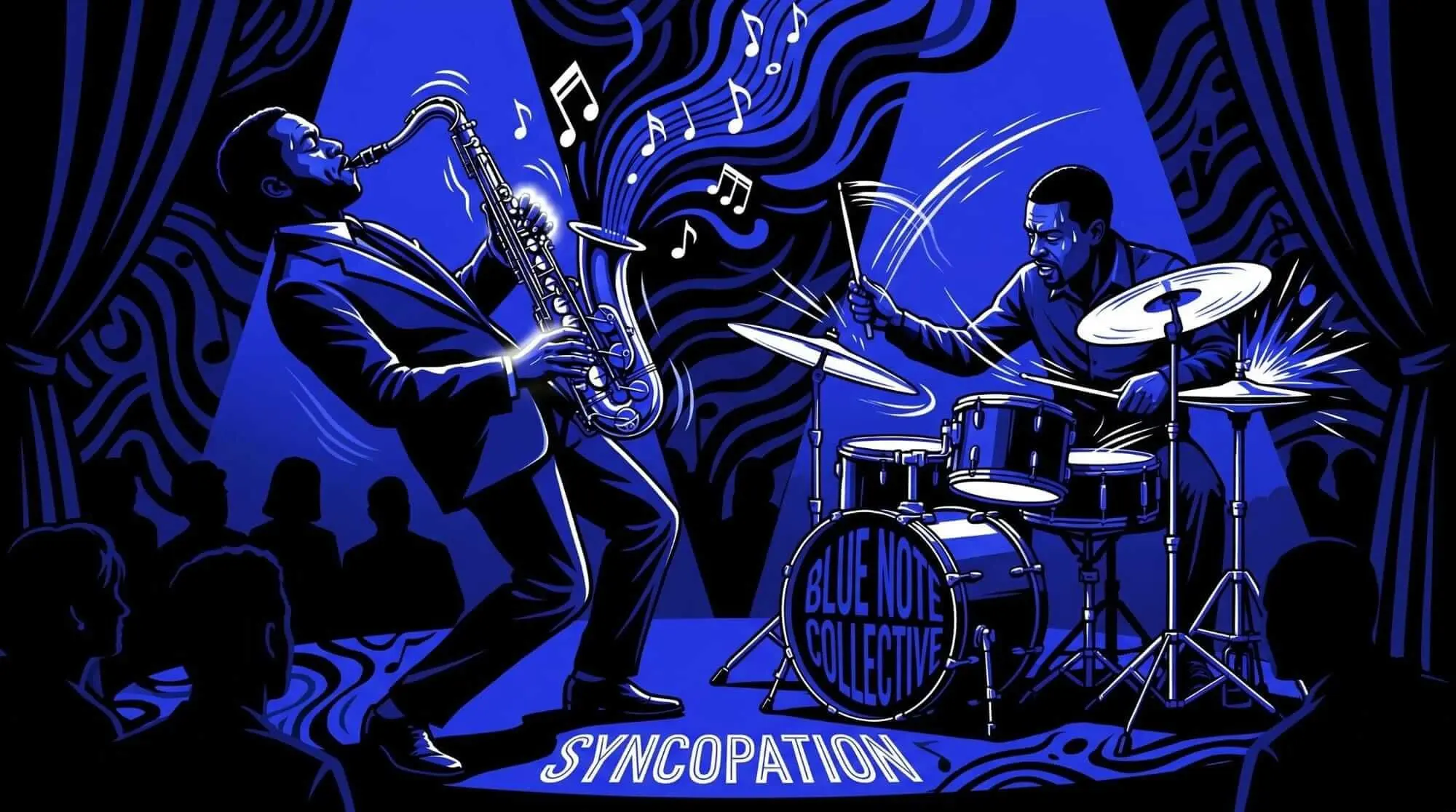
Jazz represents the ultimate refinement of syncopation. In Dave Brubeck’s legendary composition Take Five, written in an unusual 5/4 time signature, the rhythm section maintains a steady, asymmetrical pattern grouped as 3+2.
Over this foundation, Paul Desmond’s saxophone melody floats with effortless syncopated patterns, continually accenting the offbeats and bridging the gap between the bar lines. This interaction transforms an otherwise odd, jarring time signature into a smooth, driving swing.
Modern Pop, Funk, and Electronic Foundations
In Stevie Wonder’s funk masterpiece Superstition, the primary clavinet riff is an exploration of sixteenth-note syncopation. The riff avoids articulating the downbeat of beat 1 in almost every measure, choosing instead to dance around the beat with an intricate pattern of ties and accents.
This creates an irresistible, bubbling groove that feels incredibly propulsive, even though the absolute tempo remains completely stable.
Executing Syncopation in Live Performance
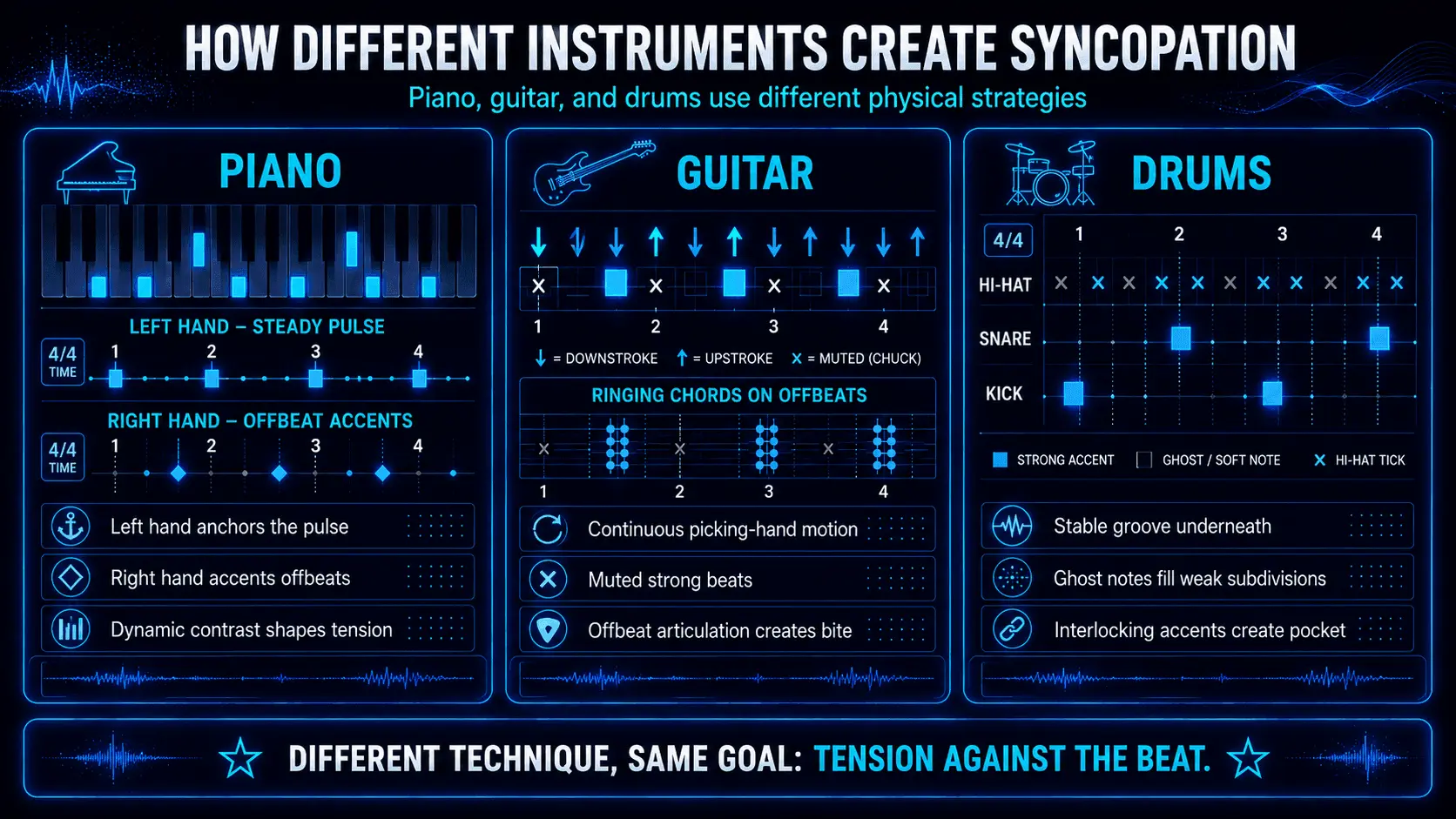
Translating syncopated concepts onto a physical instrument requires a high level of neuromuscular coordination and technical control. Each instrument group faces unique mechanical challenges when subverting the rhythmic grid.
Advanced Piano Applications: Independence of Hands and Dynamic Modulation
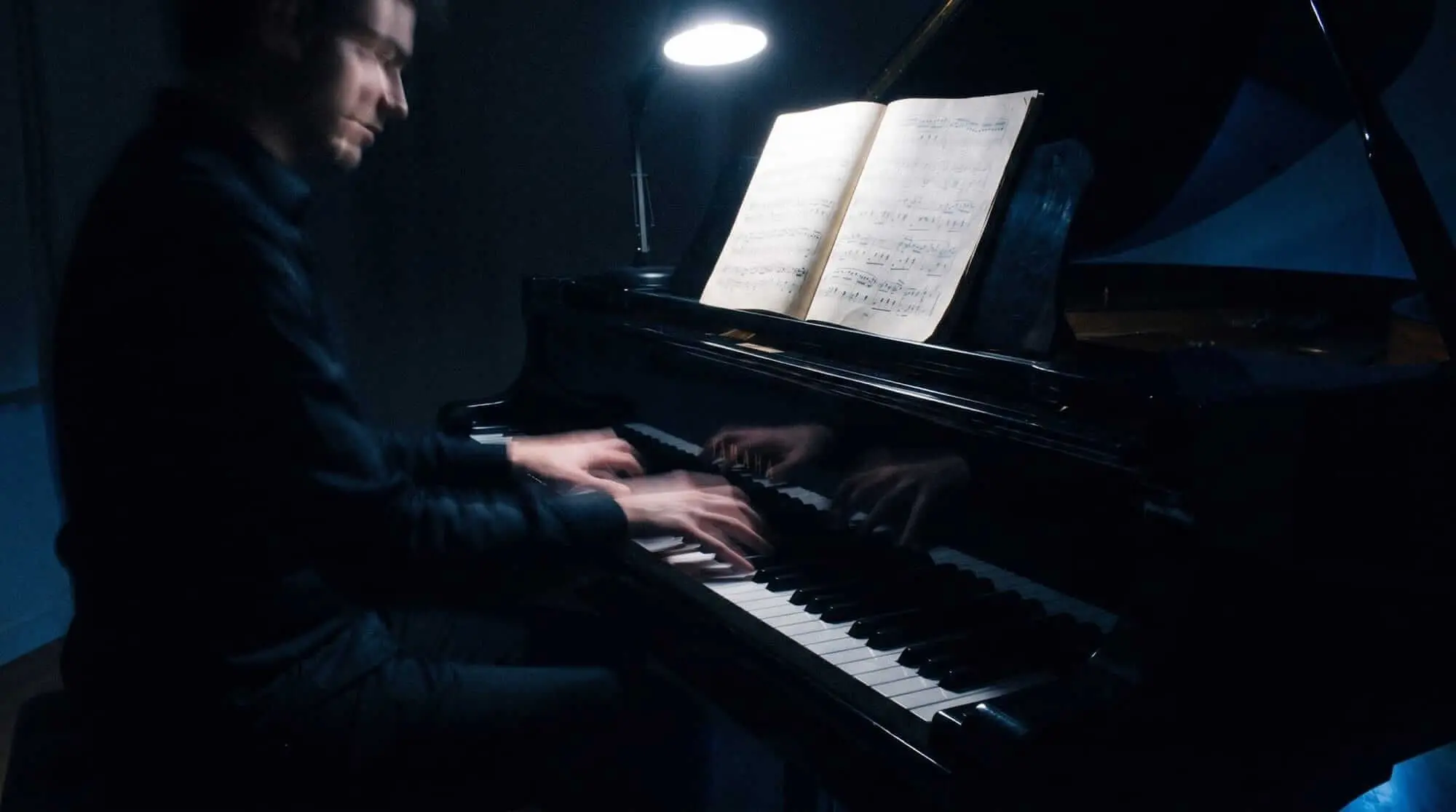
For pianists, syncopation demands absolute independence of the hands. The left hand must typically function as an unwavering metronome, maintaining a solid stride bass line, walking jazz bassline, or repeating ostinato pattern. Meanwhile, the right hand must be free to execute highly complex syncopated patterns.
To master this technique, pianists must practice dynamic modulation—the ability to control the volume levels of each hand independently. If the syncopated accents in the right hand are played with the exact same dynamic weight as the left hand's downbeats, the rhythmic tension will be lost, resulting in a muddy performance.
The offbeat accents must cut through the mix with clean articulation, while the left-hand downbeats provide a steady, supportive foundation underneath.
Guitar Techniques: Muted Strumming and Offbeat Articulation
On the guitar, syncopation is primarily executed through precise control of the picking hand and the strategic integration of muted strums. In genres like funk and reggae, guitarists use a continuous, rhythmic scratching motion with their picking hand, moving it up and down in a steady sixteenth-note pattern.
To create a syncopated line, the guitarist relaxes the fretting hand's pressure on the neck during strong beats, producing a percussive, muted click. They then clamp down on the frets with full pressure only on specific offbeats, allowing the chord to ring out with sharp articulation.
This technique ensures that the physical motion of the strumming hand remains constant, while the resulting sound waves are highly syncopated and dynamic.
Percussive Execution: Polyrhythms and Linear Drumming
For drummers, syncopation is built directly into their physical choreography. Advanced percussionists use linear drumming techniques, where no two limbs strike an instrument at the exact same moment. This approach allows them to weave intricate syncopated patterns across the snare, hi-hat, and ride cymbals, creating a complex web of sound.
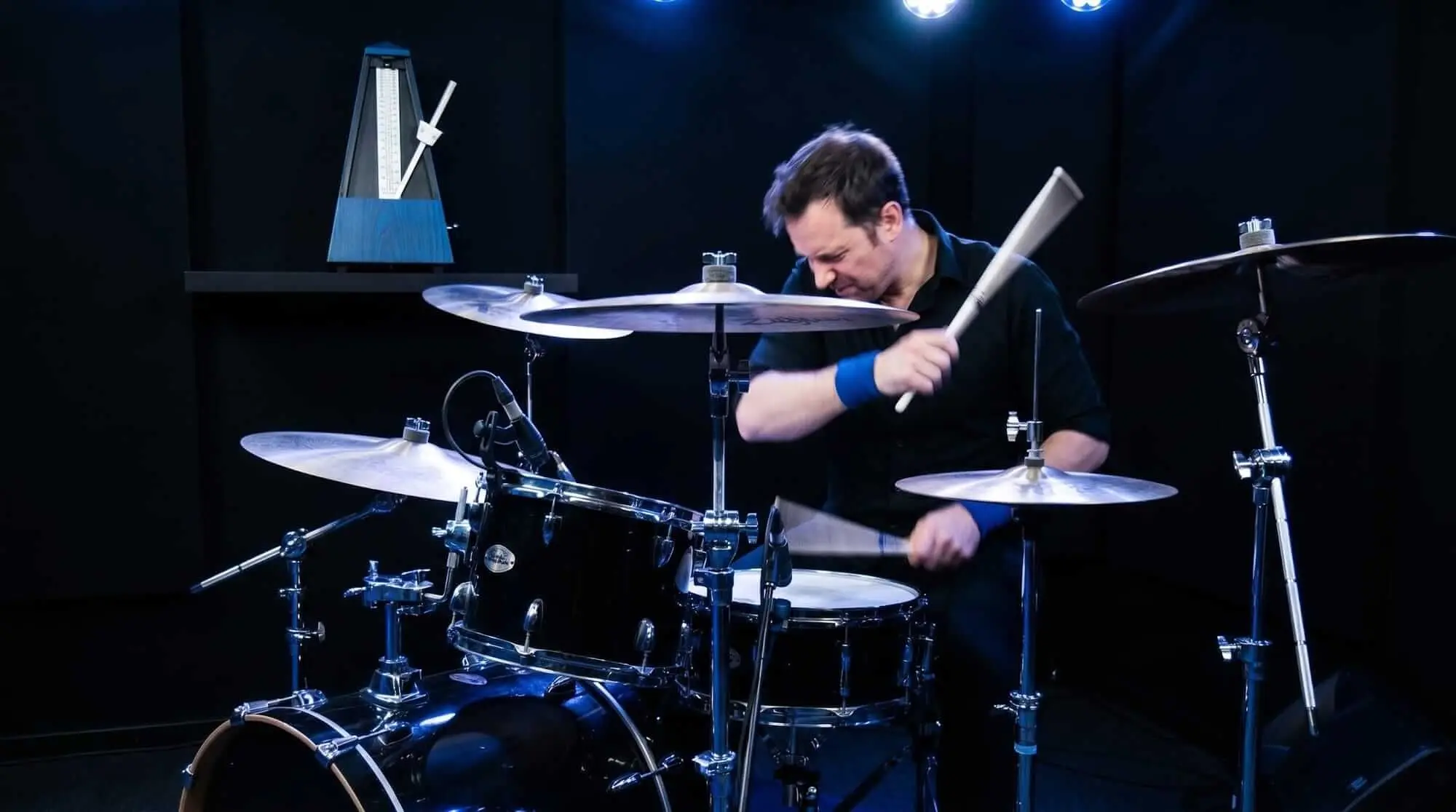
Furthermore, drummers frequently utilize ghost notes—low-volume snare hits placed on the sixteenth-note subdivisions surrounding the primary backbeat. These ghost notes add a bubbling texture underneath the main rhythm, accentuating the offbeats and transforming a standard rock beat into a highly sophisticated, syncopated groove.
Core Fundamentals: Building Blocks of Rhythmic Literacy
To fully master syncopation, a musician must ground themselves in the foundational elements of music theory that govern timing, counting, and structural organization.
Systematic Methods: How to Count Rhythms and Subdivisions
To master a syncopated passage, a musician should vocalize this entire chain of subdivisions at a slow tempo while clapping only the notes of the syncopated pattern. This practice builds an exact internal map of where each note sits relative to the pulse, eliminating guesswork and ensuring precise rhythmic delivery.
Understanding Intervals in Music Theory
While rhythm dictates the timing of musical events, intervals determine their harmonic relationship. An interval is the measurement of distance in pitch between two notes. Understanding intervals is essential for syncopation because the emotional impact of an offbeat accent is magnified by the harmonic tension of the note being played.
For example, if a syncopated note anticipating a chord change is a perfect fifth or an octave above the bass note, the transition feels relatively smooth and stable. However, if the syncopated note is a sharp eleventh or a minor seventh, the rhythmic surprise is compounded by a striking harmonic tension.
By masterfully pairing rhythmic syncopation with bold harmonic intervals, a composer can craft deeply engaging musical moments.
Implementing Syncopation Across Workflows
The practical application of syncopation varies significantly depending on your role within the creative ecosystem. The table below functions as a professional application sheet, providing targeted strategies for different types of creators.
| Creator Type | Primary Workflow Environment | Targeted Syncopation Strategy | Expected Production Outcome |
|---|---|---|---|
| Electronic Music Producer | Digital Audio Workstation (DAW) / MIDI Grid | Shift percussion hits, such as snares and hi-hats, 1-2 ticks off the grid; slice audio loops to emphasize offbeats. | Humanized swing, unique grooves, and dance-floor ready drive. |
| Film & Media Composer | Orchestral Score / Notation Software | Use tied notes across bar lines and sudden dynamic changes on weak subdivisions. | Heightened dramatic tension, suspense, and unexpected narrative energy. |
| Session Musician | Live Performance / Studio Recording | Maintain a rock-solid internal pulse while feathering ghost notes and accenting unexpected syncopated notes. | A deep, locked-in pocket that elevates the lead melody and locks with the rhythm section. |
Rhythmic Complexity in Modern Composition
As music production continues to evolve alongside technology, the way we approach syncopation is changing rapidly. The hyper-quantized grids of early digital production are increasingly giving way to humanized micro-timing models. Modern subgenres—such as math rock, complex polyrhythmic metal, and experimental electronic music—are pushing the boundaries of what the human ear can process.
We are seeing a rise in hyper-syncopation, where generative algorithms and advanced MIDI tools allow creators to modulate rhythmic accents in real time during live performances. By combining microtonal pitch variations with deep sixteenth-note syncopation, tomorrow's musicians are designing grooves that feel fluid and alive, breaking entirely free from traditional constraints.
No matter how advanced our production tools become, the core principle remains unchanged: subverting expectations through syncopation is one of our most powerful tools for capturing attention and creating timeless music.
Frequently Asked Questions (FAQ)
What is the difference between syncopation and polyrhythm?
Syncopation involves shifting accents to weak beats or offbeats within a single, established meter. Polyrhythm is the simultaneous performance of two or more conflicting meters (such as playing three beats over a four-beat pattern) across different layers of an arrangement. Syncopation alters the existing grid, whereas polyrhythm superimposes two different grids over one another.
Can syncopation be used in any time signature?
Yes. While it is most frequently discussed in 4/4 time due to its prevalence in popular music, syncopation can be applied to any meter, including odd signatures like 5/4, 7/8, or 11/4. The underlying mechanism remains identical: identify the strong metric pillars of that specific signature and shift the performance accents away from them.
How does syncopation affect the perceived tempo of a song?
Syncopation does not alter the actual mathematical tempo (Beats Per Minute) of a piece. However, it significantly changes the perceived tempo. Anticipated syncopations, where notes arrive a fraction of a second early, often give the music a rushed, high-energy forward momentum. Conversely, delayed syncopations can make a track feel relaxed, heavy, and laid-back.
Why does syncopation make people want to dance?
The human brain naturally craves patterns and predictability. When syncopation introduces rhythmic tension by omitting an expected downbeat, it creates an immediate physical desire for resolution. The body responds to this tension by moving—clapping, nodding, or dancing—physically stepping into the empty spaces left by the offbeat rhythms to bridge the gap until the next downbeat arrives.
What is the most effective way to practice syncopation on any instrument?
The most reliable method is to practice slowly with a metronome set to click on every eighth-note or sixteenth-note subdivision, rather than just the primary quarter-note downbeats. By slowing down the tempo and locking your phrases directly to these micro-subdivisions, you build the muscle memory and mental clarity required to execute complex syncopated lines flawlessly at full speed.