

Key Takeaways
- Vocal harmonies are built on intervals, chord tones, and emotional context, so understanding thirds, fifths, sixths, and sevenths helps producers choose parts that actually support the song.
- A strong background vocal arrangement is more than one extra vocal take. It can include doubles, high and low harmonies, vocal pads, choir layers, and carefully placed supporting parts around the lead.
- ACE Studio can help producers test and refine harmony ideas with MIDI, lyrics, AI voices, AI Choir, vocal doubles, and AI Instruments before committing to a final vocal stack.
- Clean editing is essential before mixing. Timing alignment, pitch correction, vowel matching, de-essing, and breath control all help stacked vocals sound tight instead of messy.
- Mixing harmonies is about support, not competition. EQ, compression, panning, subtle gating, saturation, and dynamic resonance control help background vocals feel wide, polished, and clear without overpowering the lead.
Why vocal harmonies shape the emotional power of a song
The human voice remains the most evocative instrument in the musical arsenal. While a solo melody can convey a message, the strategic application of vocal harmonies transforms that message into an immersive emotional experience. This guide serves as a definitive resource for producers, engineers, and vocalists seeking to master the complexities of vocal arrangement and the technical nuances of modern mixing.
The fundamentals of vocal harmony techniques for beginners
Before diving into the technicalities of a DAW, a foundational understanding of music theory as it applies to the human voice is essential.
Understanding intervals and tonal harmony
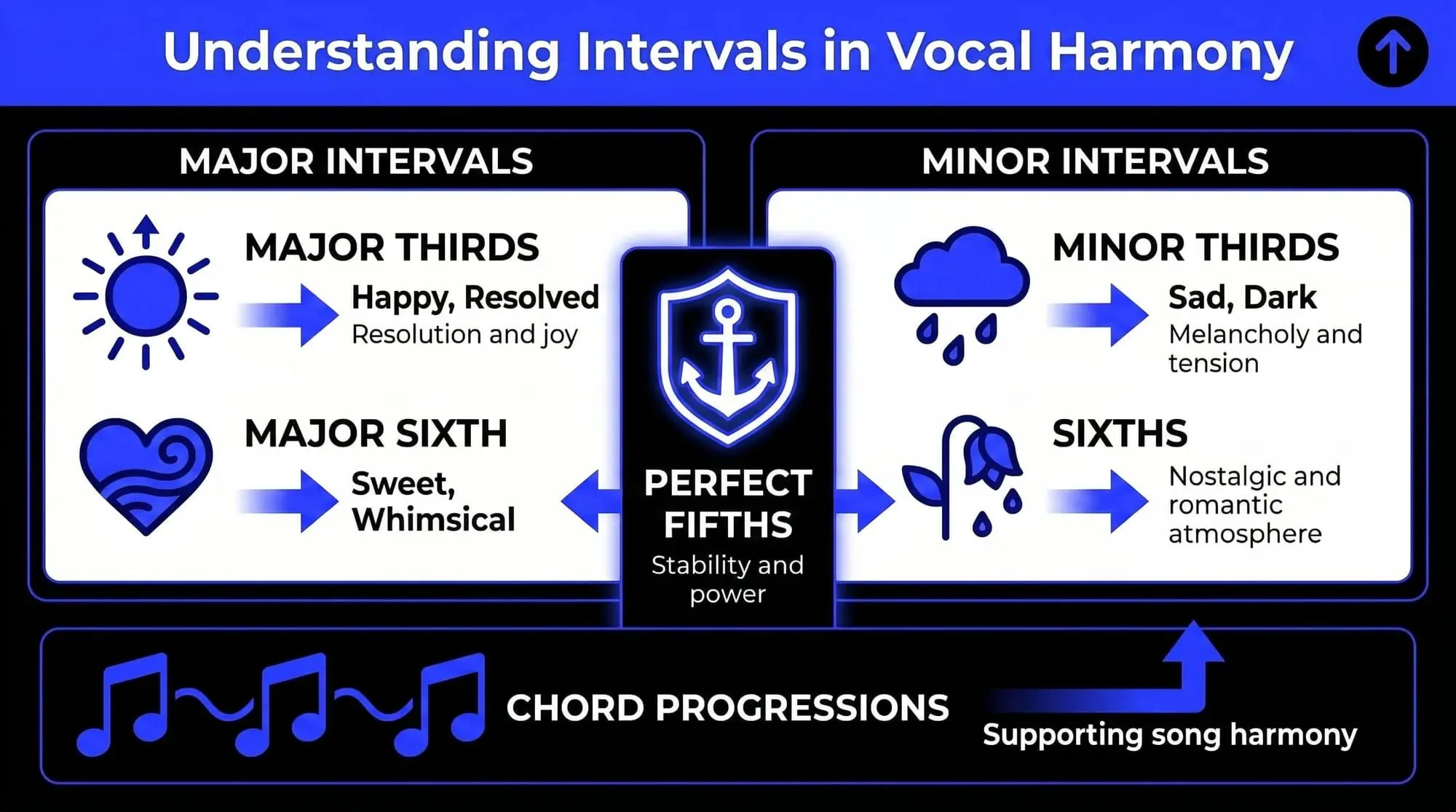
The core of any harmony is the interval—the distance between two notes. In most contemporary music, the following intervals are utilized to create specific emotional responses:
- Major thirds: Provide a sense of resolution, brightness, and joy.
- Minor thirds: Convey melancholy, tension, or introspection.
- Perfect fifths: Offer stability and power, often used in choral foundations.
- Sixths: Create a sweet, nostalgic, or romantic atmosphere.
Chord progressions in vocals
When arranging harmonies, it is critical to move the voices in a way that supports the underlying harmony of the song. This often involves pitch matching the vocal lines to the chords played by the instruments. For example, if the backing track is playing a C Major chord (C-E-G), the harmony voices should ideally occupy the E and G notes if the lead is on C.
The anatomy of a background vocal arrangement
A professional background vocal arrangement is rarely a single track of someone singing along. It is a structured hierarchy of parts designed to support the lead.

The lead vocal (the anchor)
The lead vocal is the centerpiece. Every other voice must be edited and mixed to ensure the lead remains the focal point of the listener's attention.
Vocal doubling
Doubling involves recording the same melody twice. This creates a natural chorus effect due to the micro-variations in pitch and timing between takes. Doubling adds thickness and presence without necessarily adding harmony.
High and low harmonies
- High harmony: Often a third or a fifth above the lead. This adds energy and air to the arrangement.
- Low harmony: Typically a third or a fifth below the lead. This adds weight and "chest" to the vocal stack.
Vocal pads and oohs/aahs
In many arrangements, background vocals act more like a synthesizer or an organ. These vocal pads consist of long, sustained notes that fill the frequency spectrum and provide a bed of sound for the lead to sit on.
Advanced vocal harmony production tips
Once the basics are mastered, professional production requires a deeper dive into the mechanics of vocal blending and musical layering.
Parallel vs. contrary motion
In counterpoint, voices can move in the same direction (parallel) or opposite directions (contrary). Parallel thirds are a staple of pop music, but contrary motion can create a more sophisticated and interesting arrangement that prevents the listener's ear from becoming fatigued.
The role of timbre in blending
Successful vocal blending is not just about pitch; it is about the texture of the voices. If you are layering a bright, nasal voice with a dark, breathy voice, they may struggle to occupy the same space. Producers often ask singers to modify their vowel shapes—a technique known as vowel matching—to ensure the stack sounds like a single unit rather than a collection of individuals.
Songwriting collaboration and harmony
When engaging in songwriting collaboration, it is beneficial to map out harmonies during the writing phase. This ensures that the melody leaves enough "frequency real estate" for the harmony parts to exist without clashing with guitars or keyboards.
Building vocal harmonies with ACE Studio
Vocal harmonies work best when the producer can hear, test, and refine the parts before committing to a final stack. That is where ACE Studio becomes especially useful. Instead of guessing how a third-above harmony, low fifth, doubled lead, or soft “ooh” pad might sound, you can write the part as MIDI, add lyrics, choose a singer, and shape the performance until the harmony supports the song properly.
Hear harmony ideas before you record them
ACE Studio gives producers a practical way to build harmony parts that are musical from the start. You can create a lead vocal from MIDI and lyrics, then duplicate or rewrite parts into high harmonies, low harmonies, doubles, choir layers, or sustained background pads.
Because the notes remain editable, you can adjust pitch, timing, phonemes, lyrics, vibrato, breaths, and vocal control parameters instead of being locked into a recorded take. This makes it easier to test whether a harmony actually supports the chord progression, lifts the chorus, or adds too much weight before you move deeper into production.
Shape doubles, high harmonies, and low harmonies with more control
This is especially helpful during arrangement. If a chorus feels thin, you can test a high third above the lead. If the hook needs more weight, you can add a low harmony or a doubled voice. If the bridge needs width, you can create vocal doubles with small timing and duration variations rather than simply duplicating the same audio, which helps avoid phase problems.
ACE Studio includes a dedicated doubles feature that can introduce humanized differences in note timing, consonant length, and pitch behavior. That matters because strong vocal harmonies are not only about the right notes. They need phrasing, movement, and slight variation to feel alive.
Build choir layers and vocal pads without losing detail
ACE Studio also gives you strong options for choral textures. With AI Choir, you can assemble multiple AI voices, adjust the width of the choir sound, control individual member gain, add room effects, and save custom choir presets for later use.
This makes it useful for pop background stacks, gospel-style support, cinematic choir pads, opera-inspired layers, or subtle group vocals behind a lead line. You can build a wide vocal bed while still controlling the notes, timing, and tone of the arrangement.
Choose the right vocal tone for the harmony stack
The bigger advantage is control. You decide which notes support the chord. You decide whether the harmony should feel bright, dark, intimate, wide, soft, breathy, or powerful.
You can use Voice Blending to create a hybrid vocal tone, switch singers when the timbre is not sitting correctly, or refine the phrase until the consonants, vowels, and emotional shape sit naturally around the lead. This helps prevent one of the most common harmony problems: parts that are technically correct but do not blend with the song.
Use ACE Studio beyond vocal harmonies
ACE Studio is not limited to vocal production. In ACE Studio 2.0, the platform has expanded into a fuller AI music generator with new AI voices, AI instruments, generative kits, a redesigned Canvas, and faster rendering tools.
The vocal model supports more than 140 AI voices across eight languages, while the AI instrument model adds expressive instruments such as violins, violas, cellos, saxophones, trumpets, and duduk.
For a full arrangement, those instruments can support the same harmonic movement as the vocal stack. A string line can reinforce the backing vocals. A saxophone or trumpet part can answer the vocal phrase. A cello layer can add weight under a low harmony. Because these parts are MIDI-driven, they remain editable as the song develops.
Practical ways to use ACE Studio for vocal harmony production
Practical uses for ACE Studio in vocal harmony production include:
- Creating high and low harmony parts from MIDI and lyrics
- Testing alternate harmony notes before recording a singer
- Building doubled vocals with natural timing variation
- Creating pop, gospel, cinematic, or opera-style choir layers
- Turning a rough vocal recording into editable MIDI and lyrics
- Using Stem Splitter to isolate a vocal before rebuilding or reshaping it
- Creating vocal pads, “oohs,” and “aahs” for atmosphere
- Using AI Instruments to support the same harmonic movement as the vocal stack
- Auditioning different singers or blended voices to find the right tonal balance
- Refining pitch curves, breaths, phonemes, vibrato, and expression after the harmony is written
For producers who care about arrangement details, this matters. A harmony is not only a note above the melody. It is phrasing, timing, vowel shape, tone, width, and emotional pressure. ACE Studio gives you direct access to those decisions, so the final vocal stack can feel intentional rather than patched together. The human still writes, edits, chooses, and shapes the performance. ACE Studio gives those decisions a clear musical form.
Precision editing: Preparing background vocals for the mix
Before a single plugin is touched, the audio must be pristine. Editing background vocals is a labor-intensive but non-negotiable step in modern production.
Timing alignment and flex time
The most common mistake in vocal layering is loose timing. If the "s" or "t" consonants of three different singers do not hit at the exact same millisecond, the mix will sound cluttered.
- Use tools like VocALign or manual Flex Time editing to snap the background vocals to the timing of the lead.
- Focus specifically on the starts and ends of words.
Pitch correction as a creative tool
While the lead vocal often benefits from a natural feel, background harmonies can be tuned more aggressively.
- Tonal harmony is reinforced when the background stack is perfectly in tune.
- Use Melodyne or Auto-tune on a high-retune speed for harmonies to create a locked-in sound that mimics a synthesizer.
De-essing for clarity
Sibilance is cumulative. If you have six layers of vocals all pronouncing the letter "S," the result is a piercing, distracting sound.
- De-ess heavily on background vocals.
- In extreme cases, manually clip-gain the sibilant parts down or remove them entirely from the harmony tracks, leaving only the lead vocal to provide the "S" sound.
Mastering the mix: Essential techniques for vocal harmonies
Mixing harmonies requires a different philosophy than mixing a lead vocal. The goal is cohesion and support.
Utilizing a gate with a 6-10dB range
Rather than using a gate to completely silence the audio, use it to attenuate the in-between moments by 6-10dB. This keeps the noise floor low and ensures the background vocals bloom only when they are supposed to be active, without the jarring effect of a hard gate.
Frequency management: EQ strategies
- High pass filtering: Harmonies rarely need information below 200Hz. Cutting the fundamental frequency of the double or harmony allows the lead vocal's low-end warmth to remain clear.
- The "Air" boost: A subtle high-shelf boost above 10kHz on the harmony bus can add a professional shimmer.
- Mid-side EQ: Use M/S EQ to remove the center information from the harmony bus. This carves out a physical space for the lead vocal to sit in the middle of the stereo field.
Significant compression
To make a vocal stack feel like a single instrument, you must use them together.
- Apply significant compression to the background vocal bus.
- A ratio of 4:1 or even 8:1 with a slow attack and fast release can help the harmonies sit firmly in place, regardless of how dynamic the singer was during the recording.
Advanced processing: Spatialization, saturation, and depth
Once the harmonies are balanced and tuned, spatial and harmonic effects add the final layer of polish.
Strategic panning techniques
The stereo field is your canvas.
- Symmetrical panning: Placing a high harmony 50% Left and another take 50% Right. This creates a wide, cinematic feel.
- Asymmetrical panning: Positioning a low harmony 30% Left and a mid harmony 60% Right. This is often used in indie or folk music to create a more natural and interesting soundscape.
Using stereo sample delay
A powerful technique for widening vocal arrangements is the use of a Stereo Sample Delay. By delaying the left or right side of a vocal track by a mere 10 to 30 milliseconds, you create the Haas Effect. This makes the vocal feel extremely wide without the phase issues often associated with chorus plugins.
Collectively saturate on the bus
Applying a small amount of saturation to the harmony bus can harmonize the overtones of the different voices.
- Saturation adds grit and warmth.
- It helps the background vocals feel like they were recorded through the same vintage hardware, further aiding the glue effect.
Use a dynamic resonance suppressor
If the harmonies are still masking the lead, use a dynamic resonance suppressor like Soothe 2. Place it on the harmony bus and set the sidechain input to the lead vocal. This will cause the harmonies to automatically dip in specific frequencies only when the lead vocal is fighting for that same space.

Common mistakes in vocal harmonies and how to avoid them
Even with the best tools, certain errors can ruin a professional production.
- Overpowering the lead: The most common mistake is simply having the harmonies too loud. They should be felt more than they are heard in a standard pop mix.
- Ignoring phrasing: If the lead singer breathes at a certain point, the harmony singers should ideally breathe at the same time, or the breaths should be edited out of the harmony tracks entirely.
- Clashing formants: When shifting the pitch of a vocal (artificially creating a harmony), the "formant" (the character of the throat/mouth) often shifts as well, leading to the "chipmunk" or "ogre" effect. Always use formant-corrected pitch shifting.
- Excessive reverb: Putting the same amount of reverb on harmonies as the lead can create a wash of noise. Usually, harmonies benefit from a slightly "drier" sound or a different, shorter reverb to push them back in the mix.
Frequently Asked Questions
What is the most effective way to identify the correct harmony notes for a melody?
The most reliable method for identifying harmonies involves understanding the chord progressions active in the song. A vocal harmony is essentially an extension of the underlying chord.
For a basic arrangement, identifying the third and fifth intervals of the current chord is the standard approach. If the lead vocal is singing the tonic (the root note), the most common harmony is a major or minor third above it. In terms of frequency physics, a perfect fifth maintains a frequency ratio of 3:2, while a major third is approximately 5:4. Utilizing these mathematical relationships ensures that the voices vibrate in a way that feels naturally resonant to the human ear.
How do I prevent background vocals from clashing with the lead?
Collision in a mix usually occurs in two areas: frequency and time.
Frequency: Use a high-pass filter to remove the fundamental frequencies of the harmony tracks (typically everything below 200Hz to 400Hz). This leaves the "weight" of the vocal performance to the lead.
Time: Ensure that consonants—specifically plosives and sibilants—are perfectly aligned. If the lead singer ends a word with a sharp t, the harmony voices must end at the exact same moment. Even a discrepancy of 10 milliseconds can create a "flamming" effect that distracts the listener.
Should I use a gate on my harmony tracks?
Yes, but the application must be subtle. Using a gate with a 6-10dB range is often more effective than a "hard gate" that cuts to silence. This technique, known as expansion, reduces the level of the track during the silences between phrases without creating an unnatural vacuum. This preserves the room tone and the natural decay of the singer’s breath while ensuring that headphone bleed or background noise does not accumulate as you stack dozens of vocal layers.
Is there a limit to how many vocal layers I should use?
The number of layers is dictated by the genre and the desired "size" of the vocal.
Folk and Americana: Often rely on 2 or 3 distinct voices to maintain an intimate, human feel.
Modern Pop and R&B: Frequently utilize stacks of 12 to 30 tracks. This includes triples of the lead, doubles of every harmony part, and specialized "whisper" tracks to add high-end texture. The risk of excessive layering is a loss of detail; the more voices you add, the more the stack begins to sound like a synthesizer rather than a human choir.