
Key takeaways
- Delay is a time-based audio effect that repeats a sound after a set interval, helping producers add space, depth, movement, or rhythmic energy without relying only on reverb.
- The main delay controls are delay time, feedback, mix, and filtering, and learning how they interact is essential for creating clean, musical echoes that support the track instead of cluttering it.
- Different delay types serve different creative goals: tape delay adds vintage warmth, analog delay creates darker texture, digital delay offers precision, slapback thickens vocals, and ping-pong delay expands the stereo field.
- Delay is especially useful on vocals, guitars, drums, synths, transitions, and ambient textures, but it works best when synced to the song’s tempo and filtered to avoid muddy low-end buildup.
- ACE Studio can support delay-based production by helping producers create, isolate, reshape, and test vocal, choir, or AI instrument parts before applying delay in a DAW, making echoes feel more intentional and musical.
The simple idea behind delay in music
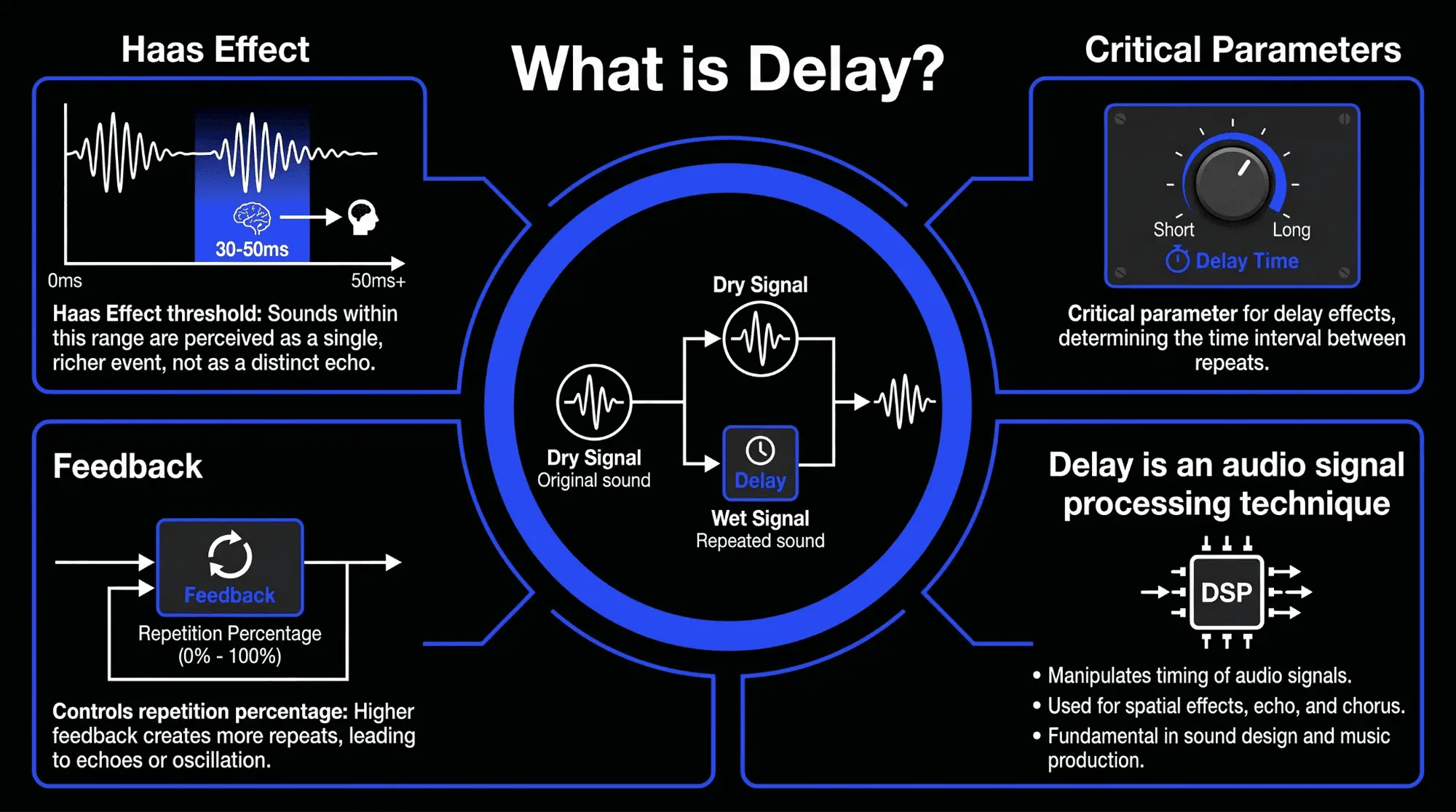
At its core, delay is an audio signal processing technique that records an input signal and plays it back after a specific period. The original sound is referred to as the dry signal, while the repeated sound is known as the wet signal. When these two signals are blended, the listener perceives a sense of space, depth, or rhythmic complexity.
In practical terms, delay works by making a sound answer itself. A vocal line can repeat softly after the singer finishes a phrase, a guitar note can bounce in time with the rhythm, or a synth melody can spread across the stereo field. The effect can be subtle, adding only a small sense of width and thickness, or it can become a major part of the arrangement by creating clear echoes that interact with the groove.
This is why delay is one of the most flexible tools in music production. It can make a dry recording feel more spacious, help fill empty moments between phrases, add movement to a static part, or turn a simple musical idea into something more rhythmic and expressive. Instead of only changing the tone of a sound, delay changes how that sound behaves over time.
The temporal mechanics of delay
The perception of delay is governed by how the human brain processes sound reflections. If a repetition occurs within approximately 30 to 50 milliseconds of the original sound, the brain integrates them into a single auditory event. This is known as the Haas Effect or the Precedence Effect. When the delay exceeds this threshold, the repetition is perceived as a distinct echo.
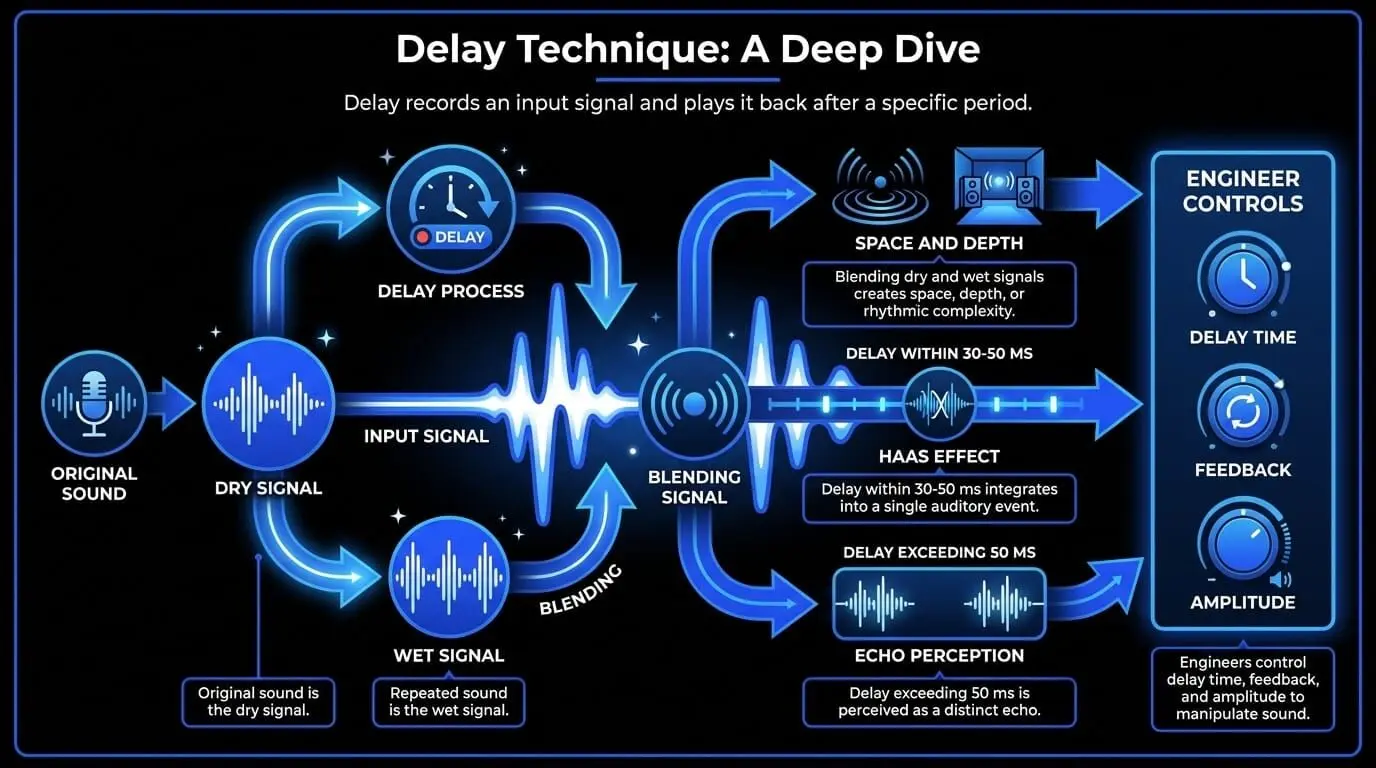
In music production, delay is used to manipulate these temporal perceptions. By controlling the delay time, feedback, and amplitude, engineers can simulate physical environments or create entirely synthetic rhythmic structures that would be impossible to achieve through performance alone.
The historical evolution of delay technology
The history of delay is a chronicle of engineers repurposing limitations into artistic strengths. To understand modern digital audio workstations (DAWs) and AI-driven effects, one must first understand the mechanical precursors.
The tape era: accidental innovation
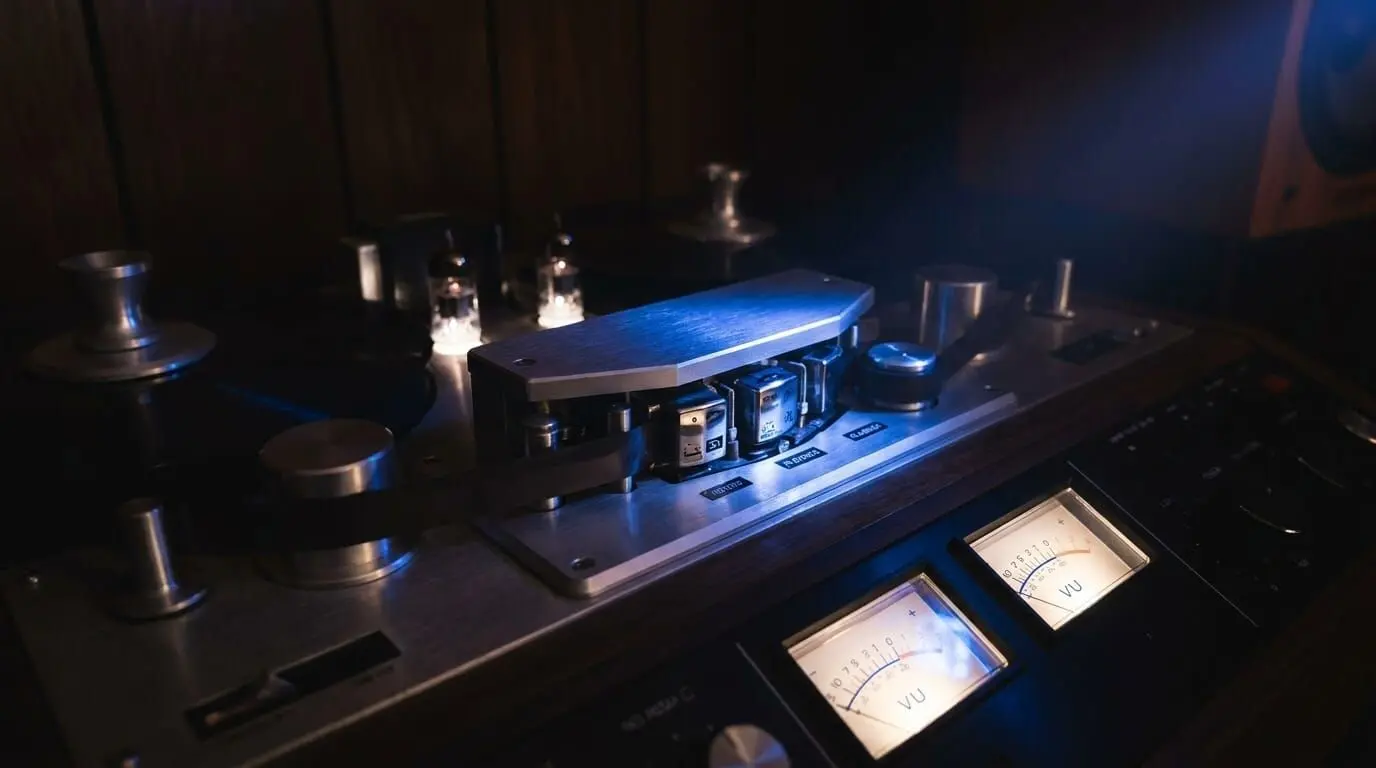
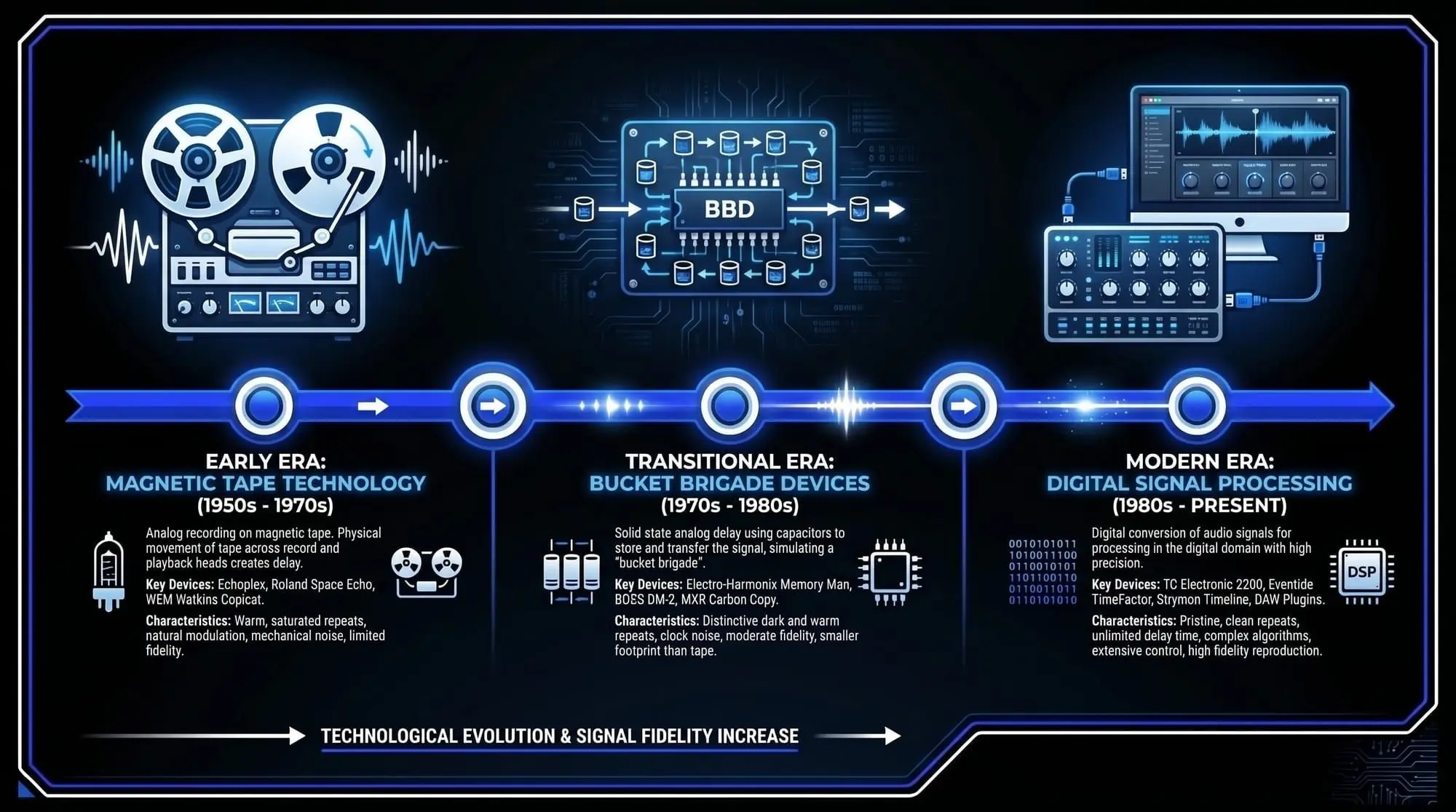
The earliest forms of delay were achieved using magnetic tape recorders. In the late 1940s and 1950s, producers discovered that by using a machine with separate record and playback heads, they could create a repetition. The distance between the heads and the speed of the tape determined the delay time.
- The Slapback Echo: This became the signature sound of Sun Studio and early Elvis Presley recordings.
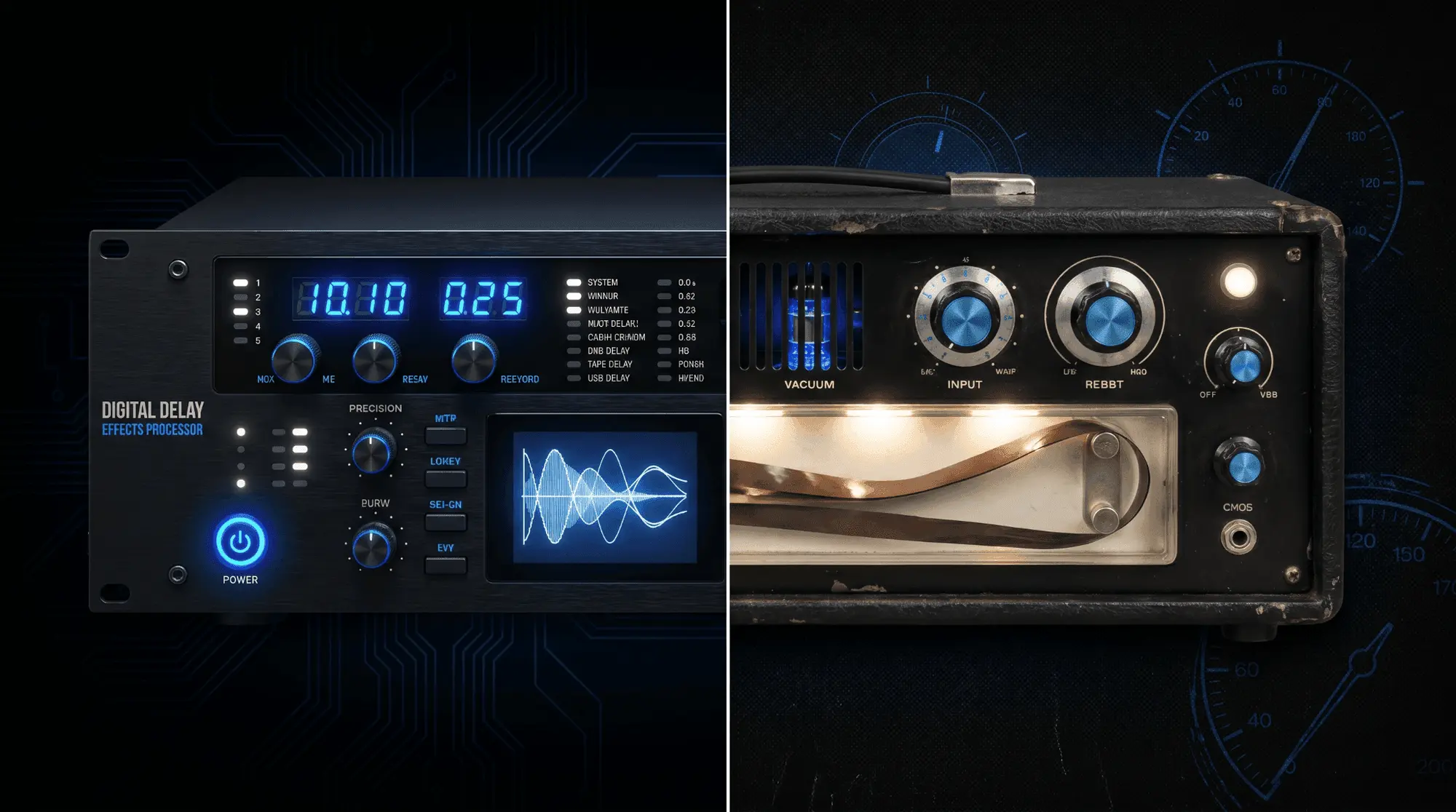
- The Echoplex and Roland RE-201 Space Echo: These dedicated hardware units used loops of tape to provide adjustable delay times and became staples for guitarists and dub producers.
The analog revolution: bucket brigade devices (bbd)
In the 1970s, the invention of the Bucket Brigade Device allowed for delay effects without moving parts. These integrated circuits passed the audio signal through a series of capacitors, much like a line of people passing buckets of water.
- Signal Degradation: Each stage of the BBD caused a slight loss of high-frequency information, resulting in a warm, dark, and lo-fi sound that remains highly sought after today.
- Portability: This technology led to the creation of the first delay pedals for guitar, such as the Boss DM-2 and the Memory Man.
The digital frontier and the rise of precision
With the advent of digital audio processing in the 1980s, delay became infinitely more flexible. Digital delay units convert the audio into binary data, store it in RAM, and play it back with perfect fidelity. This removed the inherent noise and frequency loss of tape and BBD systems, allowing for crisp, rhythmic repeats and ultra-long delay times.
Core parameters: the anatomy of a delay effect
To master how to use delay in music, one must understand the standard controls found on almost every delay plugin or hardware unit.
Delay time
This is the most critical parameter. It determines the duration between the original signal and its repetition.
- Milliseconds (ms): Used for fixed delays, often for thickening vocals or creating a Haas effect.
- Tempo sync: In modern music production, delay time is often synced to the project's BPM (Beats Per Minute). This allows for rhythmic subdivisions such as eighth notes, dotted eighths, or triplets.
Feedback (regeneration)
Feedback controls the percentage of the delayed signal that is fed back into the input.
- Low feedback: Produces a single repetition (ideal for slapback).
- High feedback: Produces multiple repeats that gradually fade away.
- Self-oscillation: At settings above 100%, the delay enters a feedback loop that creates a swelling, distorted wall of sound—a hallmark of psychedelic and experimental music.
Mix (wet/dry)
The mix knob determines the balance between the unprocessed input and the effect.
- Insert effect: Usually set between 10% and 50% so the original signal remains dominant.
- Send/return: Usually set to 100% wet, with the level controlled by the aux bus fader.
Filter and EQ
Most professional delay effects include a High-Pass Filter (HPF) and a Low-Pass Filter (LPF). Filtering the repeats prevents the delay from cluttering the mix, a technique known as the Abbey Road Delay Trick, where frequencies below 600Hz and above 3kHz are rolled off.
Types of delay in music
Different types of delay in music offer distinct sonic signatures. Selecting the right type is essential for achieving a specific genre aesthetic.
Digital delay: The standard for modern clarity
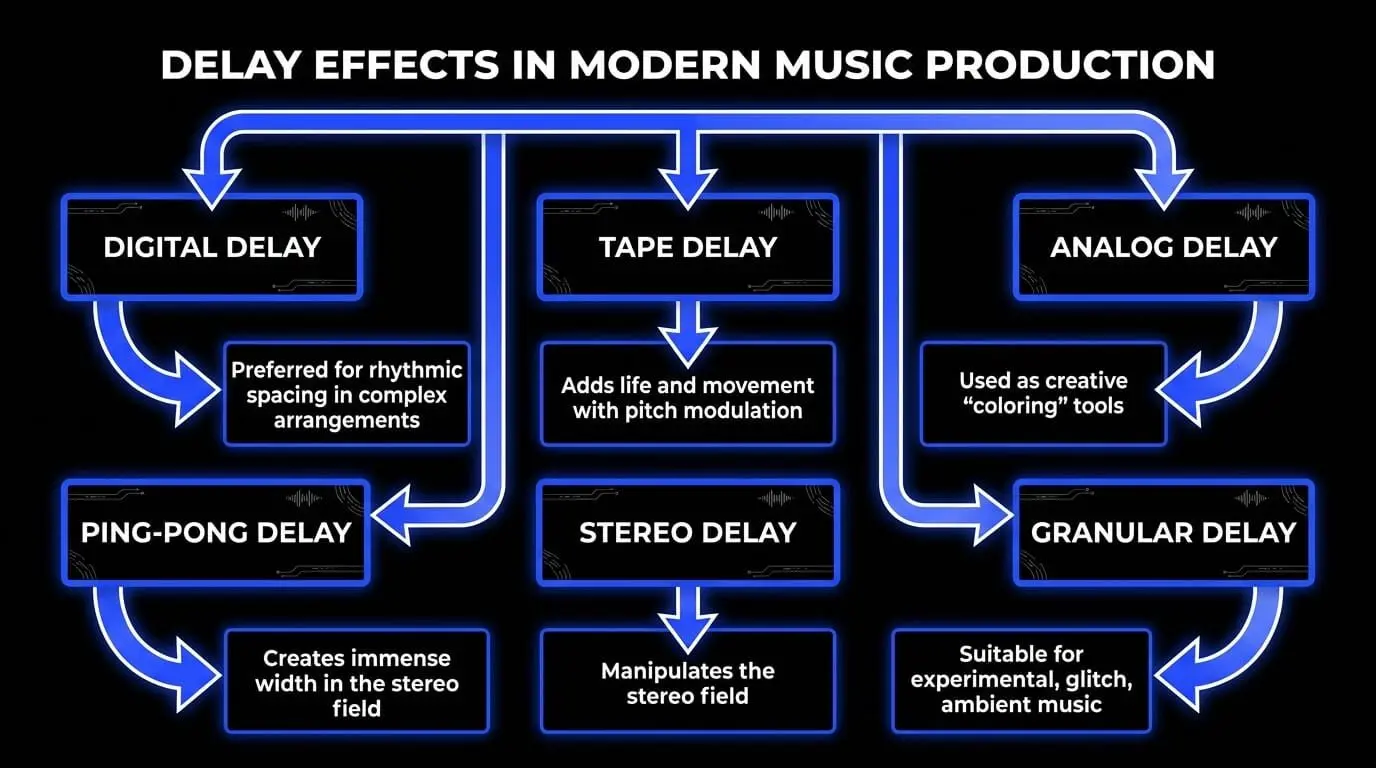
Digital delay provides the highest level of control. Because the repeats are mathematically perfect, they do not mask the original signal with harmonic distortion. This makes it the preferred choice for rhythmic spacing in complex arrangements where every millisecond counts.
Tape and analog delay: adding harmonic texture
While digital delay aims for transparency, tape delay and analog delay are used as creative "coloring" tools. The mechanical inconsistencies of tape—known as wow and flutter—introduce subtle pitch modulation. This creates a chorus-like effect that adds life and movement to static sounds.
Ping-pong and stereo delay
These effects manipulate the stereo field. By setting different delay times for the left and right channels, or by bouncing a single delay between them, producers can create immense width. This is a staple in electronic dance music (EDM) for making synthesizers feel larger than life.
Delay vs. echo vs. reverb: Clarifying the differences
In casual conversation, these terms are often used interchangeably, but in sound processing, they represent distinct concepts.
- Delay: A specific, time-based repetition of a signal. It is a discrete event.
- Echo: Technically a subset of delay, an echo is a repetition that occurs late enough for the human ear to perceive it as a distinct copy of the original sound, usually occurring in a large physical space.
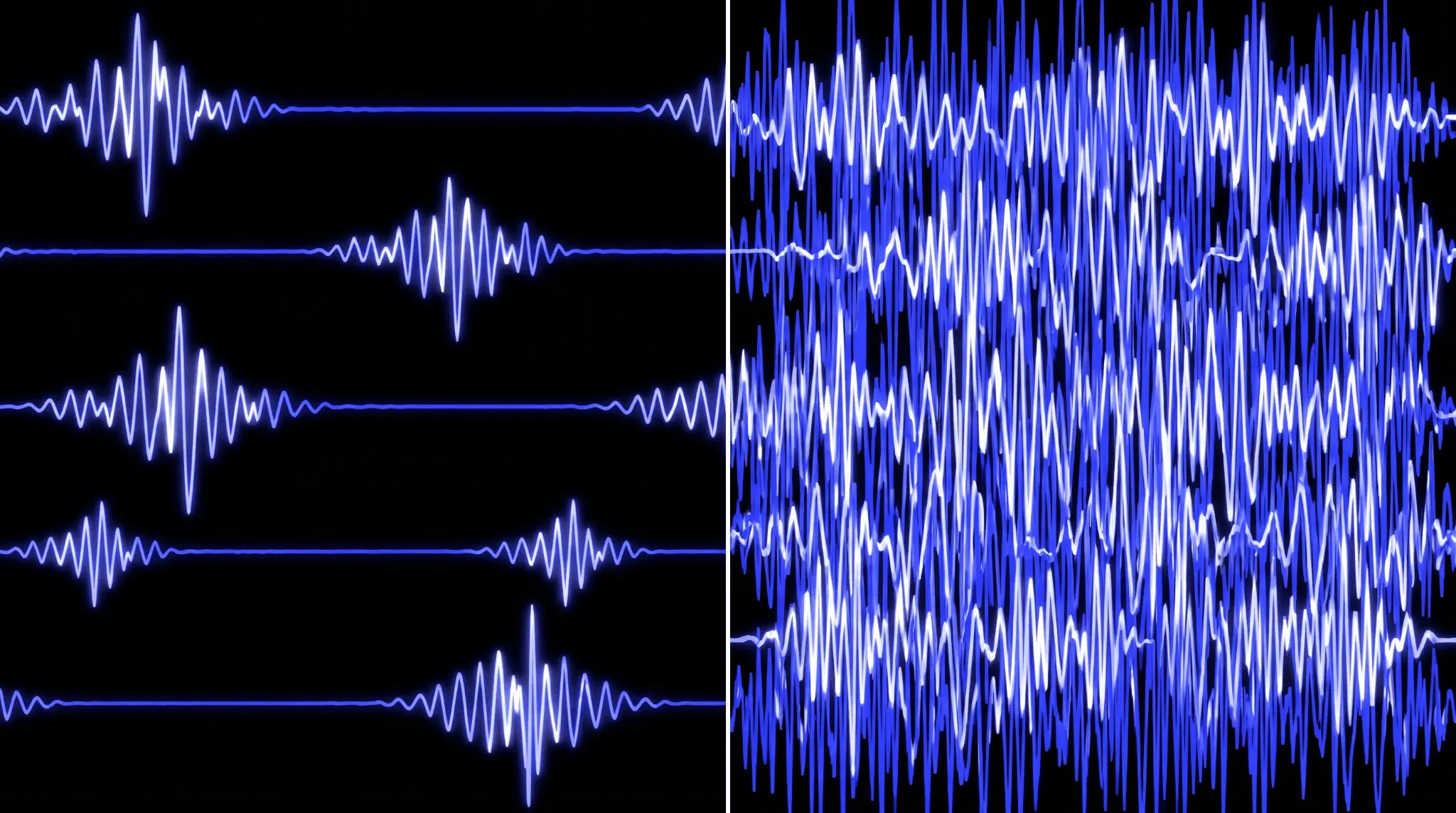
- Reverb: Reverb consists of thousands of overlapping delays (reflections) that are so close together they cannot be heard as individual repeats. Reverb creates a sense of a physical room, while delay creates a sense of rhythmic time.
Strategic applications in music production
Knowing what is delay in music is only half the battle; knowing where to apply it is what separates amateurs from professionals.
Vocal enhancement
Delay is often superior to reverb for vocals because it adds space without washing out the lyrics.
- Doubling: A very short delay (10-30ms) can simulate a double-tracked vocal, adding thickness and authority.
- Timed repeats: An eighth-note delay on a lead vocal can fill the "gaps" between phrases, maintaining energy during a performance.
- Throw delays: Using automation to send only the last word of a phrase to a long, feedback-heavy delay. This emphasizes key lyrical moments.
Guitars and the delay pedal
The delay pedal for guitar is perhaps the most famous application of the effect.
- Dotted eighth note delay: Popularized by The Edge (U2), this technique involves playing straight eighth notes while the delay repeats at a dotted eighth interval. This creates a cascading, driving rhythm that sounds much faster than the actual performance.
- Ambient swells: Using a high-feedback, long-time delay combined with a volume pedal to create violin-like textures.
Percussion and rhythmic interest
In genres like Dub and Techno, delay is treated as an instrument itself.
- Snare ghosting: Applying a synced delay to a snare drum to create complex, syncopated patterns.
- Hi-hat movement: A subtle ping-pong delay on hi-hats can add a sense of "air" and movement to a programmed drum loop.
Advanced delay techniques and sound design
For those looking to push the boundaries of delay audio processing, several innovative techniques can be employed.
Frequency shifting delay
By placing a frequency shifter in the feedback loop of a delay, each repeat is pitch-shifted slightly higher or lower. This creates an "ever-ascending" or "spiraling" effect, perfect for cinematic builds and transitions.
Ducked delay
A ducked delay uses a sidechain compressor to lower the volume of the delayed repeats whenever the dry signal is playing. This ensures that the delay doesn't interfere with the clarity of a lead vocal or instrument but rushes back in to fill the space during silences.
Multiband delay
This involves splitting the audio signal into different frequency bands (Lows, Mids, Highs) and applying different delay settings to each. For example, you might have a clean, short delay on the high frequencies of a synth but a long, distorted tape delay on the mid-range.
Phase and polarity manipulation
Inverting the polarity of one side of a stereo delay can create an "out of phase" sensation that makes the sound appear to come from outside the speakers. However, this must be used carefully to avoid phase cancellation when the mix is played in mono.
Using ACE Studio to create parts that respond well to delay
Delay becomes more creative when you test it on the right source material. ACE Studio gives producers more material to experiment with before committing to a final vocal, instrument, or texture. Instead of applying delay to whatever is already in the session, you can create, isolate, reshape, and test parts that are built to respond well to echoes.
One simple use case is vocal throw delay. In ACE Studio, you can create a lead vocal phrase with a strong final word, then leave enough space after the line for the repeat to answer naturally. This makes the delay feel like part of the performance rather than an effect added later. The same idea works for ad-libs, backing vocals, and short call-and-response phrases, especially when you want the delay to fill the gaps without cluttering the main vocal.
This AI music generator is also useful for building choir or harmony responses that leave room for delay. A stacked vocal section can sound crowded if every part keeps moving at the same time. By shaping shorter phrases, pauses, and sustained notes, you can create backing vocals that open up space for ping-pong delay, slapback, or longer ambient repeats. This is especially helpful in pop, cinematic music, EDM, and atmospheric productions where the space between phrases matters as much as the notes themselves.
For instrument-based delay, ACE Studio’s AI instruments give you more than just vocal material to process. You can create a short violin, cello, saxophone, trumpet, viola, or duduk motif, then use delay to turn it into a rhythmic pattern or atmospheric layer. A simple two-note phrase can become a pulsing echo. A sustained instrumental line can become a cinematic swell. A short melodic idea can become the foundation for a wider stereo texture when treated with ping-pong or tape-style delay.
Vocal to MIDI is another practical tool for delay-based production. If you sing a rough melody idea, ACE Studio can help turn that vocal idea into MIDI, giving you a way to reshape the rhythm, timing, or melody before applying delay. This is useful when the musical idea is strong but the original performance is not clean enough to use directly. You can keep the creative spark, refine the part, and then test how it works with eighth-note delays, dotted delays, or longer feedback trails.
Stem Splitter is useful when you already have audio and want to experiment without affecting the full mix. For example, you can isolate a vocal, instrument, or melodic layer, then test different delay treatments on that element alone. This makes it easier to hear whether a throw delay, ducked delay, slapback, or ambient wash actually improves the part before applying similar processing in the full production.
BPM Finder is especially practical when working with existing audio. Delay timing depends heavily on tempo, and an unsynced delay can quickly make a track feel messy. By identifying the BPM first, you can match delay times to the song’s pulse more confidently, whether you are using quarter-note, eighth-note, dotted, or triplet-based repeats.
ACE Studio can also help when designing transitions. A short AI instrument phrase, vocal chop, or harmony swell can be created specifically to lead into a chorus, drop, bridge, or outro. Once the phrase is in place, delay can extend its motion, making the transition feel wider and more dramatic without adding too many extra layers.
Used this way, ACE Studio is not just a place to generate vocals or instruments. It becomes a practical testing ground for delay ideas. You can create the phrase, shape the timing, isolate the part, check the tempo, and then decide which delay style actually supports the track. That gives the echo something stronger to work with, and in music production, the sound being repeated is just as important as the delay itself.
The impact of delay across genres
Delay is a stylistic chameleon, adapting its function to meet the needs of different musical cultures.
- Rock and Metal: Primarily used for lead guitar solos to provide a "stadium" feel and for slapback on vocals to emulate vintage production styles.
- Dub and Reggae: Delay is the foundation of the genre. Producers like King Tubby used delay as a primary compositional tool, constantly manipulating feedback levels to create infinite loops of sound.
- Electronic dance music (EDM): Used for tempo manipulation and building tension. The "riser" effect often relies on a delay time that gradually shortens, increasing the frequency of the repeats until it becomes a tonal buzz.
- Ambient and shoegaze: In these genres, delay is used to blur the lines between notes, creating a "wash" of sound where individual melodies merge into a single harmonic texture.
- Pop: Used for "polishing" the mix. Modern pop production uses highly synchronized delays to ensure every sound feels locked into the grid while still maintaining a sense of depth.
Common mistakes and how to avoid them
Even with the best types of delay in music, poor execution can ruin a mix.
- Overwhelming the low end: Putting long, high-feedback delays on bass-heavy instruments often leads to a "muddy" mix. Always use a high-pass filter on your delay returns.
- Ignoring the tempo: Unless you are going for a specific "avant-garde" feel, unsynced delays often clash with the rhythm of the track. Always double-check your millisecond-to-BPM calculations.
- Too much feedback: High feedback can quickly spiral out of control and mask the most important elements of your arrangement. Use automation to keep feedback levels dynamic.
- Static Delays: A delay that never changes can become fatiguing. Use subtle modulation or automation on the filter cutoff to keep the echoes evolving.
Conclusion: Delay as a creative tool for shaping time, space, and movement
Delay is much more than a simple echo. It is one of the most versatile tools in music production because it can change how a sound moves, how much space it occupies, and how it interacts with the rhythm of a track. From short Haas-style widening and slapback vocal thickness to tempo-synced repeats, ping-pong movement, ambient washes, and ducked delays that preserve clarity, delay gives producers a practical way to add depth without losing definition. The key is not just choosing a delay type, but understanding how delay time, feedback, mix level, filtering, and tempo sync work together inside the full arrangement.
Modern production also gives creators more control over the material they send into delay. With tools like ACE Studio, producers can shape vocal phrases, choir responses, AI instrument motifs, MIDI ideas, stems, and tempo references before applying delay in a DAW. That makes the effect feel more intentional, because the source part is already designed to leave room for echoes, rhythmic repeats, or spacious transitions. When used this way, delay becomes more than an effect added at the end. It becomes part of the composition, helping turn simple sounds into movement, atmosphere, and emotion.
Frequently Asked Questions about delay in music production
What is the difference between the dry signal and the wet signal?
In the context of audio processing, the dry signal refers to the original, unprocessed audio source. The wet signal is the output of the effect—in this case, the repeated echoes. The relationship between these two is critical for maintaining the clarity of the source while adding the desired depth. Most producers use a mix or blend control to determine the ratio. In a parallel processing setup, such as a send and return, the effect return is typically set to 100% wet to allow for independent control over the processed signal's volume and equalization.
How does the Haas Effect influence the perception of delay?
The Haas Effect, or the Precedence Effect, is a psychoacoustic phenomenon where the human brain integrates two sounds occurring within 30 to 50 milliseconds of each other as a single auditory event. Instead of hearing a distinct echo, the listener perceives an increase in width or spatial presence. If the delay exceeds this 50-millisecond threshold, the brain begins to process the repetition as a separate sound, creating a discernible echo. Mastering this threshold is essential for stereo widening and vocal thickening without introducing rhythmic clutter.
Why is tape delay still popular in the digital era?
Tape delay remains highly sought after because of its unique harmonic character. Unlike digital systems that strive for perfect reproduction, magnetic tape introduces mechanical inconsistencies known as wow and flutter. These produce subtle pitch modulations and high-frequency roll-offs that add organic warmth and a sense of nostalgia to a mix. In modern production, many digital plugins use complex modeling to emulate the saturation and degradation found in vintage units like the Roland RE-201 Space Echo.
What are Bucket Brigade Devices (BBD) in analog delay?
Bucket Brigade Devices are analog circuits that pass an audio signal through a series of capacitors. The name comes from the analogy of a line of people passing buckets of water. Because the signal loses a small amount of integrity at each stage, the repeats in an analog delay become progressively darker and more distorted. This natural filtering effect is ideal for creating "moody" textures that sit behind a dry signal rather than competing with it for the listener's attention.
What happens during delayed self-oscillation?
Self-oscillation occurs when the feedback parameter is set above 100%. In this state, the delayed signal is fed back into the input at a higher volume than the original, creating a recursive loop that increases in intensity. This results in a swelling, often distorted wall of sound. While dangerous if left unchecked, it is a staple technique in psychedelic rock and dub music for creating dramatic transitions and soundscapes.
How can ACE Studio help when working with delay?
ACE Studio does not need to replace your delay plugin. Its value comes earlier in the production process: helping you create clean, editable vocals, choirs, and AI instrument parts that respond well to delay. You can shape MIDI timing, lyric placement, note length, phrasing, and expression before applying delay in your DAW. This makes it easier to create vocal throws, stereo echoes, rhythmic instrument repeats, and spacious backing layers without cluttering the mix.
What is the Abbey Road Delay Trick?
The Abbey Road Delay Trick is a mixing technique designed to keep a mix clean while using heavy delay. It involves placing a High-Pass Filter (HPF) and a Low-Pass Filter (LPF) on the delay return. Typically, frequencies below 600Hz are removed to prevent low-end "muddiness," and frequencies above 3kHz are rolled off to prevent the echoes from interfering with the "air" and brightness of the lead vocal or instrument. This ensures the delay provides depth without sacrificing the clarity of the primary elements.
How does a ducked delay improve vocal clarity?
A ducked delay uses a sidechain compressor to manage the volume of the echoes. The compressor is triggered by the dry lead vocal; when the artist is singing, the delay volume is reduced (or ducked). When the artist stops singing, the compressor releases, and the delay volume rises to fill the empty space. This is a standard practice in pop and rock production to ensure that the lyrics remain intelligible while still benefiting from long, lush delay trails during the pauses between phrases.
Is there a functional difference between delay and echo?
While often used interchangeably in casual conversation, an echo is technically a type of delay that occurs specifically after the Haas Effect threshold, allowing it to be perceived as a distinct, separate repetition. In software, delay is the broad category of the effect, whereas echo often refers to a specific tonal quality that mimics natural physical reflections found in large environments like canyons or hallways.
When should I use delay instead of reverb?
Delay is generally preferred when you want to add space or depth without washing out the original sound. Reverb creates a continuous wash of reflections that can quickly clutter a busy mix, especially on fast-tempo tracks. Delay provides rhythmic spacing and can make a vocal feel "larger than life" while maintaining the punch and transients of the original performance. Many professional engineers use a combination of both: a short delay for thickness and a long reverb for atmosphere.
How does AI assist in setting delay parameters?
AI-driven spatialization tools analyze the transient profile and frequency spectrum of your audio to suggest the most effective settings. For example, our AI music SaaS can detect the tempo and the "crowdedness" of a mix to automatically set delay times and filter cutoffs that prevent frequency masking. This reduces the need for manual trial-and-error, allowing producers to focus on creative decisions rather than technical troubleshooting.
Why do my delays sound muddy in the mix?
Muddiness usually occurs when the delay repeats contain too much low-frequency information. Because delay is a repetition, the energy in the 100Hz to 400Hz range builds up quickly, clashing with the bass and kick drum. The solution is to apply a High-Pass Filter to your delay return to clear out the "mud." Additionally, ensure your feedback levels are not so high that the repeats from previous bars are overlapping and creating a dissonant buildup.
How can I prevent my delay from sounding static?
A static delay can feel mechanical and fatiguing to the listener. To add life to your echoes, use modulation to vary the pitch or filter cutoff of the repeats slightly. You can also use automation to change the delay volume or feedback intensity during different song sections, such as increasing the mix during the chorus to create a sense of expansion. Our AI tools facilitate this by providing dynamic presets that adapt to the energy levels of your arrangement.