

Key Takeaways
- Harmony is the vertical side of music: it happens when multiple notes sound together to create depth, texture, and emotional meaning.
- Intervals, key signatures, and chord types form the foundation of harmony, helping producers understand why some combinations feel stable while others create tension.
- Melody and harmony work together: the same melody can feel brighter, darker, more suspended, or more emotional depending on the chords underneath it.
- Strong harmony depends on balance, especially between consonance and dissonance, tension and resolution, and dense voicings versus open space in the mix.
- In modern production, tools like ACE Studio can help producers test vocal harmonies, choir stacks, instrumental voicings, and arrangement ideas as performed parts instead of static theory.
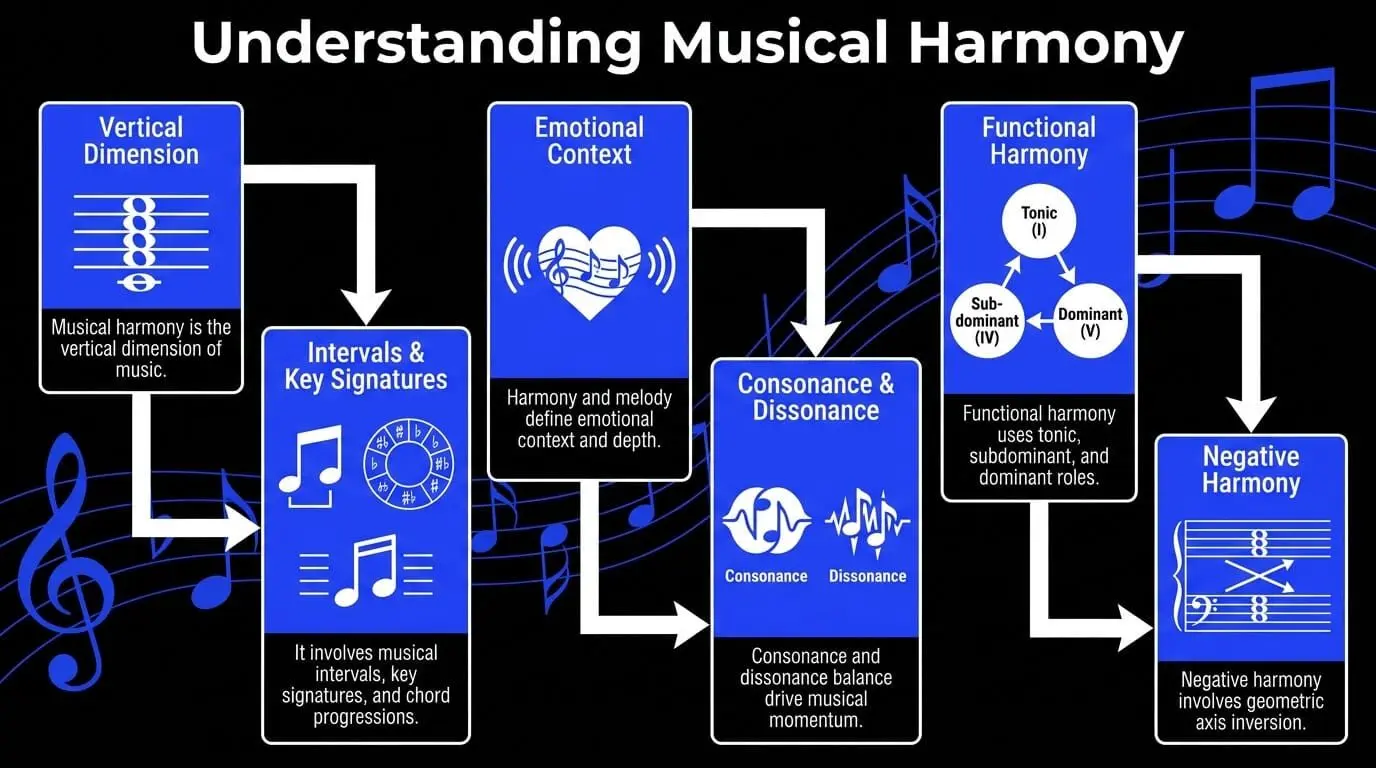
Defining Musical Harmony
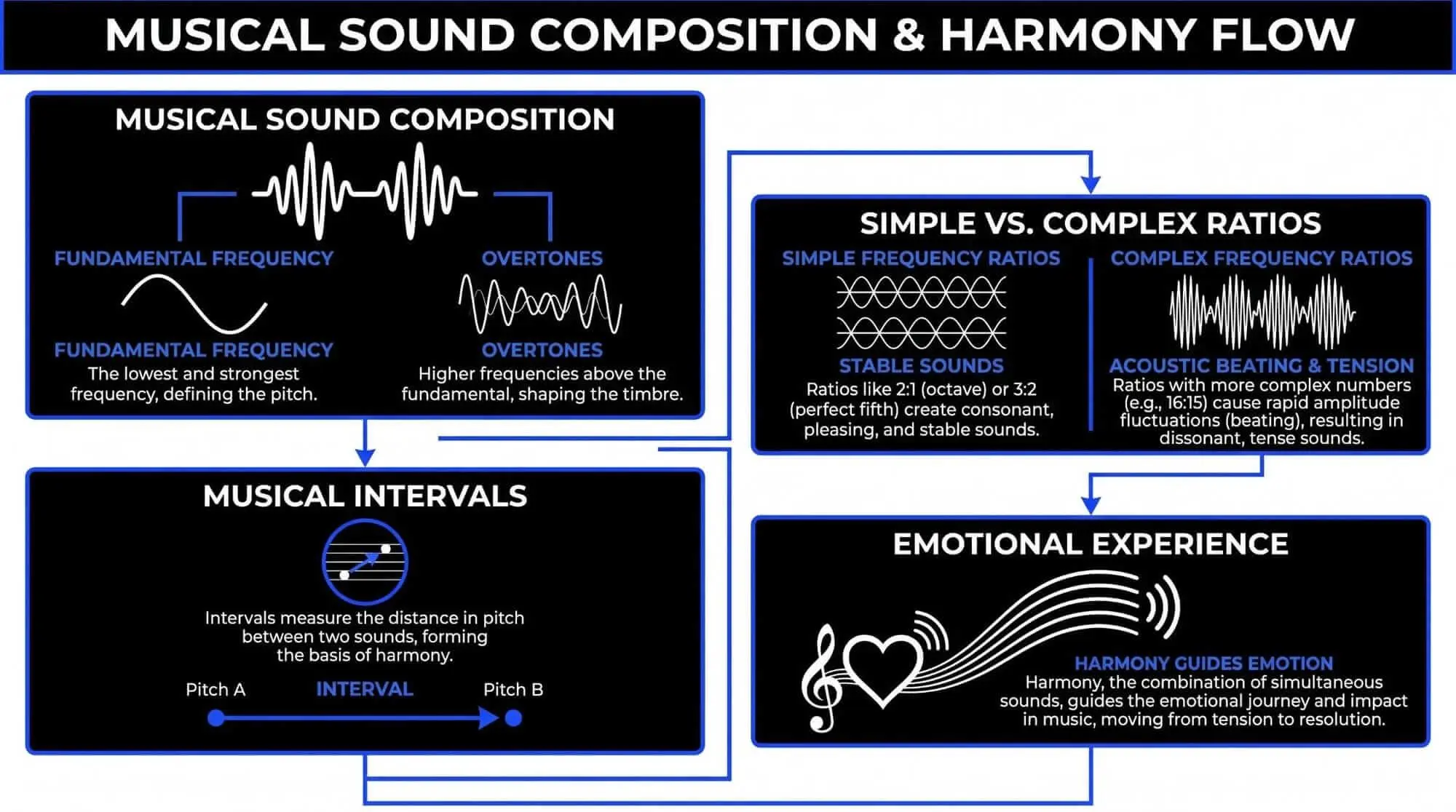
To grasp the musical harmony meaning fully, one must explore the physical laws of acoustics. Every musical sound consists of a fundamental frequency accompanied by a series of higher, faint frequencies known as overtones or harmonics. When a single note is played on an instrument, the human ear hears a complex composite tone. When multiple notes sound together, their respective overtone series interact.
The foundational units of this interaction are musical intervals, which represent the precise distance between two distinct pitches. Measured in half steps and whole steps, intervals dictate the character of the harmonic relationship.
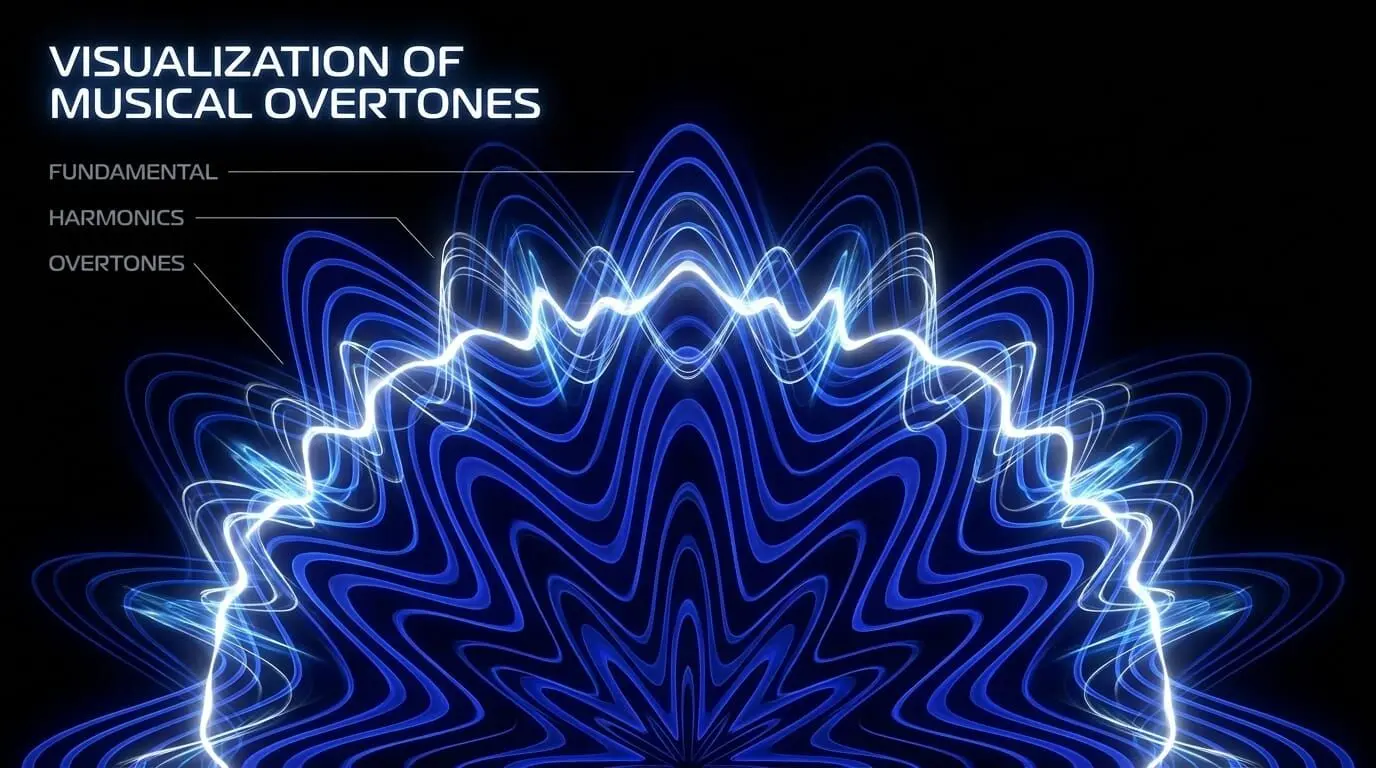
When the mathematical ratios between the frequencies of two notes are simple, the resulting sound is stable and clear. When the ratios are complex, the waveforms collide in a phenomenon known as acoustic beating, generating physical tension. This interaction forms the baseline of the music harmony definition, establishing a spectrum of stability that composers use to guide the emotional experience of the listener.
Fundamentals of Harmony in Music Theory
Structural Components: Notes, Intervals, and Key Signatures
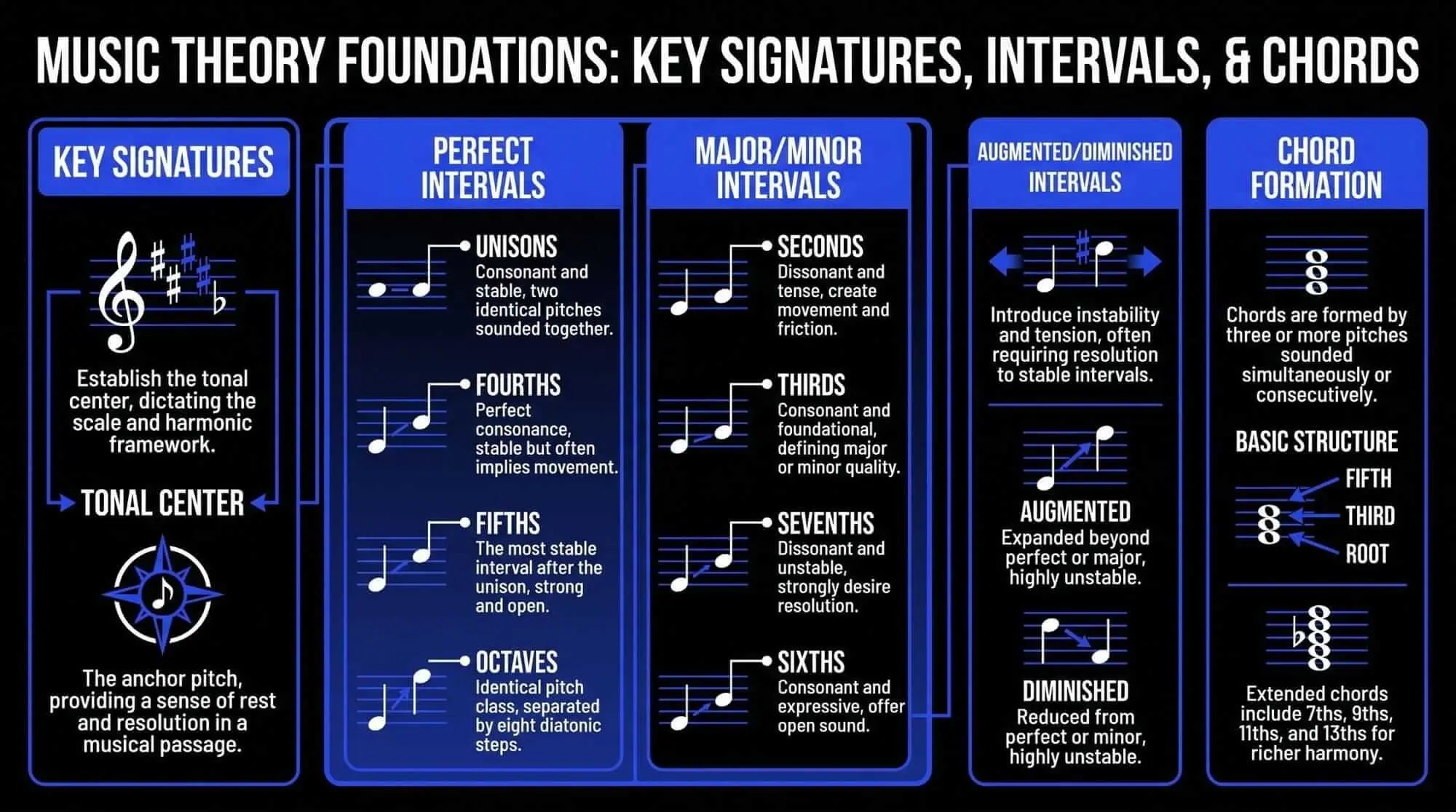
Building a solid foundation in harmony in music theory requires an understanding of how individual pitches aggregate into larger systems. The process begins with key signatures, which establish the tonal center or home key of a piece of music. A key signature designates which notes are systematically raised or lowered throughout a composition, defining the palette of pitches available to the creator.
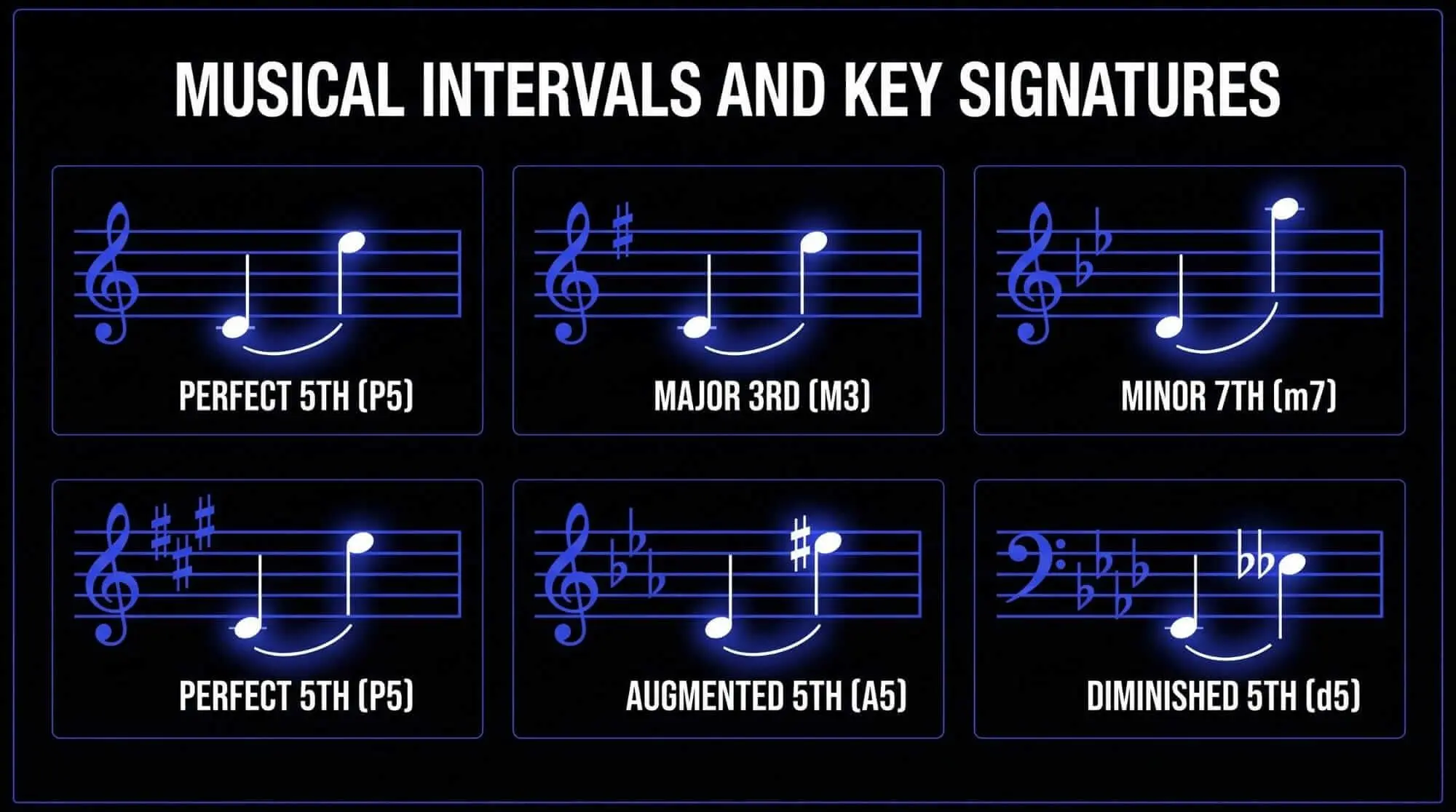
Within any given key signature, the relationships between the root note and the remaining scale degrees determine the available musical intervals. These intervals are categorized by both their distance and their specific quality:
- Perfect Intervals: Unisons, fourths, fifths, and octaves, which possess an inherently stable acoustic profile.
- Major and Minor Intervals: Seconds, thirds, sevenths, and sixths, which change the emotional color of the relationship from bright to dark.
- Augmented and Diminished Intervals: Intervals that have been expanded or contracted by a half step, introducing high degrees of instability.
The Classification of Chords
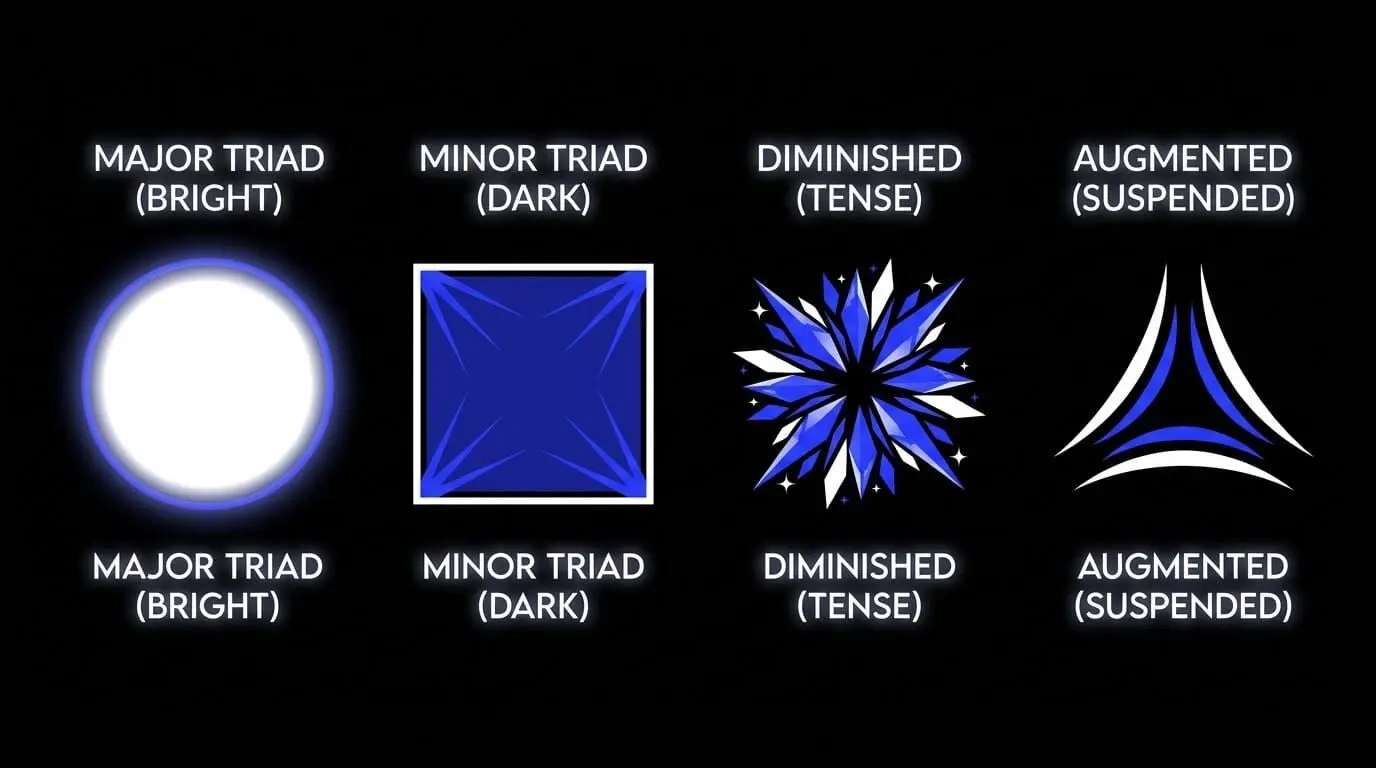
Chords are formed when three or more distinct pitches sound simultaneously according to a defined structural logic. The most fundamental chord structure is the triad, which consists of a root note, a third, and a fifth. The precise qualities of these intervals yield four primary triadic categories:
| Chord Type | Interval Structure From Root | Acoustic & Emotional Character | Production Application |
| Major | Major Third, Perfect Fifth | Bright, stable, triumphant, resolved | Foundational home chords in pop and rock anthems |
| Minor | Minor Third, Perfect Fifth | Dark, melancholic, introspective, serious | Creating emotional weight in ballad or trap melodies |
| Diminished | Minor Third, Diminished Fifth | Unstable, tense, highly expectant of resolution | Leading tones, passing chords in classical and jazz |
| Augmented | Major Third, Augmented Fifth | Dreamy, suspended, floating, disorienting | Transitions, cinematic soundscapes, psychedelic elements |
Beyond basic triads, advanced harmonic structure utilizes extended chords. By continuing to stack thirds above the fifth, musicians construct seventh, ninth, eleventh, and thirteenth chords. These extensions introduce complex inner intervals that enrich the musical texture, transforming simple progressions into sophisticated arrangements.
The Relationship Between Harmony and Melody
Linear Versus Vertical Relationships
The harmony and melody relationship represents the fundamental axis of musical composition. Melody acts as the linear, horizontal narrative, moving through time note by note. Harmony provides the vertical framework, offering an immediate contextual environment that redefines how that melody is perceived.
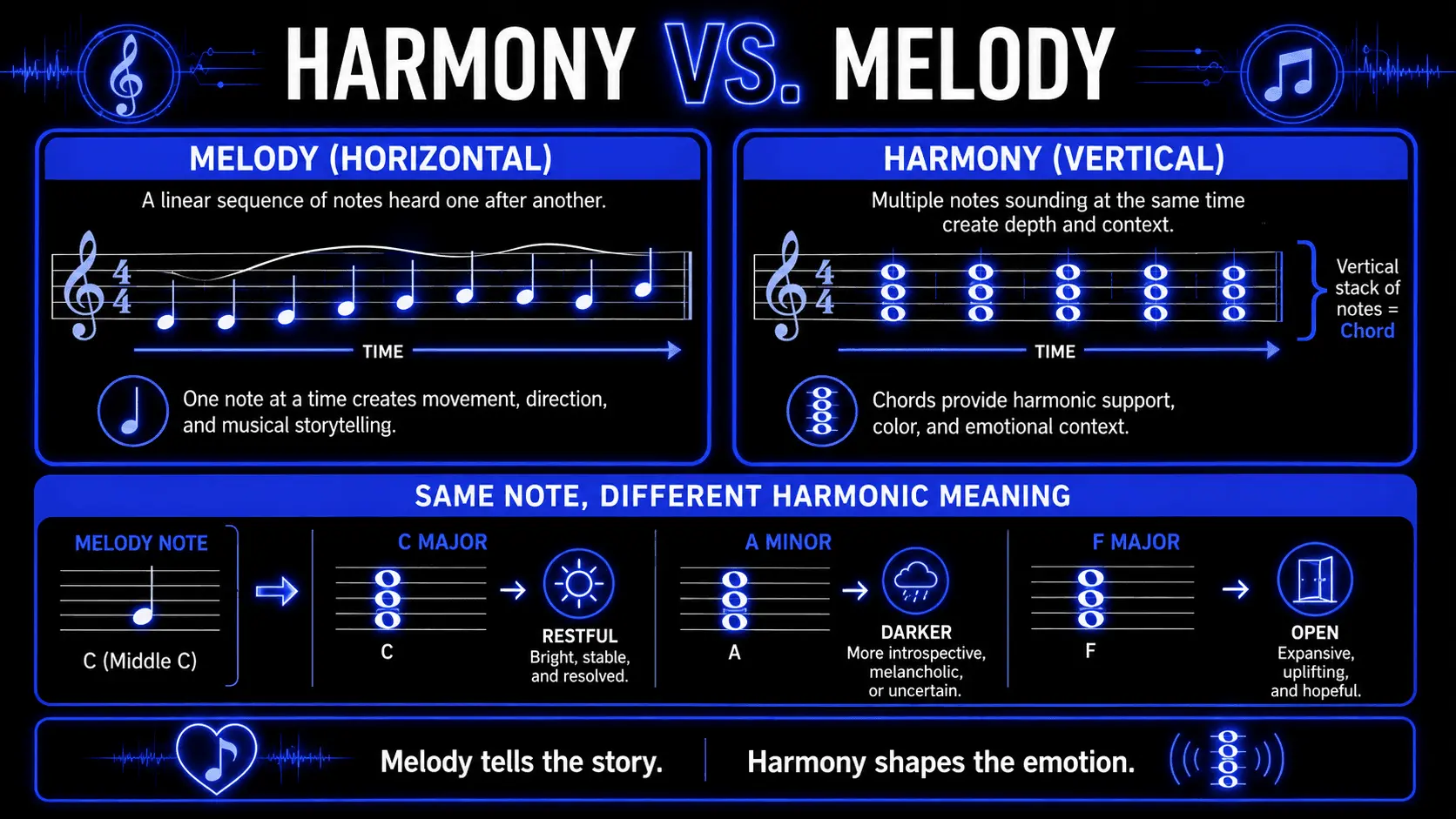
A single, unchanging four-note melody can evoke completely different emotional responses depending on the underlying chord progression. For example, if a melody sustains the note C, that note will sound deeply restful if accompanied by a C major triad.
If the underlying chord shifts to an A minor triad, the C note transforms into the minor third, deepening the emotional weight. If the chord changes to an F major triad, the C note becomes the perfect fifth, providing a sense of expansive suspension.
This interplay demonstrates that melody cannot be divorced from its harmonic environment; the vertical structure dictates the emotional meaning of the horizontal line.
Voice Leading and Counterpoint Strategies
To connect chords smoothly within a musical arrangement, composers employ voice leading. This discipline focuses on the linear movement of individual voices within a series of chords. Instead of viewing chords as isolated blocks moving up and down the instrument, expert voice leading treats each note of a chord as an independent singer in a choir, seeking the shortest, most elegant path to the next note.
The pinnacle of voice leading is found in counterpoint, a technique where multiple independent melodies run concurrently while maintaining a balanced harmonic relationship. Originating in classical polyphony, counterpoint establishes strict guidelines to prevent voices from colliding or losing their identity.
In modern electronic production and vocal arranging, applying counterpoint ensures that basslines, counter-melodies, and lead elements move in a sophisticated dance, preventing arrangement clutter and maintaining absolute clarity across the stereo field.
Core Types of Harmony in Music
Consonance and Dissonance Balance
When analyzing the types of harmony in music, the continuum of consonance and dissonance stands as the primary driving force of musical narrative. Consonance refers to acoustic combinations that feel complete, stable, and at rest. These intervals do not require a follow-up chord to satisfy the ear of the listener; they serve as points of arrival and safety.
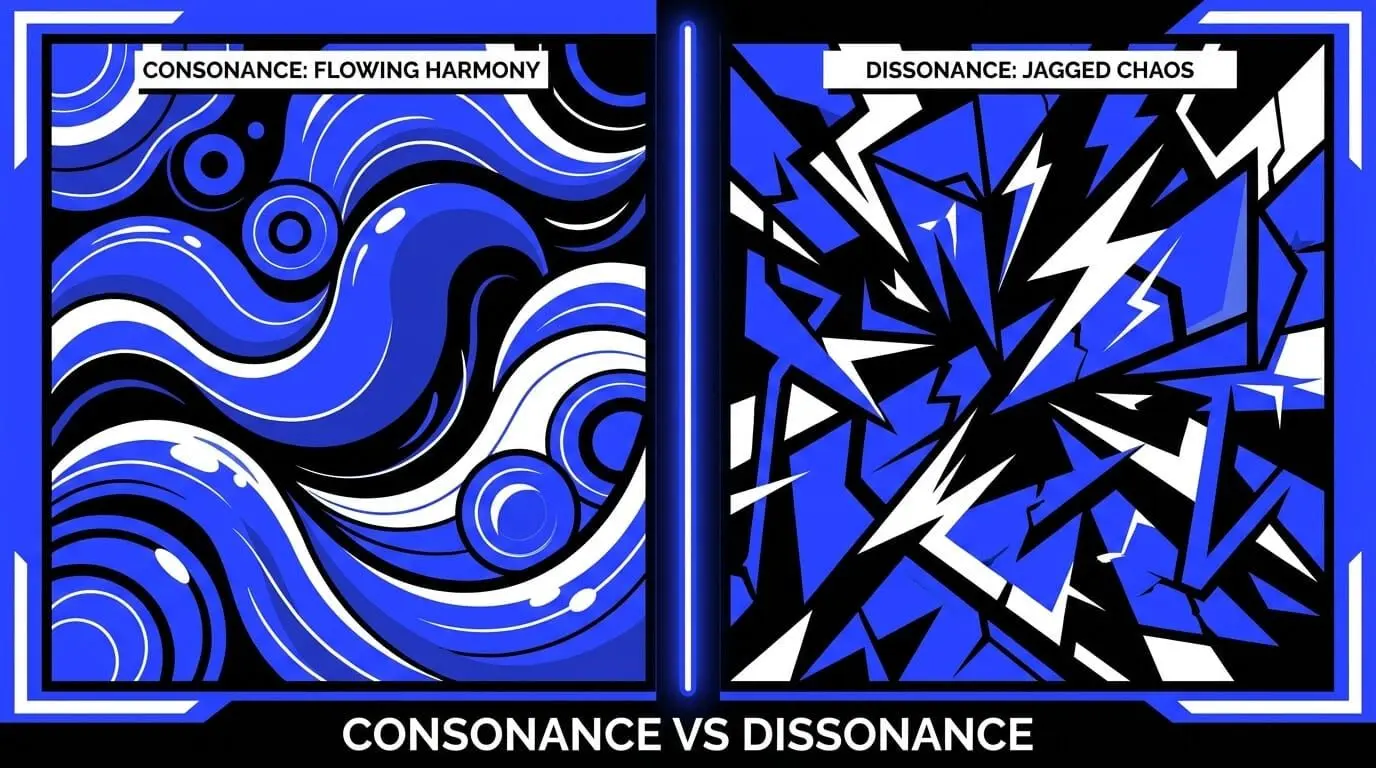
Dissonance represents intervals that sound unstable, friction-filled, and urgent. This tension creates a psychological and physical desire for resolution toward a consonant point. The master manipulation of this cycle is what gives music its kinetic energy.
A composition entirely devoid of dissonance becomes predictable and flat, lacking narrative stakes. Conversely, an arrangement consisting solely of unresolved dissonance can quickly induce listener fatigue. Achieving a precise musical balance requires a calculated distribution of these elements across the timeline of a track.
Tonal Harmony and Modal Systems
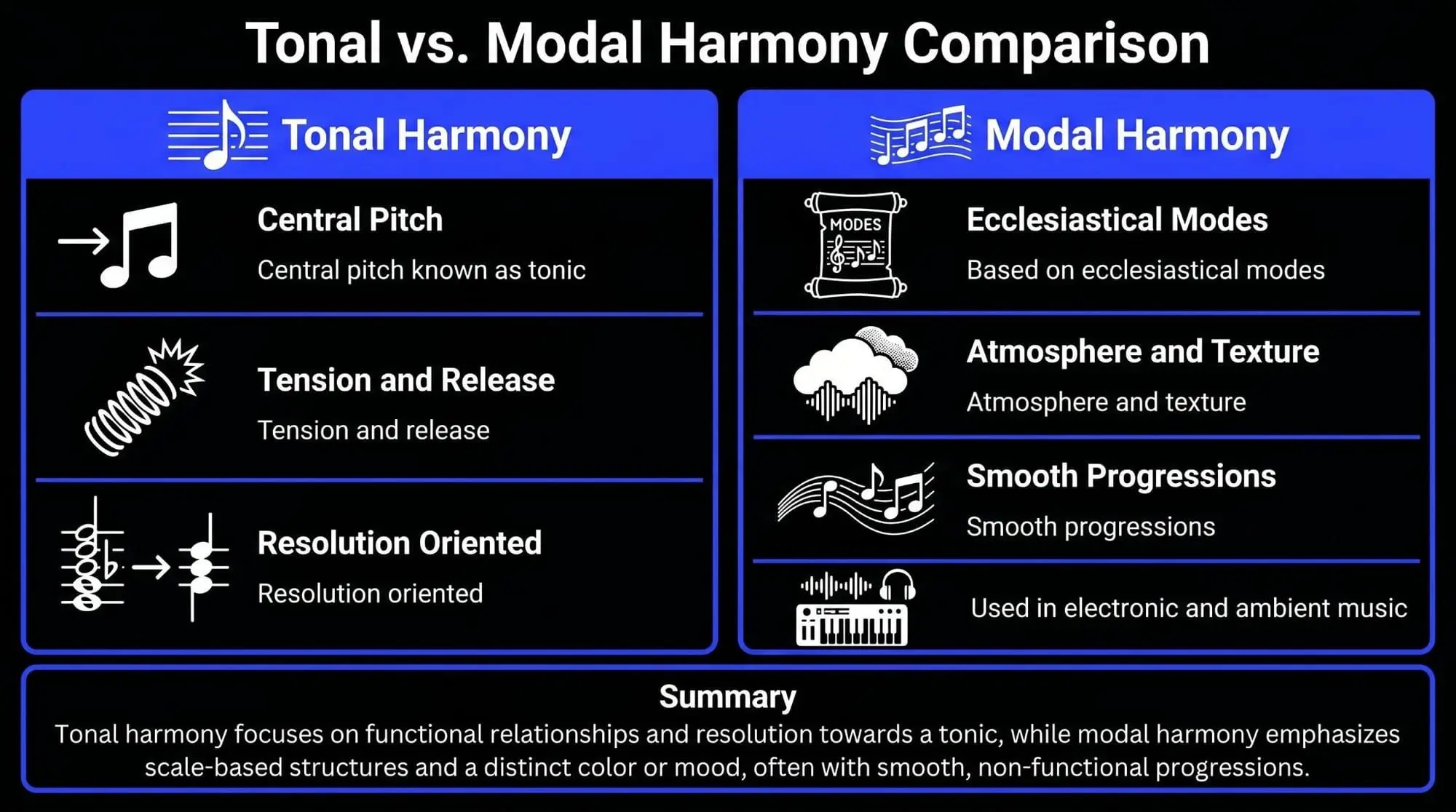
Western music primarily relies on tonal harmony, a system organized around a single central pitch known as the tonic. In tonal harmony, every chord within a key signature possesses a specific relationship to this home note, creating a hierarchy of stability. The entire system behaves like a gravity well, where chords venture away from the tonic to build tension and inevitably loop back to achieve total resolution.
In contrast, modal harmony relies on ecclesiastical modes, such as the Dorian, Phrygian, or Mixolydian scales, rather than standard major and minor systems. Modal harmony prioritizes atmosphere, texture, and linear movement over the aggressive tension-and-release loops of tonal harmony. Instead of driving toward a decisive cadence, modal progressions float smoothly, making them highly effective for atmospheric electronic music, cinematic scoring, and modern ambient sound design.
Advanced Harmonic Frameworks
Functional Harmony and Roman Numeral Analysis
What is functional harmony in music? It is the theoretical system that assigns specific roles, or functions, to chords based on their position within a scale. To analyze these relationships globally, theorists use Roman numeral analysis, which represents scale degrees as numerals to decouple harmonic concepts from specific keys.
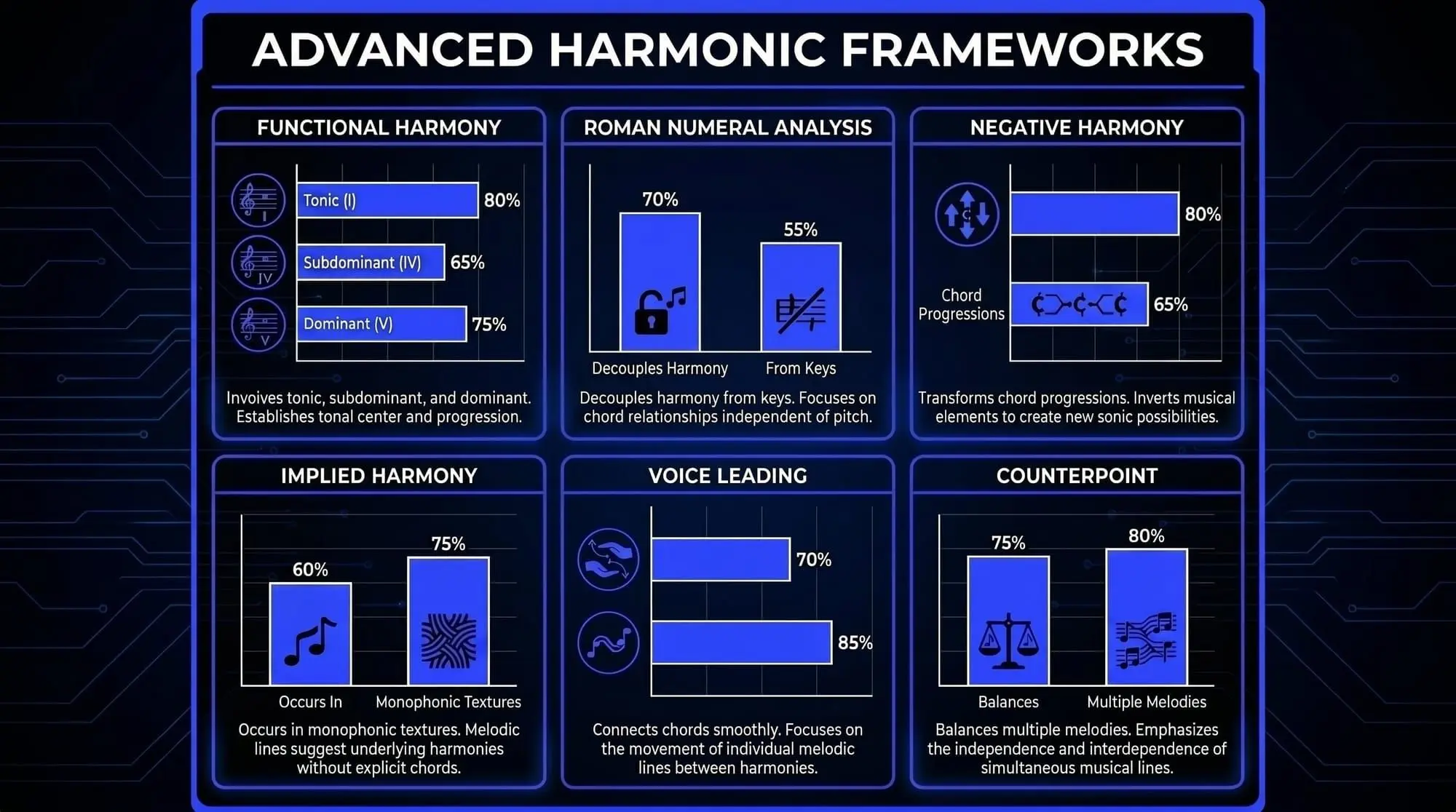
In this system, chords are grouped into three primary functional families:
- Tonic Function (I, vi, iii): Chords that represent stability, rest, and completion. The piece almost always starts or ends here.
- Subdominant Function (IV, ii): Chords that move away from the tonic, introducing mild instability and serving as a bridge toward higher tension.
- Dominant Function (V, vii°): Chords containing the highly unstable leading tone, creating maximum harmonic tension that demands an immediate return to the tonic.
Understanding functional harmony allows a producer to map out the narrative arc of a song systematically, ensuring that transitions occur at moments of peak harmonic momentum.
Negative Harmony Foundations and Axis Inversion
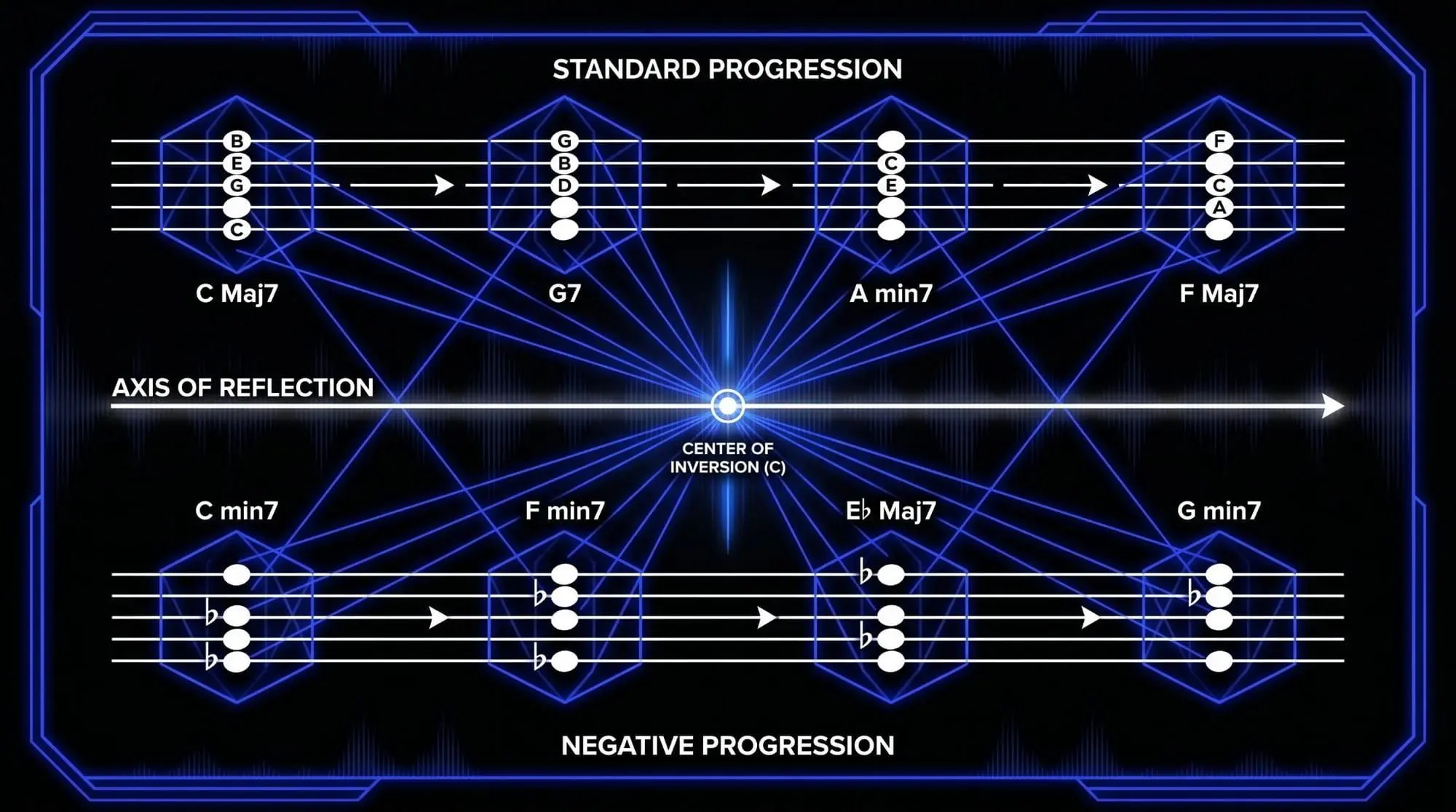
What is negative harmony in music? Originating from the theoretical musings of Ernst Levy and brought into contemporary prominence by modern arrangers, negative harmony is a system of chord transformation based on geometric axis inversion around a specific key center.
To generate negative harmony, you establish a mirror axis exactly halfway between the tonic note and the perfect fifth note of your chosen key. For example, in the key of C major, the axis sits directly between C and G. Every note of the chromatic scale is then mapped to its exact geometric reflection across this mirror line.
When you invert a standard chord progression through this axis, major intervals transform into minor intervals, and dominant tension chords turn into dark subdominant minor equivalents. The resulting negative chords maintain the exact same voice leading distances and gravitational pull toward the tonic, but with an entirely inverted tonal color. This provides producers with a mathematical method for generating unique chord progressions that feel structural yet sound unpredictable.
Implied Harmony in Monophonic Textures
Harmony does not always require multiple instruments to sound simultaneously. Implied harmony occurs when a single, monophonic melody line successfully suggests an underlying chord progression to the ear of the listener. This is achieved through the strategic placement of chord tones on strong metrical beats, or through rapid arpeggiation that outlines the boundaries of a triad.
This technique is invaluable for minimalist arrangements, solo instrument compositions, and driving club basslines. By carefully selecting which scale degrees to emphasize within a solo melody, a creator can make a single synthesizer line or an isolated vocal track sound incredibly deep, triggering the subconscious harmonic expectations of the listener without needing a wall of supporting pad instruments.
The Role of Harmony in Composition and Arrangement
The Impact of Harmony on Emotional Expression
The impact of harmony on emotional expression is a direct bridge to human psychology. While rhythm commands physical movement, harmony acts on the nervous system to evoke precise emotional states. This phenomenon is rooted in how the brain decodes interval interactions and structural expectations.
By choosing specific modal colors or deceptive resolutions, an arranger can inject nuanced emotional layers into a piece:
- Dorian Mode: Offers a bittersweet, melancholic yet hopeful state, widely used in cinematic themes and reflective electronic tracks.
- Phrygian Mode: Instantly delivers an aggressive, dark, tense atmosphere, frequently utilized in heavy trap production and orchestral horror scores.
- Lydian Mode: Creates an ethereal, celestial sense of wonder and curiosity, common in science fiction soundtracks.
- Deceptive Resolutions: Routing a dominant chord to the unexpected submediant chord instead of the tonic subverts expectations, generating an immediate sense of emotional vulnerability.
Harmonic Progression Design and Tension Cycles
An effective musical arrangement relies on the deliberate management of tension cycles. A song must carefully balance moments of stability with moments of departure to maintain engagement over its entire duration. This is accomplished by designing a chord progression that moves through varying degrees of harmonic distance from the home key.
A standard pop progression might use a short, highly cyclical four-chord loop to establish immediate familiarity. A cinematic or progressive arrangement, however, will expand these cycles across long arcs, using extended delays of resolution, modulation to foreign keys, and modal interchange to build massive walls of emotional tension before finally delivering a satisfying consonant payoff.
Genre Analysis: Harmony in Action
Pop and Commercial Music Realization
Harmony in different music genres reveals how diverse musical cultures prioritize acoustic elements. In pop and commercial music, harmony functions primarily as a supportive framework for the lead vocal hook. The priority is immediate accessibility, memorability, and clarity.
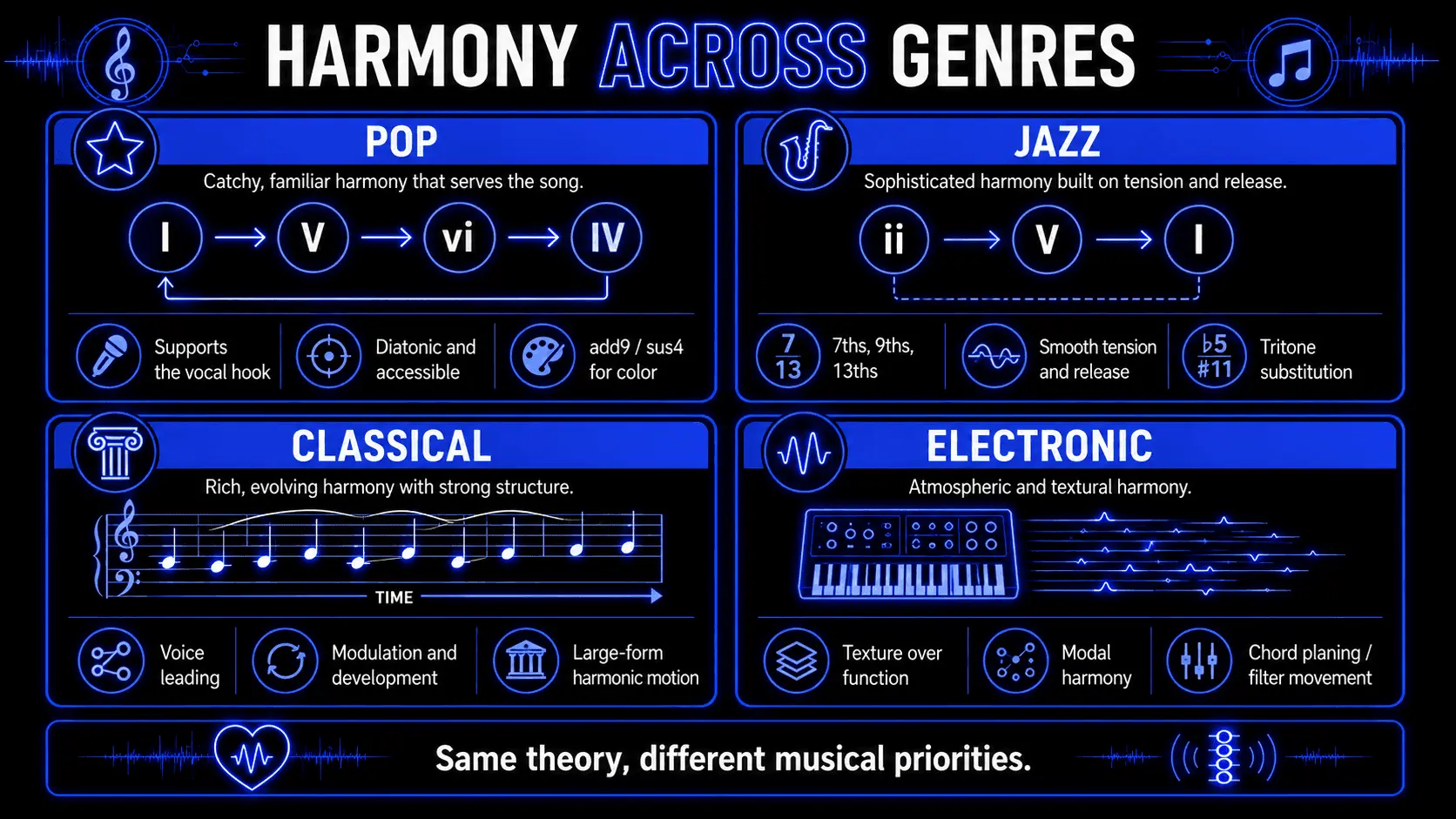
Pop arrangements lean heavily on diatonic chords, utilizing highly efficient, time-tested loops such as the classic I-V-vi-IV progression. To prevent these simple structures from sounding generic, modern pop producers rely heavily on sophisticated production techniques:
- Vocal Layering: Creating tight, multi-tracked vocal harmonies that thicken the chorus section.
- Subtle Extensions: Adding add9 or sus4 variations to standard triads to introduce modern texture without disrupting the underlying pop structure.
- Tonal Contrast: Keeping verses harmonically open or minor, then resolving to bright, straightforward major chords during the chorus for an impactful lift.
Jazz and Extended Chord Modalities
Jazz production rejects simple triadic limitations, fully embracing extended chord vocabulary and constant harmonic modulation. In this genre, a standard major triad is rarely heard; instead, chords are routinely extended to seventh, ninth, eleventh, and thirteenth degrees, creating a highly sophisticated, complex musical texture.
Key characteristics of jazz harmony include:
- ii-V-I Progressions: The foundational engine of jazz movement, driving smoothly between tension and release.
- Tritone Substitution: Replacing a dominant seventh chord with a chord a tritone away, creating smooth chromatic bass movement.
- Modal Interchange: Temporarily borrowing chords from parallel keys to introduce unexpected tonal colors during a live performance or improvisation.
Classical Traditions and Orchestral Textures
In classical traditions, harmony is deeply intertwined with macro-architectural form and intricate voice leading. From the Baroque era to the late Romantic period, composers treated harmony as a dynamic canvas where large orchestral forces could interact across complex formal structures like the sonata form.
Classical orchestration utilizes the full range of the acoustic spectrum. Rather than relying on static loops, pieces progress through continuous development, using radical key changes, chromatic passing chords, and elaborate counterpoint to tell a purely instrumental story. Tonal balance is achieved organically through the strategic distribution of frequencies across distinct instrumental sections: strings, woodwinds, brass, and percussion.
Electronic Music and Contemporary Sound Design
Within electronic music production, harmony is often approached through the lens of sound design, synthesis, and spatial manipulation. In styles like techno, deep house, and ambient, the traditional rules of functional progression are frequently adapted to fit loop-based environments.
Electronic music producers routinely use harmony as a texture rather than a narrative sequence. A deep house track might feature a single minor ninth chord sampled across a keyboard and played in parallel blocks, a technique known as chord planing.
Furthermore, electronic production often blends harmony with synthesis parameters. Automating the low-pass filter cutoff on a rich chord pad allows the producer to alter the harmonic brightness over time, creating a sense of movement and evolution within an otherwise static progression.
Practical Applications in Music Production and Mixing
Voicing and Inversion Implementations in Modern DAWs
Transitioning from abstract harmony theory to practical execution inside a digital audio workstation requires a deep understanding of chord voicing and inversions. Voicing refers to the specific vertical distribution of a chord's notes across the frequency spectrum. Changing the voicing transforms the spatial presence of the sound without altering its core identity.
Producers have two primary structural paths when building voicings in software like Ableton Live, FL Studio, or Logic Pro:
- Tight Voicings: Keeping all notes of a chord close together, usually within a single octave. This delivers a dense, highly focused sound that works well for aggressive brass stabs, rhythm guitars, or compact synthesizer stabs in trap and EDM.
- Open Voicings: Spreading the notes across multiple octaves, often by removing the middle note (the third) and transposing it up an octave. This creates immediate space in the arrangement, allowing other mid-range elements like vocals to breathe.
Additionally, mastering chord inversions is essential for smooth transitions. An inversion occurs when a note other than the absolute root is placed at the bottom of the chord. Using a first inversion triad (putting the third in the bass) gives a sense of forward motion and lift, making it a perfect transition tool immediately before a major chorus or arrangement drop.
Managing Tonal Balance and Frequency Accumulation
During the mixing phase, managing the tonal balance of harmonic elements is critical to preventing mix mud and ensuring absolute clarity. When multiple polyphonic instruments—such as acoustic pianos, synthesizers, and distorted guitars—play large chords simultaneously, their frequencies inevitably pile up in the low-mid frequency spectrum (between 200 Hz and 500 Hz).
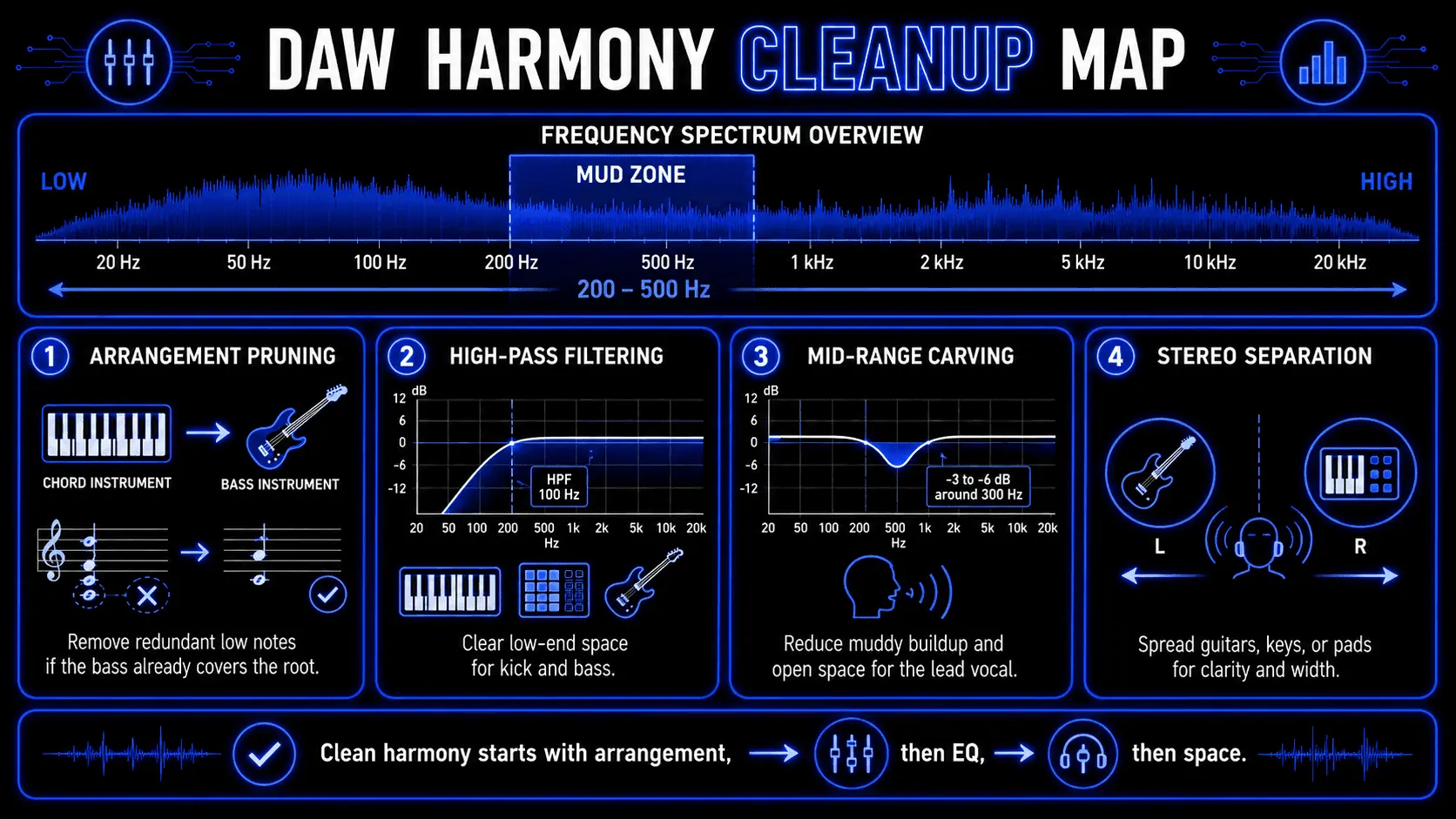
To counteract this frequency accumulation, audio engineers use a disciplined approach to cleanup and arrangement:
- Arrangement Pruning: Before reaching for an equalizer, examine the MIDI data. Remove redundant notes from the lower registers of pad instruments if a dedicated bass instrument is already covering that root frequency.
- High-Pass Filtering: Apply a high-pass filter to non-bass harmonic tracks. Cutting unnecessary low-end rumble below 100 Hz on pads, guitars, and keys frees up essential headroom for the kick drum and bassline.
- Mid-Range Carving: Use a parametric equalizer to gently cut a wide, shallow dip around 300 Hz on thick chord tracks. This reduces muddy build-up and carves out a clear pocket for the lead vocal to sit forward in the mix.
- Stereo Separation: Panoramic placement can separate clashing harmonic elements. Pan a major acoustic guitar track hard left and a keyboard track hard right to maintain a balanced, wide stereo image while minimizing direct frequency collision.
Using ACE Studio to Build Practical Harmonies in Real Productions
Harmony becomes easier to understand when you can hear it as a performed part, not just as notes stacked on a piano roll. A third above the melody may look correct, but it can sound too sweet in the verse. A lower fifth may add weight, but it can also crowd the lead vocal. A wide choir stack may feel cinematic on its own, then lose clarity once drums, bass, and guitars enter.
ACE Studio AI music generator is helpful in this exact part of music production because it lets you test harmony as a real arrangement. Instead of guessing how a vocal stack, choir part, or string voicing will feel, you can write the parts with MIDI, assign voices or instruments, and refine the result until the harmony supports the song.
For vocal harmonies, AI Singing Voice Generator lets you generate singing from MIDI notes and lyrics, then shape details like notes, lyrics, phonemes, pitch, and vocal control parameters. That means you can build a lead vocal, create a harmony line above or below it, and adjust the performance until the two parts feel connected rather than pasted together.
A practical example would be a pop chorus where the melody feels too thin. Instead of adding a full block chord behind every word, you could add a simple upper third only on the final phrase of each line. If the chorus still needs lift, you could widen the last hook with an added sixth or octave double. This keeps the harmony intentional. The listener feels the emotional rise without the vocal arrangement becoming crowded.
ACE Studio’s AI Choir is especially relevant for harmony writing because it is built for layered vocal groups. You can adjust Offset to create small timing differences between voices, Spread to control the width of the choral sound, and Gain to balance individual choir members. These controls are useful when a harmony stack needs to feel like multiple singers instead of one duplicated line.
That matters in practical arranging. A close three-part harmony can make a chorus feel intimate and tight. A wider choir voicing can make a bridge or final hook feel larger. Slight timing offsets can keep the voices from sounding rigid. Spread can move the harmony outward so the lead vocal still owns the center. Gain lets you tuck certain notes back when they support the chord but should not distract from the main phrase.
ACE Studio also includes Doubles, which can help make a lead vocal or harmony vocal feel wider and fuller. This is different from simply duplicating the same audio, which can create phase problems because the two files are identical. Doubles are useful when the harmony itself is already written, but the production needs more width or density around the vocal image.
Harmony in production is not only about vocals. ACE Studio also supports AI Instruments, allowing producers to turn MIDI into performed instrumental parts. This is valuable when testing how chord tones behave across strings, brass, saxophone, duduk, or other instrument colors. You can try a cello holding the root, a violin carrying the third, or an ensemble spreading the chord across octaves instead of forcing every note into one keyboard patch. ACE Studio’s instrument tools also support articulation and expression controls, so harmonic parts can be shaped with more nuance than static MIDI blocks.
For ensemble harmony, ACE Studio’s Ensemble feature gives similar practical control over spacing and realism. Spread controls width, Offset adds slight timing variation between instruments, Gain balances individual parts, and the Room effect can add a shared sense of space. This makes it useful for testing whether a string harmony should feel close and focused, wide and cinematic, or soft enough to sit behind a vocal without pulling attention away from it.
ACE Studio can also help producers study harmony from existing recordings. Stem Splitter can separate a full mix into core components such as vocals, drums, bass, and other instruments. Vocal to MIDI can convert a vocal track into editable MIDI with lyrics on each note. Together, these tools can help you examine where a melody lands against the underlying chords, then write new harmony parts with more confidence.
The key benefit is control. ACE Studio does not have to replace harmonic decision-making. It gives producers a clearer way to hear those decisions. You still choose the intervals, chord tones, voicings, inversions, and emotional direction. ACE Studio simply makes it easier to test whether a harmony line adds lift, warmth, tension, or space before the arrangement becomes too dense.
For producers learning harmony, that kind of feedback is practical. You can hear why a third feels bright, why a sixth feels open, why a close voicing feels tense, or why a low harmony muddies the mix. Instead of treating harmony as theory only, ACE Studio lets you shape it as performance.
Historic and Modern Masterpieces: Analytical Studies
Case Study 1: Johann Sebastian Bach – Prelude No. 1 in C Major
A monumental popular example of harmony in music analysis is Johann Sebastian Bach's Prelude No. 1 in C Major from The Well-Tempered Clavier. This piece features no distinct melody line; instead, it consists entirely of a continuous stream of broken, arpeggiated chords.
Bach utilizes strict functional harmony to construct a masterful narrative arc. The piece begins with a perfectly stable C major triad, gradually wanders away through minor passing chords to introduce a subdominant bridge, and then systematically builds tension using a dominant seventh chord over a static bass note. The entire emotional power of the piece is derived from the calculated management of voice leading, demonstrating that harmony alone can carry an entire musical narrative without any relying on a traditional vocal or instrumental hook.
Case Study 2: The Beach Boys – God Only Knows
In modern commercial music, Brian Wilson's composition for The Beach Boys, God Only Knows, stands as a masterpiece of non-functional, fluid harmonic arrangement. The song is famous for its sense of emotional weightlessness, achieved by deliberately avoiding a clear statement of the home key tonic chord.
Wilson relies extensively on inverted chords, slash chords (a triad played over a foreign bass note), and modal interchange. The song begins on an E major chord over an F-sharp bass note, constantly shifting the ground beneath the listener's feet. By denying a straightforward return to a standard tonic chord, the harmony perfectly mirrors the lyrical vulnerability and existential longing of the text, setting a benchmark for emotional expression in pop production.
Frequently Asked Questions
What is the primary difference between harmony and melody?
Melody represents the horizontal, linear sequence of individual pitches that a listener perceives as a singular, cohesive narrative line over time. Harmony represents the vertical dimension of music, created when multiple pitches are played simultaneously to provide texture, context, and emotional depth beneath that melody.
Can a song have harmony without a melody?
Yes. A composition can consist entirely of a chord progression or ambient harmonic textures without ever introducing a singular, defining lead melody. Ambient music, drone soundscapes, and classical chord exercises frequently rely solely on harmonic movement to generate emotional impact.
How does negative harmony alter a song?
Negative harmony systematically mirrors a chord progression across a fixed geometric axis based on the key signature. This inversion transforms major intervals into minor intervals and shifts dominant chords into dark subdominant minor variations, maintaining the structural voice leading gravity of the original progression while creating an entirely unique emotional color.
Why do some chord combinations sound smooth while others sound harsh?
This distinction is governed by the physical laws of consonance and dissonance. Smooth combinations, or consonances, feature simple mathematical frequency ratios between the notes, allowing the sound waves to merge cleanly. Harsh combinations, or dissonances, feature complex mathematical ratios that cause the sound waves to physically collide and beat against one another, generating acoustic tension.
How can I improve my ear training for identifying harmonies?
To develop a strong ear for harmony, practice breaking down multi-note chords from the bottom up. Start by identifying the lowest note (the bass root), then try to sing or isolate the middle third to determine if the chord is major or minor. Using dedicated ear training applications daily to practice identifying interval qualities will significantly sharpen your processing speed when mixing or arranging complex tracks.