

Key Takeaways
- Pitch is the perceived highness or lowness of a sound, while frequency is the measurable vibration rate behind it. Understanding both helps producers make more accurate musical and technical decisions.
- Pitch and tone are not the same: pitch defines the note, while tone includes the sound’s character, timbre, loudness, and overall color.
- A440, octave relationships, scales, intervals, and harmony form the foundation of how musical notes are organized and used in composition.
- In music production, pitch affects much more than melody. It shapes tuning, vocal correction, sample matching, drum impact, bass clarity, and the emotional direction of a track.
- Modern tools, including AI music software like ACE Studio, make pitch more editable and expressive by helping producers refine vocals, harmonies, MIDI parts, vibrato, timing, and instrumental performances.
The science behind pitch and frequency
Pitch is the way we perceive how high or low a sound feels to the ear. It is one of the most natural parts of musical listening, because the human brain constantly organizes sound by pitch, even before we describe it with musical terms.
When a singer moves from a low note to a high note, or when a bassline sits below a melody, we are experiencing pitch as a musical sensation. To understand musical pitch properly, however, it is important to separate the physical cause from the listener’s perception.
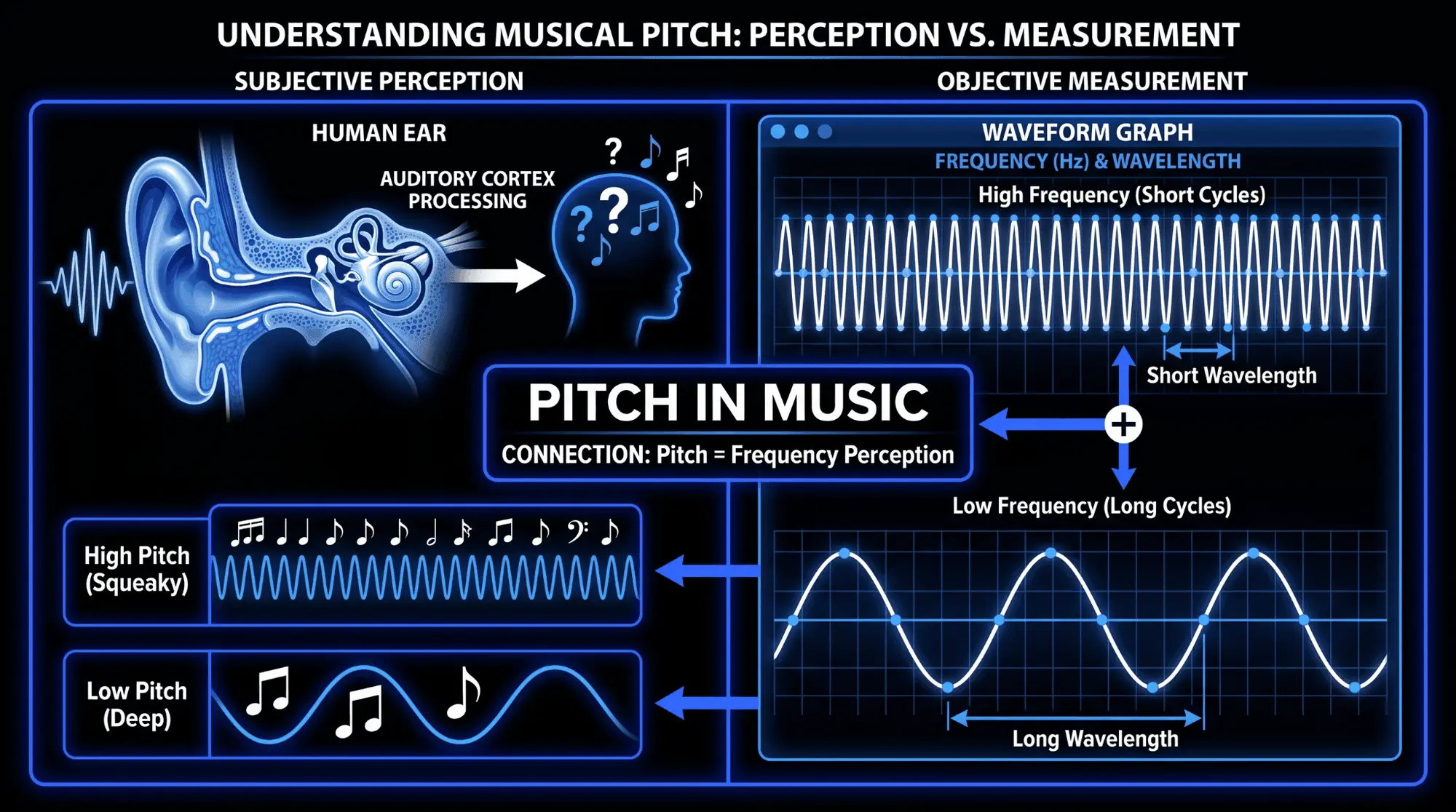
Frequency is the measurable behavior of the sound wave, while pitch is how the ear and brain interpret that vibration. Although the two terms are often used interchangeably in everyday conversation, they describe different sides of the same musical experience: one belongs to physics, and the other belongs to psychoacoustics.
Sound frequency
Sound frequency refers to the number of vibrations or cycles a sound wave completes in one second. This physical property is measured in Hertz (Hz). In music, these vibrations are typically periodic, meaning they repeat in a consistent pattern over time.
Frequency in music is the objective measurement of a sound wave’s speed. When an object, such as a guitar string, a vocal fold, or a synthesizer oscillator, vibrates, it creates pressure waves in the air.
High-frequency sounds have a high number of cycles per second, which usually results in a higher perceived pitch. Low-frequency sounds have fewer cycles per second, which usually results in a lower perceived pitch.
Audio perception and pitch
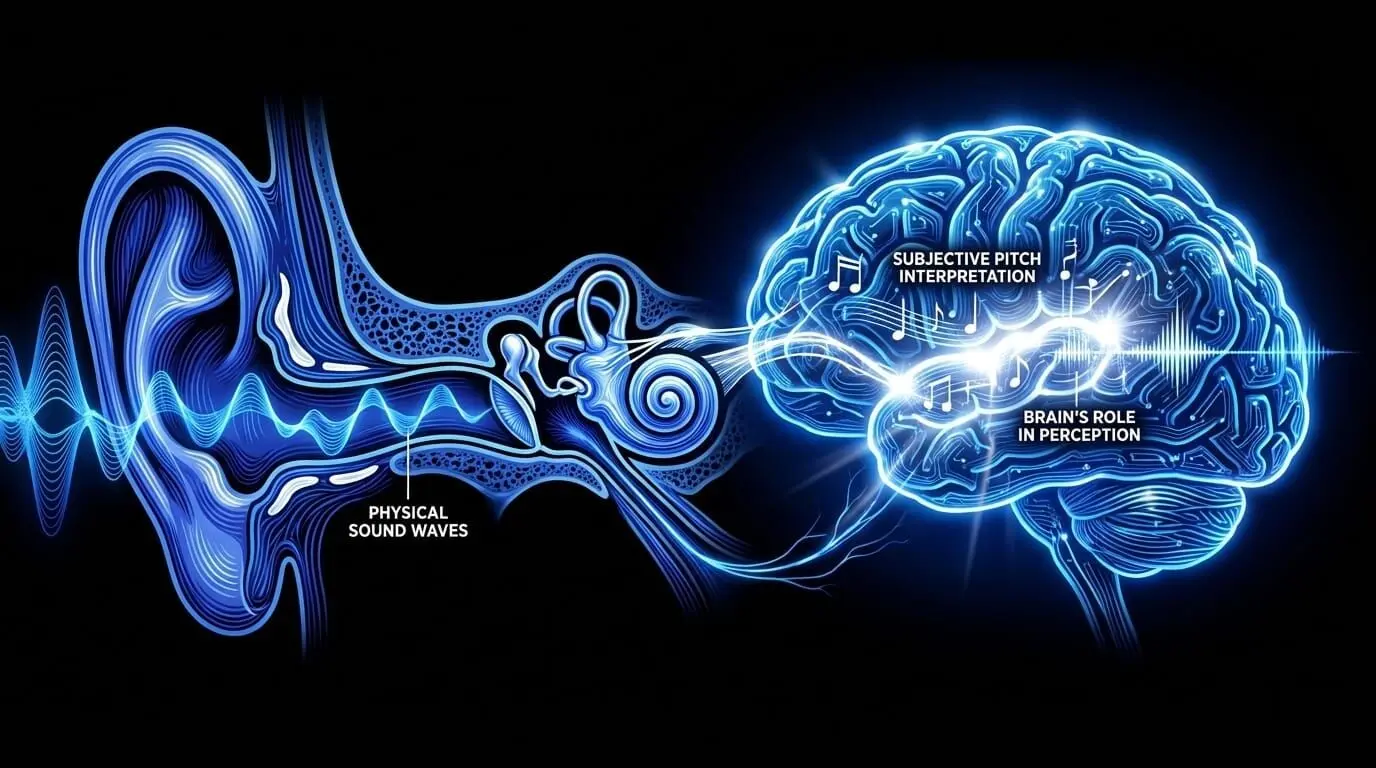
Audio perception is the process by which the human ear and brain interpret these physical frequencies. Pitch is a subjective psychoacoustic attribute. While frequency can be measured with an oscilloscope, pitch is what the listener hears.
The relationship between frequency and pitch is logarithmic rather than linear. For example, doubling the frequency of a sound creates the perception of an octave increase. This is why A4 at 440 Hz and A5 at 880 Hz sound like related versions of the same note, even though their frequencies are different. This relationship is one of the core principles behind musical scales, tuning systems, melody, and harmony.
Pitch vs. tone: Clarifying the distinction
A common point of confusion in music production is the difference between pitch and tone. The two are closely related because they both describe how we experience sound, but they do not refer to the same thing.
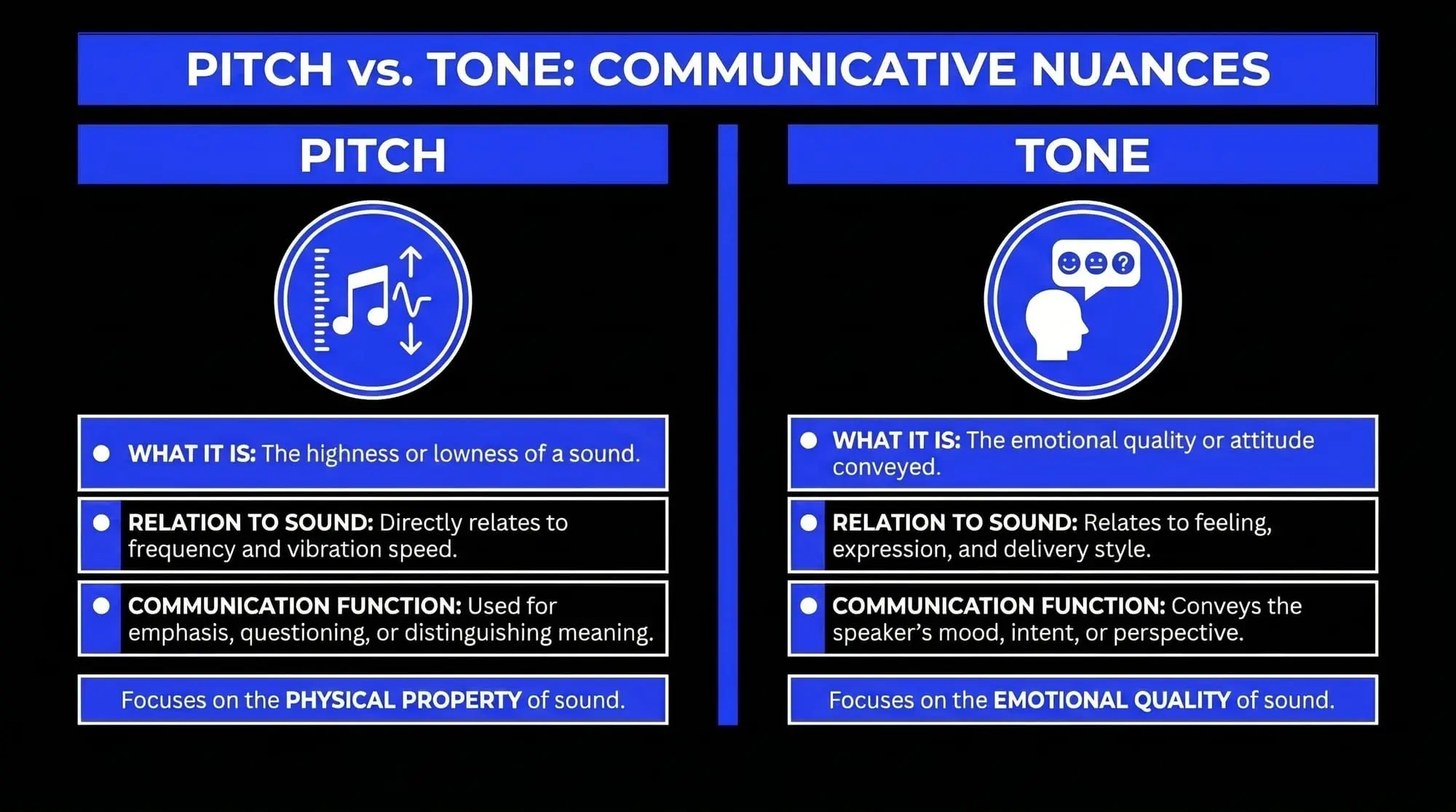
Pitch tells us whether a sound feels high or low, usually based on its fundamental frequency. Tone, on the other hand, describes the overall character of that sound, including its timbre, loudness, duration, harmonic content, and expressive quality.
This distinction matters in music because a producer may correct the pitch of a vocal, but still need to shape its tone with EQ, compression, saturation, reverb, or performance editing. In other words, pitch helps define the note, while tone helps define the personality of the sound.
Musical Tone Definition
A musical tone definition encompasses more than just the frequency. A tone in music is a sound that has a definite pitch, duration, loudness, and timbre. While pitch refers strictly to the highness or lowness of the sound, tone refers to the specific character of that sound.
Comparing pitch and tone
The easiest way to understand the difference is to imagine several instruments playing the same note. A piano, violin, human voice, and synthesizer can all perform A4 at 440 Hz, which means they share the same pitch. However, they will not sound identical because each one produces a different tone. Their waveforms, harmonics, attack, resonance, and expressive behavior all shape how the listener experiences the sound. For producers and sound designers, this comparison is important because pitch organizes the musical structure, while tone determines how that structure feels inside the mix.
Understanding the musical tone definition is vital for sound designers. Two synthesizers may play the exact same pitch, such as 440 Hz, but their tones will differ based on harmonic content, waveform shape, envelope, filter movement, and modulation. This is why pitch can be technically correct while the sound still feels too thin, harsh, dull, bright, warm, or aggressive in the context of a song.
The mechanics of musical notes
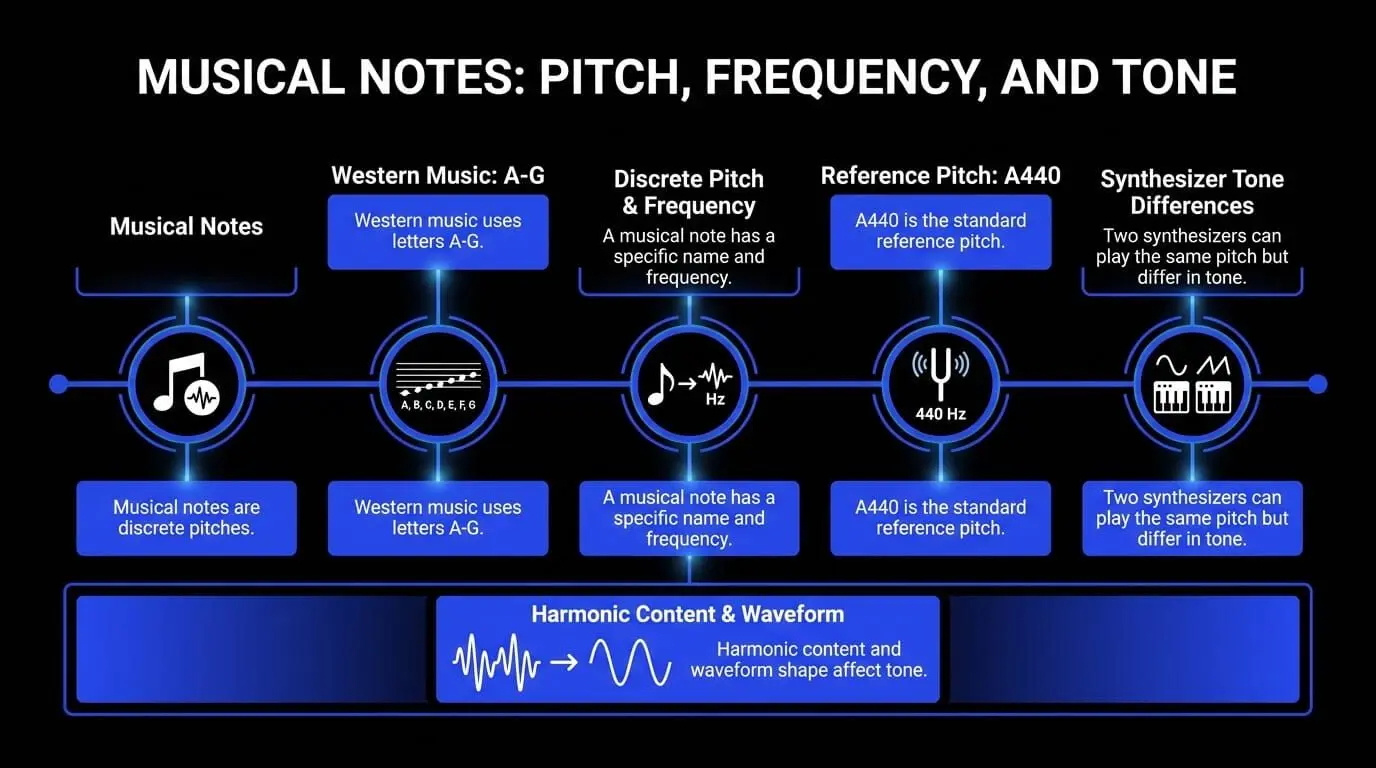
A musical note definition describes a discrete pitch that has been assigned a specific name and frequency within a tuning system. In Western music, we use the first seven letters of the alphabet (A, B, C, D, E, F, G) to identify these notes.
The reference pitch: A440
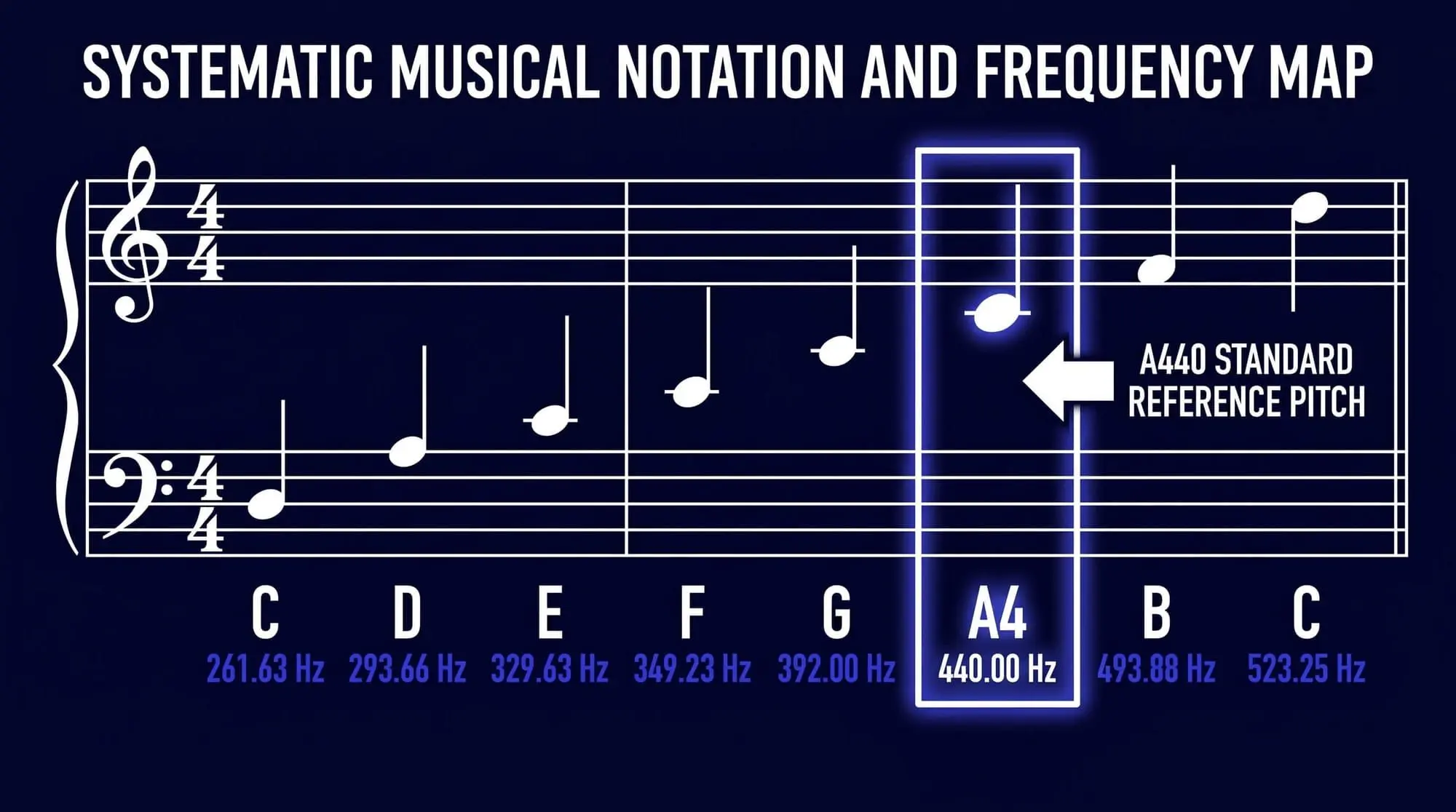
In modern music, the standard reference for tuning is A4, which is set to a frequency of 440 Hz. This is often called Concert Pitch. All other musical notes in a standard tuning system are calculated relative to this frequency.
The role of the octave
The octave is the most fundamental interval in music. It occurs when the frequency of a note is exactly doubled or halved.
- A4: 440 Hz
- A5 (One octave higher): 880 Hz
- A3 (One octave lower): 220 Hz
Despite the difference in frequency, the human brain perceives these notes as having the same identity, a phenomenon known as octave equivalence. This allows for the construction of a musical scale, which is a series of notes organized by pitch.
Types of pitch in music
Pitch is not a monolithic concept. In professional music theory and performance, it is categorized based on how it is produced and perceived.
Definite vs. indefinite pitch
- Definite pitch: Sounds that have a clear, identifiable frequency that can be matched by a listener. Examples include the piano, flute, and most vocal performances. These sounds allow for the creation of melody and harmony.
- Indefinite pitch: Sounds that contain a complex mixture of frequencies, making it difficult to assign them a specific note. Examples include snare drums, cymbals, and white noise. While these sounds lack a melodic pitch, they still occupy a specific area of the frequency spectrum.
Absolute pitch and relative pitch
- Absolute pitch: Commonly known as perfect pitch, this is the rare ability to identify or recreate a musical note without a reference tone.
- Relative pitch: The ability to identify the relationship between two or more pitches. This is a skill that can be developed through ear training and is essential for understanding an interval or a chord progression.
Fixed pitch vs. variable pitch
- Fixed pitch instruments: These instruments are designed to produce specific, unchangeable frequencies. A piano is a prime example; once a key is pressed, the pitch is set until the instrument is retuned.
- Variable pitch instruments: These allow the performer to manipulate the pitch continuously. The violin, trombone, and human voice are variable pitch instruments, capable of pitch modulation and microtonal adjustments.
Scales, intervals, and harmony
Pitch is the raw material used to build the structural elements of a composition. Without pitch differentiation, melody and harmony cannot exist.
Musical scales and intervals
A musical scale is an ordered sequence of pitches. The distance between any two pitches is called an interval.
- Semitone (half-step): The smallest interval in standard Western music (e.g., C to C#).
- Whole Tone (whole step): An interval consisting of two semitones (e.g., C to D).
By arranging these intervals in specific patterns, we create scales (Major, Minor, Pentatonic), which dictate the emotional "flavor" of a piece of music.
Harmony and chords
Harmony occurs when multiple pitches are sounded simultaneously. The vertical relationship between these pitches creates chords.
- Consonance: Pitches that sound stable and pleasant together (e.g., a Major Third).
- Dissonance: Pitches that create tension and a need for resolution (e.g., a Minor Second).
Pitch notation in music
To communicate pitch across time and geography, musicians use pitch notation. This system provides a visual representation of how high or low a note should be played.
The musical staff and clefs
The staff consists of five lines and four spaces. The position of a musical note on the staff indicates its pitch.
- Treble Clef: Used for higher-pitched instruments like the violin or the right hand of a piano.
- Bass Clef: Used for lower-pitched instruments like the cello or the bass guitar.
MIDI and digital notation
In the modern DAW (Digital Audio Workstation), pitch is often represented using MIDI (Musical Instrument Digital Interface). In MIDI notation, each pitch is assigned a number (0-127). For example, Middle C is MIDI Note 60. This allows producers to manipulate pitch with mathematical precision, facilitating complex arrangements and sound design.
Pitch range and register
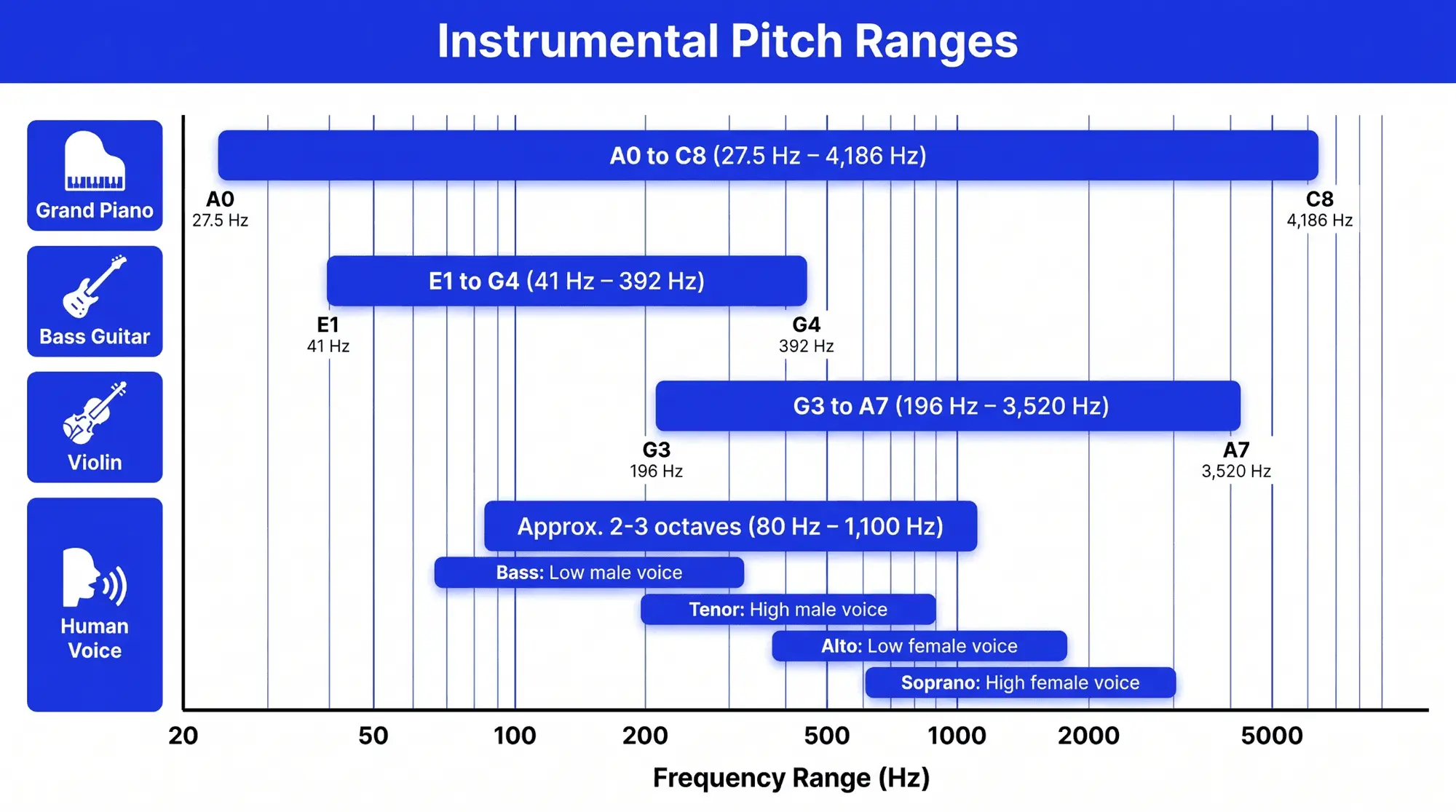
Every instrument and voice has a specific pitch range, which is the distance from the lowest to the highest note it can produce.
Vocal registers
The human voice is typically classified into four primary ranges:
- Soprano: High female voice.
- Alto: Low female voice.
- Tenor: High male voice.
- Bass: Low male voice.
Instrumental frequency ranges
Understanding these ranges is critical for frequency masking management during the mixing process. If a bass guitar and a kick drum occupy the same pitch range without proper EQ, the mix will lack clarity.
Pitch modulation and processing in music production
In contemporary music production, pitch is rarely static. Producers use various techniques to manipulate pitch for both corrective and creative purposes.
Vibrato and tremolo
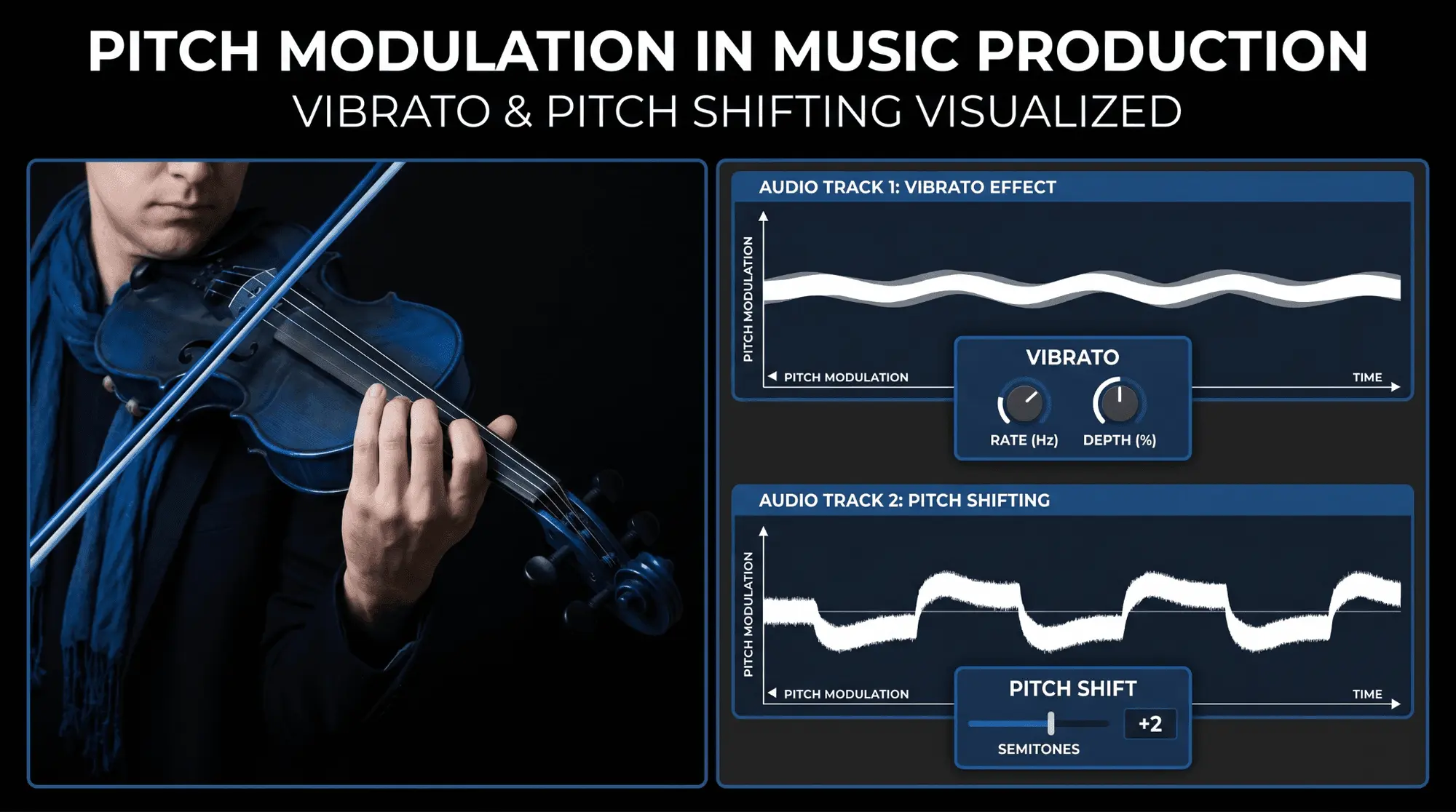
Pitch modulation is a technique where the pitch of a sound is varied over time.
- Vibrato: A rapid, slight variation in pitch. It adds warmth and expression to vocals and string instruments.
- Tremolo: Often confused with vibrato, tremolo is a rapid variation in volume (amplitude), not pitch.
Pitch shifting and correction
Modern software allows for extreme manipulation of pitch:
- Pitch Shifting: Changing the pitch of an audio recording without altering its duration. This is used to transpose loops or create vocal harmonies.
- Auto-Tune and Melodyne: These tools provide real-time or offline pitch correction. They analyze the sound frequency of a performance and pull it toward the nearest intended musical note.
- Formant Shifting: This involves manipulating the resonant frequencies of a sound (the tone) while keeping the pitch constant, often used to make a vocal sound more masculine or feminine.
AI and pitch synthesis
The advent of Artificial Intelligence in music technology has revolutionized how we interact with pitch. AI models can now analyze the audio perception of a listener and generate melodies that adhere to complex harmonic structures. Furthermore, AI-driven synthesis can create entirely new musical tones by morphing the pitch and timbre of existing sounds in ways that were previously impossible with traditional oscillators.
AI has changed pitch work from simple correction into performance shaping. Instead of only moving a note to the nearest scale degree, modern tools can preserve phrasing, vibrato, timing, and tone while making pitch editable. ACE Studio is a good example of this shift: this AI music generator lets musicians work from MIDI, lyrics, or recorded audio, then refine the pitch behavior of vocals and instruments with musical control.
Using ACE Studio to turn pitch decisions into performances
Understanding pitch becomes much more practical when you can hear and adjust it directly inside a musical part. This is where ACE Studio can be useful, especially for producers who work with MIDI, vocals, harmonies, and expressive instrument lines.
ACE Studio has expanded into a wider AI music workstation with AI voices, AI instruments, Stem Splitter, Vocal-to-MIDI conversion, and a redesigned Canvas for arranging musical ideas. For a topic like pitch, the most relevant advantage is simple: you can shape notes as musical decisions, not just as audio corrections.
For vocals, ACE Studio lets you create singing from MIDI notes and lyrics. The MIDI defines the pitch and rhythm, while the lyrics define what the voice sings. From there, you can refine the performance by editing notes, pitch curves, vibrato, timing, phonemes, and expression. This matters because a vocal pitch is rarely just “in tune” or “out of tune.” A singer may slide into a note, lean slightly sharp for tension, soften the end of a phrase, or use vibrato to add warmth. ACE Studio gives you access to those details so you can shape the performance instead of flattening it into robotic correction.
It is also useful when starting from existing audio. With Vocal to MIDI, a sung line can be converted into editable MIDI and lyrics. That means you can inspect the melody, adjust the pitch map, clean up notes, change phrasing, or rebuild the vocal with another voice while keeping the musical idea intact. If a rough demo has a strong melody but uncertain tuning, this gives you a way to refine the line without losing the original direction.
ACE Studio 2.0 also brings pitch control into instruments. Its AI Instruments can generate natural-sounding performances from MIDI, including strings and other expressive instruments. Instead of only triggering static samples, you can work with musical details such as vibrato, articulation, dynamics, and ensemble layering. For pitch-based writing, this is especially helpful with parts like violin lines, cello melodies, brass phrases, or layered sections where small pitch movements affect emotion and realism.
In ACE Studio’s MIDI-driven vocal and instrument workflows, you choose the notes, register, range, timing, harmony, and emotional direction. The software gives you a more flexible way to hear those pitch decisions performed by voices and instruments, then refine them until they support the song.
How to identify and learn pitch
Developing a keen sense of pitch is a fundamental requirement for any serious musician or producer.
Ear training techniques
Learning to identify pitch involves training the brain to recognize intervals and chord qualities.
- Interval training: Associating specific intervals with well-known songs (e.g., the Perfect Fourth is the first two notes of Here Comes the Bride).
- Solfège: Using syllables (Do, Re, Mi, Fa, Sol, La, Ti) to represent pitches within a scale. This helps in understanding the functional role of each pitch in a melody.
Utilizing software tools
Producers can use several tools within their DAW to identify and visualize pitch:
- Spectrum analyzers: These plugins display the frequency content of a signal, allowing you to see the fundamental frequency of a sound.
- Tuners: Essential for ensuring that live instruments and synthesizers are perfectly in line with the A440 standard.
- Pitch-to-MIDI converters: These tools analyze an audio file and convert the detected pitches into MIDI notes, which can then be used to trigger other sounds.
The importance of pitch in modern music
The importance of pitch in music extends beyond simple melody. It affects the psychological and physical impact of a composition.

Emotional resonance
Higher pitches are often associated with tension, excitement, or brightness, while lower pitches evoke feelings of stability, darkness, or melancholy. By strategically placing pitches within a composition, a producer can guide the listener’s emotional journey.
Structural cohesion
In electronic music, the relationship between the pitch in the beat (such as a tuned kick drum) and the pitch in the bass is the foundation of a professional mix. If the kick drum is out of tune with the bassline, the low end of the track will feel muddy and lacks impact. This is why many producers "tune" their drums to the key of the song.
Advanced concepts: Microtonality and temperament
While standard Western music relies on 12-tone equal temperament, other systems exist that explore the spaces between the notes.
Microtonal pitch
Microtonal pitch refers to intervals smaller than a semitone. This is a staple in many non-Western musical traditions, such as Indian Classical music (using shrutis) and Middle Eastern music (using quarter tones). In the Western avant-garde and electronic scenes, microtonality is used to create eerie, otherworldly, or hyper-expressive textures.
Tuning systems
Historically, how we define the frequency of musical notes has changed.
- Just intonation: Tuning based on simple whole-number ratios. It sounds extremely "pure" but makes it difficult to change keys.
- Equal temperament: The modern standard where an octave is divided into 12 equal parts. It allows for modulation between all keys but involves slight "out-of-tune" compromises that the modern ear has become accustomed to.
Conclusion: The foundation of musical expression
Understanding what pitch means in music is the gateway to professional-grade composition and production. It is the intersection of physics and emotion, requiring both a scientific grasp of sound frequency and an artistic intuition for melody and harmony.
From the basic musical pitch definition to the complexities of microtonal tuning and AI-driven pitch modulation, the mastery of this element allows you to transform raw sound into a cohesive musical experience. Whether you are tuning an 808, transcribing a vocal line, or designing a new synth lead, pitch remains the most powerful tool in your sonic arsenal.
By consistently applying the principles of audio perception, identifying the nuances of pitch vs tone, and utilizing modern pitch-processing software, you ensure that your music stands on a solid harmonic foundation, ready to resonate with your audience on a professional level.
Frequently Asked Questions about pitch in music
What is the scientific difference between pitch and frequency?
Frequency is the objective measurement of sound waves, counted in Hertz (Hz), which shows how many vibrations occur per second. Pitch is the listener’s perception of that frequency. In simple terms, frequency is what can be measured with scientific tools, while pitch is what the human ear and brain interpret as high or low sound.
How do pitch and tone differ in a professional context?
Pitch describes how high or low a sound is, based on its fundamental frequency. Tone is broader: it includes pitch, duration, loudness, and timbre, which is the unique color or character of a sound. Two instruments can play the same pitch, but they will still sound different because their tones have different harmonic qualities.
What does A440 represent in music production?
A440 means the note A above middle C is tuned to 440 Hz. It is the standard reference pitch used in most modern music production and performance. By tuning instruments to A440, musicians and producers can keep different instruments harmonically aligned across recordings, sessions, and live performances.
What is the difference between definite and indefinite pitch?
Definite pitch refers to sounds with a clear, recognizable note, such as a piano, trumpet, violin, or singing voice. Indefinite pitch refers to sounds with a more complex mix of frequencies that cannot easily be named as one specific note, such as a snare drum, cymbal, or white noise. Both can sit high or low in the frequency spectrum, but only definite pitch clearly forms melody or harmony.
How does the octave function in relation to sound frequency?
An octave is based on a 2:1 frequency ratio. When a note’s frequency doubles, the pitch moves one octave higher; when it is halved, the pitch moves one octave lower. For example, A4 is 440 Hz, A5 is 880 Hz, and A3 is 220 Hz. Even though these frequencies are different, the ear hears them as versions of the same note.
What is the technical distinction between vibrato and tremolo?
Vibrato is a rapid, subtle variation in pitch that adds expression, movement, and warmth to a performance. Tremolo is a rapid variation in volume, not pitch. In other words, vibrato changes how the note bends or moves in frequency, while tremolo changes how loud or soft the note feels over time.
Why is it necessary to tune percussion, such as kick drums, in a mix?
Many drums, especially kick drums and toms, have a fundamental frequency that interacts with the key of the song. If the kick clashes with the bassline or root note, the low end can feel muddy or unfocused. Tuning percussion helps the rhythm section support the harmony instead of fighting against it, which gives the mix more clarity and impact.
What are microtonal pitches and where are they used?
Microtonal pitches are intervals smaller than the standard Western semitone. They appear in many musical traditions, including Indian Classical and Middle Eastern music, where smaller pitch divisions create more nuanced melodic expression. In modern electronic and experimental music, microtonality is often used to create unusual, expressive, or otherworldly textures.
How is Artificial Intelligence changing how we use pitch?
AI is expanding pitch work beyond simple correction. Modern tools can analyze melodies, preserve phrasing, adjust pitch behavior, and help reshape performances while keeping musical context intact. In production, this can make pitch editing more expressive, allowing musicians to refine notes, vibrato, timing, and tone without treating the performance as a flat technical problem.
How can a producer identify the pitch of a sample without a MIDI reference?
A producer can identify the pitch of a sample using a tuner, a spectrum analyzer, or a pitch-to-MIDI converter. A tuner maps the sound to the nearest note, a spectrum analyzer shows the strongest frequency peaks, and pitch-to-MIDI tools convert detected notes into editable MIDI. Together, these tools help producers tune samples, rebuild melodies, or match audio to the key of a track.