
Key Takeaways
- Sampling in music means reusing recorded audio inside a new track, whether it is a drum break, vocal chop, loop, one-shot, field recording, or tiny sound fragment.
- A sample can be used in many ways: looped, chopped, pitched, stretched, reversed, filtered, layered, resampled, or turned into a playable instrument.
- Sampling has shaped hip-hop, electronic music, pop, film scoring, and sound design by giving producers access to texture, groove, history, and emotion.
- Producers should understand the legal side before releasing sample-based music, especially the difference between sound recording rights and composition rights.
- The safest way to sample is to use self-recorded sounds, royalty-free material, properly licensed samples, public domain sources, or original audio created with tools like ACE Studio.
Sampling as a creative production language
Sampling in music is the practice of taking a recorded sound and using it as part of a new composition, beat, arrangement, or sound design idea. The source can be a drum break from an old record, a single vocal syllable, a piano chord, a field recording, a film-style texture, a short percussion hit, or a multisampled instrument built from many individual notes. In modern music production, sampling is both a creative language and a technical process. It lets producers transform existing audio into new rhythm, melody, atmosphere, and identity.
At its simplest, sampling is sound reuse. At its deepest, it is sound manipulation, historical reference, arrangement, audio editing, and copyright awareness all working together. A producer might loop a four-bar groove, chop a phrase into one-shots, stretch a vocal into a pad, layer a vinyl crackle under clean drums, or resample a synth performance into a playable instrument. These are all forms of sound sampling, and they sit alongside other music production techniques such as sequencing, mixing, synthesis, recording, and arrangement.
This guide explains what sampling means, where it came from, how producers use it today, what the main types of sampling in music are, how to sample music in a DAW, and what legal issues producers need to understand before releasing sample-based music commercially. It also covers advanced audio sampling methods, the cultural impact of sampling in hip hop and electronic music, hardware versus software approaches, and the future of licensing as technology changes.
What sampling means in modern music production
The practical definition
In practical terms, a sample is any piece of audio that has been captured and reused. The audio might come from a commercially released song, a royalty-free loop, a drum machine, a YouTube field recording, a voice memo, a synth patch, a live instrument take, or a sound you recorded on your phone. Once that audio is brought into a sampler, drum rack, audio track, or editing timeline, it can be triggered, chopped, looped, pitched, stretched, reversed, filtered, or layered.
Sampling is different from playing a melody on a keyboard because the tone, timing, noise, room character, performance feel, and recording artifacts of the original audio are part of the musical material. A two-second piano sample contains more than notes. It contains attack shape, microphone color, room reflections, pedal noise, timing imperfections, and emotional context. That is why sampling can feel immediate and human even when the final track is programmed entirely inside a DAW.
Sampling versus related production terms
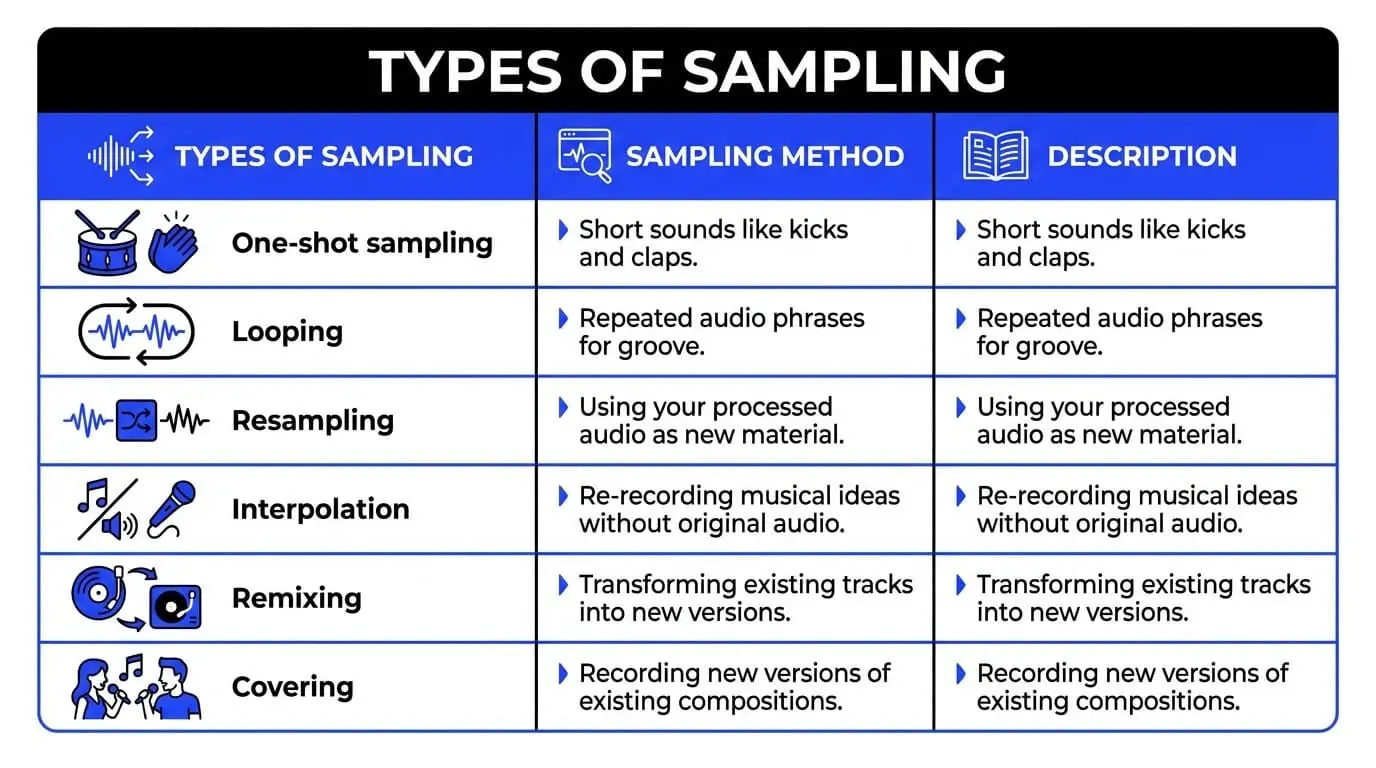
Sampling often overlaps with loops, remixes, covers, interpolations, and sound design, but those terms do not mean the same thing. Understanding the difference helps producers make better creative choices and avoid legal confusion.
| Term | What it uses | What the producer is doing |
|---|---|---|
| Sampling | A piece of existing recorded audio | Using actual audio from a recording as part of a new work |
| Interpolation | A melody, lyric, chord movement, or musical idea | Re-recording the idea without using the original audio file |
| Looping | A repeated audio or MIDI phrase | Repeating a section to create groove, structure, or momentum |
| Remixing | Stems, parts, or a finished recording | Creating a new version by rearranging or transforming an existing track |
| Covering | An existing composition | Performing and recording a new version of a song |
| Resampling | Your own processed audio | Bouncing audio and using it again as new source material |
This distinction matters because audio sampling uses the actual sound recording, while interpolation uses a musical idea without copying the recording itself. In production terms, interpolation gives the producer more control over sound and arrangement. In legal terms, it may avoid the master recording license, although the composition rights can still matter.
Why sampling became fundamental
Sampling became fundamental because it solves creative problems that traditional performance and synthesis do not always solve. It gives producers access to rhythm, texture, realism, history, imperfection, and contrast. A sampled drum break can carry a groove that is difficult to program by hand. A sampled vocal fragment can add emotional color without becoming a full lead vocal. A found sound can make a track feel connected to a place, scene, or memory. A chopped soul chord can become the harmonic center of a beat without sounding like a standard keyboard preset.
For beat makers, sampling is a way to build groove quickly. For electronic producers, it is a way to turn ordinary sounds into new timbres. For pop producers, it can provide recognizable hooks and nostalgic references. For film and game composers, it can become a sound design tool for atmospheres, impacts, transitions, and hybrid instruments. For beginners, sampling is one of the fastest ways to learn arrangement because loops and one-shots make it easy to hear how rhythm, repetition, and variation work inside a track.
How sampling evolved from tape to DAWs
Tape collage and musique concrete
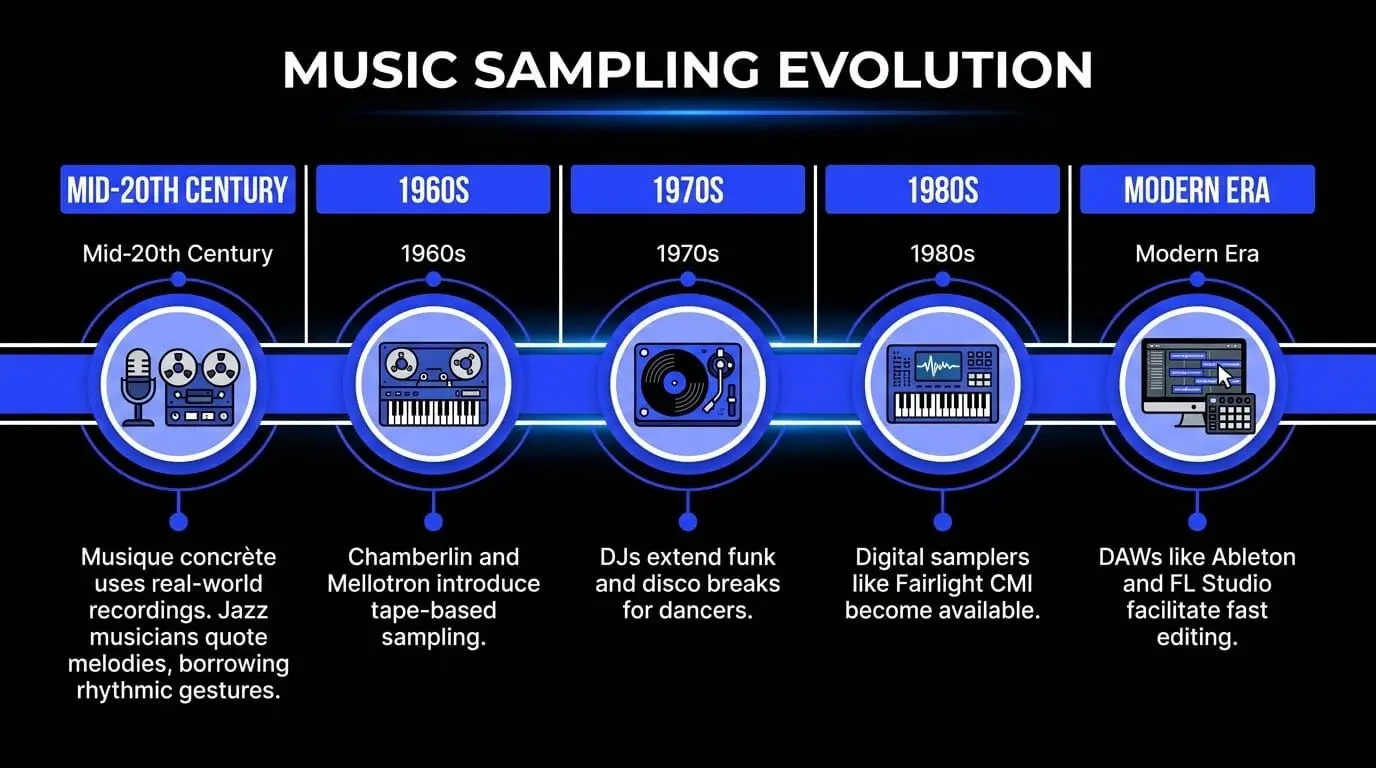
The roots of sampling reach back before digital samplers. In the mid-twentieth century, composers began using recorded sound as raw musical material. Musique concrete was especially important because it treated real-world recordings as compositional objects. Instead of writing only for traditional instruments, composers recorded trains, voices, machines, percussion, and environmental sounds, then edited and arranged them with tape techniques such as splicing, reversing, looping, and speed changes.
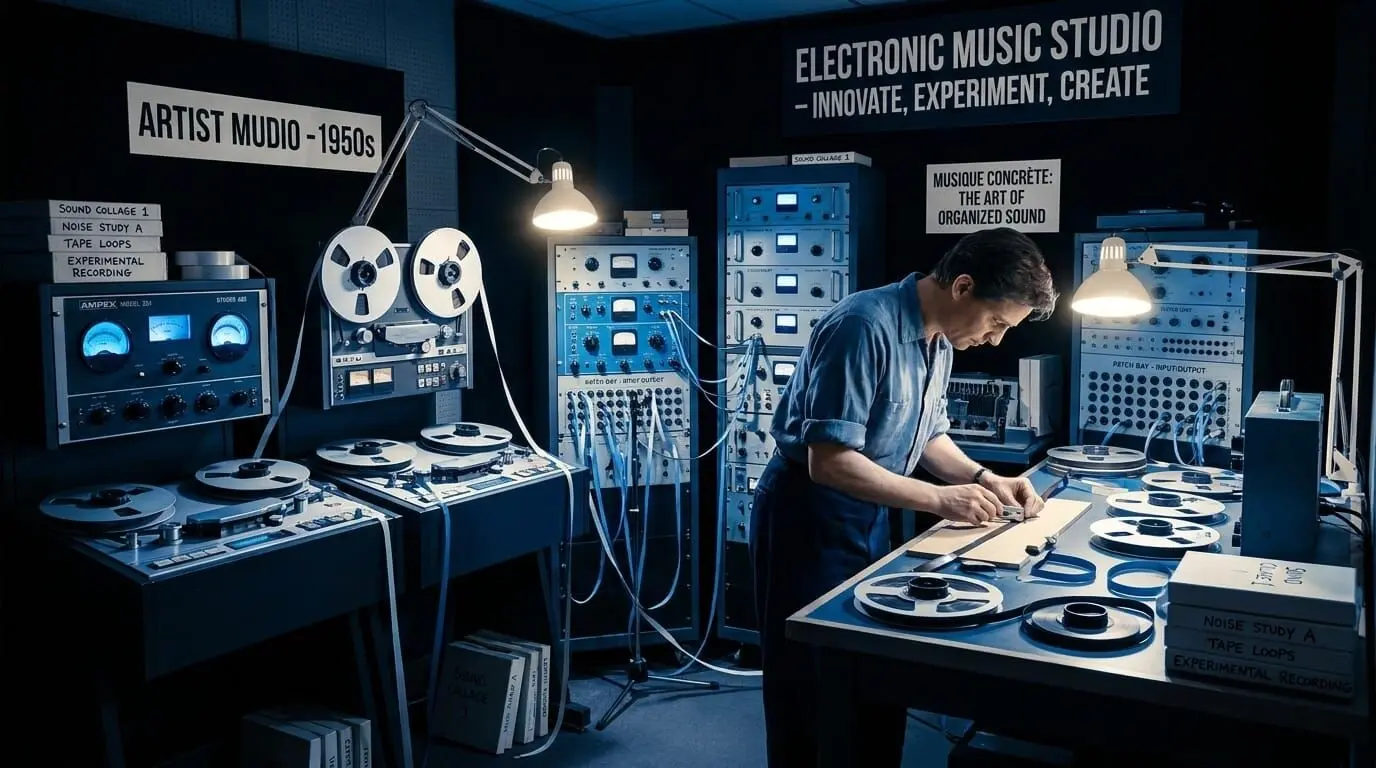
This early work matters because it introduced a core idea behind sampling in music production: a sound does not need to come from a conventional instrument to become musical. A door, a radio burst, a footstep, a speech fragment, or a mechanical rhythm can become part of a composition when it is selected, repeated, transformed, and placed in context.
Jazz, collage, and the culture of quoting
Sampling also has a cultural ancestor in jazz and other improvisational traditions. Jazz musicians often quoted melodies, reworked standards, borrowed rhythmic gestures, and built new performances from shared musical memory. This was not digital sampling, because no actual audio recording was copied into a new record. Still, the mindset is related. Sampling continues that tradition with recorded sound: it allows a producer to create conversation between past and present.
That cultural conversation is one reason sampling can feel so powerful. A sample can bring historical memory into a new beat. It can connect a modern producer to funk, soul, gospel, jazz, disco, rock, video games, regional music scenes, advertising jingles, or everyday sound. The sample becomes more than a sound source. It becomes a reference point.
The Chamberlin, the Mellotron, and keyboard-based sampled sound
Before affordable digital sampling, tape-based keyboard instruments pointed toward the same concept. The Chamberlin and the Mellotron used recorded tape strips triggered by keys. Press a key, and the instrument plays back a recording of a flute, string section, choir, or other source. These machines were not samplers in the modern DAW sense, but they introduced a major idea: recorded performances could be mapped across a keyboard and performed like an instrument.
That idea is still central today. A modern orchestral library, drum sampler, piano instrument, or vocal chop rack is built on the same basic promise. The producer is not only playing a synthesized tone. The producer is triggering recorded sound.
Breakbeats, hip-hop, house, and the loop as an instrument
Sampling in hip hop changed music production because it turned the break into a compositional engine. DJs extended drum breaks from funk, soul, and disco records so dancers could move to the most rhythmic sections. As samplers became available, producers could capture those breaks, loop them, chop them, layer them, and sequence them into new beats. The loop became an instrument, and the sampler became a performance tool.
House and other forms of electronic music also relied heavily on looping. Disco fragments, drum machine hits, vocal hooks, bass riffs, and percussion grooves could be repeated and rearranged into dance tracks. In both hip-hop production and club music, sampling made repetition expressive. A loop could hypnotize the listener, while small changes in filtering, arrangement, muting, and layering created movement.
Digital samplers and producer accessibility
Early digital instruments such as the Fairlight CMI and E-mu Emulator were powerful but expensive. Later hardware samplers and workstations made digital sampling more accessible to beat makers, studios, and independent producers. Devices from Akai, E-mu, Roland, Ensoniq, and others changed the workflow by combining audio capture, pads or keys, sequencing, storage, and performance control.
The most important shift was not only technical. It was cultural. Sampling allowed producers who did not have access to large studios, session musicians, or formal conservatory training to build sophisticated tracks from records, drum hits, household sounds, and fragments of performance. This helped expand who could make music and what counted as musical skill.
The current era of software, stems, and fast editing
Today, a producer can sample inside almost any DAW. Ableton Live, FL Studio, Logic Pro, Pro Tools, Cubase, Studio One, Reason, Reaper, Maschine, MPC software, and many mobile apps allow audio to be sliced, warped, triggered, and arranged quickly. Modern tools also make it easier to detect tempo, identify key, separate stems, remove noise, match timing, and turn a sample into MIDI or a playable instrument.
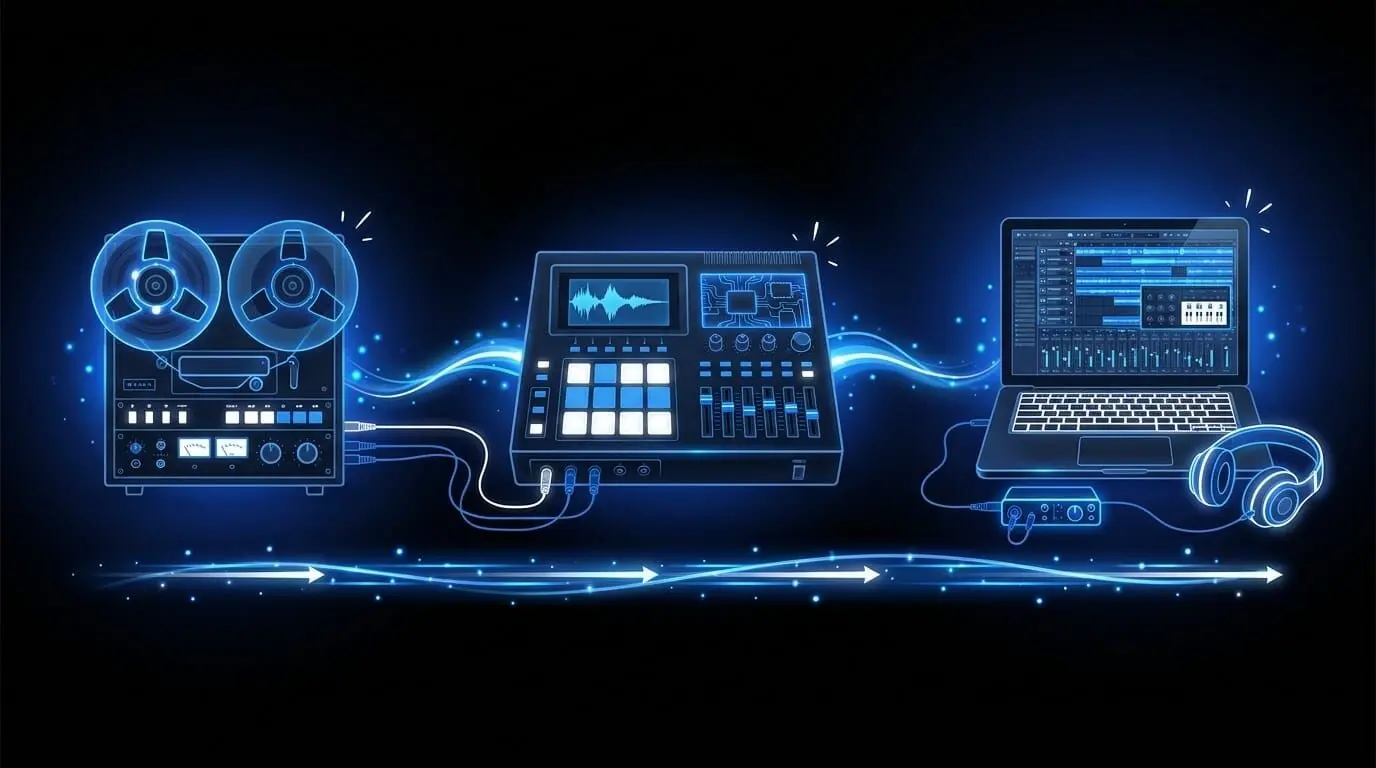
This has changed the workflow. Earlier sampling often required physical digging, hardware memory limits, and slow editing. Modern digital sampling makes experimentation fast. A producer can record a voice memo, stretch it across eight bars, reverse it, chop it into pads, add granular processing, and resample the result in minutes. The challenge is no longer only access. The challenge is taste, originality, arrangement discipline, and rights management.
Main types of sampling in music
One-shot sampling
A one-shot sample is a short sound played once when triggered. Kick drums, snares, claps, hats, impacts, vocal shouts, bass hits, orchestral stabs, and sound effects are common one-shots. One-shots are useful because they can be sequenced like drum machine sounds while still carrying the texture of a recording.
- Beat makers use one-shot drums to build custom kits.
- Electronic producers use one-shots for impacts, risers, foley hits, and percussion layers.
- Pop producers use vocal one-shots to create hooks, transitions, and ear candy.
- Film and game composers use one-shots for hits, booms, UI sounds, and hybrid percussion.
Loop sampling
A loop sample is a repeated musical phrase. It can be a drum break, guitar riff, piano progression, percussion groove, vocal phrase, bassline, or full musical section. Loop-based music works when repetition feels intentional, not lazy. The producer must shape the loop through arrangement, filtering, chopping, muting, layering, and contrast.
A strong loop can become the identity of a track, but it can also trap the producer into a static arrangement. The solution is to create development. Drop elements out. Change the drums. Filter the sample during transitions. Chop it differently in the chorus. Add counter-melodies. Use silence. A loop becomes musical when the listener feels movement across time.
Melodic and harmonic sampling
Melodic samples include phrases with identifiable pitch, such as piano chords, guitar riffs, string lines, vocal melodies, synth hooks, horns, or basslines. These samples need special attention because they influence key, harmony, and emotional direction. A beautiful melodic sample can make a beat feel complete quickly, but it can also clash with added bass, vocals, or chords if the producer does not understand the key center.
Good practice is to identify the key, decide whether to keep or change it, then build the rest of the arrangement around that decision. Pitch shifting by one or two semitones can change the mood. Larger shifts can create unnatural artifacts, which may be useful for lo-fi, experimental, or hyperpop textures.
Vocal sampling
Vocal samples can be lyrical phrases, breaths, shouts, ad-libs, single syllables, spoken words, choir notes, or chopped vowel sounds. They are powerful because the human voice attracts attention quickly. Even a tiny vocal texture can make a beat feel more emotional or memorable.
Vocal sampling requires taste. A phrase with clear words can dominate the track or create copyright and clearance issues. Non-lyrical chops are often easier to use as texture, especially when pitched, reversed, filtered, or rearranged. Producers also create their own vocal samples by recording humming, whispers, stacked harmonies, or nonsense syllables, then processing them into pads, leads, and rhythmic hooks.
Field recording and found sound sampling
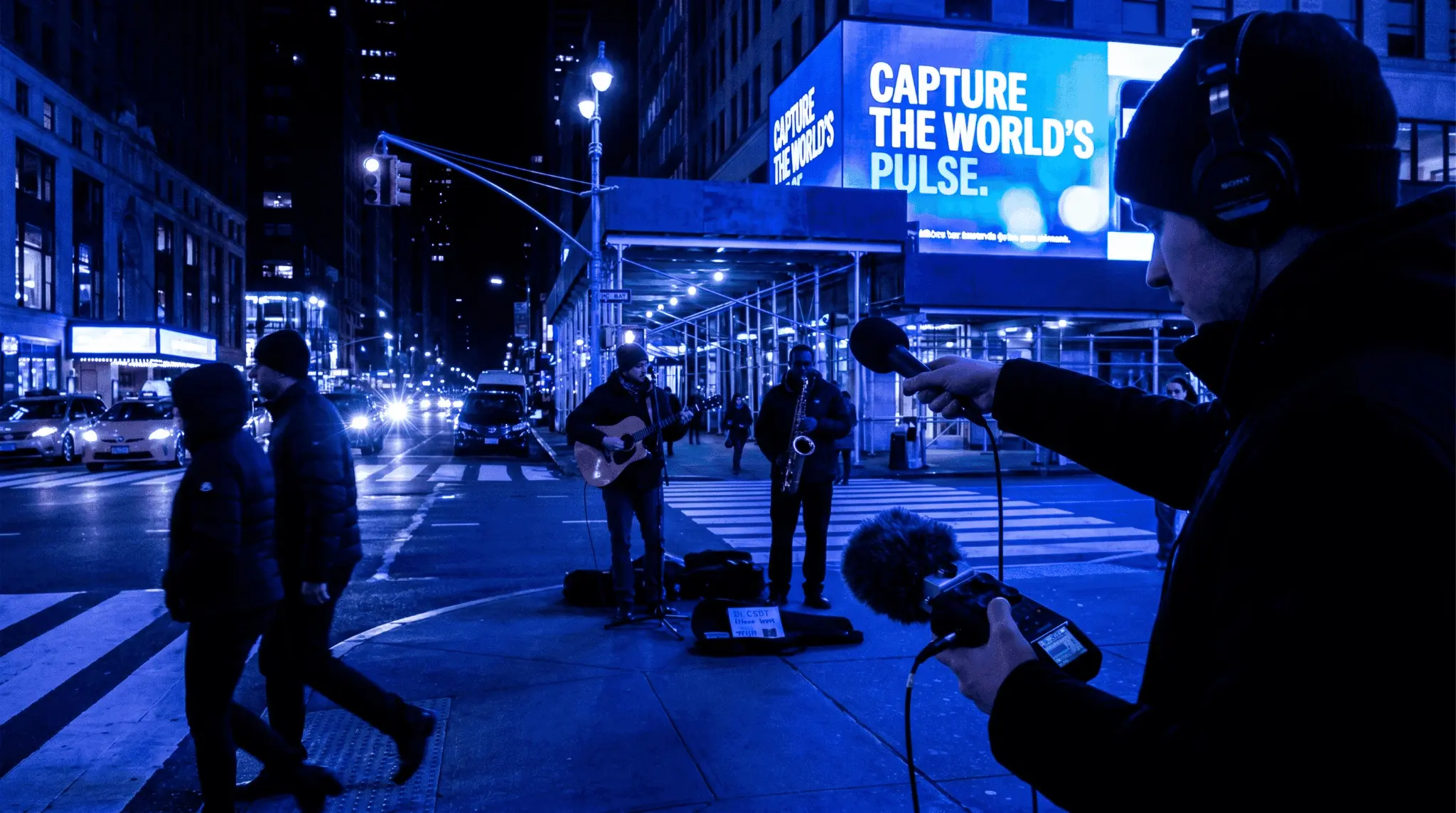
Samples do not have to come from music. Field recordings can include trains, rain, footsteps, crowds, doors, traffic, kitchen sounds, hand percussion, room tone, birds, switches, paper, or everyday objects. This is one of the most flexible audio sampling methods because it gives the producer unique material that nobody else has.
Field recordings are useful for atmosphere, rhythm, transitions, and sound design. A subway recording can become a drone. A lighter click can become percussion. A room tone can glue a scene together. A hand tap on a desk can become the attack layer of a snare. This is where sampling connects closely to sound design.
Multisampling and instrument building
Multisampling means recording many notes, velocities, or articulations of an instrument and mapping them across keys or pads. This is how realistic piano libraries, drum kits, orchestral instruments, and sampled synth patches are often built. Instead of one sample stretched across the keyboard, the instrument uses many samples so each note range sounds natural.
For producers, multisampling is useful when building a personal instrument library. You can sample an old keyboard, a guitar note, a bottle, a toy piano, or a vocal tone at several pitches, then map the recordings into a sampler. The result is a playable instrument with your own sonic signature.
Stem sampling and micro-sampling
Stem sampling uses isolated parts of a recording, such as drums, vocals, bass, or instruments. Modern source separation makes stems easier to create, although rights issues still apply when the source is copyrighted. Micro-sampling uses tiny fragments such as clicks, consonants, attacks, transients, breaths, or single notes. These fragments can be rearranged into new rhythms or textures that barely resemble the source.
Micro-sampling is valuable because it pushes sampling away from obvious borrowing and toward new sound design. A producer can take a vocal consonant, turn it into hi-hat texture, resample it through distortion, then layer it under drums. The listener may never identify the source, but the track gains detail and movement.
Where producers find samples
Royalty-free sample packs
Royalty-free sample packs are one of the easiest starting points for beginners. In this context, royalty-free usually means the buyer can use the sounds in music without paying ongoing royalties to the sample creator. It does not always mean free of cost, and it does not always mean unlimited rights for every use. Producers should read the license carefully, especially for restrictions around redistribution, sample pack creation, content ID, sync licensing, or isolated sample resale.
Royalty-free packs work well for drums, percussion, risers, impacts, atmospheres, textures, and construction kits. They are convenient and usually safer than ripping a sample from a copyrighted song. The main downside is originality. If many producers use the same loop unchanged, the result can sound generic. The better approach is to treat packs as raw material, not finished ideas.
Paid sampling and licensing services
Paid sample services can provide curated libraries, subscription access, pre-cleared loops, one-shots, and sometimes licensing pathways for recognizable catalog material. These platforms help producers move faster, but they still require careful reading. The license determines what is allowed. Some services allow broad commercial use. Others have limitations depending on whether the sample is used in isolation, in sync media, in templates, or in monetized content.
Vinyl, archives, and old media
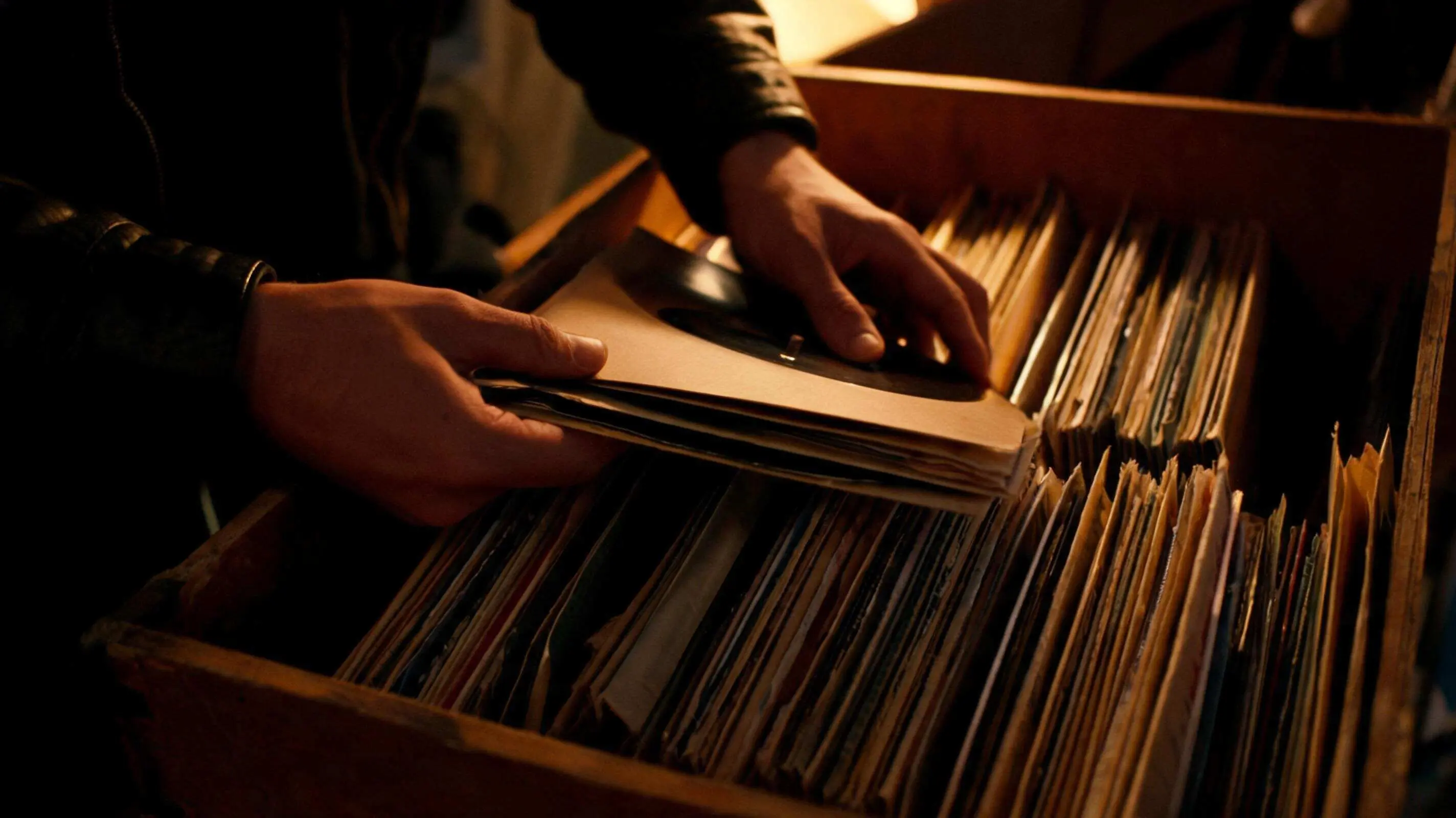
Traditional digging through vinyl, tapes, CDs, film audio, radio recordings, and library music remains a major part of sampling culture. The advantage is character. Older recordings often contain room tone, analog saturation, performance imperfections, and arrangements that feel different from modern loops. The disadvantage is legal complexity. A commercially released old record can still be protected, and an obscure recording is not automatically safe.
Self-recorded samples
Recording your own samples is one of the best ways to develop an original sound while avoiding many clearance problems. A producer can build a personal library from hand percussion, room sounds, friends playing instruments, voice memos, modular synth jams, guitar noises, household objects, or outdoor recordings. These sounds can be edited, labeled, and reused across projects.
Self-recording also teaches better listening. You begin to notice attack, decay, room reflections, noise floor, distance, transients, and texture. These details help with mixing and sound design beyond sampling.
Public domain and Creative Commons material
Public domain recordings and permissively licensed Creative Commons material can be useful, but producers should verify the status carefully. A composition might be public domain while a specific recording is not. A Creative Commons license might require attribution, prohibit commercial use, or prevent derivative works. The safest approach is to document the source, license type, date accessed, and any usage conditions before releasing music.
Sources beyond old records
- Voice memos recorded during rehearsals or writing sessions.
- Original drum hits made from objects, claps, taps, boxes, and layered foley.
- Hardware synth phrases bounced to audio and resampled.
- Live instrument one-shots recorded through inexpensive microphones.
- Atmospheres from parks, streets, kitchens, stations, crowds, and rooms.
- Old personal recordings that you own, such as family instruments or rehearsal tapes.
- Generated textures that are exported, chopped, and treated as audio rather than left as presets.
How to sample music in a DAW
A practical beginner workflow
The easiest way to learn how to sample music is to start with a short loop or one-shot and build a small beat around it. The goal is not to use every feature in the DAW. The goal is to understand the chain from source selection to arrangement.
- Choose a source. Start with a royalty-free loop, your own recording, or a sound you have permission to use. Avoid commercial copyrighted songs while practicing for public release.
- Import the audio into your DAW. Place it on an audio track or load it into a sampler, drum rack, slicer, or audio editor.
- Find the tempo. Use the DAW tempo detection, tap tempo, or manual warping. Make sure the sample loops cleanly before building the beat.
- Find the key if the sample is melodic. Use your ear, a tuner, a piano roll, or key detection as a starting point. Then confirm by playing bass notes under the sample.
- Decide whether to loop or chop. Looping preserves the original phrase. Chopping gives you more control and helps create a new rhythm.
- Time-stretch or pitch-shift. Match the project tempo and key, but listen for artifacts. Sometimes artifacts are useful; sometimes they weaken the sound.
- Program supporting drums or instruments. Leave space for the sample, especially if it already contains rhythm or harmony.
- Process the sample. Use EQ, filtering, compression, transient shaping, saturation, reverb, delay, sidechain compression, stereo width, or modulation.
- Arrange the track. Create an intro, main section, variation, breakdown, and ending. Avoid letting the sample loop unchanged for the entire song.
- Check rights before release. If the source is not yours or properly licensed, do not assume transformation alone makes it safe.
Working with tempo
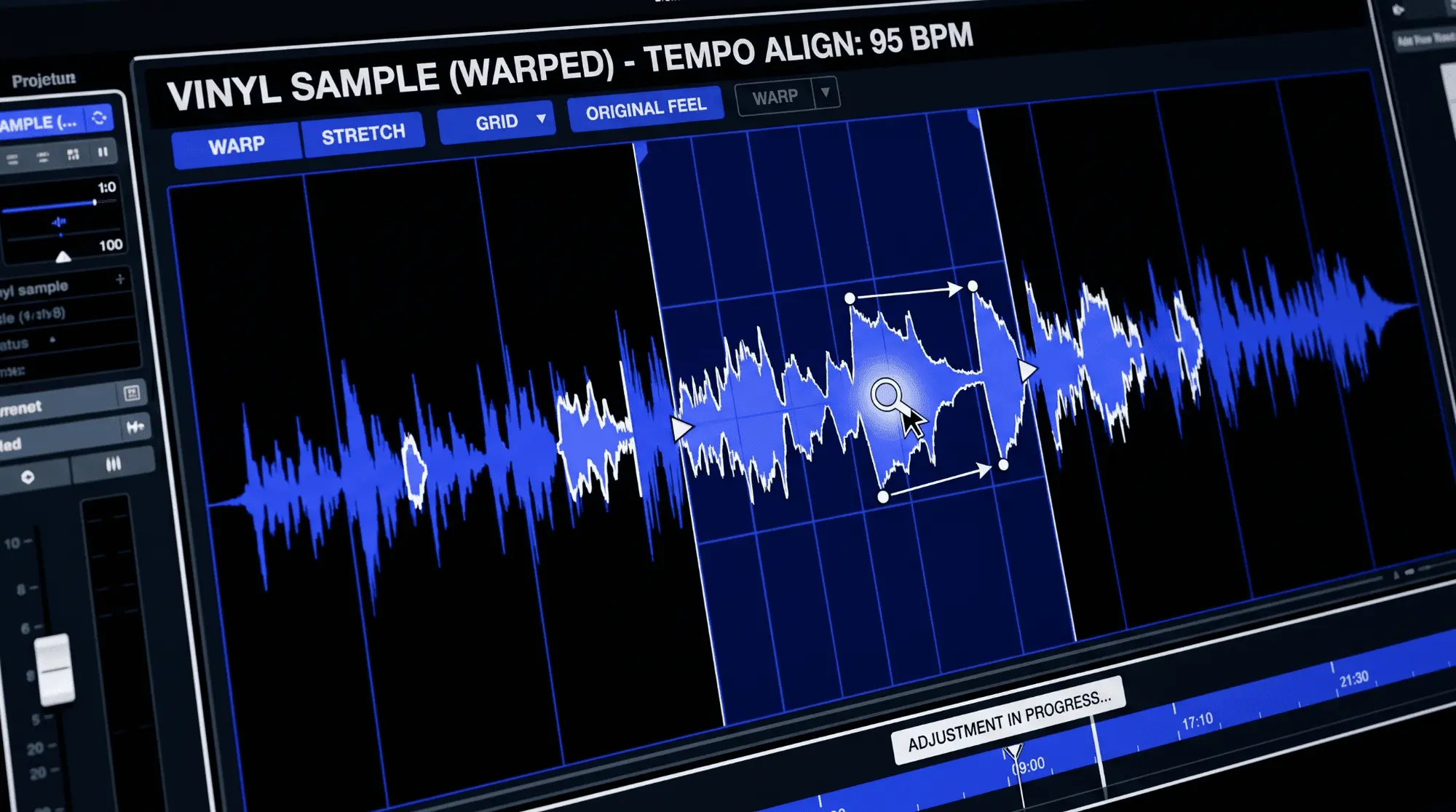
Tempo problems are common in sampling. Old recordings often drift because they were played by live musicians or transferred from tape or vinyl. A DAW can warp audio to a fixed grid, but over-correcting can remove feel. For drums, keep enough natural swing to preserve groove. For melodic samples, stretch gently when possible. If the sample is too far from the target tempo, consider chopping it rather than forcing it to stretch unnaturally.
Working with key and pitch
Pitch shifting changes both musical key and sound character. Raising a sample can make it brighter, tighter, or more energetic. Lowering it can make it darker, slower, or heavier. Extreme pitch changes can create artifacts, but those artifacts are part of many modern styles. In trap, lo-fi, jungle, footwork, hyperpop, and experimental electronic music, the unnatural texture of stretched or pitched audio can become a feature.
Making a sample fit the mix
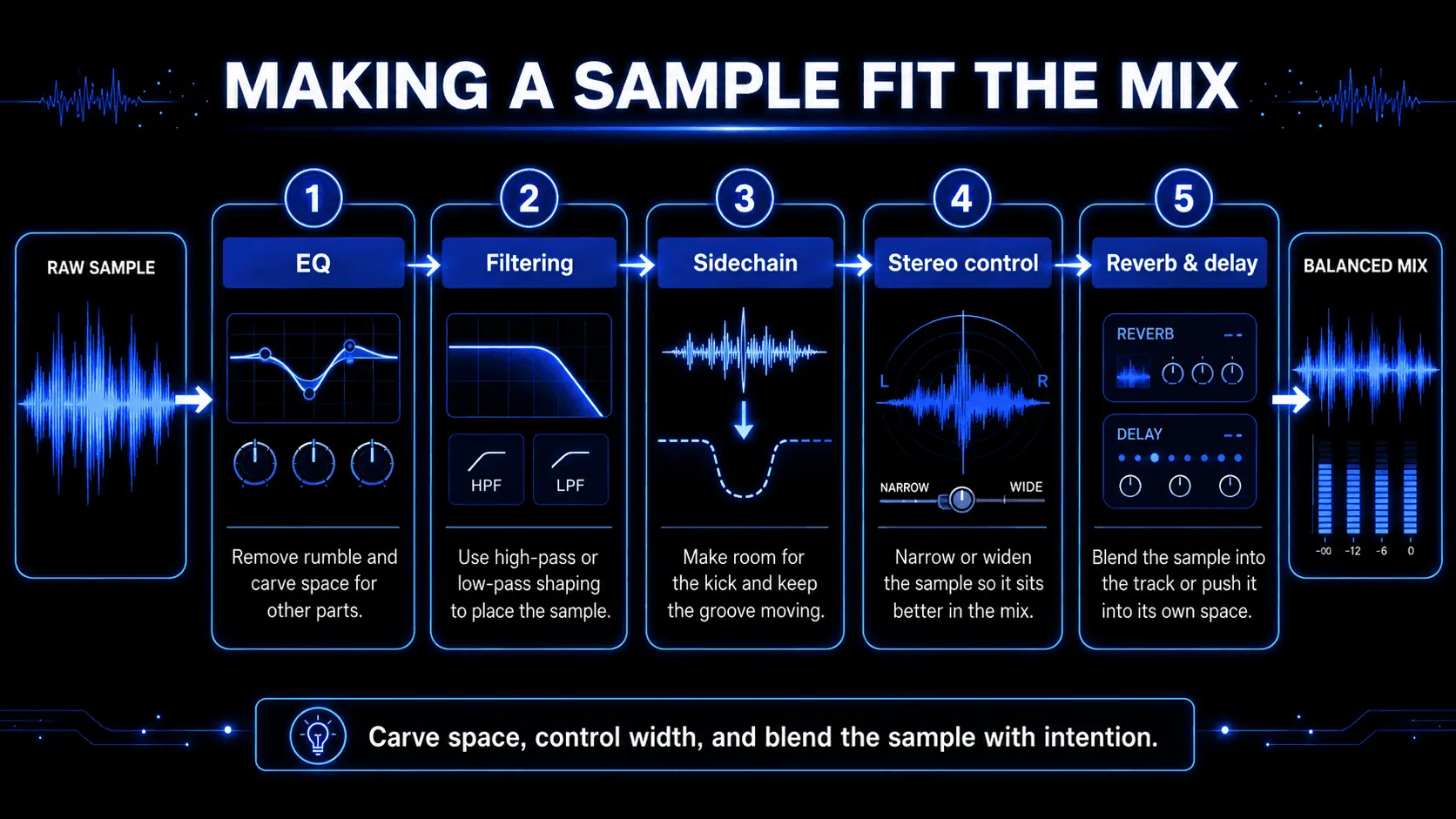
A sample often contains frequencies that fight with new drums, bass, vocals, or synths. EQ is usually the first fix. High-pass filtering can remove rumble. Low-pass filtering can make a bright sample sit behind vocals. Notching harsh resonances can reduce fatigue. Sidechain compression can create space for the kick. Stereo narrowing can keep a wide sample from crowding the mix. Reverb and delay can either blend the sample with the track or push it into a separate space.
Building original samples with ACE Studio
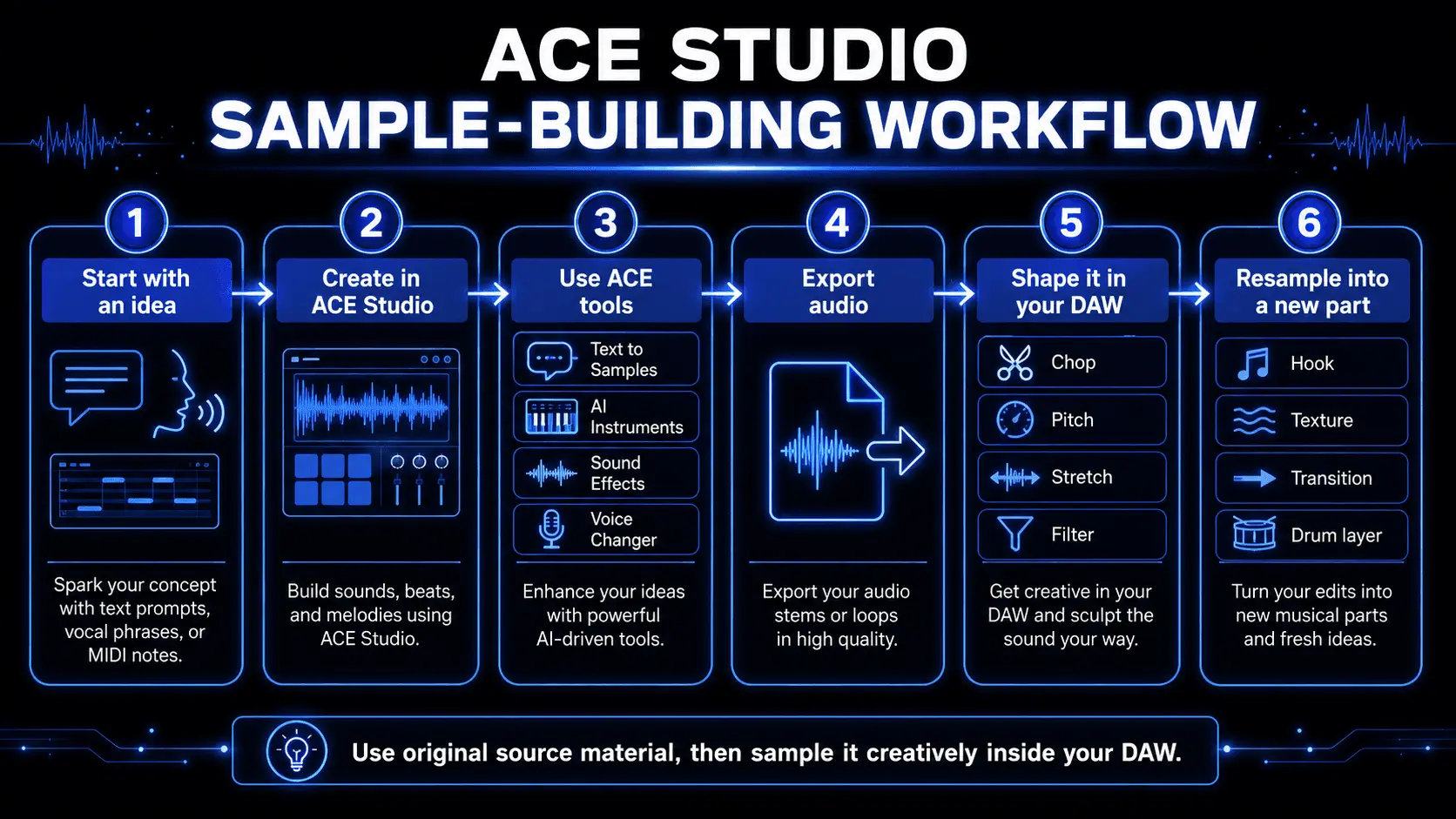
One of the safest and most creative ways to sample music is to build your own source material. Instead of pulling a recognizable phrase from a protected recording, you can create a short vocal idea, instrumental phrase, texture, sound effect, or loop, then treat that audio like a sample. You still get the creative feel of sampling – chopping, reversing, pitching, layering, stretching, filtering, and resampling – but the starting point belongs to your own session.
That is where ACE Studio gives producers a useful advantage. It can help you create new sample-ready material from scratch, reshape rough ideas, and turn fixed audio into parts you can edit with more control.
For example, Text to Samples can generate sample loops from a written prompt, which gives producers a fast way to create original material instead of searching through the same loop packs as everyone else. You might generate a dusty piano phrase, a soft ambient layer, a rhythmic texture, or a small melodic idea, then export it, chop it, pitch it, and resample it inside your DAW. The value is not that the generated loop finishes the track for you. The value is that it gives you a fresh starting point that can be shaped into something personal.
ACE Studio’s Sound Effects tool is also useful for producers who treat sampling as sound design. If a beat needs a transition, impact, riser, room tone, glitch, atmosphere, or background movement, you can create a custom effect for that moment instead of forcing a generic sample to fit. Sound Effects is a tool for generating sound design elements inside an ACE Studio project based on a prompt.
There is also a strong sampling use case for Voice Changer. ACE Studio can transform a vocal track into another voice or even into instrument-like sounds while keeping the melody and lyrics unchanged. That opens up a different kind of resampling: you can record or sketch a simple vocal line, transform its tone, then chop the result into hooks, pads, stabs, or melodic fragments.
For melodic sampling, AI Instruments give you another path. Instead of relying only on old records or static loops, you can write a MIDI phrase and generate an expressive instrument performance from it. ACE Studio’s docs describe AI Instruments as a way to generate human-level performances with MIDI, and the official download page highlights realistic instrument performances without bulky sample libraries. That matters for sampling because the result can be bounced to audio and treated like any other sample: chopped, filtered, reversed, stretched, or layered under drums.
ACE Studio can also help when a sample begins as audio but needs to become editable. With Stem Splitter, you can separate a track into stems, which is useful when working with your own demos, licensed material, or practice sources. With Vocal to MIDI & Lyrics, a vocal line can become editable MIDI and lyrics, giving you more control over pitch, timing, and phrasing before you turn it back into audio. ACE’s homepage describes this directly: users can separate vocals from a track, convert vocal lines into editable MIDI, and regenerate them with AI singing voices.
A practical producer approach could look like this:
- Create a short original phrase in ACE Studio using Text to Samples, AI Instruments, Sound Effects, or a vocal idea.
- Export the result as audio.
- Chop it into smaller pieces inside your DAW.
- Pitch, reverse, filter, stretch, or layer it like a traditional sample.
- Resample the processed version into a new hook, texture, drum layer, or transition.
This keeps the spirit of sampling alive while reducing dependence on uncleared recordings. You are still making the creative choices: what to keep, what to cut, what to repeat, what to hide, what to exaggerate, and what to turn into something new.
It also connects to the legal side of sampling. ACE Studio does not claim copyright ownership over user-generated outputs, and that outputs can generally be used in commercial or non-commercial projects unless a specific feature, model, voice, instrument, or third-party service states otherwise. The same page also makes an important point for sampling: users are responsible for having the necessary rights to any input materials they provide.
So ACE Studio is not a shortcut around copyright. It is better understood as a way to create more of your own source material, then sample that material with intention. For producers learning what sampling is, that is an important shift. Sampling does not have to mean taking from finished records. It can also mean generating, recording, transforming, and reusing your own sounds until they carry the texture, rhythm, and identity of a real sample.
Core music sampling techniques
Looping
Looping is the foundation of much sample-based music. A loop can hold the groove, harmony, or atmosphere while the producer builds around it. The key is to make repetition feel musical. Change the drums around the loop. Automate filters. Add fills. Create call-and-response. Mute the loop before a drop. Bring it back with a different bassline. A loop can be simple and still feel alive if the arrangement evolves.
Chopping and re-sequencing
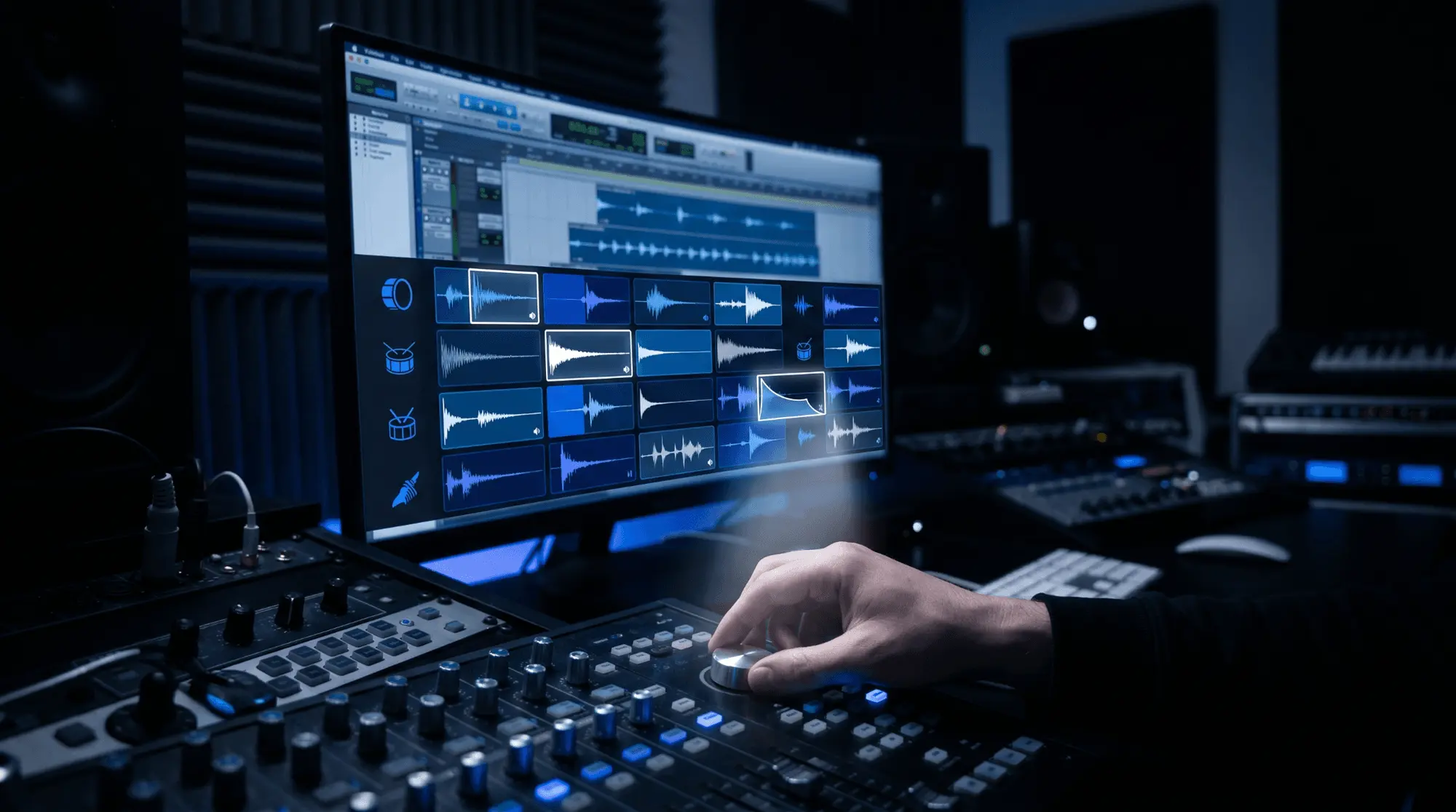
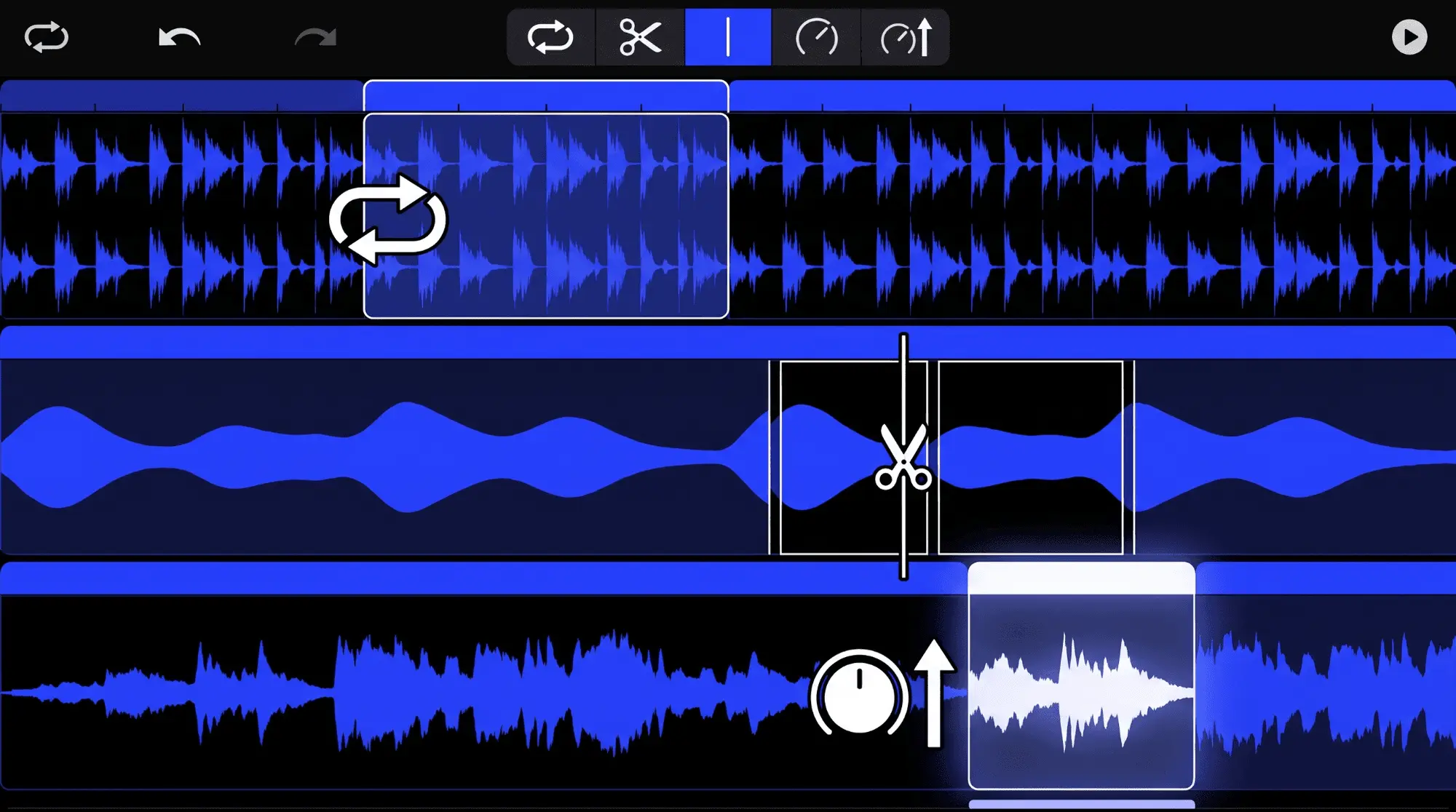
Chopping means slicing audio into smaller pieces. Re-sequencing means triggering those pieces in a new order. This is one of the most important music sampling techniques because it lets producers transform source material rather than simply repeat it. A four-bar phrase can become new chords, stabs, rhythms, and fills. A drum break can be split into kick, snare, hat, ghost note, and percussion slices. A vocal can become a playable hook.
Good chopping depends on listening for useful entry points. Transients are obvious slice points, but musical phrasing matters too. Chopping slightly before or after a transient can preserve feel. Leaving small gaps can create bounce. Overlapping slices can make a sample smoother. Tight quantization can sound mechanical; loose timing can sound human.
Pitch shifting and time stretching
Pitch shifting changes the note or key of a sample. Time stretching changes the duration without necessarily changing pitch. Together, they let producers adapt audio to a new tempo and harmonic setting. These tools are essential in modern digital audio work, but they should not be treated as automatic fixes. Every algorithm has a sound. Some preserve drums well. Some preserve vocals. Some create metallic or grainy artifacts. Choosing the right mode is part of the craft.
Filtering and subtractive shaping
Filtering turns a sample into a more flexible arrangement element. A low-pass filter can make a bright sample feel distant or vintage. A high-pass filter can create space for bass. A band-pass filter can turn a full mix sample into a telephone-like texture. Filter automation is especially useful for transitions because it changes energy without adding new parts.
Layering
Layering combines samples to create a fuller sound. Producers often layer drums, such as a clean kick under a dusty break or a bright clap over a roomy snare. Layering also works for melodic textures. A piano sample can sit under a synth pad. A vocal chop can be doubled with a flute-like synth. The goal is not simply more sound. The goal is complementary roles: attack, body, sustain, width, texture, and emotion.
Resampling
Resampling means recording or bouncing processed audio and using it again as new source material. This is one of the fastest ways to move beyond presets. For example, a producer can take a synth chord, add distortion and reverb, bounce it to audio, reverse it, chop it, pitch it down, and build a new hook. Resampling encourages commitment and experimentation because audio is easier to cut, stretch, and manipulate than a live plugin chain.
Granular synthesis
Granular synthesis breaks audio into tiny grains and reorganizes them. This can turn a short sample into a long evolving texture, a pad, a shimmer, a glitch rhythm, or a frozen atmosphere. Granular processing is especially useful for ambient music, cinematic sound design, experimental pop, and electronic transitions. It is also a strong example of sampling as transformation rather than simple reuse.
Reverse, stutter, and glitch editing
Reverse sampling can create tension, swells, and unexpected transitions. Stutter editing repeats tiny fragments to create rhythmic movement. Glitch editing uses cuts, repeats, pitch jumps, dropouts, and artifacts as musical events. These techniques work best when they support the groove and structure rather than distract from them.
Hardware and software sampling options
Producers can sample with a full DAW, a plugin sampler, a mobile app, a groovebox, a drum machine, or a standalone hardware sampler. The best option depends on budget, workflow, performance needs, and how much tactile control the producer wants.
| Approach | Best for | Strengths | Limits |
|---|---|---|---|
| DAW audio tracks | Arranging loops, editing vocals, building full songs | Large screen editing, automation, mixing, precise timing | Can feel less performative than pads or hardware |
| DAW sampler plugins | One-shots, key mapping, slicing, instrument building | Fast integration with MIDI, effects, routing, and automation | Depends on computer and DAW setup |
| ACE Studio | Creating original sample material, separating stems, shaping vocal ideas, adding AI instrument layers | Stem Splitter, Vocal to MIDI & Lyrics, AI vocals, AI instruments, voice shaping, custom textures | Best paired with a DAW or sampler for detailed chopping, sequencing, and final mixing |
| Pocket samplers | Sketching ideas and lo-fi textures | Portable, immediate, fun for creative limits | Small memory, limited editing, less detailed mixing |
| Grooveboxes | Beat making without a laptop | Pads, sequencing, performance control, focused setup | Less flexible than a full DAW for final mix work |
| Performance samplers | Live triggering, transitions, effects, resampling | Hands-on control, strong for stage and beat sets | Project management can be slower |
| Standalone workstations | Complete production outside the computer | Sampling, sequencing, drums, MIDI, arrangement, performance | Higher cost and learning curve |
DAW-based sampling
DAW-based sampling is the most flexible option for most producers. It allows detailed editing, tempo warping, pitch correction, plugin processing, stem organization, arrangement, and mixing inside one environment. It is ideal for long-form production, vocal arrangement, complex automation, and final delivery.
Hardware samplers and grooveboxes
Hardware samplers remain popular because they encourage performance and decision-making. Devices such as compact pocket samplers, pad-based grooveboxes, performance samplers, drum computers, and MPC-style workstations make sampling physical. Pads invite finger drumming. Knobs invite filtering. Resampling becomes part of performance. The limitations can be productive because they reduce screen fatigue and force faster choices.
Common hardware categories include pocket samplers for portable ideas, grooveboxes such as rhythm-focused samplers, performance units in the SP style, drum computers with sampling capability, and standalone MPC-style systems. The right device is not the one with the longest feature list. It is the one that makes you finish more music.
Cultural impact and ethics of sampling
Sampling as musical memory
Sampling is culturally important because it turns recordings into memory objects. A sample can preserve a drum break, revive a forgotten record, introduce younger listeners to older genres, or connect a new artist to a musical lineage. It can function like quotation, collage, archive, remix, tribute, critique, and reinvention at the same time.
This is why the cultural impact of sampling is larger than production technique. It changed how listeners hear history. A modern beat can carry traces of gospel harmony, funk rhythm, jazz phrasing, disco groove, regional dance music, or everyday street sound. Sampling makes music feel layered with time.
Democratization and access
Sampling helped democratize production because producers could create complex music without hiring a full band or renting a major studio. A record collection, sampler, turntable, drum machine, and imagination could become a full production system. In the DAW era, that access has expanded even further. A laptop and a small audio interface can become a complete sampling studio.
Access, however, does not remove responsibility. Producers still need to think about copyright, attribution, cultural context, and fairness. Sampling from underrepresented traditions without understanding or credit can feel exploitative. Sampling can honor a source, but it can also erase the people behind it if the producer treats the original as anonymous raw material.
Respectful creative practice
- Learn where a sample comes from before building a release around it.
- Credit collaborators, sample creators, musicians, and vocalists when required or appropriate.
- Avoid presenting the distinctive performance of another artist as your own original recording.
- Use samples to create dialogue, not to hide dependence on another creator.
- When in doubt, use original recordings, licensed material, or interpolation rather than uncleared audio.
Legal issues in music sampling
This section is educational, not legal advice. Laws and outcomes vary by country, jurisdiction, contract, release type, and specific use. For commercial releases, sync placements, label deals, or high-value projects, speak with a qualified music attorney or clearance professional.
The two copyrights that matter
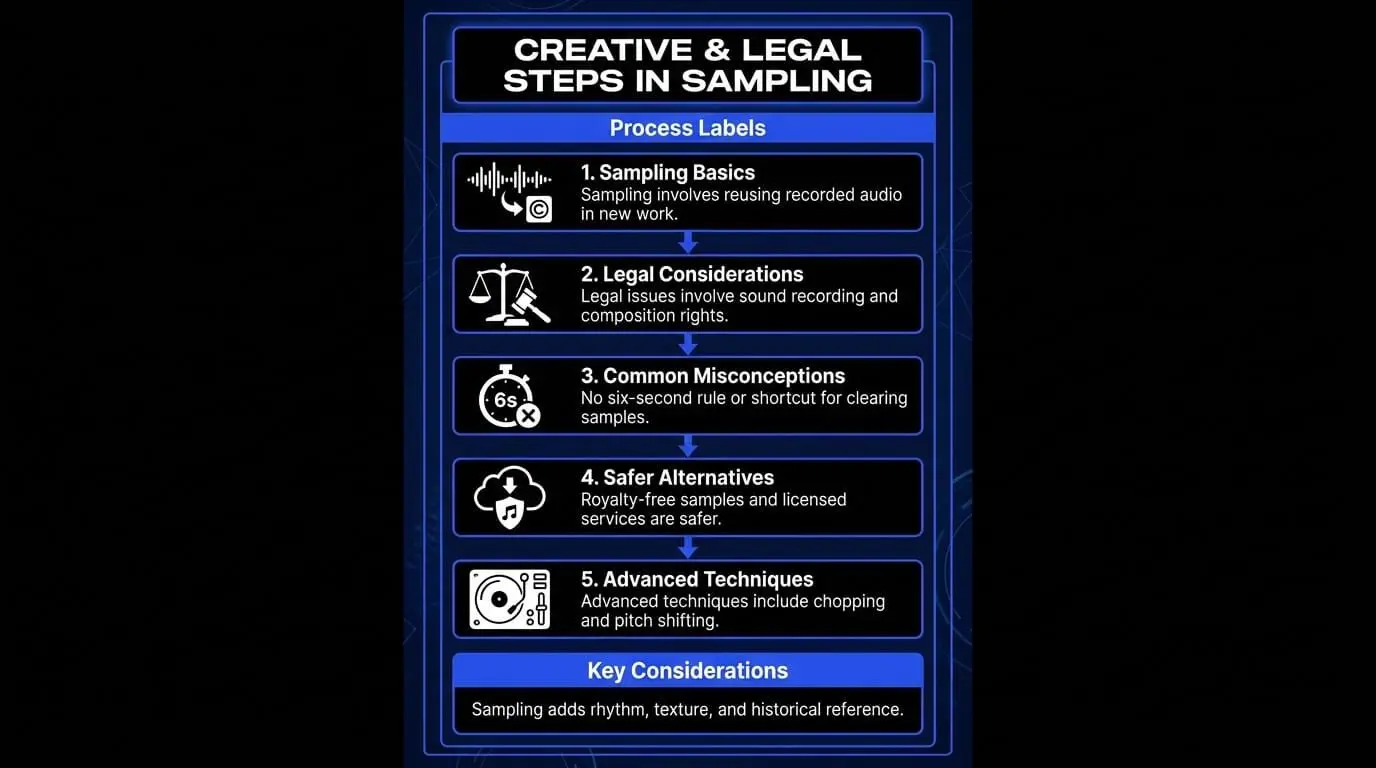
Most legal issues in music sampling begin with the fact that a song recording can involve two separate rights. The musical composition covers the underlying song: melody, lyrics, and composition. The sound recording covers the specific recorded performance fixed in an audio file, tape, vinyl, CD, or other medium. These rights can be owned by different people or companies. A songwriter, publisher, label, artist, producer, estate, or catalog company may be involved.
When you sample actual audio from an existing recording, you may need permission for the sound recording and the composition. When you interpolate a musical idea by re-recording it yourself, you may avoid the master recording license, but you may still need permission for the composition. This distinction is one of the most important practical concepts in music production sampling.
Common legal myths
- The six-second myth: There is no dependable rule that a sample becomes legal because it is under a certain length.
- The free-release myth: Giving a track away for free does not automatically remove copyright risk.
- The unrecognizable myth: Heavy processing may reduce practical detection risk, but it does not automatically create a legal shield.
- The credit myth: Crediting the original artist is respectful, but credit is not the same as permission.
- The low-stream myth: A small audience does not guarantee safety, especially when platforms use automated detection and rights owners can act later.
Fair use and why producers should be cautious
Fair use is often misunderstood. It is a legal defense, not a simple permission system. It usually depends on factors such as purpose, nature of the work, amount used, and market effect. In commercial music, fair use can be difficult to rely on because the sample is often part of the product being sold, streamed, synced, or monetized. Transformative use can matter, but transformation alone is not a magic rule.
Some cases have recognized very small or unrecognizable uses as de minimis in certain jurisdictions, while other decisions have taken a stricter view for sound recordings. This is one reason producers should not build release plans around internet myths. The safer mindset is simple: if the source is protected and you are using the actual audio, treat clearance as necessary unless a qualified professional tells you otherwise.
What affects clearance cost
There is no universal sample clearance price. Costs can depend on how recognizable the sample is, how famous the source is, how much of the sample is used, whether the sample forms the hook, how large the new artist is, whether the release is independent or label-backed, whether the use is audio-only or sync, and whether multiple rights holders need approval. A tiny texture from an obscure recording may be easier than a famous chorus from a major catalog, but obscure does not always mean simple.
Influential cases producers should know
Several legal disputes shaped modern sampling practice. Grand Upright Music v. Warner Bros. Records involved Biz Markie and helped push the industry toward routine sample clearance. Bridgeport Music v. Dimension Films took a strict view of sampling sound recordings in the Sixth Circuit and became known for its strong clearance-first message. VMG Salsoul v. Ciccone, involving a very brief horn segment, created an important contrast in the Ninth Circuit by recognizing a de minimis analysis for sound recordings. The practical lesson is that sampling law can be jurisdiction-specific and fact-specific.
A release-safe producer checklist
- Use royalty-free or self-recorded sounds when you do not have a budget for clearance.
- Save licenses, receipts, screenshots, and terms for every sample pack or service.
- Avoid using famous hooks, vocals, or melodies without permission.
- Do not assume that chopping, pitching, or reversing removes copyright risk.
- For commercial releases, involve a clearance specialist early, not after the song gains traction.
- Consider interpolation when the musical idea matters more than the actual recording texture.
Advanced sampling and technology trends
Stem separation and sample extraction
Stem separation tools can isolate vocals, drums, bass, and other instruments from mixed audio. This creates new creative possibilities because producers can work with parts that were once locked inside full recordings. A drum break can be separated from bass. A vocal can be extracted for remixing. A texture can be isolated for sound design.
ACE Studio is useful in this part of modern sampling because its Stem Splitter gives producers a way to pull a track apart before deciding what is worth keeping, reshaping, or rebuilding. For example, a producer working from their own demo could separate the vocal, drums, and instrumental bed, then use only the most interesting fragment as sample material. A weak full mix might contain one useful vocal phrase, one rhythmic pocket, or one atmospheric layer. Once separated, that detail becomes easier to edit, chop, mute, replace, or build around.
This is especially useful for producers who sample from their own sessions. A rough voice memo, rehearsal bounce, exported demo, or unfinished beat can become a source library instead of staying trapped as one flat audio file. You might extract a vocal idea, turn part of it into a hook, remove the drums from a melodic section, or isolate a bass movement that works better in a new arrangement.
However, stem separation does not erase copyright. If the original recording is protected, extracted stems usually raise the same rights questions as the full recording.
AI-assisted organization and transformation
AI-assisted tools can now suggest tempo, key, transients, stem categories, similar sounds, and arrangement ideas. They can help producers find samples faster and transform audio more deeply. The best use is not to let software make creative decisions, but to remove friction. Faster searching and slicing gives the producer more time to judge feel, emotion, groove, and originality.
ACE Studio adds another layer to this trend because it can help producers move between audio and editable musical material. A sampled or self-recorded vocal idea does not have to stay as a fixed waveform. With tools such as Vocal to MIDI & Lyrics, a vocal line can become something you can adjust in pitch, timing, phrasing, and lyric placement before turning it back into a new performance. That gives producers more control than simply stretching or tuning the original audio.
ACE Studio can also support sound design around samples. A producer might create a custom transition, atmosphere, choir layer, or instrument phrase to match the mood of a sample instead of searching through folders for something close enough. This keeps the producer in control of the final shape while making it easier to create original source material.
New licensing models
Sample licensing is slowly adapting to modern production. More services offer pre-cleared material, creator marketplaces, revenue-share systems, direct licensing, and catalog access designed for independent producers. These models can make sampling more ethical and practical by connecting sample creators, rights holders, and producers before release. The opportunity is a healthier ecosystem where creators can build on each other with permission, attribution, and compensation.
Metadata and attribution
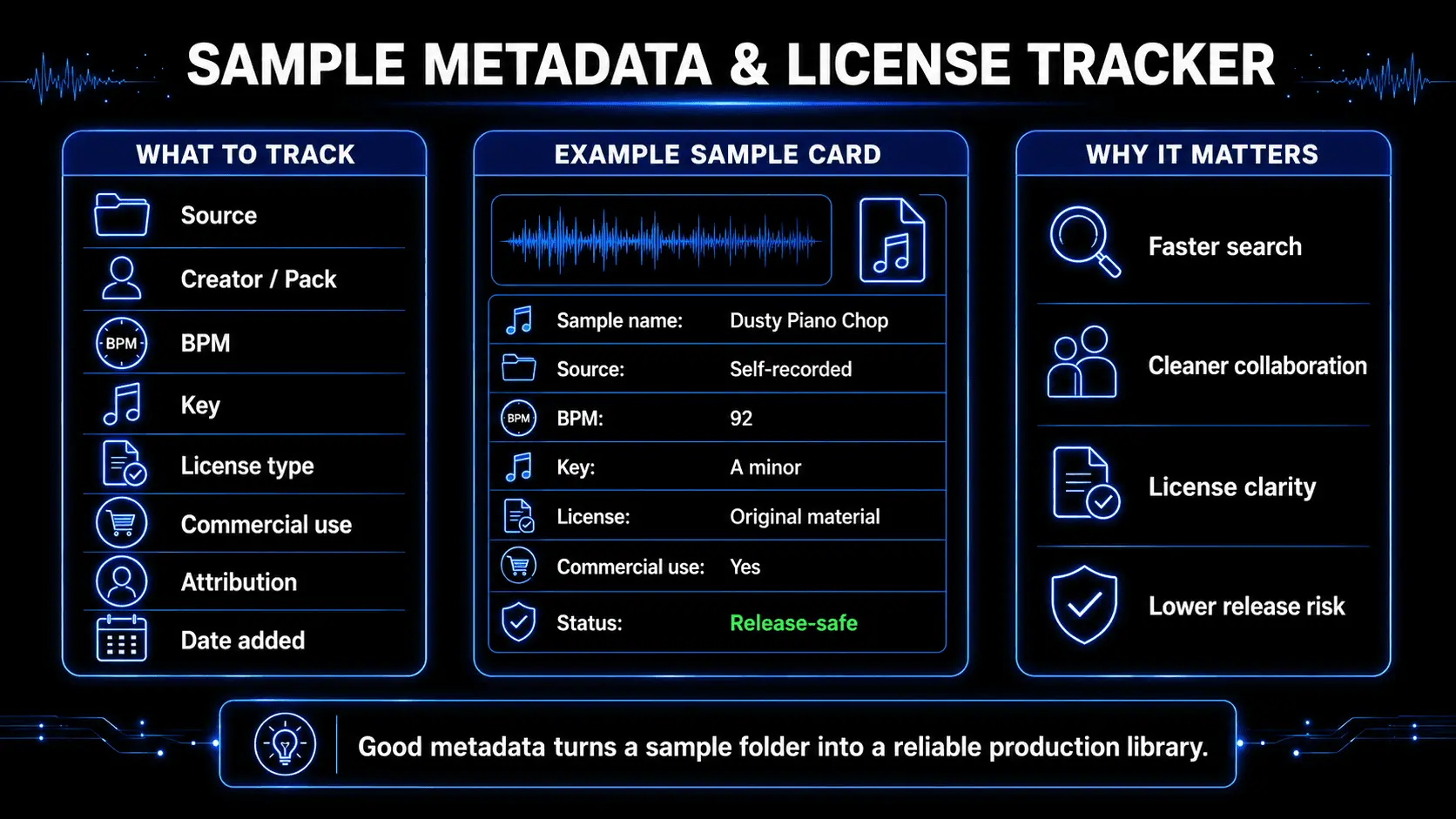
One future challenge is metadata. Samples often move through hard drives, DAWs, exports, stems, and collaborations without clear documentation. Better metadata could help producers track source, license, BPM, key, creator, usage restrictions, and clearance status. For professionals, good sample documentation is not boring admin. It is risk management.
Common sampling mistakes
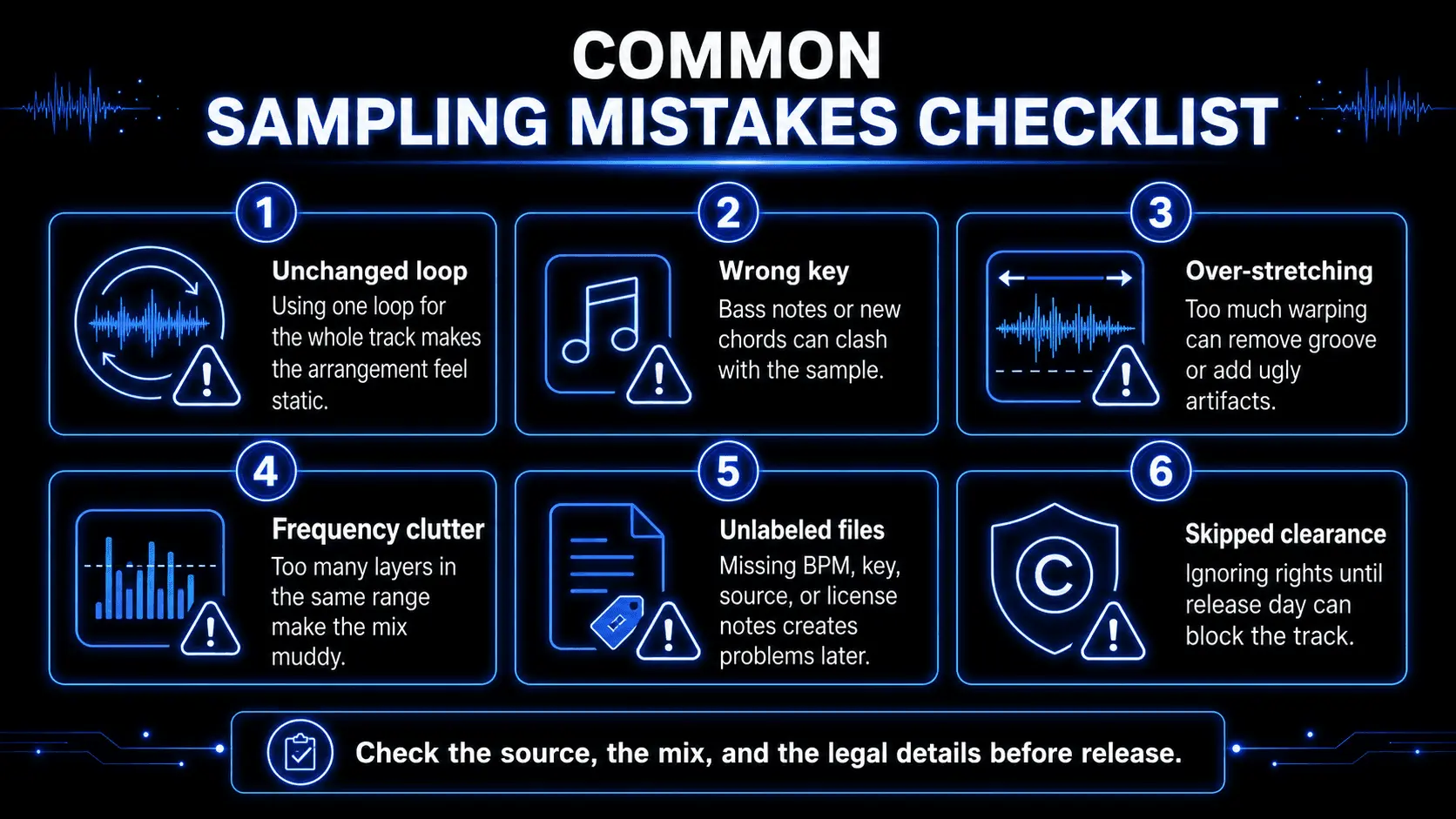
- Using a loop unchanged for the entire track, which makes the arrangement feel static.
- Ignoring key and adding bass notes that clash with the sample.
- Over-stretching audio until it loses groove or becomes full of unwanted artifacts.
- Layering too many samples in the same frequency range.
- Forgetting that a sample may already contain reverb, compression, noise, and stereo width.
- Assuming royalty-free means the same thing on every platform or license.
- Leaving sample files unlabeled, which creates problems later during release or collaboration.
- Depending on sample packs so heavily that every track sounds like a preset demo.
- Skipping clearance until after the track is finished, promoted, or signed.
Resources for learning more about sampling
Producers can learn sampling from several directions. Technical learning helps with DAW operation. Historical learning helps with taste and context. Legal learning helps with release decisions. Listening helps more than any tutorial because sampling is about selection, not only technique.
Practical learning resources
- DAW manuals for sampler instruments, warping, slicing, audio editing, and MIDI mapping.
- Producer breakdowns that show how a beat changes from source material to final arrangement.
- Sample pack licenses and music library terms, read carefully before release.
- Music copyright resources from official copyright offices, PROs, publishers, and music attorney education pages.
- Books and documentaries about hip-hop production, electronic music, musique concrete, and studio technology.
- Listening sessions where you compare original sources with sample-based songs and focus on what changed.
FAQ
What is sampling in music?
Sampling in music is the process of taking recorded audio and using it in a new track, beat, composition, remix, or sound design piece. The sample can be a loop, one-shot, vocal phrase, drum break, field recording, instrument note, or tiny sound fragment.
Is sampling the same as using loops?
Not exactly. A loop is one type of sample that repeats. Sampling is broader and includes one-shots, chops, vocal fragments, field recordings, multisampled instruments, and resampled sounds that may not loop at all.
What are the main types of sampling in music?
The main types include one-shot sampling, loop sampling, melodic sampling, vocal sampling, field recording, multisampling, stem sampling, and micro-sampling. Each type supports a different production goal.
How do beginners start sampling?
Beginners should start with royalty-free or self-recorded sounds, import them into a DAW, match tempo, identify key if needed, chop or loop the audio, build drums and bass around it, then arrange variations so the track develops.
Is music sampling legal?
Sampling can be legal when you use original sounds, properly licensed samples, public domain material with verified status, or cleared copyrighted material. Sampling copyrighted recordings without permission can create legal risk, especially for commercial releases.
Do I need to clear a sample if it is only a few seconds long?
A short length does not automatically make a sample safe. The idea that every short sample is legal is a myth. The safest professional approach is to clear protected samples or use material that is already licensed for your intended use.
What is the difference between sampling and interpolation?
Sampling uses actual audio from an existing recording. Interpolation re-records a musical idea, such as a melody or phrase, without using the original audio. Interpolation may avoid the master recording license, but the composition rights may still matter.
Can I sample music if I give credit?
Credit is not the same as permission. Crediting the original artist may be required by a license or ethically appropriate, but it does not automatically authorize use of copyrighted audio.