

Key Takeaways
- The seven modes use notes from the same parent scale, but changing the tonal center creates a different hierarchy of tension, resolution, and emotional color.
- Each mode has a defining interval, such as Dorian’s major sixth, Phrygian’s flat second, Lydian’s sharp fourth, and Mixolydian’s flat seventh.
- Modes become easier to recognize when practiced over drones, pedal tones, or static chords that prevent the harmony from returning to ordinary major or minor.
- Modal interchange, characteristic-note emphasis, and parallel-mode comparisons help musicians create contrast without relying on complete key changes.
- ACE Studio allows musicians to compare modal variations, test melodies with different AI Instruments, and create focused accompaniment with Add a Layer.
How One Scale Creates Seven Distinct Musical Moods
Most musicians treat the major scale like a single destination. In reality, it is a map with seven different starting points, each leading to a completely unique emotional landscape. If you have ever wondered why some songs feel "dreamy" while others feel "dark" or "exotic" despite using the same basic notes, you have already experienced the power of modes.
Modes are not just a more complicated way of playing scales; they are the secret to moving past repetitive patterns and gaining direct control over a listener’s mood. By shifting the "tonal center"—the note that feels like home—you can completely rebrand a sound without ever changing your key signature.
Differences Between Scales and Modes
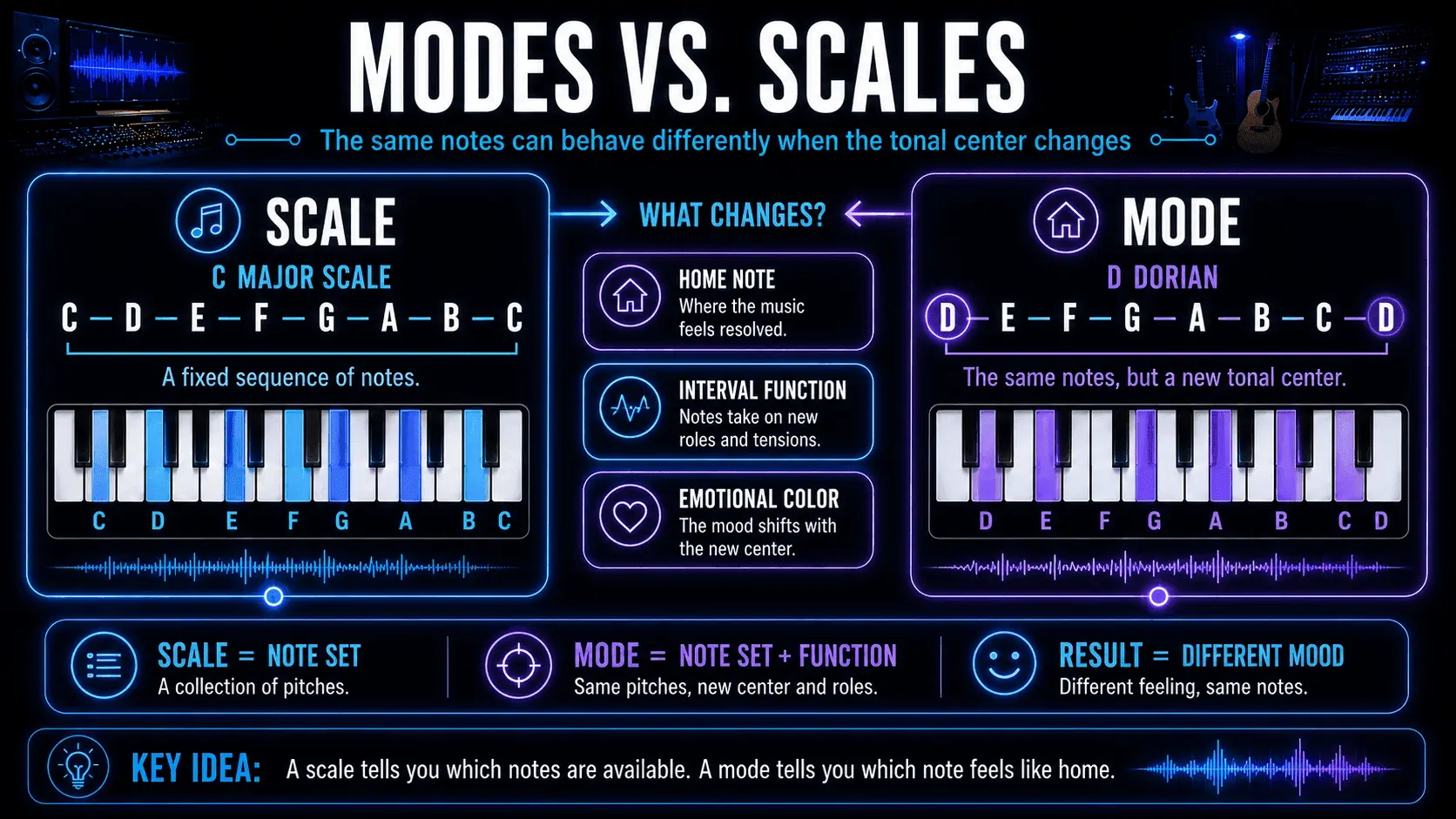
While the terms are frequently used interchangeably in casual conversation, scales and modes represent distinct layers of musical organization. A scale is a fixed sequence of notes arranged by pitch; a mode is a specific application or "rotation" of that scale that establishes a new tonal hierarchy.
The Parent Scale and its Derivatives
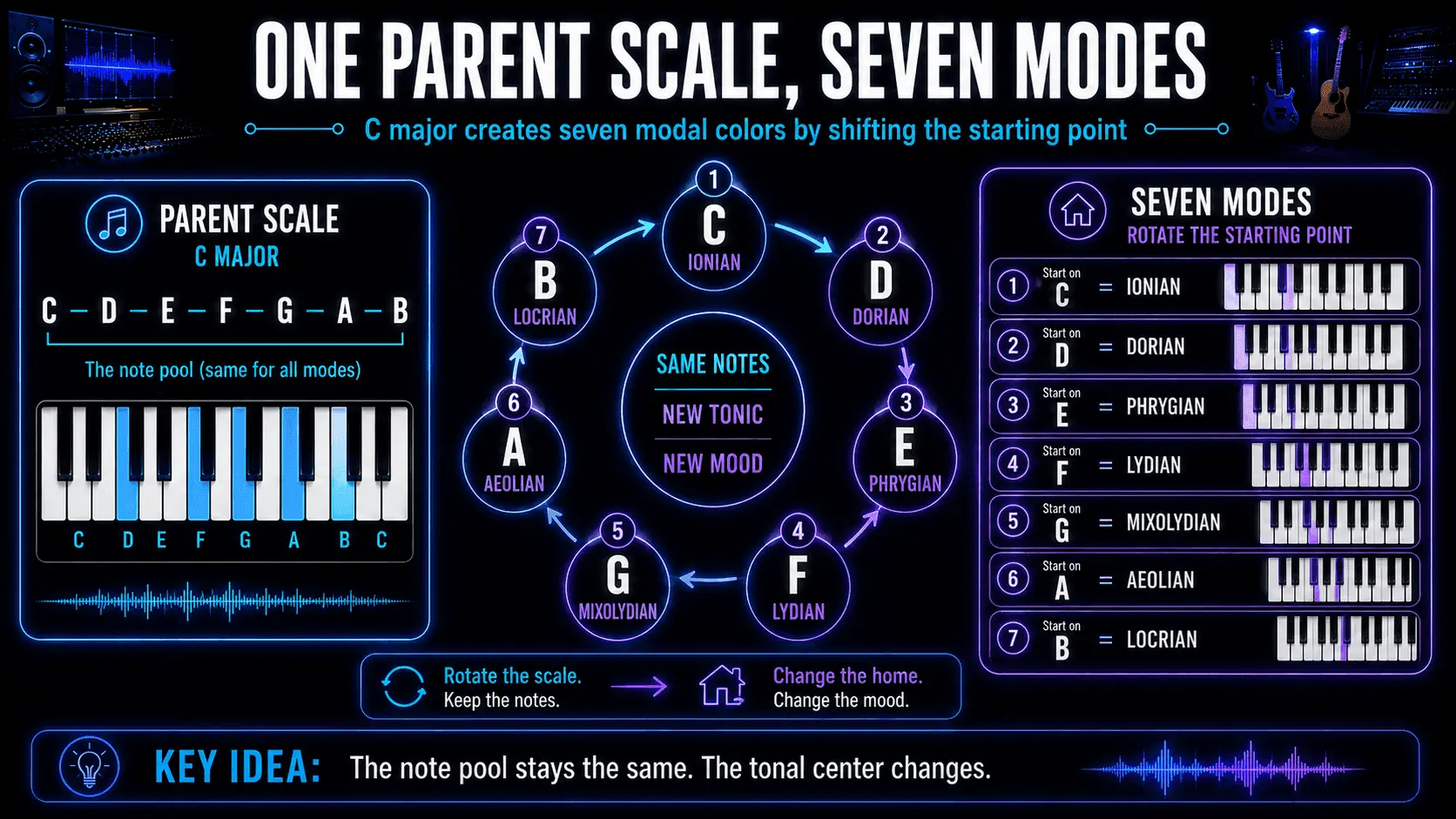
The relationship between the two is best understood through the concept of the parent scale. Using the C Major scale as the foundation, we can derive seven distinct modal "flavors" by simply shifting the starting note (and thus, the tonal center).
The "Ingredients vs. Recipes" Analogy
A common pedagogical approach is to view scales as a set of ingredients and modes as the recipes derived from them. While the raw materials (the notes) remain identical, the "preparation" (the intervallic sequence) dictates the final result.
For instance, the intervallic formula for the Ionian mode is:
W - W - H - W - W - W - H
When rotated to the second degree for the Dorian mode, the formula becomes:
W - H - W - W - W - H - W
This redistribution of half-steps (H) and whole-steps (W) is what creates the distinct emotional profile of each mode.
From Mechanical Patterns to Functional Mastery
Many instrumentalists plateau because they treat modes as physical "finger patterns" to be memorized across the fretboard or keyboard. However, true modal proficiency occurs when a musician stops focusing on the shapes and starts focusing on the function.
Understanding that the F in a C Major scale sounds "resolved" in Ionian but creates a "suspended, ethereal tension" in Lydian is a critical developmental milestone. For the professional composer, this shift in perspective is what allows for the precise manipulation of a listener’s emotional state. By treating each note as a relative interval to the new tonic (1, 2, 3, etc.), you gain the ability to navigate complex harmonic landscapes with intentionality rather than relying on rote memorization.
The 7 Modes Explained and How to Apply Them
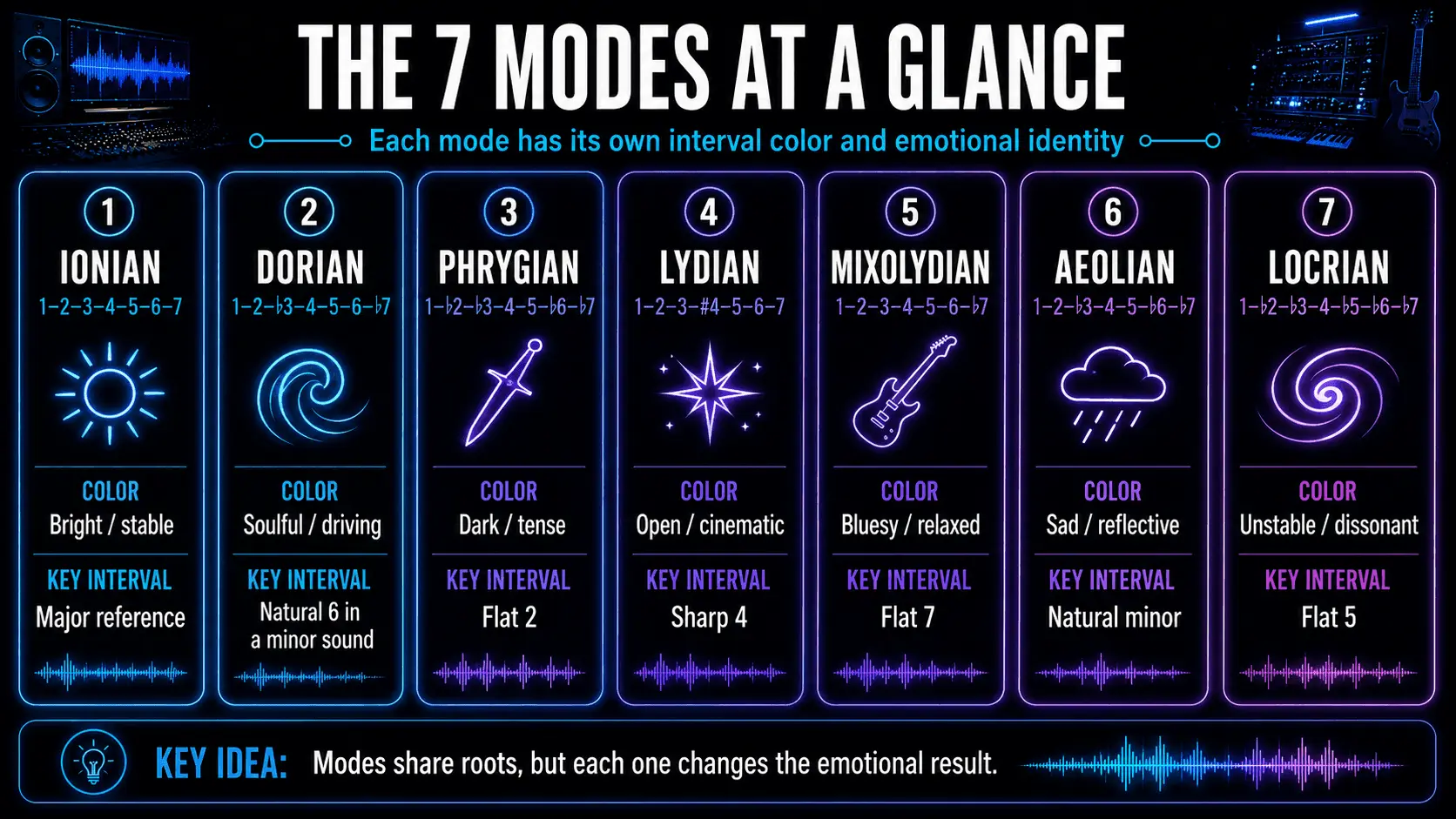
Understanding each mode individually allows a composer to select the precise "harmonic lens" required for a specific project. While they all originate from the same scale degrees, their intervallic structures create vastly different psychological profiles.
| Degree | Mode Name | Starting Note | Tonal Identity |
|---|---|---|---|
| 1st | Ionian | C | Standard Major; Bright and stable. |
| 2nd | Dorian | D | Minor with a major 6th; Jazzy and sophisticated. |
| 3rd | Phrygian | E | Minor with a flat 2nd; Dark and exotic. |
| 4th | Lydian | F | Major with a sharp 4th; Ethereal and cinematic. |
| 5th | Mixolydian | G | Major with a flat 7th; Bluesy and dominant. |
| 6th | Aeolian | A | Natural Minor; Sad and reflective. |
| 7th | Locrian | B | Diminished feel; Tense and unstable. |
1. Ionian Mode (The Major Scale)
The Ionian mode is the cornerstone of Western tonality. It is defined by its bright, stable, and highly resolved character.
- Interval Formula: 1 - 2 - 3 - 4 - 5 - 6 - 7
- Example (C Ionian): C – D – E – F – G – A – B – C
- Professional Application: Its inherent balance makes it the default choice for pop, folk, and traditional orchestral compositions. While foundational, many modern producers use it as a "neutral" base before introducing more complex modal substitutions.
2. Dorian Mode (The Soulful Minor)
Dorian is a minor mode distinguished by its raised sixth degree. This single alteration transforms a standard minor sound into something more sophisticated and less tragic.
- Interval Formula: 1 - 2 - b3 - 4 - 5 - 6 - b7
- Example (D Dorian): D – E – F – G – A – B – C – D
- Professional Application: Widely used in jazz, funk, and modern cinematic scores, Dorian offers a "melancholic but driving" atmosphere. It provides enough hope to keep a track moving forward without the brightness of a major scale.
3. Phrygian Mode (The Exotic Tension)
The Phrygian mode is defined by its flattened second degree. This creates a half-step interval immediately following the tonic, resulting in a dark, tense, and distinctive sound.
- Interval Formula: 1 - b2 - b3 - 4 - 5 - b6 - b7
- Example (E Phrygian): E – F – G – A – B – C – D – E
- Professional Application: This mode is a staple in metal, b menco, and dramatic film scores. Professionals often use the b2 sparingly to create intentional tension rather than overwhelming the listener with dissonance.
4. Lydian Mode (The Cinematic Ethereal)
Lydian is a major mode featuring a raised fourth degree. This # 4th (#4) removes the "grounded" feeling of the standard major scale, replacing it with a floating, expansive quality.
- Interval Formula: 1 - 2 - 3 - #4 - 5 - 6 - 7
- Example (F Lydian): F – G – A – B – C – D – E – F
- Professional Application: Lydian is the "sound of wonder" in cinematic orchestration. It is the go-to mode for creating magical, futuristic, or ethereal atmospheres where standard major feels too predictable.
5. Mixolydian Mode (The Blues/Rock Foundation)
The Mixolydian mode is a major scale with a lowered seventh degree. This b7 provides a "bluesy" or relaxed edge to an otherwise bright tonality.
- Interval Formula: 1 - 2 - 3 - 4 - 5 - 6 - b7
- Example (G Mixolydian): G – A – B – C – D – E – F – G
- Professional Application: This is the foundational sound of classic rock and blues improvisation. Its harmonic flexibility makes it ideal for vamping over dominant seventh chords, offering a sophisticated middle ground between major and minor.
6. Aeolian Mode (The Natural Minor)
Aeolian is the standard natural minor scale. It is characterized by its melancholic, emotional, and deeply reflective tone.
- Interval Formula: 1 - 2 - b3 - 4 - 5 - b6 - b7
- Example (A Aeolian): A – B – C – D – E – F – G – A
- Professional Application: Aeolian is used extensively in ballads and scores where raw emotional depth is required. It is often the first "minor" sound a musician masters, serving as the primary vehicle for sadness or vulnerability in songwriting.
7. Locrian Mode (The Dissonant Outlier)
Locrian is the most unstable of the seven modes due to its diminished fifth. It lacks a perfect fifth, which makes it feel unresolved and highly tense.
- Interval Formula: 1 - b2 - b3 - 4 - b5 - b6 - b7
- Example (B Locrian): B – C – D – E – F – G – A – B
- Professional Application: Because of its instability, Locrian is rarely used for entire compositions in mainstream music. However, it is an essential tool in experimental jazz and heavy metal for creating extreme tension before a resolution.
Historical Context of Musical Modes
The history of musical modes is a journey from ancient philosophy to modern technical mastery. Long before the "Major vs. Minor" binary dominated Western music, modes were the primary architectural framework for melody and atmosphere.
1. Ancient Origins and the "Doctrine of Ethos"
In Ancient Greece, modes were viewed as more than mathematical sequences; they were believed to possess the power to influence the human psyche. This concept, known as the Doctrine of Ethos, suggested that specific modes could trigger distinct behavioral responses:
- Dorian: Associated with courage, discipline, and stability.
- Phrygian: Viewed as ecstatic, passionate, and occasionally volatile.
- Lydian: Often linked to mourning or excessive relaxation.
For the Greeks, selecting a mode was a moral and civic decision, not just an artistic one.
2. The Medieval and Renaissance Eras
During the Middle Ages, the modal system became the foundation of Gregorian Chant and sacred liturgy. These "Church Modes" were the standard for centuries before modern functional harmony existed.
- Linearity over Verticality: Music of this period was primarily monophonic (single melody) or polyphonic (intertwining melodies), focusing on the horizontal flow of the mode rather than the "vertical" movement of chord progressions we use today.
- The Shift: During the Renaissance, as composers began experimenting with richer harmonies, the modal system started to consolidate.
3. The Baroque Transition and the "Major-Minor" Era
By the 17th century, the Baroque period introduced functional harmony—a system built on "tension and resolution" (specifically the V–I cadence).
- To facilitate this new harmonic language, the complex modal system was simplified into the Major (Ionian) and Minor (Aeolian) keys.
- For nearly two centuries, the other five modes were largely relegated to folk traditions and academic study, as they didn't fit the rigid requirements of classical "Common Practice" tonality.
4. The 20th Century: The Great Modal Revival
The return of modes in the modern era was driven by a desire to break away from the predictability of major and minor keys.
- Modal Jazz: In the late 1950s, artists like Miles Davis and John Coltrane pioneered "Modal Jazz" (most notably on the album Kind of Blue). Instead of navigating fast-changing chords, they stayed on a single mode for extended periods, allowing for more melodic freedom and "cool" sophistication.
- Cinematic and Folk Influence: Film composers (like John Williams and Howard Shore) revived modes to create specific "otherworldly" or "period" atmospheres. Similarly, the 1960s folk revival brought modal melodies back into the mainstream.
- Modern Production: Today, genres like Progressive Rock, Heavy Metal, and Ambient Electronic rely heavily on modes to create textures that feel more expansive or aggressive than traditional pop music.
How to Apply Music Modes in Practice
The Drone Method: To isolate the specific "color" of each mode, play through them over a sustained pedal point (e.g., a continuous C bass note). This helps the ear recognize how the varying intervals change the emotional atmosphere against a fixed tonal center.
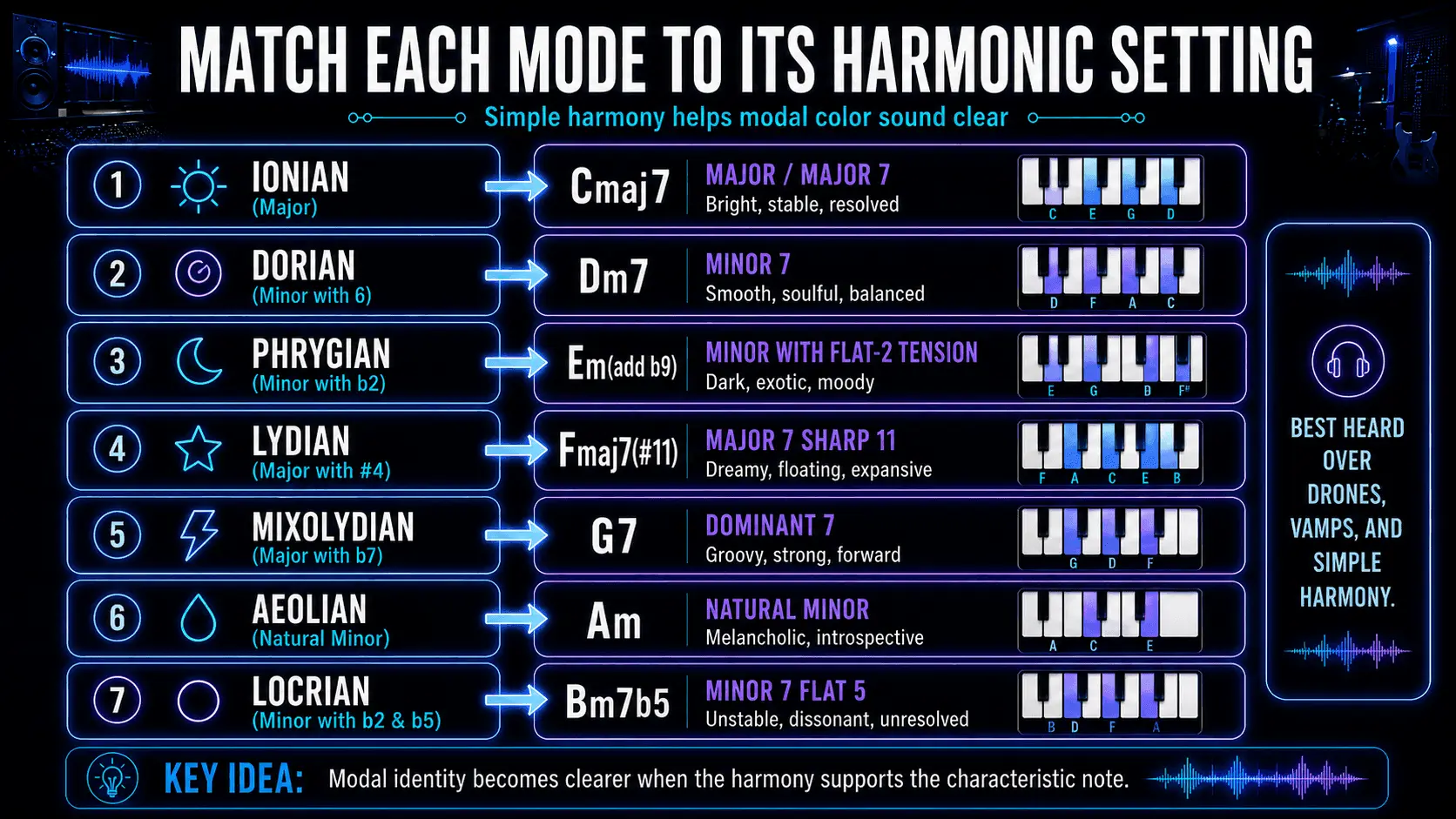
Chord-Mode Compatibility: For professional arrangement, match each mode to its corresponding harmonic function to ensure melodic and harmonic cohesion:
- Ionian: Major / Major 7th chords
- Dorian: Minor 7th chords
- Phrygian: Suspended tension / Minor chords
- Lydian: Major 7th (#11) chords
- Mixolydian: Dominant 7th chords
- Aeolian: Natural Minor chords
- Locrian: Half-diminished (m7b5) harmony
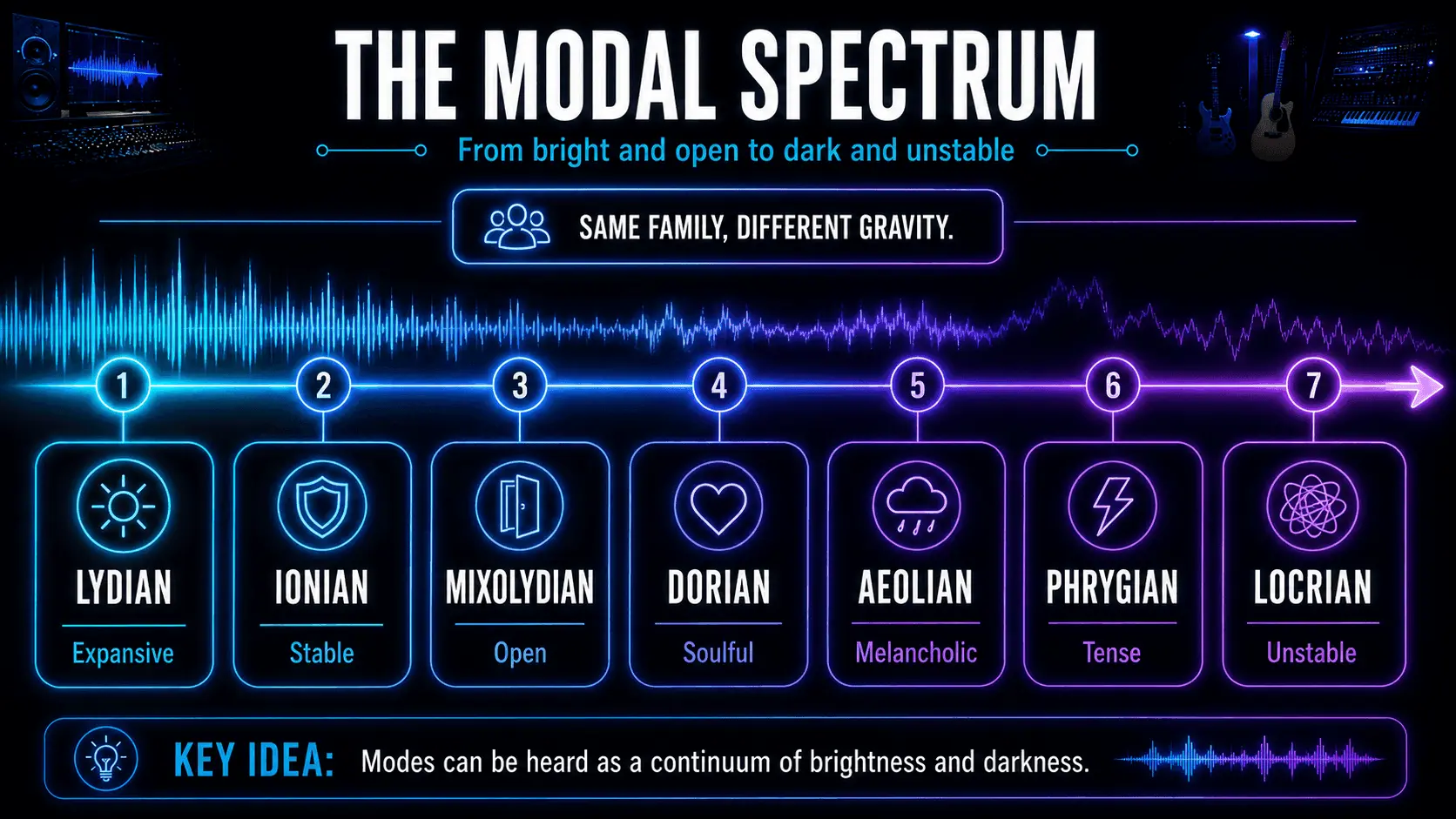
Horizontal Thinking: Transition from a "vertical" mindset (viewing modes as isolated scale shapes) to a "horizontal" one. This allows you to treat modes as a spectrum of musical color, moving fluidly between brightness and darkness within a composition.
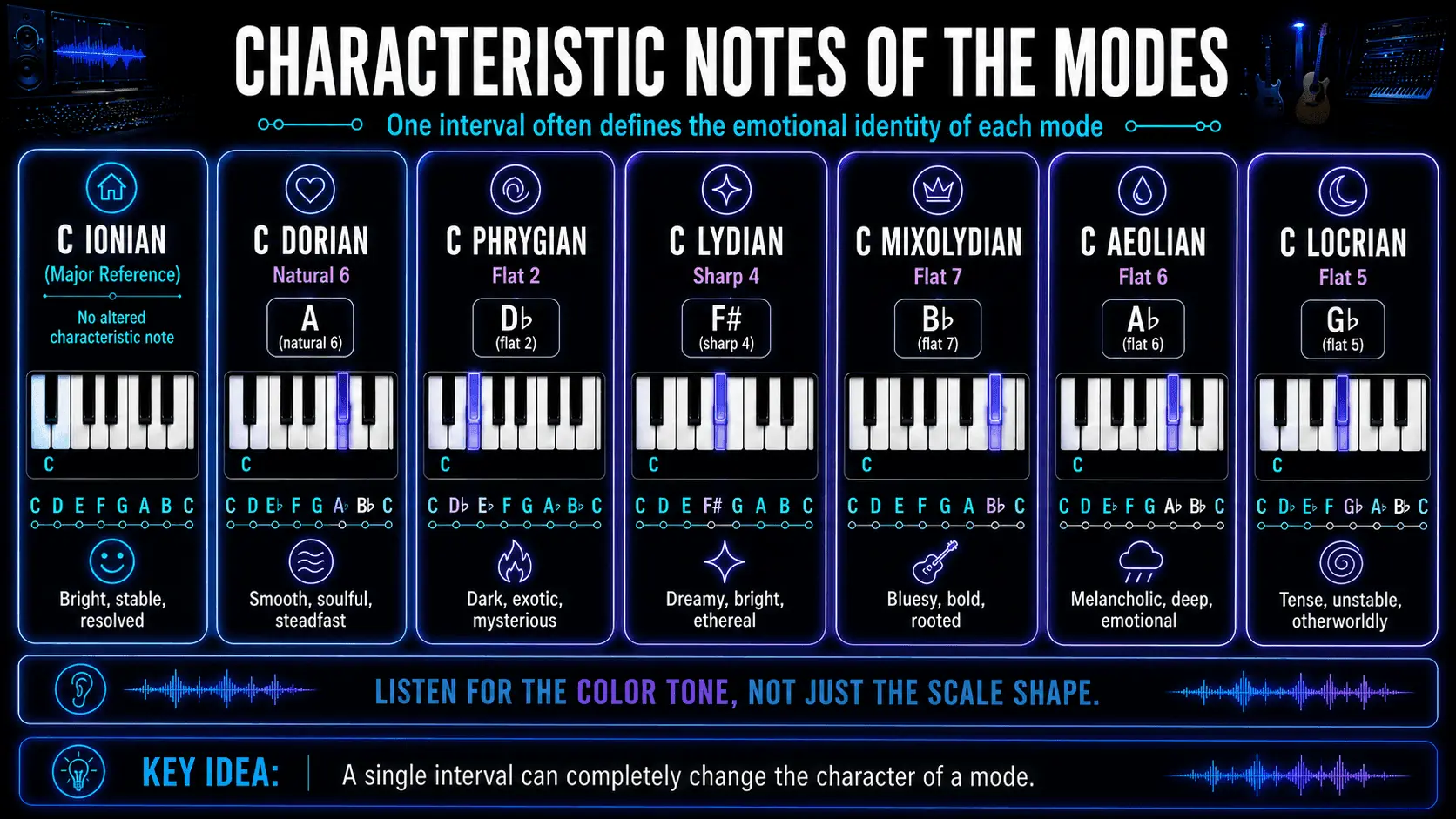
Contextual Improvisation: Instead of running full scales, focus on the "characteristic notes"—the specific intervals that define the mode (such as the sharp 4th in Lydian or the flat 2nd in Phrygian). Emphasizing these tones over the corresponding chord is the most efficient way to establish a modal identity.
Exercises to Master the Modes
Transitioning from theoretical knowledge to professional fluency requires structured practice that prioritizes auditory recognition over mechanical memorization.
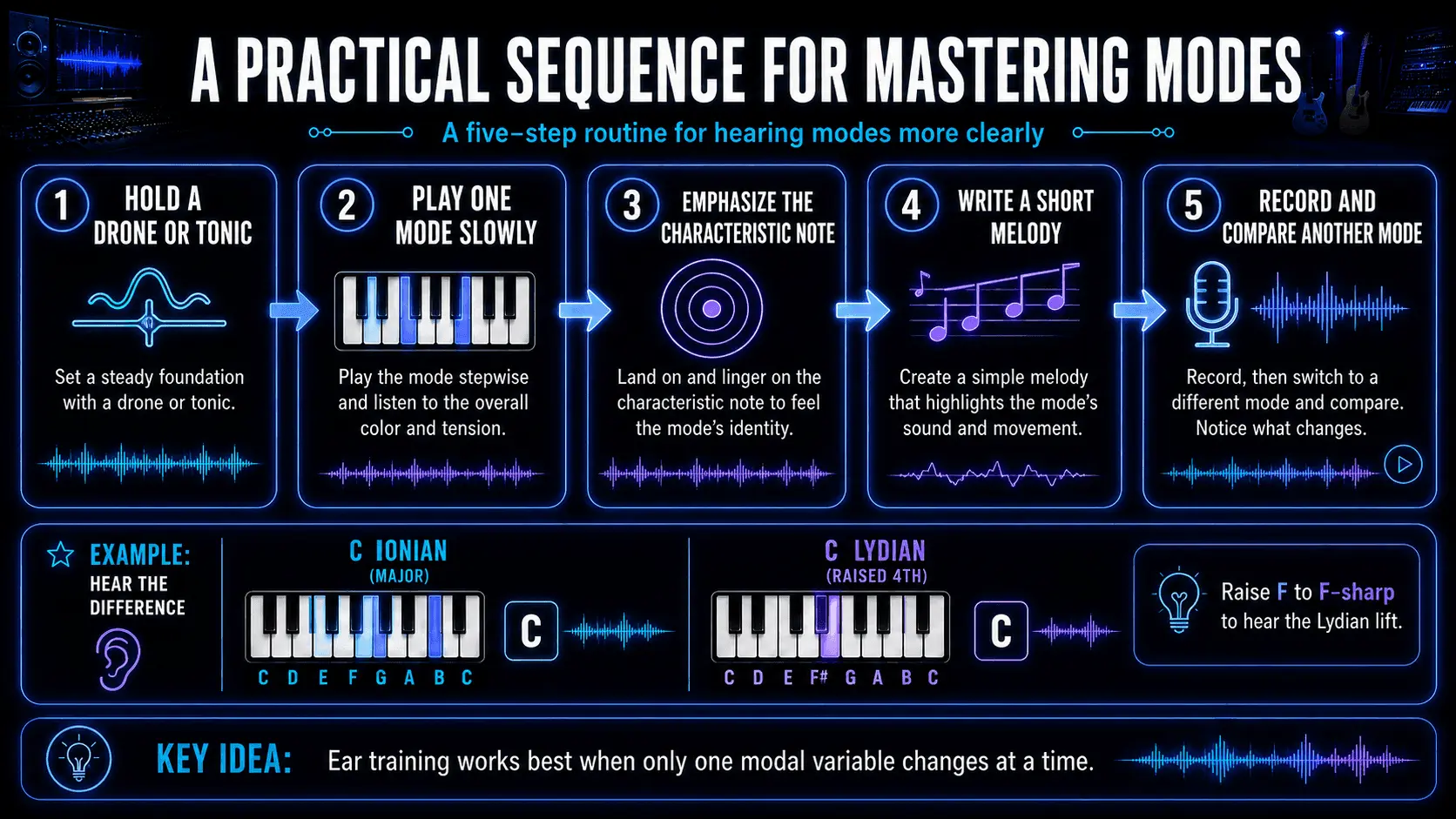
- Parent Scale Cycling and Recording: Perform all seven modes derived from a single parent scale in a continuous cycle. Record these sessions for post-performance analysis; listening objectively often reveals subtle intervallic nuances that are missed during the act of playing.
- Static Chord Improvisation: Select a single foundational chord and improvise using one specific mode for an extended period. Subsequently, switch to a different mode over the same chord (e.g., transitioning from C Ionian to C Lydian). This exercise clearly illustrates how changing a single interval—the #4 in this case—completely redefines the atmosphere.
- Characteristic Note Vocalization: To sharpen ear training, sing the "characteristic note" of each mode relative to the tonic (such as the b2 in Phrygian or the major 6th in Dorian). Internalizing these specific "color tones" through vocalization builds a faster mental connection than technical drills alone.
- Pre-Auralization: Before engaging with your instrument, attempt to "hear" the mode in your head. Advanced educators consistently note that the ability to imagine the modal color before playing is a primary differentiator between intermediate players and professional-tier improvisers.
Advanced Applications of Modes
For the professional composer and producer, modes transcend the status of "alternative scales" and become tactical tools for structural innovation. Mastering these advanced applications allows for the creation of music that is harmonically rich without becoming unnecessarily cluttered.
1. Modal Interchange and Parallel Borrowing
One of the most powerful techniques in modern songwriting is Modal Interchange. This involves "borrowing" chords from a parallel mode (a mode with the same tonic) to introduce unexpected emotional contrast.
- The Major-to-Minor Shift: A composition in C Ionian (Major) can borrow the bVI chord (Ab Major) from C Aeolian (Minor). This provides a moment of dramatic, dark tension before returning to the brightness of the major key.
- Contextual Depth: Similarly, a progression primarily in D Dorian might borrow a chord from D Aeolian to deepen a melancholic passage. This technique allows you to stay grounded in your primary key while momentarily accessing a completely different emotional palette.
2. Cinematic Ambiguity and Pedal Points
Film composers frequently utilize modes to create "emotional suspension"—a state where the listener isn't quite sure whether to feel hope or dread.
- Static Harmony: By layering modal melodies over a pedal point (a sustained, unchanging bass note), composers can shift through different modes to create evolving textures.
- The Lydian Lift: Moving from Ionian to Lydian over a fixed bass note creates a sense of "ascending" or "lifting" into a dreamlike state without the jarring effect of a full key change.
3. Electronic Production: The "Loop-and-Shift" Method
In loop-based electronic music, constant chord changes can often clutter the arrangement. Professional producers use modal shifting to maintain interest within a repetitive rhythmic structure.
- Color Variation: Instead of changing the underlying bassline or chord progression, a producer might keep the loop intact but shift the lead melody from Aeolian to Phrygian.
- Spectral Freshness: This provides the "novelty" the human ear craves while maintaining the hypnotic stability of the track's groove. It is an efficient way to evolve a track’s energy across a six-minute arrangement.
4. Jazz Superimposition and Harmonic Tension
In advanced jazz improvisation, players often "superimpose" one mode over an unrelated chord to create high-level tension, known as playing outside.
- Intervallic Friction: A soloist might play a B Altered scale (a mode of C Melodic Minor) over a G7 dominant chord. This creates specific dissonances that, when resolved correctly, sound incredibly sophisticated and "modern."
5. The Synergy of Mode and Rhythm
Different modal "colors" naturally suggest different rhythmic phrasing. Because modes distribute tension in specific ways, they often dictate the "groove" of a performance:
- Phrygian (Tension/Release): The proximity of the b2 to the tonic often encourages tight, syncopated, and aggressive rhythmic patterns—a hallmark of modern metal and flamenco.
- Lydian (Expansion): The "floating" nature of the #4 often inspires longer, more fluid, and "rubato" phrasing that feels less anchored to a rigid beat.
Explore Musical Modes by Hearing Them in ACE Studio
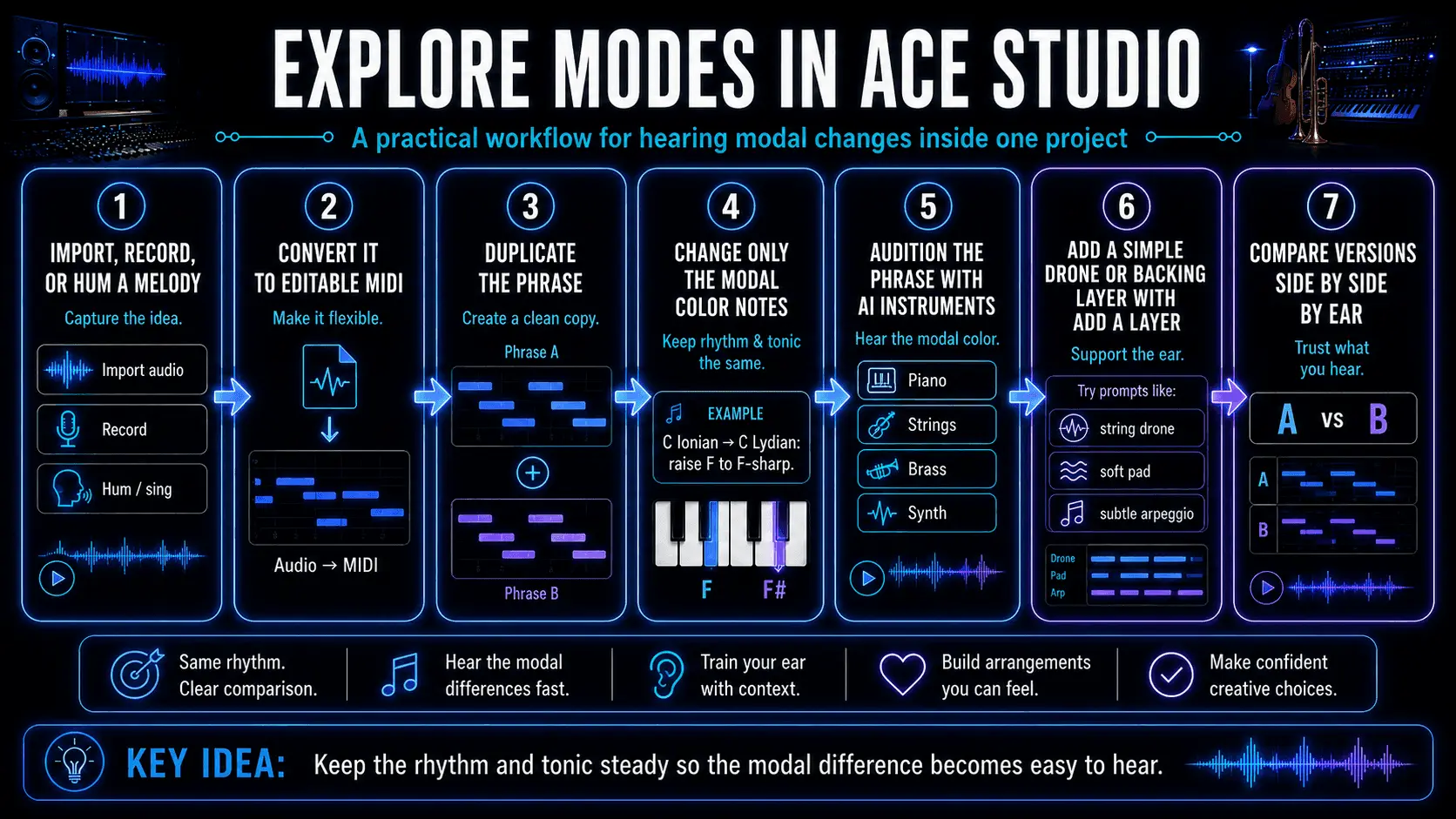
Reading interval formulas can explain how modes are constructed, but the differences become much clearer when you can compare them without changing the rhythm, tempo, or tonal center. ACE Studio makes this possible by turning a melodic idea into editable MIDI that can be duplicated and reshaped into several parallel modal versions.
Begin with a short melody played, imported, recorded, or hummed. ACE Studio can convert a dry vocal recording into MIDI, after which individual notes can be moved in the piano roll. Duplicate the phrase and change only the notes that define each mode. For example, compare C Ionian with C Lydian by raising every F to F-sharp, or compare D Aeolian with D Dorian by raising B-flat to B natural. Since the tonic and phrasing remain unchanged, the effect of the characteristic note becomes immediately recognizable.
Test the Same Mode Through Different Instruments
Modal character is shaped by timbre as well as intervals. A Lydian phrase may feel expansive when performed by strings, while the same notes can sound more intimate on saxophone or more exposed on a solo trumpet. ACE Studio’s AI Instruments turn MIDI notes into editable performances and provide controls for articulation and expression, allowing the same modal idea to be evaluated through strings, brass, woodwinds, or a layered ensemble without rewriting the melody.
This is particularly useful when choosing a mode for an arrangement. Instead of deciding that Phrygian is automatically “dark” or Lydian is always “cinematic,” you can hear how the mode behaves with the instruments, register, note lengths, and dynamics intended for the actual composition.
Build a Clear Harmonic Setting Around the Tonic
A mode is difficult to hear when the accompaniment keeps pulling the music toward ordinary major or minor harmony. Add a Layer can generate supporting audio for a selected part of the timeline from a focused text prompt.
A prompt such as “sustained low C drone with sparse ambient strings” can create space for comparing C Ionian and C Lydian, while “dry funk rhythm section over a static D minor chord” can provide a foundation for testing Dorian phrases.
The generated layer should support the experiment rather than decide the mode for you. Keep the prompt harmonically simple, listen for notes that conflict with the intended scale, and adjust or replace the layer when necessary.
ACE Studio generates instrumental parts, vocal layers, and sample-style loops from prompts, but the editable MIDI melody remains the most reliable place to control the exact modal notes.
Used this way, ACE Studio is not an automatic mode generator. It is a practical listening and composition space where you can hold several musical elements constant, change one characteristic interval, and judge the result by ear. That makes abstract differences such as the Dorian major sixth, the Phrygian flat second, or the Lydian sharp fourth easier to recognize—and much easier to use intentionally in original music.
Beyond practice and analysis, these tools open broader creative possibilities for modal composition. A single melody can be transformed into several emotional versions, orchestrated with different AI Instruments, expanded with prompt-generated accompaniment, or developed into contrasting song sections that move between parallel modes.
Producers can turn a simple Dorian phrase into a funk arrangement, place a Lydian variation inside a cinematic soundscape, or use Phrygian and Locrian colors to introduce controlled tension before returning to a more stable mode.
By making melodies, performances, and supporting layers easy to revise, ACE Studio encourages musicians to treat modes not as fixed scale exercises, but as flexible starting points for songs, scores, arrangements, and new sonic ideas.

Common Mistakes and How to Avoid Them
Prioritizing Finger Patterns Over Sonic Identity
The most frequent mistake is treating modes as "shapes" rather than "sounds." If you memorize a Dorian pattern but your ear is still hearing Ionian, your playing will sound like a major scale starting on the wrong note.
- The Fix: Move away from "Parent Scale" thinking (viewing D Dorian as just a C scale) and embrace "Parallel" thinking. Compare C Ionian directly to C Dorian. This forces your ear to hear the flattened 3rd and the natural 6th, defining the mode's true character.
Forced Harmonic Context
Not every chord progression can support every mode. Trying to force a Lydian melody over a standard V–I cadence in a major key will often result in "harmonic clashing" rather than "ethereal wonder."
- The Fix: Modes require specific "breathing room." To truly hear a mode, the underlying harmony should ideally be static (a drone) or utilize "modal vamps"—simple two-chord progressions that emphasize the characteristic note of the mode.
"Over-Announcing" the Characteristic Note
When beginners discover the "magic note" of a mode—like the #4 in Lydian or the b2 in Phrygian—they often lean on it so heavily that the melody becomes predictable and "stiff."
- The Fix: Treat the characteristic note like a high-end spice in cooking; it should color the dish, not become the primary ingredient. Professional improvisers use these notes as focal points of tension that eventually resolve back to the chord tones.
Mechanical vs. Musical Practice
Running modal scales up and down in sixteenth notes improves finger dexterity, but it does nothing for your phrasing. Mechanical practice leads to "scalar" playing, which sounds like an exercise rather than a composition.
- The Fix: Practice modes through melodic constraints. Try writing a four-bar melody using only three notes of the mode, or practice calling and responding with a recording. If you can't whistle a modal melody, you haven't mastered the mode yet.
Final Thoughts on Mastering the Seven Modes
The seven modes of music are more than an academic system. They provide a practical way to understand how melody, harmony, timbre, and rhythm work together to shape emotion.
For beginners, modes reveal why the same collection of notes can produce several distinct tonal identities. For advanced musicians and producers, they offer a precise language for creating contrast, controlling tension, and moving beyond predictable major and minor patterns.
The most effective way to master modes is to hear them in context. Comparing parallel modes, emphasizing their characteristic notes, testing them over drones, and applying them through different instruments makes their individual qualities easier to recognize. Tools such as ACE Studio can extend this process by allowing a melody to be converted into editable MIDI, rearranged into multiple modal versions, orchestrated with AI Instruments, and placed over supporting layers created for a specific tonal center.
The real value of modes appears when they stop feeling like scale formulas and become creative choices. Once their colors can be heard, compared, and shaped intentionally, the same notes can begin telling entirely different stories.
Frequently Asked Questions
Are modes the same as scales?
No. A scale is a sequence of notes, while a mode changes which note feels like the tonal center, creating a new emotional sound.
Which mode should beginners learn first?
Most beginners start with Ionian and Dorian because they are easiest to hear and apply in real music.
Why do modes matter in modern music?
Modes help musicians create different emotional colors without changing the entire key. They are widely used in jazz, rock, film music, and modern production.
How can I hear the difference between modes?
The best way is to play each mode over a sustained drone note so your ear can hear how each mode changes the feeling of the same notes.