

Key Takeaways
- The Interoperable Master Format (IMF) stores video, audio, subtitles, metadata, and version instructions within one structured master package.
- IMF reduces duplication by allowing multiple languages, regional edits, and platform versions to reuse the same core media assets.
- Its modular structure simplifies localization, version control, revisions, quality management, and global content distribution.
- Film studios, streaming platforms, broadcasters, and archives use IMF to manage complex deliverables more efficiently and consistently.
- IMF adoption requires compatible systems, reliable infrastructure, accurate metadata, and staff training, but it can significantly improve long-term scalability.
A Smarter Foundation for Global Media Versioning and Delivery
The film and media industries depend on efficient collaboration, accurate version control, and seamless content delivery. That is where the Interoperable Master Format, commonly known as IMF, becomes essential. In simple terms, IMF acts as a standardized framework for packaging audio, video, subtitles, and metadata into a single master ecosystem that can be distributed across multiple platforms without recreating separate files for every version.
A useful comparison for music producers is MIDI compatibility across different DAWs. Just as MIDI allows projects to move between software environments while preserving structure and flexibility, IMF allows studios to manage and distribute complex media assets across different systems while maintaining consistency and quality.
Instead of storing dozens of complete copies of the same film for different languages, regions, or streaming services, IMF stores a single master package with interchangeable components. This significantly reduces redundancy, simplifies workflows, and lowers storage requirements. For large-scale productions, that efficiency can save both time and operational costs.
Today, IMF has become a cornerstone of modern media production because it supports scalable, flexible, and globally compatible content delivery.
What is the Interoperable Master Format (IMF)?
The Interoperable Master Format (IMF) is a professional media packaging standard designed to simplify how high-quality audio-visual content is stored, managed, versioned, and distributed.
At its core, IMF allows multiple versions of the same project to exist within a single master framework. Instead of exporting entirely separate files for different languages, aspect ratios, edits, or streaming platforms, IMF stores shared assets once and references them dynamically when needed.
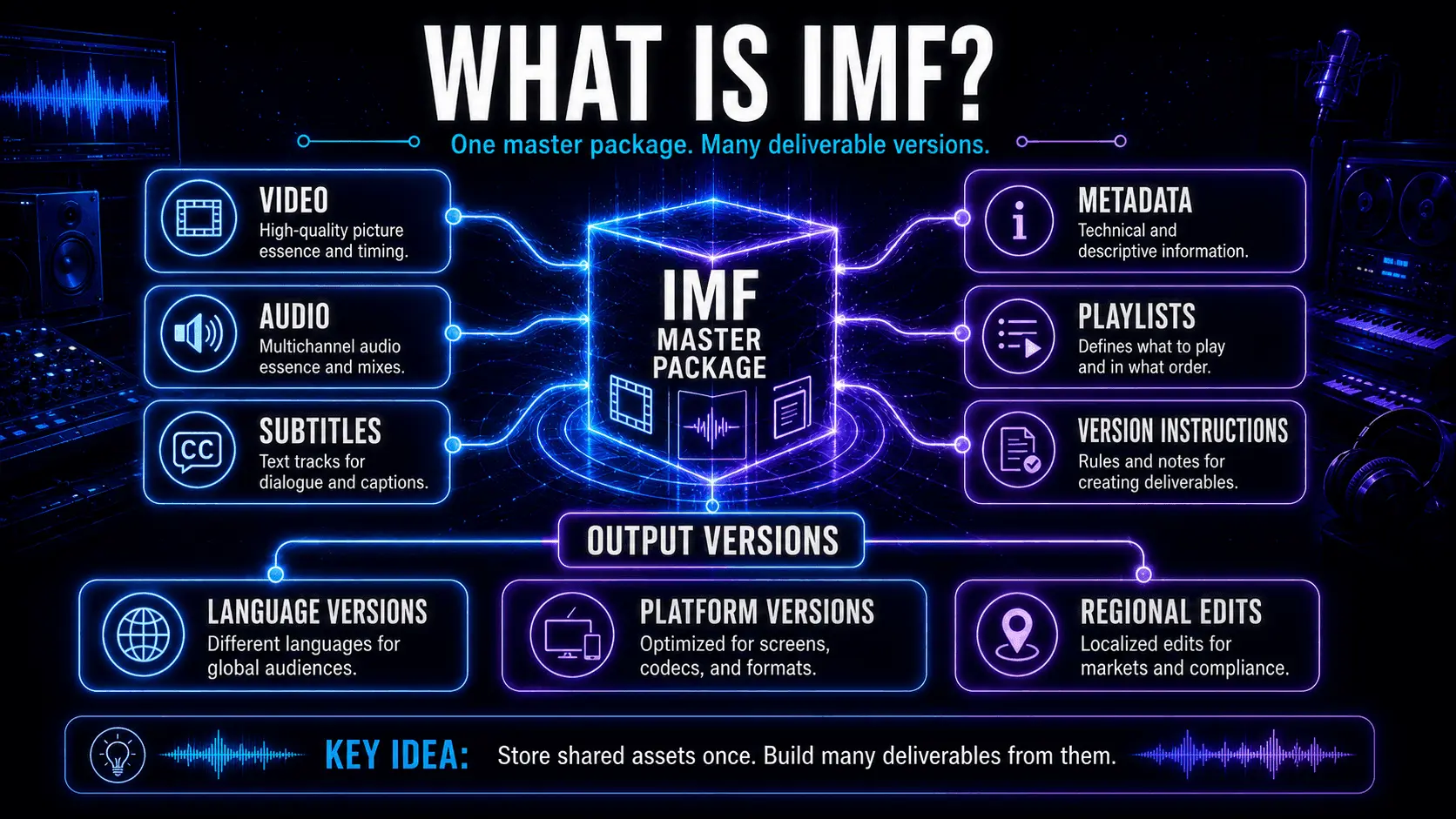
Think of IMF as the equivalent of a non-destructive workflow in music production. Rather than rendering dozens of bounced versions of a track, you maintain one central project with interchangeable components that can be updated independently.
This approach provides several major advantages:
- Consistent media quality across platforms
- Faster localization workflows
- Reduced duplication of assets
- Better scalability for large productions
- Easier collaboration between studios and distributors
Because of these advantages, IMF has become widely adopted by film studios, streaming platforms, and broadcast networks that require efficient global distribution pipelines.
Why IMF Matters in Modern Media Production
Modern media distribution involves far more than delivering a single finished video file. A movie, television episode, or other long-form production may need to be prepared for numerous languages, regions, platforms, devices, and technical standards. The same title might require dubbed audio for one market, subtitles for another, regional compliance edits, separate HDR and SDR versions, alternative aspect ratios, and different encoding profiles for cinema, broadcast, mobile, and streaming services.
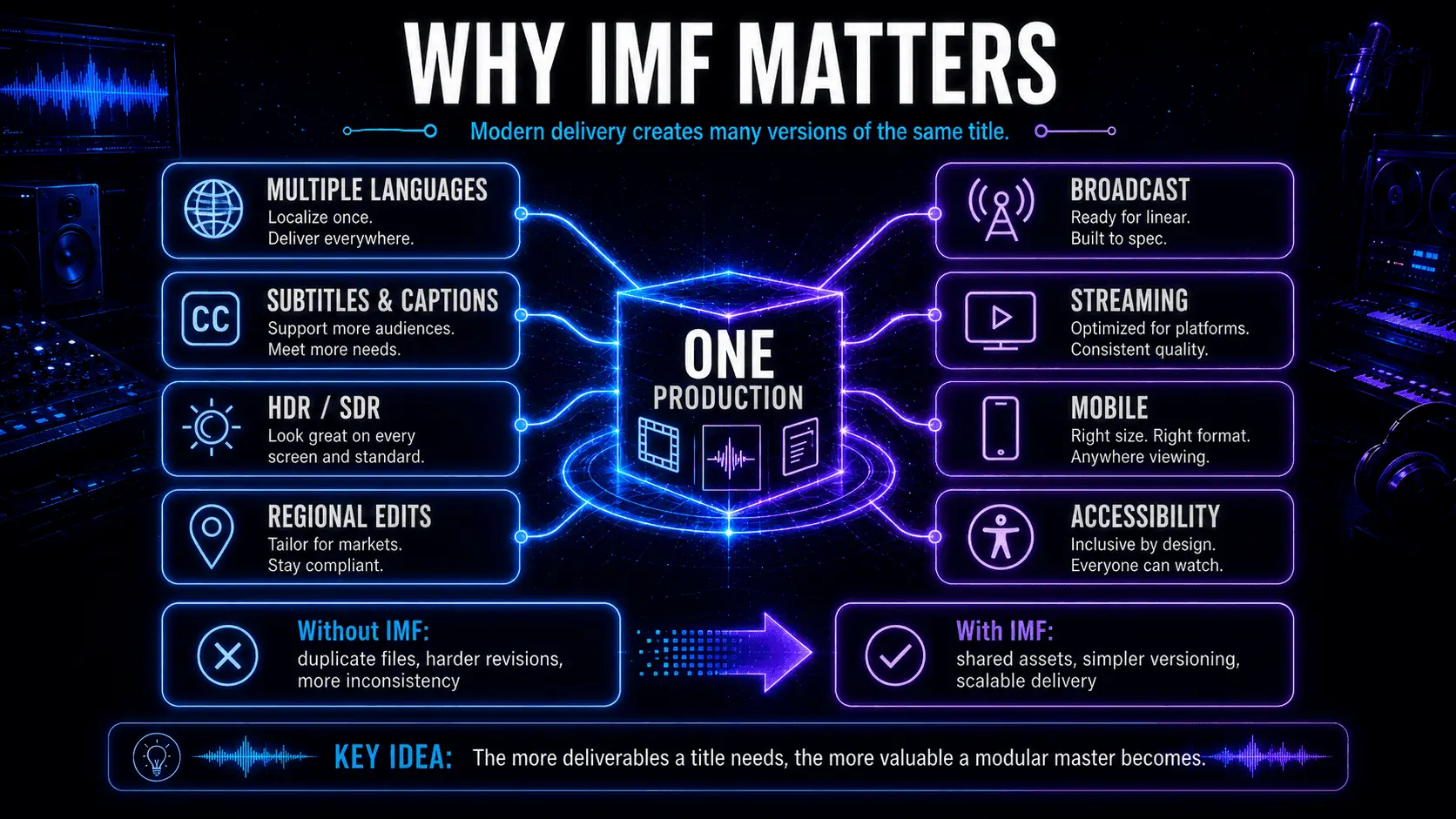
Managing all these variations through traditional delivery workflows can quickly become expensive and difficult to control. When every version is exported and stored as a separate master file, studios must maintain large amounts of duplicated media. This increases storage requirements, slows down revisions, and creates more opportunities for inconsistencies. A corrected scene, updated subtitle, or replacement audio track may need to be applied across multiple files, making version control increasingly complex.
IMF addresses this problem by treating a production as a collection of reusable media components rather than a series of complete, independent exports. Shared elements, such as the main video track, can remain centralized, while language tracks, subtitles, alternate scenes, and technical instructions are combined according to the requirements of each deliverable. A North American release might reference English audio, while a Latin American version uses the same video with Spanish subtitles. A broadcast version can include an approved regional edit, while a mobile platform receives a version prepared with a different compression profile.
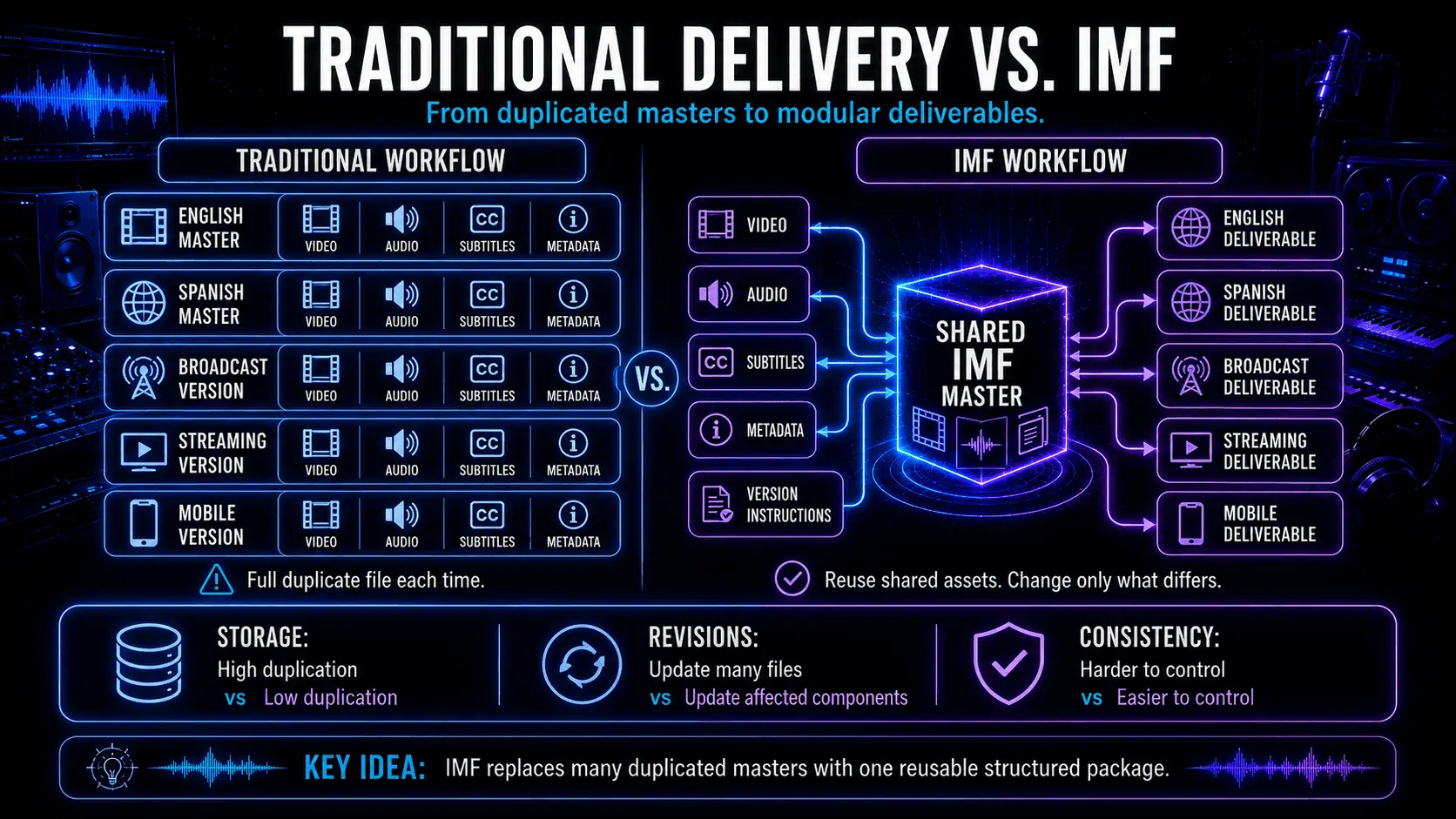
Because each deliverable draws from the same controlled master package, teams can create, revise, and distribute multiple versions without duplicating the entire project. This modular structure reduces storage demands, improves consistency, and makes large-scale localization and platform delivery much easier to manage. These advantages have made IMF an essential standard for studios, broadcasters, and streaming services distributing content across global markets.
How IMF Works
IMF organizes a production as a structured package containing the media components and instructions needed to create different deliverable versions. Depending on the project, this package may include video tracks, audio stems, subtitle files, metadata, version instructions, and playback timelines. Rather than combining everything into one fixed master file, IMF keeps these elements separate but connected within a centralized system.
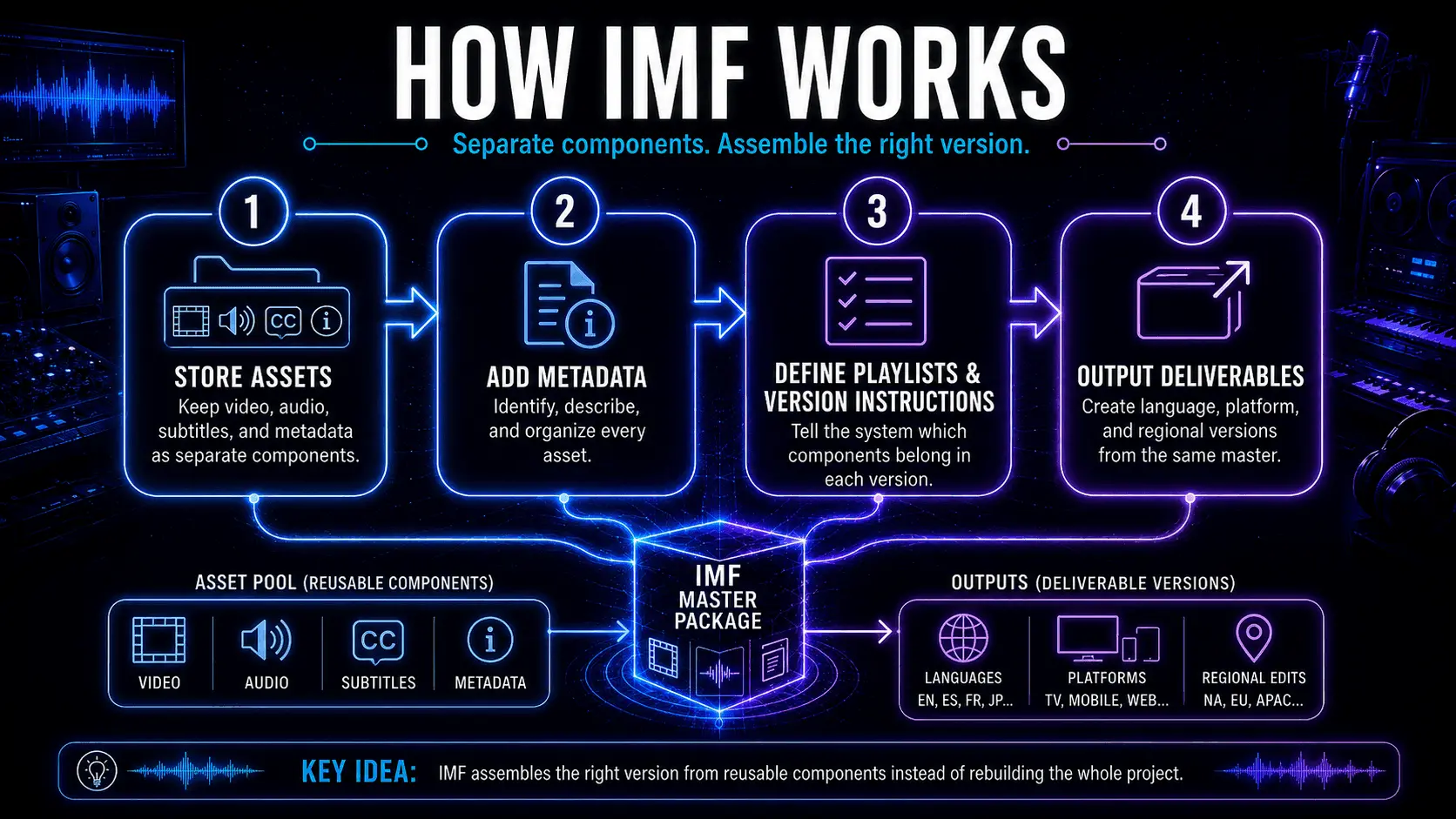
Playlists and metadata mapping determine how the available assets should be assembled for a particular version. The playlist defines which video, audio, subtitle, and alternate content elements belong in the deliverable, while the associated metadata identifies the assets and provides the technical information required to process them correctly. This allows the same underlying material to support many outputs without requiring teams to rebuild or duplicate the complete production.
A useful way for music producers to understand this structure is to compare it with working inside a DAW session. A producer can mute, replace, or rearrange individual stems while preserving the rest of the song. IMF applies a similar principle to audiovisual media. One video master can support several language tracks, subtitles can be added or removed as required, regional versions can reference alternate scenes, and platform-specific exports can follow different encoding settings.
All these variations remain connected to the same controlled master ecosystem. When an audio track, subtitle file, scene, or delivery instruction changes, the relevant component can be updated without recreating every version from the beginning. This makes updates and revisions faster, improves asset organization, reduces storage requirements, and helps studios maintain greater consistency across every final deliverable.
Key Benefits of IMF
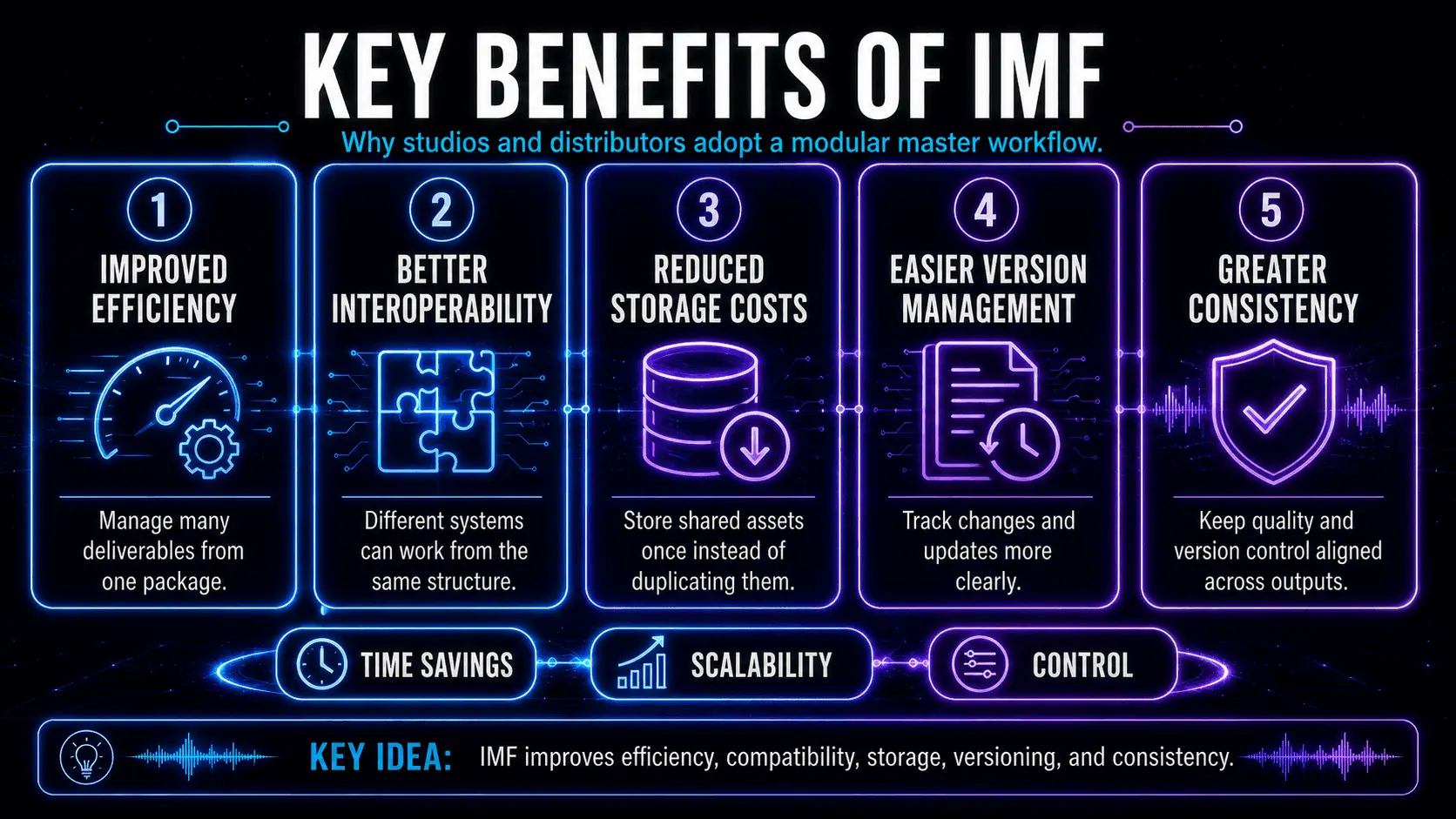
Improved Efficiency
One of the most important benefits of IMF is that it reduces the need to create and maintain duplicate master files. Teams can manage multiple deliverables from one structured package rather than exporting a complete new file for every language, region, platform, or technical specification. Because shared assets remain centralized, the same source material can be reused across different versions of a production.
This approach saves time throughout the delivery process. Localization teams can add new audio or subtitle tracks without rebuilding the entire project, while version updates can be applied only to the affected components. Platform distribution, quality control, and long-term archiving also become easier because teams are working from one organized master structure instead of tracking dozens of independent exports.
Better Interoperability
Interoperability is another major strength of IMF. The format provides a standardized framework that allows editing systems, post-production tools, quality-control software, and distribution platforms to work with the same package structure. This makes it easier to move content between studios, vendors, broadcasters, and streaming services while preserving the relationships between the video, audio, subtitles, metadata, and version instructions.
For music producers, this principle is comparable to the way standardized plugin formats improve compatibility across audio-production environments. A common technical structure allows different tools to recognize and process the same material, reducing compatibility problems and making collaboration more reliable.
Reduced Storage Costs
Large-scale film and television productions can require enormous amounts of storage when every regional or platform version is saved as a complete standalone file. Much of the content in those exports is identical, meaning the same high-resolution video and audio assets may be duplicated many times.
IMF reduces this redundancy by storing shared assets once and referencing them wherever they are needed. Only the elements that differ between versions, such as a language track, subtitle file, alternate scene, or delivery instruction, need to be added separately. For studios distributing content across many international markets, this can substantially reduce storage demands and produce meaningful operational savings.
Easier Version Management
Modern productions often require different edits for specific regions, streaming services, broadcasters, and release formats. Managing these variations as separate masters can make it difficult to identify which version is current, which assets have changed, and whether every deliverable includes the correct updates.
IMF simplifies version management by allowing individual components to be replaced or rearranged without rebuilding the complete project. A subtitle can be corrected, an audio track can be updated, or an alternate scene can be assigned to a particular market while the remaining assets stay unchanged. This is particularly valuable for streaming platforms, international releases, broadcast networks, and localization teams that must manage large numbers of related deliverables while maintaining consistent quality and accurate version control.
Challenges of IMF Implementation
Although IMF can simplify media versioning and distribution over the long term, adopting it is not always straightforward. The format depends on coordinated systems, accurate metadata, and clearly defined delivery procedures. Studios moving from traditional file-based workflows may therefore need to update both their technical infrastructure and their internal production practices before they can take full advantage of the format.
Complex Workflow Integration
Implementing IMF requires compatibility across the systems used for editing, post-production, quality control, asset management, and delivery. Older software and legacy production environments may not fully support current IMF standards, which can create gaps when packages move between departments or external vendors. Even when the necessary tools are available, inconsistent naming conventions, metadata practices, or versioning procedures can make integration more difficult.
Studios may need to upgrade parts of their infrastructure, introduce compatible software, and establish standardized workflows across all participating teams. Clear procedures are especially important when multiple post-production houses, localization vendors, broadcasters, or streaming services are involved. Once these systems and processes are aligned, however, IMF can make collaboration and delivery considerably more efficient.
Large Package Sizes and Infrastructure Demands
IMF reduces unnecessary duplication, but the master package itself can still contain a substantial amount of data. High-resolution video, multiple audio tracks, subtitle files, alternate scenes, playback instructions, and extensive metadata can produce very large media packages, particularly for feature films and premium television productions.
Handling this volume of material requires reliable technical infrastructure. Studios may need faster storage systems, high-bandwidth networks, scalable cloud resources, and efficient media asset management solutions to transfer, process, and archive packages without creating production delays. The challenge is therefore not simply storing the files, but ensuring that teams can access and update them quickly throughout the production and distribution process.
Technical Learning Curve
Teams that are unfamiliar with IMF may initially find its structure more complicated than working with conventional exported masters. Staff must understand how metadata identifies assets, how playlists assemble specific versions, how packages should be organized, and how delivery specifications differ between platforms and distributors. Errors in any of these areas can result in missing components, incorrect playback sequences, or rejected deliverables.
Training and documentation are therefore important during the transition. Teams need shared standards for package creation, naming, validation, quality control, and delivery. The initial learning period may require additional time and oversight, but once these procedures are established, IMF usually reduces long-term operational complexity by making versions easier to organize, revise, and distribute.

Real-World Applications of IMF
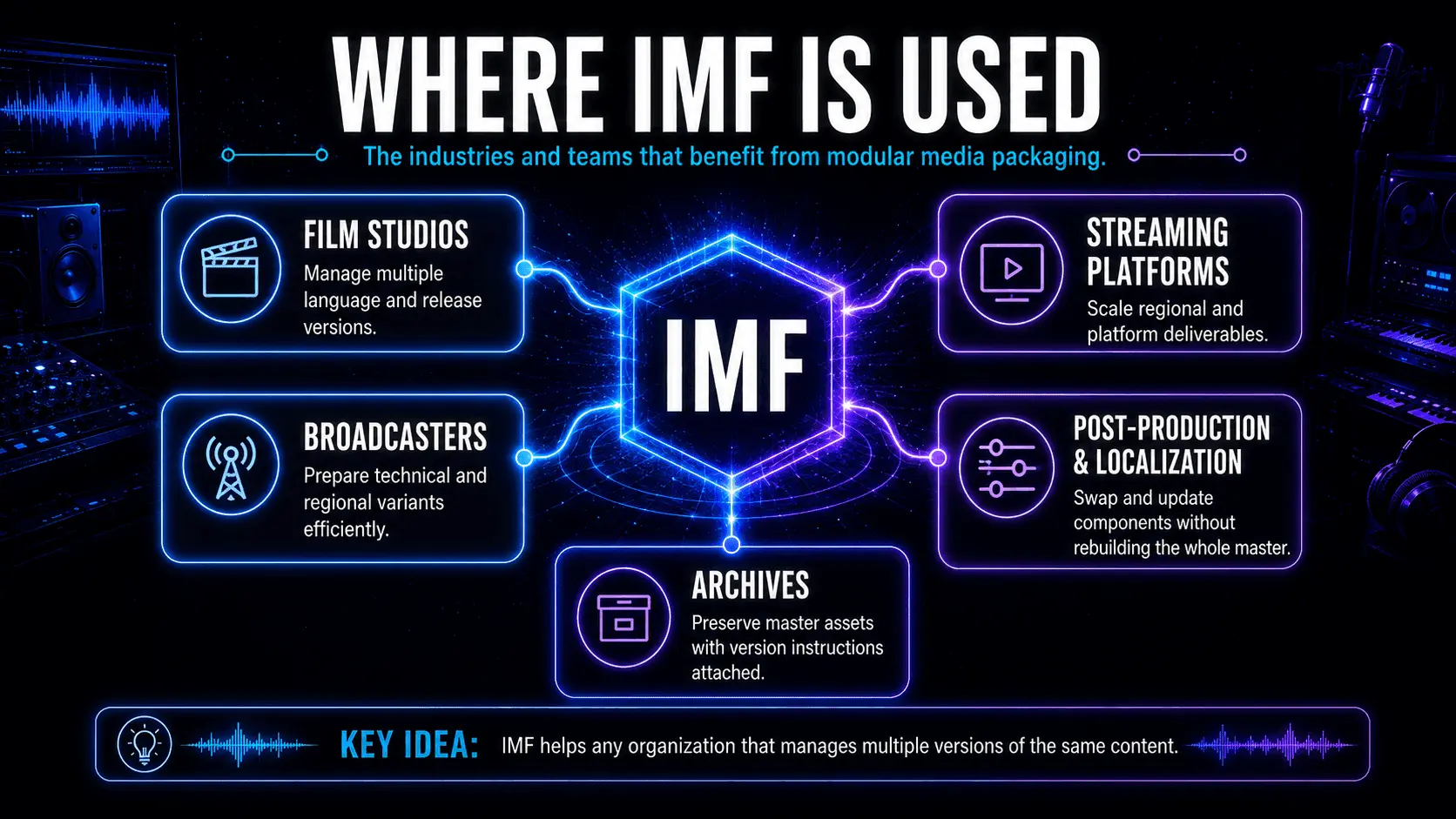
IMF is used across film, television, streaming, broadcasting, and media preservation because these industries often need to manage many versions of the same production. Its modular structure allows organizations to prepare content for different audiences and technical environments without creating a separate full master for every use case.
Film Distribution
Major film studios use IMF to manage international releases more efficiently. A single production may require different audio languages, subtitle packages, regional edits, and compliance changes before it can be distributed across multiple markets. In a traditional workflow, each combination might need to be exported and stored as a separate master file.
With IMF, these regional variations can remain connected within one structured package. Localization teams can add dubbed audio, update subtitles, or reference an alternate scene without duplicating the complete film. This simplifies subtitle management, language versioning, localization, and regional compliance while helping studios maintain consistency across international releases.
Streaming Platforms
Streaming services also rely on IMF because they must deliver the same content across a wide range of devices, resolutions, regions, and network conditions. A title may need to support televisions, computers, tablets, and mobile phones, along with several resolutions and bitrate profiles designed for different connection speeds.
IMF allows these services to create the required outputs from a centralized set of approved assets. Language tracks, subtitles, regional versions, and technical delivery instructions can be combined according to the needs of each platform or market. This supports faster deployment while helping streaming providers maintain consistent quality and accurate version control across their content libraries.
Broadcast and Archiving
Broadcasters use IMF to manage content that may require different edits, language options, or technical specifications for particular channels and regions. Because individual components can be updated without replacing the entire master, broadcasters can prepare new versions more efficiently as distribution requirements change.
Archival institutions can use the same structure to preserve master-quality audiovisual assets while retaining the information needed to reconstruct different versions in the future. Instead of preserving numerous largely identical exports, they can maintain shared source material together with the metadata, playlists, and version instructions that define how each presentation should be assembled. This improves long-term media preservation while keeping archived content adaptable to future platforms and delivery standards.
Preparing Modular Audio Assets Before IMF Packaging
An IMF workflow begins long before the final package is assembled. During production and post-production, audio is typically created as separate components—including dialogue, music, vocals, sound effects, and instrumental stems—so each element can be updated, localized, or replaced independently without affecting the rest of the project. This modular approach simplifies collaboration between creative teams and makes it easier to prepare multiple deliverables for different regions, platforms, and release requirements.
For example, productions often require music to be synchronized with picture, AI-generated vocals for localized versions, or alternate instrument arrangements for promotional edits and regional releases. Tools that analyze video content and generate editable music, vocals, AI instrument performances, and sound effects can help accelerate this creative stage while keeping every asset separate for later mixing, mastering, and version management.
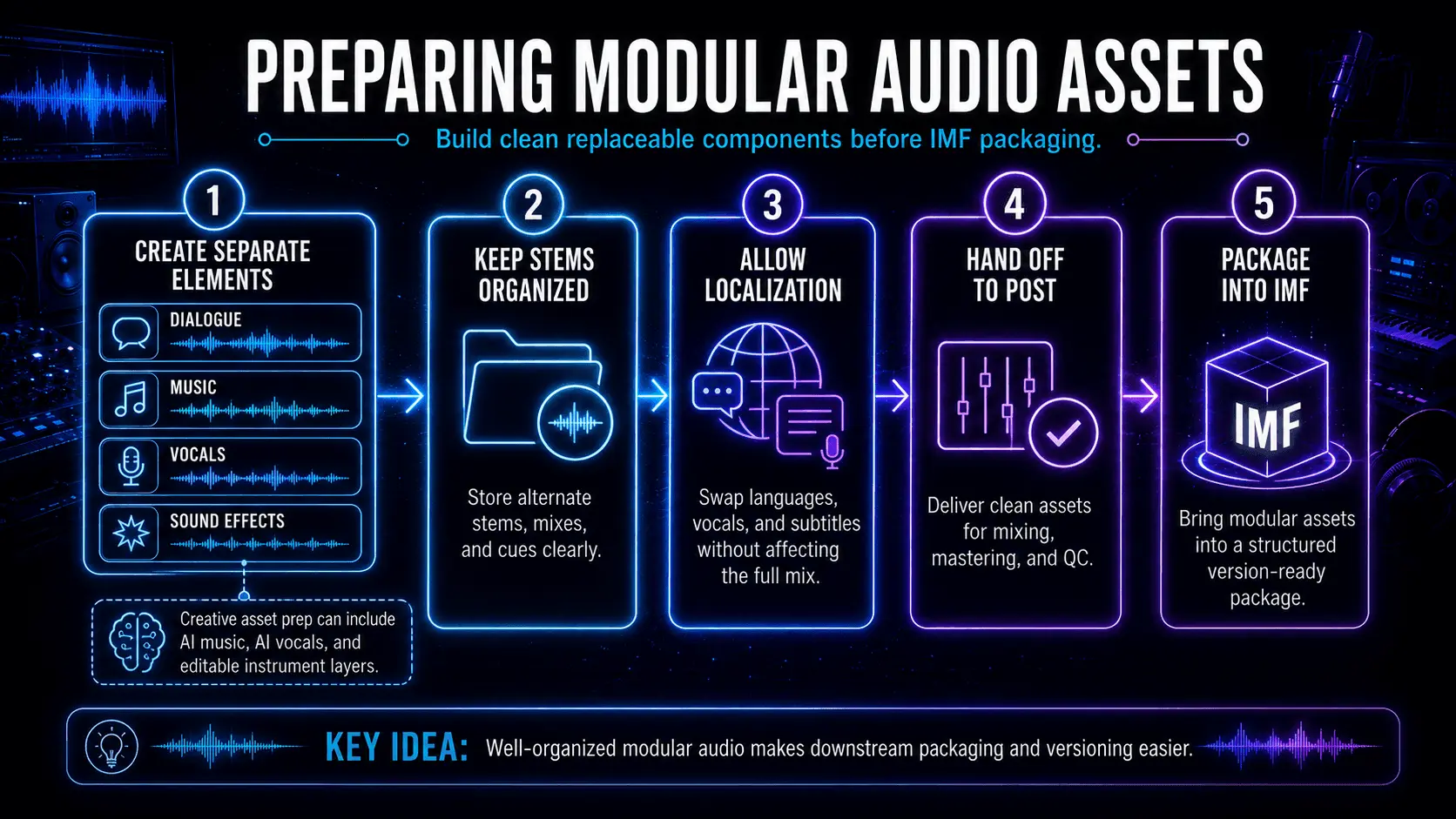
By organizing audio in this way before the packaging process begins, post-production teams can deliver clean, replaceable assets that integrate more efficiently into professional mastering workflows. Although IMF itself focuses on packaging and version control rather than content creation, preparing well-structured modular assets upstream helps streamline localization, revisions, and multi-platform distribution.
Future Trends in IMF
The future of IMF is likely to be shaped less by changes to its basic modular principle and more by the technologies being built around it. IMF already provides a standardized way to exchange finished audiovisual masters containing multiple versions, languages, edits, and technical configurations. As media supply chains become more automated, cloud-based, and globally distributed, the format can serve as a consistent foundation across increasingly complex production and delivery environments.
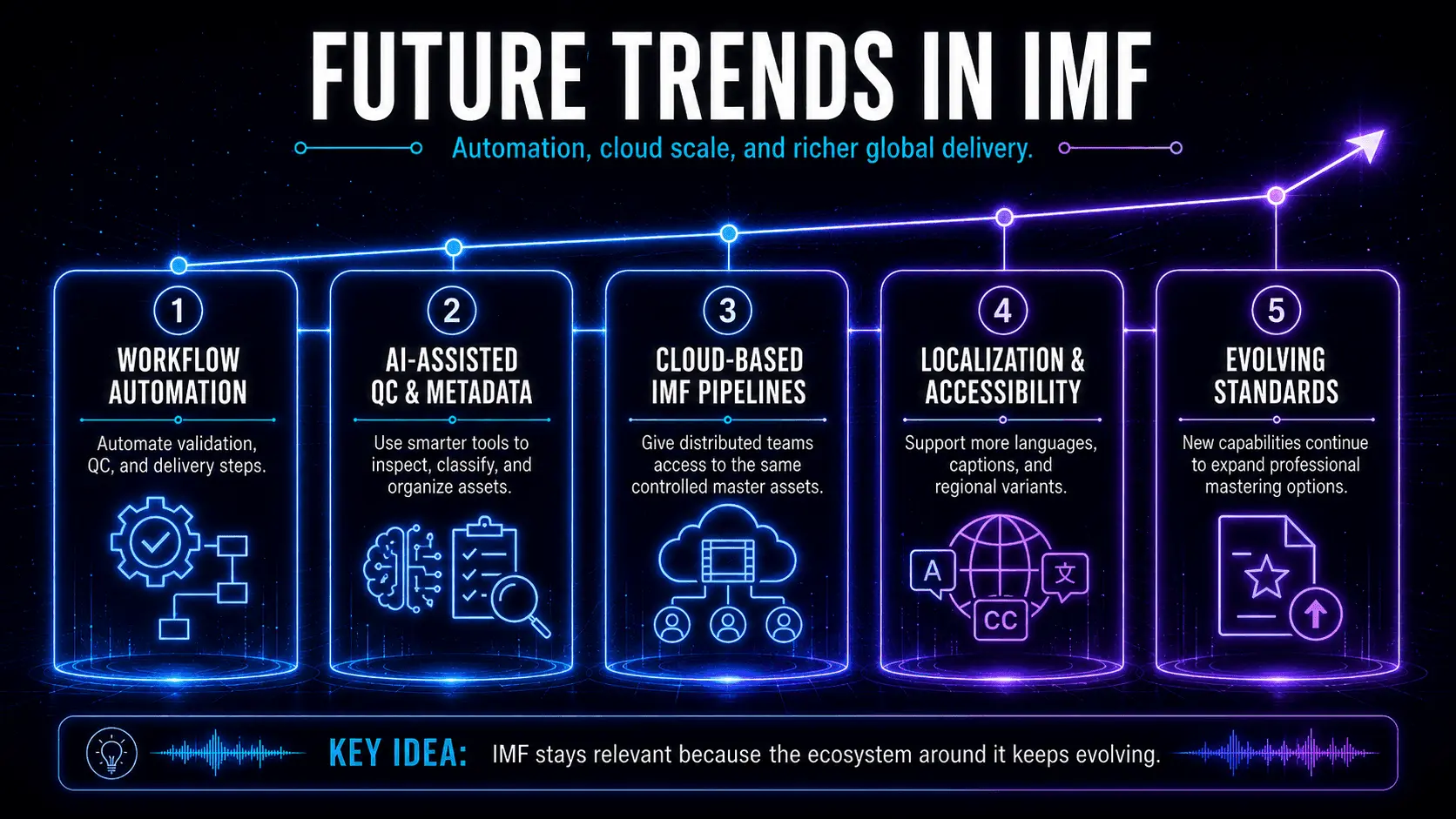
SMPTE also continues to maintain and extend the ST 2067 family of standards. Recent development has included new mechanisms for carrying richer audio metadata, demonstrating that IMF is still evolving to support current and next-generation audiovisual requirements rather than remaining a fixed legacy specification.
Greater Workflow Automation
Automation is already becoming more common throughout IMF-based media supply chains. Software can automatically ingest packages, validate their structure, perform technical quality-control checks, identify the required components, generate platform-specific outputs, and route approved versions to the appropriate delivery destination. These processes reduce the amount of repetitive manual work involved in preparing large numbers of related deliverables.
Artificial intelligence and machine learning may expand this automation further by assisting with metadata enrichment, asset classification, content discovery, anomaly detection, and quality-control review. However, these capabilities should not be described as functions of IMF itself. IMF provides the standardized package and component structure, while external systems use automation or AI to inspect, organize, process, and distribute the assets it contains.
Cloud-Based IMF Pipelines
Cloud infrastructure is also making IMF workflows more scalable and accessible to distributed teams. Instead of keeping every master package and processing system within one physical facility, studios can store approved assets in centralized cloud environments and give authorized production, localization, quality-control, and distribution partners access to the same controlled material.
Cloud-based systems can scale processing resources according to demand, allowing teams to perform tasks such as validation, quality control, transcoding, packaging, and delivery without maintaining the same level of local infrastructure. They can also make it easier for geographically dispersed teams to coordinate version updates and distribute completed deliverables across international markets. This does not eliminate the need for careful security, permissions, and asset management, but it can reduce dependence on fixed on-premises storage and processing systems.
More Complex Localization and Accessibility Requirements
The continued international growth of streaming and digital distribution will increase the number of versions that studios need to manage. A single title may require numerous dubbed languages, subtitle and caption packages, regional edits, accessibility assets, technical formats, and market-specific compliance changes. IMF is well suited to this environment because its component-based structure allows these variations to reference shared master assets rather than duplicating the complete production.
Future development is therefore likely to focus on supporting richer metadata and more complex audiovisual configurations. SMPTE’s continuing work on IMF includes mechanisms for carrying Audio Definition Model metadata, which can support more advanced and structured audio presentations. Localized audio, subtitles, captions, and alternate versions can then be prepared within the master package for use by downstream broadcast and streaming systems. IMF does not dynamically deliver those options to viewers by itself, but it provides the organized source components from which distribution platforms can create them.
Why IMF Continues to Matter
IMF reflects a broader shift in professional media production toward standardized, component-based, and non-destructive processes. Its relationship to media distribution can be compared with non-destructive editing in music production: shared source material remains intact while different versions are assembled through instructions and interchangeable components. The comparison is illustrative rather than technically exact, but it helps explain why the format is valuable.
For studios, broadcasters, localization providers, and distributors, IMF offers a structured way to manage growing numbers of content versions without sacrificing control over quality or creating unnecessary duplication. Its extensible design, continuing standards development, and support across commercial and open-source implementations indicate that it remains an established foundation for professional audiovisual mastering and exchange, particularly when content must be prepared for multiple territories and platforms.
Frequently Asked Questions
What does IMF stand for in media production?
IMF stands for Interoperable Master Format. It is a standardized media packaging framework used in film, television, and streaming distribution to manage multiple versions of content from a single master package.
What is the purpose of the IMF?
The primary purpose of the IMF is to simplify media versioning and distribution. Instead of creating separate master files for every language, platform, or regional edit, IMF allows all variations to exist within one structured ecosystem, improving workflow efficiency, storage management, content localization, and the scalability of global distribution.
How does the IMF reduce storage requirements?
IMF reduces storage needs by referencing shared media assets instead of duplicating complete files. For example, multiple versions of a film can share the same video master while using different subtitle tracks or audio files. This eliminates unnecessary redundancy and lowers operational costs.
Is IMF only used for movies?
No. Although IMF is heavily used in the film industry, it is also widely adopted by streaming platforms, television broadcasters, post-production houses, archival institutions, and media distribution companies. Any organization that manages multiple versions of the same content can benefit from an IMF workflow.
What files are included in an IMF package?
An IMF package can contain several media components, including video tracks, audio files, subtitle files, metadata, playlists, and version instructions. These elements work together to create different deliverable versions without requiring the entire project to be rebuilt each time.
How is IMF different from traditional media delivery workflows?
Traditional workflows often require separate exported master files for every platform or language version. IMF centralizes all versions into one structured package, allowing individual components to be swapped dynamically. This makes updates, localization, and distribution much more efficient.
Why is interoperability important in the IMF?
Interoperability ensures that media assets can move between different systems, software platforms, and distribution environments without compatibility issues. This allows studios, editors, distributors, and streaming platforms to collaborate more efficiently while maintaining consistent media quality.
Do streaming services use IMF?
Yes. Many major streaming platforms rely on IMF because it simplifies the management of multiple resolutions, audio languages, subtitles, and regional deliverables from one centralized master package.