
Key Takeaways
- Song structure controls a track’s energy, narrative flow, and emotional impact by organising sections such as the intro, verse, pre-chorus, chorus, bridge, and outro.
- Common formats—including verse-chorus, AABA, strophic, and through-composed structures—provide useful foundations, but the best arrangement depends on the song’s genre and purpose.
- Contrast between sections is essential: changes in dynamics, instrumentation, stereo width, frequency range, and rhythmic intensity help choruses feel bigger and transitions feel more impactful.
- A DAW makes it possible to test different arrangements by moving, shortening, repeating, or replacing sections, while tools such as ACE Studio support editable MIDI, vocals, instruments, and AI-generated layers.
- Strong song arrangements balance repetition with variation, using techniques such as bridges, breakdowns, automation, layering, beat switches, and moments of silence to maintain listener interest.
How Song Structure Shapes the Listener’s Experience
Song structure is the architectural blueprint of musical composition. It is the strategic arrangement of distinct sections that governs how a listener experiences a piece of music over time. For producers, audio engineers, and songwriters, mastering song structure is not merely a matter of following a template; it is about managing energy, narrative arc, and audience expectations.
In the modern music landscape, where attention spans are short and the DAW (Digital Audio Workstation) allows for infinite revision, understanding the interplay between verses, choruses, and bridges is more critical than ever. This guide provides a high-authority deep dive into every facet of song structure, from traditional verse-chorus formats to fluid arrangements enabled by emerging AI in music composition.
The Parts of a Song: A Technical Deep Dive
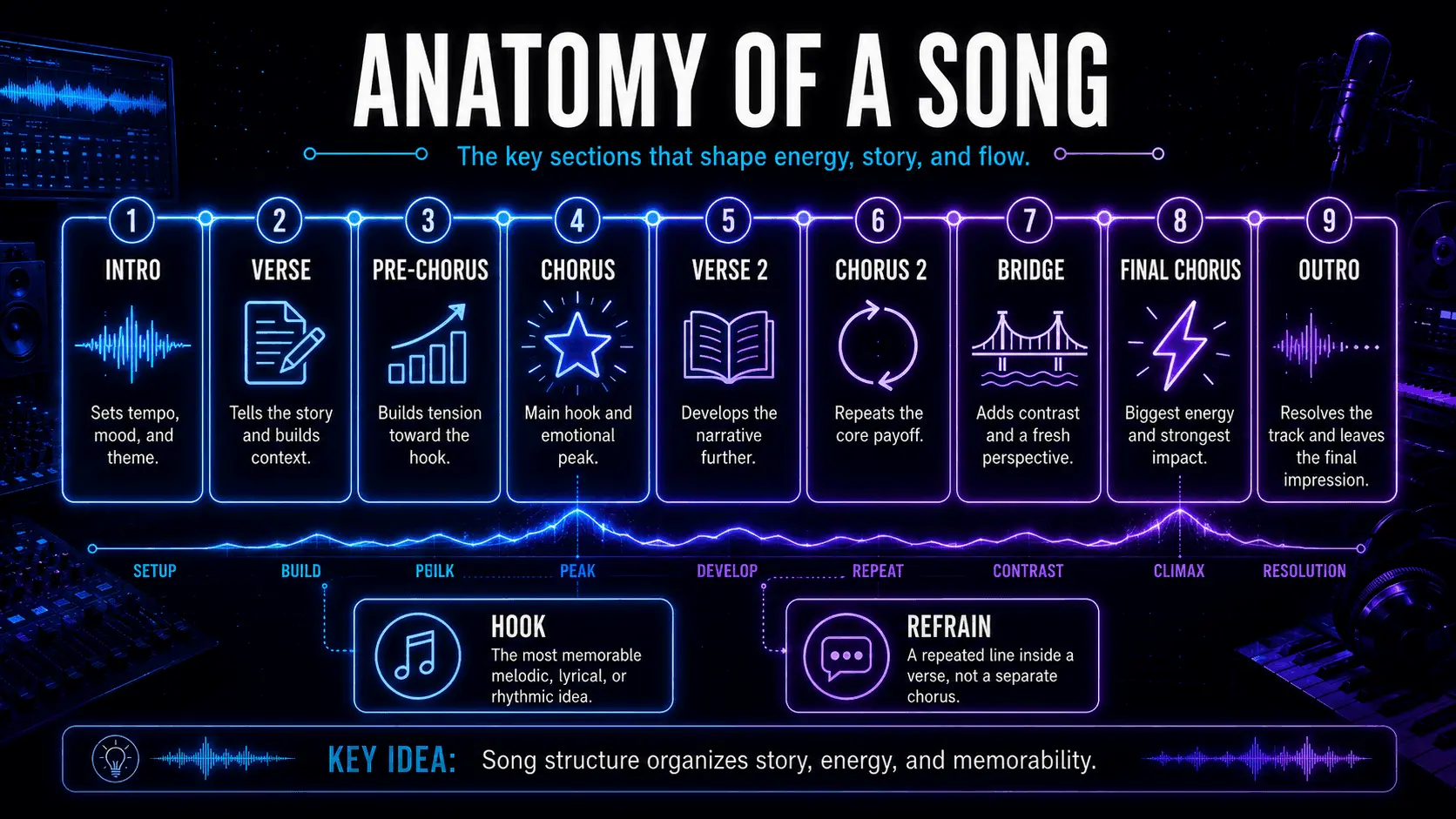
To build a professional track, one must understand the specific role of each component. Every section is a tool used to manage energy and narrative progression.
The Intro
The intro is the gateway to the song. Its primary function is to establish the tempo, melody, and atmosphere.
- Duration: Typically 4 to 8 bars, though modern streaming trends often favor 2-bar intros to capture the audience quickly.
- Instrumentation: Often features a stripped-back version of the main theme or a signature atmospheric texture.
- Technical Tip: Use automated filter sweeps or volume swells to transition the listener from silence into the world of the track.
The Verse
The verse is the storytelling engine. In the songwriting process, this is where the lyrical details and thematic context are established.
- Musical Characteristics: Generally has lower dynamics and a more restrained chord progression than the chorus.
- Lyrical Content: Focuses on the who, what, and where of the narrative.
- Arrangement: The verse should leave plenty of headroom for the vocal or lead instrument to shine, as this is where the most information is conveyed.
The Refrain
Often confused with the chorus, a refrain is a recurring line or phrase that appears at the end of each verse. Unlike a standalone chorus, a refrain is integrated into the harmonic structure of the verse.
- Example: In many folk and blues songs, the title of the track is delivered in a one-line refrain that resolves the tension built during the verse lyrics.
The Pre-Chorus
The pre-chorus acts as a bridge between the verse and the chorus. It is designed to build momentum and signal that a major change is coming.
- Harmonic Role: Often uses subdominant chords or a rising melodic line to create a sense of lifting.
- Dynamics: This is where the first significant build-up occurs. Producers often add rhythmic subdivisions (like eighth-note shakers or faster snare patterns) to increase the perceived energy.
The Chorus
The chorus is the core of the song. It contains the primary hook and the emotional climax.
- Energy Level: This should be the loudest and most dense part of the arrangement.
- Repetition: The chorus is typically repeated two to three times throughout the track to ensure it sticks in the listener's memory.
- Technical Profile: In a professional mix, the chorus often occupies the widest stereo image and the fullest frequency spectrum.
The Bridge
The bridge provides a departure from the established cycle of verses and choruses. It offers a fresh perspective, both lyrically and musically.
- Technical Function: It introduces new melody, harmony, and often a shift in tempo or dynamics.
- Placement: Usually occurs after the second chorus, serving as a reset before the final high-energy push.
- SEO Gap Insight: Many beginner producers overlook the power of the bridge to resolve thematic tension. It is the perfect place to modulate to a relative key or introduce a new instrumental texture.
The Outro (or Coda)
The outro brings the song to a close. It can be a simple fade-out or a complex coda that introduces a final musical idea.
- Function: To let the listener down gently or leave them with a lasting impression of the main hook.
- Technical Tip: Use a coda to showcase a final instrumental solo or a variation of the melody that provides emotional resolution.
The Hook
While not a section in itself, the hook is the most vital element of hook development. It can be a vocal melody, a guitar riff, or a unique rhythmic pattern. A song can have multiple hooks, but the primary hook usually resides in the chorus.
Understanding Song Structure: Core Formats
To master music composition, one must be fluent in the various archetypes of musical form. These structures serve as the starting point for most tracks in the modern industry.
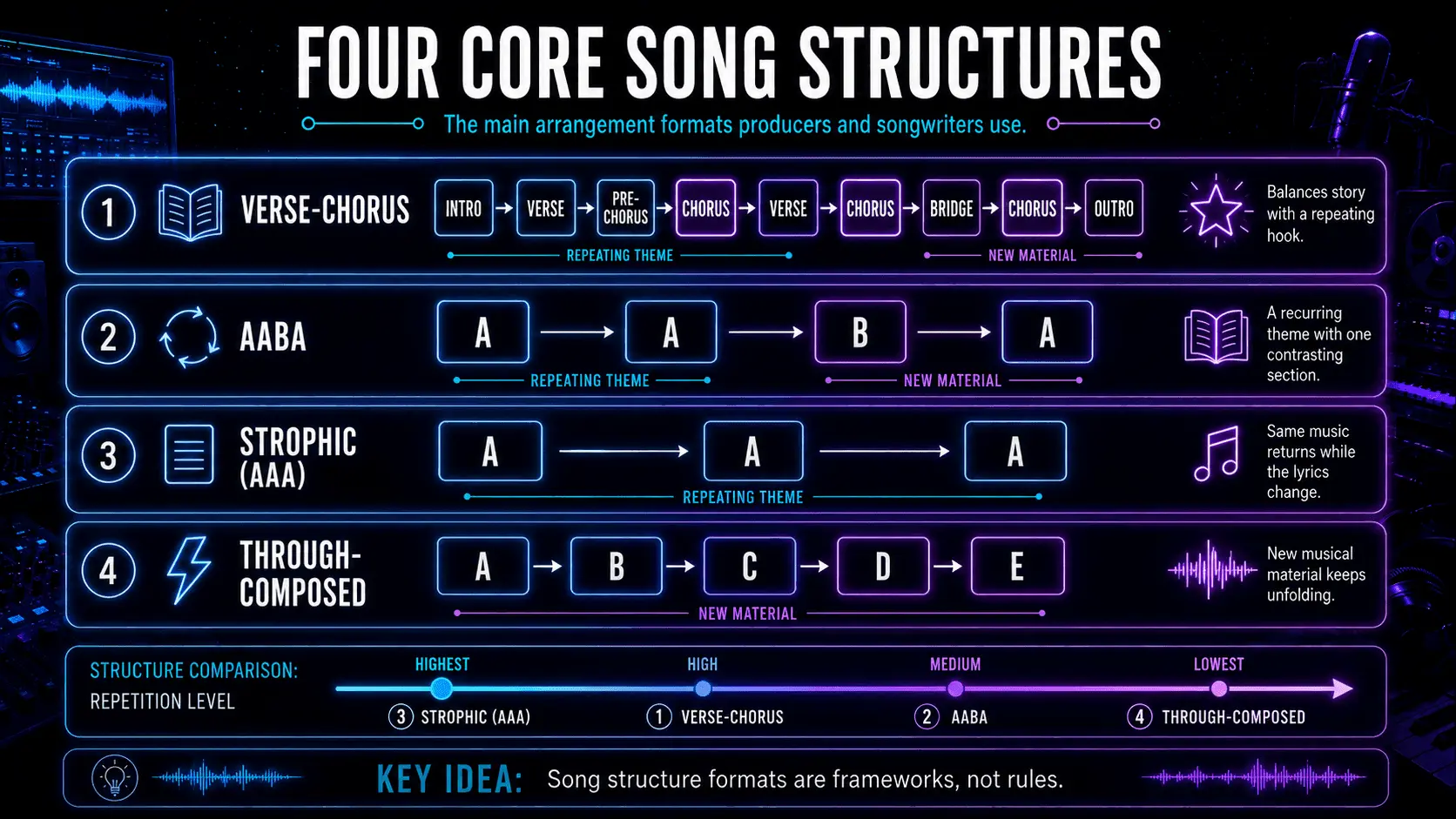
Verse-Chorus Structure (ABAB / ABABCB)
This is the gold standard for popular music. Its popularity stems from its ability to balance narrative (the verse) with an infectious, repeating theme (the chorus).
- Structure: Intro - Verse 1 - Pre-Chorus - Chorus - Verse 2 - Pre-Chorus - Chorus - Bridge - Chorus - Outro.
- Analysis: This format provides two opportunities to establish the story before introducing a twist (the bridge) and concluding with the emotional peak.
AABA Form
Common in early 20th-century standards and jazz, this form focuses on a recurring theme with a single contrasting section.
- Structure: Verse - Verse - Bridge - Verse.
- Technical Detail: There is no distinct chorus. Instead, the title or main hook is woven into the end of the A sections.
Strophic Form (AAA)
The oldest and simplest form, where the same musical section repeats with different lyrics.
- Use Case: Ideal for long-form storytelling, folk music, and protest songs.
- Challenge: The producer must use arrangement and dynamics to prevent the repetition from becoming monotonous.
Through-Composed Structure
A fluid arrangement where new musical material is introduced throughout the track without literal repetition.
- Use Case: Common in progressive rock, cinematic scores, and experimental electronic music.
- Execution: Relies on thematic motifs to maintain coherence while avoiding traditional verse-chorus formats.
Innovative Approaches to Song Structure
In the age of the DAW, the traditional boundaries of structure are being pushed by producers looking for unique sonic signatures.
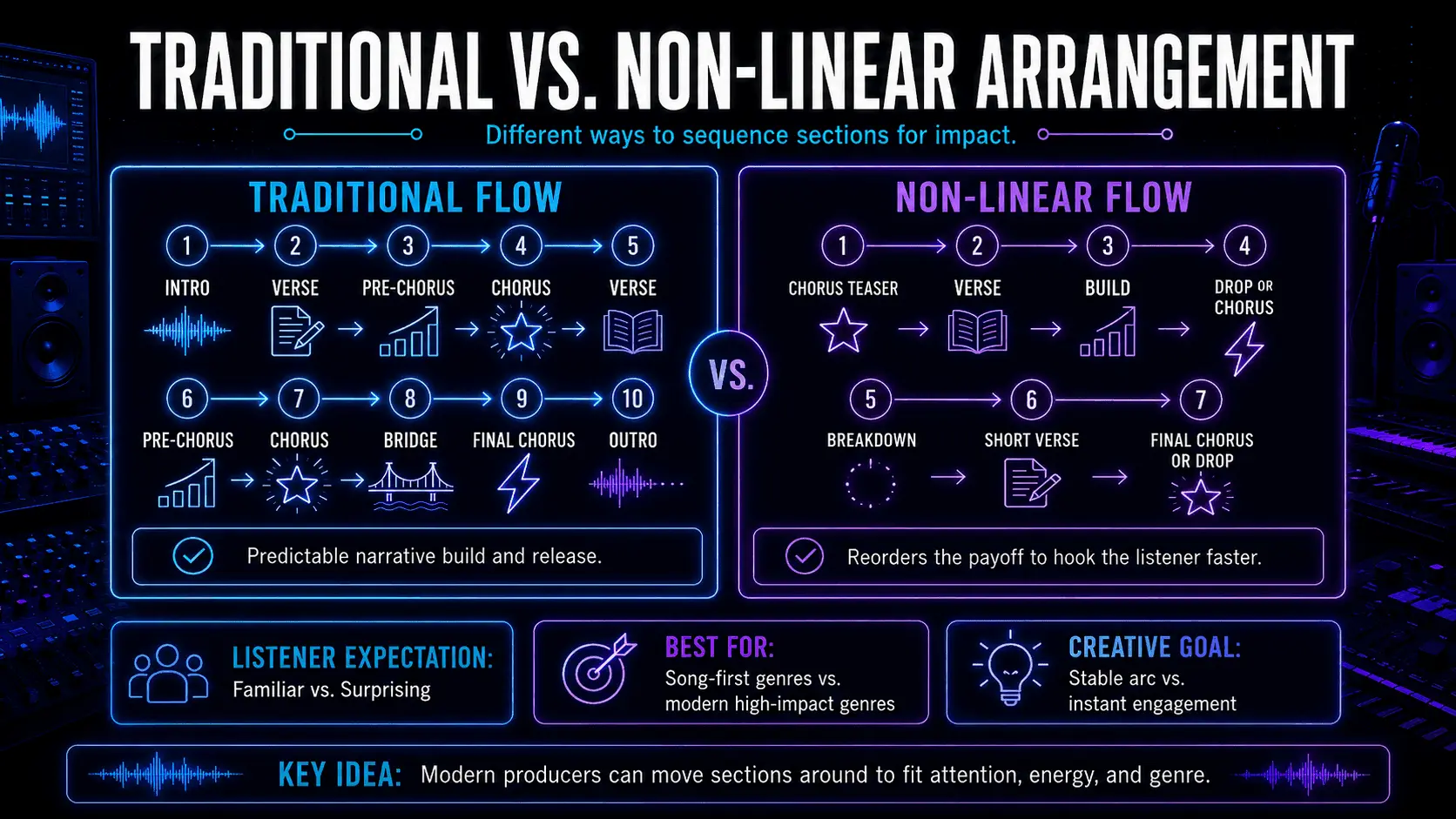
Non-Linear Arrangements
With the ability to cut and paste sections effortlessly, many modern tracks utilize non-linear flows. For example, starting with the bridge or a stripped-back chorus can immediately hook the audience.
- The Drop-First Strategy: Popular in EDM and Trap, where the highest energy section is teased in the first 15 seconds.
Generative and AI-Assisted Structure
AI tools can make it faster to test arrangement ideas, but they should support rather than replace structural decisions. The most useful tools allow producers to move between sections, compare alternatives, and keep the musical performance editable.
In ACE Studio, audio and MIDI clips can be created, copied, moved, trimmed, and rearranged directly on the Canvas. This makes it possible to test a shorter intro, move the first chorus forward, extend the bridge, or create a larger final chorus without rebuilding the entire project.
Producers can also use AI Voices and AI Instruments to create editable performances from MIDI. Add a Layer can generate new instrumentals, vocals, or sample loops within a selected part of the timeline, making it useful for testing transitions, breakdown textures, countermelodies, and additional layers for later choruses.
The goal is not to force a song into a formula. It is to compare structural options and decide which arrangement best supports the song’s energy, narrative, and emotional direction.
Fluid Arrangements in Electronic Music
Electronic producers often view structure as a series of additive and subtractive layers rather than distinct "song parts."
- The Build: Using tempo changes and rising white noise to create tension.
- The Breakdown: Removing the drums and bass to create a sense of weightlessness before the final re-entry.
Using Dynamics to Enhance Song Structure
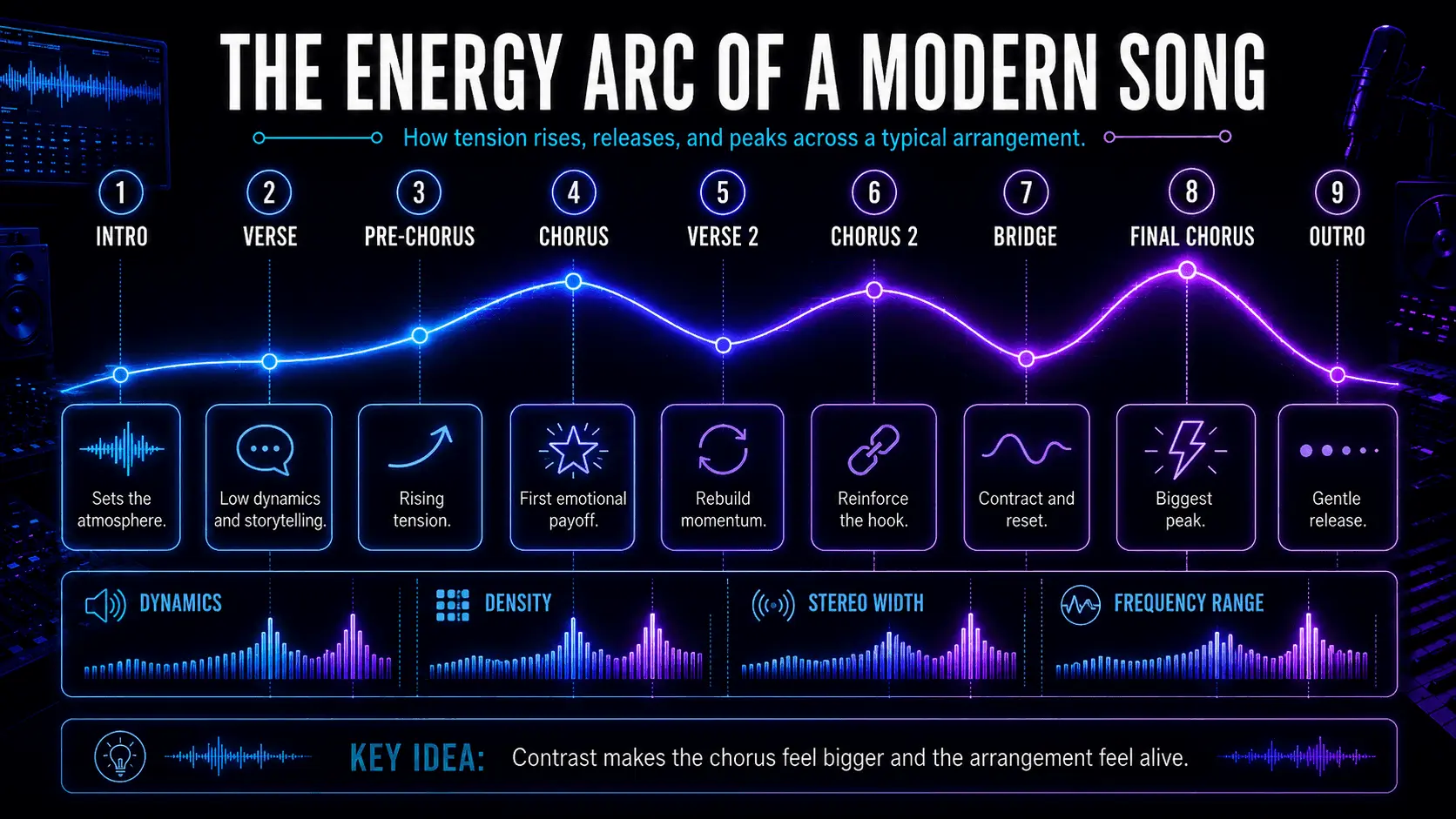
Dynamics are the soul of an effective arrangement. They dictate the emotional rise and fall of the track.
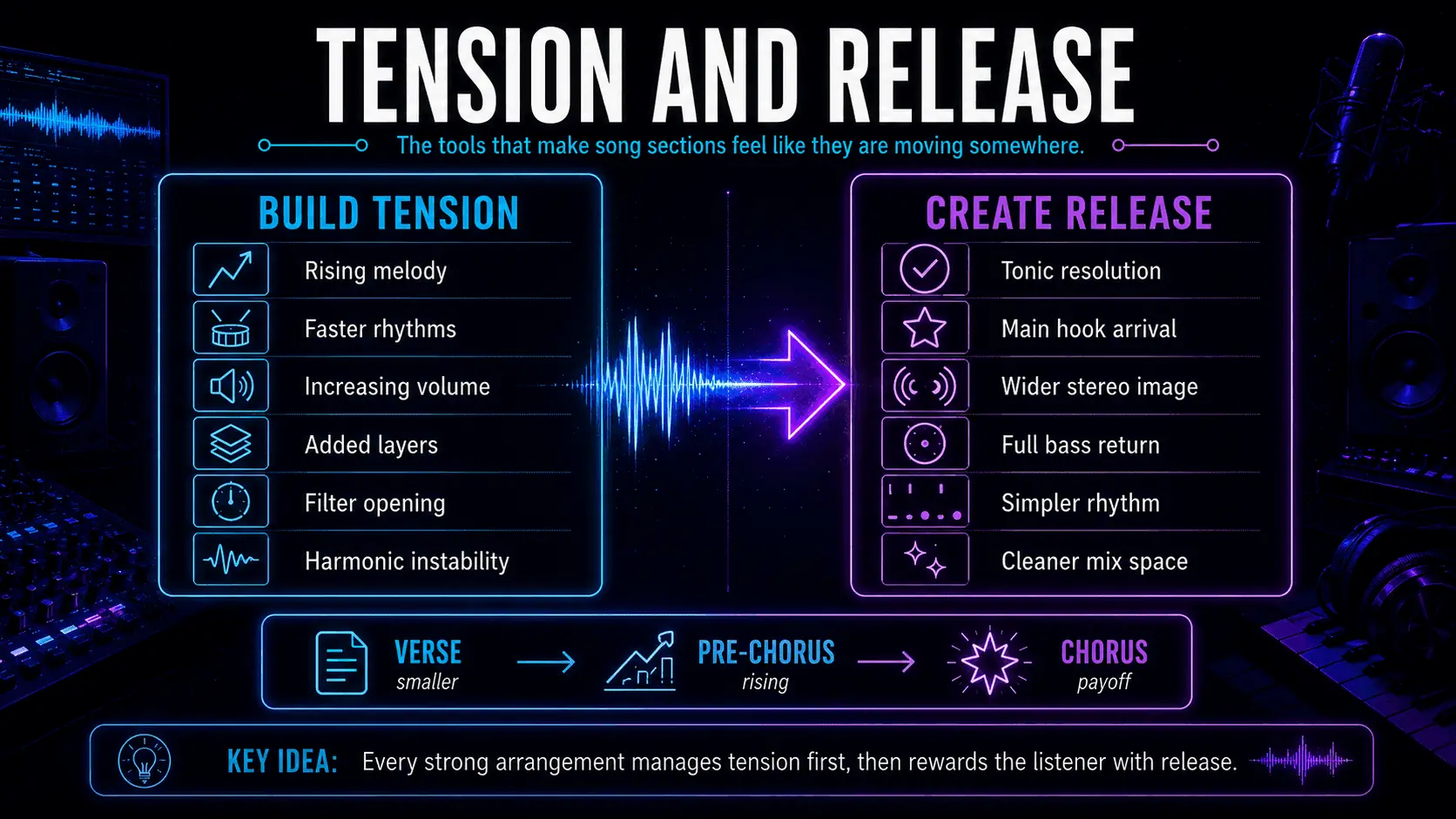
Creating Contrast Between Sections
A common mistake in the songwriting process is keeping the energy level static. To make a chorus feel big, the verse must feel relatively small.
- Stereo Width: Keep the verse centered and mono-compatible, then explode into a wide stereo field for the chorus.
- Frequency Management: Use high-pass filters on the verse to remove sub-frequencies, then let the sub-bass hit hard when the chorus arrives.
The Role of Tension and Release
Every section should either be building tension or providing release.
- Tension Builders: Dissonant chords, increasing volume, faster rhythmic patterns, and rising pitch.
- Release Providers: Resolution to the tonic chord, simplification of rhythm, and the arrival of the main melody.
The Role of Genre in Song Structure Understanding
Different genres have different structural expectations. Mastering these genre conventions is key to professional music composition.
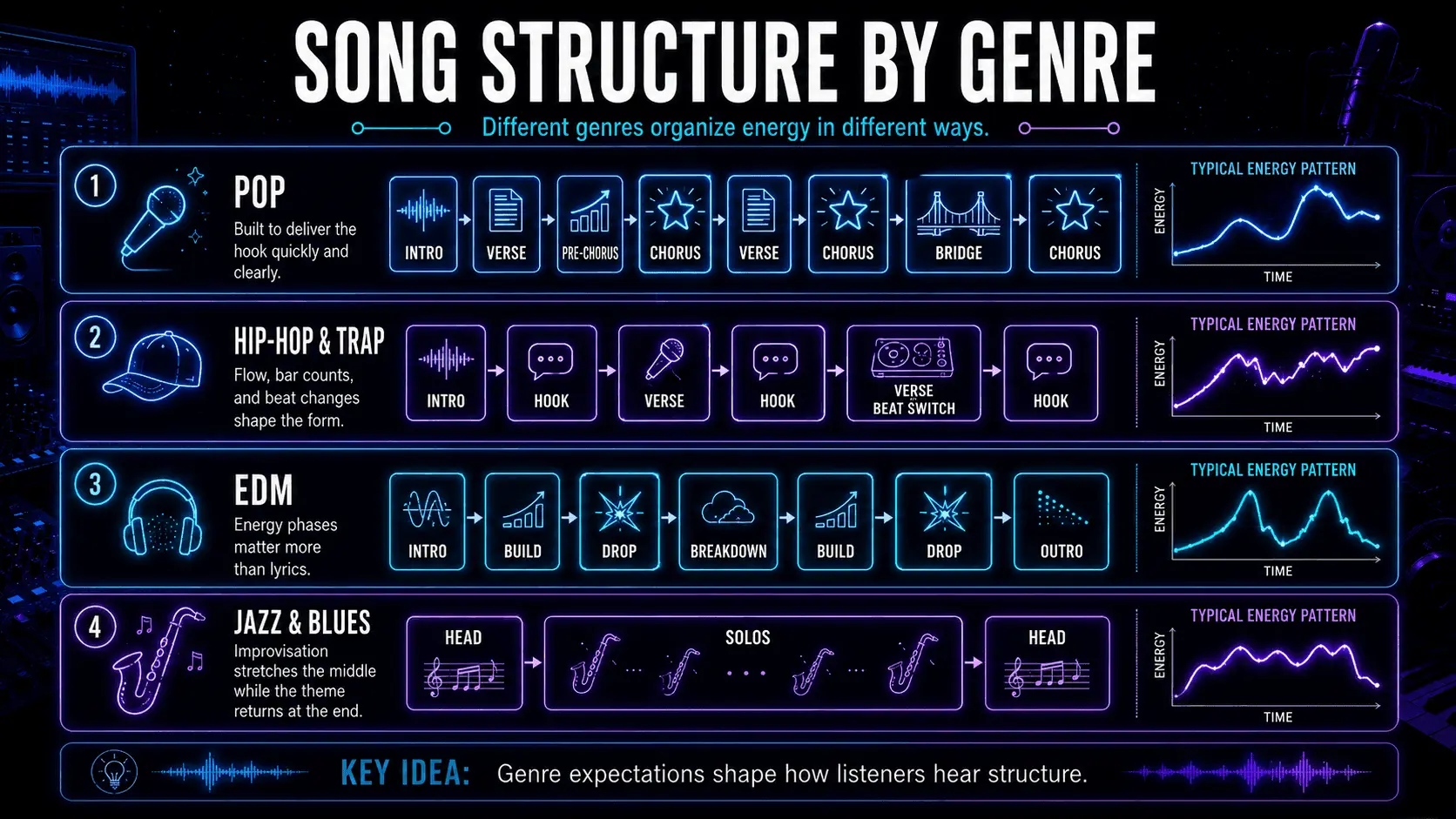
Pop and Top 40
The primary goal is the hook. Pop songs are structurally efficient, often cutting anything that doesn't lead directly to the chorus.
- Key Feature: The post-chorus, a wordless melodic hook (often a synth lead or vocal chop) that extends the energy of the chorus.
Hip-Hop and Trap
The focus is on the beat and the lyrical delivery. Structure is often dictated by bar counts (e.g., 16-bar verses and 8-bar choruses).
- Innovation: Beat switches in the middle of a track are a popular way to introduce a new arrangement without changing the song.
Electronic Dance Music (EDM)
Structure is measured in energy phases: Intro, Build-up, Drop, Breakdown, Build-up, Drop, Outro.
- Technical Detail: The drop serves the function of the chorus, but often focuses on rhythmic and timbral innovation rather than a lyrical hook.
Jazz and Blues
Often follow a Head-Solos-Head structure. The Head is the main melody, followed by improvised sections over the same chord progressions, returning to the Head for the finish.
- Fluidity: The length of the solo sections can change in real-time, making jazz a highly fluid arrangement style.
Lyrical Structure and The Importance of Prosody
Lyrical structure must work in harmony with the musical structure. This relationship is known as prosody.
Narrative Arch
- Verse 1: Set the scene.
- Verse 2: Introduce a conflict or a secondary perspective.
- Bridge: The emotional epiphany or a shift in the timeline (past or future).
Rhyme Schemes and Meter
The choice of rhyme scheme influences the "feel" of the verse.
- AABB: Provides a sense of resolution and simplicity.
- ABAB: Creates a more sophisticated, flowing rhythm that encourages the listener to wait for the next line.
- Internal Rhymes: Using rhymes within a single line to add a percussive quality to the vocals, which is essential for hook development in genres like Rap and Pop.
Syllabic Consistency
Maintaining a consistent number of syllables across corresponding lines in different verses ensures that the vocal melody remains stable and predictable, which aids in memorability.
Songwriting Techniques for Professional Producers
Effective songwriting techniques involve more than just writing a good melody; they involve the strategic management of the music composition process.
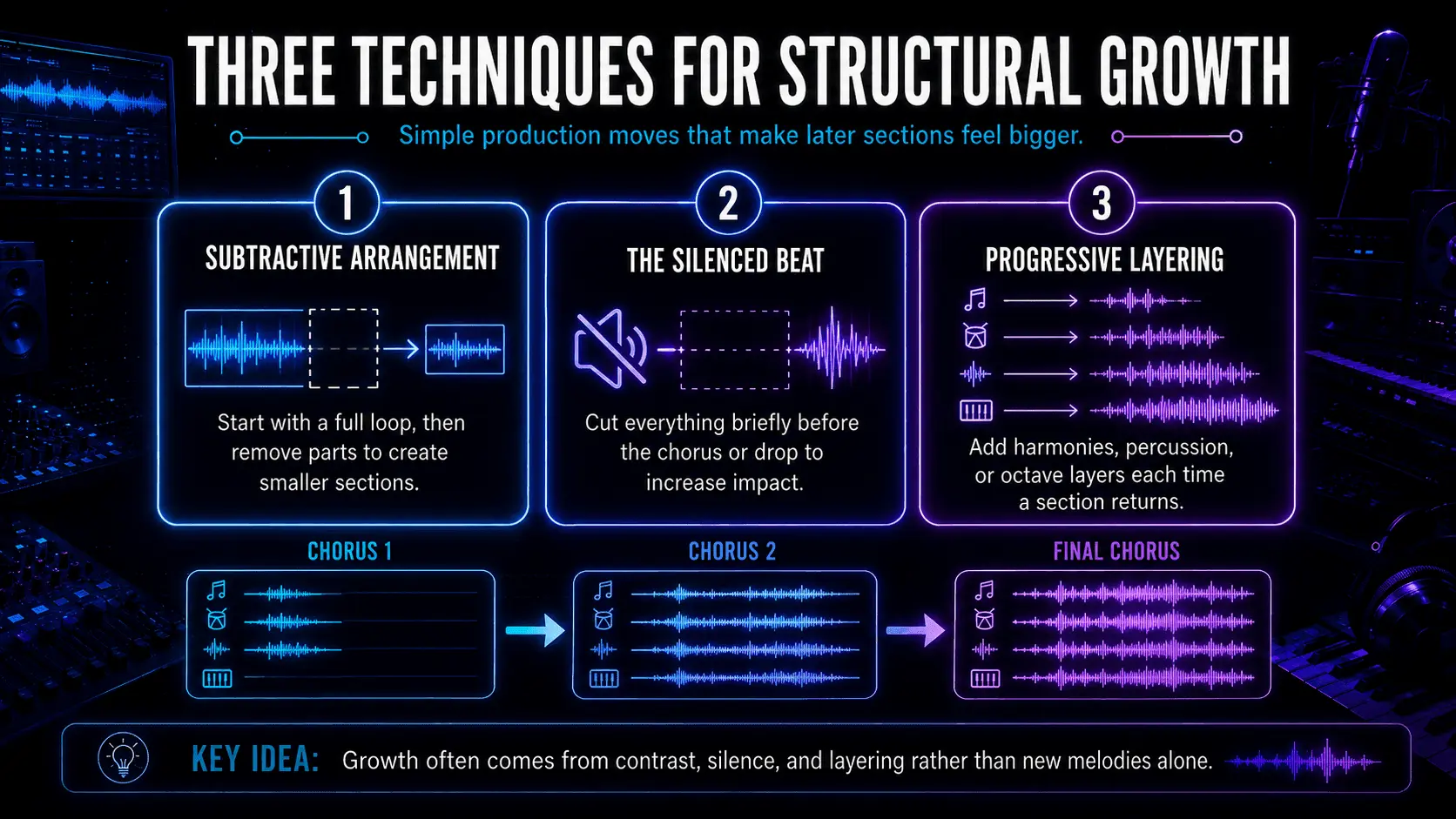
Subtractive Arrangement
Start by creating a 4-bar or 8-bar loop that contains every element of your song (the "wall of sound"). Then, spread this loop across the timeline and start removing elements to create the verse, pre-chorus, and bridge.
- Benefit: This ensures that the song feels cohesive, as every section is derived from the same core elements.
The Power of the Silenced Beat
Using a "stop-start" technique where all instruments cut out for half a bar before a chorus can create a massive amount of impact. This moment of silence resets the listener's ears and makes the subsequent entry feel more powerful.
Layering for Structural Growth
Instead of introducing new melodies, try layering existing ones.
- Example: In the second verse, add a harmony to the vocal. In the second chorus, add an octave-up synth to the main lead. This creates a sense of "unfolding" without requiring the listener to learn new information.
Technical Workflow: Organizing the DAW for Structure
A professional DAW session should be a visual representation of the song structure.
Using Markers and Colors
Most producers use markers at the top of the timeline to label sections.
- Visual Aid: Color-code your regions. For example, make all verses blue, all choruses red, and the bridge yellow. This allows you to see the "pace" of the song at a glance.
Automation as a Structural Tool
Automation is the key to making a static arrangement feel alive.
- Volume Automation: A 1dB boost in the chorus can make it feel more energetic without ruining the mix balance.
- Reverb Automation: Use "washy" reverb on the transitions (the last bar of a verse) to create a sense of space before the "dryer" and more "upfront" chorus.
The Arrangement Window vs. Session View
In DAWs like Ableton Live, the "Session View" allows you to experiment with different verse-chorus formats in real-time. Once you find a flow that works, you can record it into the "Arrangement Window" for fine-tuning.
Using ACE Studio to Develop Song Structure
ACE Studio combines arrangement, MIDI editing, AI vocals, AI instruments, and generative tools in one production environment.
The Canvas provides a timeline where producers can organize audio and MIDI clips into intros, verses, pre-choruses, choruses, bridges, breakdowns, and outros. Clips can be copied and repositioned to test different forms without losing the original musical material.
AI Voices turn MIDI and lyrics into editable vocal performances, while AI Instruments generate instrument performances from MIDI notes. This allows the same melody or progression to be reshaped for different sections through changes in timing, expression, articulation, dynamics, and layering.
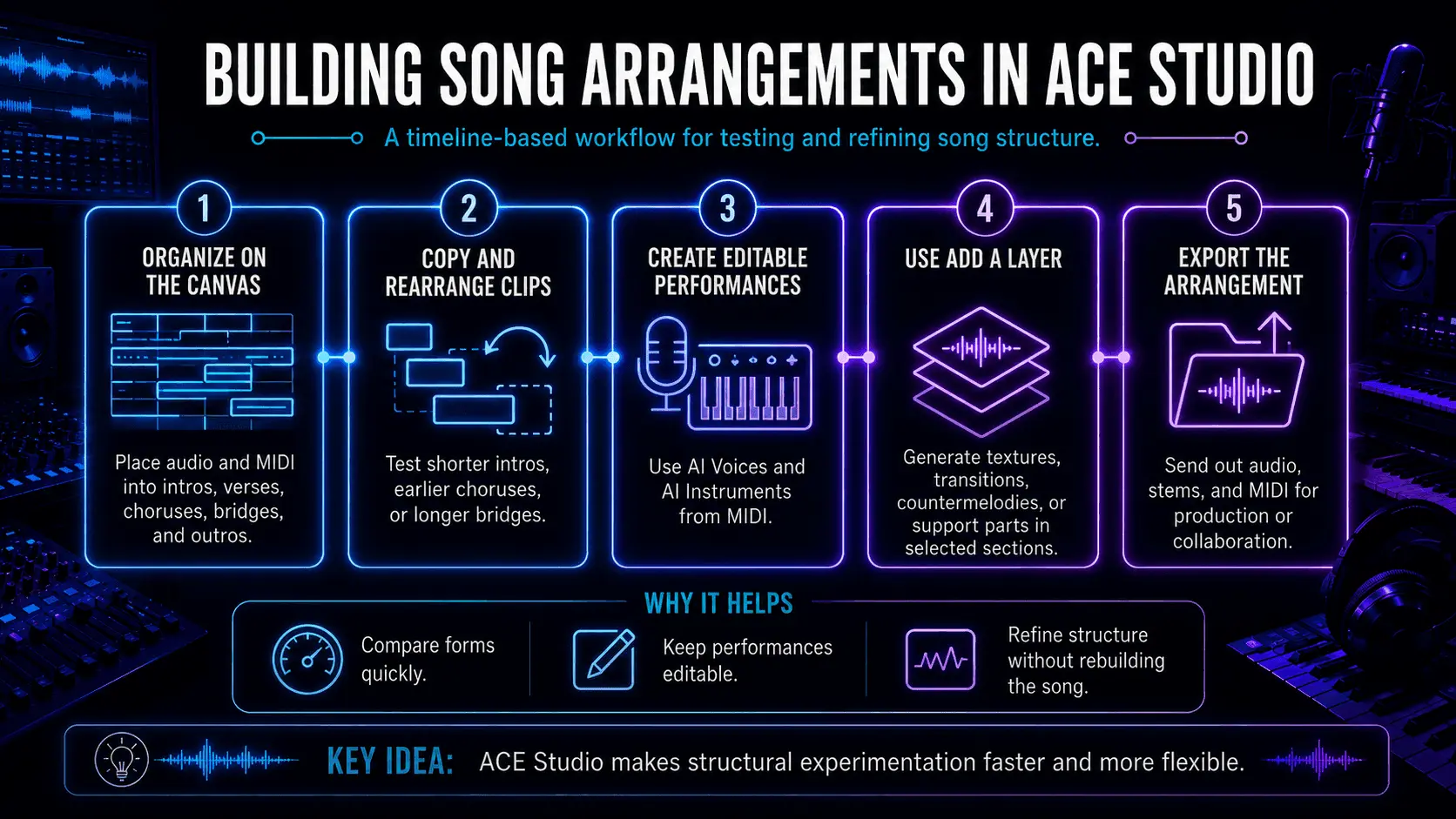
Add a Layer can generate supporting material inside a selected timeline range. A producer might use it to explore a sparse bridge texture, add rhythmic movement before a chorus, or introduce a new layer during the final section.
Once the arrangement is ready, audio tracks, individual stems, and MIDI can be exported for further production, mixing, or collaboration.
Protect Your Rights: The Business of Song Structure
Every time you contribute to a song arrangement, you are creating intellectual property. In the music industry, the way a song is structured can often dictate how publishing is split.
Music Publishing and Split Sheets
A split sheet is a document that outlines who owns what percentage of a song. If a producer creates the hook and the bridge, but a songwriter writes the verses, both parties must agree on the ownership of the final tracks.
- Fact: The chorus and the hook are often considered the most "valuable" parts of a song in a legal dispute, though standard practice is to split the composition 50/50 between the music and the lyrics.
Registering Your Songs
Once your arrangement is finalized, it is vital to register the work with a Performance Rights Organization (PRO). This ensures that you receive royalties whenever the song is played through streaming services, radio, television, live venues, or other licensed uses.

Future Outlook: The Death of the Standard Format?
As we look toward the future of music composition, we must ask: Is the verse-chorus structure still relevant?
The Rise of the "Vibe" Track
Many modern producers are moving away from traditional narrative structures in favor of "vibes"—tracks that maintain a consistent mood and texture without distinct sections. This is particularly prevalent in Lo-Fi, Ambient, and some branches of Modern Jazz.
Interactive Music
With the rise of gaming and the metaverse, we are seeing the emergence of "modular songs." These are tracks where the structure changes based on the player's actions. A player entering a combat zone might trigger a high-energy chorus loop, while a player exploring a peaceful forest might hear a stripped-back verse arrangement.
AI and the Democratization of Structure
Artificial Intelligence is making it easier for non-musicians to create well-structured songs. While some fear this will lead to "formulaic" music, it also frees professional producers to focus on more complex, innovative approaches to song structure that AI cannot yet replicate.
Frequently Asked Questions
What Is the Primary Difference Between a Chorus and a Refrain?
A chorus is a distinct, standalone song section that usually contains the main hook, a fuller arrangement, and greater energy than the surrounding sections. A refrain, by contrast, is a repeated line or phrase placed within a verse, often at its beginning or end. Unlike a chorus, it typically does not introduce an independent chord progression, melody, or arrangement, but instead reinforces the song’s central idea while maintaining the established verse structure.
Why Is a Bridge Essential in Modern Music Composition?
A bridge gives listeners a psychological and musical break from the repetition of the verses and choruses. It can introduce harmonic contrast through a key or chord change, provide a new lyrical perspective, and reset the song’s energy by removing existing elements or adding new instruments. This departure creates renewed interest and helps the final chorus feel more powerful and satisfying.
How Do Producers Use a DAW to Experiment With Fluid Arrangements?
A digital audio workstation allows producers to test different song structures through non-destructive editing without permanently changing the original arrangement. Sections such as verses, choruses, and bridges can be copied, moved, shortened, or reordered to explore different sequences, while alternative versions can be stored in separate arrangement folders or scratch areas. Producers can also use automation to introduce gradual changes in tempo, volume, effects, and texture, creating more fluid structures in electronic, cinematic, and experimental music.
Can a Song Be Successful Without a Traditional Verse-Chorus Structure?
Yes, a song can succeed without following a traditional verse-chorus format. Strophic structures repeat the same musical section with new lyrics and work well for narrative-driven folk and country songs, while through-composed arrangements continuously introduce new musical material and are common in progressive music and film scores. Loop-based structures are also central to many hip-hop and house tracks, where groove, texture, and gradual variation are more important than clearly separated sections.
How Do Dynamics Impact the Perception of Song Structure?
Dynamics help listeners recognise where one section ends and another begins by creating changes in volume, density, and intensity. Producers can make a chorus feel larger by adding percussion, harmonies, synths, or other layers, while removing drums or bass during a bridge can create contrast and vulnerability. Volume, effects, and instrumental automation can also build energy through a pre-chorus, making the transition into the next section feel clear and impactful.
How Can ACE Studio Help With Song Arrangement?
ACE Studio provides a timeline-based Canvas where producers can create, move, copy, trim, and reorganize audio and MIDI clips. This makes it easier to compare different intros, verse lengths, chorus placements, bridges, breakdowns, and outros without rebuilding the project from the beginning.