

Key Takeaways
- The 1-5-6-4 chord progression creates a natural cycle of stability, tension, emotional contrast, and resolution, making it effective across many styles of music.
- In C major, the progression is C–G–Am–F, but the same scale-degree pattern can be transposed into any major key.
- Its familiar harmony supports strong melodies and lyrics, while rhythm, dynamics, instrumentation, and production choices determine the song’s individual character.
- Inversions, smoother voice leading, chord extensions, and key changes can make the progression sound more polished without losing its accessibility.
- ACE Studio lets musicians test the progression with editable chords, AI Instruments, vocal performances, and prompt-generated supporting layers before committing to a final arrangement.
Why This Familiar Progression Connects Across Genres
The 1-5-6-4 chord progression is one of the most significant and recognizable harmonic patterns in contemporary music. Its prevalence across diverse genres—including pop, rock, electronic production, and cinematic scoring—is due to its inherent balance between harmonic familiarity and emotional resonance.
Within the key of C Major, this sequence translates to C–G–Am–F. This specific movement has served as the foundational structure for a vast catalog of commercial and independent music over the past several decades.
Professional Application and Versatility
For the developing musician, the 1-5-6-4 pattern provides a foundational understanding of functional harmony and the relationships between tonic, dominant, and subdominant chords. For the professional producer, the progression serves as a versatile framework that allows for high levels of sophistication through arrangement.
By manipulating variables such as rhythmic syncopation, instrumentation, chord voicing, and dynamic shifts, an artist can maintain the underlying structural integrity of the progression while achieving a unique sonic result. Industry professionals have frequently noted that even common harmonic sequences can be revitalized when approached with creative intentionality.
Emotional Impact vs. Technical Complexity
In the context of songwriting, technical complexity does not always equate to emotional efficacy. Producers often find that returning to a fundamental 1-5-6-4 progression provides a track with a necessary emotional anchor that more complex harmonic arrangements may lack.
Observations within the industry suggest that audiences often respond more profoundly to familiar harmonic movements that facilitate an emotional connection rather than to compositions that prioritize technical abstraction at the expense of accessibility. This reality explains the continued dominance of the 1-5-6-4 pattern in both high-budget commercial releases and intimate independent projects.
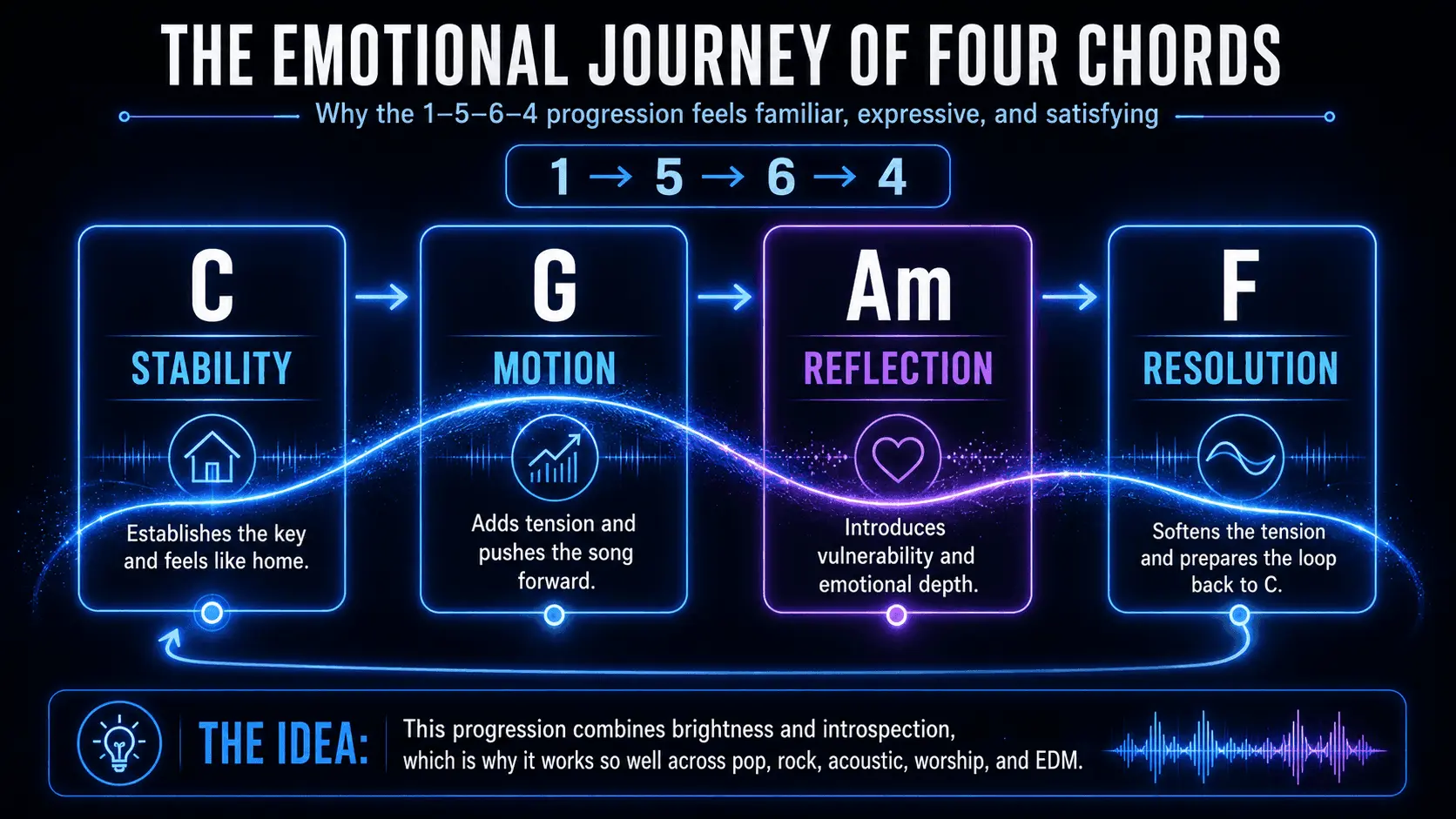
What is the 1-5-6-4 Chord Progression?
The 1-5-6-4 chord progression is a sequence constructed from specific degrees of a major scale. These numeric designations represent the harmonic position of each chord relative to the tonic, or home key.
The Scale Degree Framework
In musical theory, each number corresponds to a functional role within the scale:
- 1 (The Tonic): The foundational chord of the key.
- 5 (The Dominant): A chord that introduces harmonic tension and forward momentum.
- 6 (The Submediant): A minor chord that provides emotional contrast within a major key.
- 4 (The Subdominant): A chord that offers a soft resolution and facilitates a smooth transition back to the tonic.
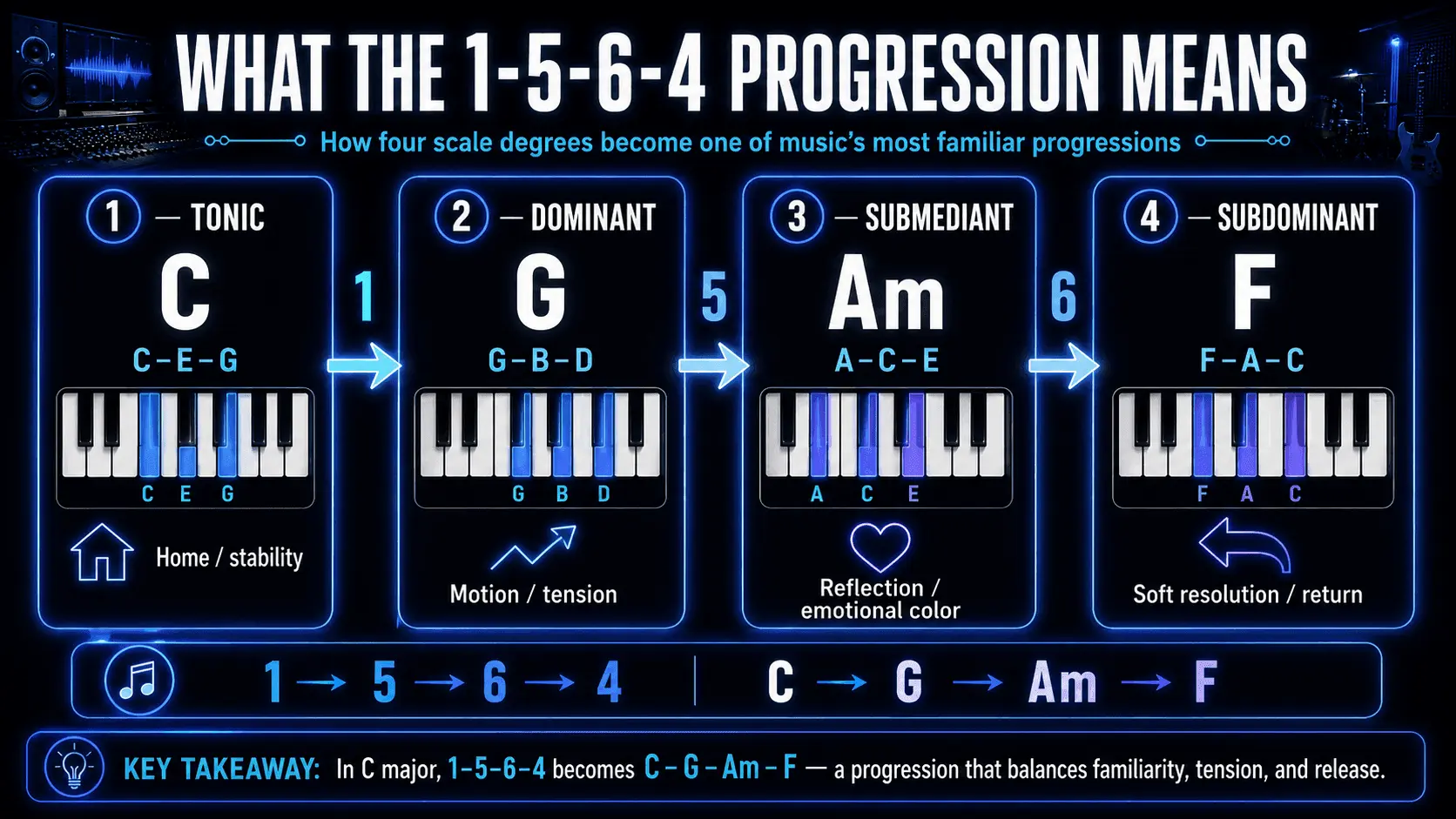
In the key of C Major, this sequence is realized as C Major – G Major – A Minor – F Major. The progression is structured to establish a sense of grounding, introduce tension, shift into a more reflective tonality, and finally resolve in a manner that allows for a seamless loop.
Functional Characteristics and Melodic Support
One of the primary advantages of the 1-5-6-4 progression is its ability to support a diverse range of melodies without overwhelming the lead performer. Because the harmonic movement is steady and predictable, vocalists and instrumentalists have the freedom to explore complex melodic lines. Producers frequently utilize this sequence when the objective is to maintain the listener's focus on the primary melody or lyrical content.
Emotional Duality
This progression is unique due to its tonal versatility. It effectively balances brightness and vulnerability:
- Major Elements (1, 5, and 4): Provide a sense of triumph, stability, and optimism.
- The Minor Element (6): Introduces a layer of introspection and depth.
This combination allows the progression to feel simultaneously uplifting and melancholic, granting it a broad emotional range that is applicable to a variety of lyrical themes.
The Strategic Role of Each Chord
To utilize this progression effectively, a producer must understand the specific contribution of each component within the harmonic narrative.
| Scale Degree | Harmonic Function | Emotional Impact |
|---|---|---|
| 1 (Tonic) | Stability | Establishes the key and provides a sense of arrival or home. |
| 5 (Dominant) | Motion | Generates the necessary tension to move the composition forward. |
| 6 (Submediant) | Reflection | The minor tonality adds a sophisticated, emotive quality to the sequence. |
| 4 (Subdominant) | Resolution | Softens the progression and prepares the listener for the return to the tonic. |
Structural Continuity
The 1-5-6-4 progression is highly valued for its ability to create a cycle that feels complete without sounding stagnant. Rather than relying on a dramatic or jarring resolution, the shift from the subdominant (4) back to the tonic (1) creates a professional, polished loop.
Understanding these roles transforms the progression from a simple set of chords into a structured emotional story. For the professional arranger, this knowledge allows for more intentional decisions regarding instrumentation and dynamic changes, ensuring that the harmonic foundation fully supports the artistic vision of the track.
Benefits of Learning the 1-5-6-4 Progression
Acquiring a deep understanding of the 1-5-6-4 progression provides musicians with more than a singular melodic tool; it establishes a foundational comprehension of harmony that is directly applicable to songwriting, professional arrangement, and improvisation.
1. Enhanced Auditory Recognition and Analysis
One of the primary benefits of mastering this sequence is the development of advanced ear training. Once a musician internalizes the intervals of the 1-5-6-4, they can identify its presence across a vast array of recorded music. This awareness allows for the rapid deconstruction of contemporary hits and provides a lens through which other complex harmonic structures can be analyzed and understood.
2. Accelerated Creative Workflow
The progression serves as an efficient catalyst for the songwriting process. Many professional composers utilize this sequence as a stable structural starting point, allowing them to focus immediately on melodic development and lyrical content. By utilizing a proven harmonic framework, writers can bypass the initial creative inertia often associated with seeking a unique chord sequence, focusing instead on the emotional delivery and overall impact of the track.
3. Professional Communication and Collaboration
In a studio or live environment, the 1-5-6-4 progression functions as a standardized harmonic shorthand. This shared musical language significantly streamlines professional collaboration. Communicating a desired progression via its numeric degree—such as requesting a 1-5-6-4 in the key of G—allows an entire ensemble to synchronize instantaneously, preserving the momentum of a session.
4. Prioritizing Emotional Efficacy over Complexity
The practical utility of this pattern is often demonstrated when advanced harmonic variations fail to serve the specific needs of a composition. Professional producers frequently observe that a simple 1-5-6-4 structure can provide an emotional center that more intricate arrangements lack.
Songs Featuring the 1-5-6-4 Chord Progression
The 1-5-6-4 progression is utilized in a significant volume of globally recognized compositions. The prevalence of this sequence does not result in sonic uniformity; rather, it provides a highly adaptable structural framework capable of supporting diverse artistic signatures.
Landmark Examples in Contemporary Music
The following compositions are frequently cited by musicologists and professional producers as definitive examples of the 1-5-6-4 progression in practice. While these tracks vary in tempo and production style, they utilize the same underlying harmonic foundation.
| Artist | Composition | Key Signature | Chord Sequence |
|---|---|---|---|
| The Beatles | Let It Be | C Major | C – G – Am – F |
| U2 | With or Without You | D Major | D – A – Bm – G |
| Bob Marley | No Woman No Cry | C Major | C – G – Am – F |
| Adele | Someone Like You | A Major | A – E – F#m – D |
| The Calling | Wherever You Will Go | D Major | D – A – Bm – G |
Cross-Genre Adaptability
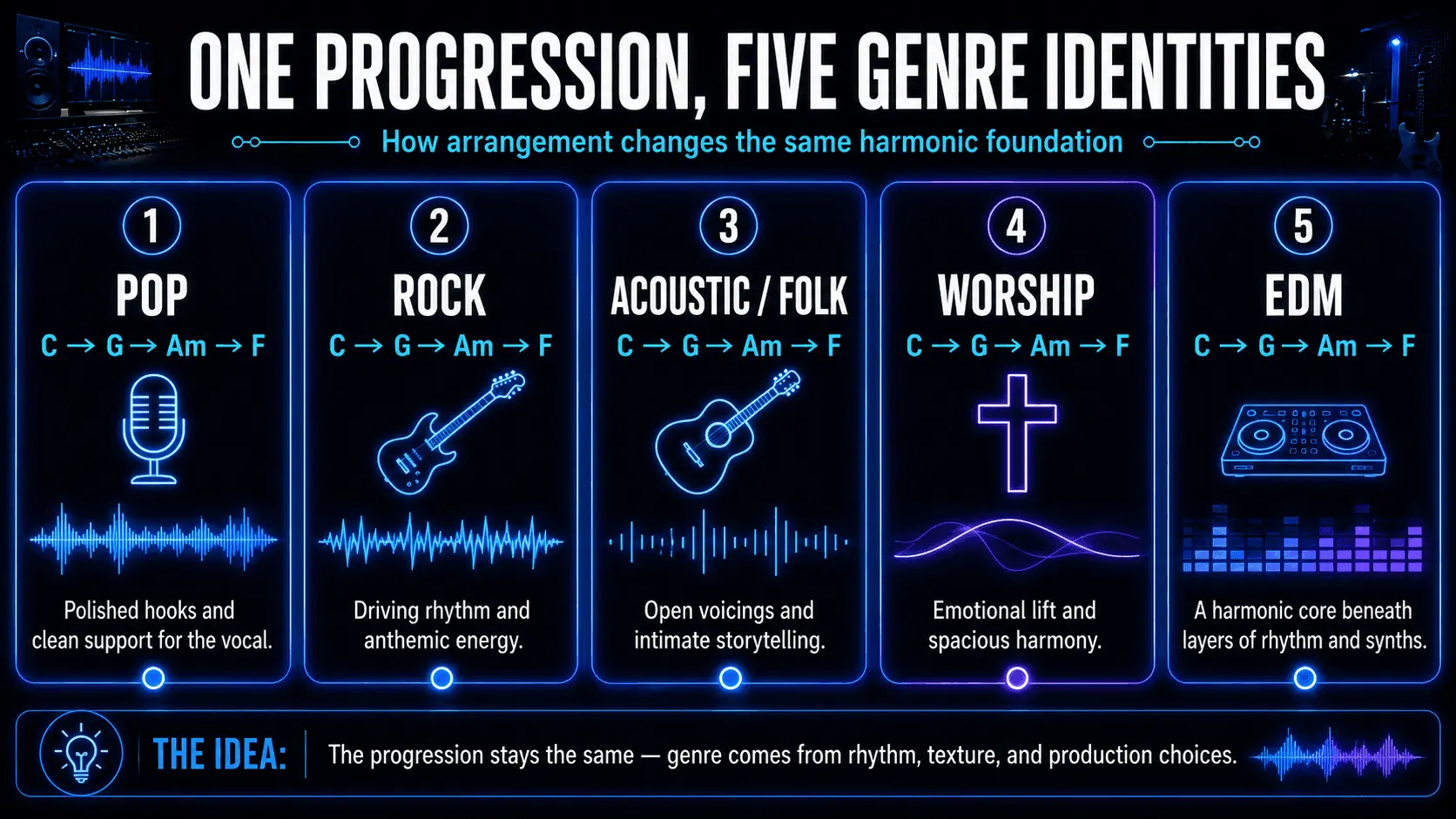
The utility of the 1-5-6-4 progression lies in its ability to adapt to the specific aesthetic requirements of various musical traditions.
- Pop Music: In this context, the progression serves to highlight polished vocal hooks. The inherent harmonic familiarity facilitates rapid listener engagement, making it a staple of commercial radio.
- Rock Music: When combined with high-gain distortion and aggressive rhythmic patterns, the 1-5-6-4 takes on a driving, anthemic quality. It maintains its emotional resonance even within high-energy arrangements.
- Acoustic and Folk: Stripped-down instrumentation reveals the natural supportive quality of the chords. In this setting, the progression creates an intimate atmosphere that prioritizes narrative storytelling.
- Worship Music: The movement from the minor submediant to the major subdominant often creates a sense of emotional ascent. This specific dynamic is a primary reason the progression is foundational to modern liturgical music.
- Electronic Dance Music (EDM): Producers frequently integrate the 1-5-6-4 beneath layers of synthesis and rhythmic processing. While the listener may not consciously identify the harmonic changes, the progression remains the primary driver of the track's emotional arc.
Techniques for Mastering the 1-5-6-4 Progression
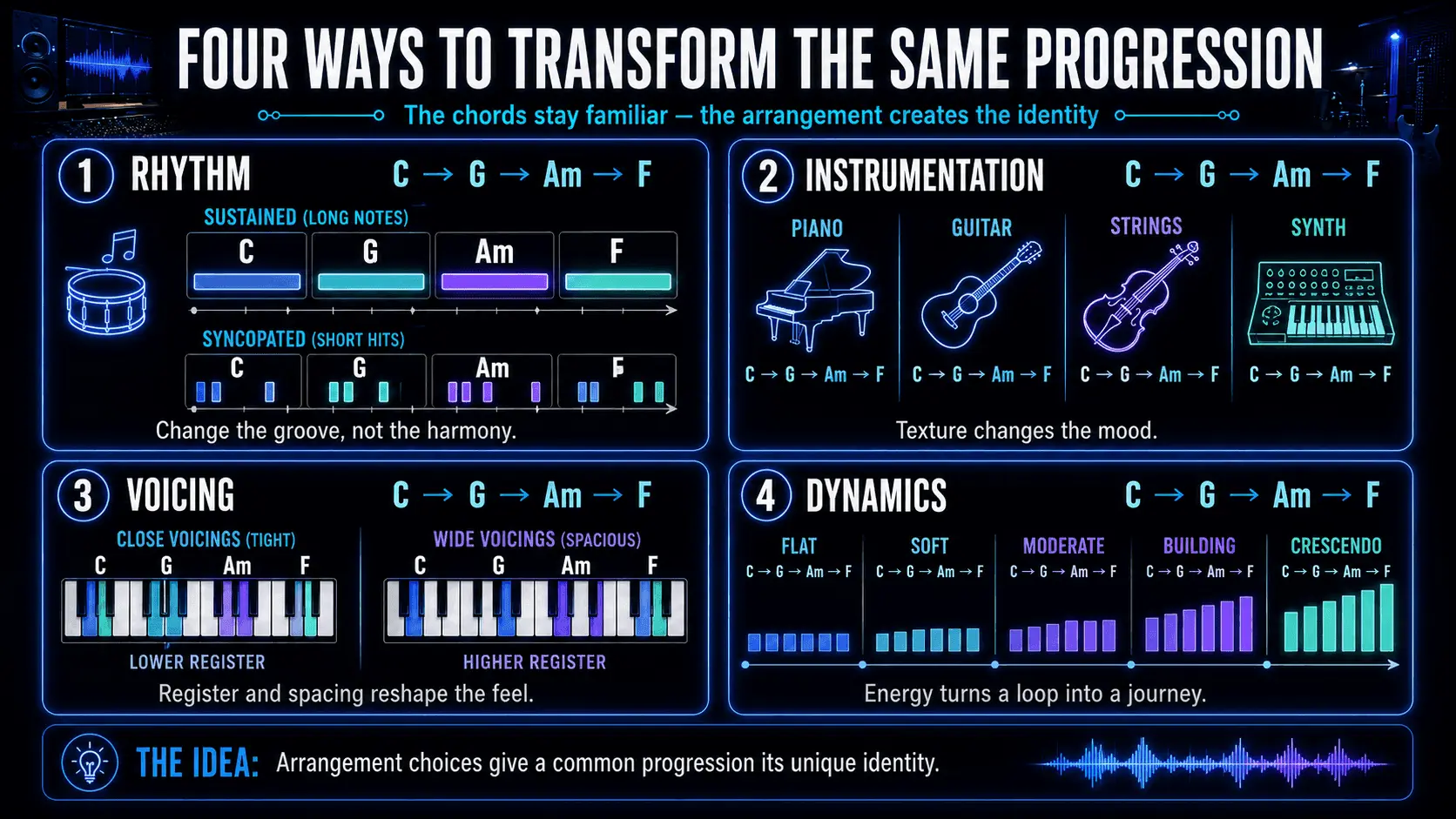
Conceptual knowledge of the chord sequence is merely the preliminary stage of professional production. To achieve a sophisticated result, a producer must strategically manipulate variables such as rhythm, dynamics, and voicing.
1. Rhythmic and Dynamic Modulation
Rhythmic variation is often more influential than harmonic change in maintaining listener interest. A progression utilizing steady whole notes serves a different functional purpose than one employing syncopation.
Furthermore, the application of dynamic shifts—such as a gradual crescendo across several cycles—transforms a repetitive loop into an evolving emotional narrative. This prevents the arrangement from sounding static and ensures the progression supports the track’s overall energy arc.
2. Timbral and Textural Diversity
The emotional resonance of a progression is heavily dictated by the choice of instrumentation. Diverse textures—including acoustic piano, electric guitar, synthesizer pads, or orchestral strings—can perform the same 1-5-6-4 structure while yielding vastly different results.
To prevent structural stagnation, professional arrangers frequently vary the instrumentation between song sections. For example, transitioning from a piano-led verse to a synth-driven chorus ensures the progression feels cinematic and progressive rather than repetitive.
3. Inversions and Voice Leading
Strategic chord voicings are essential for creating fluid harmonic transitions. Utilizing inversions allows for smoother movement between chords, as demonstrated by the descending bass line technique:
- C Major (Root Position)
- G Major / B (First Inversion)
- A Minor (Root Position)
- F Major (Root Position)
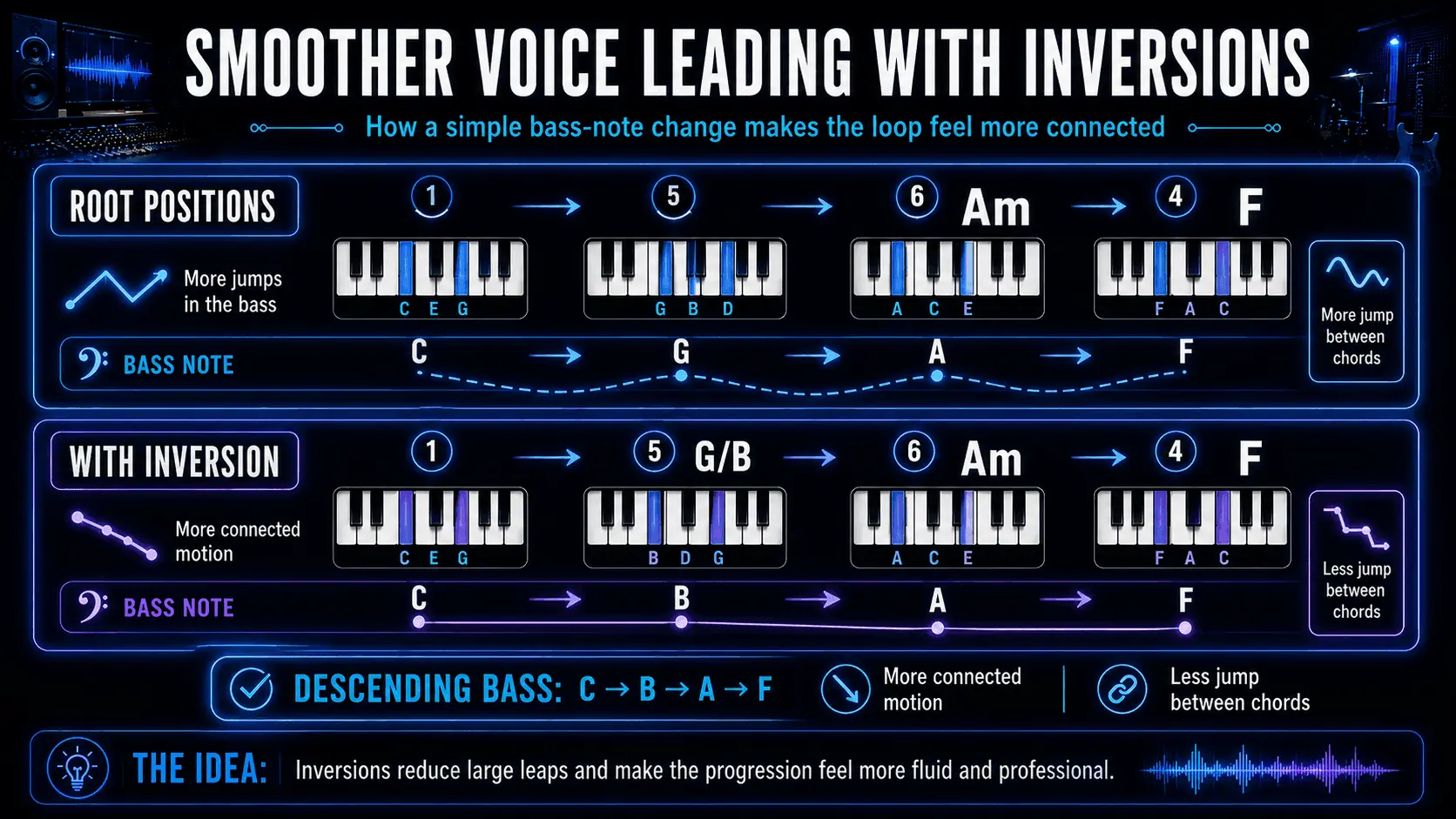
This configuration creates a stepwise bass movement (C–B–A), resulting in a more integrated and professional sound. In addition to inversions, pianists may utilize wide-spread voicings across both hands, while guitarists may leverage open strings to enhance harmonic resonance.
4. Harmonic Extensions and Coloration
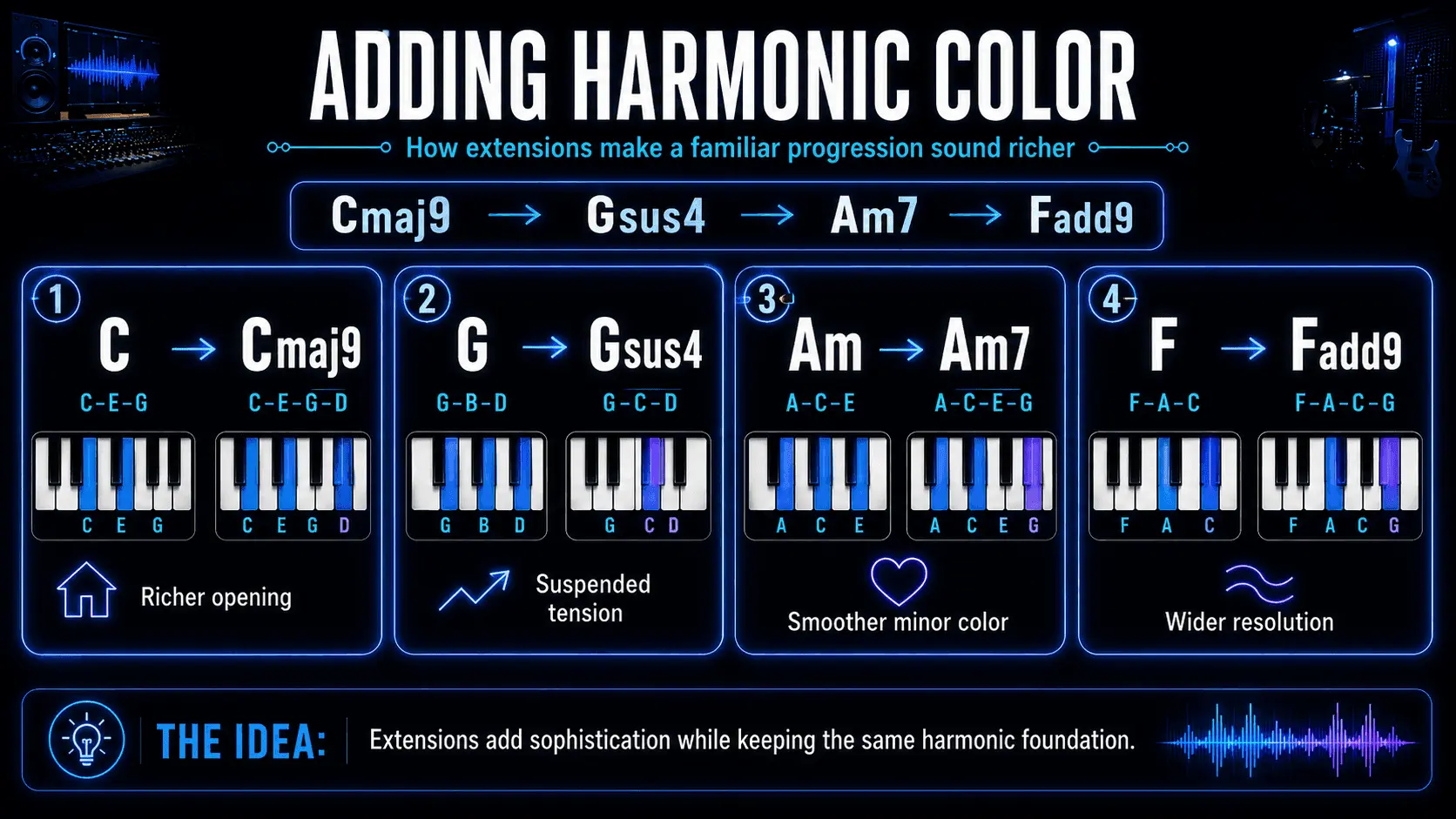
Experienced musicians often apply chord extensions to introduce harmonic depth without compromising the foundational structure of the 1-5-6-4 pattern. Adding 7ths, 9ths, or suspended tones provides a more refined aesthetic.
| Standard Chord | Extension Example | Harmonic Impact |
|---|---|---|
| C Major | Cmaj9 | Adds harmonic richness and complexity. |
| G Major | Gsus4 | Creates temporary tension. |
| A Minor | Am7 | Softens the minor tonality for a smoother feel. |
| F Major | Fadd9 | Enhances the subdominant resonance. |
A modified sequence such as Cmaj9 – G – Am7 – Fadd9 retains the accessibility of the original progression while elevating the overall sophistication of the composition.
5. Transposition and Structural Modulation
A key change, or modulation, can provide a composition with a significant surge in energy. A standard industry technique involves repeating the progression in the primary key throughout the initial sections, then transposing the entire sequence up a whole step for the final climax.
- Primary Key (C Major): C – G – Am – F
- Modulated Key (D Major): D – A – Bm – G
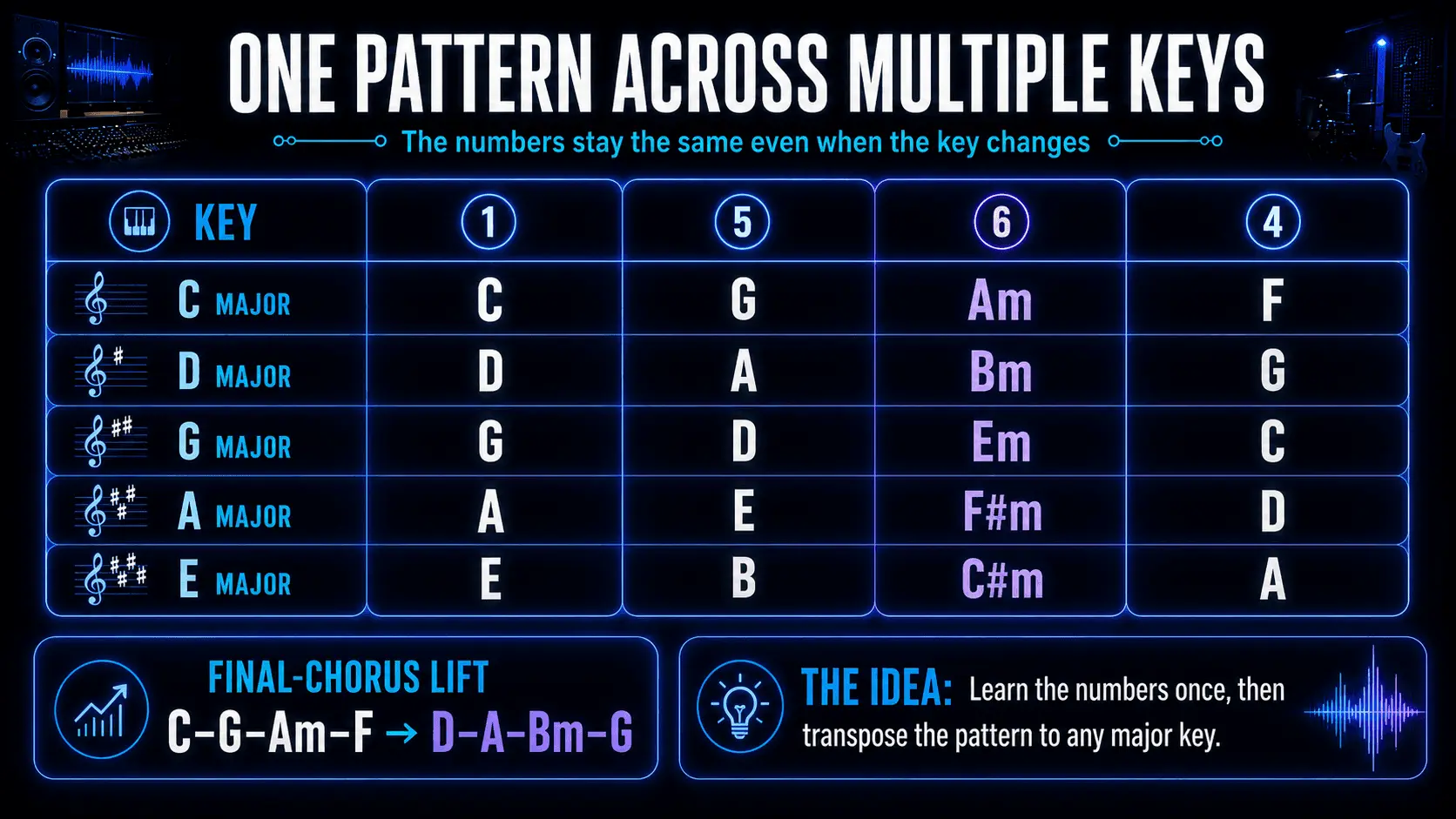
This upward shift provides an immediate emotional lift. Additionally, brief modulations during a bridge section can establish necessary tension before the track returns to the original tonic. These structural adjustments are essential for creating high-impact arrangements that resonate with a professional audience.
Make the 1-5-6-4 Progression Sound Like Your Song With ACE Studio
Understanding how to vary the 1-5-6-4 progression is useful, but hearing those ideas in an arrangement often makes them much easier to evaluate. ACE Studio is an AI-powered music production platform where you can build songs with editable vocals, instruments, MIDI, chords, and generated audio layers. This makes it possible to start with a simple progression such as C–G–Am–F and explore how different voicings, performances, textures, and section changes affect its character before developing the complete production.
Start by entering the progression into ACE Studio’s Chord Track. In C major, you can place C–G–Am–F on the timeline, change how long each chord lasts, add seventh chords, or assign a different bass note to create inversions. For example, changing G to G/B produces the descending C–B–A bass movement discussed earlier. The Chord Track can also highlight the current chord tones in the Piano Roll, making it easier to write melodies and basslines that respond to each harmonic change.
Once the harmony is established, use AI Instruments to hear how the progression changes with performance and texture. The same MIDI notes might become a restrained cello part in the verse, a pizzicato string pulse before the chorus, or a wider ensemble during the final repetition. Articulation and expression controls let you change how notes connect and intensify, so the progression can develop without adding more chords.
When a section still feels too predictable, select only those bars and use Add a Layer with a focused prompt. You might request “a muted electric guitar rhythm with no lead melody,” “a rising cello counterline over the A minor and F major chords,” or “wide cinematic strings that gradually lift into the final chorus.” Because the generated material is added to a chosen section of the timeline, you can strengthen a verse, transition, or chorus without rebuilding the whole arrangement.
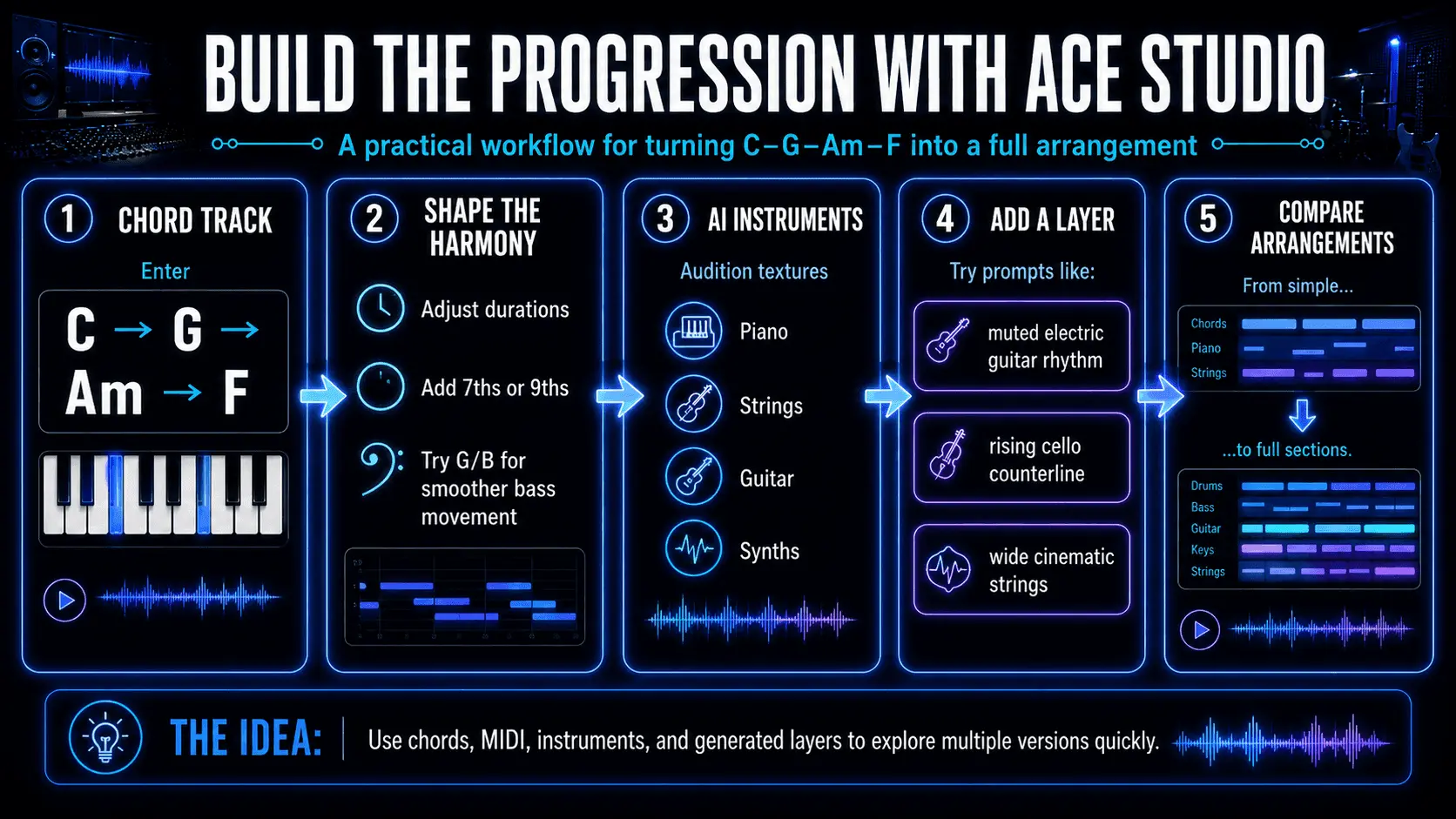
ACE Studio can also turn MIDI notes and lyrics into an editable vocal performance, but the useful lesson here extends beyond vocals. By keeping C–G–Am–F in place and changing the bass movement, register, articulation, instrumentation, and supporting layers around it, you can compare several distinct interpretations of the same progression before committing to the final arrangement.
Final Thoughts
The 1-5-6-4 chord progression remains one of the most useful foundations in modern songwriting because it combines accessibility with creative depth. Beginners can learn it quickly, while experienced musicians can continue reshaping it through rhythm, voicing, instrumentation, dynamics, and arrangement.
Its lasting popularity comes from its emotional balance. It feels familiar without sounding empty, simple without being restrictive, and flexible enough to support everything from intimate acoustic songs to layered electronic and cinematic productions.
Learning this progression is not about copying songs that already use it. It is about understanding why the harmonic movement connects with listeners and discovering how performance and production choices can give it a distinct identity. Tools such as ACE Studio make that process more immediate by allowing you to hear how different instruments, chord voicings, vocal ideas, and supporting layers change the same underlying sequence.
Whether you are writing your first song or refining an established production, mastering the 1-5-6-4 progression gives you a reliable starting point for experimentation. The chords may be familiar, but the way you arrange and perform them is what ultimately makes the song your own.
FAQs
Why is the 1-5-6-4 chord progression so popular?
The 1-5-6-4 chord progression is popular because it creates a strong emotional response while remaining simple enough to feel natural. The progression moves from stability to tension and then into a softer resolution, which makes it effective in many styles of music. Songwriters often use it because listeners immediately connect with its familiar sound.
Can beginners learn this chord progression quickly?
Yes, beginners can usually learn this progression quickly because it follows a predictable pattern. Once you understand the scale degrees in one key, you can apply the same chord sequence in other keys. Many musicians use this progression as one of their first steps into understanding music chord progressions.
Does using common chord progressions make songs unoriginal?
Using common chord progressions does not automatically make music sound unoriginal. Many successful songs share the same harmonic foundation. What makes a song unique is the melody, lyrics, rhythm, production choices, and the way the musician interprets the progression.
What are the most useful progression variations?
Some of the most useful progression variations include changing the rhythm, using inversions, adding suspended chords, or starting from a different point in the sequence. For example, the 6-4-1-5 pattern offers a more emotional alternative while still using closely related harmony.
How can I make the progression sound more professional?
To make the progression sound more professional, focus on chord voicings, dynamics, and arrangement. Musicians often create a fuller sound by layering instruments, using inversions, or adding subtle harmonic extensions like seventh and ninth chords. These small adjustments can make a familiar chord progression feel more polished.
Which songs use the 1-5-6-4 progression?
Many well-known songs use this chord sequence. It appears in tracks across pop, rock, and acoustic genres because it supports memorable melodies and emotional storytelling. Studying songs built around this progression can help musicians understand why it works so effectively.
Should I learn other chord progressions too?
Yes, learning other common chord progressions is helpful because it expands your songwriting vocabulary. While the 1-5-6-4 progression is extremely useful, combining it with other progressions gives you more creative flexibility and helps you avoid repetitive writing.