
Key Takeaways
- Additive synthesis creates complex sounds by combining multiple sine waves, with each partial controlled through its frequency, amplitude, and phase.
- Unlike subtractive synthesis, which removes frequencies from a rich waveform, additive synthesis builds timbres from the ground up by adding individual harmonic components.
- Resynthesis uses spectral analysis and Fast Fourier Transform technology to reconstruct recorded audio as editable partials, enabling spectral warping, freezing, and detailed harmonic manipulation.
- Modern additive synthesizers simplify control over hundreds of partials through spectral envelopes, visual editors, macro controls, modulation, and harmonic grouping.
- Additive synthesis offers exceptional clarity and precision for evolving pads, metallic tones, acoustic modeling, cinematic textures, and electronic sounds, but it can require significant processing power and a steeper learning curve.
Introduction to Audio Synthesis Methods
The landscape of audio synthesis is vast and varied, comprising several distinct methodologies developed over the past century to generate and manipulate electronic sound. At its core, digital sound synthesis is the practice of using hardware or software algorithms to create audio signals from scratch or modify existing signals to achieve a desired acoustic result. Understanding these synthesis techniques is foundational for any professional working in music production, sound design, or audio engineering.
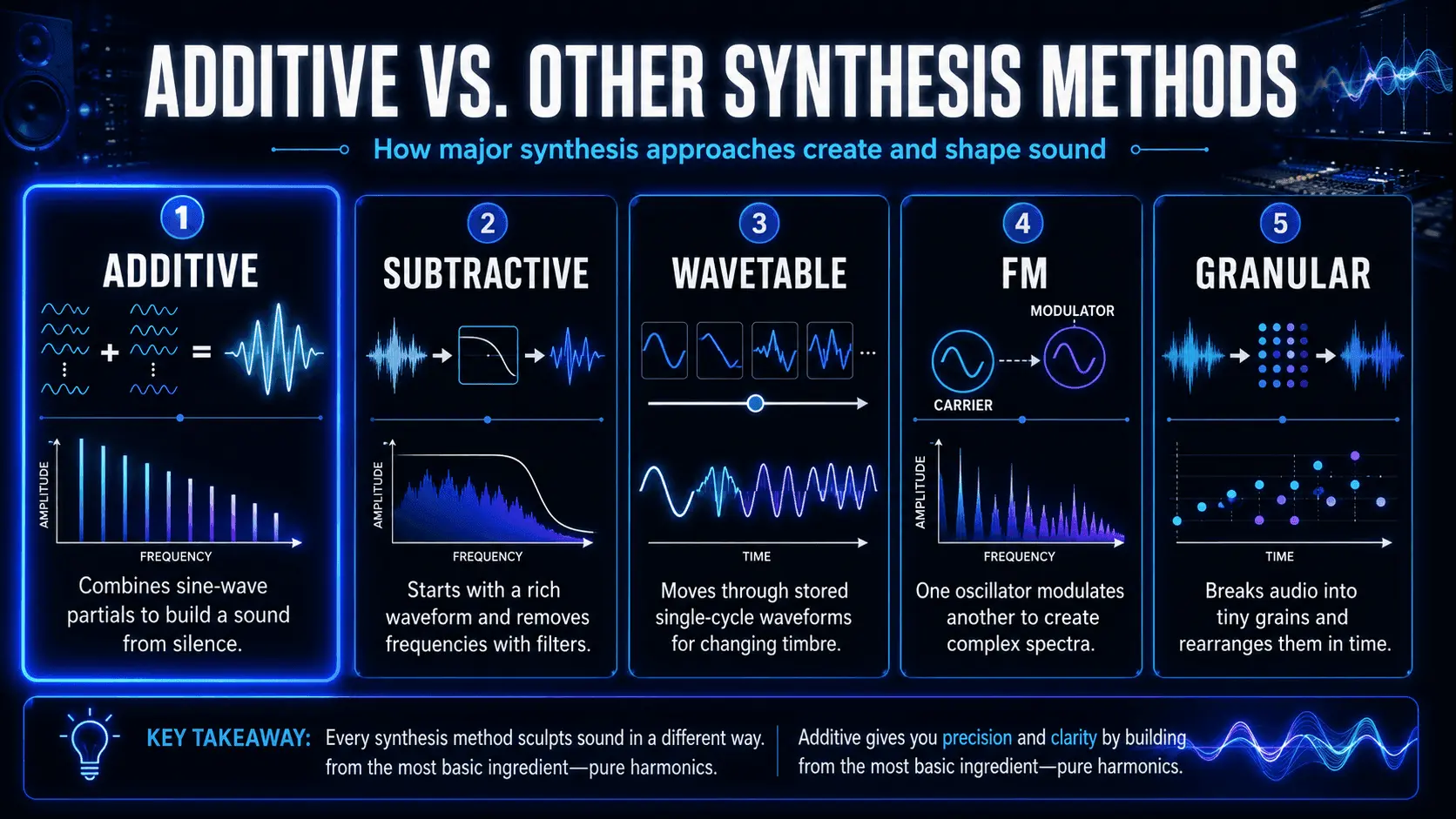
To fully appreciate the position of additive synthesis within this landscape, it is helpful to contrast it with other mainstream audio synthesis techniques. The most prevalent method in historical analog synthesis and modern software instruments is subtractive synthesis, which can also be referred to technically as subtracting synthesis. This approach begins with a harmonically rich source waveform, such as a sawtooth or square wave, and uses filter modulation and attenuation to carve away unwanted frequencies, shaping the final timbre.
Other notable methods include wavetable synthesis, which cycles through single-cycle waveforms arranged in a grid; frequency modulation, which uses one oscillator to alter the frequency of another at high speeds; and granular synthesis, which splits audio files into microscopic grains to rearrange them in time and space.
Additive synthesis occupies a unique, foundational position among these synthesis algorithms. Rather than modifying a pre-existing complex sound, it starts with absolute silence and builds complex timbres from the ground up. This method provides an extraordinary level of control over the harmonic content of a sound, allowing a sound designer to manipulate individual components of an audio signal with mathematical precision.
Acoustics and the Physics of Sound
To harness additive synthesis effectively, one must understand the underlying principles of acoustics and signal processing. Every sound heard in the physical world is a pressure wave moving through a medium. In the electronic domain, these waves are represented as alternating electrical currents or digital streams of data.
The Harmonic Series and Fourier Theory
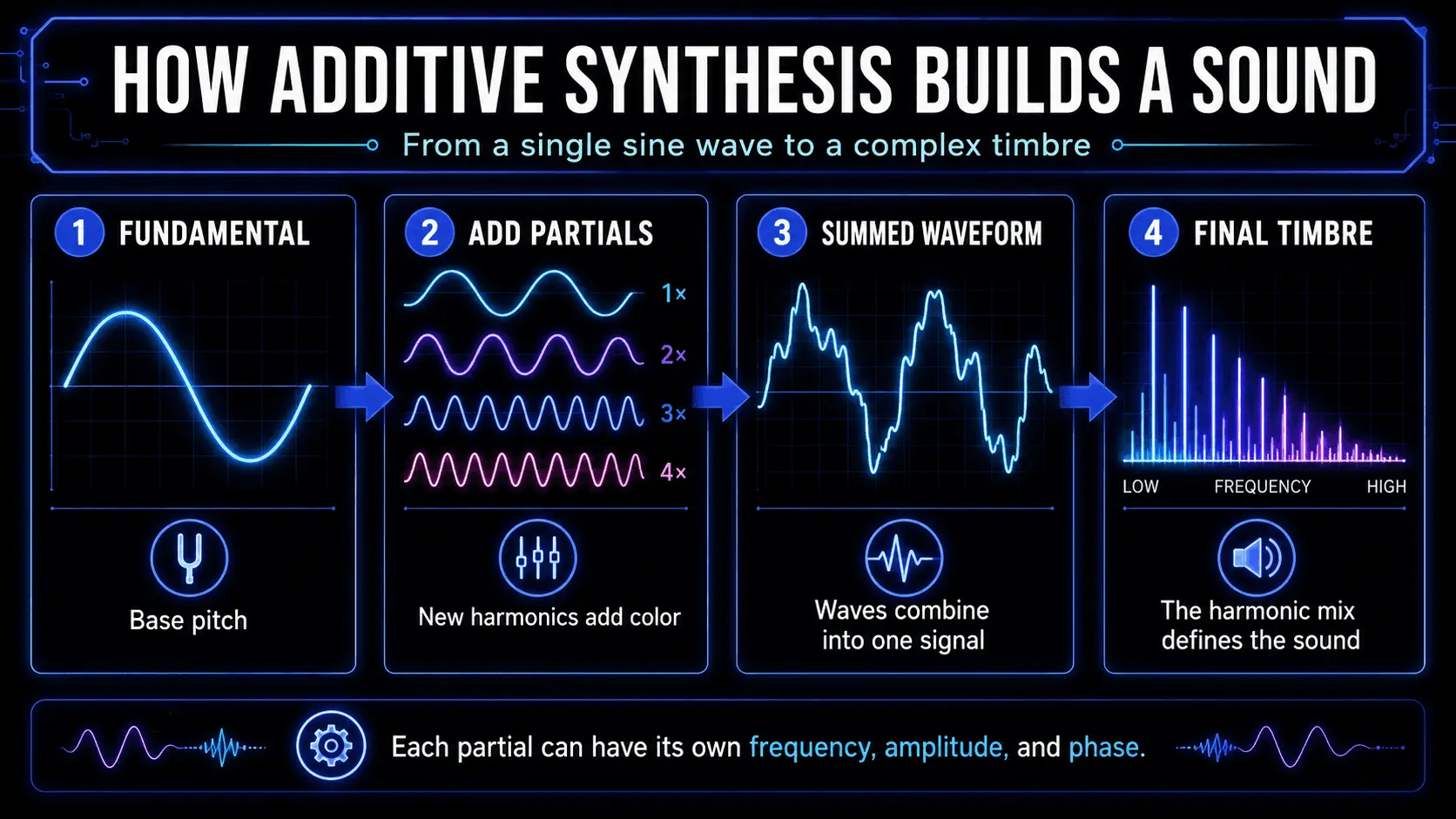
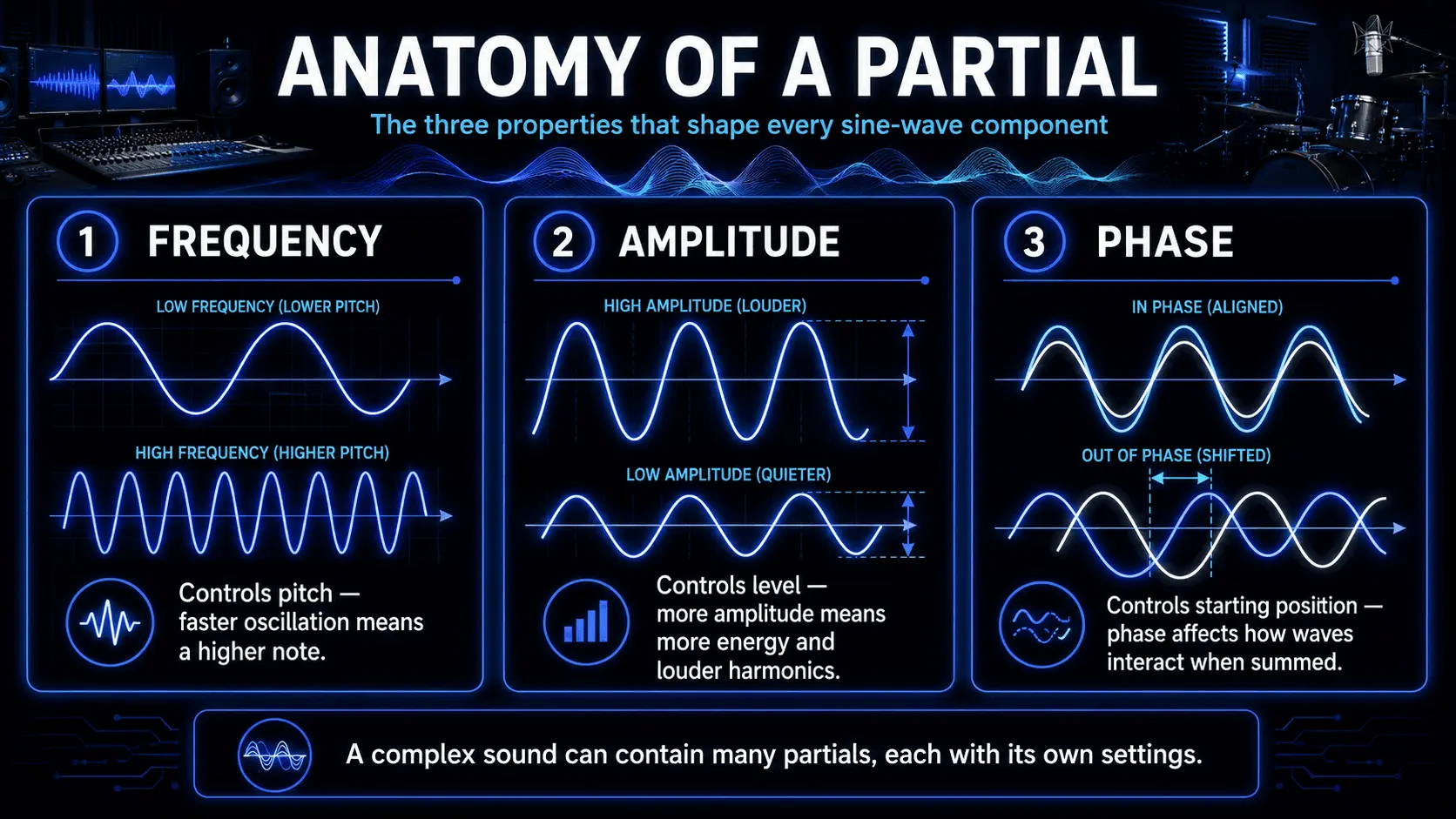
The theoretical foundation of additive synthesis lies in the work of the mathematician Joseph Fourier. Fourier theory establishes that any complex, periodic waveform can be mathematically deconstructed into a sum of simple, sinusoidal waves. Each of these sinusoidal waves, known as a partial, possesses three primary properties:
- Frequency: The speed of oscillation, which determines the perceived pitch.
- Amplitude: The volume or energy of the oscillation.
- Phase: The starting point of the wave relative to a specific point in time.
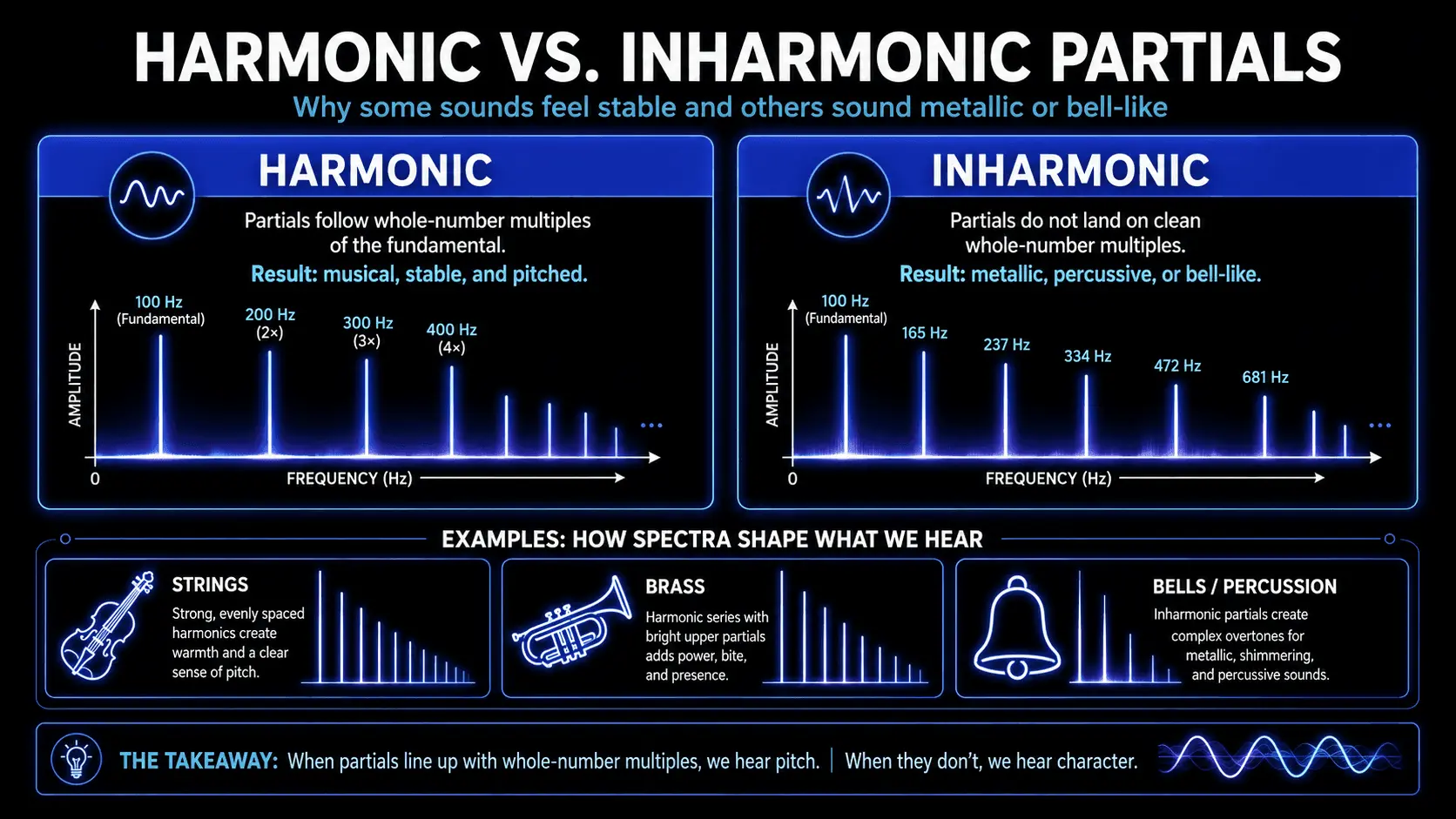
In a perfectly harmonic sound, the frequencies of these partials are integer multiples of the lowest frequency, known as the fundamental frequency. If the fundamental frequency is 100 Hertz, the subsequent harmonics will reside at 200 Hertz, 300 Hertz, 400 Hertz, and so on.
However, many real-world sounds, particularly acoustic percussion, bells, and strings, contain inharmonic partials. These are frequencies that do not fall on neat integer multiples. Additive synthesis excels at replicating these intricate structures because it allows for the independent tuning of every single partial.
Waveform Generation and Behavior
During waveform generation, an additive synthesizer uses a bank of oscillators running in parallel. By altering the specific relationships between these oscillators, a designer can achieve precise waveform shaping. For instance, a square wave can be constructed additively by combining only the odd-numbered harmonics (the first, third, fifth, and seventh harmonics) with amplitudes that decrease inversely proportional to their harmonic number.
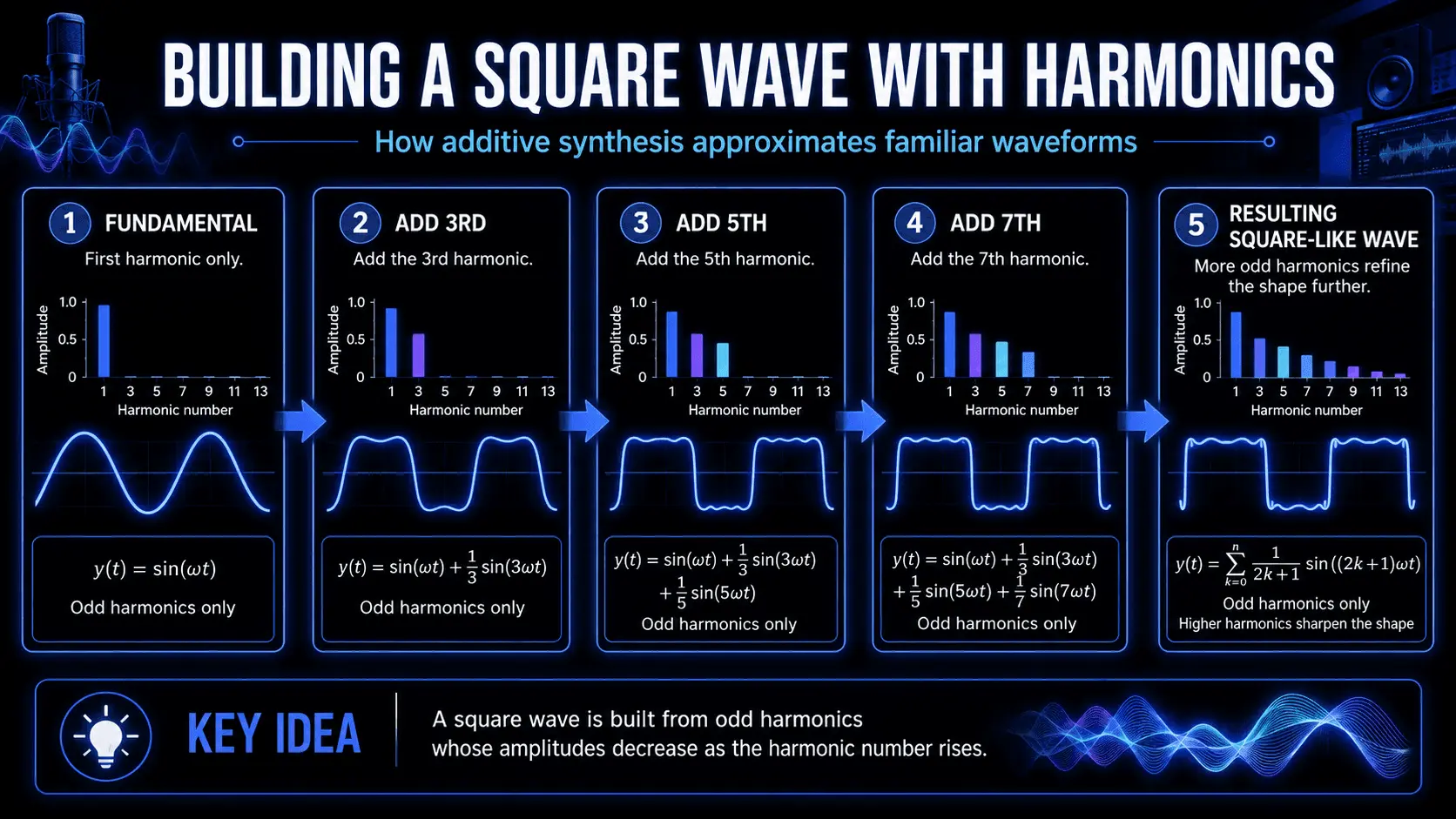
When these individual waves are summed together through signal processing, their peaks and troughs combine. If two partials are perfectly in phase, they experience constructive interference, reinforcing one another. If they are out of phase, destructive interference occurs, canceling out specific frequencies. This precise interaction demonstrates why control over phase is a critical element in advanced digital audio synthesis.
Historical Evolution of Additive Sound Creation
The conceptual journey of additive sound design predates the invention of modern computers by centuries, rooted firmly in pipe organ construction and early electrical engineering.
Early Mechanical and Acoustical Experiments
The earliest practical implementation of additive principles can be observed in the pipe organ. By pulling out different drawbars or stops, an organist introduces different pipe ranks that tune to specific intervals above the fundamental note. Combining a fundamental pipe with pipes tuned to the octave, the twelfth, and the fifteenth changes the overall timbre of the instrument, effectively functioning as a mechanical additive synthesizer.
In the late nineteenth century, Hermann von Helmholtz conducted extensive harmonic analysis using spherical glass resonators. By placing these resonators to his ear, he could isolate individual frequencies within complex environmental sounds, proving empirically that complex timbres were combinations of simpler tones.
This led directly to the creation of the Telharmonium by Thaddeus Cahill in the early twentieth century. This massive electromechanical instrument used tonewheels to generate pure electrical currents at specific frequencies, which were then mixed together and transmitted over telephone lines. Though logistically impractical, the Telharmonium was the first true additive electronic instrument. The concept was refined decades later in the Hammond organ, which used a more compact tonewheel system and nine drawbars to give musicians direct control over the balance of harmonics.
The Digital Revolution and Computer Music
The true power of additive synthesis remained unfulfilled until the advent of computer music and advanced audio processing algorithms in the mid-twentieth century. Max Mathews and his contemporaries at Bell Laboratories developed the MUSIC-N software languages, which allowed computers to calculate and sum sine waves digitally.
In the 1970s and 1980s, commercial instruments began to explore this territory. The Synclavier and the Fairlight CMI offered rudimentary additive synthesis options, though their processing power was severely limited. Musicians had to wait hours for a computer to compute the samples required to play back a complex additive patch.
The breakthrough for real-time performance arrived with instruments like the Kawai K5000 in the late 1990s. The K5000 utilized specialized digital signal processors to manage up to 128 individual partials per source sound in real time. This allowed keyboardists to modulate harmonics live on stage, cementing the role of additive tools within modern electronic music.
The Mechanics of Resynthesis
One of the most powerful extensions of the additive framework is resynthesis. While pure additive synthesis involves building a sound completely from imagination, resynthesis uses an existing audio recording as a blueprint.
Spectral Analysis and Reconstruction
The process begins with an alternative approach to handling audio data: spectral analysis. A digital audio sample is fed into an analytical engine that applies a mathematical process known as the Fast Fourier Transform. The Fast Fourier Transform breaks the continuous audio stream down into consecutive, short segments of time. For each segment, the algorithm calculates the exact frequency, amplitude, and phase of every component present in the signal.
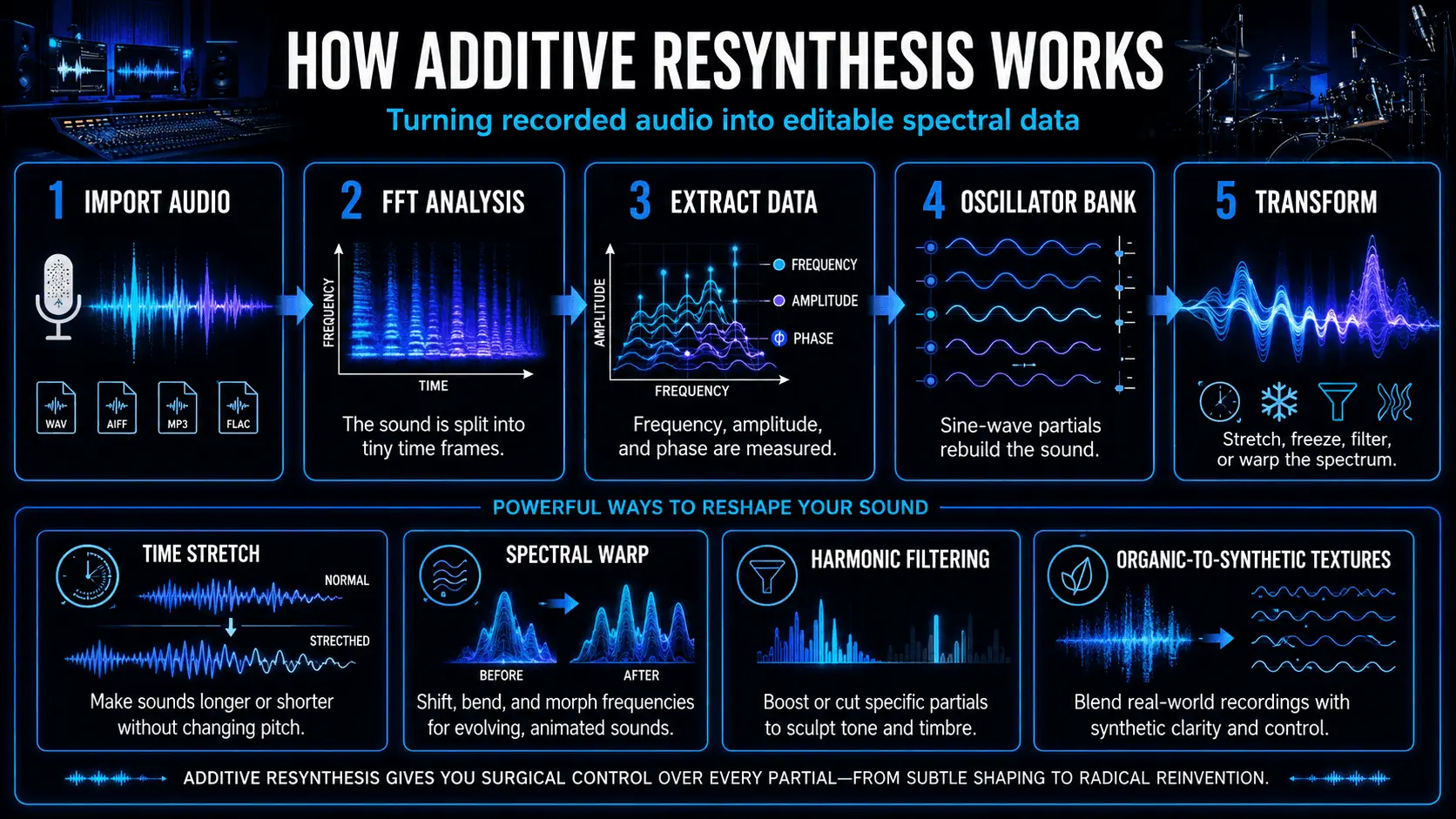
Once this data is collected, it is translated into a set of instructions for an additive synthesis engine. The synthesizer assigns a bank of sine wave oscillators to mirror the analyzed data. If the original sample was a spoken human vocal, the analysis determines how the harmonics of the voice change over time, and the oscillator bank reproduces those changes precisely.
Practical Workflows for Sound Designers
For a sound designer, resynthesis bridges the gap between organic field recordings and synthetic manipulation. Once an audio file is converted into additive data, it is no longer bound by the standard constraints of digital audio playback.
- Time Stretching Without Artifacts: Because the sound is being generated by oscillators in real time, a user can slow down the playback speed of the analysis data to an absolute freeze without introducing the grainy artifacts common to traditional time-stretching tools.
- Spectral Warping: Designers can shift the frequencies of the partials independently of the fundamental pitch. This allows an acoustic guitar recording to be transformed into a metallic, giant instrument by moving its upper harmonics out of their natural relationships.
- Harmonic Filtering: Specific harmonics can be muted or amplified algorithmically. For example, a designer can instruct the engine to delete all even harmonics from a recorded piano sample, instantly shifting its timbre to a woodwind character.
Technical Implementation and Control
The primary obstacle to the widespread adoption of additive synthesis has always been the sheer volume of data required to create compelling sounds. A simple subtractive synthesizer might require a user to manage two oscillators, one filter cutoff knob, and two envelope generators. An advanced additive synthesizer, by contrast, might utilize 512 partials per voice. If each partial requires its own amplitude envelope and frequency offset over time, the user is faced with managing thousands of parameters simultaneously.
Control Structures for Partials
To overcome this logistical hurdle, modern synthesis algorithms employ macroscopic control structures. Instead of forcing the sound designer to draw hundreds of individual envelope lines, software instruments provide high-level parameters that shape groups of partials at once.
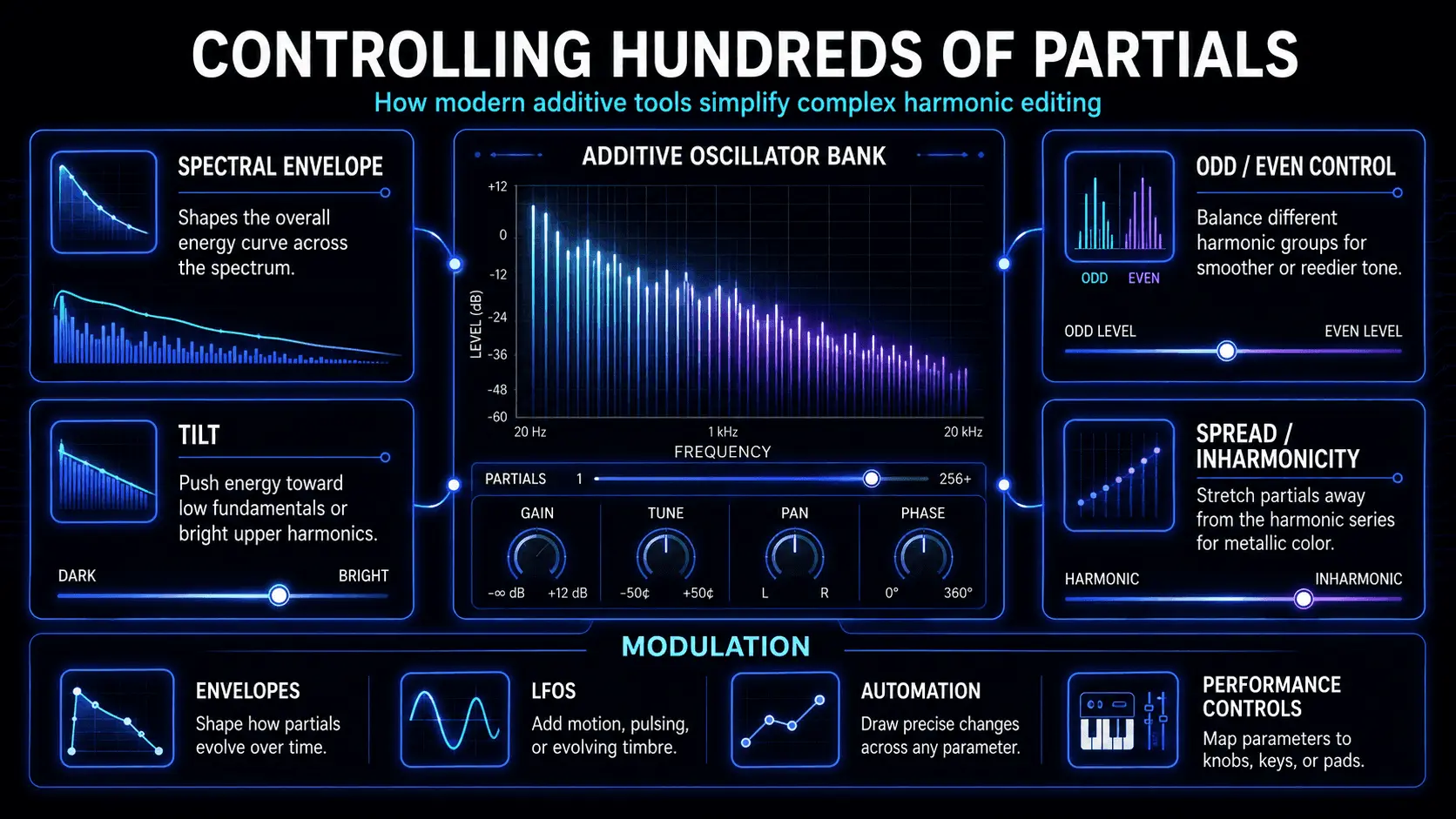
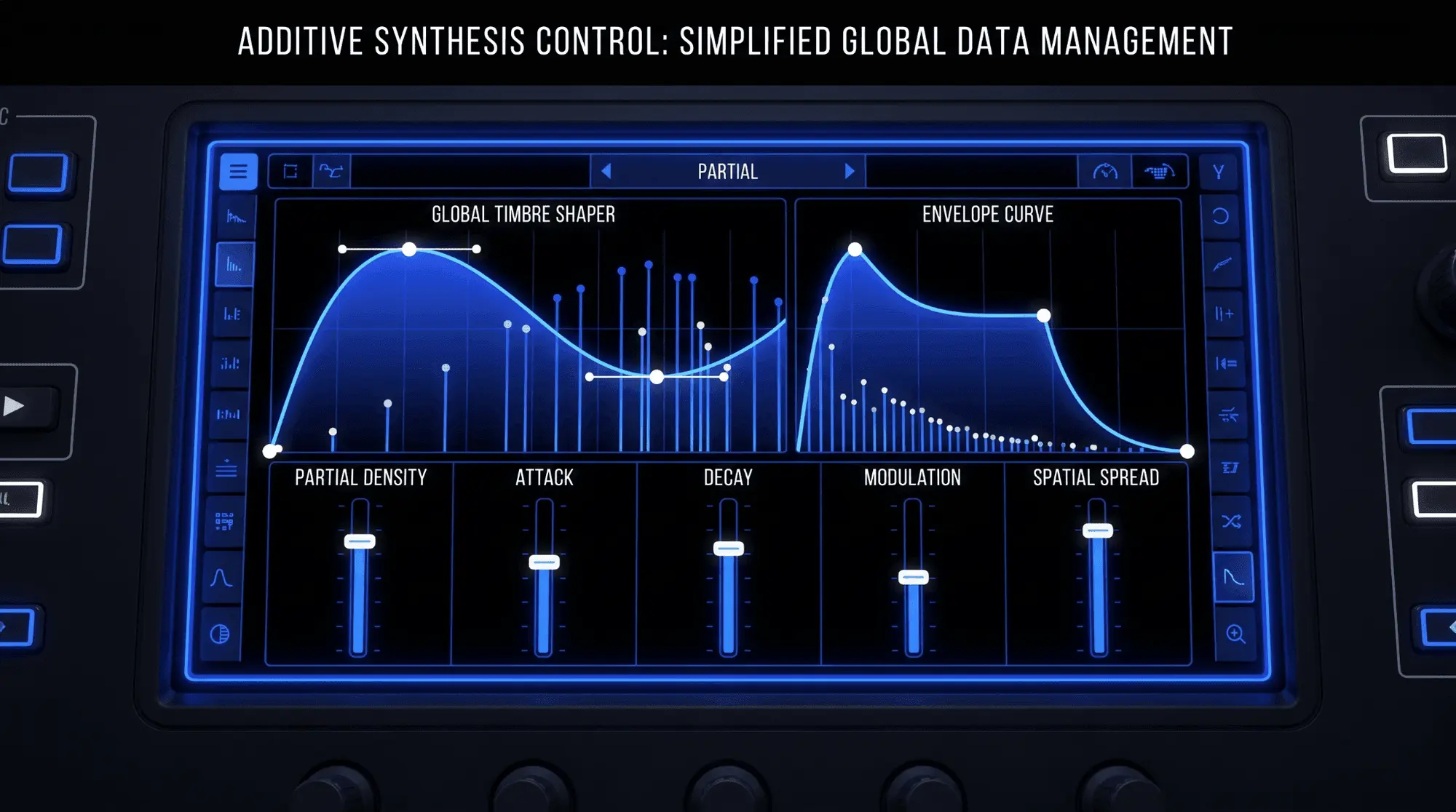
- Spectral Envelopes: A user can draw a global curve over the entire frequency spectrum. The synthesizer then scales the amplitudes of the individual partials to match this overarching shape.
- Odd and Even Grouping: Split controls allow for the independent manipulation of odd and even harmonics. By increasing the amplitude of odd harmonics while attenuating even ones, a sound can be shifted from a smooth, brassy texture to a hollow, reedy character.
- Tilt and Spread Controls: Tilt functions allow a user to skew the energy of the sound toward the upper harmonics or the lower fundamental with a single slider. Spread controls stretch the partials away from the harmonic series to introduce inharmonic, metallic dissonance.
Automation and Modulation Strategies
Advanced sound design relies heavily on dynamic movement. In an additive environment, this is achieved by modulating the relationships between partials using low-frequency oscillators, envelopes, and real-time controller inputs.
Unlike standard filter modulation in an analog instrument, which cuts off all frequencies above a certain point uniformly, an additive spectral filter can attenuate frequencies in intricate patterns. A user can create a comb-filter effect by modulating the amplitude of every tenth partial, or create morphing vowel sounds by moving specific peaks across the harmonic spectrum. This deep level of control is what makes real-time audio processing in additive synthesis so expressive, enabling textures that evolve organically over extended periods.
Contemporary Additive Synthesis Tools
Modern additive synthesis tools use visual editors, spectral displays, resynthesis systems, and grouped controls to make complex harmonic structures easier to manage. Although an additive engine may generate hundreds of individual partials, producers are rarely expected to adjust every oscillator separately.
Instead, contemporary instruments provide higher-level controls that allow users to shape large groups of frequencies at once. These may include spectral envelopes, harmonic drawing tools, odd-and-even harmonic controls, formant shaping, partial spreading, and automated modulation.
The exact workflow depends on the type of additive synthesis system being used. Some tools focus entirely on building sounds from sine-wave partials, while others combine additive synthesis with sampling, granular processing, wavetable synthesis, or frequency modulation.
Dedicated Additive Synthesizers
Dedicated additive synthesizers construct most or all of their sounds through banks of sine-wave oscillators. They typically provide detailed control over harmonic amplitude, frequency, phase, and movement over time.
These instruments are especially useful for creating precise digital textures, metallic tones, evolving pads, synthetic choirs, bells, and highly controlled bass sounds. Because the user can directly shape the harmonic structure, dedicated additive systems offer a level of spectral precision that is difficult to achieve with traditional filters alone.
However, this precision can also make them more complex to program. For that reason, many modern additive instruments include macro controls that adjust multiple partials simultaneously.
Hybrid Synthesis Systems
Hybrid synthesizers combine additive synthesis with one or more additional sound-generation methods. An instrument might use additive synthesis to control the sustained harmonic portion of a sound while using a sample or noise generator to recreate its initial transient.
This approach is particularly useful for acoustic modeling. For example, the sharp attack of a mallet could be created from a sample, while the sustained resonance of the instrument is reconstructed through additive partials.
Hybrid systems may also combine additive synthesis with granular, wavetable, subtractive, or frequency modulation techniques. This gives sound designers the precision of harmonic editing alongside the movement, texture, and unpredictability of other synthesis methods.
Resynthesis Tools
Resynthesis tools begin with recorded audio rather than an empty oscillator structure. The system analyzes how the frequency content of a sample changes over time and reconstructs that information with controllable partials.
Once the sound has been converted into spectral data, users can manipulate it in ways that would be difficult with conventional audio editing. They may stretch the sound for long periods, remove specific harmonic groups, shift upper partials independently, freeze sections of the spectrum, or transform an acoustic source into a completely new instrument.
The quality of the result depends on the analysis resolution, the number of available partials, and the way the system separates pitched content from noise and transient information.
Spectral Drawing and Visual Editing
Some additive systems allow users to draw directly across a visual representation of the frequency spectrum. Brighter areas may represent stronger harmonics, while darker areas indicate weaker or absent frequencies.
This type of interface makes additive synthesis more intuitive because the user can see the structure of the sound rather than working only with numerical oscillator settings.
A producer might draw a smooth harmonic slope to create a soft tone, introduce narrow peaks to emphasize resonant frequencies, or remove alternating partials to create a hollow timbre. Spectral shapes can also be animated over time, producing sounds that gradually shift between dark, bright, metallic, and vocal-like characteristics.
Hardware and Modular Workflows
Hardware additive instruments and modular systems provide a more tactile approach to harmonic sound design. Instead of editing hundreds of partials on a detailed software display, users typically control harmonic groups, frequency bands, or spectral relationships through physical knobs, sliders, and modulation inputs.
Modular systems may not always generate large oscillator banks in the same way as dedicated software instruments. However, they can still apply additive principles by combining several oscillators, controlling separate frequency bands, or layering multiple harmonic sources.
Control-voltage modulation can then be used to animate the balance between these components in real time. This makes hardware systems particularly useful for live performance, experimentation, and evolving sound design.
Common Additive Synthesis Workflows
The following comparison shows how the main additive synthesis workflows differ in their operation, strengths, and practical applications.
| Additive Workflow | How It Works | Main Strength | Common Applications |
|---|---|---|---|
| Manual partial construction | Individual harmonics are added and adjusted directly. | Maximum control over spectral structure. | Custom waveforms, bells, basses, digital leads. |
| Macro-controlled additive synthesis | Groups of partials are shaped through high-level controls. | Faster and more accessible programming. | Pads, evolving textures, production-ready presets. |
| Audio resynthesis | Recorded audio is analyzed and reconstructed as spectral data. | Transforms organic recordings into editable instruments. | Experimental instruments, cinematic textures, vocal manipulation. |
| Spectral drawing | Users draw or edit harmonic energy on a visual spectrum. | Intuitive visual control over timbre. | Formant sounds, metallic tones, morphing textures. |
| Hybrid synthesis | Additive synthesis is combined with samples or other synthesis engines. | Greater tonal variety and realism. | Acoustic modeling, cinematic sounds, layered instruments. |
| Hardware or modular synthesis | Multiple oscillators or frequency bands are combined through physical controls. | Tactile performance and real-time experimentation. | Live performance, modular sound design, evolving drones. |
Choosing an Additive Synthesis Tool
The best additive synthesis workflow depends on the producer’s goals and level of experience. A sound designer seeking complete harmonic precision may prefer a system with detailed partial editing, while a music producer working quickly may benefit more from macro controls and preset-based spectral shaping.
Important features to consider include:
- Number of Partials: A larger number of partials can provide more detailed and realistic sound reconstruction, although it may also increase CPU demand.
- Resynthesis Support: Audio import and spectral analysis are essential for users who want to transform recorded sounds into playable instruments.
- Visual Feedback: Spectral displays make it easier to understand how harmonic changes affect the final timbre.
- Modulation Flexibility: Envelopes, low-frequency oscillators, automation, and controller mapping determine how dynamically the sound can evolve.
- Noise and Transient Handling: Advanced systems may separate harmonic content from noise and attack information, producing more convincing resynthesis results.
- Workflow Complexity: Detailed partial control offers precision, but grouped controls and macros are often more practical for everyday music production.
- Processing Requirements: Large oscillator banks, high polyphony, and real-time spectral modulation can place significant demands on a computer.
- Integration with Production Software: Producers should consider how easily the instrument supports MIDI input, automation, audio export, and the wider production workflow.
Ultimately, additive synthesis tools range from highly technical spectral laboratories to streamlined instruments designed for immediate musical results. The underlying principle remains the same: complex sounds are created by controlling the frequencies, amplitudes, and movement of simpler components.
Strategic Advantages and Operational Challenges
Like any sound design methodology, additive synthesis presents a distinct set of pros and cons that dictate when it should be deployed in a production workflow.
Sonic Precision and Clarity
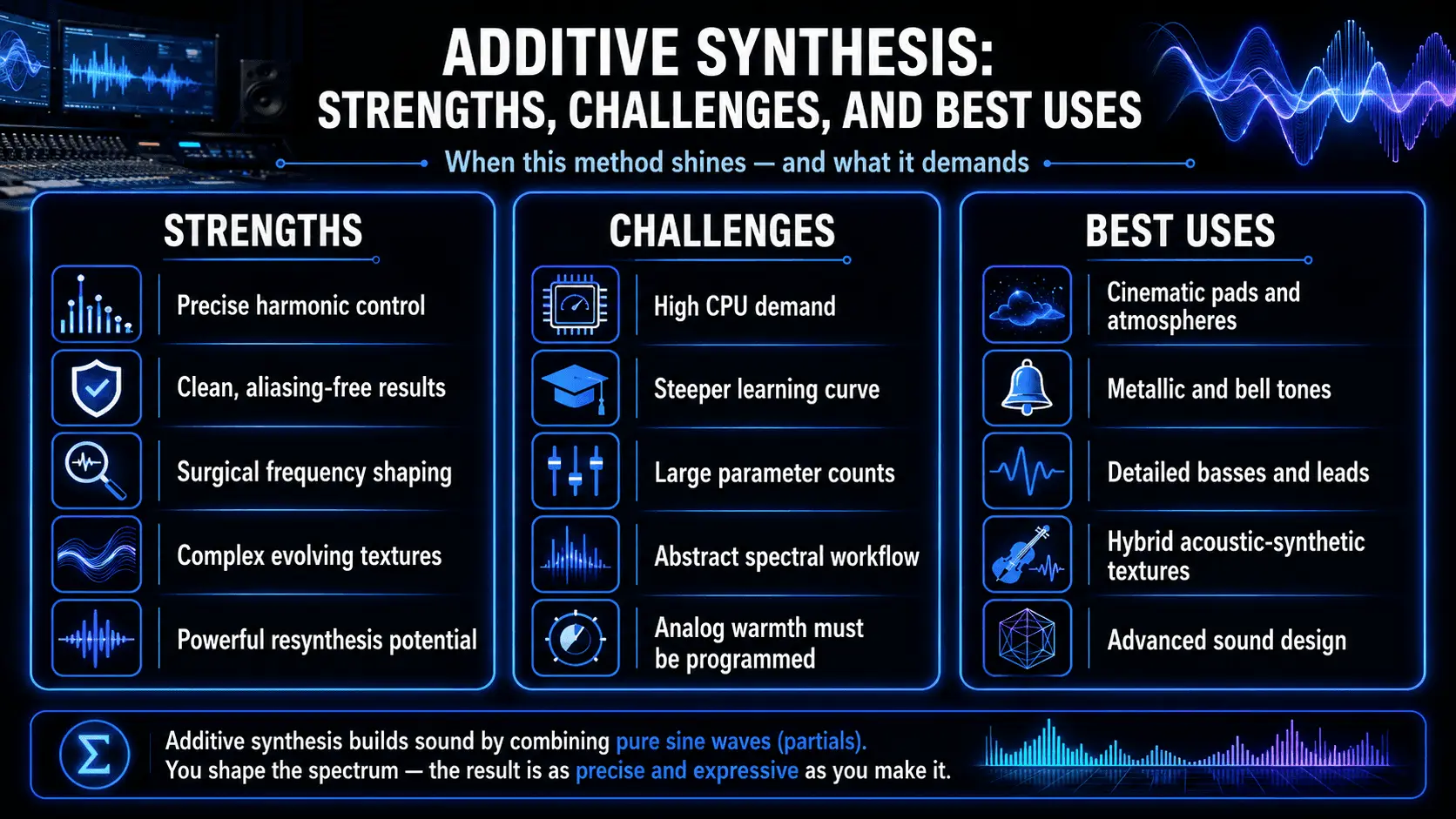
The primary advantage of constructing sound additively is the absolute clarity of the output signal. Because every frequency present in the sound is generated by a pure mathematical sine wave, there is a complete absence of unwanted mud or phase incoherence.
- Aliasing-Free Performance: Traditional digital oscillators often suffer from aliasing, an artifact where high frequencies fold back down into the audible spectrum, creating harsh distortion. Additive engines avoid this entirely by simply choosing not to generate any partials that exceed the upper limits of human hearing or system sample rates.
- Surgical Frequency Control: If a specific frequency is causing resonance issues in a mix, a sound designer does not need to apply an external equalizer. They can go directly into the instrument's harmonic editor and lower the volume of that specific partial at the source.
- Complex Evolving Textures: The ability to give every single harmonic its own independent volume envelope means that a sound can start as a simple low hum and slowly evolve into a bright, shimmering chime over thirty seconds without using external modulation effects.
Computational Demand and Workflow Overhead
These creative benefits come at a cost. The primary challenge of additive synthesis is the immense processing power required to calculate the behavior of hundreds of oscillators simultaneously for every note played.
- High CPU Utilization: Polyphonic additive synthesis can easily strain a computer processing unit. Playing a ten-note chord on a patch utilizing 512 partials requires the system to calculate over five thousand oscillators in real time, alongside their associated envelopes and modulators.
- Steep Learning Curve: The abstract nature of working with partials and spectral envelopes can be intimidating for producers accustomed to the immediate feedback of turning a filter knob on an analog synthesizer. It requires a conceptual shift from physical tweaking to mathematical planning.
- Difficulty in Replicating Raw Inaccuracy: Analog synthesizers are prized for their instability, drifting pitches, and unpredictable distortion. Because additive synthesis is fundamentally precise, replicating the raw, imperfect warmth of vintage hardware requires conscious, meticulous programming of subtle instabilities into every single partial.
Applications in Modern Production
Additive synthesis is not merely an academic exercise; it is heavily utilized across various sectors of the modern entertainment industry to solve specific sonic problems.
Cinematic Sound Design and Atmospheres
In film scoring, television production, and video game audio design, there is a constant demand for sounds that feel otherworldly, immense, and constantly shifting. Additive synthesis is perfectly suited for this application. Composers utilize resynthesis to convert field recordings of scraping metal, rushing wind, or industrial machinery into playable musical instruments. By stretching these sounds out and manipulating their harmonic content, they can create tense, eerie soundscapes that retain an organic quality while sounding distinctly synthetic.
Electronic Music Production and Lead Design
In electronic music, staying relevant often requires developing unique sonic signatures. Additive tools allow producers to craft lead instruments and basslines that stand out due to their distinct harmonic profiles. For example, by carefully adjusting waveform shaping parameters within an additive engine, a producer can create a bass patch that retains a powerful, pure sub-bass fundamental while simultaneously generating bright, distorted upper harmonics that cut through small playback speakers without tearing up the mid-range of the mix.
Use Cases by Creator Type
The implementation of additive techniques varies significantly depending on a creator's professional focus:
Film Composers
Composers use additive tools to create hybrid scores where acoustic instruments morph into synthesized textures. For example, a recorded violin section can be analyzed and slowly transformed into a glass bell sound over the course of a musical cue by shifting its harmonic partials upwards.
Electronic Dance Music Producers
These artists use additive engines to build highly aggressive, precise timbres for lead melodies. The absolute clarity of additive oscillators allows their tracks to remain clean and impactful even at extreme volumes in a club environment.
Game Audio Designers
Sound designers for interactive media use additive synthesis to build dynamic sound engines. For instance, the sound of a futuristic vehicle's engine can be synthesized additively so that the pitch, harmonic density, and inharmonic distortion scale fluidly based on real-time game telemetry, avoiding the repetitive nature of looping traditional audio samples.
Frequently Asked Questions
How does additive synthesis differ fundamentally from subtractive synthesis?
Subtractive synthesis starts with a complex, harmonically rich waveform and uses filters to remove unwanted frequencies to shape the sound. Additive synthesis begins with complete silence and builds a complex sound by layering simple sine waves together at specific frequencies and volumes.
Can additive synthesis replicate the warmth of old analog synthesizers?
Yes, but it requires deliberate programming. Analog warmth comes from subtle instabilities, pitch drift, and harmonic distortion. To achieve this additively, a user must intentionally program tiny variations in pitch and volume into the individual partials to mimic the imperfections of analog hardware circuits.
What is the relationship between Fourier theory and additive synthesis?
Fourier theory states that any complex, repeating sound wave can be broken down into a collection of pure sine waves. Additive synthesis uses this principle in reverse, combining multiple pure sine waves to construct complex sounds.
Why does additive synthesis require so much computer processing power?
Every single harmonic or partial used in an additive synthesizer is generated by its own independent digital oscillator. If a synthesizer is using 512 partials per note, playing a chord with multiple notes requires the computer to calculate the behavior of thousands of oscillators simultaneously, along with all their individual volume changes and modulations.
What is resynthesis, and how does it work within an additive synthesizer?
Resynthesis is a process where an existing audio recording is analyzed using a mathematical tool called the Fast Fourier Transform to find its frequency components over time. The additive synthesizer then uses its bank of oscillators to rebuild that sound based on the analysis data, allowing the user to manipulate the sound in ways that are impossible with standard audio samples.
Is additive synthesis useful for creating realistic acoustic instruments?
Yes. Because it allows for complete control over the volume and pitch of every single harmonic over time, it is excellent for acoustic modeling. It can replicate the complex way a string vibrates or a bell resonates, capturing the subtle, changing details that define real-world acoustic instruments.