
Key Takeaways
- FM synthesis creates complex sounds by using one oscillator, called a modulator, to rapidly alter the frequency of another oscillator, called a carrier.
- Frequency ratios determine the tonal character: integer ratios produce harmonic, musical sounds, while non-integer ratios create metallic and inharmonic textures.
- Modulation depth, operator envelopes, and routing algorithms control a sound’s brightness, complexity, transient detail, and evolution over time.
- FM synthesis excels at creating bells, electric pianos, sharp basses, crystalline pads, metallic percussion, evolving drones, and procedural sound effects.
- A suitable FM synthesis tool should balance operator count, routing flexibility, visual feedback, envelope control, automation options, and an accessible workflow.
What is Frequency Modulation Synthesis?
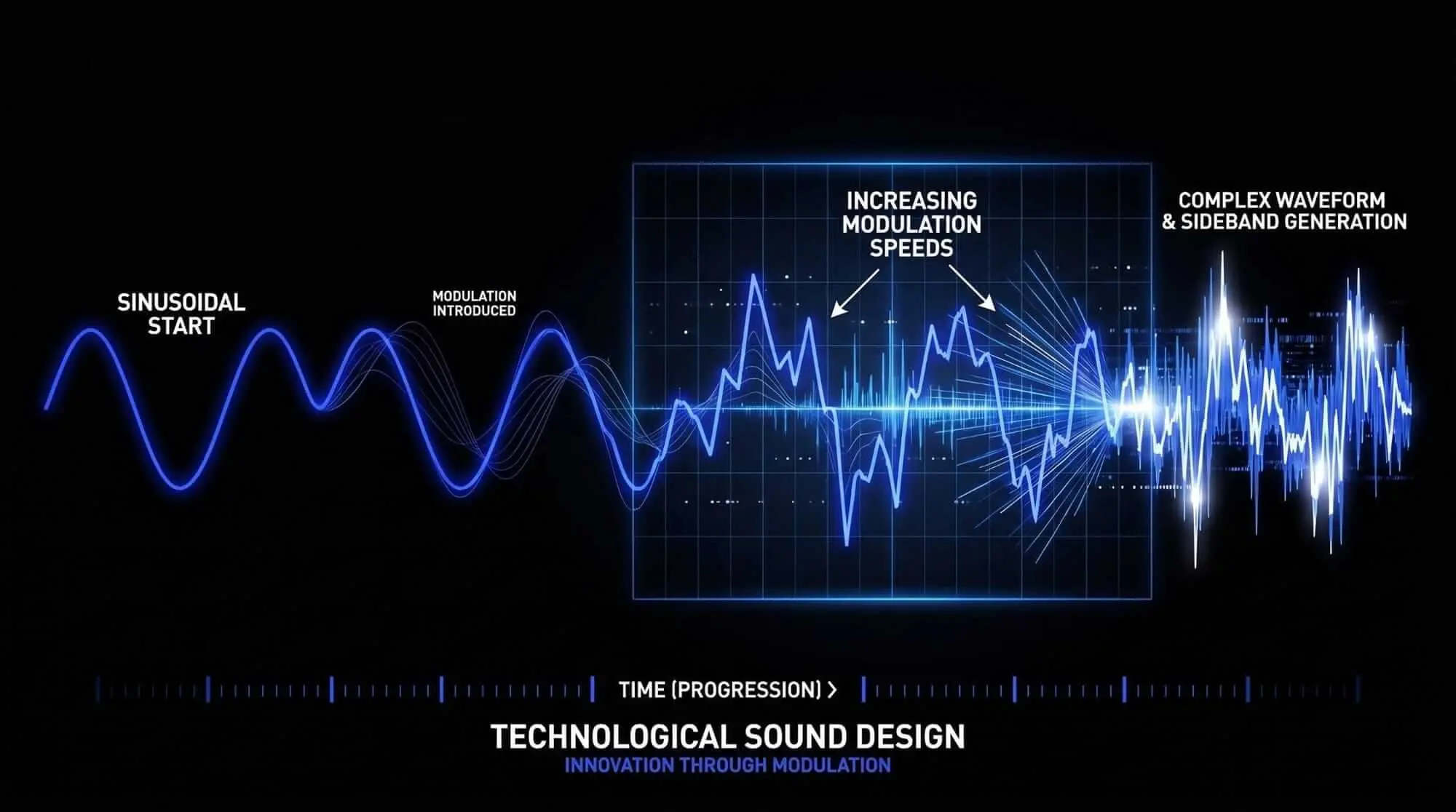
At its core, FM synthesis is a sound design method where one audio wave rapidly changes the pitch of another. This process happens within the human hearing range, typically between 20 Hz and 20,000 Hz.
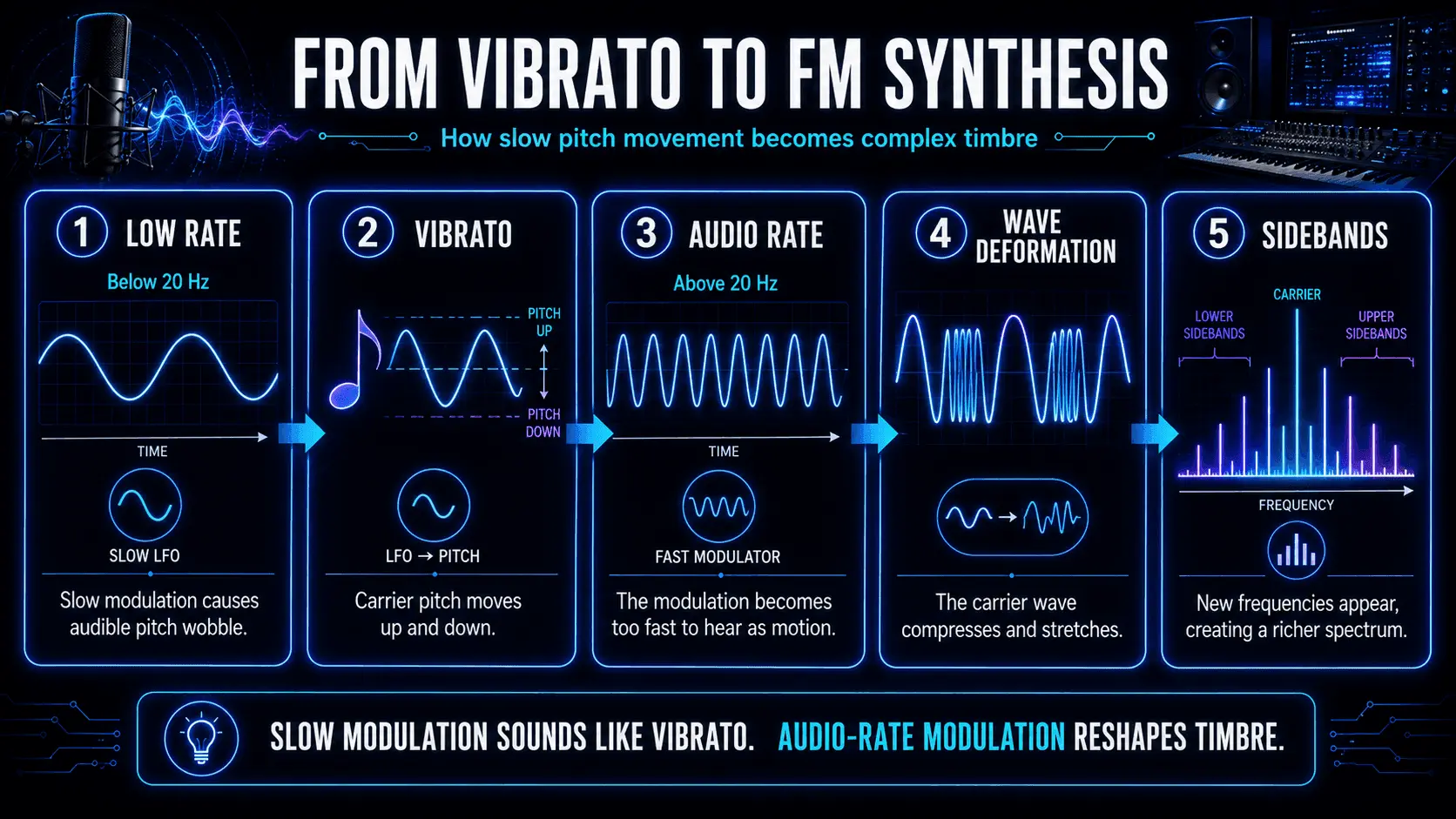
From Vibrato to Timbre Manipulation
- Low Speeds (Below 20 Hz): If you modulate an oscillator's pitch slowly, you hear a standard cyclical pitch change called vibrato.
- Audio Rates (Above 20 Hz): When the modulation speed accelerates past the human hearing threshold, your ear stops tracking the moving pitch. Instead, the rapid movement deforms the raw waveform shape.
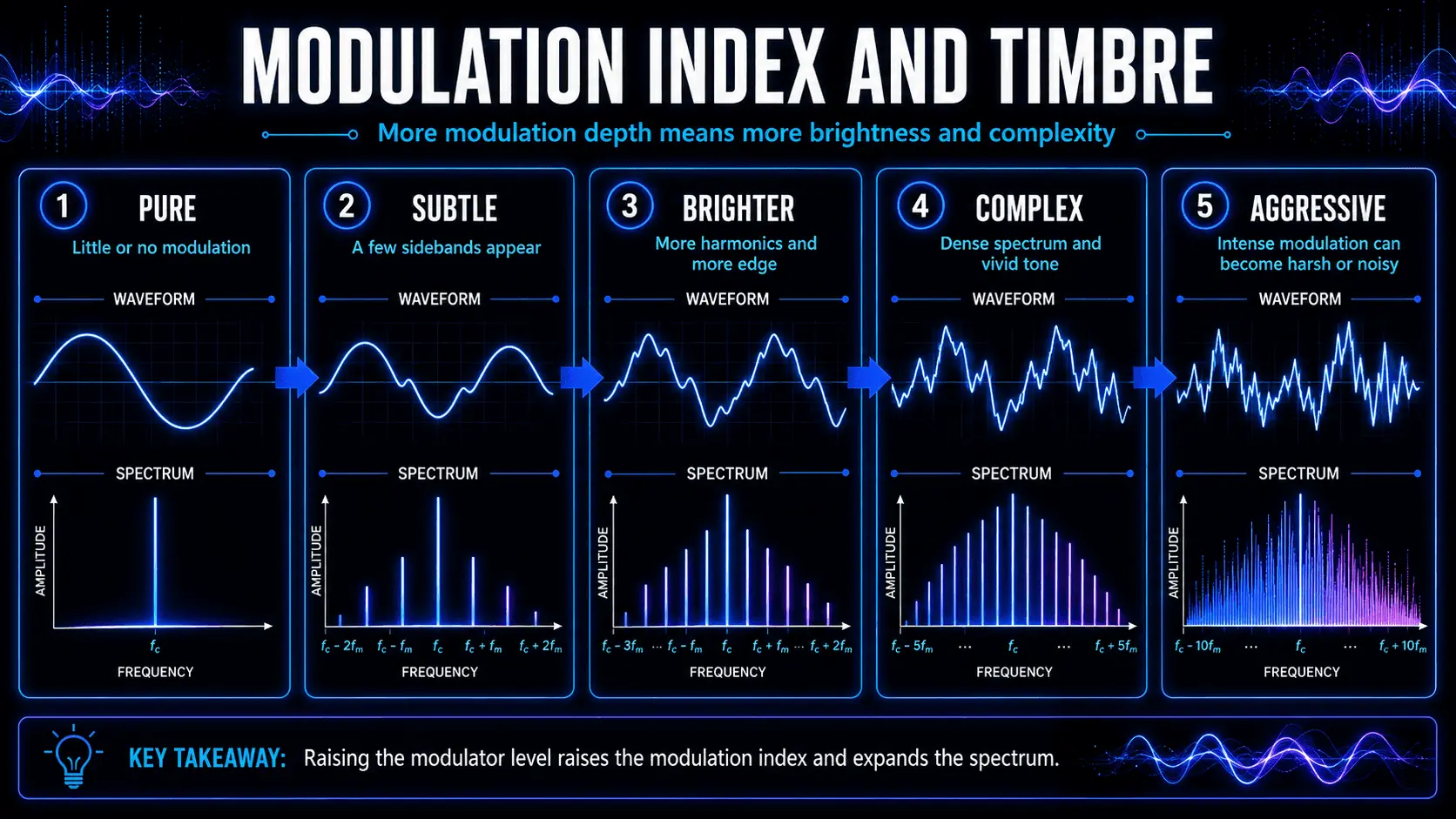
- Sideband Generation: This continuous deformation introduces entirely new frequencies, called sidebands, directly into the audio spectrum.
This approach to waveform modulation allows for extreme timbre manipulation without needing large filtering circuits or massive sample storage arrays, making it a highly efficient form of electronic music synthesis.
How Frequency Modulation Synthesis Works
The entire architecture relies on the high-speed interaction between two or more digital signals.
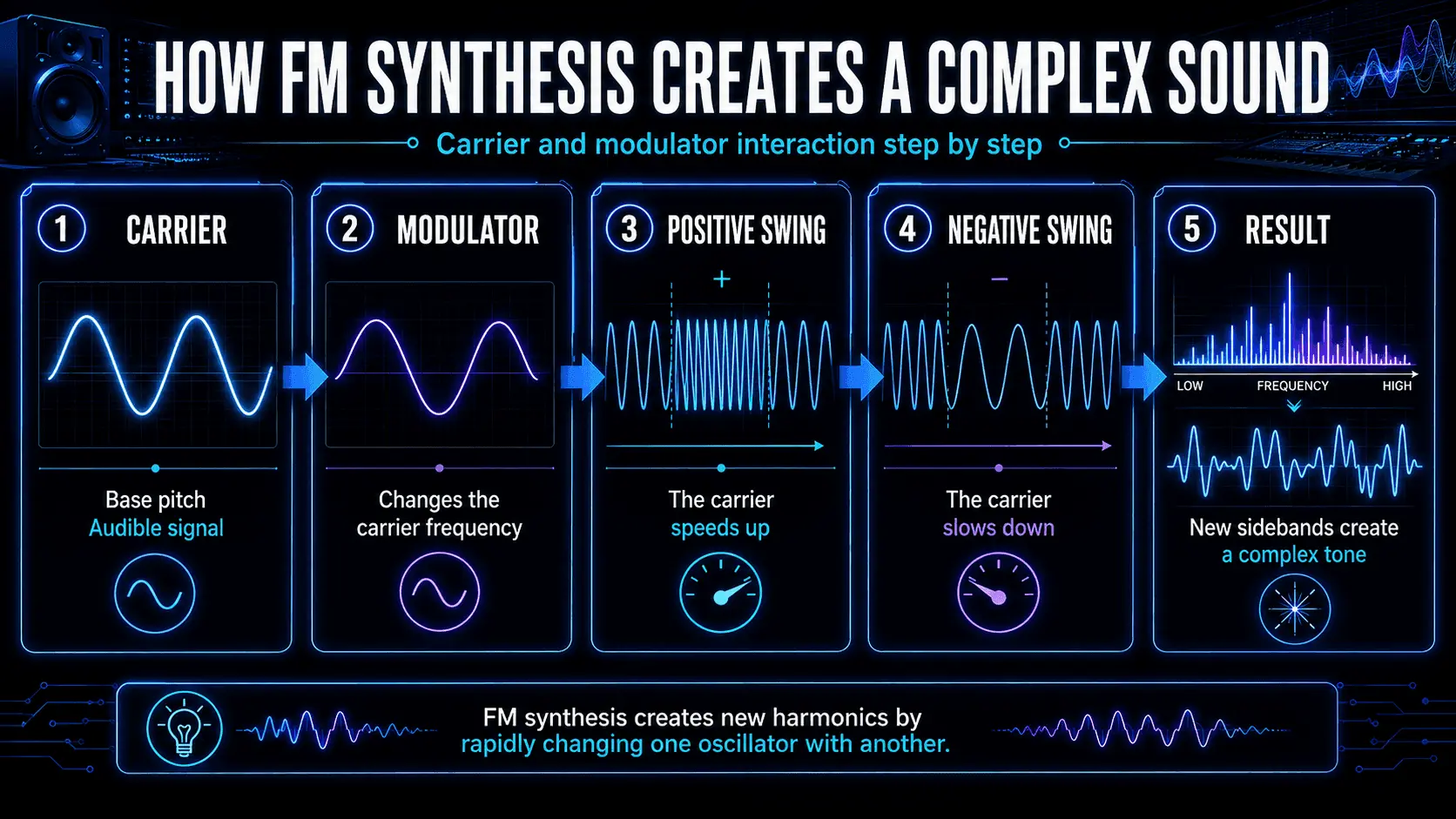
The Waveform Deformation Process
- Zero Point: When the modulation wave sits at zero, the target oscillator runs at its normal base frequency.
- Positive Peak: As the modulation wave rises to its positive peak, it accelerates the target oscillator's frequency.
- Negative Peak: As the modulation wave dips to its negative peak, it decelerates the target oscillator's frequency.
Because this cycle repeats thousands of times per second, the time-domain wave becomes compressed and stretched. This interactive sound design process transforms simple, pure sine waves into dense, complex harmonic spectrums.
Core Architecture and Component Breakdown
Operators
In audio synthesis, an operator is the absolute fundamental building block. It is not just a raw oscillator; it is an integrated voice channel consisting of three distinct elements:
- A digital oscillator that generates a pure sine wave.
- A dedicated amplifier to control the output volume of that wave.
- A multi-stage envelope generator that automates the volume changes over time.
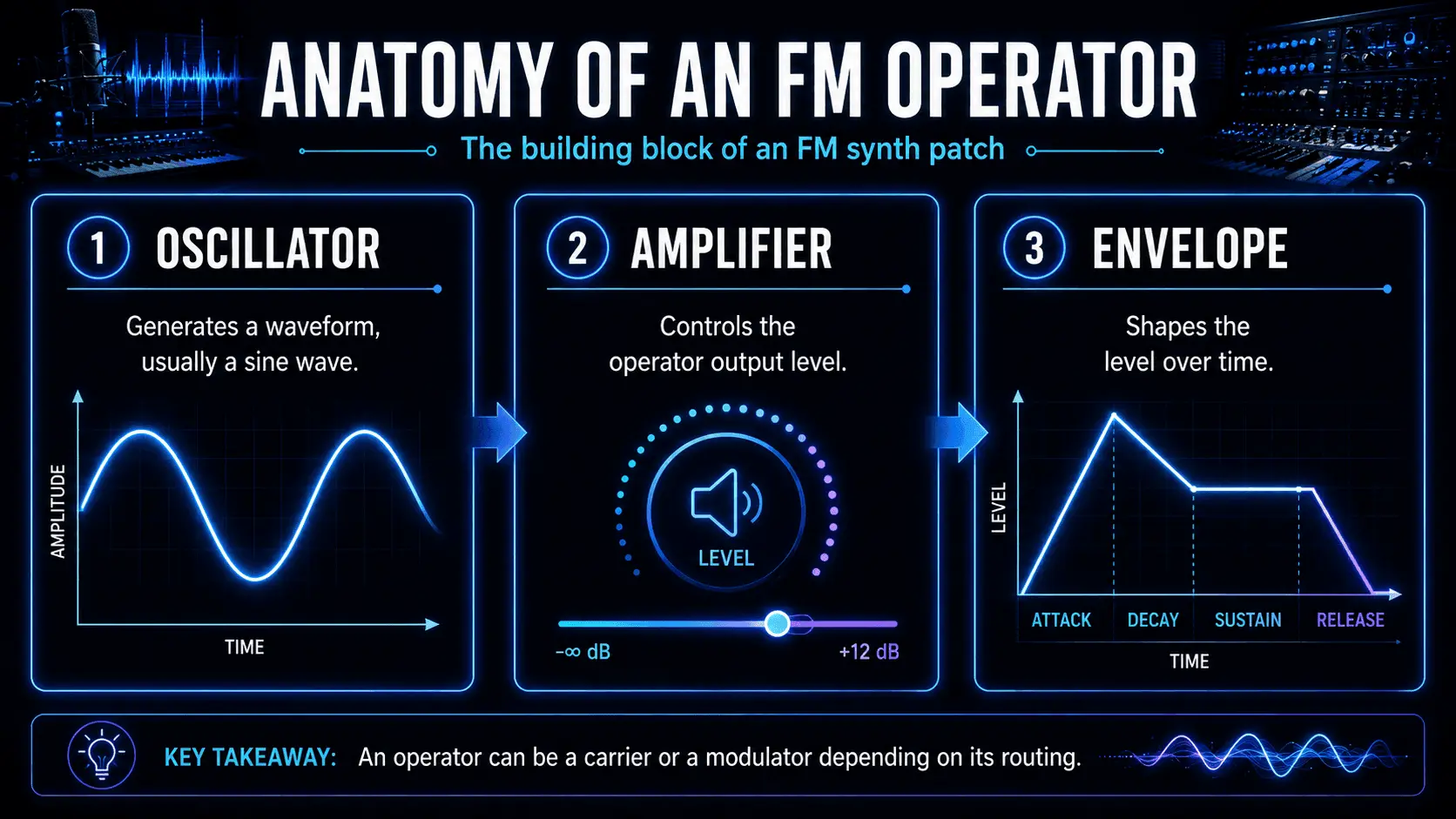
Modern software and hardware instruments typically use configurations of four, six, or eight operators running simultaneously.
Carriers and Modulators
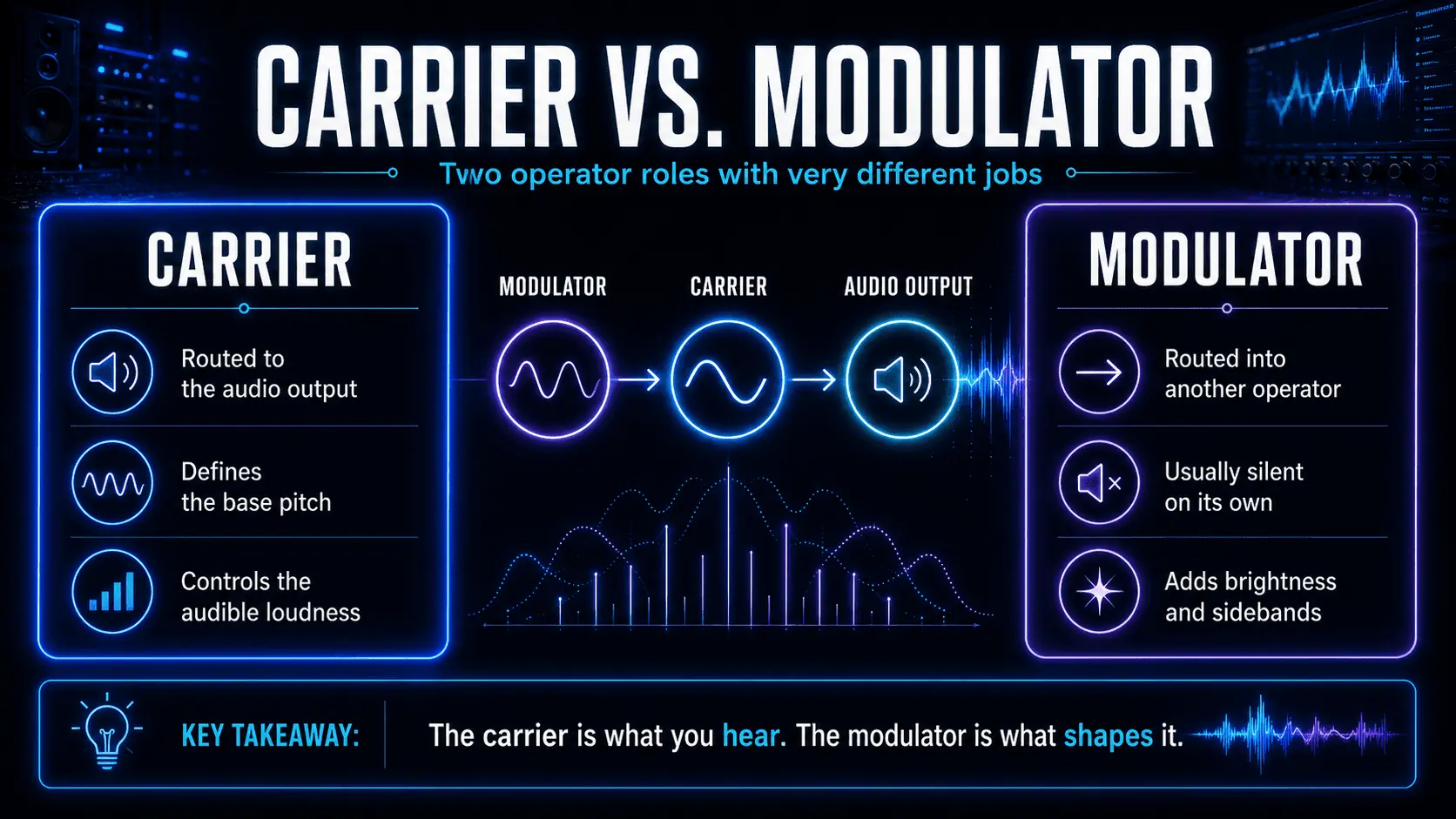
Operators are assigned specific functional roles within a patch layout.
Carriers: These operators are routed directly to the master audio output. They are the components you actually hear. The carrier dictates the overall volume envelope and provides the fundamental pitch foundation.
Modulators: These operators route their audio output directly into the frequency or phase input of another operator. They are completely silent on their own. Their sole job is to reshape the waveform of the target operator.
Ratios
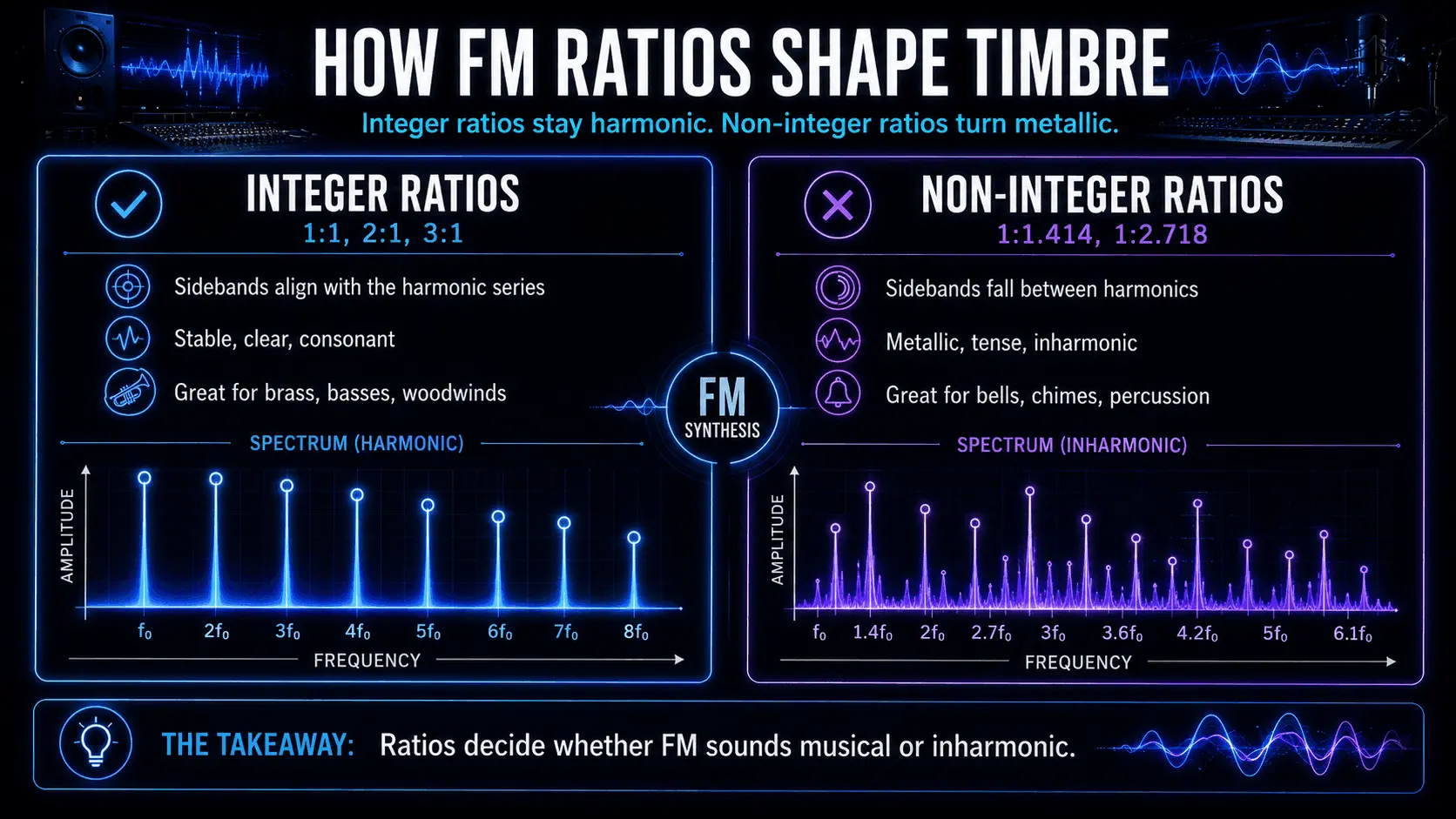
Instead of using fixed pitches, operators scale their speeds relative to the note played on a keyboard using frequency ratios.
- Integer Ratios (e.g., 1:1, 2:1, 3:1): The generated sidebands align perfectly with the standard harmonic series. This produces clear, stable, consonant sounds like brass, woodwinds, and clean bass lines.
- Non-Integer Ratios (e.g., 1:1.414, 1:2.718): The sidebands fall outside the traditional harmonic series. This creates an inharmonic spectrum filled with internal acoustic tension, which is essential for rendering bells, chimes, and industrial percussion.
Algorithms
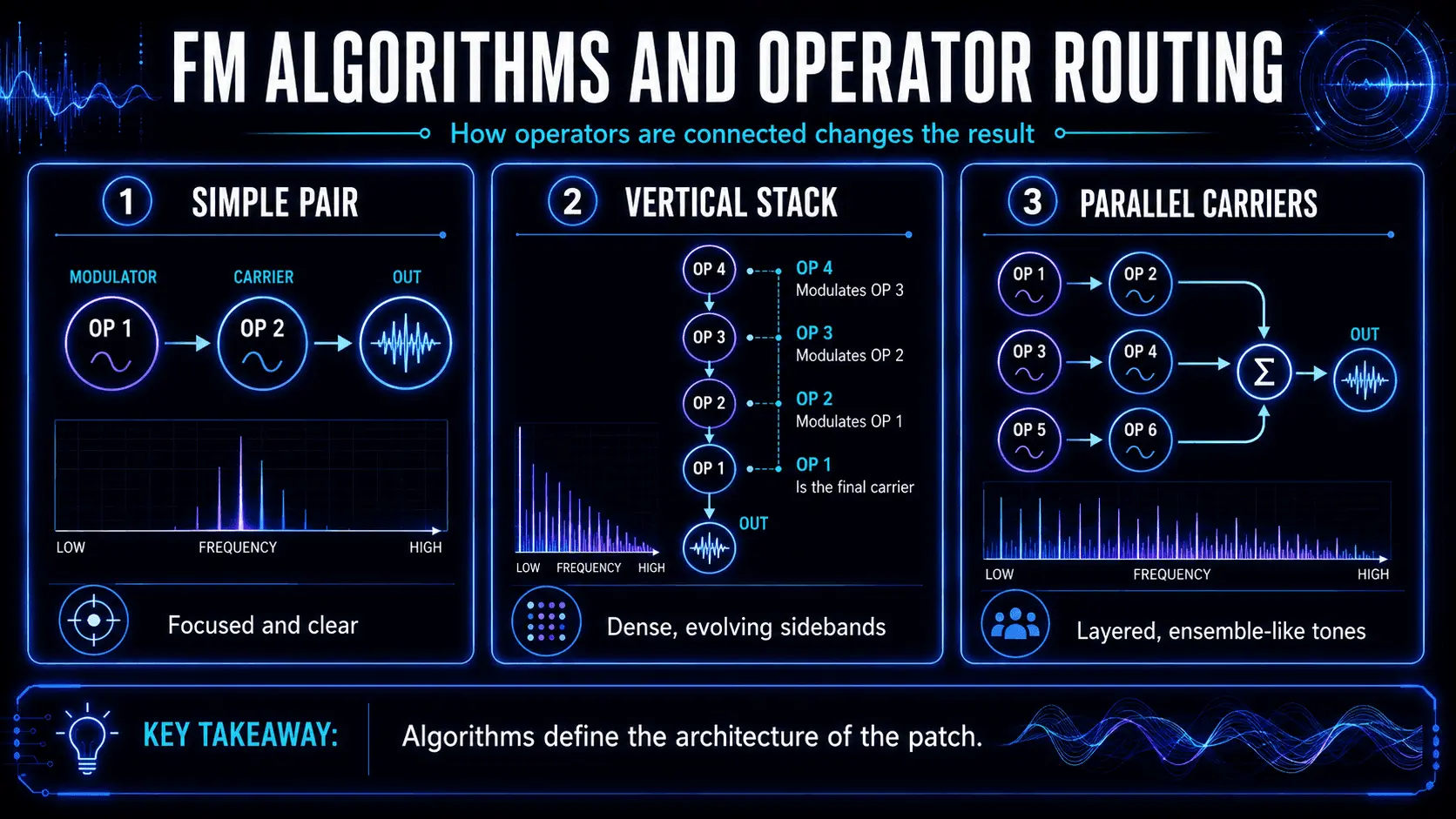
An algorithm is the pre-defined structural routing layout that dictates how your operators connect to one another.
- Vertical Stacks: Operator 3 modulates Operator 2, which modulates Operator 1 (the carrier). This chain creates layers of sidebands, allowing for highly complex, evolving textures.
- Parallel Layouts: Multiple independent carriers output sound directly to the mixer simultaneously, each modulated by a single, dedicated operator. This configuration excels at creating rich ensemble sounds or layering a punchy transient over a smooth pad.
Envelope Generators
Because synthesis techniques in FM rely entirely on volume changes to alter harmonic complexity, multi-stage envelope generators are critical.
- Timbral Control: Instead of just shaping loudness, an envelope on a modulator directly controls the brightness and grit of the sound over time.
- Transient Design: Giving a modulator a lightning-fast initial peak that immediately decays allows you to inject sharp, realistic attack transients—such as the physical strike of a wooden mallet—into the beginning of a sound.
FM Synthesis vs. Subtractive Synthesis
| Feature / Dimension | Subtractive Synthesis | Frequency Modulation Synthesis |
|---|---|---|
| Starting Waveform | Harmonically rich shapes (Sawtooth, Square). | Harmonically pure shapes (Sine waves). |
| Brightness Control | Moving a physical filter cutoff knob. | Adjusting a modulator operator's volume level. |
| Component Efficiency | Requires multiple oscillators for complex tones. | Achieves immense complexity using very few oscillators. |
| Transient Definition | Soft or limited by filter circuit speeds. | Sharp, highly detailed, and mathematically precise. |
| Acoustic Emulation | Ideal for warm brass, analog strings, fat bass. | Ideal for bells, mallets, electric pianos, metallic textures. |
What FM Synthesis Excels At
- Glassy and Crystalline Textures: Creates sparkling digital pads and ice-like leads that maintain pristine note definition in dense musical mixes.
- Metallic and Inharmonic Timbres: Pinpoints precise, unconventional sideband placements to synthesize realistic industrial impacts, anvils, gongs, and metallic percussion.
- Highly Articulated Transients: Uses fast operator envelopes to replicate the precise pluck of an acoustic string, the snap of a bass wire, or the strike of a tine.
- Deep, Evolving Drones: Cross-modulates multiple operators over long timeframes to build vast soundscapes that shift textures slowly over several minutes.
Advanced Techniques in Modern Electronic Music Synthesis
Feedback Loops
A feedback loop occurs when an operator's output is routed directly back into its own frequency input.
- Wave Shaping: Gradually adding feedback to a standard sine wave morphs it into a shape resembling a sawtooth wave.
- Noise Generation: Pushing the feedback level to its maximum limits completely destabilizes the cycle, converting the tone into pure digital noise. This is ideal for sculpting hi-hats, snares, and aggressive bass grit without wasting extra operators.
Interactive Sound Design
To make digital instruments sound alive and responsive, link your internal modulation matrices directly to real-time performance controls.
- Velocity Mapping: Route keyboard velocity directly to your primary modulators' output volumes. Soft playing yields a warm tone; striking the keys hard opens up a bright, aggressive harmonic bite.
- Modulation Wheel Controls: Assign your mod wheel to subtly shift the frequency ratios of secondary modulators. Moving the wheel during a performance introduces evolving, metallic tension.
- Aftertouch Integration: Connect key pressure to feedback loop depths, allowing you to manually add grit, distortion, and harmonic screams into sustaining leads or pads.
Hands-On Hardware FM Synthesis
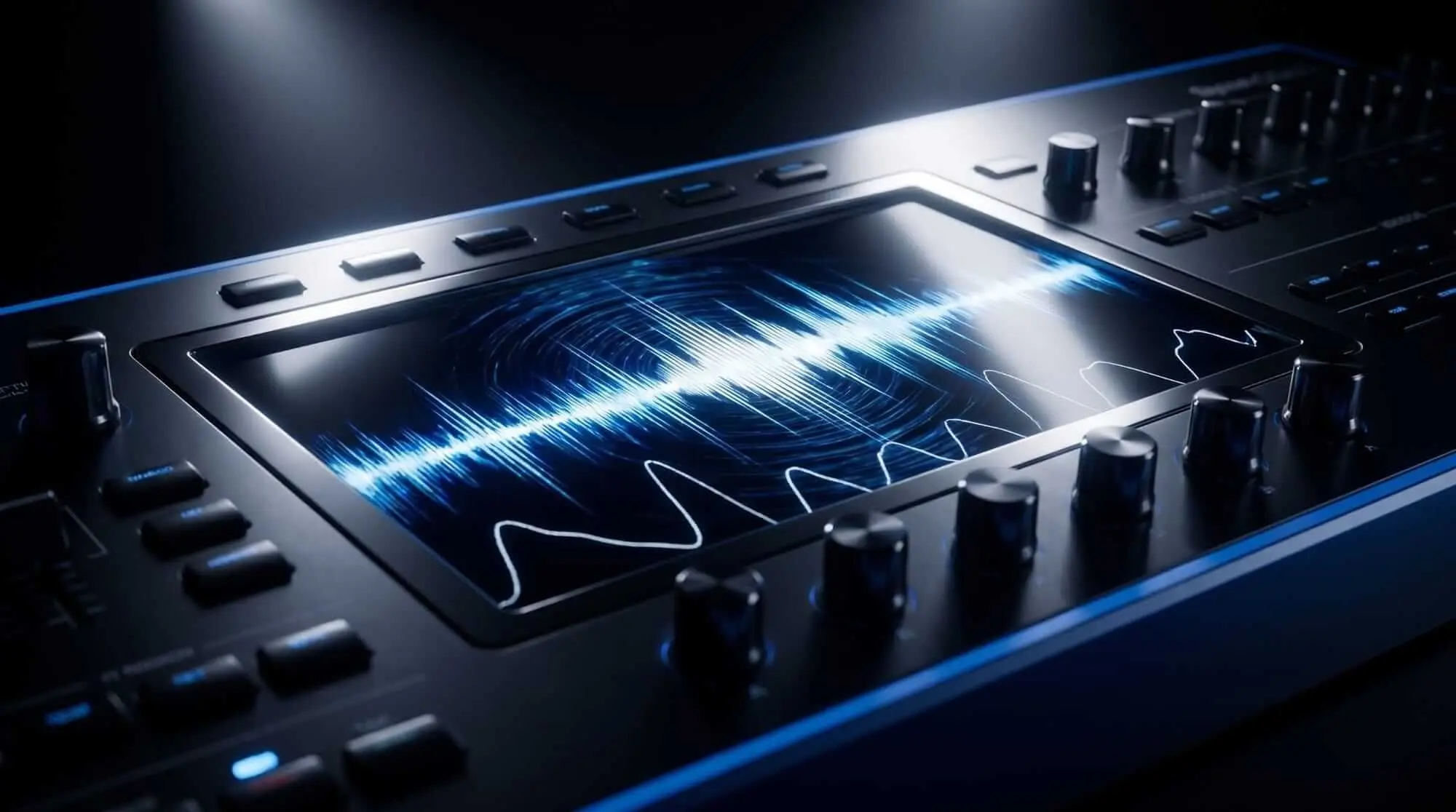
Modern hardware FM synthesizers make frequency modulation easier to control by placing essential sound-design parameters within immediate reach. Instead of navigating through complex menus, musicians can adjust frequency ratios, modulation depth, envelopes, feedback, and operator routing through dedicated knobs, sliders, buttons, or clearly organized control panels.
Direct Parameter Control
Hands-on controls make it easier to hear how each adjustment changes the sound. Increasing a modulator’s level can add brightness and harmonic complexity, while changing its frequency ratio can transform a stable tone into a metallic or inharmonic texture.
This immediate feedback is especially useful when designing evolving pads, percussive sounds, electric piano tones, aggressive basses, and digital effects.
Performance-Based Sound Design
Hardware controls also allow FM parameters to be changed during a performance. Musicians can use velocity, aftertouch, modulation wheels, expression pedals, and assignable macro controls to alter the character of a patch in real time.
For example, a performance control could simultaneously increase modulation depth, open a filter, and add feedback. This allows a smooth tone to become brighter, sharper, or more distorted as the performer applies additional pressure or movement.
Hybrid Signal Workflows
Many modern FM instruments combine digital modulation with features commonly associated with subtractive synthesis. These may include filters, drive stages, effects, low-frequency oscillators, and conventional amplitude envelopes.
This hybrid structure gives musicians access to the harmonic precision of FM synthesis while preserving a familiar workflow for shaping brightness, dynamics, movement, and spatial depth.
How to Choose an FM Synthesis Tool
The best FM synthesis tool depends on the level of control, complexity, and immediacy required by the user. Some instruments provide detailed access to individual operators and modulation paths, while others simplify the process through presets, visual routing systems, and macro controls.
Important features to consider include:
| Feature | What to Consider |
|---|---|
| Operator Count | A higher operator count allows for deeper modulation chains, layered carriers, and more complex timbres. However, additional operators can also make patches more difficult to manage. |
| Routing Flexibility | Look for support for serial stacks, parallel carriers, feedback loops, and customizable algorithms. Flexible routing provides more options for building layered or evolving sounds. |
| Envelope Control | Detailed multi-stage envelopes offer precise control over loudness, brightness, transients, and tonal development. Separate envelopes for each operator provide the greatest flexibility. |
| Waveform Options | Traditional FM synthesis often uses sine waves, but some instruments support triangle, square, sawtooth, wavetable, or custom waveforms. Complex starting shapes can produce richer spectra with fewer operators. |
| Visual Feedback | Operator diagrams, spectrum displays, and modulation meters make it easier to understand routing relationships and see how parameter changes affect the resulting sound. |
| Automation and Modulation | DAW automation, velocity sensitivity, aftertouch, LFOs, envelope mapping, and macro controls allow patches to react dynamically to performances and arrangement changes. |
| Feedback Control | Adjustable feedback can expand the available sound palette from subtle harmonic enrichment to sharp, noisy, or distorted textures. |
| Presets and Starting Points | A well-organized preset library can make FM synthesis more approachable, especially for users who prefer modifying existing sounds instead of building patches from scratch. |
| Workflow | Choose between detailed operator programming, simplified macro-based controls, hands-on hardware interaction, or close DAW integration based on how you prefer to create music. |
| Processing Requirements | Complex routing, high operator counts, unison, oversampling, and high polyphony can increase processing demands. Consider available computer or hardware resources when building large arrangements. |
A beginner may benefit from an instrument with visual routing, useful presets, and a limited number of operators. More experienced sound designers may prefer deeper envelope editing, custom algorithms, flexible modulation assignments, and precise control over every operator.
The most suitable tool is not necessarily the one with the largest number of features. It is the one that provides enough control for the intended sound while keeping the programming process clear and manageable.
FM Synthesis in Game Audio and Procedural Design
Immersive Soundtracks
Unlike sample-based instruments that use up massive amounts of storage memory, algorithmic synthesis engines generate audio procedurally in real time. This allows game soundtracks to adapt dynamically to player choices. When a player moves from a peaceful area into a dangerous environment, the game engine can automatically scale up a modulator's ratio to shift a soft ambient chord into a tense, metallic texture seamlessly.
Dynamic Sound Effects
Sound effects rely on varied, expressive feedback to make gameplay actions feel rewarding.
- Real-time Scaling: By linking a sci-fi weapon's charge level directly to an FM modulator's volume envelope, the audio automatically morphs from a low hum into a screeching digital tone the longer the player holds down the trigger.
- Interactive Control: This provides clear, responsive audio cues that match the player's direct inputs on screen.
Procedural Audio Generation
The efficient structure of frequency modulation makes it an ideal fit for creating real-time sound effects via code.
- Engine Synthesis: In racing game audio systems, one operator pair can model the low-end rumble of exhaust cylinders while a fast-modulated secondary pair recreates the high-frequency whine of transmission gears.
- Dynamic Feedback: This produces a highly responsive engine roar that updates continuously based on vehicle speed and throttle changes, completely eliminating the need for large sample libraries.
Troubleshooting Common Issues in FM Synthesis
1. Digital Aliasing and High-Frequency Harshness
The Problem: Intense modulation can generate high frequencies that exceed the maximum sample rate limit, folding back down into the audible spectrum as harsh, brittle digital distortion.
The Fix:
- Turn down the output level of your highest modulators to lower the modulation index.
- Turn on oversampling within your software instrument's settings menu.
- Apply a gentle low-pass filter to roll off brittle high-end frequencies before they hit your main mix bus.
2. Loss of Fundamental Pitch and Low-End Power
The Problem: Raising a modulator's volume to add grit can pull energy away from the fundamental frequency, leaving your bass patches sounding bright and buzzy without any low-end weight.
The Fix:
- Keep a clean carrier operator running at a 1.00 ratio completely untouched by any modulators to anchor your sub-bass.
- Use an algorithm that separates your patch into parallel tracks: use one operator chain for the mid-range distortion and a separate, unmodulated operator for a solid, clean low-end foundation.
3. Unwanted Pitch Tracking and Detuning Issues
The Problem: The patch sounds perfectly in tune on one key but grows highly dissonant or out of scale as you play up and down the keyboard.
The Fix:
- Check that all active operators are locked to fixed integer ratio increments rather than absolute, non-tracking hertz values.
- Ensure fine-tuning or detuning offsets applied to modulators are used subtly, as small fractional offsets multiply quickly across multi-stage modulation loops.
The Lasting Creative Power of FM Synthesis
FM synthesis shows how a small number of simple oscillators can produce an enormous range of detailed, expressive sounds. Once you understand carriers, modulators, frequency ratios, envelopes, algorithms, and feedback, the process becomes far less intimidating. Whether you are building bright electric pianos, metallic percussion, evolving pads, aggressive basses, or responsive game audio, the key is to experiment with one parameter at a time and listen closely to how each change reshapes the spectrum. With practice, FM synthesis becomes not just a technical method, but a flexible creative system for designing sounds that would be difficult to achieve through any other approach.
Frequently Asked Questions
What is the difference between Linear FM and Exponential FM?
In linear frequency modulation, the modulation voltage shifts the carrier's frequency by a fixed, equal number of Hertz per volt, keeping your harmonic relationships perfectly stable across the entire keyboard. In exponential frequency modulation, the pitch changes exponentially relative to the input voltage. While this mimics how human ears perceive pitch, it causes musical intervals to break apart and detune when you play different keys up and down the keyboard.
Why did the Yamaha DX7 have a reputation for being difficult to program?
The DX7 lacked a dedicated physical knob for each function, forcing users to navigate through hundreds of deeply nested digital parameters using a tiny LCD screen and a single data slider. Additionally, the interactions within multi-operator chains are highly sensitive, meaning a tiny adjustment to a modulator's volume can completely transform the underlying sound.
Can I use waveforms other than sine waves for FM synthesis?
Yes. Modern software and hardware instruments allow you to use sawtooth, square, triangle, or custom wavetable shapes as carriers and modulators. Starting with complex waveforms provides a rich set of built-in harmonics right out of the gate, allowing you to build highly aggressive, multi-layered patches with fewer operators.
How do I make an FM synth patch sound warmer and more analog?
Digital phase modulation is naturally precise, which can sometimes sound clinical or cold. To inject analog warmth, use a slow LFO to introduce subtle pitch drift to your modulators' fine-tuning. You can also run the master output through a simulated analog low-pass filter model, introduce tape saturation or preamp drive, or add a chorus effect to soften brittle digital edges.
What is the difference between Frequency Modulation and Phase Modulation?
The vast majority of commercial commercial hardware instruments actually use phase modulation. Instead of directly altering the oscillator's core speed, the modulator shifts the phase angle of the carrier's waveform. While phase modulation yields a nearly identical sonic result to true linear frequency modulation, it offers one major advantage: it maintains absolute pitch stability even when extreme feedback loops and intense modulation settings are applied.