
We value your privacy

By clicking "Allow", you agree to the storing of cookies on your device to enhance site navigation, analyze site usage, and assist in our marketing efforts.

Consent Selection
Details
  • Necessary cookies help make a website usable by enabling basic functions like page navigation and access to secure areas of the website. The website cannot function properly without these cookies.
    • Learn more about this provideropens in a new window

      Some of the data collected by this provider is for the purposes of personalization and measuring advertising effectiveness. The provider may use the IP Addresses for ads measurement and ads personalization.

      test_cookieUsed to check if the user's browser supports cookies.
      Maximum Storage Duration: 1 dayType: HTTP Cookie
    • Learn more about this provideropens in a new window
      bcookieUsed in order to detect spam and improve the website's security.
      Maximum Storage Duration: 1 yearType: HTTP Cookie
      li_gcStores the user's cookie consent state for the current domain
      Maximum Storage Duration: 180 daysType: HTTP Cookie
    • Learn more about this provideropens in a new window
      datadomeUsed in context with the website's BotManager. The BotManager detects, categorizes and compiles reports on potential bots trying to access the website.
      Maximum Storage Duration: SessionType: HTTP Cookie
    • studio-web-language-keyPending
      Maximum Storage Duration: SessionType: HTML Local Storage
    • _cfuvid [x2]This cookie is a part of the services provided by Cloudflare - Including load-balancing, deliverance of website content and serving DNS connection for website operators.
      Maximum Storage Duration: SessionType: HTTP Cookie
    • __cf_bm [x5]This cookie is used to distinguish between humans and bots. This is beneficial for the website, in order to make valid reports on the use of their website.
      Maximum Storage Duration: 1 dayType: HTTP Cookie
    • CookieConsent [x2]Stores the user's cookie consent state for the current domain
      Maximum Storage Duration: 1 yearType: HTTP Cookie
    • guidPreserves users states across page requests.
      Maximum Storage Duration: 1 yearType: HTTP Cookie
    • ttRegisters the website's speed and performance. This function can be used in context with statistics and load-balancing.
      Maximum Storage Duration: 1 yearType: HTTP Cookie
    • sc_anonymous_idUsed in context with the 3D-view-function on the website.
      Maximum Storage Duration: 10 yearsType: HTTP Cookie
  • Preference cookies enable a website to remember information that changes the way the website behaves or looks, like your preferred language or the region that you are in.
    • Learn more about this provideropens in a new window
      lidcRegisters which server-cluster is serving the visitor. This is used in context with load balancing, in order to optimize user experience.
      Maximum Storage Duration: 1 dayType: HTTP Cookie
  • Statistic cookies help website owners to understand how visitors interact with websites by collecting and reporting information anonymously.
    • Learn more about this provideropens in a new window
      geoSaves the user's current geographical location based on the user's IP address.
      Maximum Storage Duration: SessionType: HTTP Cookie
    • Learn more about this provideropens in a new window
      ajs_anonymous_idThis cookie is used to identify a specific visitor - this information is used to identify the number of specific visitors on a website.
      Maximum Storage Duration: 1 yearType: HTTP Cookie
      ajs_anonymous_idThis cookie is used to count how many times a website has been visited by different visitors - this is done by assigning the visitor an ID, so the visitor does not get registered twice.
      Maximum Storage Duration: PersistentType: HTML Local Storage
    • Learn more about this provideropens in a new window
      _tt_enable_cookieUsed by the social networking service, TikTok, for tracking the use of embedded services.
      Maximum Storage Duration: 1 yearType: HTTP Cookie
    • Learn more about this provideropens in a new window
      personalization_idThis cookie is set by Twitter - The cookie allows the visitor to share content from the website onto their Twitter profile.
      Maximum Storage Duration: 400 daysType: HTTP Cookie
    • FPGSIDRegisters statistical data on users' behaviour on the website. Used for internal analytics by the website operator.
      Maximum Storage Duration: 1 dayType: HTTP Cookie
      FPIDRegisters statistical data on users' behaviour on the website. Used for internal analytics by the website operator.
      Maximum Storage Duration: 400 daysType: HTTP Cookie
      FPLCRegisters a unique ID that is used to generate statistical data on how the visitor uses the website.
      Maximum Storage Duration: 1 dayType: HTTP Cookie
      sajssdk_2015_cookie_access_testPending
      Maximum Storage Duration: 73000 daysType: HTTP Cookie
      sajssdk_2015_cross_new_userCollects statistics on the user's visits to the website, such as the number of visits, average time spent on the website and what pages have been read.
      Maximum Storage Duration: 1 dayType: HTTP Cookie
      sensorsdata_domain_testPending
      Maximum Storage Duration: SessionType: HTTP Cookie
      sensorsdata2015jssdkcrossCollects statistics on the user's visits to the website, such as the number of visits, average time spent on the website and what pages have been read.
      Maximum Storage Duration: 2 yearsType: HTTP Cookie
    • sentryReplaySessionRegisters data on visitors' website-behaviour. This is used for internal analysis and website optimization.
      Maximum Storage Duration: SessionType: HTML Local Storage
    • u_scsidRegisters data on visitors' website-behaviour. This is used for internal analysis and website optimization.
      Maximum Storage Duration: SessionType: HTML Local Storage
      X-ABThis cookie is used by the website’s operator in context with multi-variate testing. This is a tool used to combine or change content on the website. This allows the website to find the best variation/edition of the site.
      Maximum Storage Duration: 1 dayType: HTTP Cookie
    • SERVERCORSIDPending
      Maximum Storage Duration: SessionType: HTTP Cookie
      SERVERIDThis cookie is used to assign the visitor to a specific server - this function is necessary for the functionality of the website.
      Maximum Storage Duration: SessionType: HTTP Cookie
    • number(#)Used to track user’s interaction with embedded content.
      Maximum Storage Duration: SessionType: HTML Local Storage
  • Marketing cookies are used to track visitors across websites. The intention is to display ads that are relevant and engaging for the individual user and thereby more valuable for publishers and third party advertisers.
    • Learn more about this provideropens in a new window
      _fbpUsed by Facebook to deliver a series of advertisement products such as real time bidding from third party advertisers.
      Maximum Storage Duration: 3 monthsType: HTTP Cookie
      lastExternalReferrerDetects how the user reached the website by registering their last URL-address.
      Maximum Storage Duration: PersistentType: HTML Local Storage
      lastExternalReferrerTimeDetects how the user reached the website by registering their last URL-address.
      Maximum Storage Duration: PersistentType: HTML Local Storage
    • Learn more about this provideropens in a new window
      mtClientConfig_cachedSource_xp_amp_music_webplayerUsed to implement iTunes content and presentation of covers.
      Maximum Storage Duration: PersistentType: HTML Local Storage
    • Learn more about this provideropens in a new window
      __tld__Used to track visitors on multiple websites, in order to present relevant advertisement based on the visitor's preferences.
      Maximum Storage Duration: SessionType: HTTP Cookie
      ajs_user_idThis cookie is used to collect data on the visitor's behavior on the website - this information can be used to assign the visitor to a visitor segment, based on common preferences.
      Maximum Storage Duration: SessionType: HTTP Cookie
      ajs_user_idCollects data on visitors' preferences and behaviour on the website - This information is used make content and advertisement more relevant to the specific visitor.
      Maximum Storage Duration: PersistentType: HTML Local Storage
    • Learn more about this provideropens in a new window

      Some of the data collected by this provider is for the purposes of personalization and measuring advertising effectiveness. The provider may use the IP Addresses for ads measurement and ads personalization.

      IDEUsed by Google DoubleClick to register and report the website user's actions after viewing or clicking one of the advertiser's ads with the purpose of measuring the efficacy of an ad and to present targeted ads to the user.
      Maximum Storage Duration: 400 daysType: HTTP Cookie
      ads/ga-audiencesUsed by Google AdWords to re-engage visitors that are likely to convert to customers based on the visitor's online behaviour across websites.
      Maximum Storage Duration: SessionType: Pixel Tracker
      pagead/1p-user-list/#Tracks if the user has shown interest in specific products or events across multiple websites and detects how the user navigates between sites. This is used for measurement of advertisement efforts and facilitates payment of referral-fees between websites.
      Maximum Storage Duration: SessionType: Pixel Tracker
    • Learn more about this provideropens in a new window
      _uetsidCollects data on visitor behaviour from multiple websites, in order to present more relevant advertisement - This also allows the website to limit the number of times that they are shown the same advertisement.
      Maximum Storage Duration: 1 dayType: HTTP Cookie
      _uetvidUsed to track visitors on multiple websites, in order to present relevant advertisement based on the visitor's preferences.
      Maximum Storage Duration: 1 yearType: HTTP Cookie
      _uetsidUsed to track visitors on multiple websites, in order to present relevant advertisement based on the visitor's preferences.
      Maximum Storage Duration: PersistentType: HTML Local Storage
      _uetsid_expContains the expiry-date for the cookie with corresponding name.
      Maximum Storage Duration: PersistentType: HTML Local Storage
      _uetvidUsed to track visitors on multiple websites, in order to present relevant advertisement based on the visitor's preferences.
      Maximum Storage Duration: PersistentType: HTML Local Storage
      _uetvid_expContains the expiry-date for the cookie with corresponding name.
      Maximum Storage Duration: PersistentType: HTML Local Storage
      MUIDUsed widely by Microsoft as a unique user ID. The cookie enables user tracking by synchronising the ID across many Microsoft domains.
      Maximum Storage Duration: 1 yearType: HTTP Cookie
    • Learn more about this provideropens in a new window
      _rdt_uuidUsed to track visitors on multiple websites, in order to present relevant advertisement based on the visitor's preferences.
      Maximum Storage Duration: 3 monthsType: HTTP Cookie
      rp.gifNecessary for the implementation of the Reddit.com's share-button function.
      Maximum Storage Duration: SessionType: Pixel Tracker
    • Learn more about this provideropens in a new window
      sc_atUsed by Snapchat to implement advertisement content on the website - The cookie detects the efficiency of the ads and collects visitor data for further visitor segmentation.
      Maximum Storage Duration: 1 yearType: HTTP Cookie
      pUsed to track visitors on multiple websites, in order to present relevant advertisement based on the visitor's preferences.
      Maximum Storage Duration: SessionType: Pixel Tracker
    • Learn more about this provideropens in a new window
      dd_testcookiePending
      Maximum Storage Duration: SessionType: HTTP Cookie
      ddSession_datadomePending
      Maximum Storage Duration: PersistentType: HTML Local Storage
    • Learn more about this provideropens in a new window
      sp_landingUsed to implement audio-content from Spotify on the website. Can also be used to register user interaction and preferences in context with audio-content - This can serve statistics and marketing purposes.
      Maximum Storage Duration: 1 dayType: HTTP Cookie
      sp_tUsed to implement audio-content from Spotify on the website. Can also be used to register user interaction and preferences in context with audio-content - This can serve statistics and marketing purposes.
      Maximum Storage Duration: 1 yearType: HTTP Cookie
    • Learn more about this provideropens in a new window
      _ttp [x2]Used by the social networking service, TikTok, for tracking the use of embedded services.
      Maximum Storage Duration: 1 yearType: HTTP Cookie
      ttcsidUsed to track visitors on multiple websites, in order to present relevant advertisement based on the visitor's preferences.
      Maximum Storage Duration: 1 yearType: HTTP Cookie
      ttcsid_#Tracks the conversion rate between the user and the advertisement banners on the website - This serves to optimise the relevance of the advertisements on the website.
      Maximum Storage Duration: 1 yearType: HTTP Cookie
      tt_appInfoUsed by the social networking service, TikTok, for tracking the use of embedded services.
      Maximum Storage Duration: SessionType: HTML Local Storage
      tt_pixel_session_indexUsed by the social networking service, TikTok, for tracking the use of embedded services.
      Maximum Storage Duration: SessionType: HTML Local Storage
      tt_sessionIdUsed by the social networking service, TikTok, for tracking the use of embedded services.
      Maximum Storage Duration: SessionType: HTML Local Storage
    • Learn more about this provideropens in a new window
      1/i/adsct [x2]Collects data on user behaviour and interaction in order to optimize the website and make advertisement on the website more relevant.
      Maximum Storage Duration: SessionType: Pixel Tracker
      muc_adsCollects data on user behaviour and interaction in order to optimize the website and make advertisement on the website more relevant.
      Maximum Storage Duration: 400 daysType: HTTP Cookie
      guest_idCollects data related to the user's visits to the website, such as the number of visits, average time spent on the website and which pages have been loaded, with the purpose of personalising and improving the Twitter service.
      Maximum Storage Duration: 400 daysType: HTTP Cookie
      guest_id_adsCollects information on user behaviour on multiple websites. This information is used in order to optimize the relevance of advertisement on the website.
      Maximum Storage Duration: 400 daysType: HTTP Cookie
      guest_id_marketingCollects information on user behaviour on multiple websites. This information is used in order to optimize the relevance of advertisement on the website.
      Maximum Storage Duration: 400 daysType: HTTP Cookie
    • Learn more about this provideropens in a new window
      __Secure-ROLLOUT_TOKENUsed to track user’s interaction with embedded content.
      Maximum Storage Duration: 180 daysType: HTTP Cookie
      __Secure-YECStores the user's video player preferences using embedded YouTube video
      Maximum Storage Duration: SessionType: HTTP Cookie
      __Secure-YNIDUsed to track user’s interaction with embedded content.
      Maximum Storage Duration: 180 daysType: HTTP Cookie
      LAST_RESULT_ENTRY_KEYUsed to track user’s interaction with embedded content.
      Maximum Storage Duration: SessionType: HTTP Cookie
      LogsDatabaseV2:V#||LogsRequestsStoreUsed to track user’s interaction with embedded content.
      Maximum Storage Duration: PersistentType: IndexedDB
      ServiceWorkerLogsDatabase#SWHealthLogNecessary for the implementation and functionality of YouTube video-content on the website.
      Maximum Storage Duration: PersistentType: IndexedDB
      TESTCOOKIESENABLEDUsed to track user’s interaction with embedded content.
      Maximum Storage Duration: 1 dayType: HTTP Cookie
      VISITOR_INFO1_LIVETries to estimate the users' bandwidth on pages with integrated YouTube videos.
      Maximum Storage Duration: 180 daysType: HTTP Cookie
      YSCRegisters a unique ID to keep statistics of what videos from YouTube the user has seen.
      Maximum Storage Duration: SessionType: HTTP Cookie
      yt-icons-last-purgedNecessary for the implementation and functionality of YouTube video-content on the website.
      Maximum Storage Duration: PersistentType: HTML Local Storage
      ytidb::LAST_RESULT_ENTRY_KEYUsed to track user’s interaction with embedded content.
      Maximum Storage Duration: PersistentType: HTML Local Storage
      YtIdbMeta#databasesUsed to track user’s interaction with embedded content.
      Maximum Storage Duration: PersistentType: IndexedDB
    • _gaUsed to send data to Google Analytics about the visitor's device and behavior. Tracks the visitor across devices and marketing channels.
      Maximum Storage Duration: 2 yearsType: HTTP Cookie
      _ga_#Used to send data to Google Analytics about the visitor's device and behavior. Tracks the visitor across devices and marketing channels.
      Maximum Storage Duration: 2 yearsType: HTTP Cookie
      _gcl_auUsed by Google AdSense for experimenting with advertisement efficiency across websites using their services.
      Maximum Storage Duration: 3 monthsType: HTTP Cookie
      _/set_cookieUsed by server-side Google Tag Manager to set or update cookies required for analytics or marketing tags.
      Maximum Storage Duration: SessionType: Pixel Tracker
      _gcl_lsTracks the conversion rate between the user and the advertisement banners on the website - This serves to optimise the relevance of the advertisements on the website.
      Maximum Storage Duration: PersistentType: HTML Local Storage
    • _schn1Sets a unique ID for the visitor, that allows third party advertisers to target the visitor with relevant advertisement. This pairing service is provided by third party advertisement hubs, which facilitates real-time bidding for advertisers.
      Maximum Storage Duration: 1 dayType: HTTP Cookie
      _scidSets a unique ID for the visitor, that allows third party advertisers to target the visitor with relevant advertisement. This pairing service is provided by third party advertisement hubs, which facilitates real-time bidding for advertisers.
      Maximum Storage Duration: 13 monthsType: HTTP Cookie
      _scid_rSets a unique ID for the visitor, that allows third party advertisers to target the visitor with relevant advertisement. This pairing service is provided by third party advertisement hubs, which facilitates real-time bidding for advertisers.
      Maximum Storage Duration: 13 monthsType: HTTP Cookie
      _screloadUsed by Snapchat to implement advertisement content on the website - The cookie detects the efficiency of the ads and collects visitor data for further visitor segmentation.
      Maximum Storage Duration: SessionType: HTTP Cookie
      u_sclidSets a unique ID for the visitor, that allows third party advertisers to target the visitor with relevant advertisement. This pairing service is provided by third party advertisement hubs, which facilitates real-time bidding for advertisers.
      Maximum Storage Duration: PersistentType: HTML Local Storage
      u_sclid_rSets a unique ID for the visitor, that allows third party advertisers to target the visitor with relevant advertisement. This pairing service is provided by third party advertisement hubs, which facilitates real-time bidding for advertisers.
      Maximum Storage Duration: PersistentType: HTML Local Storage
      u_scsid_rSets a unique ID for the visitor, that allows third party advertisers to target the visitor with relevant advertisement. This pairing service is provided by third party advertisement hubs, which facilitates real-time bidding for advertisers.
      Maximum Storage Duration: SessionType: HTML Local Storage
  • Unclassified cookies are cookies that we are in the process of classifying, together with the providers of individual cookies.
    • Learn more about this provideropens in a new window
      _rdt_pnPending
      Maximum Storage Duration: 3 monthsType: HTTP Cookie
    • Learn more about this provideropens in a new window
      tt_pixel_is_enrich_ipv6_triggered_by_enrich_amPending
      Maximum Storage Duration: SessionType: HTML Local Storage
    • adjust-sdk#asPending
      Maximum Storage Duration: PersistentType: IndexedDB
      adjust-sdk#edPending
      Maximum Storage Duration: PersistentType: IndexedDB
      adjust-sdk#gpPending
      Maximum Storage Duration: PersistentType: IndexedDB
      adjust-sdk#qPending
      Maximum Storage Duration: PersistentType: IndexedDB
      adjust-sdk.pPending
      Maximum Storage Duration: PersistentType: HTML Local Storage
      redirectPathPending
      Maximum Storage Duration: SessionType: HTML Local Storage
      studio-web-web-uuidPending
      Maximum Storage Duration: PersistentType: HTML Local Storage
    • __oaiq_domain_probePending
      Maximum Storage Duration: SessionType: HTTP Cookie
      __obrefPending
      Maximum Storage Duration: SessionType: HTTP Cookie
      oaiq_cs:TMBW9u3qWVchcyxjFU4gVQPending
      Maximum Storage Duration: SessionType: HTML Local Storage
    • _vbPending
      Maximum Storage Duration: SessionType: HTTP Cookie
    • _twpidPending
      Maximum Storage Duration: SessionType: HTTP Cookie
    • pixel/sPending
      Maximum Storage Duration: SessionType: Pixel Tracker
Cookie declaration last updated on 8/17/26 by Cookiebot
[#IABV2_TITLE#]
[#IABV2_BODY_INTRO#]
[#IABV2_BODY_LEGITIMATE_INTEREST_INTRO#]
[#IABV2_BODY_PREFERENCE_INTRO#]
[#IABV2_BODY_PURPOSES_INTRO#]
[#IABV2_BODY_PURPOSES#]
[#IABV2_BODY_FEATURES_INTRO#]
[#IABV2_BODY_FEATURES#]
[#IABV2_BODY_PARTNERS_INTRO#]
[#IABV2_BODY_PARTNERS#]
About
Cookies are small text files that can be used by websites to make a user's experience more efficient.

The law states that we can store cookies on your device if they are strictly necessary for the operation of this site. For all other types of cookies we need your permission.

This site uses different types of cookies. Some cookies are placed by third party services that appear on our pages.

You can at any time change or withdraw your consent from the Cookie Declaration on our website.

Learn more about who we are, how you can contact us and how we process personal data in our Privacy Policy.

Please state your consent ID and date when you contact us regarding your consent.
Get Started

What is Reverb in music production?

Reverb is the sound of space: reflections that add depth, distance, and emotion. Use it intentionally to place vocals and instruments without blurring clarity.

What is Reverb in music production?

Key takeaways

  • Reverb is the effect that makes a sound feel like it exists in a space. In a mix, it helps define whether a vocal or instrument feels close and intimate, slightly behind the lead, or far away in a larger environment.
  • In music production, reverb is mainly used to shape depth, cohesion, and emotion. It can make separate tracks feel like they belong together, but if overused, it can also blur lyrics, weaken punch, and muddy the overall sound.
  • Reverb is different from delay. Delay creates clear, repeatable echoes, while reverb creates a smooth, continuous tail of reflections that your ear reads as room size, distance, and atmosphere.
  • The most important reverb choices are the size and type of space, the length of the decay, and how much wet signal you add. Small, short reverbs usually sound tighter and more natural, while longer spaces feel smoother, bigger, and more cinematic.
  • ACE Studio makes reverb easier to test in practice with simple built-in presets like Room, Hall, Church, and Cinematic, plus the choir-focused Room Effect. That gives creators a fast way to place vocals and harmonies in a believable space while writing or arranging.

The effect that gives music a sense of space

If you’ve ever searched what reverb in music is, you’re really asking a practical question: why do some recordings feel close and “in your face,” while others feel like they’re happening inside a room, a hall, or a cathedral? Reverb is the sound of space – and in production, it is one of the most direct ways to control depth, distance, and emotion.

Reverb is also one of the easiest effects to overdo. A little ambience can glue a mix together. A little too much can blur the groove, smear lyrics, and push your lead out of focus. The goal is not “more vibe.” The goal is intentional placement: deciding how close the singer feels, how wide the instruments sit, and how big the track’s world should be.

This guide breaks reverb down in musician language: what it is, what it sounds like, how it works, and how to use it without losing clarity. And because a lot of modern productions involve stacked vocals, harmonies, and choral layers, you’ll also see practical notes on how to audition space quickly inside ACE Studio – using the built-in Reverb (Room, Hall, Church, Cinematic) and the choir-focused Room Effect, where you can literally place singers in a virtual room by dragging their positions.

What is Reverb?

Reverb (reverberation) is the dense collection of reflections you hear after a sound happens in a space. When a voice, snare, or guitar plays in a room, you hear:

  • Direct sound – the signal traveling straight to your ears (or microphone)
  • Reflected sound – the same signal bouncing off surfaces and arriving slightly later

Those reflections aren’t a single repeat like an echo. They’re thousands of tiny overlaps that your brain reads as space: size, distance, and material. Hard walls reflect bright and fast. Soft surfaces absorb highs. Big rooms create longer tails. Small rooms create tight, quick ambience.
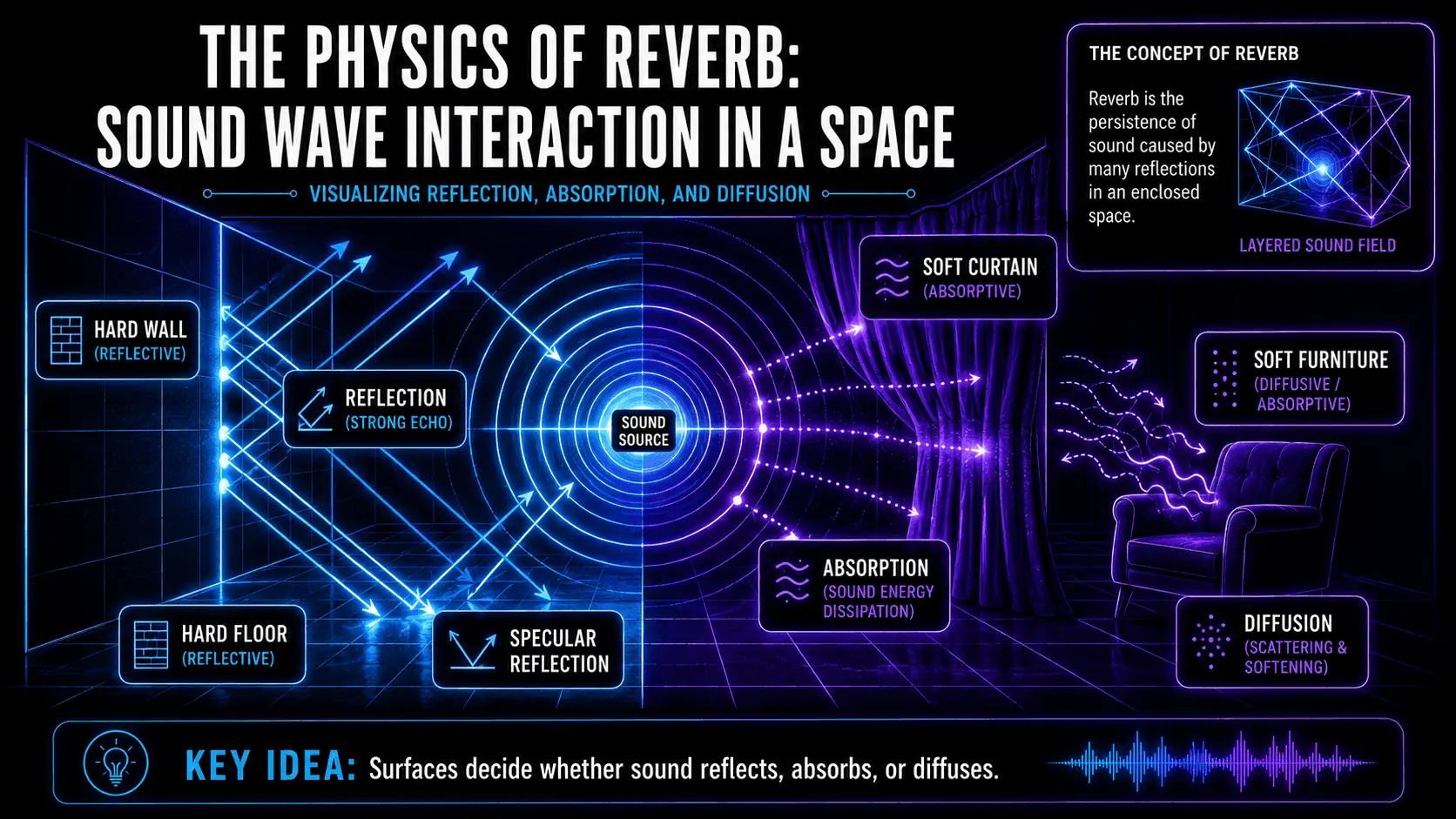
Infographic explaining the physics of reverb, showing sound wave reflections, absorption, diffusion, hard surfaces, curtains, and furniture in a room.
How reverb forms as sound waves reflect, absorb, and diffuse through a space.

In production, reverb becomes a design tool. You can keep a vocal dry and intimate, add a subtle room for realism, or wash a chorus in a longer hall to make it feel wider and more emotional. Most importantly: reverb changes where a sound appears to sit – up close, mid-depth, or far back.

A practical way to think about reverb

Reverb answers questions like:

  • Where is this instrument placed in the depth of the mix?
  • How “big” is the world of the song?
  • Is this performance intimate, cinematic, nostalgic, airy, or distant?
  • Do separate takes feel like they share the same room?

What does reverb sound like?

Reverb sounds like a sound continuing after it stops – not as a clear repeat, but as a fading “field” around it. The same vocal line can feel:

  • Tight and real (short room) – like a singer in a booth or small studio
  • Smooth and lush (hall) – sustained, blended, emotional
  • Huge and cinematic (large space) – dramatic tail, wider sense of distance
  • Distant and washed (too much) – transients soften, lyrics blur, groove feels slower
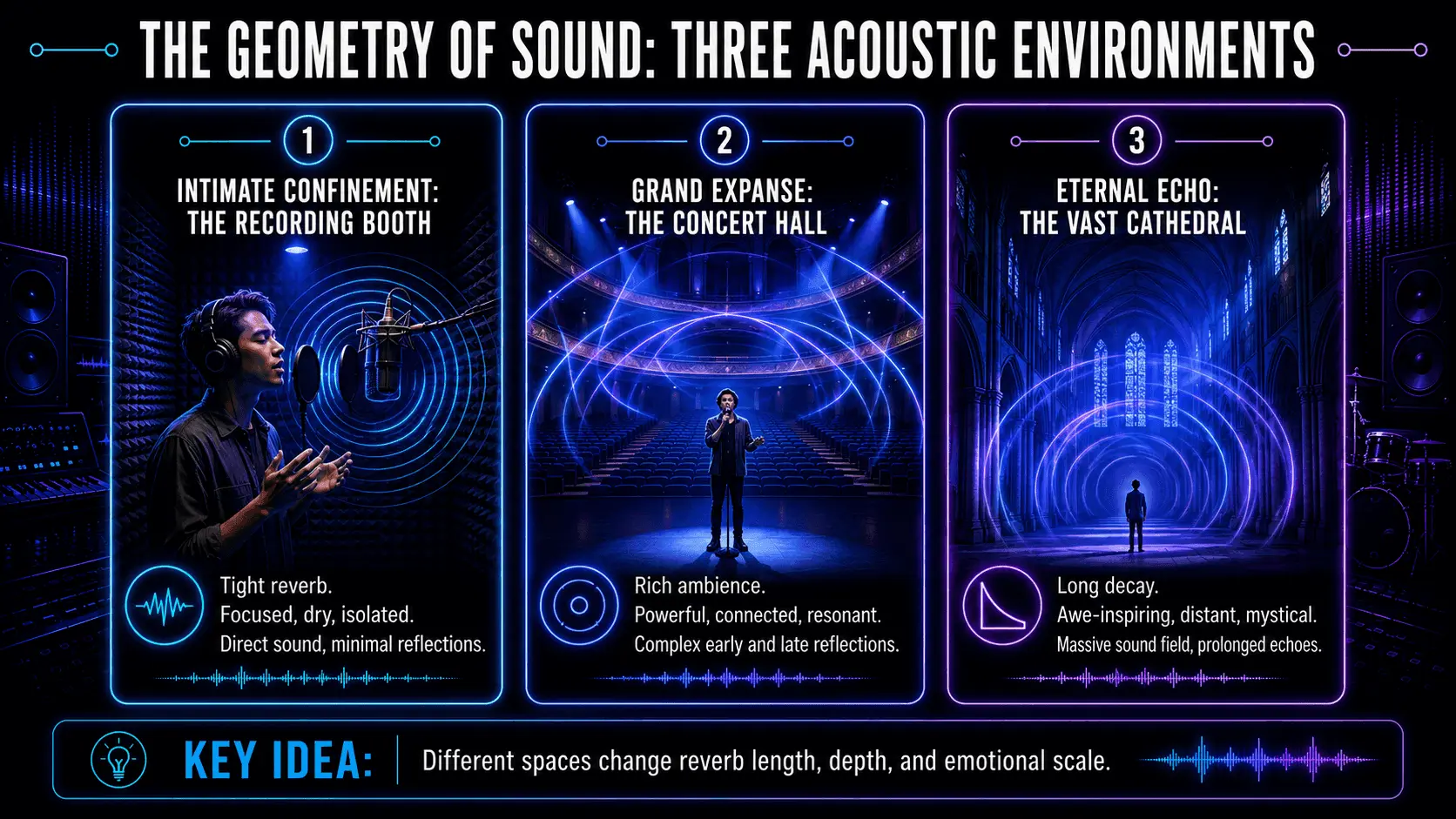
Infographic comparing recording booth, concert hall, and cathedral acoustics with different reverb and reflection characteristics.
Different acoustic environments shape sound through tight reverb, rich ambience, and long echo decay.

A good ear-training trick is to focus on what changed, not whether it sounds “pretty.”

A listening test that actually works

Take a dry vocal phrase. Add reverb. Then mute the reverb return and ask:

  1. Distance – did the vocal move backwards?
  2. Size – did the track suddenly feel like it has walls?
  3. Tail – are word endings overlapping the next phrase?
  4. Clarity – do consonants (t, k, s) still read clearly?

If the answer is “it just sounds nicer,” you’re still treating reverb like decoration. If the answer is “it changed depth and emotion,” you’re using it like a mix tool.

How does reverb work?

Reverb happens in stages:

  1. Early reflections – the first bounces, arriving quickly after the direct sound. These give your ear clues about size and shape.
  2. Late reflections (tail) – the dense build-up that continues after the early reflections. This creates the decay you perceive as reverb length.

In a physical room, that’s acoustics. In a mix, it’s either captured or simulated. The important part is that reverb is time-based: it occupies time, frequency, and stereo space. That’s why it’s so powerful and so easy to overuse.

Why “pre-delay” changes everything (in general)

Many reverbs include pre-delay – a short gap before the reverb starts. That single detail can keep a lead vocal clear while still sounding huge. The direct signal arrives first (so lyrics stay readable), then the space blooms behind it.
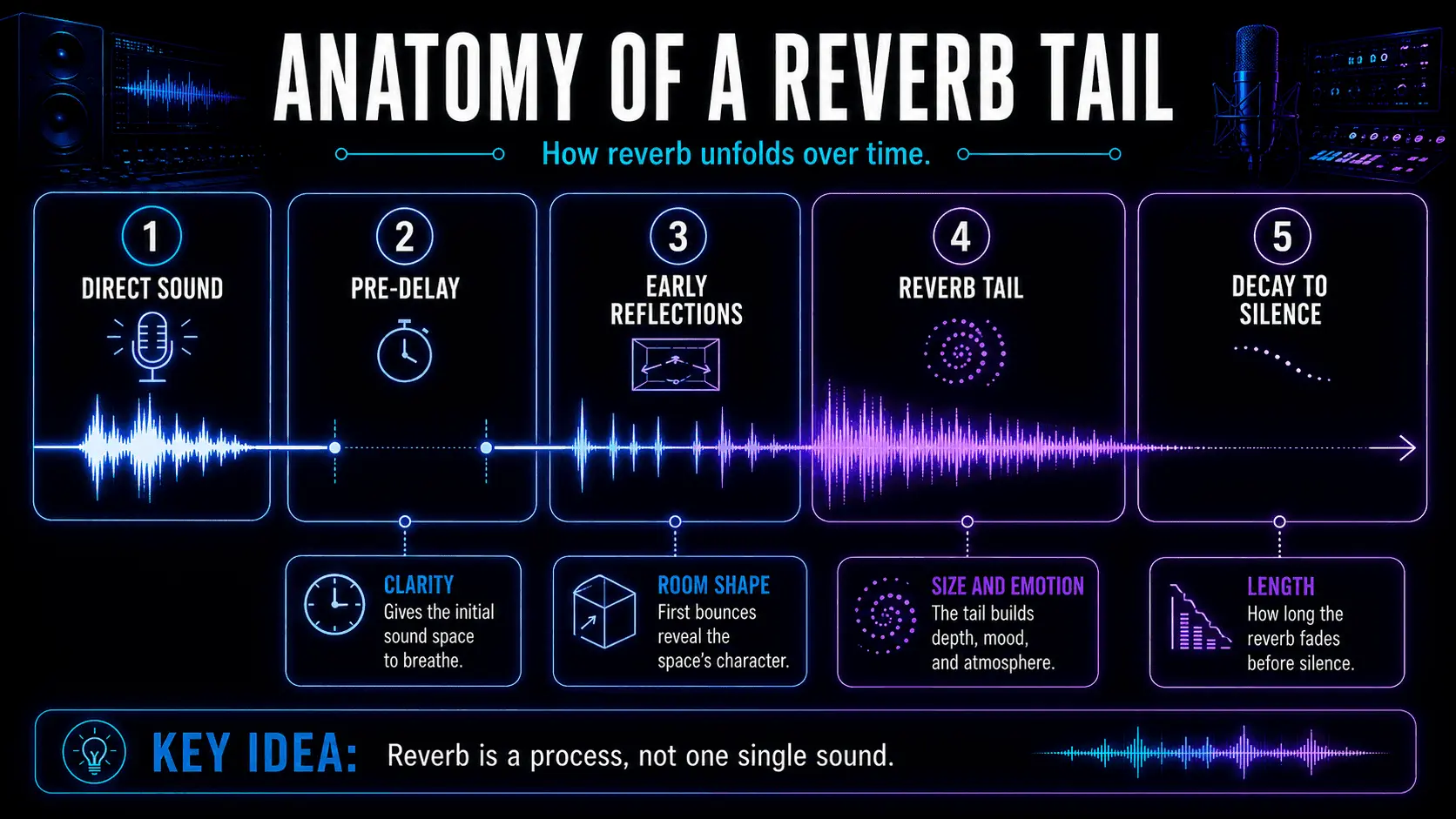
Infographic showing direct sound, pre-delay, early reflections, reverb tail, and decay to silence.
How direct sound develops into reflections, decay, and a complete reverb tail.

Reverb interacts with tempo and arrangement

A long decay that feels gorgeous on a slow ballad can turn a fast verse into mush. The more rhythmic and dense your arrangement is, the shorter and tighter your reverbs often need to be.

What’s really happening in a mix

Reverb competes for:

  • Low-mids (where mud builds quickly)
  • Stereo width (reverb spreads)
  • Forward focus (too much pushes things back)

So a good reverb isn’t “add it and forget it.” It’s selecting the space, then shaping it so the performance stays in control.

What does reverb do in music production?

Reverb has three main jobs:

  1. Depth – placing sounds front-to-back
  2. Cohesion – making separate recordings feel like they belong together
  3. Emotion – shaping the listener’s sense of intimacy, distance, and mood

In a vocal-heavy production, reverb decisions are basically arrangement decisions. A dry lead can feel vulnerable and direct. A longer tail can feel cinematic and “bigger than life.” A shared room on backing vocals can glue stacks together. Separate spaces can create layering: lead up front, harmonies behind.

This is especially relevant if you’re building harmonies or choral textures in ACE Studio. Since ACE Studio can generate vocals from MIDI and lyrics, you can write clean harmonic movement, then decide how much space the stack needs to feel unified. That’s a big advantage: your harmony is already precise, so you can use reverb for depth and emotion, not to hide instability.

Reverb vs delay: what’s the difference?
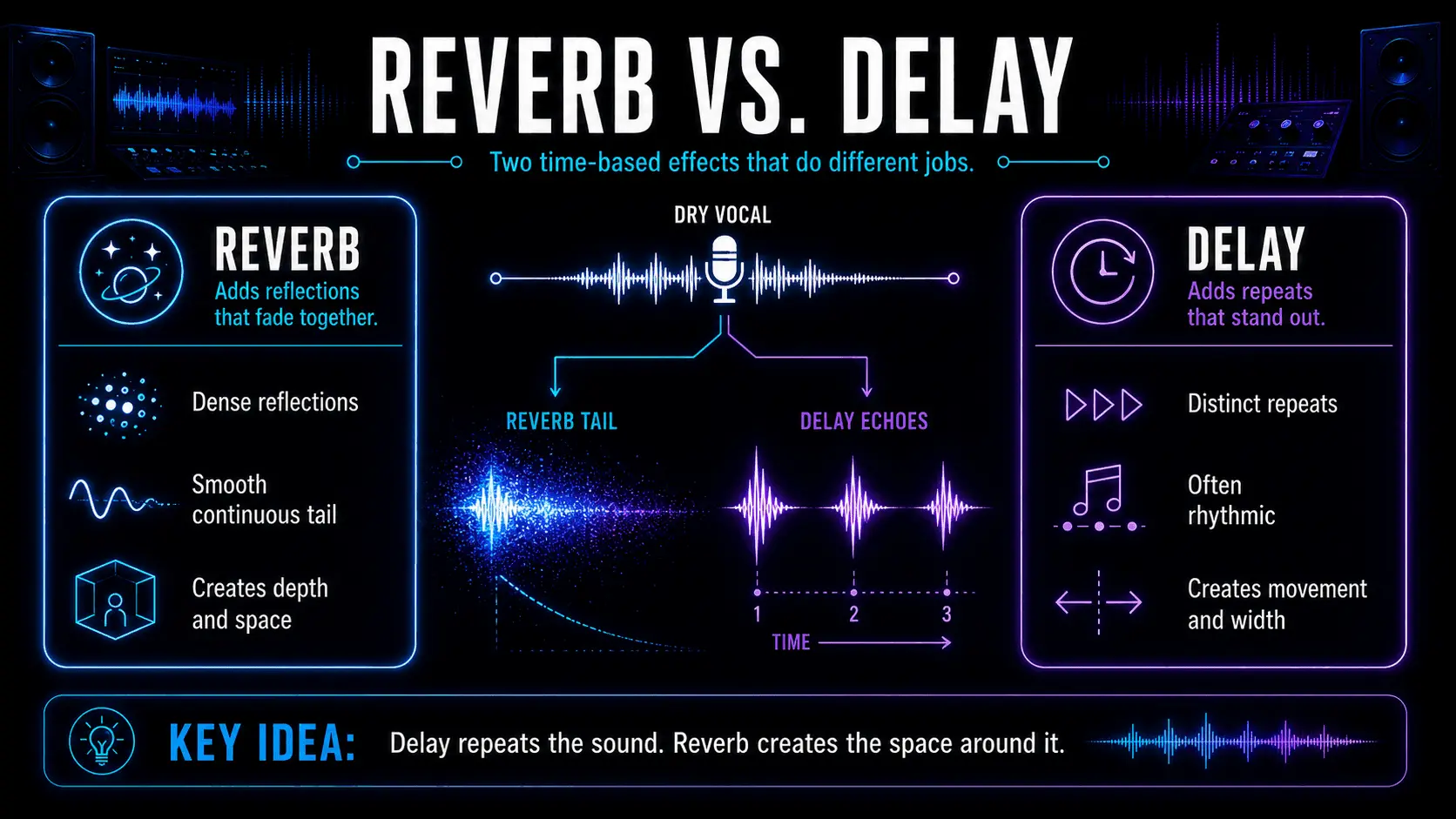
Comparison of reverb’s smooth reflection tail and delay’s separate repeating echoes.
Reverb creates continuous space, while delay produces distinct rhythmic repeats.

Delay is repeatable reflections – you hear distinct repeats (often rhythmic). Reverb is dense reflections – a continuous tail. In modern vocal mixes, a common approach is:

  • delay for rhythmic width and movement
  • reverb for depth and realism

When reverb helps (and when it hurts)

Reverb helps when you want:

  • a believable environment
  • glue across layers
  • a softer, more blended performance
  • a chorus to open up emotionally

Reverb hurts when:

  • transients lose punch
  • low-mids build up
  • lyrics blur
  • tails overlap fast phrases

A simple rule: if you’re unsure, lower the wet level first, then shorten the decay, then filter the return. The best reverb usually supports the mix quietly.

Types of reverb (and what they’re best for)

Different reverbs are different behaviors, not just different “colors.” Here’s how producers usually think about them:
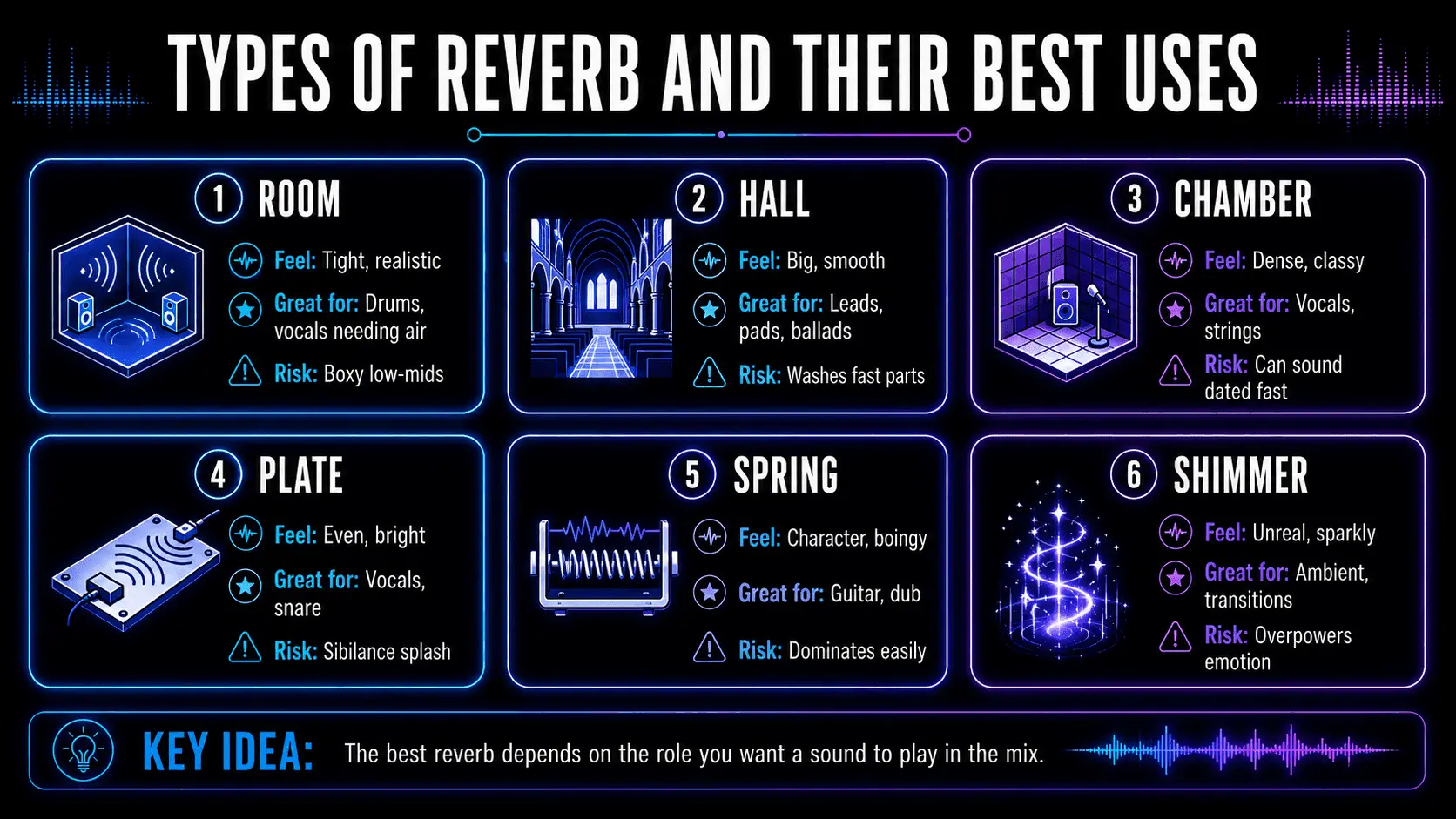
Infographic showing six types of reverb and their best uses, including room, hall, chamber, plate, spring, and shimmer reverb.
Different reverb types shape space and mood, from tight room reflections to large halls, bright plates, and dreamy shimmer.

A practical shortcut inside ACE Studio

If you don’t want to dive into a long plugin menu while you’re writing or arranging, ACE Studio’s Reverb preset selector gives you four clear spaces: Room, Hall, Church, Cinematic. Those aren’t “types” in the traditional engineering sense (plate vs spring), but they map cleanly to what your ear needs to decide early:

  • Room – realism and closeness
  • Hall – lush blend and length
  • Church – long tail and strong depth cue
  • Cinematic – exaggerated size for dramatic moments

Use the presets to decide the role of reverb in the song, then refine later if needed.

Where the choir-specific Room Effect fits

When you’re building choir sections, you often want something more physical than a generic reverb tail. ACE Studio’s Room Effect is a specialized reverb for Singer Tracks that simulates placing virtual singers in a recording space – not just adding tail, but controlling perceived position and room size.
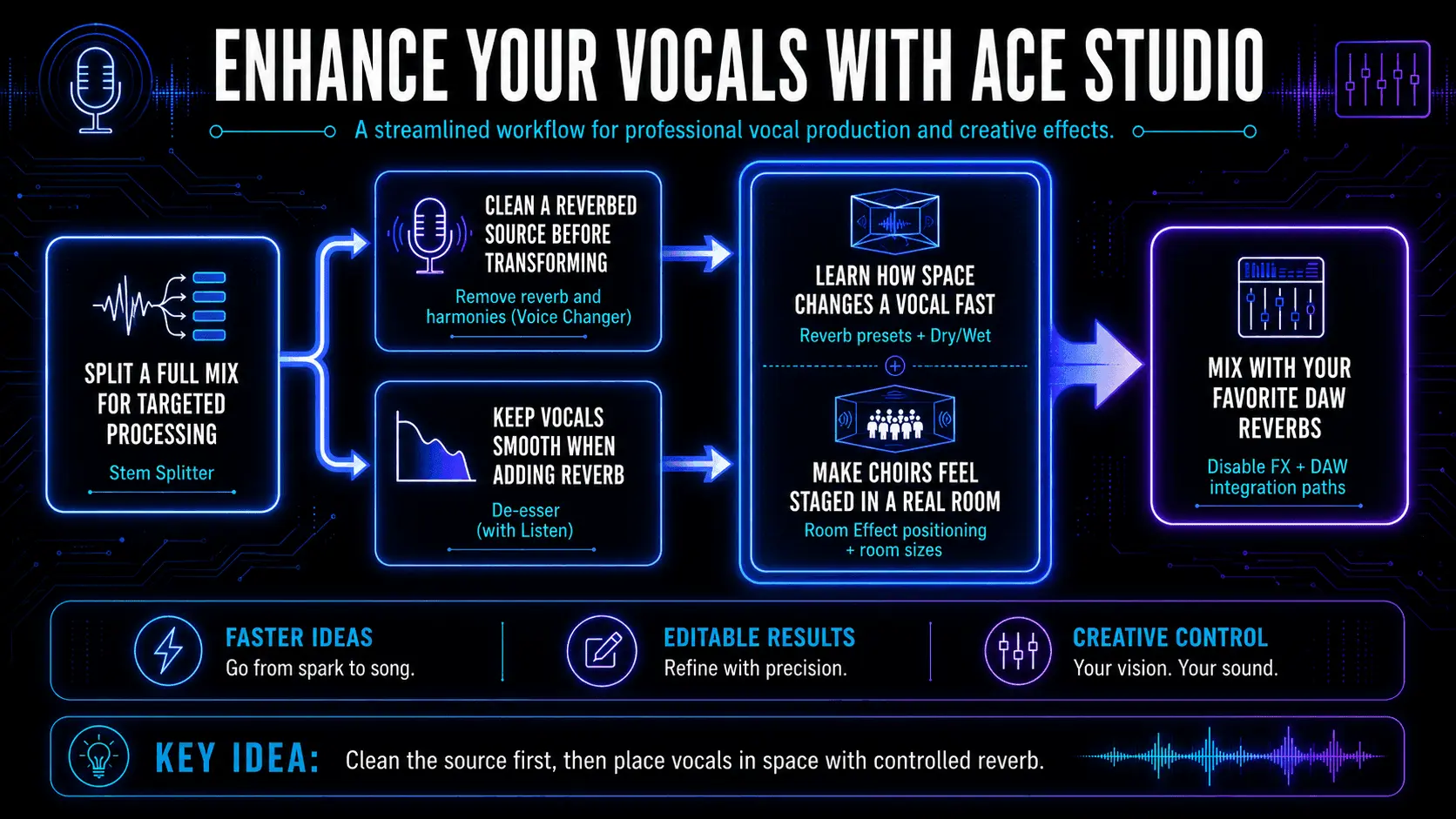
Infographic showing ACE Studio vocal workflow with stem splitting, reverb removal, de-essing, reverb presets, choir room effects, and DAW integration.
A vocal production workflow in ACE Studio for splitting stems, cleaning vocals, shaping space, and mixing with DAW reverbs.

Digital reverb vs real reverb

Real reverb is what happens in physical spaces: rooms, halls, chambers. Digital reverb is how we recreate or simulate those spaces in a mix. Neither is automatically better. What matters is whether the reverb supports the performance and arrangement. In production, you’ll usually run into two digital approaches.
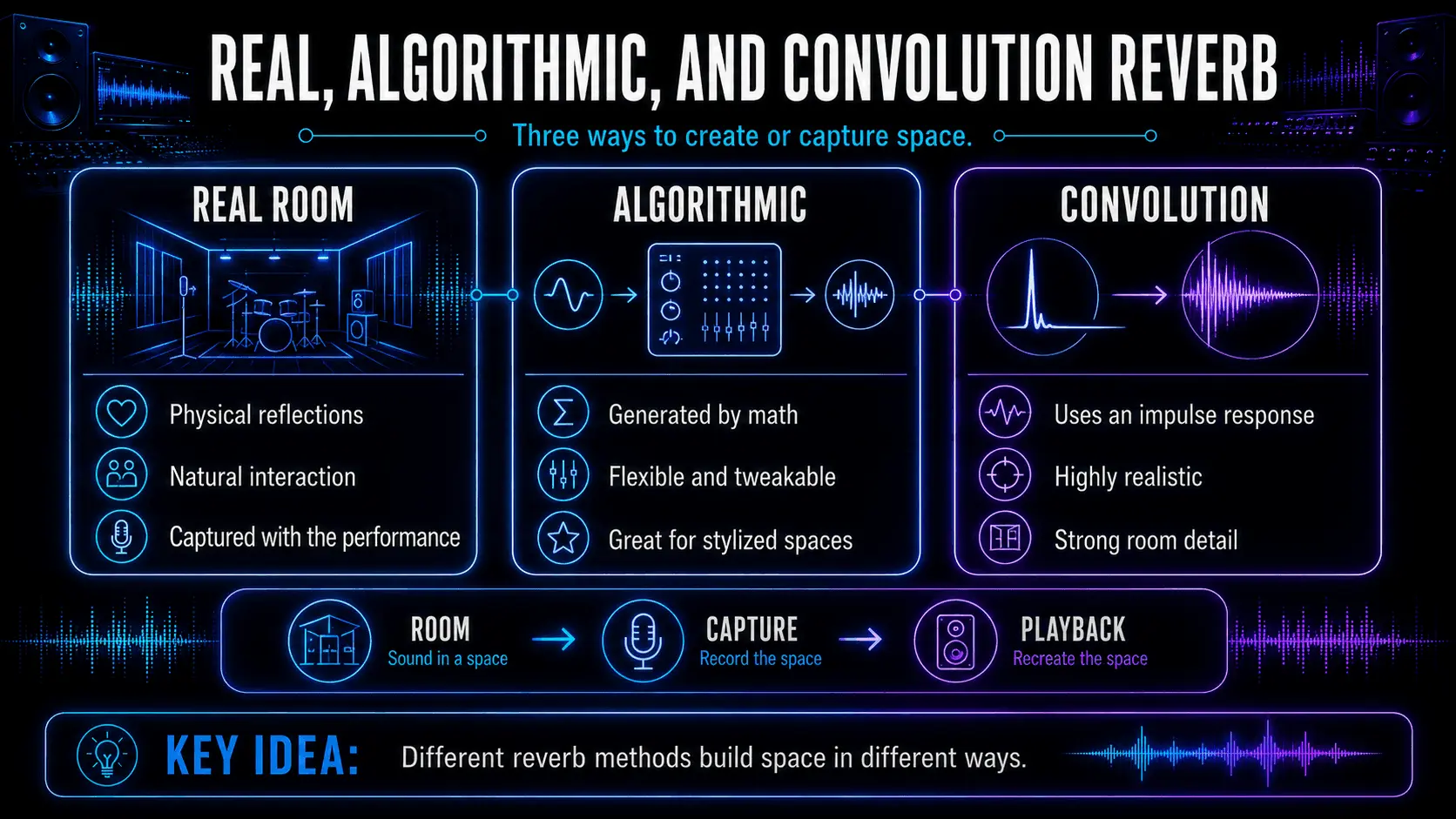
Infographic comparing real room, algorithmic, and convolution reverb production methods.
Three different approaches to capturing, generating, and recreating acoustic spaces.

Algorithmic reverb

Algorithmic reverbs are built from math – they synthesize reflections and tails. They’re flexible and tweakable, and often great for musical or stylized spaces.

Convolution reverb

Convolution reverbs use impulse responses (IRs) – snapshots of real rooms or hardware. They can sound extremely realistic, especially for early reflections and room tone.

Plugins vs hardware vs real rooms

  • Plugins: recallable, flexible, quick to audition
  • Hardware: character, sometimes a unique depth
  • Real rooms: unbeatable realism if recorded well, but you commit to it

Where ACE Studio fits in a modern workflow

ACE Studio is useful because you can do both:

  • keep things simple with built-in Reverb presets and Dry/Wet while writing and arranging
  • or treat space as a mixing decision and move to your DAW via ACE Bridge 2 integration or exports

And for choirs, the Room Effect gives you a more “real-world” approach: you can set a studio room (8m × 8m), choir hall (16m × 16m), or church (30m × 30m) and drag singer positions for depth and mic distance cues.

Reverb controls explained

Most reverbs share a core set of controls. Learning them turns reverb from a preset gamble into a deliberate tool.
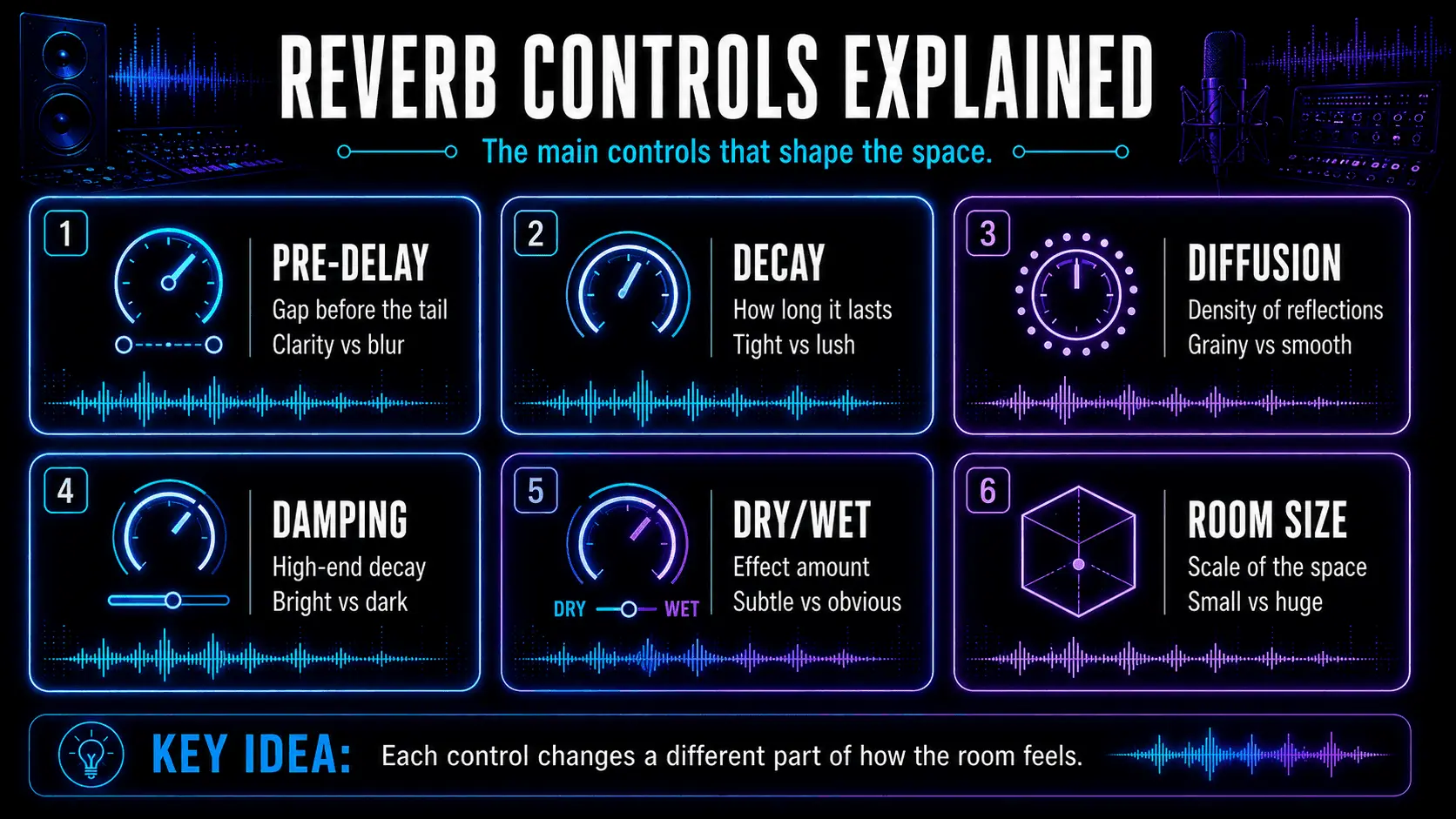
ControlWhat It ChangesWhat You Hear
Pre-DelayGap Before Reverb StartsClarity vs Blur
Decay (RT60)How Long Tail LastsTight vs Lush
DiffusionDensity of ReflectionsSmooth vs Grainy
DampingHigh-End DecayBright vs Dark
Wet/DryEffect LevelSubtle vs Obvious
Six reverb controls showing pre-delay, decay, diffusion, damping, dry/wet, and room size.
The essential controls that determine reverb clarity, size, tone, and intensity.

The ACE Studio version: keep it simple, keep it honest

In ACE Studio’s built-in Reverb, you get two primary controls:

  • Preset Selector (Room, Hall, Church, Cinematic)
  • Dry/Wet balance

That simplicity is actually a strength while arranging vocals. It forces you to answer the important questions first: How big is the space? How far back should this part feel? Then you can decide whether you need more detailed controls later.

De-ess before reverb (this is not optional on modern vocals)

Reverb exaggerates sibilance. If “s” and “t” splash into the tail, your vocal can feel harsh even when the dry track is fine. ACE Studio includes a De-esser as part of Basic Effects, and it even has a Listen function to audition what it’s removing so you can set it precisely. De-ess first, then add space. You’ll often use less reverb and get more clarity.

How to use reverb in a mix

Reverb works best when you treat it like an arrangement choice, not a finishing polish. A reliable approach is:

  1. Pick one main space for cohesion (often a short room).
  2. Add one feature space for emotion (plate or hall style behavior).
  3. Filter and balance so the reverb supports, not smothers.

If you’re building vocal stacks or choirs, you also want consistency: multiple takes feel more convincing when they share a common “room,” even if the lead stays drier.
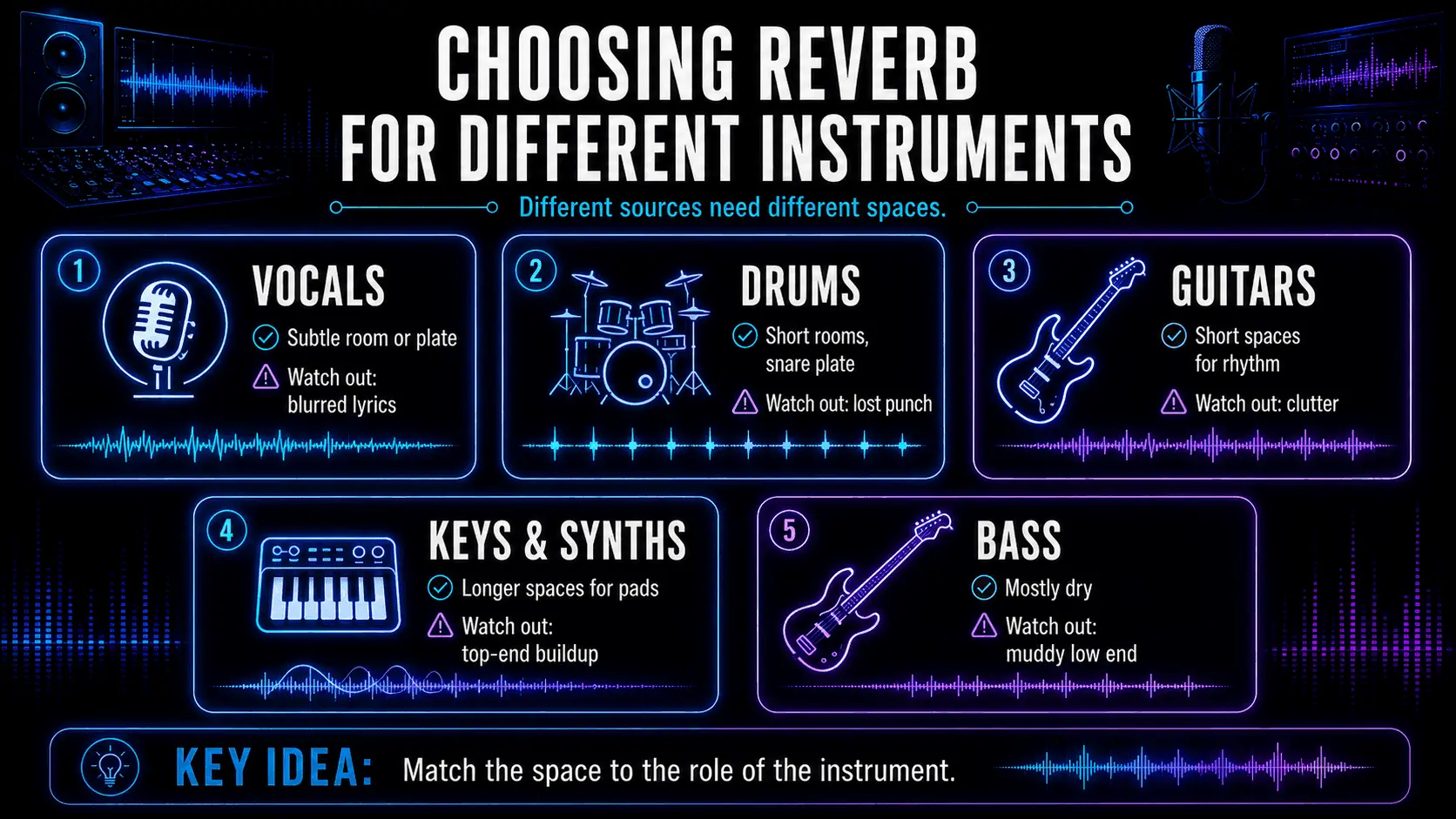
Infographic recommending reverb settings and warning risks for five instrument groups.
Practical reverb choices for vocals, drums, guitars, keyboards, synths, and bass.

Reverb on vocals

Start subtle. If you can clearly “hear the reverb” in the verse, it’s probably too loud.

  • Keep wet low until the vocal feels placed.
  • Use darker tails if the track is bright.
  • Automate bigger reverb moments at phrase endings.

ACE Studio advantage for vocal stacks: you can generate harmonies from MIDI and lyrics, then shape space quickly with built-in Reverb and Dry/Wet while you’re still composing.

ACE Studio advantage for choirs: enable the choir-focused Room Effect and literally place voices in a virtual room by dragging their positions, choosing the room size (8m × 8m studio room, 16m × 16m choir hall, 30m × 30m church). That turns “reverb” into staging: closer singers feel intimate, farther singers feel like they’re behind the lead.

Reverb on drums

Short rooms can add realism. Plates can add snare sustain. Longer tails can soften punch.

  • Keep the kick mostly dry (or filter reverb aggressively).
  • If the groove loses impact, shorten the space.

Reverb on guitars, keys, and synths

These sources already sustain, so reverb stacks quickly.

  • Shorter spaces for rhythmic parts.
  • Longer spaces for pads and transitions.
  • Consider darker reverbs to avoid harsh top build-up.

Reverb on bass

Most bass does not need reverb. If you do add it:

  • keep it extremely subtle
  • high-pass the reverb return
  • aim for “air,” not tail

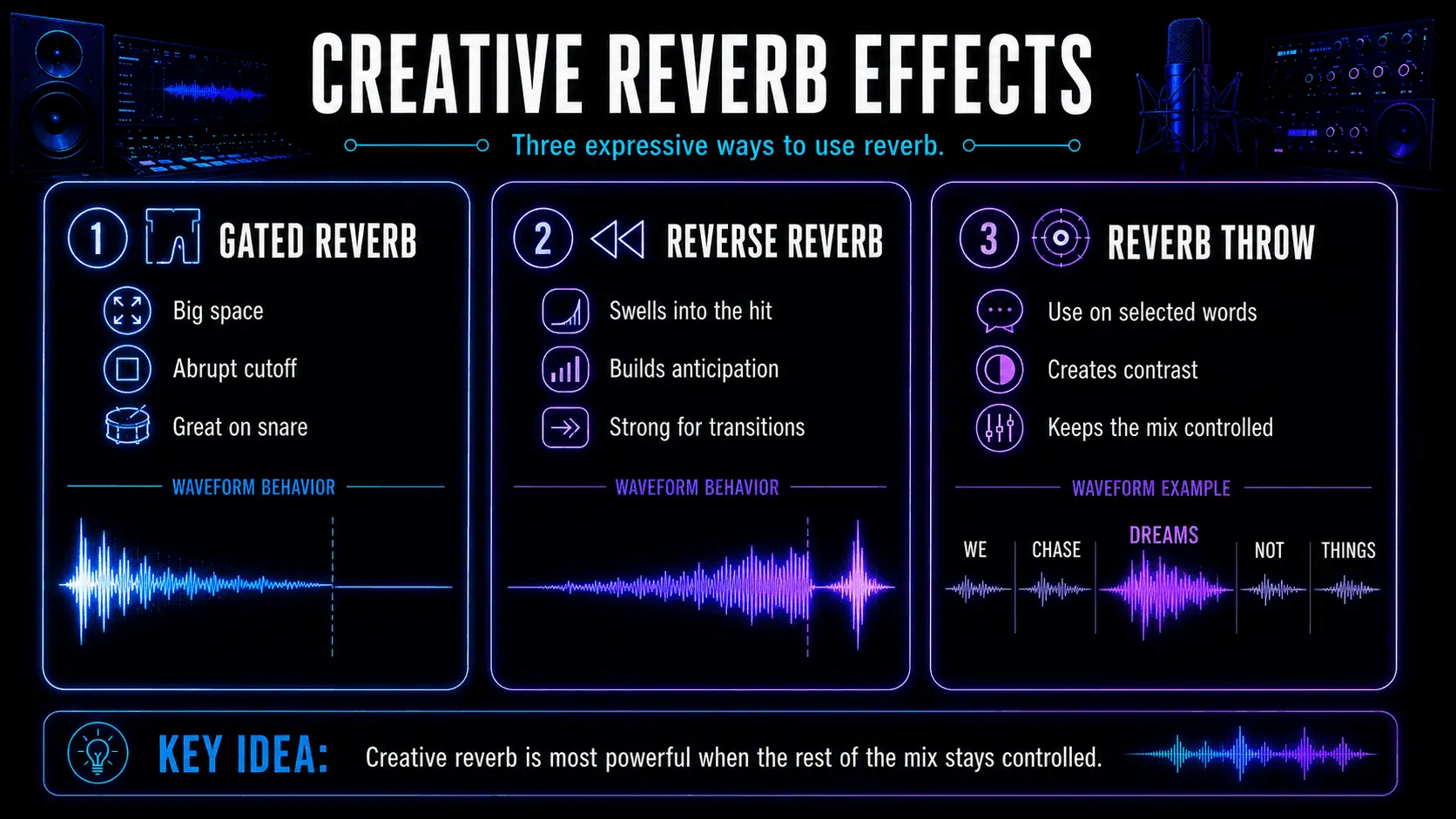
Using reverb as an effect

Use contrast. A dramatic reverb throw works because the rest of the track stays controlled.

And if you prefer mixing all effects in your DAW, ACE Studio can still fit cleanly: you can integrate with your DAW using the ACE Bridge plugin (real-time syncing and drag-and-drop transfers are specifically called out in documentation-style content).

Infographic showing gated reverb, reverse reverb, and selective reverb throw waveforms.
Gated, reverse, and throw effects turn reverb into a creative production tool.

Gated reverb

Big reverb that cuts off abruptly. Punchy on snares and toms.

Use it when you want size without wash:

  • bright, short-ish reverb feeding a gate
  • release timed to the groove

Reverse reverb

A swell that rises into the sound. Great for transitions, lead-ins, and vocal spotlights.

Workflow conceptually:

  1. print a reverb tail
  2. reverse it
  3. fade it into the hit

Use it sparingly. Reverse reverb is strongest when it’s clearly a moment, not constant texture.

Common reverb mistakes (and fixes)

Reverb problems usually come from three things: too much level, too long decay, or too much low-mid energy.
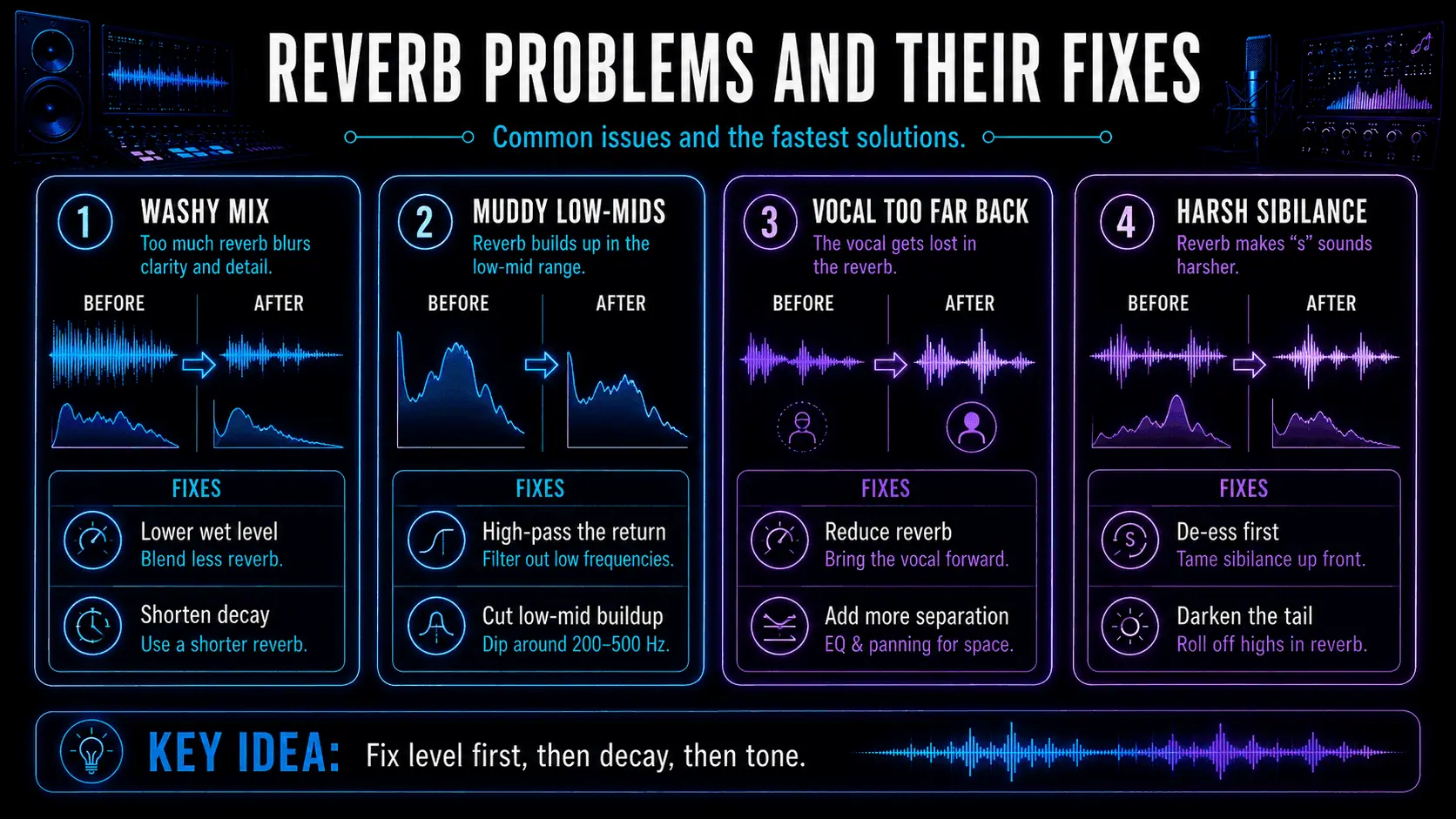
Reverb troubleshooting infographic with fixes for wash, low-mid mud, distance, and sibilance.
Quick solutions for washed-out mixes, muddiness, distant vocals, and harsh sibilance.

Too much reverb (washy mix)

Symptoms: vocals feel far away, drums lose punch, lyrics blur.

Fixes:

  • lower wet level first
  • shorten decay
  • darken or filter the return
  • automate: less in verses, more in choruses

ACE Studio quick fix: cycle reverb presets and keep Dry/Wet conservative. If you need extra control later, you can keep composing with built-in FX, then switch to your DAW.

Muddy low end

Symptoms: cloudiness around low-mids, reduced vocal clarity.

Fixes:

  • high-pass the reverb return
  • cut low-mids on the return
  • choose darker spaces

Pushing sounds too far back

Symptoms: lead disappears behind instrumentation.

Fixes:

  • reduce wet level
  • increase separation (conceptually: pre-delay, early reflection control)
  • use delay for width instead of more reverb

ACE Studio's option for external mixing: if you want to avoid committing to built-in effects, ACE Studio explicitly supports disabling built-in FX via a “Disable FX” button in the Track Control Panel (so you can process elsewhere).

Neon recording studio with a mixing console, speakers, and cyan-to-violet sound waves.
Sound waves transform a modern studio into a responsive three-dimensional acoustic space.

Reverb for post-production (film, dialogue, podcasts)

In post, reverb is realism, not vibe. If dialogue doesn’t match the room, it feels wrong immediately.

Matching room tone and space

You’re trying to keep a consistent environment across cuts:

  • short, believable room reflections
  • minimal tails
  • careful EQ so speech stays intelligible

When to use subtle reverb

Spoken word can tolerate very little reverb before clarity drops. A tiny ambience can reduce the “dry booth” feel, but tails can make edits obvious.

ACE Studio note for creators working from full mixes: if you start with a full song file and need cleaner elements, ACE Studio includes a Stem Splitter that can separate a full mix into components like vocals, drums, bass, and other instruments. That can be useful before you try to match ambience or clean up a vocal for a new context.

Can you remove reverbs from audio?

Sometimes. But there’s a difference between “reduce” and “erase.” If reverb is baked into a recording, removal tools can help, but they often introduce artifacts. A practical expectation is:

  • reduce room sound enough to regain clarity
  • then add a controlled, intentional space that fits the mix

If the original reverb is heavy, the best result is often a compromise: less reverb, not zero reverb.

ACE Studio advantage for cleanup before transformation: in the Voice Changer settings, ACE Studio includes a checkbox to “Remove reverb and harmonies” from the source content before conversion. This is especially useful if you’re converting a vocal that already has room sound or stacked layers and you want a cleaner starting point.

Pair that with Stem Splitter (when you only have the full mix) and you can often get to a cleaner vocal foundation faster than doing everything manually.

Where ACE Studio fits without forcing a “one-place” workflow

ACE Studio can be your vocal and harmony creation environment, then you decide where final mixing happens:

  • Use built-in Reverb presets and Dry/Wet for quick placement while arranging
  • If you want your favorite third-party reverbs, disable built-in FX and process in your DAW
  • For DAW integration, ACE Studio supports ACE Bridge 2 (install/uninstall, reinstall, update notifications are explicitly referenced in settings documentation).

Also, ACE Studio’s broader ecosystem explicitly supports syncing with a DAW using the ACE Bridge plugin for workflow continuity (especially when your mix is already living in a DAW).

Frequently Asked Questions 

Is reverb an echo?

Not exactly. Echo is a repeat you can count. Reverb is a dense field of reflections that blends into a continuous tail.

How much reverb should I use?

Enough that the track has depth, not so much that clarity drops. A good habit: set it, then pull it down until you barely miss it, then bring it up slightly.

If you’re learning, use a simple tool: pick a space and set a low wet amount. ACE Studio’s Dry/Wet explanation is very literal: 10% wet means the final sound is 90% dry and 10% reverb – that’s a useful mental anchor when you’re avoiding wash.

What reverb is best for vocals?

Short rooms and smooth reverbs tend to work well. The key is keeping consonants readable and controlling the tail.

What are good beginner reverb settings?

Start with:

  • a short room or moderate hall
  • low wet level
  • darker tails if the mix is bright

Then adjust based on tempo and arrangement density.

What’s the difference between Room and Hall reverb?

Room is tight and realistic. Hall is longer and smoother, creating more depth and emotion. In ACE Studio’s simplified preset world, the same idea applies when you switch between Room and Hall: you’re choosing closeness vs blend and tail length.

Maxine Zhang
Written by
Maxine Zhang
Maxine Zhang is Head of Operations at ACE Studio, where she bridges AI technology and creative music applications. With deep expertise in user experience and product development, she champions the needs of musicians in the age of AI.
View full profile →