
Key Takeaways
- The snare drum is a central rhythmic element across rock, jazz, marching music, hip-hop, trap, and electronic music, shaping each track’s groove, energy, and identity.
- Learning snare notation helps musicians understand timing, subdivisions, accents, dynamics, ghost notes, and rolls while improving communication during rehearsals and recording sessions.
- Quarter notes establish the basic pulse, while eighth and sixteenth notes introduce movement, syncopation, fills, and more expressive rhythmic possibilities.
- Effective snare practice depends on slow tempos, consistent daily sessions, relaxed technique, dynamic control, metronome work, and regularly recording performances for review.
- Producers can strengthen snare-led arrangements by adjusting timing, layering complementary sounds, preserving space in the mix, and using ACE Studio to isolate drum stems and create supporting percussion, AI instrument, and AI vocal parts.
Why the Snare Drum Defines the Groove
The snare drum has long been one of the most recognizable voices in modern rhythm. Its sharp crack, subtle ghost notes, and rolling accents can completely change how a piece of music feels. In many styles of music, the snare is far more than a supporting instrument. It often becomes the element that gives a groove its identity. From marching ensembles to jazz clubs, from rock recordings to modern trap music, the snare continues to shape the way listeners experience rhythm.
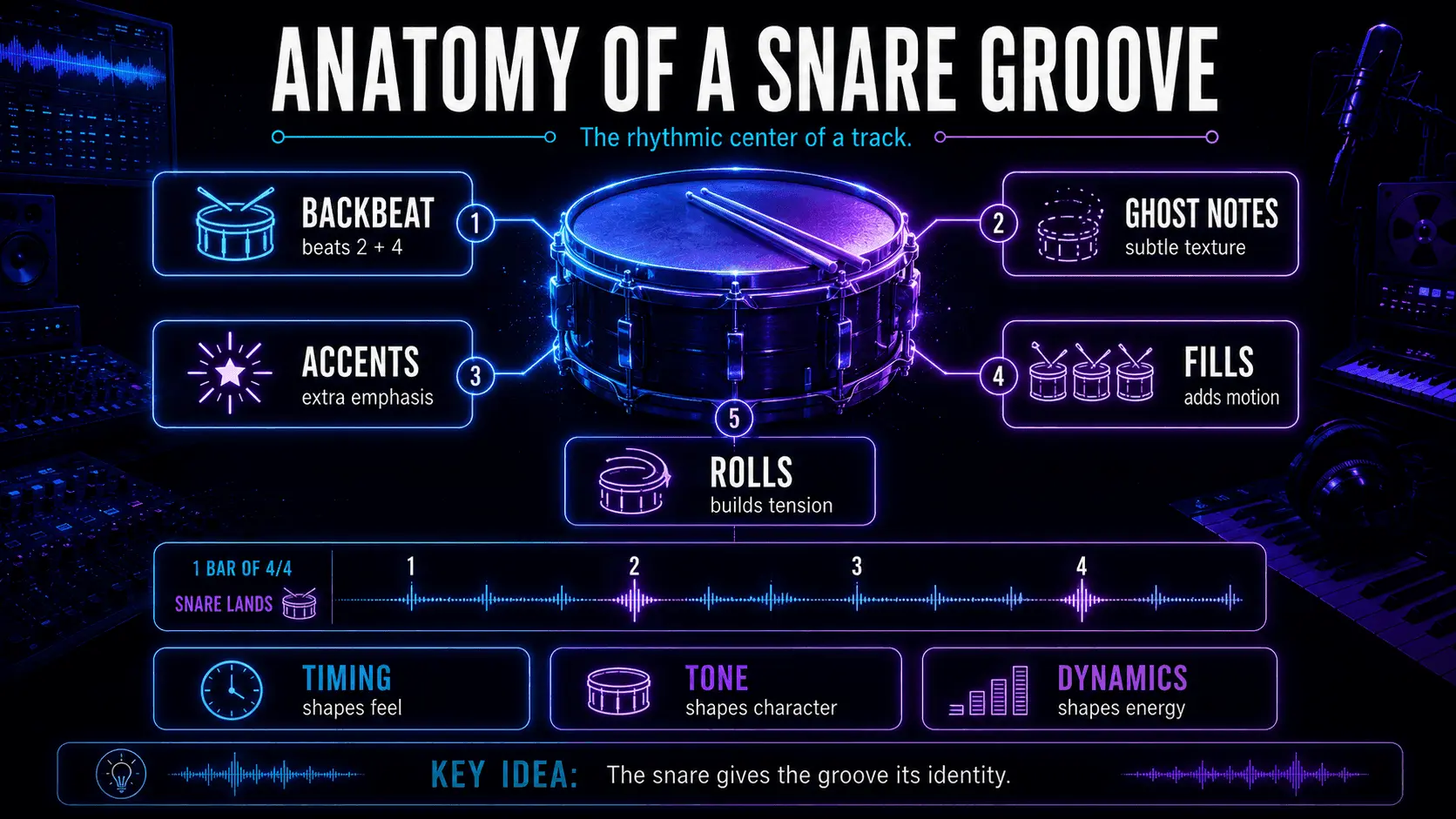
For producers building hip hop beats, drummers refining live performance, and engineers creating polished mixes, understanding snare music can transform the entire sound of a track. The snare sits in a unique place where technique, feel, and production all come together. A slightly delayed hit can create a more laid-back groove, while tighter tuning can create urgency. A layered sample can move a track from natural to futuristic in just a few seconds.
Snare music also extends into electronic music, where producers often manipulate snare sounds far beyond the acoustic instrument itself. In modern bass music, the snare may be layered with white noise, synthetic transients, or distorted textures to create a larger-than-life impact. In more intimate styles, the snare can remain soft and organic, adding warmth to an urban sound that feels more personal and human.
This guide explores how the snare works across different genres, how notation helps drummers understand rhythm, why practice matters, and how both beginners and professionals can improve their relationship with one of music’s most important instruments.
Understanding Snare Drum Music Notation
Learning snare drum notation gives musicians a deeper understanding of rhythm. Unlike melodic instruments, the snare drum focuses primarily on timing, articulation, and dynamics. Reading music for snare helps players see the structure behind what they hear, making complex rhythms easier to understand and repeat.
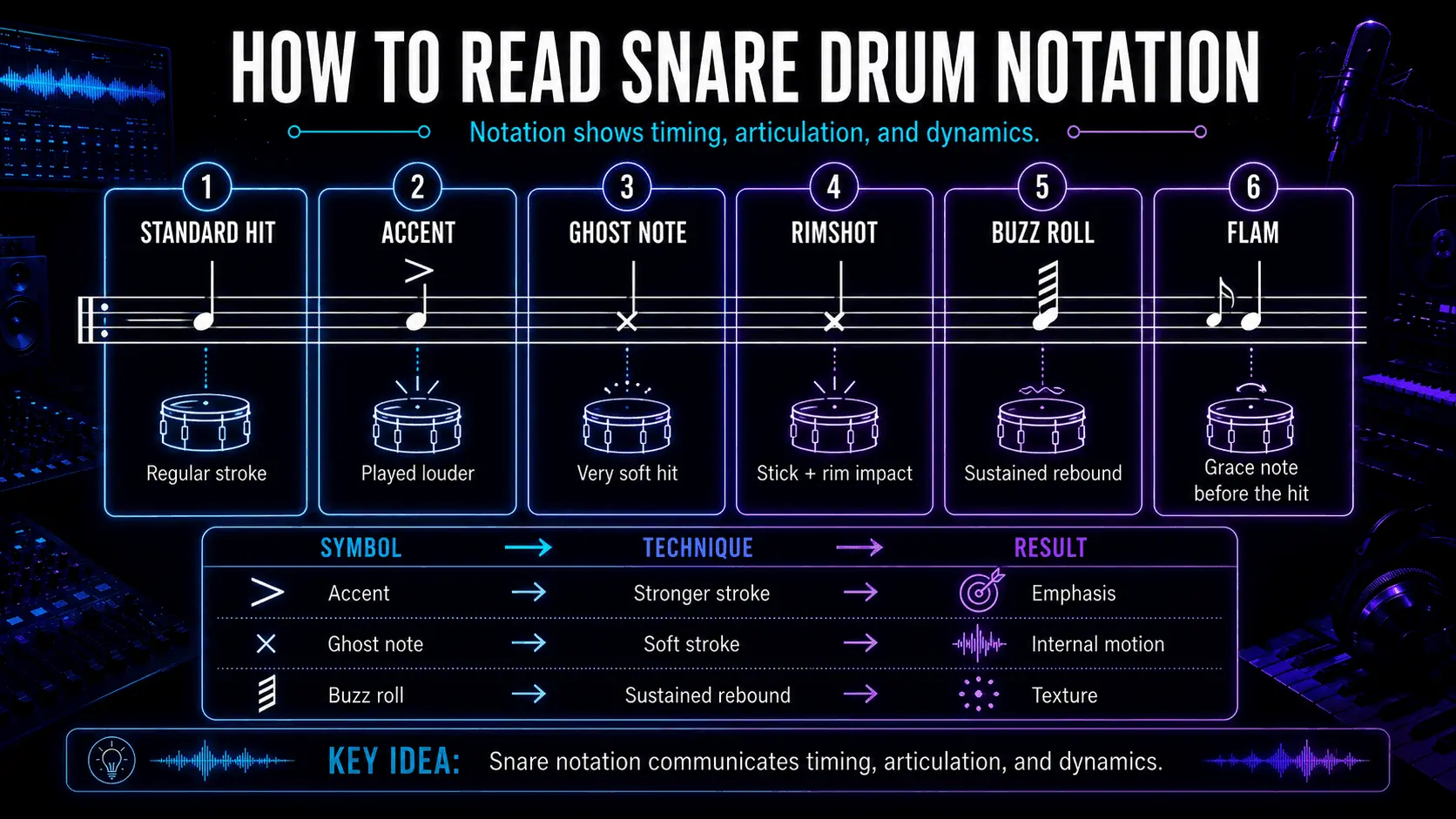
Snare notation usually appears on a five-line staff. Instead of showing pitch, the notes represent when and how the drum should be played. A standard note in the center often indicates a normal hit, while markings above or below can signal techniques such as:
- accents
- rimshots
- buzz rolls
- ghost notes
For beginners, reading notation can feel overwhelming at first. Many drummers initially rely only on listening, but over time they realize that notation reveals patterns the ear can sometimes miss.
For professionals, notation provides precision. In studio sessions, film scoring, and ensemble work, being able to interpret written rhythm quickly can save valuable time. It also allows musicians to communicate ideas more clearly. Instead of saying “play that little bounce before beat three,” a producer can point directly to the written rhythm.
The relationship between notation and percussion rhythm becomes even more important when combining live drums with programmed music. In genres like hip hop beats and electronic music, understanding rhythmic placement helps producers create grooves that feel human instead of robotic.
Quarter Notes Explained
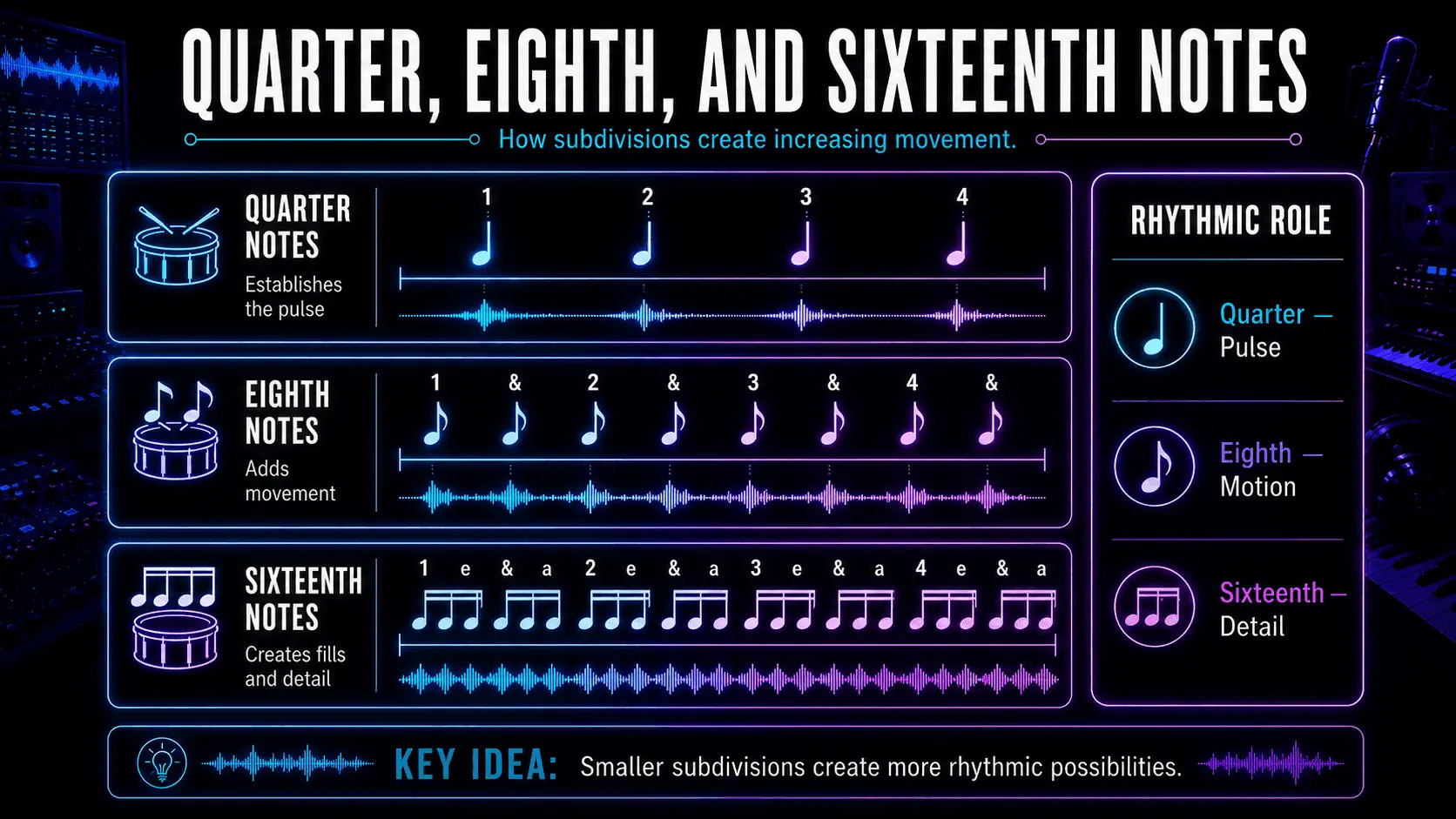
Quarter notes form the foundation of most snare rhythms. In common time, each quarter note receives one beat. These notes often define the pulse that listeners naturally follow.
When a snare lands on beats two and four in a 4/4 measure, it creates one of the most familiar grooves in popular music. This backbeat appears across:
- rock
- pop
- funk
- urban sound
Even the simplest rhythm can feel powerful when the timing is solid. Quarter notes also help drummers develop timing. Practicing them slowly with a metronome builds control and consistency, both of which become essential later when more advanced patterns are introduced.
Eighth and Sixteenth Notes
Once quarter notes feel comfortable, eighth notes and sixteenth notes open the door to more expressive rhythm.
Eighth notes divide each beat into two equal parts, while sixteenth notes divide each beat into four smaller parts. These subdivisions allow drummers to create more movement, tension and variation inside a groove.
In trap music, sixteenth-note snare fills can create excitement before a transition. In electronic music, tightly placed snare subdivisions can build anticipation before a drop. In jazz, subtle sixteenth-note ghost notes can make a groove breathe naturally.
Some musicians struggle because they can count the rhythm but cannot truly feel it. One drummer described practicing sixteenth notes mechanically for months without improvement. The breakthrough came when he started singing the rhythms aloud while playing. That helped him internalize the groove instead of simply reading it.
Experts often advise players to slow everything down. Fast rhythms only become clean when they are first mastered at slower tempos. This approach may feel repetitive, but it usually produces better results than rushing through difficult patterns.
The History of Snare Drums
The snare drum has a long history that reaches back centuries. Early versions appeared in military settings, where drummers used them to communicate commands across battlefields. The sharp sound carried farther than many other instruments.
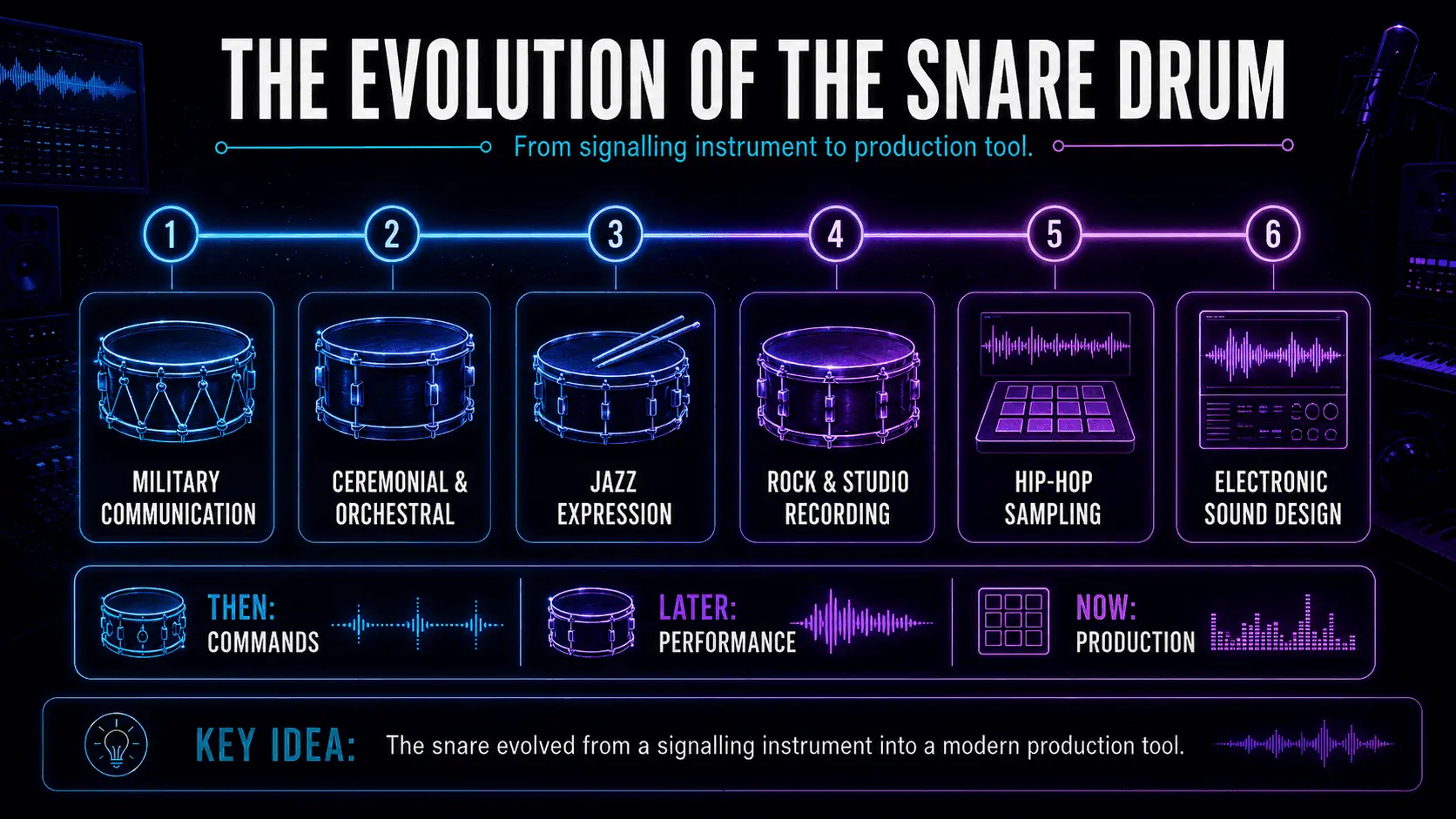
Over time, the instrument moved into orchestras and ceremonial music. It later found a place in jazz, where players expanded its expressive potential. As recording technology improved, the snare became central to studio production.
By the time modern electronic music emerged, producers began sampling acoustic snares and reshaping them digitally. What once served military communication became a defining sound in contemporary bass music and urban sound.
Today the snare exists in both physical and digital form. A drummer may tune a wooden shell for warmth, while a producer may design a snare entirely from synthesized noise. Both approaches continue the instrument’s evolution.
Why Learning to Read Music is Important for Drummers
Many drummers start by imitating what they hear. While listening is a vital skill, learning to read notation provides a deeper understanding of how music is built. Here are the primary benefits of mastering drum notation:
- Reveals Musical Structure: Notation shows exactly how rhythms fit into a measure, where accents should be placed, and how volume changes (dynamics) affect the energy of a song.
- Increases Employability: Professional session drummers are often hired because they can read charts. Being able to interpret music quickly saves time during rehearsals and expensive recording sessions.
- Improves Communication: For producers and songwriters, notation provides a precise way to communicate drum parts without guessing.
- Develops Better Beats: Understanding subdivisions and phrasing helps in beat-making and programming. It allows you to place every snare hit with intention rather than at random.
- Expands Creativity and Independence: Reading allows you to study advanced exercises and orchestral parts that you might never encounter by just listening, helping you develop a unique playing style.
Unlocking New Musical Capabilities
Once rhythm becomes visible through notation, you gain a new level of control over your performance. Musicians often describe this as unlocking a hidden skill set.
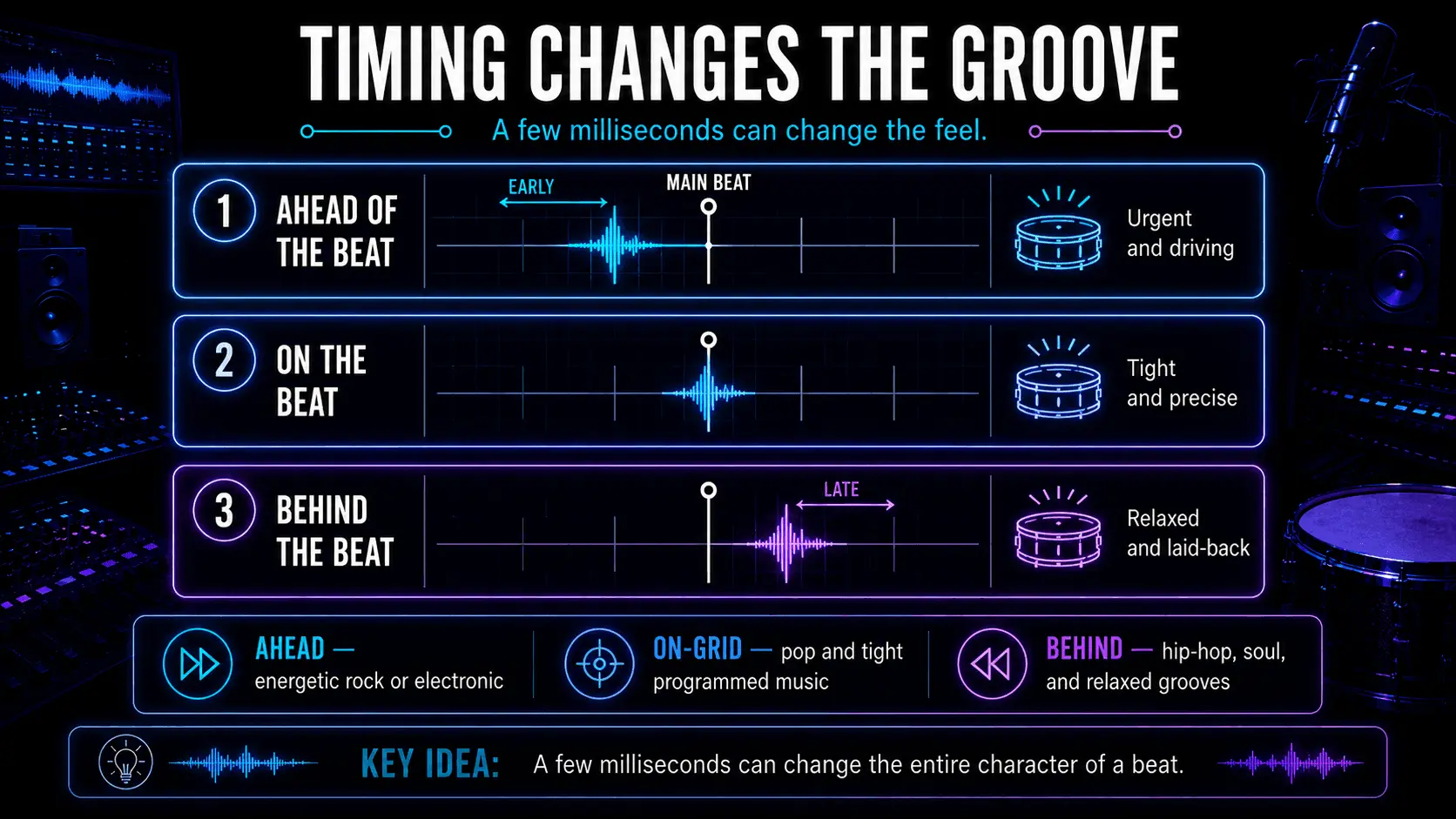
- Understanding Groove: Reading helps you identify why one beat feels heavy while another feels light. You begin to see the relationship between note placement and "feel."
- Enhancing Emotional Impact: Producers can use notation to see how a syncopated snare hit changes the listener's response. This is especially helpful in genres like bass music, where the snare must cut through heavy low-end sounds.
- Precision without Volume: You can learn how to make a snare hit feel massive through perfect timing and placement rather than just making it louder.
- Building Confidence: When you can read music, you no longer have to guess what to play. This certainty leads to better timing, more consistent performances, and stronger creative choices.
Practice Tips for Snare Drum Music
Improving your snare technique requires focused, intentional habits rather than random playing. Use these actionable strategies to see immediate results in your performance and production.
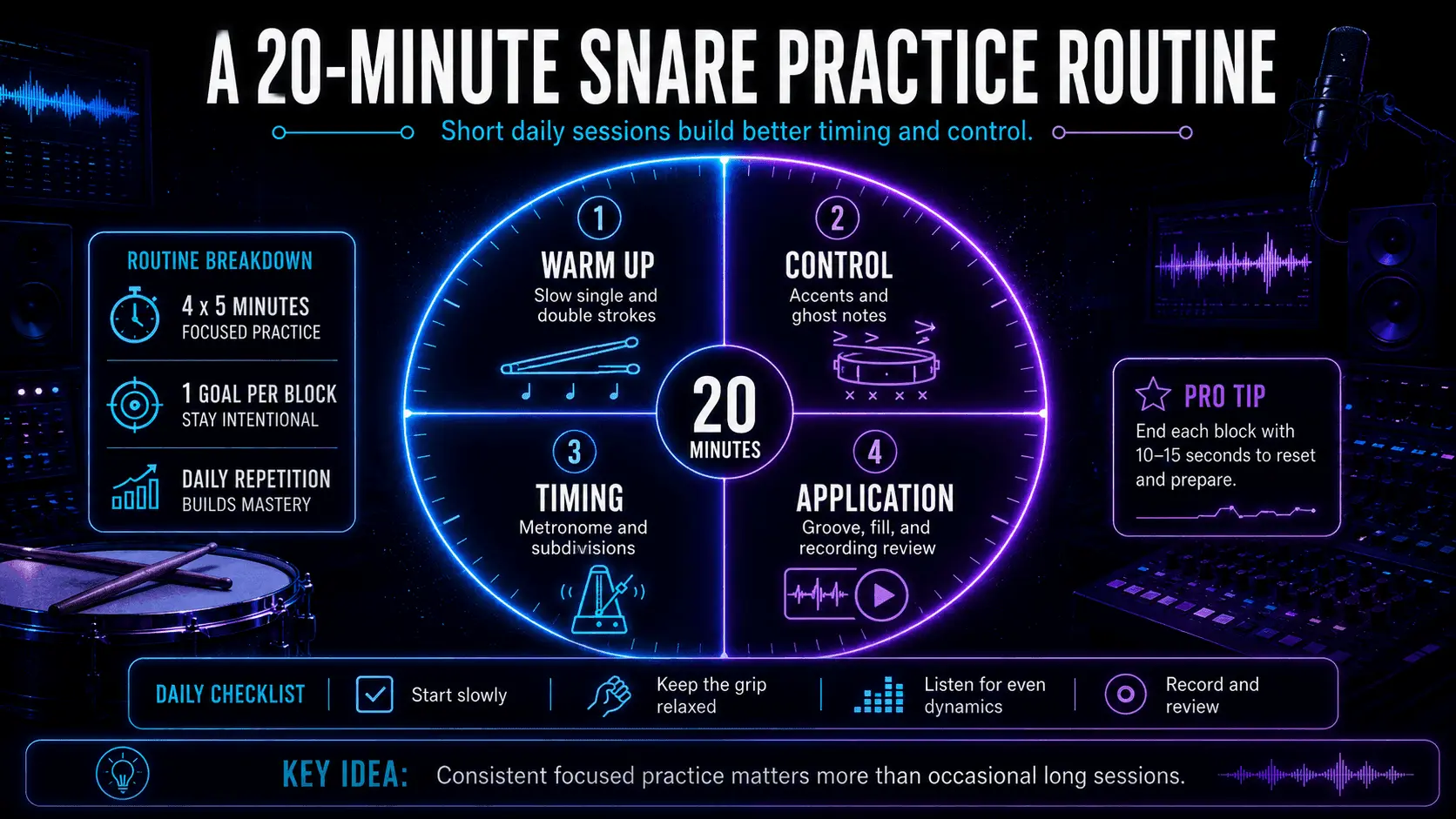
- Prioritize Consistency Over Duration: Short, daily practice sessions are more effective than occasional long ones. Dedicate 20 minutes of concentrated work every day to build muscle memory faster than a single two-hour session of distracted playing.
- Master Slow Tempos First: Practice at slow speeds to expose technical weaknesses that fast playing often hides. This makes uneven strokes, poor stick control, and timing issues obvious, allowing you to fix them before they become habits.
- Record and Review Your Sessions: Use your phone to record your practice. Listening back is the only way to hear subtle mistakes, like rushing through fills or uneven volume, that are impossible to notice while you are actively playing.
- Develop Dynamic Contrast: Avoid hitting every note with the same force. Focus on the relationship between soft ghost notes and loud accented hits. This contrast adds depth and transforms a basic rhythm into an expressive groove.
- Maintain Relaxation: Grip the sticks loosely to prevent tension. Relaxed hands significantly improve your speed, control, and endurance while lowering the risk of repetitive strain injuries.
- Program with a Human Touch: If you are a producer, practice by recreating live snare patterns in your DAW. Avoid "quantizing" every hit to the grid; leaving slight timing imperfections creates a more natural, professional sound.
Explore Snare-Led Production With ACE Studio
For producers who want to turn snare theory into practical arrangement decisions, ACE Studio offers tools for examining existing drum parts and developing new musical ideas around them. By isolating the drums and creating focused supporting layers, producers can explore how the snare interacts with the rest of a track without overcrowding the arrangement.
Start by using Stem Splitter to separate the drum stem from a finished demo, reference track, or older production. Although the resulting stem contains the complete drum part rather than the snare alone, it provides a much clearer view of the backbeat, ghost notes, fills, decay, and dynamic changes. You can hear whether the snare sits directly on the beat, arrives slightly late for a relaxed feel, or pushes forward to create urgency.
Once you understand the groove, select four or eight bars in ACE Studio and use Add a Layer to create one focused supporting element. Instead of generating an entirely new beat, write a prompt with a specific rhythmic purpose: a sparse shaker pattern between the snare hits, dry metallic percussion for a transition, or a short bass response after each backbeat. The new part can develop the rhythm while allowing the snare to remain the main point of impact.
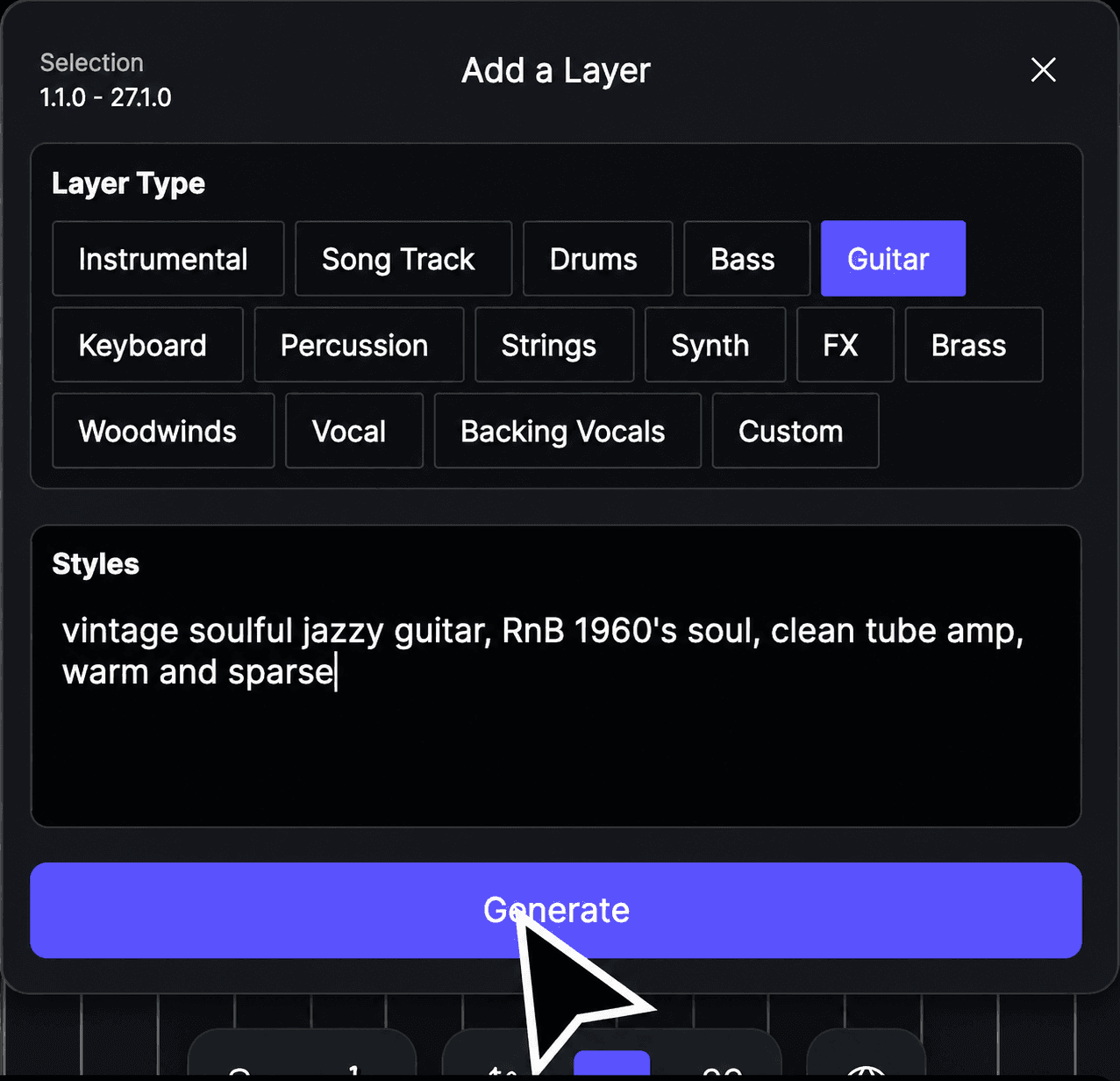
This approach also provides a practical way to test arrangement decisions. Compare several supporting layers, mute them one at a time, and listen to how the perceived weight of the snare changes. In hip-hop, trap, electronic music, and hybrid productions, the snare may become more powerful simply because the surrounding parts create better contrast. ACE Studio helps reveal when impact should come from timing and space rather than another round of processing.
The same tools support broader creative experimentation. Producers can build alternate percussion sections for different verses, introduce a new rhythmic texture before a chorus, create call-and-response patterns around the backbeat, or transform an acoustic groove into a more electronic arrangement.
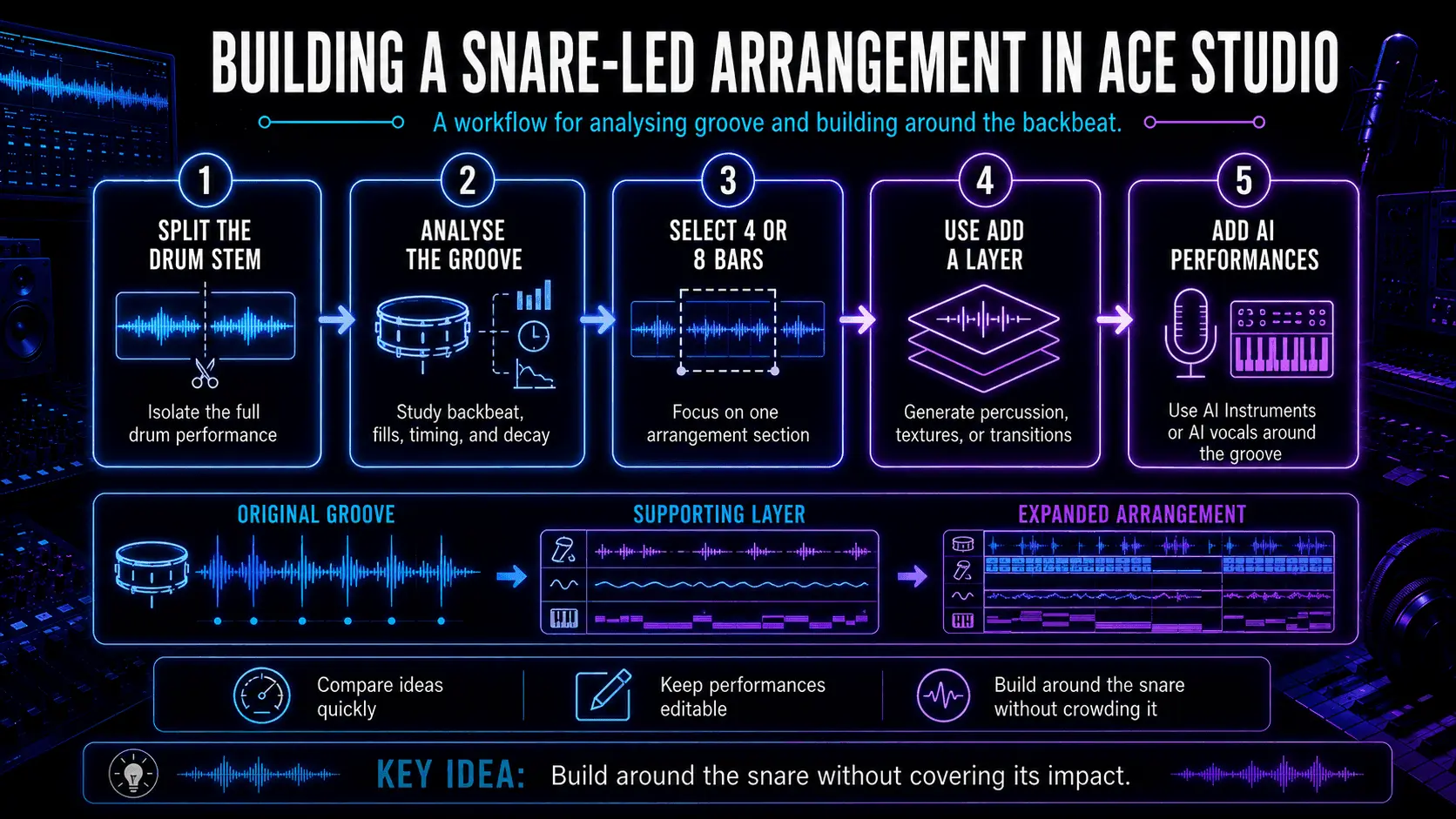
AI Instruments can add expressive melodic parts that reinforce or contrast with the snare rhythm, while AI vocals can introduce hooks and phrases shaped around the groove. By experimenting with small, purposeful additions, ACE Studio makes it easier to explore new directions while preserving the snare pattern that gives the track its identity.
Applications of Snare Drums in Different Music Genres
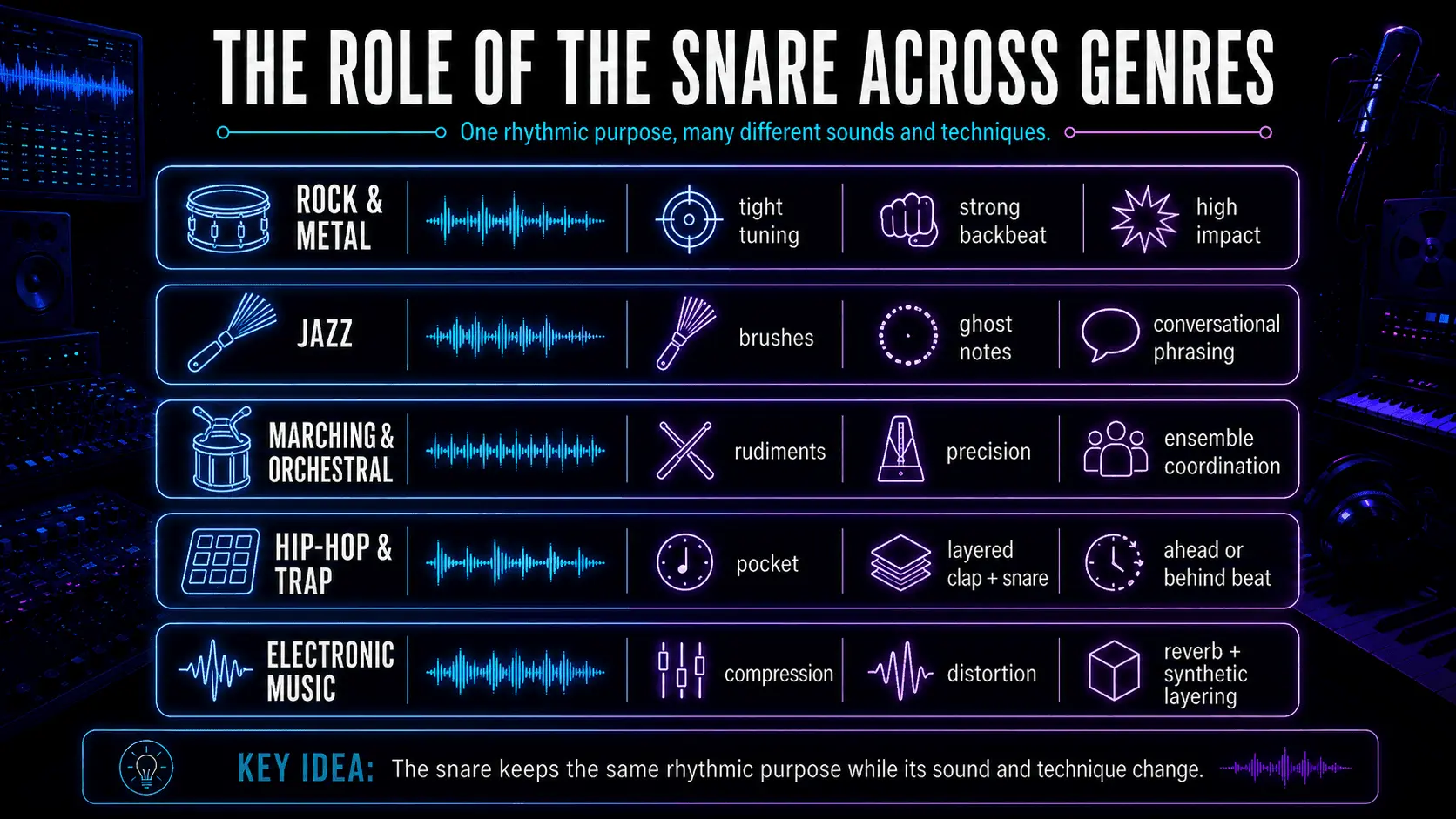
The snare drum is one of the most versatile instruments in a musician's toolkit, acting as the rhythmic "heartbeat" across vastly different landscapes. Here is a professional breakdown of its role in various genres.
Rock & Metal: Power and Presence
In high-energy genres, the snare is a driving force designed to cut through dense walls of distorted guitars.
- Often tuned high and tight for a bright, aggressive "crack."
- It provides the "backbeat" (beats 2 and 4), creating a sense of forward momentum and physical energy.
Jazz: Texture and Conversation
In jazz, the snare moves away from rigid timekeeping and becomes an expressive voice.
- Drummers use brushes for a soft, stirring texture or "ghost notes" (very quiet hits) to fill the space between main beats.
- It is used for "comping"—a conversational style of playing that reacts to a soloist’s melodies in real-time.
Marching & Orchestral: Precision and Discipline
The marching snare demands extreme technical proficiency and synchronization.
- Players use intricate rudiments, such as rolls and flams, to create a disciplined rhythmic language.
- It serves as the steady pulse that coordinates large ensembles, requiring perfect execution and consistent dynamics.
Hip-Hop & Trap: Groove and Sound Design
In urban music, the snare (or "clap") defines the "pocket" or feel of the track.
- Producers often shift the snare slightly "behind the beat" to create a laid-back, soulful swing, or "ahead" to create urgency.
- Snares are often layered with synthetic 808s and rapid hi-hat rolls to create a modern, metallic hybrid tone. Many producers prioritize snare selection over melody, as the wrong sample can make a beat feel "weak."
Electronic (EDM): Processing and Innovation
In electronic music, the snare is often a feat of engineering rather than just a recorded sound.
- Producers use heavy compression, distortion, and reverb to make the drum sit perfectly within a digital arrangement.
- While the sound may be heavily processed to the point of being unrecognizable as an acoustic drum, it still serves the vital purpose of anchoring the track's rhythm.
Famous Songs and Musicians
Some tracks are defined not by their melody, but by the distinct crack of a snare drum. Here is a detailed look at four legendary examples that showcase the instrument's critical role in music history:
Phil Collins "In the Air Tonight" (1981)
- This track introduced the world to gated reverb—a production technique where the natural echo of the drum is cut off abruptly by a noise gate. This created a massive, "vacuum seal" sound that was explosive yet unnaturally clean.
- The sound didn't just define the song; it defined the entire sonic palette of 1980s pop and rock. That legendary drum fill remains one of the most recognizable moments in music history.
Dave Grohl "Smells Like Teen Spirit" – Nirvana (1991)
- Grohl's snare hits are famous for their sheer physical power and the use of flams—striking the drum with both sticks slightly apart in time to create a thicker, heavier impact.
- The snare serves as the anchor for the song's chaotic energy. By driving the backbeat with such consistency and volume, Grohl allowed the distorted guitars to rage without the song losing its rhythmic center.
Buddy Rich: Big Band Jazz
- Rich is renowned for his mastery of rudiments like rolls and paradiddles performed at blistering speeds. He utilized the traditional grip to execute one-handed rolls and complex stick tricks that turned the snare into a solo instrument.
- He proved that the snare drum could be the lead voice of an orchestra, combining athletic speed with deep musicality and dynamic control.
Metro Boomin: Trap / Modern Hip-Hop
- Metro Boomin’s production highlights the importance of placement and sound selection. He often layers a sharp snare sample with a "clap" to create a unique, cutting texture that defines the track's "bounce."
- By leaving ample space in the mix and carefully choosing when the snare hits—often strictly on the 3rd beat—he creates the hypnotic, head-nodding rhythm essential to modern trap.
Beginners Guide to Snare Drums
Starting with the snare drum is often the most effective path for a new drummer. It allows you to master timing, coordination, and control in a focused environment before moving to the complexity of a full kit.
Ergonomic Foundation: Posture and Grip
Efficiency begins with the alignment of the skeletal system to ensure zero-resistance movement.
- Structural Alignment: Adjust the throne height so the hips sit slightly above the knees (90–105 degrees). This maintains a neutral spine and prevents lumbar compression. The drum should be level with the navel to keep forearms parallel to the floor, optimizing the angle of attack.
- The Primary Fulcrum: Establish a pivot point between the thumb and index finger, located approximately five inches from the butt of the stick. This axle allows the stick to rotate freely, utilizing natural resonance rather than muscular force.
- Grip Orientations: Use Matched Grip (German) with palms down for maximum power and wrist-led velocity, or French Grip with thumbs up for finger-led finesse and high-speed dynamic control.
2. Rhythmic Literacy: The Rudimental Alphabet
Rudiments are formalized kinetic sequences that build bilateral symmetry and neurological coordination.
- Core Classifications: Master the Single Stroke Roll for alternating speed, the Double Stroke Roll for rebound control, and the Paradiddle for seamless lead-hand transitions.
- Neurological Adaptation: Systematic repetition develops Ambidextrous Parity, ensuring the non-dominant hand mirrors the mechanics and tonal output of the dominant hand.
- Musical Synthesis: Apply these patterns to external pulses (metronomes or recorded tracks). This transforms abstract technical drills into functional tools for professional composition and orchestration.
3. Acoustic Precision: Quality Over Velocity
Professionalism is defined by the ability to produce a consistent, high-fidelity timbre at any tempo.
- Tonal Consistency: Train for Center-Point Accuracy. Striking the geometric center of the head ensures the purest fundamental pitch and minimizes erratic overtones.
- The Velocity Threshold: Practice at low temporal frequencies (40–60 BPM) to expose mechanical flaws. Speed is a byproduct of Economy of Motion—the elimination of extraneous movement—not raw physical exertion.
- Muscle Memory and Myelin: Executing perfect, slow-motion repetitions builds insulated neural pathways. This creates a permanent foundation of precision, preventing the need for corrective practice later in a professional career.
Benefits of Learning Snare Drum Music
- Core Skill Development: Improves timing, coordination, discipline, and active listening.
- Emotional Expression: Teaches how rhythm directly shapes the emotion of a track.
- Production Edge: Enhances understanding of arrangement, particularly for electronic and bass music producers.
- Stronger Songwriting: Better rhythmic foundations often lead to more compelling compositions.
- Versatile Path: Provides a clear entry point for beginners and endless technical refinement for professionals.
- Holistic Growth: Deepens overall musical understanding regardless of your primary instrument.
Frequently Asked Questions
Is snare drum music only important for drummers?
Not really. Even though drummers play it directly, snare thinking is essential for producers working in trap music, hip hop beats, and electronic music. Anyone shaping rhythm benefits from understanding how snare placement affects groove and energy.
Are snare drums good for beginners?
Yes, they are one of the best starting points. A snare drum strips music down to its core element: rhythm. Beginners can focus on timing, stick control, and basic percussion rhythm without being overwhelmed by multiple instruments. Many professionals started on a practice pad before moving to full kits.
What kind of music is snare drum used for?
The snare drum is used in almost every genre, including rock, jazz, orchestral music, marching bands, and modern production styles like urban sound, bass music, and electronic music. In hip hop beats, it often defines the groove, while in jazz it adds subtle expression.
What songs start with a snare drum?
Some songs begin with percussion-driven intros where the snare sets the tone before any melody appears. Tracks like “We Will Rock You” by Queen or certain modern hip hop and trap intros rely heavily on isolated snare or percussion hits to build anticipation.
Who is a famous musician that plays the snare drum?
Many influential drummers are known for their snare work, including Steve Gadd, Buddy Rich, and Stewart Copeland. In modern production, figures like J Dilla are often referenced for their unique snare timing in hip hop beats, even though they worked more as producers than traditional drummers.
What are common issues beginners face with snare drumming?
Most beginners struggle with timing consistency, tension in their hands, and uneven dynamics. Another common issue is rushing faster rhythms in percussion rhythm exercises before mastering slow control. This is why experts often recommend practicing with a metronome at reduced tempo.
Why is the snare so important in trap music and hip hop?
In trap music, the snare creates bounce and structure, often working with hi-hats and 808s to define the groove. In hip hop beats, it acts as a rhythmic anchor. Even small changes in snare placement can completely change the feel of a track.
Do producers really spend a lot of time on snare sounds?
Yes. In modern production, especially in electronic music and bass music, snare selection and processing can take longer than melodies. Layering, EQ, reverb, and transient shaping are often adjusted repeatedly until the snare sits perfectly in the mix.